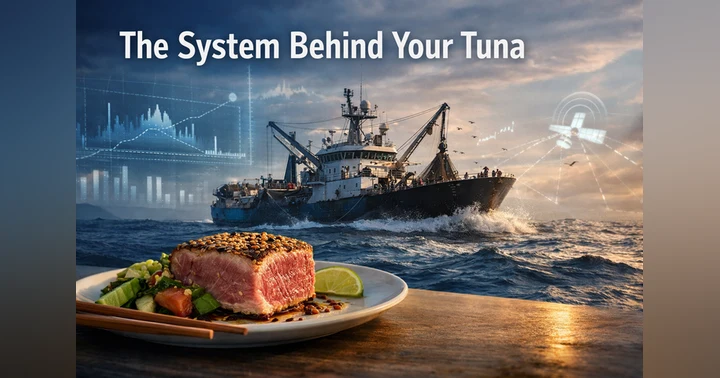
Why the Tuna on Your Plate Didn’t Run Out


 Apple Podcasts

 Spotify

 YouTube

 Amazon Music

 PocketCasts

 Overcast
Tuna sustainability might be the biggest ocean success story you’ve never heard about. Nearly 100 percent of global tuna catch is no longer experiencing overfishing, but that didn’t happen by accident. There is a hidden system behind the scenes that most people never see, and it is quietly changing how fisheries work around the world.
Harvest rules for fisheries are replacing political negotiations with science-based decisions. Instead of arguing every year about how much fish to catch, managers now use pre-agreed rules that respond automatically to changes in fish populations. This shift has helped tuna stocks recover and stay stable, even as global demand continues to grow.
Ocean conservation solutions are often criticized for failing, but tuna shows what happens when science, industry, and policy align. In this episode, you will learn how this system works, why it matters for the seafood you eat, and what it tells us about the future of ocean protection.
👉 Follow the show to get daily ocean insights that connect science to real-world impact.
0:00 What if fisheries didn't rely on last-minute political negotiations? What if we already knew exactly how much fish could be caught before the season even started? No guesswork, no lobbying battles, no delays. Just science, rules, and then of course action. That's what harvest strategies are designed to do. And they're one of the biggest reasons why we saw such an important result come to fruition in the tuna fishing industry this year. We're going to talk more about that on Friday with the International Seafood Sustainability Foundation's President Susan Jackson.
0:40 She's going to talk about their latest state of the stock report. But in the meantime, we're going to go over harvest strategies and why they played such an important role. This is the How to Protect the Ocean podcast. Your weekday ocean news update. If you care about staying informed on the ocean every weekday, hit that follow button right now on your favorite podcast app. And we will be able to you will be able to hear tomorrow's story in the day after. And of course Friday's episode is going to be a lot of fun. So make sure you hit that episode. Make sure you hit that follow button for a long time. Fisheries management followed a predictable pattern. Scientists would run stock assessments and say, hey, we need to reduce fishing. But the governments would meet, negotiate and often compromise.
1:24 Not based on science, based on politics. And to be honest, I hate to say it. It still happens today. And you know, that led and it continues to lead to problems. And at one point, only 66 percent of the tuna catch came from stocks not experiencing overfishing. So the system existed, but it wasn't working fast enough. And that gap between science and decision making is exactly what harvest strategies were designed to fix. Now, one thing that's that's interesting when you look at the cod fisheries just to compare fishery, the collapse of the cod fishery in the early 1990s didn't just happen in the 1990s.
2:04 It started to happen 15 years before that or even before that. But within those the 70s and 80s, we had stock assessments done every year. And we knew scientists, new government scientists were saying, hey, by the way, this stock is not doing very well. You know, Haddock and Halibut weren't doing very well either. And they started to decline and they were declining pretty fast until the early 1990s when fishing experts and scientists were like, you know what, we can't fish this anymore. We're going to have to close the fishery. And that led to a huge uproar in Newfoundland and other areas and other provinces in Canada that fully, full fledgedly relied on cod fishery.
2:45 Right. That was their big thing. After that, their families, the next generations had to switch industries and do something else. A lot of them went into the oil and gas industry, not an industry that they wanted to go into. They want to go into the fisheries industry, but they were led to believe that everything was fine. Maybe a little bit of pressure from the fisheries unions and so forth. But it just those political decisions just didn't help in any kind of way. So to make sure that management is done properly, harvest strategies in the tuna fishing industry have been put into place. So what is a harvest strategy? It's a simple concept. Essentially what it is, it's a pre-age set of rules. Instead of negotiating every year, managers decide in advance.
3:28 If the fish stock is healthy, we can increase the catch. If the stock declines, we reduce the catch. If it drops too low, strict limits are kicked in. So based on these rules, there are certain actions that the fisheries management can take. Instead of debating what to do, the system already knows what to do because they follow science as the guide. Imagine if the science says and continues to say that the cod fishery is not doing very well. Not as well as we think. Right now, present day in Canada, the cod fishery is not doing well. So the scientists come out and say, hey, you know what, it grew but it didn't grow significantly. Actually, one year it stayed the same. So what do we do? We should stop. We shouldn't increase the quota. We should probably reduce it a little bit because we know that it's going to start declining if we continue at this rate.
4:20 And then the government turns around and goes and negotiates and says, hey, you know what? We're actually going to increase. We're going to allow offshore cod stocks to be fished. Well, that doesn't make sense, right? Now you're laying offshore boats to fish cod. You're going to start to see a decrease because the science is saying that it's not going to increase anytime soon. It could decrease with the fishing pressure that we have now. If they follow the harvest strategies, if the stock starts to decline or stays the same, then the limits don't change. They don't add another fishery on top of that. So they're going to increase. So it's basically looking at the set of rules, right? It's a very simple process. And the thing is, it works. You know, harvest strategies work because they change the system in three big ways.
5:01 First, they remove politics out of it, which makes it so, so, so much easier. Second, they respond faster because they know what action to take. They already, it's already predetermined. And third, they rely on data, like actual scientific data. They go out and observe, they collect the data, field data, they do it with the proper methods, and then they act on what the data tells them to do. Now, today, we're starting to see that success, which we're going to talk about on Friday with Susan Jackson. And it's, it's not a small improvement. It's a huge, huge improvement. It's really a system level shift. That's the, that's the big thing that you're going to hear on Friday. And I think it's, I think it's really important. This type of harvest strategy, it just doesn't come out out of thin air, right?
5:44 Just didn't happen because one organization, it happened because an alignment across an entire system. So the International Seafood Sustainability Foundation helped fund and improve stock assessments. They brought industry data into the science models. They push for science based decisions and the United Voices across the supply chain. That's a huge thing to do. Not many people have been able to do that in the past. To be able to come forward with that, and I mean, ISSF is in itself, you know, supported and represented by the supply chain, not the Fishers, but the supply chain. And there's science scientists involved. There's policymakers involved. There's a whole bunch of people, industry, industry exacts and so forth involved. It's a, it's a big deal. And to be able to put all that information, put all of that effort into making the system better and to shift like this and to get to results that we're going to discuss on Friday.
6:37 I think is even better. So even companies that like share detailed purchase data, which you never get to improve assessment. That's a huge, huge deal because better data leads to better management, especially when you have these harvest strategies in place, right? So another major driver was market pressure. So the Marine Stewardship Council certification process requires that they have harvest strategies and their science based management. So fisheries that are available, they're available. So fisheries that wanted certification had to adapt. So and they did in 2012 100,000 tons of tuna were certified today 2.5 million tons, about half of the global catch is certified. That's a huge shift, right? Not in a lot of like in a very small amount of time, especially when you consider how things have changed over the years and over the decades with fisheries.
7:30 So it shows that markets can actually drive conservation, just like we talked about last week with businesses, right? How they can scale and how they can move things faster. But fishers weren't just out of the process. They were also included in the process and and they are not separate from this story. You know, they're actually central to it. So they pushed for certification. They advocated to governments and they change practices on the water because at the end of the day, if nothing changes at sea, nothing changes at all. And eventually we're going to start to see the extirpation or even extinction of tuna because of fisheries. We do not want tuna to be overfished by any means.
8:13 So this is bigger than than just tuna, though. Harvest strategies prove something important. Fisheries can recover, systems can improve and collaboration works. It's really what it comes down to. But only if science is followed, rules are clear and accountability exists. This is what real ocean protection looks like. It's about collaboration, science and action. That's what it really comes down to. And I love this process. I wish we could see it more because we're not finished, right? Some of the gaps that we see within this. These harvest strategies remain like not all stocks have fully implemented harvest strategy. So we need to make sure that the tuna fishing stocks have that monitoring and compliance need improvement technology like electronic monitoring is underused and climate change is reshaping ecosystems.
9:00 The next milestone is clear. 100% of the tuna stocks must have fully tested harvest strategies. So all the rules need to be put in place. All the actions need to be put in place depending on what the results are from the scientific data. So not just planned, it has to be working 100%. Harvest strategies turn fisheries management from reactive into proactive. And that is a huge mind shift for a lot of fisheries. It removes all the guesswork, right? They reduce conflict. And when applied properly, they work at bringing back fisheries. It works. We've seen it in a bunch of different tuna fisheries where we're going to talk about on Friday. It's such an important aspect. So I want you to really think about what harvest rates are because you know, a lot of times if I say harvest strategies are important, you probably like how does this actually matter if you want tuna to continue and you want other fish to continue.
9:51 Harvest strategy should be in every fishery, every wild fishery harvest should be in whether it's ocean or freshwater. I strongly believe that rules should be put in place. It should be guided by science and it should be bought in by every part of the process. And we're seeing it here where organizations are coming together, industries coming together, scientists are coming together under one umbrella to work together. And the guidance is provided by the International Seafood Sustainability Foundation, which we love to have that. We're going to hear more about that in on Friday in two days from Susan Jackson, who's the president of ISSF. She's going to be talking about the big result that they got, but also about harvest strategies, stock assessments and more.
10:33 So if you don't want to miss that episode, hit the follow button right now or come back on Friday or come back tomorrow because we're going to be talking about more fun stuff about tuna stocks. And it's going to be important. It's always important. It's always important to you, especially if you like seafood. So hit that follow button. I want to thank you for joining me on today's episode of the How to Protect the Ocean podcast. I'm your host, Andrew Lewin. Have a great day. We'll talk to you tomorrow and happy conservation.