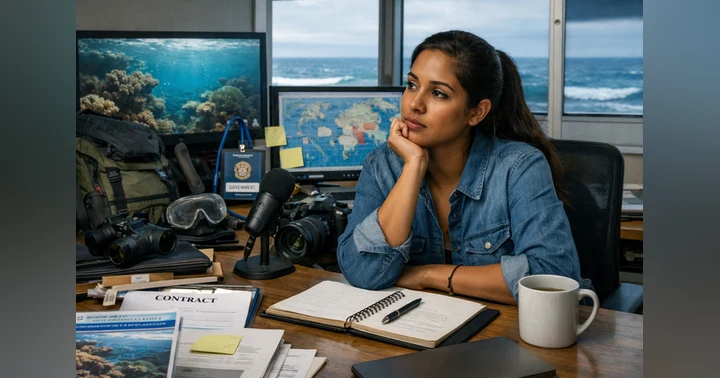
Why Ocean Jobs Look Great, Until You Actually Start One


 Apple Podcasts

 Spotify

 YouTube

 Amazon Music

 PocketCasts

 Overcast
A lot of people dream about working in ocean conservation, but far fewer talk about what it takes to actually stay in the field. In this episode, Andrew breaks down why so many careers in ocean conservation burn out, from low pay and short-term contracts to emotional exhaustion and unstable funding.
You’ll hear the truth about the three major career paths in the field, why passion alone is not enough, and how building transferable skills, multiple income streams, and your own platform can help you create a career that lasts. This episode is for anyone trying to get into ocean conservation, stay in it, or rethink what a sustainable path really looks like.
Support Independent Podcasts: https://www.speakupforblue.com/patreon
Help fund a new seagrass podcast: https://www.speakupforblue.com/seagrass
Connect with Speak Up For Blue
Website: https://bit.ly/3fOF3Wf
Instagram: https://bit.ly/3rIaJSG
TikTok: https://www.tiktok.com/@speakupforblue
Twitter: https://bit.ly/3rHZxpc
YouTube: www.speakupforblue.com/youtube
0:00 There are a lot of people who get into ocean conservation and they quietly leave a few years later. They don't make a big announcement. They don't post about it. They just disappear from the field. It's not that they died or anything. It's just they've gone. And it's not because they didn't care enough to become a marine biologist or become a marine conservationist or ocean conservationist. It's because their career wasn't built to last or they had difficulty breaking in. This is the How to Protect the Ocean podcast, your weekly ocean news and conservation podcast. If you care about protecting the ocean and building a real career in this space, follow the show so you don't miss tomorrow's episode. Let's be honest about something. Most people don't say it out loud.
0:41 Ocean conservation careers can be tough. Low pay, short term contracts, constant uncertainty. And on top of that, emotional burnout. Let's be honest here. We're working on problems that feel massive. Climate change, overfishing, habitat loss, probably some of the most important jobs that we've seen today for food security and safety from climate change and stuff like that. And from the ocean and sea level rise and everything like that. And sometimes it feels like you're not making progress fast enough or that funding continues to get cut so you can't do those jobs.
1:22 And it won't. Passion gets you in the door for sure. But structure, income and stability are what keep you there. But structure, income and stability are what eventually keeps you there. If you look at ocean conservation careers, most people fall into one of three paths. First, there's academia, research, publishing, grants, teaching, all that stuff. It can be really rewarding, but it's competitive and often unstable early on. Second, there's the NGO and government work, policy, conservation programs, communications, field projects. This path can offer some structure, maybe a pension every once in a while if you're working for government.
2:02 But budgets are super tight and burnout is very common. And also, there's also when you have a president or prime minister who comes in and just cuts the jobs altogether because they don't believe in environmental anything. And then, of course, third, the path is growing far out fast right now is entrepreneur or creator, people building platforms, consulting, media or businesses around ocean conservation. This is the least traditional path, but it's also one where there's a lot of flexibility and opportunity that exists. And here's the key. The path is perfect, but no path is perfect. But some give you more control than others.
2:44 If you want to career that last, you need stability and most ocean jobs won't give you that by default. So you have to build it yourself. One way is through multiple income streams. Maybe you work a conservation job, but you also consult inside or you have a side hustle, whatever that might be. You know, I know some people who work in conservation and then they walk dogs, which is very, I'll be honest, it's kind of lucrative if you walk dogs. I've never done it, but I know people who've done it and they make like 75 grand a year by walking dogs. It's incredible. Or you run a podcast and get sponsored by it or you're an influencer and you get you get sponsors through there. You can create content that leads to partnerships.
3:24 Another way is building transferable skills. So communication, data analysis, storytelling, project management skills that work across all sectors. I got a GIS analyst diploma, advanced diploma after while I was doing my master's or just before I did my master's. And that kept me employable across every sector if I wanted to. You know, I went through a period where I couldn't find a science job. So I became a GIS analyst for a company, which was doing science and I got to do field work as well as do as be a GIS analyst. You know, that's how I got into I eventually how we stayed in the government as a GIS analyst. It wasn't my perfect career by any means, but it got the skill got me other jobs.
4:04 So these skills work across sectors. So if you know one job ends your career doesn't in the government when you work for the federal government here in Canada, there's a bunch of different opportunities. So there's indeterminate, which is full time permanent. There's terminant, which is full time, but there's an end date to it. Usually every year or if there's a like a fun, like a three year funded project is after three years. Then there's a there's contractor and then there's casual right or casual, which is you could be in the building 90 days and then there's contractor, which is kind of like off and on. You know, you come in, but if you're a terminant employee, like I was, if my boss couldn't renew the position the next year because of funding, I had to go and network within the building to be like, hey, I'm looking for a job this, you know, in this April because we had year end is March and I'm looking to see if you have an opening, you know, and then you would talk to people and stuff like that.
4:57 Some people would hold interviews. Some people would just like, yeah, no, come along. I've known you for years. I want to get on that board and I was able to get on it because I had GIS and that's what kept me employable within the building. Right. So, you know, you don't just start over. You're just shifting a little bit. It all depends on, you know, networking always plays a role, but looking for that extra position. Now, this is the mindset shift that changes everything. Your career is not your job. Your career is the collection of of everything you build over time. Too many people pull all their too many people put all of their trust in one organization. You're not going to work with your entire life. That's very rare that you do that.
5:39 You might be great if you did, but it's not always going to happen that way. One contract, one boss, one opportunity. That doesn't happen like it used to. I remember when I went to school, you know, people were talking like in a DFO fisheries and oceans in Canada. People were talking about, yeah, I got hired right out of school and I've been there ever since and I've been there for 50 years and they were doing their 50 year retirement. That doesn't happen with my generation or the next generation or the next generation. I'm Gen X, by the way. And so, you know, instead, like, so you want to like, make sure you're a part of something. Right. So that, you know, when it disappears, when that one job disappears, everything doesn't just fall apart. Instead, you want to own something. You want to have an audience, a network, a niche, a body of work, something that moves with you no matter where you go.
6:25 That's how you stay in the game long term. My podcast has stayed with me for 11 years. I was working during the podcast, like when I not when I started it, but after I started it and then I've been working all the way through ever since there's a period where I didn't work. But then when I like the last six and a half years, I've been working and I've been doing this podcast at the same time. And, you know, if somebody wants to buy the episodes, they'd license it out if they want to put it on their platform, you know, but I never give it up. I never give the rights up to it. Because I always have this. This always keeps me not only connected to ocean conservation, but connected to all like the colleagues and friends that I've made over the years.
7:08 And that's been important. It's also given me the experience and skill set to get to have a potential change in a career, which I hear more tomorrow. Right. So that's how you stay in the game long term is keep something going for a long while. You continue to keep it, whether it's on the side or it's your full time gig. And then you become a resource within that within for that niche. It's really great. So here's the truth. Most people don't realize a career in ocean conservation isn't a straight line. It's a series of pivots. You might start in field work, which I did. You might move into policy, shift into communication and maybe even build something of your own. That's not failure. That's adaptation, which is great, especially if you work in a field with nature.
7:54 The people who last in this field aren't the ones who had the perfect plan. If you listen to the Beyond Jaws podcast, where we talked to shark shark experts and shark scientists and shark conservationists and just conservationists in general, their path is never linear. It's always meandering. They're the ones, the people who adapted, right? The people who are in the field, the longest, they're the ones who kept evolving. They treated their career like a long game, not a single game. And I think it's really important if you want to stay in ocean conservation, you need more than just passion. You need a plan that actually supports your life. So you don't plan the next job. You plan your career. You can actually sustain.
8:38 Right. That's what you really want to do. And if you go over to ocean conservation careers dot com, you can see job postings that are up there. And I have a resource that I'm building to help people like yourself. If you're looking for a job to help people build out resumes to help people really organize their conservation career, especially in oceans. So check that out. Ocean conservation careers dot com. If this episode helped you think differently about your plan, about your future, follow the podcast and share it with someone who's trying to break into ocean conservation. It's really important that we get more people listening to this stuff. Because I see on Facebook, I see people posting about jobs and everything like that. If you know of somebody who has a job available here or if you know anybody in Africa, if you know anybody, it's not about finding like asking people to get that job. It's about building your skill, building your experience to get that job. Right.
9:30 And if you listen to any of the episodes we've done this week, you'll find that these skills, I hope you find that these skills will help you and not only gaining experience, but break into that either first, second, third or fourth job and move around and adapt, you know, with specific skills that can help you move across the sector, you know, within ocean conservation or even maybe outside for a little bit. You know, I've been outside of the game for 16 years, but I've kept in it because I've been doing communication for those 16 years. And I think that's a that's an important thing to have always in your heart to be able to say, hey, you know, I've just I've done this. You know, this is what I've been able to accomplish. This is this is my legacy eventually. So that's it for today's episode. You know, if you like I said, if you know someone who is going to benefit or if you have like send it to them, send this podcast to him.
10:19 If you have a question or comment, I would love to hear from you. If you're listening to this on Spotify, feel free to leave a comment because they allow that if you're not. No worries. You can hit me up on speak up for blue.com forward slash feedback that speak up for blue.com forward slash feedback. I want to thank you so much for joining me on today's episode of the how to protect the ocean podcast tomorrow. You're going to hear a big announcement that I have to make about my career and has to do with stuff I've done that I've talked about this entire week. So tune in tomorrow for the next episode and follow this podcast to learn more about career building, ocean conservation and science enjoy and I'll talk to you next time.