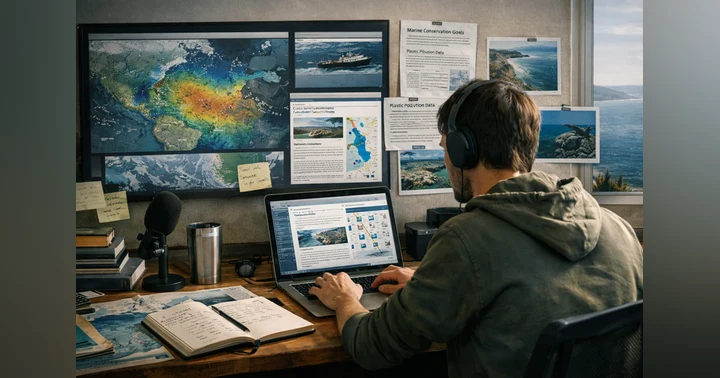
What’s Really Stopping You From Starting an Ocean Career


 Apple Podcasts

 Spotify

 YouTube

 Amazon Music

 PocketCasts

 Overcast
A lot of people think the path into ocean conservation is simple: get the degree, get the experience, then get the opportunity. But that is not how it works for many people anymore.
In this episode of How to Protect the Ocean, I talk about why waiting for permission, waiting to feel ready, or waiting for someone to teach you everything first can quietly kill momentum before your career even begins. I break down the myth that credentials alone will open doors, the real skills employers and collaborators notice, and why building proof of your abilities matters more than saying you are passionate.
If you want to work in ocean conservation, marine science communication, policy, data, or research support, this episode will help you think differently about how careers actually get built. Because the people getting noticed are often the ones who start before they feel ready.
Support Independent Podcasts: https://www.speakupforblue.com/patreon
Help fund a new seagrass podcast: https://www.speakupforblue.com/seagrass
Connect with Speak Up For Blue
Website: https://bit.ly/3fOF3Wf
Instagram: https://bit.ly/3rIaJSG
TikTok: https://www.tiktok.com/@speakupforblue
Twitter: https://bit.ly/3rHZxpc
YouTube: www.speakupforblue.com/youtube
0:00 What if the biggest thing that's holding you back isn't your experience? It's the fact that you're waiting for someone to teach you, to build skills, to build some type of experience that you need to get, you think you need to get to get a job. But here's the truth for most people. A lot of people working in ocean conservation right now didn't wait until they were quote unquote ready. They just started. This is the How to Protect the Ocean podcast, your weekly ocean news and career insight podcast. If you care about building an career that actually helps the ocean, hit that follow button right now. So you don't miss any episodes we're doing this week. That was yesterday's episode. Today's tomorrow's Thursday's and Friday's today.
0:43 We're talking about something that quietly stops more careers than anything else. Waiting for permission. There's this belief that's been baked into science careers and ocean conservation for decades. You need the degree first, then the job, then the experience. But that's not how it actually works anymore because employers, especially in conservation, are not just looking for credentials. They're looking for proof. Can you communicate science? Can you analyze science? And can you tell a story people care about? Because a degree tells someone what you've learned. But your work shows what you can actually do.
1:23 And those are not the same thing. I've seen people with advanced degrees struggle to get traction. And I've seen people with no formal training build entire platforms, projects, and even careers. Because they showed up and created something real. Let's be honest here. There is a shift in how ocean conservation is being done. Whether it's science or even conservation. We are seeing that a lot of agencies, a lot of nonprofit organizations, even government departments and governments, they can't afford to pay everybody who wants to get into ocean conservation. Funding is limited and competition is getting real. It always has been, but it gets more and more every year as more people are getting degrees or more people are trying to get into ocean conservation.
2:10 Now there have been a shift in how people are doing ocean conservation. Whether they're doing it on their own voluntarily, whether they get their own fundings through revenue generation or through grants or something else. They may have a degree, but they may not have a job like a 9 to 5 where they go with an organization or a government department or even a private consultant. They may just do it on their own and build their own thing. So when we talk about what skills matter or what actually matters, it's not just the title on your degree or your diploma. It's the skill set that you have. How can you contribute to a team or how can you contribute with your skills to science, to conservation?
2:52 Things like communication can take complex ocean science and make people care. Data literacy. Can you work with information and draw insights? GIS and mapping, storytelling, which honestly is one of the most underrated skills in conservation. And understanding policy, how decisions actually get made. If you look at your own career or even mine, none of it came from just sitting in the classroom. For me, podcasts became the skill that open everything for me. Not because someone gave me permission, but because I kept showing up and I kept doing it. This is my 19th, 100th and third episode. Imagine that.
3:33 19 hundred and three episodes and I am still moving strong. I did that and through that I was able to craft my message. I was able to look in how to communicate. I was able to build a network. I was able to have people understand how much work I've put into this. And on Friday, you're going to hear what podcasting has actually been able to let me do things. Right. And change the way I view my life from a work perspective or even from a like a personal growth perspective. Now here's where it gets interesting. You don't need to wait for a program to teach you the skills anymore. Everything is accessible. Now look, I know you're probably thinking like, we need a degree to be a marine biologist. Absolutely. You may even need a degree to be a communication person or like a certification at least. But everything is accessible these days.
4:22 You've got online courses, YouTube tutorials, open data sets from organizations around the world, free tools for mapping analysis and communication. And one of the smartest things you could do, reverse engineer job descriptions. So go look at the jobs you want. Don't apply yet. Just study them. What skills keep showing up? What tools do they mention? That's your roadmap, not a degree, a roadmap. You get your degree through your schooling. That's how it works. Like you have to get your degree for some jobs. But all the other skills you can get while you're studying for that degree, even before your degree or during your degree and after your degree, you can always like you can always increase your skill set by doing what you want to do.
5:09 You don't have to wait for permission from your work. You don't have to wait for permission from your parents. You can just go ahead and do what you think is necessary to get what you want. Right? That's what you really have to do. You know, when I want to get like communication experience, I couldn't find a job that would give me communication experience because I didn't have any communication experience of my own. So I built my own communication experience. I blogged, I vlogged and I even started a podcast. And that's what stuck for me. And it's gotten me to be able to do that. My group rock had me and it's gotten me job offers, it's gotten me projects, it's gotten me to a lot of places and you'll hear what happens on Friday with what it's gotten me recently when it's gotten here. Now, this is where people hesitate most, right?
5:50 They think "I'll start at once, I know enough!" Right? That's the trap because the people who actually move forward start before they're ready, you're never ready to start a podcast. podcast. You're never ready to do science communication. You're never really ready to start a project on your own to take like ocean candidate, ocean networks, candidate data that's available for free and start processing it and making a project out of it. You're never really ready for it. You probably don't have the time etched out for it that you really realize you need. You may have some other priorities, but if you really want to build that skill set, you'll get it, right? You know, some of us like this, some of them have started a blog. They've launched a small social media account. They analyze a data set and share them where they will share what they find.
6:31 They break down a research paper in simple terms. They don't wait to become the expert or even a guide to being an expert. They document the process of becoming one, right? That's what they're doing. That's the difference. Document don't wait because every piece of content you create is proof. Whether that's a data set or data analysis or statistics. Or that is, you know, communications or anything else you can think of. At the end of the day, a hiring manager has a choice. Two candidates. One says, I'm passionate about ocean conservation. The other says, here's what I've done. I blog, I project a series of posts, a podcast, a data analysis. Who do you think stands out? Your portfolio is louder than your resume. Every single time. One story that always keeps coming up is the first started podcasting. There was a gentleman that that I knew a friend of mine that that we didn't know each other before this, but contact me. He said, Hey, Andrew, I want to help you with your podcast and I want to write your show notes and you know, I want to write blogs and stuff like that. Do you want me to have? Do you need help? And I said, you know what? That's great. Because I've been thinking about going five days a week from one day a week, doing some solo episodes, but I can't do the show notes at the same time. Because I have a job and kids and all that kind of stuff. And he was like, perfect. It's a perfect opportunity to do that. So we've been doing a lot of things. We've been doing a lot of things. We've been doing a lot of things. We've been doing a lot of things. We've been doing a lot of things. We've been doing a lot of things. We've been doing a lot of things. We worked together for over a year. And when it came time for him to look for a job, he asked if he can use me as a reference because he's been working on this
8:01 project forever. Not only did he write for me at, you know, every Friday we had ocean talk Friday and Nathan Johnson was on the podcast where he would pick like four or five stories and we would talk about those stories on a podcast. It was great. It was wonderful. We got to know each other. We built a relationship. This was all done over his job. We both had jobs and we both did it over his job, over our jobs. And when he went for a new job, he used me as a reference. And that reference called me and said, Hey, like, you know, why would, why should we hire Nathan essentially? And I said, you know what? I was like, he's been doing this apart from work. This isn't part of his job description. This is separate. He's been doing it for free just because he loves writing. He loves communicating. He loves the ocean. So if you don't hire him for the passion, like if you're not going to hire from skills, hire from his passion at the very least, because he's got the passion, the dedication to do the work. And now he's built this entire skill set and they hired him.
8:53 You know, I know it was partly due to the extra passion that he had. So take on that extra passion project, you know, do that side hustle, whatever that might be that has to do with the ocean if you want a job in ocean science and conservation. So if you're going to take anything from this episode, it's this. Stop waiting for permission. Pick one skill, just one and publish something within this week, right? Next, not next month, not when you feel ready this week because the people building careers in ocean conservation aren't waiting to be chosen. They're making themselves visible. And that's how you start. There are so many cases where I've seen people show up online, whether it be social media or whether it be through any other means, a blog or anything like that, where they've shown what they've been able to do. And people look to them as a resource. They look to them as someone who's like, I see this person would be good for this project or that project or this project, right? At the very least, like I know some of my friends who've gone on TV shows because they post so much with their ocean communication and sharing what the work they're doing. And that's how they get big. And that's how they get on these ships and these TV shows and all that kind of stuff, right? There's so many examples of this happening and don't want to miss out. I'm not saying that's going to happen for everybody, but you don't want to miss out because there's always opportunities that comes around the corner when you do this kind of stuff and you put yourself out there and you talk about the ocean, you talk about your passion and you just never know what's going to come your way. I would never have thought what I'm going to talk about Friday would
10:24 have happened unless I had this podcast. So that's it for today's episode. If you have a question or a comment and you want to let me know if you want to talk to me, this is the beginning of a conversation. I'd love for you to continue it. You can comment on Spotify or you can hit me up on speak up for blue dot com forward slash feedback that speak up for blue dot com forward slash feedback. I'd love to hear from you. You can either leave a voicemail or you can write down something. But I'd love to hear from you. And that's it for today's episode. And this has been the how to protect the ocean podcast. I'm your host, Andrew Lewin. Have a great day. We'll talk to you next time and happy conservation.