Why Ocean Solutions Fail Without Collaboration (And How to Fix It)


 Apple Podcasts

 Spotify

 YouTube

 Amazon Music

 PocketCasts

 Overcast
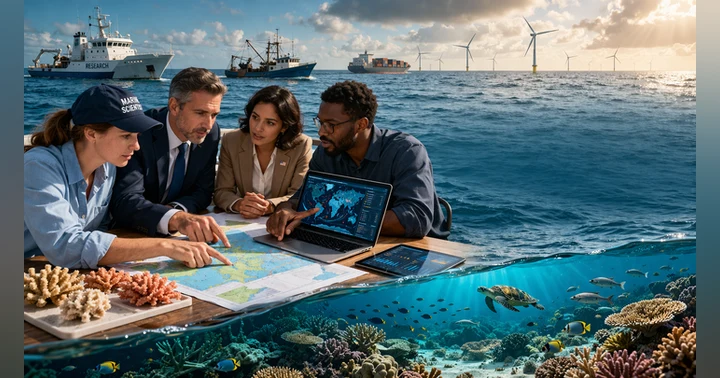
Ocean conservation solutions often fail, not because the science is wrong, but because the right people aren’t working together. In this episode of How to Protect the Ocean, we break down why collaboration between scientists, businesses, and policymakers is essential to solving today’s biggest ocean challenges.
Ocean collaboration is already transforming conservation, and the results are powerful. Using real-world examples like Global Fishing Watch, you’ll learn how satellite data, artificial intelligence, and policy advocacy came together to expose illegal fishing on a global scale. We also explore how cross-industry partnerships are influencing policy, unlocking funding, and accelerating real-world impact.
Ocean solutions depend on people who can connect science, business, and policy. Whether you’re an early-career scientist, a conservationist, or someone interested in protecting the ocean, this episode will help you understand how meaningful change actually happens and how you can be part of it.
Support Independent Podcasts: https://www.speakupforblue.com/patreon
Help fund a new seagrass podcast: https://www.speakupforblue.com/seagrass
Connect with Speak Up For Blue
Website: https://bit.ly/3fOF3Wf
Instagram: https://bit.ly/3rIaJSG
TikTok: https://www.tiktok.com/@speakupforblue
Twitter: https://bit.ly/3rHZxpc
YouTube: www.speakupforblue.com/youtube
0:00 The future of ocean conservation won't be built by scientists alone, and it won't be built by businesses alone. It'll be built when those worlds collide. Because the biggest ocean problems we face today aren't just scientific. They're economic, they're political, and they're technological. And no single sector can solve all on its own. And if you look at how politics are done in today's world, if you look at how everything is done in today's world, businesses play a very important role, not only from running the economy or influencing the economy, but these days, a lot of the billionaires or the CEOs tend to be the experts that people turn to, that politicians turn to, and other people turn to, to find out how to build businesses and how to run a country in some cases.
0:47 So we know that businesses are going to be influential, and not only being able to scale projects like we've talked in the last two episodes, but also to combine with ocean conservationists and scientists to help protect the ocean. This is the how to protect the ocean podcast. And if you're listening, because you want to find out more about the ocean each and every weekday, and you want to find out the breakdown of science, policy, and solutions, hit that follow button right now, because this week, we are going over solutions and how businesses and science can collide together to partner in protecting the ocean. And we do that at conferences like the World Ocean Summit that I went to a couple weeks ago.
1:29 And we also can do that at the Earth X conference that's happening April 20 to the 22nd of this year. It happens each and every year. If you want to go to it, you're going to want to listen to Friday's episode, right? Interview the CEO of Earth X, Peter Simic, who talks about how this conference is not just a conference of just the oceans, the constant conference of solutions of engineering of everything. It's actually 20 conferences in one. So if you are someone who's interested in protecting the ocean, want to find solutions, scale those solutions, you'll want to listen to that episode and go to the Earth X conference. And by the way, they are not sponsoring us today. They just tend to be the theme of this week because I've been doing a lot of themes for the podcast every week. And today we're talking this week, we're talking about ocean solutions and something that I feel is really, really important.
2:12 Okay, right now, most ocean work still happens in silos. Like I have scientists talk to scientists, businesses talk to businesses, policy makers talk to policy makers. And even within that escape, I've worked in government before, you know, you tend to work, you tend to stick in silos within government, not just within like ministries, but like or among ministries, but within the ministry. So I remember in Canada for fisheries and oceans, Canada, I didn't know really what the west and country, west coast was doing or the east coast was doing because I was in the central coast. And that's what we did. We worked on the Great Lakes and we didn't really go outside unless you met them at a workshop or anything like that. So silos exist in every aspect of ocean conservation, any kind of aquatic conservation or just conservation in general.
2:55 And when they don't connect, when people don't connect, solutions get stuck. A scientist can discover a breakthrough in coral resilience, but without funding, that research never scales. A company might build a tool that reduces bycatch, but without policy support, no one is required to use it. A government might create a marine protected area, but without enforcement or technology, it exists mostly on paper. So the problem isn't a lack of solutions. It's a lack of connection between the people who can make those solutions work. Take Global Fishing Watch. The project only exists because three very different organizations came together. Google, Oceana and SkyTruth. They combined satellite data, AIS signals and machine learning to do something that used to be impossible.
3:45 Track fishing activity across the entire ocean in near real time. And what they found changed everything. They revealed that vast areas of the ocean, once thought to be lightly fished, were actually heavily exploited. They exposed patterns of illegal, unreported and unregulated fishing, which is called IUU fisheries. And they made the data public, which means governments, NGOs and journalists can now hold the bad actors accountable. That's not just technology, that's collaboration, creating transparency at global scale. At Earth-X, something unexpected happened. Two politicians from completely different political backgrounds met.
4:27 Not online, not through headlines. In the same room. They had conversations. They built trust. And over time, they found common ground. Eventually, they helped launch a bipartisan energy caucus. Now, why does that matter for the ocean? Because ocean solutions often fail, not because they don't work, but because they don't survive politics. And we've seen that time and time again, especially in these days. Collaboration creates alignment. And alignment creates action. When different sectors collaborate, something powerful happens. Problems get reframed. A scientist may see coral bleaching as a biological issue. A business might see it as a risk to tourism.
5:10 A government might see it as a threat to coastal economies. Put those perspectives together. And suddenly the solutions become bigger, faster and more urgent. Solutions get stronger. Science ensures they work. Businesses ensure they scale. And policies ensure they stick. And barriers get removed. Funding flows more easily. Regulations become more realistic. And technology gets adopted faster. Because everyone is involved from the beginning. If you're in science, your work matters. But it won't reach its full impact unless it connects to the real world. If you're in business, you're not just part of the problem. You're not just part of the problem. You can be part of the solution.
5:53 But only if you understand the science behind what you're building. And if you're early on in your career, this is your advantage. Because the future belongs to people who connect both worlds. People who understand science, business and policy. And know how to bring them together. This is the important part of collaboration. And if you are, like I said, if you're an early scientist or you are an early career scientist or an early career conservationist or even someone who has an idea for a business. This is your advantage now. In today's world, when you have the technology, you can use a number of different tools to start your project, to start your idea and develop that along with scientists, along with conservationists, along with business businesses, along with policy makers.
6:34 And make sure that it sticks and make sure that you can help solve ocean problems and scale that solution to make it even bigger and have a bigger impact. So if you want to be a part of that future, make sure you're following how to protect the ocean. And if you are and if this episode helped you see conservation differently, share with one other person who needs to hear it. Because the more people who understand how solutions actually work, the better chance we have to protect the ocean. No more just sticking in our silos of science, conservation, business and policy. It is time to bring us everybody to it's time to bring everybody together and understand that we all have to solve the problems that are facing the ocean because the problems that are facing us.
7:17 I want to thank you so much for joining us on today's episode of the How to Protect the Ocean podcast. Have a great day. Don't forget to follow for the next episode and have a great day. Talk to you next time and happy conservation.