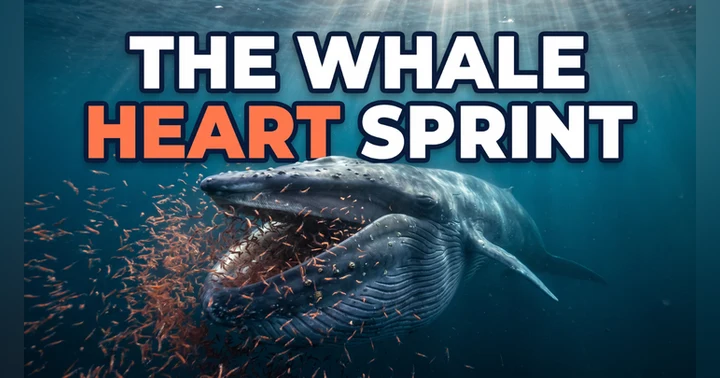
Whales Are Sprinters: What a Blue Whale's Heart Does When It Lunge Feeds


 Apple Podcasts

 Spotify

 YouTube

 Amazon Music

 PocketCasts

 Overcast
What happens to the heart of the largest animal on Earth when it charges into a swarm of krill? Dr. Ashley Blawas, a postdoctoral scholar in Jeremy Goldbogen's lab at Stanford's Hopkins Marine Station, joins Andrew to unpack new research published in PNAS that measured the heart rates of lunge-feeding blue whales and humpback whales using suction-cup ECG tags.
Ashley explains the three phases of lunge feeding (accelerate, engulf, filter) and why these giants behave a lot like human sprinters. Their heart rates stay high after each lunge, then gradually recover while they glide and filter, refuelling muscles for the next burst. She also shares how body size gives big whales a heart rate range of roughly sevenfold, compared with about threefold in humans, which may be one of the keys to life at the largest scale.
Along the way, Ashley tells the story of how beach vacations in North Carolina and a biomedical engineering degree at Duke led her to whale physiology, how COVID pushed her PhD into molecular research, and where this work is heading next. Think minke whales, North Atlantic right whales, and one day a "smartwatch" that could help track whale health over time.
Takeaways
- Lunge feeding has three phases: acceleration (about 4 m/s), engulfment (a few seconds), and filtering (up to 1 to 1.5 minutes in the largest blue whales).
- Blue and humpback whale heart rates mimic human sprinters, staying elevated after a lunge and recovering gradually.
- That elevated heart rate likely helps oxygenated blood restore energy stores between lunges.
- Big whales access a heart rate scope of roughly 5 to 35 bpm, about sevenfold, versus about threefold in humans.
- Data came from nine tag records on blue and humpback whales across multiple field seasons.
- Tags attach with suction cups from a roughly 6 m carbon fibre pole and record for about 12 to 36 hours.
- Lunge feeding only pays off when prey patches are dense, which makes finding those patches a survival issue.
- Future work targets minke whales, ram-feeding right whales, and long-term health indicators like heart rate variability.
Links for Ashley's Work:
The PNAS paper discussed in the episode: Sprint-like cardiac dynamics support repeated acrobatic lunges in foraging rorqual whales
Ashley's website: ashleyblawas.com
Goldbogen Lab: goldbogen.stanford.edu and whales.stanford.edu
Support Independent Podcasts: https://www.speakupforblue.com/patreon
Need help with your ocean non-profit, company, or project? Get the help you need with Pisces Oceans Inc.: https://www.piscesoceans.ca
Connect with Speak Up For Blue
Website: https://bit.ly/3fOF3Wf
Instagram: https://bit.ly/3rIaJSG
TikTok: https://www.tiktok.com/@speakupforblue
Twitter: https://bit.ly/3rHZxpc
YouTube: www.speakupforblue.com/youtube
0:00 What happens to a whale's heart rate when it lunge feeds? That's our topic for today's episode when we talk to Ashley Blawas from the Hopkins Marine Center at Stanford at the Doerr School of Sustainability. She's on the podcast. She's doing her postdoc on this type of subject, measuring the heart rates of blue whales and humpback whales to see how the heart rate is affected when they actually lunge feed. She goes into about her career and how she got to where she is right now, how she started as a biomedical engineer and is now studying the physiology of some of the biggest animals on the planet. Uh, and, uh, she also talks about, like, how lunge feeding works.
0:40 There's three parts. It's really cool to see how it works and to see how these animals are taking advantage of these prey patches that they want to eat, of krill and maybe depending on, the animal, depending on the marine mammal, these, uh, small fish, prey patches as well. This is a really interesting topic that we haven't touched on at all yet, on the podcast out of over 2,000 episodes that we've done here. So sharing this type of science has benefits to even human physiology and understanding human physiology. Apparently, whales can really change their heart rate from, like, 120 beats per minute to 40 beats per minute in two beats. That's pretty phenomenal, and it doesn't really affect them from a health perspective that we've found so far. Imagine a human doing that.
1:21 That would not be good. So it's kind of cool to hear the differences and, how these animals work, uh, especially from a physiological standpoint and a scientific standpoint. So thank you, Ashley, for bringing that. So here is the interview. We're talking all about blue whales, humpback whales, and lunge feeding and their heart rates. Enjoy, and I'll talk to you after. Hey, Ashley. Welcome to the How to Protect the Ocean podcast. Are you ready to talk about lunge feeding in whales? Thanks, Andrew, for having me. I'm super excited. Can't wait to get into it. All right. I, I, you know, I have to admit, I don't think that's ever on this episode come out of my mouth, where I said, "Are we ready to talk about lunge feeding in whales?" But it's always something I've been interested in. Because I've seen, you know, studies on it. I've seen people talking about it. Um, and then you watch it happen, like, you know, with these now that with drones and, aerial photography and stuff like that.
2:05 And you watch these, blue whales and sperm whales and humpback whales and all these, like, massive whales just kinda be able to just carry themselves, just even in the water, and then be able to do these lunge feeding. And I just think it's awesome, and I can't wait to be able to talk about it with you. But before we get into that, Ashley, why don't you just let us know who you are and what you do? Yeah, sure. So my name is Ashley Blawas, and I am a postdoctoral researcher in Jeremy Goldbogen's group. We are based at Hopkins Marine Station, which is affiliated with Stanford University. And, um, basically, I'm a physiologist, and I'm motivated to ask and answer questions about how animals work, and primarily I work in big whales.
2:47 And so those are the rorqual whales, which include blue whales, fin whales, humpback whales. And mostly I'm interested in heart rate, and so that's been sort of the latest and greatest of my research. I love it. I love it. So post-docs, that means you've been through PhD. Did you do a master's or did you go straight to a PhD? I went straight from undergrad to the PhD. Okay. Amazing. before we get into that part, what got you interested just in the ocean in general and wanting to be a marine scientist or marine physiologist? so I grew up in central North Carolina and spent every summer vacationing for like a week or two with family at the beach. And I think without knowing it, that was probably where my first interests you know, the seed got planted.
3:32 But, um, then growing up and sort of having that as a part of my life and really valuing, you know, not just the time spent like in an environment like that, but how unique it is to be able to access the water, see the animals in the water. uh, yeah, I think honestly it started there with beach vacations, and then sort of- Yeah … tumbleweeded into where I am now. I love it. Now, you went to Duke University, uh, obviously, and that makes sense because you're so close in North Carolina, like in that area. now you, got your undergrad in biomedical engineering. I guess not too far off in terms of, looking at physiology as you get older, but what made you go into biomedical engineering?
4:12 When I was in high school, I really liked science and I really liked math. and so I kind of, going into college, I thought engineering could be a nice way to fuse those two interests. but I also kind of had this part of me that was really interested in, you know, specifically like how things work under the hood, which is a lot of what engineers do, right? But I think I was most interested in applying that to biological systems, which is really right where physiology falls. So, when I was going to college, I knew I wanted to focus on engineering, but biomedical engineering was this sort of, you know, perfectly, designed major for what I wanted to do, which is like how do things work, but how do things work biologically rather than maybe understanding like the electrical or mechanical systems behind them.
4:58 Yeah. and I, I'm glad you brought that up because when I hear of engineer, when I think of engineering, you think of the mechanical, the electronical, even the software engineers. Right. You don't hear a lot of people go into, you know, biomedical engineering, but it makes sense, right? Obviously, there's a lot of people who do. It doesn't get talked about a lot, sort of like in the mainstream conversations, I should say. maybe it's just my conversations or I don't know. But it seems like engineers are more focused on like you have mechanical, civil, you know, you have those engineers. what type of career could you have, you know, other than one that you took? Like what were you thinking as you went through this of like, as you go through those careers, what kind of careers could someone with a biomedical engineering degree have? Yeah. So one of the main ones I would say that sort of I was, in the track for was biomedical device design.
5:43 That's a lot of what- folks who are getting this kind of training do, is how do we build the systems that measure the physiology, that we're interested in in a clinical setting. But also a lot of folks who are pursuing med school, a lot of folks who are pursuing like graduate level education in biology or staying in that biomedical engineering track. But I think, to be honest, you know, it's a lot of having this like problem-solving mindset- Mm-hmm … and applying that to how we learn more about biology. So, you know, there are definitely the folks who are gonna build systems that are electrical and mechanical and- Of course … and use those. but there are also folks who are just, you know, thinking about how do we do engineering, but how do we do it maybe on the human body, Yeah rather than, a lab setting.
6:24 I, I picture Rocky III. You know, where they have the Russian boxer who's got… Like he's on the treadmill, and he's got everything like, you know, hooked up to him, all the pads hooked up to him so they were looking at heart rate. I'm thinking of when you mentioned like coming up with the devices to measure all like the physiological system and how it responds to probably like stimuli and stuff. And then it goes to like Rocky trying to catch a chicken in a farm somewhere- … in the, in the winter. this is where my mind is going of like, 'cause like this is what I think about when I think of biomedical engineering. And I'm sure a lot of it was catered toward human biology, I assume- Right like in that program. Was there ever a time where you started to deviate from that and start to think of, oh, well, there's mammals here as humans, but then there are other mammals as other animals?
7:06 Did you ever think… Like was that when that started to deviate? Or when did that hit? Yeah. So I had, as an sort of early college student, always been interested in, um, visiting the Duke Marine Lab while I was at Duke for undergrad. So Duke has this campus down by the coast that you can go and do, quote-unquote, "a study abroad semester," though you're not going abroad, there. And that actually happened to be in the town that I had, vacationed in growing up with family. Oh. And so when I got in to Duke, part of me was really excited. Wow, I could actually go and take classes there, this place that I've known for so long. So I had always sort of planned that I'd like to incorporate time at the Duke Marine Lab into my engineering curriculum, and I was able to do that, and met a faculty member there who ended up being my PhD advisor, who was actually doing this exact thing, which is that he was trained as a biologist, in his undergraduate, and then trained as an engineer in his graduate training.
8:04 Mm-hmm. And then building tools to study animals in the ocean. And that was, I think, when it clicked for me. oh, wait, actually maybe my sort of, otherness in the sense that I'm an engineer playing marine scientist, could actually come in handy here. And some of the things that I think about building or for understanding humans might be relevant in a way that I didn't- Yeah think of before. That's really cool. So I love it. It's out of curiosity of just being in the town that you used to vacation in. You're gonna go and do, like, a semester just to see what's there. Then you meet somebody there that is doing something very similar to what you wanted to do, but you never really thought about from an animal or ocean animal perspective at that point until you met… Who, who was it, sorry?
8:48 This was, my PhD advisor, Dr. Doug Nowacek. Okay, cool. Mm-hmm. So you d- you hadn't really thought about animals until, like, or doing what you were, gonna do and applying it to animals at that point? Not really. I think I almost saw it as, like, a two disparate paths of my career. It was like- Right … "Okay, I'm an engineer." And then, every once in a while go to the beach and, like, play this marine scientist role. and I think it was when, yeah, really seeing him and his expertise that I realized those two things could synergize in an interesting way. I love it. I think that's great. I mean, so what a way to explore, too. Um, even just natural curiosity coupled with sort of, like, childhood feelings, you know, about being- Yeah … in that town. But then just being like, "Oh, this would be kinda cool." And then it ends up kinda changing your life in a way of, like, or the path of your life, in that way.
9:34 Right. That's amazing. Totally. Yeah. That's, that's awesome. And so your PhD was on that type of work. Can you kinda go into a little bit about what you were doing? Yeah, sure. So then sort of for the last two years of undergrad, I really started to orient towards, you know, how could I apply these engineering skills towards building, for lack of a better term, biomedical devices for, um, for marine mammals. Mm-hmm. And one of the courses that I got to take while I was at the Duke Marine Lab was, uh, the biology of marine mammals, and that was where I first learned about these bio logging tags that are so standard in the field, that I'm working in now. Um- But so I was exposed to this in the last couple years of undergrad, pursued a couple opportunities in the summers to, get exposure to the field more like out of the classroom and- Mm-hmm in a research setting.
10:23 And so I got the chance to work with Dr. Andres Folman, who's a comparative physiologist that's worked with like any marine system you can name, he's worked with it. He's worked with penguins, he's worked with Steller sea lions, he's worked with whales, and, he let me sort of be a, you know, sort of an undergraduate volunteer on a project, to look at dolphin physiology. And yeah, that really led me to pursuing, the graduate research with Doug as my advisor. And for that work, I studied both dolphin and pilot whale physiology. Those are two fairly related species. the pilot whales are much better divers than the dolphins.
11:05 But, um, my graduate work was basically on diving physiology of these animals. Mmm. What are the specifically cardiac and respiratory adaptations that they have to hold their breath underwater for extended periods of time? So I did that in a couple different ways, but that was the broad theme of it. yeah, so I spent- That's crazy Four and a half-ish really fun years working on that- Yeah before the postdoc. That's amazing. and to think that hasn't really been studied that much before, I assume, like in terms of the adaptations for these different whales or these different, like dolphins and stuff? Yeah. I mean, I would say there are definitely experts who've dedicated full careers to this field, but I think that, it wasn't really till the 1940s that you see the first publications on these animals, in terms of like how do they hold their breath and what might be going on under the hood- Mm that's different than humans.
11:53 Um, so yeah. I mean, there's only been, you know, a handful of generations of people doing this kind of work. Mm. So there's still quite a bit that's new and that we haven't learned yet. It's amazing, though, how much we can still find out about, you know, just whales in general. Like you'd think everybody loves whales. We pretty much know everything we do, but no, there's still so much we can find out. I find the same thing when we do the Beyond GE Shark podcast. Like we know very little about sharks- Yeah … in the world compared to what we can find out, and we're always finding new ones, and we're always finding new things. It's the same, I feel the same thing with marine mammals is just- Totally … you just, you never know, right? Yeah. Re- Um, which is awesome … is it… Yeah. It's awesome, and then it's an exciting part of the job is that often- Yeah we might put one of these bio logging tags out that we use, and chances are you're probably gonna see something you've never seen before just because- Mm there's not that much data of this type.
12:45 Yeah … yeah. And I, I mean, you know, something we'll get to later, but like something as basic as heart rate. You know, we don't even know- Yeah … the heart rates of these animals, which is like such a basic measurement, uh- Yeah … for people. So yeah, it's an exciting- But- field to work in, for sure. And if you think about it, it's like how do you get a heart rate from… Like it's not as if you can have a stethoscope and just kinda swim as they're diving down. Like that's not happening. Um, so yeah. So there's obviously challenges, uh, with that. Can I ask from your PhD, what's like something that you figured out that has stuck with you today? That's a good question. I would say, I think probably the main takeaway from my graduate research that I still really look back to is that, the dive response, which is sort of the, this is the main adaptation that we think of when we think of, you know, how is a blue whale going down and performing exercise underwater.
13:42 It all comes back to this idea of a dive response. And I think one of the things that I learned is it, it is so complex- Mm-hmm … as a graduate student. and so one of the papers that I wrote was looking at how breathing alone affects heart rate. Mm-hmm. in dolphins, if they're just sitting at the surface and breathing, just the act of breathing itself can vary their heart rate dramatically from, say, 120 beats per minute, during the breath down to, like, 40 beats per minute- Wow in the period between breaths, which is really dramatic, and that's not something- Yeah … as humans… You know, actually, that phenomenon does happen in humans, but we don't perceive it. It's happening to a much, uh, smaller degree.
14:23 And I think just that, how complex and how variable this sort of physiology can be was, quite fascinating and has definitely stayed with me through- I feel like if it was a human that was doing that, you would not be in good health if you were- It's true going from, like, 120 down to 40 and then back up to 120, you know, so forth, right? With every breath. Yeah. It's- So that's-- Oh, that's really interesting. Good for you. Uh, and now you're at a postdoc. did you go right from your PhD to Stanford, uh, as a postdoc? Is this your first postdoc after that, or did you do one before? I did. Yeah. So this is my first postdoc after that. So I, I finished my PhD, early 2023, and then made the move from North Carolina out here to California and started the postdoc. Okay.
15:04 Interesting. Before we go on the postdoc, you did about four and a half years, finished early 2023. How did COVID affect your PhD because, like, I don't know, I know the States didn't close down as much, but, you know, that must have impacted it. Did it impact it any, kinda change the way- Oh, definitely … what you were, you were… 'Cause I know with a lot of people who started graduate programs, you probably started, what, 2019? Is that when you started? Yeah, 2018. Yep. 2018. So starting in 2018, hitting that, like, for maybe a year and a, and a- maybe two years, and then hitting that, that pandemic March, whatever, 17th or whatever it was. Did that affect sort of, like, your field work? Did that affect anything that you had for your PhD?
15:47 It totally did. I mean, at Duke, the boats were considered an extension of the classroom. Okay. And so it meant boats were a no-go, so long as the campus itself was shut down. Yeah. Um, and so for my work specifically, I ended up doing a couple different pivots. In one sense, instead of collecting my own data in the field, I used h- basically what we would call historical data. Not that it's super old data, but just things that have been collected by lab mates in the past. So that was one change I had to make, was instead of collecting new data, turning to things that we already had. And then another pivot that I made that actually ended up being something that has continued to stay with me through the postdoc and probably will through the rest of my career, is that I got involved with a lab at the Duke Cancer Institute that was doing, lab work.
16:39 And at the time because they were caring for live cells for humans, they had the ability to go into lab and continue that work to some degree. And I had got involved with them through a, serendipitous, like, meet and greet sort of thing, and, uh, they ended up getting some whale biopsies and culturing cells from those whale biopsies for different sort of experiments. Um, but because we were in COVID and because they could still do lab work, that enabled this whole other branch of my research, which was diving into whale adaptations at the molecular scale. and like I said, it's something I still work on and something that was a chapter of the PhD, but it was, it… You know, one of those moments where you're like, "Oh, okay, this actually maybe," you know, turned out for the better.
17:25 I ha- Yeah … I mean, I had lab mates who were… Or not lab mates I should say, but cohort mates who were doing, like, marsh grass experiments in their backyard. Um- Mm-hmm. Yeah … yeah. So everyone, was doing something, but for me it, worked out well in that sense. Good. I mean, you had to be creative at, some point too, right? to be able to continue to work and towards that. And it's great that it became a chapter in your PhD, which is great- Yeah you continue to work on it. That's awesome. okay, so Going back to Stanford, you got this postdoc at Stanford. And what was this one, this specific, It's a, it's a postdoctoral scholar, I guess. And, and- Sure. Yep … so can you tell us a little bit about it? 'Cause I think this is gonna be the focus for the rest of the interview. Yeah. So I was hired as a postdoctoral researcher in Jeremy Goldbogen's group with my main, project being to enhance the design of a biologger device.
18:12 And when I say biologger, all I mean is a sort of like a mini computer, you can think of it much like an iPhone, that is, gonna sort of ride the back of the animal- Mm-hmm uh, for lack of a better explanation, and record a bunch of different parameters about its life. Okay. So I got brought on to enhance the design of one of these biologgers to record heart rate. And I say enhance because the lab had had some success in the past measuring heart rate using, a technique called an electrocardiogram, short for ECG. It's very common in human medicine too. Um, and they had recorded the f- first ever blue whale heart rates that way. Um- Wow … but then, wanted to expand the use of this device and, use it to study different species and make it more reliable in different ways.
19:01 And so that's why I got brought on specifically under an Office of Naval Research grant, which supported me to do that. And then, you know, in the off times of that, working on other related projects. So I mean, the fact that you did the biomedical engineering, giving you that basis in You know, these using devices and testing out devices and, kind of figuring out how they're built so that you can test them out later on for this postdoc and your PhD. Like, I mean, that's come in, quite a bit of handy for your career. Extremely. Very unique aspect. And I mean, obviously I was just reading up as you were reading, like Jeremy Goldberg's lab, that's essentially what he does is, is looks at the technology in that. So when you're testing this out, are you looking at both the testing itself as they're fastened to the animals, and also how they're actually built?
19:51 Like, are you using that engineering, uh, degree and, knowledge to look at how they're actually built and how they can be either improved or kind of fidget with it a little bit to do something different? Definitely. And I would say the engineering expertise has come in extremely handy. It's one of those things where people, you know, might look at my CV and imagine like, "Wow, you perfectly planned this." But I certainly did not, and I think, it's just one of these, you keep putting yourself in places to end up being at the right place at the right time, and I think it worked out really well for me that this post-doc brought together the engineering knowledge and the marine mammal physiology knowledge from grad school in a, yeah, an ideal way.
20:32 Um, but I would say as for the tags, definitely. I mean- Mm-hmm … we're, the fundamental idea of an electrocardiogram recording, we're not engineering in any way. That works the way it works. And, you know- Of course … there's some different aspects that you can, experiment with, number of, leads that you might use, the material- Mm-hmm of the electrode that's making contact with the skin. These are variables you can change. But I mean, the biggest part of that most certainly is actually the engineering of the device. What are the- Mm-hmm … drag forces on the device? Is it making contact? Do we have high-frequency oscillations of the tag that are adding noise to our signal? All of those sorts of things become really relevant.
21:15 Um, and so definitely it was an engineering project through and through. Yeah. That's awesome. That's so cool too. 'Cause it's like, people will do marine biology degrees, they'll go into marine biology, and they'll kinda come up with all these… their path leads to people who you meet, like you said, being in the right place at the right time. And, but I think it's kinda cool when you go into something where you start off with the biomedical aspect, then you go into a little bit more, but now you're in the, marine side. And then now this is like a perfect kinda thing, and you're discovering things that is just amazing. and you know, we're obviously, we're here to talk about lunge feeding. So how did you come across this project in particular? 'Cause you're measuring a bunch of things. Is it as they do the lunge feeding?
21:58 Is that it? Or how did this entire project- Mm … just kinda come up in terms of we wanna know what's happening to them physiologically? Like, how are these massive bodies are, how are they able to go through the water At this, like, lunging speed, you know- Sure … this quick burst, right? Yeah. So I think really the impetus for, like, how can we use this tool that records heart rate to understand lunge feeding comes from what our group's larger motivations are, which I would say the theme under which we all work is, um, how did we end up with the biggest animals on the planet? Why are they in the ocean? And what are the keys that unlock life at the largest scale?
22:40 Yeah. So that's what we all work on as a group, and we think one of the big keys to how we've ended up with these giant animals in the ocean, my boss Jeremy likes to say we're living in the age of giants. These are the largest animals that have ever lived. and so we have the unique opportunity to study, uh, these types of questions. But lunge feeding is definitely a key to how they've been able to do that. Right. So unlike terrestrial mammals who are, you know, single prey predators, like they're going after something, grabbing it with teeth, and then processing it, these are filter feeding animals. So they are underwater identifying in some way a big prey patch, and they're accelerating up to speed towards that prey patch, at which point they open their mouth, engulf the prey, and then instead of teeth, they have baleen plates.
23:33 These baleen plates are a lot like coffee filters, and so they allow them to push the water out, retain the prey, and then after this lunge, they can swallow. And that filtering time takes quite a bit, and so that limits how many lunges they can do per dive. But really the motivating factor for like what does heart rate do during these lunges is, is that we think these are a key, sort of a, a key life history strategy for the biggest whales, and we wanna know how it is they do that. Okay. So let's talk about, uh, first how you measure this. You have this… Say, let's take a blue whale, for instance, right? Largest animal on the planet. Uh, they're absolutely gorgeous.
24:14 They run up and down, the Pacific East Coast or like the West Coast of the US. can you just talk a little bit about how do you measure the heart rate of a massive animal that's moving through the water at I would imagine would be, at a good speed? Yeah. So it is definitely non-trivial, and, we don't get it all the time. So, when you're just like sitting on your couch measuring your heart rate with, you know, some sort of smartwatch, you might get a clean signal all the time. But if you start jumping up and down or going for a run- Mm-hmm or anything like that, you can of course add noise, and we face the same challenges. but the way that we are recording heart rate, like I said, is using, uh, a method called an electrocardiogram.
24:56 And in simple terms, what this is looking for is measuring an electrical signal across the heart as it beats. Um, because if we sort of scale down to the smallest scale of cardiac function, we have little muscle cells that are beating, and the way they do that is by moving charged particles across their membranes. And so we can measure that charge, basically the movement of that charge. Gotcha. And from that movement, we can pick up heartbeats. So functionally, that's what we're doing. What it looks like in practice is we have a bio logging device that, like I said, kinda looks like an iPhone.
25:37 In this case, it's a little bit bigger 'cause we're doing a little more with it. but it has two metal electrodes that are almost, like, quarter-sized, and they make contact with the whale's skin, and the electrical potential across those two electrodes is what we're picking up, to capture these heartbeats. And so, yeah, we use these bio logging tags that have really been the bread and butter of our group's work for the last decade or so. Yeah. And we've outfitted them with a new sensor in this case. That's amazing. So this gets attached on, so is it just like a harpoon-type thing where it gets shot and it attaches on so it's on the skin? It's on the skin … 'cause it's gotta be able to take going over the surface and, like, you know, some rough areas, you know, currents and obviously the whale movement and the friction of the ocean currents on that device, right?
26:26 So it's gotta be- Right … able to be fastened quite sturdily. Yeah, exactly. So they are- That's two words … suction cup attached tags. So they- Oh, okay. Cool yeah, so they're non-invasive and they, are attached by attaching the tag itself to the end of a six meter or so carbon fiber pole. Okay. And then one of our team members in the field gets up on the pulpit of a small boat, which is sort of like, you know, an overhanging part of the boat where they can get a good view of- Mm-hmm what's below or what's right next to the boat. And then as, say in this case, a blue whale comes up to take a breath, um, they can just go ahead and reach out this pole and basically, give it a little slap and get these suction cups to attach to the back.
27:14 And then the perk of the hydrostatic pressure in the ocean is that once the animal takes a deep dive, you get a little extra press- Oh onto the tag. Yeah. And so then because they're only suction cup attached, they won't stay on for really long periods of time. Most typically we're getting, you know, maybe 12 to 36 hours of- That's pretty good. Yeah. That's more than I expected. when you first attach them on, what's the success rate of it sticking before it goes down a little deeper to get that? It can't be easy. Yeah. I don't personally do it- Right … so I have to give big kudos to my lab mates. they're the ones who've, been putting our tags on, for this project and many others. But- I mean, I would say it's fairly high.
27:57 It depends, you know, if the animal maybe does some turn away at the last second, you know, maybe your attachment isn't so good. But I would say for the most part it's pretty good that these- Yeah … tags will stick on. we benefit from working with huge animals that we model, you know, almost like they're as flat as a table because they're so large. So - Yeah … if you were tagging something like a pilot whale, you might have a little bit more to think of in terms of finessing- Gotcha the creature, but we get away- Yeah … with a lot more. Yeah, that makes sense. You don't think about that until, like, you're right up there with them, and you're just like, "Oh, okay, there's more surface area to attach than in flat surface area." Right. That's cool. So this, device basically like a ECG, it just kinda just takes that measurement for, like, 12 to 36 hours.
28:40 It pops off. You go retrieve it, and then you get the data. It's not like satellite-driven data. It's like the data is, recorded within the tag, and then you download the data once you get the tag. Is that, is that right? Correct. Yeah, that's correct. So we call these sort of type of tag archival. Yeah. So they write all of the data onto the tag, and then, require us to go pick them up. And part of the reason for that is that not the heart rate tags specifically, but a lot of the tags we work with have video and audio data, which would be- What? … really hard to satellite up. oh, yeah. Oh, yeah, we've got- What? … you can ride the back of a blue whale. You can ride the back of a humpback whale in our lab. I mean- That is- … you know … so cool.
29:21 Theoretically speaking, not, not literally. Yeah, yeah, of course. But, um- But you're watching it like you could… Like you're on the back- Right, right … basically. Right. Yeah. That is so cool. Yeah. So this is… I mean, and this is one of the really important features of the tags that we use that allowed us to learn so much about lunge feeding. Mm-hmm. So a lot of the early work in, uh, the group was to basically use all of the sort of movement sensors that the- Yeah … tags have and compare them to what they were actually seeing in the video to be able to say, "Oh yeah, we can see the animal start to fluke. We can see the animal open- Yeah … its mouth at this time." So video has been a huge asset to the lab to be able to validate a lot of these kinematic events.
30:04 Yeah. Um, yeah, that you just otherwise you wouldn't be able to… Unless you had a scuba diver down there, you couldn't actually confirm- That's for sure … that's what the animal's doing. Yeah. And then for 12 to 36 hours, you're not gonna be able to s- keep up with an animal that long, even on a boat. Like, that's, that's phenomenal. yous- mentioned audio. Is that to hear… do you guys measure- you know, the whistles, clicks, and all that kind of stuff that they do, and are you measuring whether it coincides with heart rate or, lungeing or anything like that? Or is that, a different project? That's a good question. I would say the audio gets used for lots of different things. Right. We haven't used it specifically related to the heart rate work yet, but we use it to study noises the animal itself is making.
30:46 We use it to study noises in the animal's environment- Mm-hmm like if a ship passes by- Oh, yeah. Yep … or if, you know, there might be some other acute, uh, noise that the animal's exposed to. So yeah, the audio comes in handy for all sorts of different things, not specifically for this project though. Yeah. That's amazing. That's so cool. Before we talk about the results that you saw, let's talk a little bit about lunge feeding and what it actually is. Sure. Uh, and what can people kind of picture if they haven't seen it themselves in a, in any format? Yeah. I mean, if you can, imagine a blue whale in your mind, um, lunge feeding is sort of a three-part of feeding strategy. The first part is acceleration, and during this part, you can imagine the animal fluking hard.
31:31 So it has these large flukes. It's moving them up and down to pick up speed. Uh, so during the acceleration phase, the animal increases in speed to about four meters per second, which is about 10 miles an hour. Mm-hmm. It doesn't seem super fast, but they're huge animals, so it's pretty fast. Yeah. And then the second part of lunge feeding is the engulfment phase, and this is a really quick phase. So this is when the animal has reached peak speed, it'll open its mouth and engulf the prey patch that it finds, and then close its mouth completely, and that phase is usually several seconds long.
32:11 but during that phase, because the, ventral groove blubber, which is sort of what allows the animal to scoop up a large amount of that pre-saturated water, it expands a ton and acts almost like a parachute. So it slows the animal down. So we see their speed drop almost instantaneously from 10 miles an hour down to zero. So that's part two, and then part three is the filtering phase. And so during this phase, what you can envision is a blue whale sort of riding out its momentum of the lunge it just did. This is a largely unpowered phase, so they're not fluking at all. They're just sort of gliding through the water, and this is the part where they're pushing that water out through the baleen, and then at the end of the filter phase, they'll swallow.
32:57 and so that acceleration phase, say for like a blue whale, could be, 10 to 20 seconds or so, the engulf- Oh, they can get that fast, that, that… They can go that fast that quickly? Yeah, it depends on exactly the circumstances surrounding the prey patch- Of course … and what, at what depths they're foraging. but that's relatively short. The engulfment is very short, and then the filtering is pretty long. Okay. Um, so the filtering phase for the largest of blue whales takes about a minute to a minute and a half. Okay. So for a minute and a minute and a half, they are just gliding through the water, expending no energy, pushing this water out, Right … to then be able to swallow their prey. So that's kind of the mental image is like- Yeah … accelerate, engulf, filter.
33:41 That's amazing. to go back to the part one, the acceleration phase, do they time it? 'Cause I imagine, you know, you're going, was it 10, 10 miles per hour, equivalent of 10 miles, so four meters per second, is that what you said? Right. so you're seeing something ahead. You know there's something ahead, And obviously the distance they travel within that time is gonna be different depending on currents and everything like that. How do they see the patch ahead? 'Cause they're probably going a good distance. how do they see the patch ahead and realize, "I'm gonna start accelerating now"? Like, how do they detect that? Yeah. So I think part of it is that something we see most often when they're foraging deep is rather than come across to a patch, they're often coming up on it.
34:23 Oh, okay. And so that helps to have, depending on the depth, if there is any light penetrating, to have sort of the patch- Yeah … backlit in that way. Yeah. Um, but to be honest, that is a big question mark. We don't really know what sensory capacities they have, … what they might be cueing off of. Are they cueing visually? are they cueing with some tactile means that we don't fully understand? Are they cueing based off vocalizations that, you know, another animal's making in the same vicinity as them? It's a really big question mark, and I have a lab mate who's trying to tease apart some of that, uh- Yeah and thinking about how they might sense water temperature or some other- Right … features of the oceanography- Yeah … to sort of pick out these patches.
35:09 but this is really important. We know that, you know, sort of a big thing in our field is these marine predators cannot survive on the average distribution of prey in the ocean. They have to find patches that concentrate their prey to survive. Right. And so it's a really important question. How do they find them, um- Yeah … and how do they know what, patches are worth feeding at? Yeah. and of course, and if it changes with climate change coming in, currents changing, and that, prey patch gone or somewhere else. Right. They have to find it. that's a lot of energy they have to expend to go to a new place to find it. So yeah, that's a cool question. I love all these questions. And going back to the heart rate, so what did you find with heart rate, measuring heart rate with these lunge feedings?
35:51 Yeah. So we had two big findings that came out of the study. The first being that the heart rate patterns of these lunge-feeding blue whales and humpbacks, which were the two species that we studied here, mimic the heart rate patterns we see in human sprinters in the sense that- Hmm … the animal goes through the acceleration and the engulfment phase, and then they go into this really low energy, unpowered filtering phase. But we see that the heart rate stays pretty high at the start of the filtering phase and only gradually recovers. And actually, that's exactly what happens in human sprinters, and this is really important because it allows oxygenated blood to perfuse the body in this sort of, rest or recovery time and renew the fuel sources that the animal or that the sprinter's gonna use on the next sprint or on the next lunge.
36:41 So that was one really cool result, is that these animals act a lot like sprinters. It gives us the idea that probably they're using similar metabolic fuel sources to human sprinters, might have similar muscular adaptations to human sprinters, and so on. And then the second result that was really neat is we said, "Hey, what if we look at these heart rate patterns in the biggest animals and we compare them to smaller animals?" So that's like smaller marine mammals- Yeah … sea birds, and also terrestrial. And what we found is that it seems like these really big whales, because of their large body size, access a larger, what we called cardiac or heart rate scope.
37:23 Hmm. Which is to say, you know, maybe your average humpback or blue whale can access heart rates from 5 to 35 beats per minute, which is about sevenfold range in heart rates. Whereas a human on the day-to-day is accessing 60 to 180 beats per minute, which is only a threefold range in heart rates. And so we think this fact of large body size, unlocking this large heart rate scope might actually be a key to allow these animals to sort of, support the intense exercise of lunging at depth, but also conserve oxygen while on a breath-hold dive. That's amazing That's so cool.
38:05 Just all the, stuff that you can find out from, like, this one device, Mm-hmm. And looking at a behavior is absolutely phenomenal. Um- Yeah, it's really fun to… I think one of the things I like is to take these things we learn about in whales and compare them to other systems. There's so much to learn, you sort of take whales as, like, this extreme- Yeah … and then compare them back, um- That's awesome to the average, what the average is doing. So the results that you have now, how many… Was it more than one field season, or is this, one field season? We did collect all of these records, so there were nine records in total, over multiple field seasons in multiple different study areas. Okay.
38:45 Um, yeah. So in the future I think we'll probably target, you know, maybe broader scope of species in different areas, but at least- Yeah … for this study, it was a little bit more opportunistic where we had the chance to put these tags out. And this was on blue whales and humpbacks? Correct. Okay. So cool. So what, species are you looking forward to finding out, that you haven't done yet? So the minke whales are the smallest rorquals. Okay. Which is funny to say because they're not that small. No, exactly, yeah. They're about six meters- six meters in length, which, the biggest elephants stand at about four meters tall. So these are big animals even though- Yeah … in our world we talk about them- For sure … as small. they would be really interesting because they're sort of… We think of blue whales as pushing the upper limits of size, and minke whales as pushing the lower limits of size in this animal group.
39:33 Yeah. So that would be one. And then the second group that I'd be really interested in is big whales that don't rely on lunge feeding. So something like a North Atlantic right whale, for example. Mm. They have a totally different strategy, which is ram filter feeding. So almost like a lawnmower, like they just open their mouth and they just mow the lawn, and whatever they trap, um, while they mow the lawn is what they eat. And so- So they're going at the same speed as they would be going regularly, like swimming. Right. Exactly. Ah, interesting. Slow… Yeah, super slow speed, very sort of stable, kind of energy profile. Much different than the lunge feeders. So that's the other group that I'd be really interested in putting these tags on to understand- Yeah you know, what… how does that look in?
40:19 Is that much different from lunge feeding? Expecting it probably is. yeah, I would imagine it, it would be. But it, yeah, you wonder how much- energy it can take to do that is probably a little bit more. Cause you, wonder with these big animals, the lunge feeding, is it the most efficient way of feeding? Like I assume what happens if they just went through and did this ram feeding, they would disperse and they may not catch all of them at one time. Right. 'cause like these patches, they're essentially plankton, right? Like it's zooplankton that they're eating. Yeah, right. Exactly, yeah. So they're targeting krill and- Yeah … small forage fish for some species, but yeah, largely krill. Okay. Right, right. Yeah. and so like the lunge allows them to kinda catch them off guard, I guess- Right … in a way. But for a plankton kind of, just plankton, like they're not really going anywhere unless they're in a current of some sort, right?
41:05 Right. And I think the real key of lunge feeding is that, it's really only worth it as a feeding strategy when the prey are at high concentrations. Yeah. So we say something like, you know, you're not gonna go to a poorly stocked grocery store when there's a well-stocked- Of course one down the street. Yeah. Um, and so I think that's a big difference is that these lunge feeders rely on dense patches, whereas something like a right whale, which is more of- Yeah … a grazer, they don't necessarily require density They're just opening up the mouth when it's around. That's- Exactly that's what they do, right? Yeah. Yeah. Okay. that's really cool. So obviously you already have some questions. You kinda know what you wanna do, uh, next.
41:46 This paper, where was it published? Uh, it came out in PNAS about a month ago. Okay. Awesome. and so, You guys just probably, like, you're doing a field season or finishing up a field season. Are you doing follow-ups on this? Or like, what's the next step for this understanding of lunge feeding- Oh, yeah … with this tool? Yeah. I would say anything that probably comes to mind, we're trying. more deployments on the same species to try to capture different behaviors. So for example- Mm-hmm … can we capture heart rates, after an animal has lunge fed for an extended period of time? Can we- Mm-hmm … understand maybe how they're recovering on longer timescales? like I said, smaller species to see how these patterns translate.
42:28 and then I think, one of the hopes we have for this tool is that in the same way that you might rely on a smartwatch or a smart ring to give you heart rate information to track your health over time, or to track when you've had, like, a stressful event in life- Mm-hmm we hope that these tools can be used in a similar way for whales. Um- Yeah … and to do that, we need to collect larger data sets and get a better sense of, what's the resting behavior like, what's, the high-activity feeding behavior like, and how do heart rates, you know, track those different behaviors. So- Yeah … yeah, I think there's a million directions to go, and we're trying to pursue the ones that interest us most- Yeah … but also have important conservation impact.
43:14 Yeah. And, and speaking of that, like, you know, on, the West Coast, and I know this is not one of your study animals, so I apologize if this is kinda going out of scope. Gray whales have been hit pretty hard over the last few years, right? They're a big large animal. They're baleen. They're ba- baleen, uh- Yes … cetaceans, right? And so, but I know that a lot of their feeding style is different. They go down into the sediment. They kinda grab a bunch of stuff, and then bring it to the surface, and then kinda eat whatever's in there. It could be critters and things like that. Mostly, they travel all the way to the Arctic to do that, and then they come back. Uh, a lot of people are saying just because of the way things are happening up north, and the melting of the ice is happening a little earlier than they expect before they get there, some of the plankton's not there when they grab stuff.
43:55 so it might just be that their energy levels are just a little lower when they do these large migrations. Do you think in the future, 'cause I know that might be way off right now, this measuring of heart rate through these loggers and maybe other things as you go along and as you develop this more could give researchers insight into how their energetic resources are impacted by not enough food. Or even with the ones that, you know, you, mentioned earlier with the blue whales and like these concentrated patches, if they're not there, how does that affect their physiology in, uh, i.e. heart rate at a most basic level when they don't get the food that they need?
44:36 Yeah. And like what's the detection there? And like what's that point where survival, non-survival? Like is that- Right … something that has ever been discussed or could be a possibility way down in the future, do you think? Yeah. I think way down in the future it could be possible. We have tools that can answer that question much better than heart rate can- Oh at this point. Gotcha. So, like, there are a lot of folks, including in our lab, who use drones to track- Right … animal body condition. Right. Or even, uh, one of the students in our lab has looked at, because some of the gray whales that she studies feed in tidal cycles- Yeah … when the water sort of pulls back, she can measure the pits they make and how many- Oh count how many instances they feed and estimate how many calories they're getting from each of those.
45:22 So there's a lot of tools that could definitely answer that question better and more quickly than heart rate. But- Gotcha … just, like, to say something about it, I think the thing we would look for in heart rate data that could be helpful to that question of, you know, potentially long-term stress, are these metrics that we think about in humans called heart rate variability. Mm-hmm. So this might be something you've heard of before, but essentially- Mm-hmm heart rate variability, you want heart rate variability to be high. A high heart rate variability shows that your sort of rest and digest and fight or flight systems are- Yeah … both at play and one is not dominant over the other, which generally reflects health.
46:02 and I think there's some interesting work that can be done there with whales. And once we have bigger data sets over longer time scales, those types of measurements might be informative about long-term stress. we're not there yet. It's definitely a far off in the future thing. Yeah. But I think, there's work that could be done, and I think- Yeah there's definitely heart rate data that could be informative about long-term stress. It's amazing what we can find out from just, like, drones or a heart rate monitor or something like that about these massive animals, and, uh, still quite mysterious it, it appears to be, but we're, getting to know them bit by bit and, um- Exactly ECG by ECG- which is kinda cool. so yeah, no, this is, fantastic. you know, like, I guess one thing that I'd love to ask is, like, when you find something like this, like the heart rates and how they change, you know, as they're lunge feeding, like, from a scientific point of view for you as a scientist personally, like, what goes through your mind when you kinda come out with these two cool outcomes from this paper?
47:00 Yeah. It's a fun question to think about. I think on the day-to-day, you don't realize, you know, maybe how novel something is. Um, because of course we expect these tags to go out and collect this, and collect heart rate data, and then it's there, and then you're like, "Woo, it did the thing we wanted it to do." And then you analyze it, and you write a paper just like you've always written papers. But then I think, you know, it's at these times when something like this comes out, and you take a step back, and you're explaining it to folks who are generally curious and maybe not sort of in the weeds of the field. And, yeah, you get that sense of awe and curiosity about learning new things about awesome animals. Yeah. That I think sometimes it hits and you realize, "Wow, this is amazing." Yeah.
47:44 And I feel very proud and inspired to be able to contribute to the field in this way. So- That's awesome … yeah, it, it's very motivating. It's motivating- I can imagine … to get something like this to the finish line. Um. Yeah. Yeah. Not easy stuff to do. Like, you know, there's a lotta, stuff, a lot of variables that go into that, and, uh, you know, from the field, from like working up the data and everything. and, uh, we appreciate you coming on, Ashley, to kinda tell us all about it and what goes into a study like this. And, um, it's been a while where I've had somebody come on and we talk about like getting into the science of it and the physiology of it. Uh, and I think that's a lot of fun for I know my audience, I know for me. Uh, and so I'm sure the audience is gonna enjoy it as well. We'd love to have you back on or even some of your lab mates back on to talk about more about these massive giants and, uh, talk more about, what you guys are discovering about them that we could learn from them as well.
48:32 So, um, you're always welcome on, just let me know, uh, when you- Oh, thank you … when you wanna come on and when you have something new. That's awesome. Yeah, you may take that offer back. I, I've got- … a lot of friends who can say a lot about blue whales, so, That's… Well, that's not a bad thing. I think I like that. Yeah. that's great. Uh, so thank you very much, Ashley. We really appreciate your time. and thank you for bringing this information and the work that you do. can't wait to have you back on. And, uh, yeah, it wa- it was great. Awesome. Thanks so much for having me. I appreciate it. You bet. Thank you so much, Ashley, for joining us on today's episode of the How to Protect the Ocean podcast. It was great to be able to talk to someone talking about science and physiology and sort of all the questions that can come out of a study like this, where there are so many answers that we could get.
49:16 These little devices that these engineers are creating, to measure heart rates, to measure, you know, body size from, uh, drones and pictures and all these algorithms and stuff that are done are just phenomenal. It's being able to answers we didn't have yet about these animals, and to understand them better, to maybe even help better understand us and how we work and how we could work in the futures. Lots of stuff that's coming. Uh, Ashley, uh, and I were talking after, and talking about hooking me up to a couple people I could talk to that really look at whales and people and the differences and how that could be beneficial to people. Uh, it's gonna be a lot of fun in the future. So thank you, Ashley, for not only coming on, but also giving us those contacts. And all the people at Stanford, at the Doerr School of Sustainability and the Hopkins Marine Center, for all the work that you do.
49:59 It's just great to be able to find out more and more about these animals, more and more about our environment, and how these animals interact with them. It's so cool to see. Uh, we love whales, especially big whales, the giants, the giants of the sea, folks. That's what it's really all about. Uh, but again, thank you so much. I'm gonna put links to the website and, uh, to the papers. Uh, and then also links to, of course, my socials if you have any questions or, comments about the episode, you can go ahead and hit me up, uh, DM me on TikTok, Instagram, Facebook, LinkedIn, wherever you can find me. Uh, and of course, if you're on Spotify and you wanna make a comment, uh, you know, you can do so. I'll be more than happy to respond when I can. Uh, and, uh, yeah, I can't wait to ta- chat with you about, all this stuff and how cool it is. So thank you so much for joining me on today's episode of the How to Protect the Ocean podcast.
50:42 I'm your host, Andrew Lewin. Have a great day. We'll talk to you next time, and happy conservation.