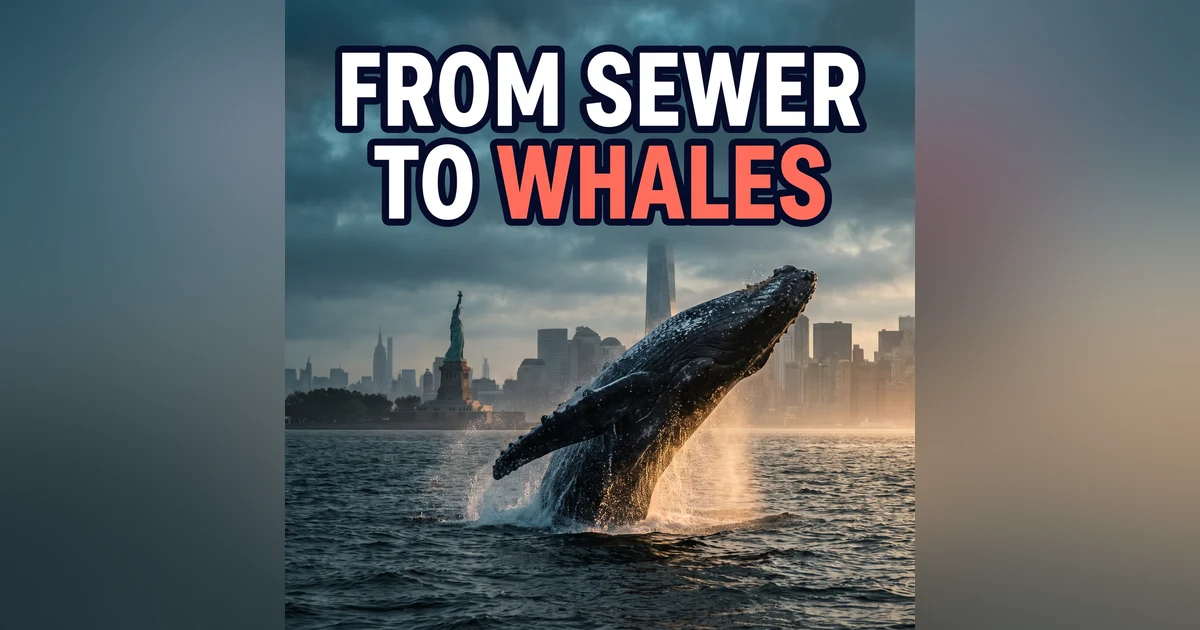
How Did Humpback Whales End Up in New York Harbour?


 Apple Podcasts

 Spotify

 YouTube

 Amazon Music

 PocketCasts

 Overcast
This summer, people are boarding whale watching boats and seeing humpbacks feeding in sight of the Manhattan skyline. Fifty years ago, that same water was an open sewer, and every toilet on Manhattan's West Side flushed straight into the Hudson River, untreated. Andrew tells the story of how the whales got here, and why it took most of a century.
He starts with the cause: sewers built to empty into the rivers, roughly 590 million gallons of raw sewage a day by the early 1900s, and floating screens at Coney Island to keep it away from swimmers. Then the turn. The city began testing the harbor in 1909 because people demanded it. In 1966, Hudson River fishermen met in an American Legion hall in Crotonville and used an 1899 bounty law against polluters, founding what became Riverkeeper. The Clean Water Act followed in 1972. The North River treatment plant, first proposed in 1938, finally opened in 1986 and ended daily raw sewage discharges into the Hudson, with the West Harlem community carrying the cost of its siting and sparking the environmental justice group WE ACT.
The results are hard to argue with: bacteria below dry-weather swimming standards since 1992, record oxygen levels, and 500 individual humpbacks identified in New York waters by Gotham Whale, helped by menhaden catch limits that let their food rebound. The work isn't finished, since heavy rain still pushes sewage through roughly 700 overflow outfalls. Andrew closes with one action: find your local Waterkeeper and follow your own water.
Takeaways:
- New York's sewers were designed to empty straight into the Hudson, the East River, and the harbor.
- By the early 1900s, roughly 590 million gallons of raw sewage a day flowed into the harbor.
- The city's Harbor Survey began in 1909 because of public outcry, and it still runs today.
- In 1966, Hudson River fishermen used an 1899 bounty law against polluters and founded what became Riverkeeper, now a model for more than 300 Waterkeeper groups.
- The 1972 Clean Water Act required real treatment and funded it.
- The North River plant took nearly 50 years from proposal (1938) to opening (1986).
- The plant's siting in West Harlem led to the founding of WE ACT for Environmental Justice.
- Bacteria have stayed below dry-weather swimming standards since 1992.
- Humpback sightings in the harbor estuary jumped from 1 (2011 to 2013) to 45 (2014 to 2016); 500 individuals have now been identified.
- Cleaner water and 2012 menhaden catch limits worked together to bring the whales back.
- Combined sewer overflows during heavy rain are the unfinished business.
Support Independent Podcasts: https://www.speakupforblue.com/patreon
Need help with your ocean non-profit, company, or project? Get the help you need with Pisces Oceans Inc.: https://www.piscesoceans.ca
Connect with Speak Up For Blue
Website: https://bit.ly/3fOF3Wf
Instagram: https://bit.ly/3rIaJSG
TikTok: https://www.tiktok.com/@speakupforblue
Twitter: https://bit.ly/3rHZxpc
YouTube: www.speakupforblue.com/youtube
0:00 Picture the West Side of Manhattan in the 1970s. The riverfront smells god-awful. Nobody walks there. Every toilet that flushes on that side of the island goes straight into the Hudson untreated. Absolutely disgusting. It had been that way for generations. Now fast-forward to this summer, and people are boarding whale watch boats in Brooklyn and seeing humpback whales in the harbor or just outside What almost nobody talks about is how this happened and how long it took, and that's what we're gonna talk about on today's episode of the How to Protect the Ocean podcast. I am trying out a new microphone, but an old microphone at the same time. This is the, uh, first, like, professional microphone that I went to, after I really started.
0:42 and so I wanna just check to see if there's a difference in here 'cause I've been having trouble with the other microphone. I would love to hear if you notice a difference. If not, that's cool, but if you wanna let me know, my socials are in the show notes. and by the way, if you don't know who I am and this is your first time here, this is How to Protect the Ocean podcast. I am your host, Andrew Lewin. I am a marine biologist, a science communicator, and the oceans communications manager for a consulting firm called Pisces Oceans based in Canada. We work with ocean projects to help them succeed so they can have a greater impact on the ocean. So let's talk about pollution in general. Yesterday's episode, I spoke to Dr. Judith Weis, who is a retired professor from Rutgers University, and she was talking about the second edition of her marine pollution book, which by the way, she was my first interview, that I ever published on how to protect the ocean.
1:33 And now she is another interview on the second edition of Marine Pollution on this How to Protect the Ocean podcast. And we are here to talk about marine pollution because, there are some things that have changed over that time, and we wanted to kinda do that, but 2,000 episodes later. So it's kind of fun to be able to do this. But the whole point of this episode today is to kinda look at the feeling that you might carry on if you see pollution in the waterways, whether it's freshwater, whether it's marine, it doesn't matter. it can really be difficult to say, "Hey, are we ever gonna get to a point where this becomes easier? Where we can actually have clean water?" And that's not always the case. It can be really hard because of the fight that you have to go through to make sure you get clean water, which to be honest, is a bit of an oxymoron.
2:17 We should always have clean water. We should always have a nice coastline, just, a nice harbor. But sometimes just historical stuff has really gone on and, really gone off the rails. Like I live right beside Hamilton Harbour here in Ontario, off the Great Lakes, off the Lake Ontario. And I look at the Hamilton Harbour and, the water itself is pretty clean. I wouldn't necessarily recommend people go swimming in it, people fish in it for all the time. But also like the bottom, the sediment in the bottom has historical like, PAH, there's like some really nasty chemicals in there. And it would take trillions of dollars just to clean that up. I'm estimating here, but just to clean all that sediment up and dispose of it properly. So what they do is they just don't touch that part of, the harbor.
2:59 They don't touch the sediment. If they do, they're very careful, and when they have to dredge it, 'cause there's a lot of boats that come in Hamilton Harbor, 'cause it is a major port in Lake Ontario, and they have to make sure that they are being very clean and, making sure that, the spread of sediment when you bring it up and you dredge doesn't go everywhere, so they have to have curtains and all this kind of stuff, make sure there's no currents. It's a really tricky process. They have to go through an environmental assessment every time they do it, and there's heavy monitoring. I used to do that monitoring while I was working as a private consultant. we know that Hamilton Harbor has gotten better, but it also has kinda stayed the same in the same way. And so it's, difficult to watch that happen, where we are looking at how, untreated sewage and chemicals that have gone on historically for decades, now, that can't happen anymore.
3:41 It hadn't happened for a long time, but it's still a problem. And so to make sure that we move forward with this, like we move forward with cleanliness and making sure our water quality is clean, we have to start looking historically at what has been done in the past so that we can continue that in the future. And New York Harbor is a huge, piece here, a, great conservation story when we look at bringing back the harbor and bringing back good water quality to the point where we bring back the menhaden, which used to be there in huge droves, used to be a very big fishing port. The menhaden that, shows off that it's healthy seas, and the humpback whales that come back to feed on the menhaden. So once you start bringing those fish back, once you get the water quality in a good condition, the healthy ecosystem comes back to life, and you start seeing the animals come back, and that's really great to see Now, let's go back and let's start to look at what caused all of this historically bad water quality, let's go back to between the 1800s and the 1960s to look at that cause.
4:42 New York City grew faster than anyone had ever planned for, and the sewers were built to flush the waste right into the Hudson River, the East River, and the harbor itself, because moving water was supposed to carry it away. So the idea is that once you put it in the ocean, it gets diluted across that big water body, and it goes out from the harbor. And by the early 1900s, roughly 590 million gallons of raw sewage a day were pouring into the harbor. As early as 1886, the city installed floating screens at Coney Island to keep the sewage away from swimmers, 'cause Coney Island was a huge place for people to just kinda hang out on the beach and enjoy the Atlantic Ocean, enjoy the weather in the summers when it gets really, really hot, and have a good time.
5:27 But you can't have a good time if the water's green or if the water smells. This is absolutely disgusting. Nobody's gonna go in there. They're gonna get sick. So they had these screens to keep the sewage away from the swimmers. Now, by early 20th century, the city's own environmental agency says the harbor had lost the ability to support wildlife and recreation. So that's early 20th century. That means early 1900s. And treatment plants started going up in the 1930s, but the West Side of Manhattan didn't have any, Every flush from Bank Street to Inwood went into the Hudson untreated. Like, think about that, that smell, that empty waterfront that nobody wants to go near. the screens at the beach. Like, that's gotta be full of just literally crap . Like, that's really what it comes down to.
6:10 And, the sewage system that everybody had to inherit is not necessarily, like, the fault of anybody. It's not the fault of New Yorkers. It's just the s- way the system was built. And so there was a, critical point where New Yorkers had to decide what they wanted to do with this system, Now, in comes up what led to this cleanup. So now between 1906 and 1972, there started to be a little bit more of an outcry. So the public outcry it came pretty early. In 1909, the city began testing the harbor water because people demanded it pretty much. And that, the survey still runs today. So the fact is, people started to smell the area, the river sucked. It was just gross.
6:50 Nobody wants to be around that. It can't be healthy for you, even for back then where they probably didn't have the testing to be able to say, "Hey, this is healthy or this isn't healthy from terms of an air quality perspective." But it can't be that healthy. But the real turn came from regular people, it's the people who actually stood up. In 1966, a group of Hudson River fishermen met in an American Legion hall in Crotonville, New York. They dug up a forgotten 1899 law that paid a bounty to anyone who reported a polluter, and they started using it. Think about that, going back 18, to 1899 law where they said, "Hey, we're gonna start giving out, these prizes for people who snitched on Heathers." Like, it was the bounty hunters of the past.
7:30 And it started to be used, and they started to win, That group became the Riverkeeper. It's a model for over 300 waterkeeping organizations worldwide. And then six years later in 1972, Congress passed the Clean Water Act, which required real treatment and sent federal money to build that treatment. So imagine this, ordinary people who fished in the area realized that the water stank. Other people also realized that the water stank. The fishermen got together and said, "Hey, we need to have a system where we can use the old law of the bounties and start to, snitch on people who are polluting." on all these different factories and all these different areas where we know that there's stuff coming out, whether it's chemicals, whether it's raw sewage, it doesn't matter.
8:16 And it started to work, and then the Clean Water Act came in 60 years later, and they said, " now we got real treatment coming in. So now we're putting in real treatment plants to the point where every river is going to be better." So that's when it started. So from like 1938 to today, we started to see this type of change. The North River plant on Manhattan's West Side was first proposed in 1938. It opened in March 1986, nearly 50 years later, so I don't know what happened between that. But the city's own records calls that moment the first time in New York's history that daily raw sewage stopped flowing into the Hudson. Even into the 1980s, Manhattan was still discharging around 200 million gallons of untreated sewage a day.
8:59 And the work didn't stop in 1986. Like the city now runs 14 treatment plants, has spent more than $4 billion on overflow control and has put another $1.2 billion in removing nitrogen since 2002. So sewer outflows capture went from about 30% in 1980 to over 80% to now. The North River plant ended up in West Harlem after wealthier neighborhoods blocked an earlier site farther south. And residents dealt with odors for years. In 1988, seven protesters called the Sewage Seven were arrested blocking the West Side Highway, that fight gave birth to the WE Act, for environmental justice. Riverbank State Park was later built on top of that plant So this is a point where we realize that standing up for what you want, standing up for what's needed for clean water was actually pushing forward.
9:50 Because it made sense for a lot of people. They're like, "Hey, wait a minute. Why can't all New Yorkers have clean water? Why can't we have these plants put in even if the rich, you know, block these areas?" Sure, some of these plants when you go by them, they stink. It's sewage water. We all have it. We all have it in our cities. It's never good to smell. But the fact is that we have clean water going back into our waters. Again, here in Burlington where I live, the sewage plant, puts out the sewage treatment all the way out, like two kilometers out into the Great Lakes. But it has to be at a certain point, like the levels have to be at a certain point, because if it doesn't, it's gonna just cause more and more pollution as we hear. And we get our source water, like we get our drinking water from Lake Ontario. So it's not a fact that this is a choice.
10:31 This is a fact that we need to have clean drinking water, whether you live in New York City, whether you live in Burlington, Ontario, it doesn't matter. You need to have clean water, not only for drinking water, but for other purposes, and making sure that you have a healthy system. Now going back to New York City, since 1992, bacteria levels in the harbor have stayed well below the standard for swimming in dry weather. Oxygen hit record highs in the city's 2017 report, and the Hudson Riverfront that nobody wanted became a walkway for people use every single day. When the whales came between 2011 and 2013, researchers logged one humpback sighting in the harbor estuary. between 2014 and 2016, they logged 45.
11:13 As of this summer, Gotham Whale has identified 500 individual humpbacks in New York waters with 80 to 100 new ones showing up every single year. The whales are not coming if the water is crappy. The whales are not coming if there's not food. The fact that in 2012, like catch limits on menhaden were put in, the small fish that whales chase, that let the fish rebound. And having the greater water quality in there allowed for the whales to come back to be like, "Hey, we found some great food source. We found a great food source and we're on the Atlantic. We have to go up to north. So on our way, we're going to stop off and we're gonna enjoy this wonderful menhaden food." because those were the indicators of a healthy ecosystem.
11:56 We see the menhaden come back and the whales come back. And it also allowed for whale watching companies to start playing. Gotham Whale it's a very popular whale watching company I think that runs out of Brooklyn, and they started to be like, "Hey, like we have all these whales here. Come look at the whales in New York Harbor. Come look at it just beyond New York Harbor. You'll be able to see these humpback whales at specific times of years when they come in," because it's so clean, because New Yorkers can enjoy not only the benefits of a big city, but also the benefits of a clean ocean, and that's huge. Now New York City is still not out of the woods, Heavy rain still overflows the old combined pipes through about 700 outfalls, around 20 billion gallons a year by one advocacy's group estimate.
12:40 So it is still a situation where we need to make sure that area gets a treatment plant, And the water isn't necessarily open for regular swimming yet. So you still have to know that there are things that we need to do in New York City to make sure that this can get back to, regular swimming, where it's healthy enough that we can do regular swimming. But the thing is, when you look at the entire history of it that we went through So sewage became treated, from the pipes because you were able to point to that. You were able to measure what the water quality was like at the end of these pipes. So the treatment plants went in, the pipes were there.
13:20 We knew we could measure, we can monitor, we can make sure that they're doing everything properly. That is huge. That is really great to see. Now, later in the week, we're gonna look at pollution that doesn't come from a pipe at all and what the ramifications are and how that is taken care of. But the big thing for you to realize that If you're in New York City, you can be part of a Waterkeeper organization. If you go to waterkeeper.org, it has a map, and you can sign up for their water quality alert. So you can see what's going on in your area or across New York City, And, like, this ties right back to those, fishermen that, met and became, like, the Riverkeepers, the Waterkeepers, in 1966.
14:01 The Harbor Cleaners started with people who watched their water and spoke up. Whether they're fishermen, whether they're New Yorkers or both, they got to see what is gonna happen with their water quality and how much better it's getting. And then now they get to make sure that it stays okay and gets better in the future. And that is huge when you're looking at a major city that had such awful water quality. Seeing a humpback surfacing in New York Harbor with a Manhattan skyline behind it, like, are you kidding me? In water that was an open sewer within, like, the living memory of most New Yorkers. This took decades. It cost a lot of money, but it worked. And it goes to show that if you speak up for your ocean, you can get things done.
14:46 It's not easy, and you need a community to do it, but there's enough communities within New York City that they got this done. And I think it's a really great story to discuss with your peers, with your family, to say, "Hey, you know what? If we ever see bad quality like we're seeing in Florida or we're seeing in other places, we know that we can stop it. We just have to speak up to the government to say, 'Hey, you know what? This has to be the end of this. We need to make sure that we are going to continue, and be better and make sure that our water quality is good.'" So this is a great example of that. The results have been amazing. Manta ray coming back, humpback whales coming back. Seeing the ability of starting new businesses within a New York Harbor for Gotham Whale, and people can go whale watching in the harbor.
15:28 It's absolutely phenomenal, and the people of New York City should be very proud of what they have been able to do. So I wanna thank you so much for listening to this. I would love to hear your thoughts on it. If you're a New Yorker or you've had a family hi- in New York. I would love to hear your thoughts about the cleanliness of the harbor or even like a first, person account of how that's been, for you as you grew up in, New York City. So I'd love to hear your thoughts. If you are on Spotify, you're listening to this on Spotify, there's a comment section. Hit me up with a comment. I would love to hear what your thoughts are on this episode. And of course, if you are listening to this on any other, app and you don't have access to comments, just hit me up like DM me or hit me up on LinkedIn. all my socials are in the show notes, so you can check that out.
16:09 I wanna thank you so much for joining me on today's episode of the How to Protect the Ocean podcast. I'm your host, Andrew Lewin. Have a great day. We'll talk to you next time, and happy conservation.