What the Coast Is Worth: How a Dollar Number Is Already Funding Its Protection


 Apple Podcasts

 Spotify

 YouTube

 Amazon Music

 PocketCasts

 Overcast
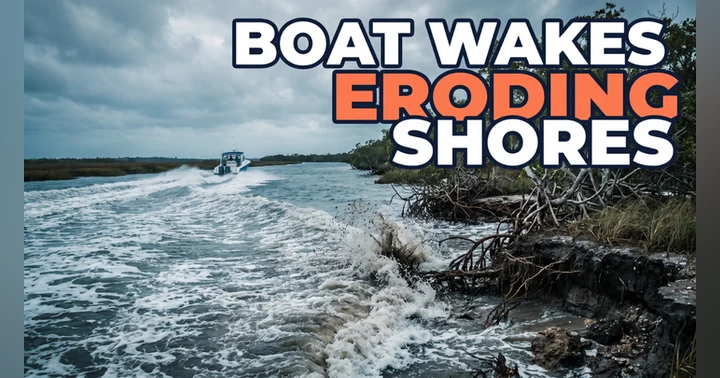
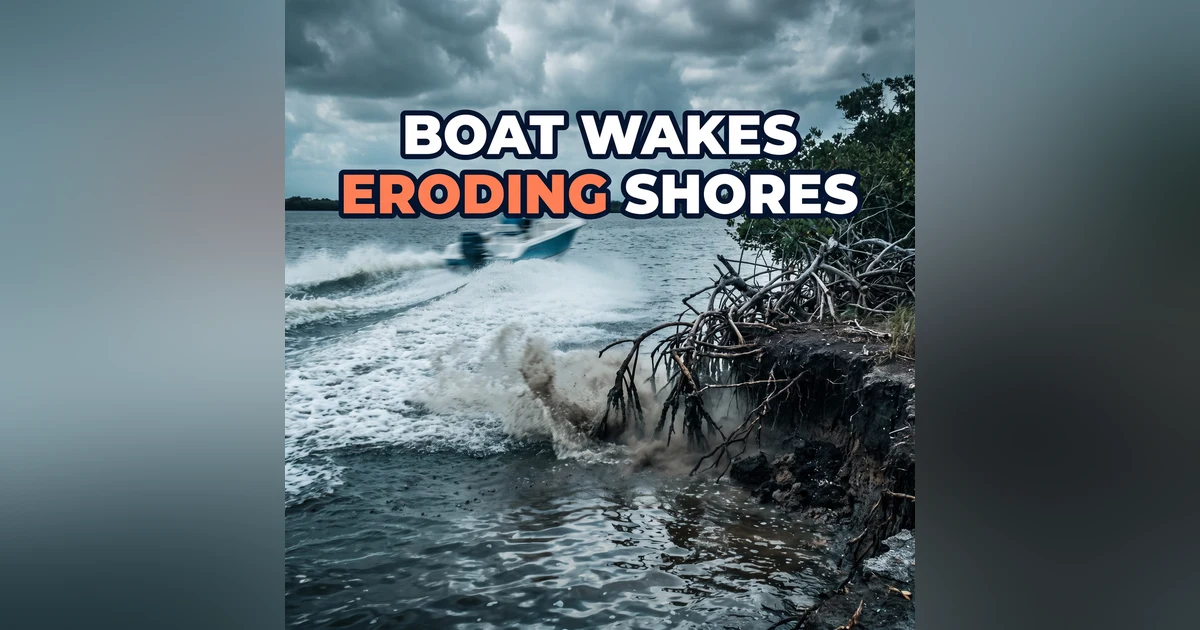
A boat's wake looks harmless right up until you watch it happen over and over. Every wake a boat throws off chips away at a shoreline that took centuries to build, and it happens on calm days, sunny days, days with no storm anywhere near. A NOAA study at Snow's Cut, North Carolina found that roughly half of all boat wake heights on that stretch of the Atlantic Intracoastal Waterway exceeded the largest wind driven waves measured there, and boats moving at the slow, considerate seeming "plowing" speed threw the tallest wakes of all.
Habitat pushes back, and now that push has a number attached to it. A study by Doughty and colleagues found mangroves and marsh can reduce wave height by up to 90 percent, and marsh grass paired with an oyster reef cuts wave energy from boat wakes specifically by 67 percent compared to bare mud. Once a benefit like that is measurable, it becomes fundable: global blue carbon storage in mangroves, marsh, and seagrass is valued at nearly $191 billion a year, and a single restored 100 acre wetland saves local water systems about $17,000 a year, the same figure from earlier this week's Nature's Kidneys episode.
Mexico's Riviera Maya coastline puts that funding model into practice. Its coral reef shields around $10 billion in annual tourism revenue, but that value sat informal for years, until a 2018 partnership between The Nature Conservancy, the Quintana Roo state government, local hotels, and the insurer Swiss Re turned it into a parametric insurance policy on the reef itself. When Hurricane Delta hit in 2020, the policy paid out $850,000 within days, funding volunteer brigades that stabilized over 2,150 coral colonies and reattached more than 13,500 coral fragments within three months. This episode closes out this week's coastal habitats series and lands on the one call to your local marina or town council that can actually move the needle.
Takeaways:
- Boat wake erosion is mechanical, not climate driven: NOAA's Snow's Cut study found roughly half of boat wake heights exceed the largest wind driven waves, and slow "plowing" speed produces the tallest wakes of all.
- Healthy habitat is a measured defense: mangroves and marsh can reduce wave height by up to 90 percent, and marsh paired with an oyster reef cuts boat wake wave energy by 67 percent (Doughty et al., PeerJ).
- Once a coastal benefit is measurable, it becomes fundable: global blue carbon storage is valued at nearly $191 billion a year, and a single restored 100 acre wetland saves about $17,000 a year in water treatment costs.
- Mexico's Riviera Maya reef shields around $10 billion in annual tourism revenue, and a 2018 insurance partnership turned that value into a parametric policy that pays out automatically after a storm, no lengthy damage assessment required.
- When Hurricane Delta hit in 2020, that policy paid out $850,000 within days, funding the stabilization of over 2,150 coral colonies and the reattachment of more than 13,500 coral fragments within three months. The model is now expanding to Belize, Guatemala, and Honduras, with mangroves named as the next expansion.
Support Independent Podcasts: https://www.speakupforblue.com/patreon
Need help with your ocean non-profit, company, or project? Get the help you need with Pisces Oceans Inc.: https://www.piscesoceans.ca
Connect with Speak Up For Blue
Website: https://bit.ly/3fOF3Wf
Instagram: https://bit.ly/3rIaJSG
TikTok: https://www.tiktok.com/@speakupforblue
Twitter: https://bit.ly/3rHZxpc
YouTube: www.speakupforblue.com/youtube
0:00 A lot of times when we talk about coastal erosion, we talk about climate change and how sea level rise and storm surges are really causing that erosion factor. And sometimes they are. But one of the things that we don't realize that causes a shoreline erosion in certain places, especially in the intercoastal ways in the United States in Carolina and Florida, is usually because of boat waves and boat traffic. That's something we don't normally talk about. We don't really think about, but it's something that can be stopped and can be not necessarily boat traffic, but the waves, the wake that it that boats cause can stop erosion if we do it the right way. That's with natural coastal habitats and proper speed limits and enforcement. We're gonna talk about all of that on today's episode of the How to Protect the Ocean podcast.
0:48 This is what we do we talk about actionable items that we can put in place as people. As coastal people, as countries and states and provinces, we can put those together and really make a difference. That's what we talk about here on this podcast called How to Protect the Ocean. If you like this kind of stuff, hit that follow button. make sure you get more. We do episodes Monday to Friday. ~ and this has been a fun week of talking about coastal habitats. We've talked about nutrients, we've talked about a lot of things. But today we're gonna be talking about something that is. Very, very important to ~ how we look at managing coastlines.
1:29 And we're gonna be talking about mangroves and marshes just as we've been talking about all week, but we're also gonna be talking a lot about the different aspects of coastal management and putting a price on the coastline. And so I think that's that's really important. So, like I said, if if we start to think about climate change all the time, we always think climate change is causing every problem. It's it's making things worse, but it's not necessarily causing every problem. And because it's such a big problem, it's really hard to control the local effects. But what we can control is something that's fixable, is how humans behave really locally within these areas. And that is one, is like this, these boat wakes, And and and boat traffic.
2:11 And so what I want to explain here is is how like awake mechanisms work. NOAA's snow's Cut findings. ~ they found about half the wake heights of of the boat. So as a boat moves through the water, the back of the motor po pushes the water away from the boat as it tries to move through the water. That that part of the water in the back of the boat are the wakes of the for that the boat ~ contained. The faster the boat moves, the larger the wake. So the higher those waves. You see it a lot when people are ~ are water skiing, And and you see those, like you can actually take jumps off of them because they're so high. ~ and you can get some really height. And you can it makes it more fun for for ~ water skiing, which is great. I'm not a water skier, I don't like that kind of stuff.
2:56 Everybody else who likes it, good on you, but that's not for me. But people love that. It's fun to watch, it's it's fun to to go into those waves. But those waves, especially in areas where there's not an established coastal habitat that or or maybe it's a vulnerable habitat. To erosion, like maybe it's just sandy or it's it's got like some sediment there, but nothing to really stop it, nothing, nothing to hold the sediment together, ~ like a mangrove or a salt marsh where the plants are holding the roots of the plants are holding that sediment together, that soil together. And so what they what they found in this these snows cut findings is that the the the wakes of the boats or half of the wakes heights beat the biggest wind waves.
3:40 So, like if if you look at if you measure all these heights over a certain time and you look at half of them were bigger than ~ the waves caused by wind, which would be considered something like ~ like like climate change storms or things like that. and and so like slow slow plowing speeds through throws like the worst wakes of all. So as you start to slow plowing where the bow of the boat is up in the air, it it almost it makes it makes it worse. So what I what I want to really punch home here is that these wakes are mechanical. They are done by a machine. They were done by a motor. It's not done by climate ch like climate driven storms or climate driven winds.
4:21 And it's happening right now on the waterways as you listen to this. and this is something that can be cleared up and can be managed appropriately. Now, if you don't know who I am, I'm a marine biologist. I use I've studied the oceans for quite some time. I'm not an expert in anything, but I'm a bit of a generalist all around. And I cover this kind of stuff because I feel like it's important for us to know that activities that we can do to reduce our ~ influence on these types of shorelines. And so when you have intact habitats like mangroves or or salt marshes or seagrasses, that's a measurable defense, We have this these defenses up.
5:04 And there's a a study with by Dowdy and all that looks at the numbers and it's up to 90% of the wave height reduction from mangroves and marshes, 67% wave energy reduction from marsh and oyster reef against boat wakes specifically. So there's an engineering method of doing this by making sure that we have These complex habitats that provide this this this ruggedness that will when the ~ the energy of the waves move into the area, it gets it gets taken out. ~ that energy gets taken out and it dissipates over this ruggedness of like an oyster reef or mangrove roots or or what have you.
5:47 Right. And so that's that's important. That's part of nature. And plus you get nature along the sides of this. these intercoastal highways in these areas where they're exposed to waves of boats all the time. and so once you have the understanding of what this can cause, right, you can use it, you can measure it. And that's fundable. when you look at the blue carbon and how much that's worth, that's worth like globally, it's worth 191 billion dollars. on Tuesday, I talked about an example where they lined the coastline with natural habitat, and they were able to save $17,000 per acre, and I think that's an important aspect in in that I mentioned on Tuesday.
6:34 Because I feel like that's something that that really puts a a tangible number to what it costs to restore, So you you're looking at it cost seventeen thousand dollars per hundred acres. but it was protected. And the the amount of protection saves a lot in the future. and I think that's like a smaller scale. You have the global, then you the smaller scale. But then there's there's methods to fund. these types of of coastal habitats. And it doesn't necessarily have to be a salt marsh or doesn't necessarily have to be a mangrove. It could be a coral reef. In fact, there's a a really great example in Mexico where there was looked at like the resystem protecting Mexico's ~ Maya Riviera ~ was was really was really important. it's it's definitely, it's not a mangrove that this was that this had.
7:21 It was a coral reef. And it's something that's that's very important. So, the coastline for the Mexico's Riviera Maya was was known to be valuable informally for years, it shields around $10 billion in annual tourism revenue for the region. But the the the valuable part, isn't the same as like what can be funded. So after a storm damaged the reef, there was no fast way to act to restore it. And there's no way to get dedicated repairs. So the people couldn't pay for it. People couldn't go out and do something for it, And so, the restoration was weighted on like organizations who do it themselves who fundraise. And that's difficult. Fundraising is almost impossible these days.
8:02 Now in 2018, the Nature Conservancy, the Quintana Roo state government, local hotels And the insurer named Swiss RE, I think it's Swiss RE or Swiss Re, I'm not sure exactly how you pronounce it, They set up a coastal zone management trust. Now, hotels already paid the tax for the beach usage rights in the in that area, because it's all resorts. And that tax now funds this parametric insurance policy on the reef itself. So it's a policy that pays out automatically once wind speeds in a defined area cross a certain threshold. So there's no lengthy damage assessment that's required first. It's right away, it happens. And as an example, in 2020, Hurricane Delta ~ hit the area.
8:48 And that that policy triggered its first payout $850,000 within days. So they had volunteer brigades already assigned. And they used it to stabilize over 2,150 uprooted coral colonies and reattach more than 13,500 coral fragments within three months. And then the neighboring towns got wind of it and they we're gonna come up with our own model, for these volunteer brigades. And it's now it's expanding into Belize, Guatemala, and Honduras because working so well. Mangroves are named as the next planned expansion of the same insurance framework because they realize look, this is the funny thing about insurance groups.
9:28 and insurance companies, they know what protects a coastline. They know what will reduce damage. And the fact that they have they have an incentive to ensure that these areas don't have to put out a payout, it's cheaper for them to ensure that there's a healthy coastline, whether that's mangroves or that's marshes or that's seagrasses or that's a coral reef. They know that having an intact and healthy coastal habitat complex that has all of those is really important to The structure and safety and security of that coastline. this is not a fact of like this is a charitable work. This is working actively to protect the people who are paying in insurance to make sure that their business, their activities don't stop. Because if you lost that coastline, or if that coastline got eroded, all that beachfront is gone. All those resorts that will not make money.
10:25 People go for the beaches. And and they're already having enough problems with with sargasm to have this aspect to help them out with this coastal security is huge. And to have the money already saved up so that when it comes when and the policy just triggers it in a response right away. So within three months, they're back up and they feel safer. And I think this is what it requires to ensure that we we've talked all week about how. Making sure that coastal habitats can sequester that nitrogen and the carbon, making sure that healthy coastal reefs are there to act as the the like nature's kidneys to make sure nutrients don't get out into the ocean and into the coastline to cause all this green water and disrupt coastal ecosystems, which would cause a lot of death, would cause red tide, all this kind of stuff.
11:19 And then, yesterday we talked about, black like making sure that these like like from like the as example of the Blackwater ~ area, making sure that the marshlands can move back inland if there's if there's a problem with sea level rise. So making like this is all what happens when we manage a coastline properly. The policies need to be in place right off the bat. Today's story is an example of that with Quintana Roo. Making sure that we have a policy that triggers the funds like right away. Not an assessment done first, not waiting a year for it to happen. The money gets triggered. The policy gets triggered, the money gets given, volunteer brigades go out and the the pay the payments done to restore this area. It is expensive.
12:04 Almost a million dollars to restore parts of a reef is hugely expensive. And and so all week we've been talking about managing the coastline by looking at specific habitats. This happens with all habitats all around the world. A lot of places don't have these policies in place or don't have the ability to trigger the money to come out. And it requires community to actively investigate these types of setbacks or predict these types of things that are happening to manage that, making sure that, coastal habitats can migrate back in case sea level rise takes them over. All these things, making sure that there's money available for restoration after a storm. Make sure that the ~ the the habitats are healthy, make sure that at the end of a pipe of an industry, it's down to a specific number for nitrogen and phosphorus, those nutrients, so that you don't trigger a a bloom, along the coastal area that could trigger a red tide bloom.
13:03 All this happens through management activities. Sometimes you just can't. Allow, nature to recover on its own because we've damaged it so much. And there's so many combinations of things that can happen that will take it out. And if you set up the habitat properly and you manage the habitat properly, and there's areas of restoration, identifying areas of vulnerability, working with the community, ensuring that human disturbances like boat wakes and things like that are taken out. Well, now you've got a a properly managed area. Whether it's you call it a marine protected area or a managed area, you're managing that coastline properly.
13:49 And and so what I want you to think about is if you live along a coastal area, you live near a marina, you live near a mangrove, you live near a marsh, make sure that, these areas are managing those properly. That's there's enforcement in in like slow speed or no wake zones, right, near marsh and mangrove shorelines. It's a mechanical mechanism that can be controlled. And and this is like one lit like this these types of calls to action by calling local marinas, calling harbor authorities, or calling your town council, that's one mechanism you can use as an individual and you can push on it. To make sure, like, not to where the boat wakes are in the habitats protection.
14:33 That's where they meet. That's where you want to hit. That's where you want to focus your energy on. That's where we start to see real policy happen. This this series, this week was all about nutrient pollution ~ that has a natural filter. And we know that red tide has a tracking tool, so we don't have to be exposed to it. we know that sea level ride has a a moving target, these habitats can actually chase. And now coastal erosion has a real dollar value attached to it so that it can get fixed. none of this here is like guesswork because of major problems with climate change or anything like that. It's about engineering and finance. And in a lot of places it's already working to man like the management is already working. And and that is helping to bring back areas like Tampa Bay, to protect areas like Quintana Roo, to make sure that the future of the Blackwater Park.
15:30 will continue because we'll have migration corridors where these marshes can still be healthy and can be out of the way from of danger. And and that's the episode. That's what that's what we talk about here. We talked about a lot of stuff. I'd love to hear you your thoughts about this episode as well as the other episodes this week about coastal habitats, about nutrients, about carbon, all these things that are really important they have fixes. And and that's where I want you to get is like you can Take a bite out of this. You can actually have make a difference in this by ensuring that policies are in place locally to protect those areas. And you'll be well off for that. I guarantee you, especially if you live in those areas or you don't live in those areas. Maybe you visit that area.
16:12 That's that's what's really gonna help. So that's it for the episode for today. And of course, this week, tune in on Monday because we have a really great episode for you on Monday. We have ~ Anupa Ahsoka, who's gonna be talking about how the California Marine Protected Area System is failing the people in the way they are implementing adaptive management. And that could be fixed. Again, another fix that can happen. But we're gonna talk about some of the problems and some of the recommendations that her and her organization fish on, as well as her collaborators, really have for this marine protected area process and making sure that they approach it from a scientific angle. and maybe that will reduce a lot of the conflicts that are happening there.
16:52 That's on Monday. We're gonna talk all about marine protected areas for the rest of the week on that day, on that week. And I can't wait to ~ be able to provide that to you. So thank you so much for joining us on this episode of the How to Protect the Ocean podcast and all this week. I'm your host, Andrew Lewin. Have a great day. We'll talk to you next time in happy conservation.