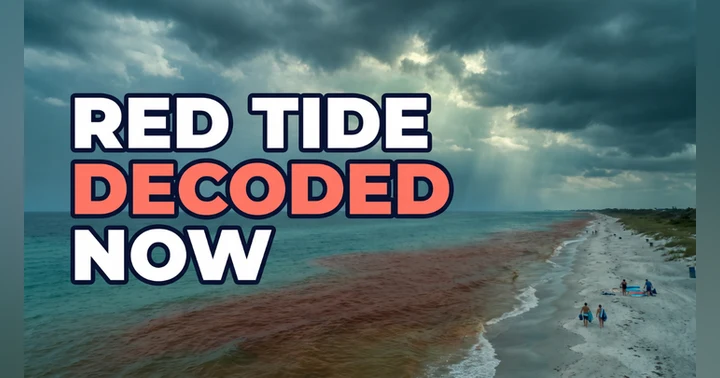
Red Tide, Decoded: Why It Isn't Random, and How to Track It


 Apple Podcasts

 Spotify

 YouTube

 Amazon Music

 PocketCasts

 Overcast
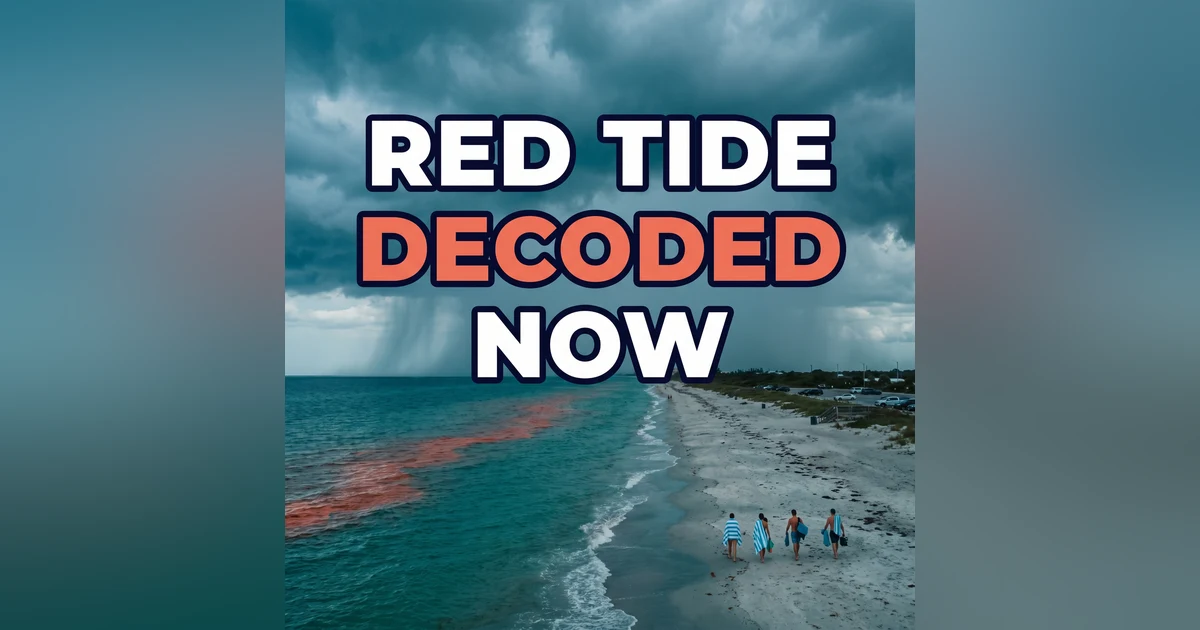
No smell. No warning. Just a beach full of people who start coughing at the same time, grab their towels, and leave. That's red tide, and it feels completely random until you know what's actually happening in the water.
Karenia brevis, the algae behind it, produces a toxin called brevetoxin that rides the wind and waves into the air along the shoreline, which is why people can start coughing with no visible sign anything's wrong. The 2017 to 2019 Southwest and Southeast Florida bloom cost the region an estimated $2.7 billion, mostly in tourism losses, and it wasn't a freak event. Follow the water back far enough and it traces to nitrogen and phosphorus flowing out of the Kissimmee River basin, through Lake Okeechobee, and down the Caloosahatchee River into the Gulf, fueling the same algae that's always been there into a much bigger, longer bloom.
Here's the turn: this is trackable. Mote Marine Laboratory's Beach Conditions Reporting System lets anyone on the Gulf Coast check named beaches for red tide conditions before they ever leave the house, the same way you'd check a weather forecast. This episode also connects back to the nutrient-pollution mechanism from the "nature's kidneys" episode with Adam Langley, and lands on one thing you can actually do this season.
Takeaways:
- Red tide is caused by Karenia brevis, an algae that produces brevetoxin, a toxin that becomes airborne in sea spray and can cause coughing and respiratory irritation, worse for people with asthma but capable of affecting anyone near the water.
- The 2017–2019 Southwest and Southeast Florida red tide bloom cost the region an estimated $2.7 billion, mostly in tourism-dependent business losses.
- Red tide blooms are naturally occurring, but excess nitrogen and phosphorus flowing from the Kissimmee Basin through Lake Okeechobee and down the Caloosahatchee River make them bigger, longer, and more frequent.
- A legally mandated program has cut phosphorus leaving Everglades-area farmland by roughly 55 percent long-term, against a 25 percent legal minimum, but the broader system still isn't meeting the water quality standard the Gulf and estuaries need.
- Mote Marine Laboratory's free Beach Conditions Reporting System lets Gulf Coast beachgoers check red tide conditions beach by beach before they go.
Gulf Of Mexico Red Tide Tracker: https://coastalscience.noaa.gov/science-areas/habs/hab-forecasts/gulf-coast/
Support Independent Podcasts: https://www.speakupforblue.com/patreon
Need help with your ocean non-profit, company, or project? Get the help you need with Pisces Oceans Inc.: https://www.piscesoceans.ca
Connect with Speak Up For Blue
Website: https://bit.ly/3fOF3Wf
Instagram: https://bit.ly/3rIaJSG
TikTok: https://www.tiktok.com/@speakupforblue
Twitter: https://bit.ly/3rHZxpc
YouTube: www.speakupforblue.com/youtube
0:00 Today we're gonna be talking about red tide. And I know it's it's a tough battle. You may not know what red tide is. You've probably heard a lot of the things, but I'm just gonna get a a bit of a summary from someone I spoke to recently. Actually it was Monday's episode with Adam Langley. He said one time he was on the beach and him and his wife are on the beach, and all of a sudden, you know, without any warning, people were just starting to like, you know, you didn't really smell anything, but suddenly people started to cough around them. And people like grabbing their towels and just kind of leaving the area. And and they didn't really know what it was at the time. They just thought, hey, like if everybody's coughing, it's not just one particular individual, it's it's a a number of different individuals. And then more and more people are starting to cough.
0:40 It's not necessarily that they have asthma. Probably people who have asthma probably feel it a little bit more, obviously, than others. But then you start to cough you're like, something's not right. Like it doesn't smell of anything, but there's something that's affecting my breathing, and I'm not gonna stay in this area. So I'm gonna leave the beach. Beautiful day on the beach. I'm gonna leave it and I'm gonna get out of there, maybe call the authorities, be like something is going on. That's red tide. And a lot of times it's not it's not random. It can be trackable. And there's actually a free tool that you can tell that can tell you before it even happens, and before you even leave the house. So you don't have to go through that and you don't have to worry about going on the beach when there's a red tide. We're gonna talk all about what a red tide is, why you should know about it, and that the fact is that people are doing a lot of work to stop it from happening.
1:23 And there is a way to stop it from happening more often. than it has and I think that's the that's the important part of of where we're talking about here. Because when we hear red tide or what what scientists called harmful algal blooms or habs, we see this happening on a regular basis, Because there is a specific algae called carinia brevis, and it blooms in warm coastal waters and produces a toxin known as brevitoxin, which is the toxin that you're pro like that people are probably Smelling in the air. You know, the wind and the waves, they carry that toxin into the air, which is why you start coughing on the beach with no visible sign that that really there's anything wrong, other than people coughing on the beach when nobody should be, Because that's not a normal thing that happens.
2:12 Now it's worse for people with asthma or any kind of respiratory conditions, but it can affect anyone standing close enough to the water or even in the water, Now, in 2018 to 2019, the numbers like were huge. And the losses were huge. They lost $2.7 billion over a year of disruption, To it, and and that is not something that became like a rare occurrence like it normally did, but it's it's something that's really, really bad. why is this happening more often than not? Carina Brevis, this this algae is naturally occurring in the Gulf of Mexico in the Atlantic.
2:53 And in between 2017 and 2019, the southwest and southeast parts of Florida were hit pretty much the worst they've ever been hit before. Now, there have to be specific conditions for Karina Brevis to really become overpopulated, which which makes the red tide. You'll see start to see in the water a little bit of a reddish tint color, like a tan color or a rust color in the water. But for sometimes it's really difficult to tell until it's too late. Or until you start to feel that. Now, here's the thing. There needs to be like the right amount of wind to bring the like a lot of Karina brevis together to create the red tide.
3:34 There needs to be heat in the water to I guess be hospitable to the Karina brevist because it needs heat. Heat is is helpful. But then it needs something else which can be controlled. And we talked about it yesterday's episode and we talked about it the day before. It's all about nutrients. There's specific nutrients that when fed to phytoplankton, which is what these carina brevis are, they will bloom like crazy. And if you get the right amount of mix of all three C sub C temperature, wind that brings them all together, and then feed them nutrients, you get a massive red tide. If that happens over and over and over again, so we we know we've seen high temperatures.
4:19 We know the winds are kind of gathering a little bit. And we know nutrients in Florida over the past five years, maybe more, probably eight to ten years, have been flowing into the river systems a lot more. Right. So I want to just kind of give you a picture of essentially what's happening, So the bloom has always been there, but it's the freshwater discharges that come down from the Casalahache River. In Florida, carrying like decades of nitrogen phosphorus from the Kissimmee Basin and Lake Okeechobee. I always say Okechibi, but it's Okeechobee. And that's what we know happens.
4:59 So all that nitrogen phosphorus, which are the nutrients that help animal or plants' cells grow, like these plankton, these these phytoplankton, So you follow from Lake Okeechobee, And you know that. It there's nutrients in there because there's a lot of industry along that area, And that industry, even below it and above it, dumps their waste, like we talked a little bit yesterday. And for a while, that waste had to meet a certain number. And that number has now changed to best practices. So instead of hitting a certain, like you have to be below a certain number in nitrogen, so ammonia, nitrate, nitrite.
5:41 And phosphorus, now you can pretty much put it whatever you want and say, hey, we're following best practices. We know companies, and there's a lot of sugar companies that like big sugars known in Florida. There's a lot of sugar companies out there, and we know that they're very important to Florida's economy, but they will try and get away with pretty much anything. Right. And so the fact is, is that once the state said, hey, best manager practices is great, you know, the Difference in the phosphorus amounts, where before when there was regulation, they were at about 25, Legal minimum. And they grew to about 55%. So that's there's a there's a difference there, There's a a huge difference in the numbers.
6:29 So phosphorus grew ~ in availability, nitrogen grew in availability. And then what happens is because Lake Okeechobee is dammed, once the spring rains come, it will eventually fill up. And managers, water water managers, have to release this water that is full of excess phosphorus and ex excess nitrogen. So then it'll grow down the Kissmi Basin and it'll it'll flow down the Kalo Sachi River and it'll go into the Gulf of Mexico or the Atlantic. Right, so these are the southwest Gulf of Mexico, Southeast Atlantic areas. And then what happens as those nutrients feed those Carina bevis, like these red tide forming plant plant cells, you get a red tide.
7:22 the fact is that because the nitrogen and phosphorus, aren't meeting what was met before, we are getting more red tides because there's increased cease temperature and the winds are changing a lot more and they're a lot stronger. So they bring this phytoplankton in, which is naturally occurring. They just bring them into groups where you get to that, And I think this is where I keep telling people that we can control. The amount of times we get red tide by controlling what feeds them. We can't necessarily control sea temperature at this point unless we reduce our carbon and greenhouse gas output, which is obviously a lot harder than ever.
8:04 But nitrogen can be controlled locally or by state. That can be controlled. I've worked in environmental consulting before. I worked in with a wastewater company where we looked, we would do measurements to make sure that they're following the regulations. And it would be, you know, provincial or state and federal that would be looking at these and they would be reviewing them to make sure they're under. And if they go above, you know, they the government works with them to say, hey, you need to keep this down because they had to follow the law. That was part of the regulation. So I think that the thing is here where everybody's like, well, we get more red tide. Like we're seeing, you know, the coast of Florida at a certain times like disgusting and there's there's dead animals everywhere and sometimes sea turtles and And manatees and dolphins and and fish everywhere.
8:48 They're just dead. It's disgusting. It's gross. I'm never, I don't want to go there. How we can't even control this. We can control it. That's the funny thing. It's not a random thing, It's not a mystery that strikes without a pattern. Like we know what's happening. We know how to stop it. We know how to starve this animal from growing to a point where it becomes a red tide. And I think that's the big turn in this story. That's the thing that. can help us bring the red tide anxiety down a little bit. I know it helps me because I know what needs to be done. Right. I know that if we start to get governments on point and say, hey, we need to protect our coastlines, our water quality is going to crap because we haven't been holding companies and industries who who put out this stuff.
9:36 And it's not necessarily like it's bad stuff. Like they provide products that we use. So it's it's hard to say that we're against them. I don't want to vilify them, but we need to make sure that they their point sources that come out have to fall with it below a number. And that's where these wastewater engineers kind of do all this modeling to make sure that if everybody stays within a certain range, then our system will be fine. That's all it takes. It's money, yes. It's money worth spending, I guarantee you. I think that's where. A lot of people just don't realize that it's this is what happens. this is how we change. And I think if you go back to yesterday, where the red tide is like the the dramatic visible symptom of that same excess nitrogen story that we talked about what I talked about, how coastal environments, coastal habitats like mangroves, marshes are the are nature's kidneys.
10:31 Healthy coastal wetlands will help filter nitrogen out of the water. But like just to go back to it, the big sugar wanted to remove some Everglades to put in a new plant. The Everglades are that coastal habitat that removes the excess nitrogen. So instead of like emptying right into the Everglades, they empty out into a river system that goes right into the Gulf. Makes no sense. And so there's ways that we can actually figure out how to change our water quality. Now, in the meantime, there is a bloom tracker. There is a red tide bloom tracker. So if you are in Florida or you are in an area where you want to go to the beach, you want to make sure you don't have to be subjected to that.
11:14 Maybe you have some asthma problems or respiratory problems, or you just don't want to go there when it's going be nasty. There is a beach conditions reporting system that, People have if you're on the Gulf Coast. And so there are ways you can find out. You can just track this. You can look it up. I'll try and look it and put a the link in the show notes that you can find. But for now, you can look at that. But really, like this is where we elect government officials that will promise to make sure they hold industry accountable to ensure that we are not putting excess nitrogen in the water. that's pretty much what it is. We have the knowledge. We have the system to put in place. We have the regulation. It's just a matter of keeping industries to that regulation and not giving them what they want in terms of they don't have to spend extra money on making sure that they can put that into place and they less headache for them.
12:02 But no, ~ sorry, it's a headache for you, but it's life to us. That's really what it comes down to, Businesses do not run the world. They think they want to, they think they can, but it really is the people. We are the people. We need to hold them accountable through government. Government needs to hold accountable. Elect the people who hold them accountable. That's what we need to do. That's my that's that's my my call to action for you today. ~ and especially in the US where Florida is located, there's a important elections coming up. This is where you make those elections count. I know there's like a bigger picture here for a lot of people from a federal perspective, but think about locally of what's happening to you and make sure that those ~ state, whether they're Senate.
12:43 Or Congress people, they are looking out for what's local for you and not what's, you know, federally always for the the the overall country that may not be in your interest, Whether you're on one side or the other, this is still nature. This is still where you live. You want to make sure ~ you are living in a healthy coastal area so you can enjoy the coast because that's where you want to live, And that's the beauty about living in places like Florida. So, anyway, that's it for the episode today. I would love to hear your comments. If you're watching this on YouTube. Let me know in the comments below if you're watching this or listening to this, sorry, on Spotify or Apple or your favorite podcast app. Spotify, you can leave a comment, which I love. So please leave a comment. Love to hear what you think. Or if you have a question, love to hear your thoughts. but other than that, you can hit me up on my socials, links in the show notes. Thank you so much for joining me on today's episode of the How to Protect the Ocean podcast.
13:33 Have a great day. We'll talk to you next time and happy conservation.