Nature's Kidneys: How Coastal Wetlands Stop Ocean Pollution


 Apple Podcasts

 Spotify

 YouTube

 Amazon Music

 PocketCasts

 Overcast
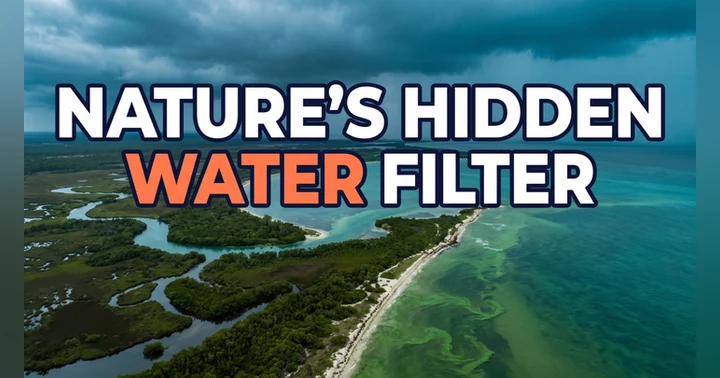
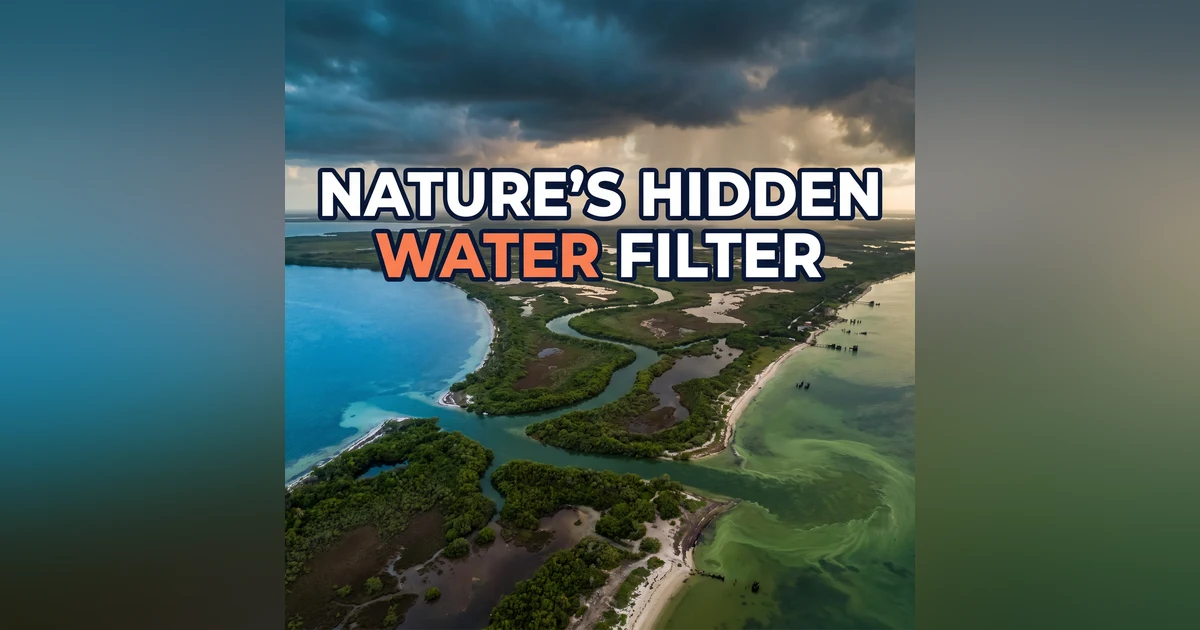
Green water. A smell that won't go away. Sometimes, dead fish washing up on shore. That's what too much nitrogen does to a coastline, and it's easy to hear stories like this and feel like the ocean is just losing. This episode is the opposite of that.
Here's what most people don't know: a healthy stretch of marsh or mangrove can pull nitrogen straight out of the water before it ever becomes a problem. A single restored 100-acre wetland cut nearby ammonia by 62 percent and total nitrogen by 37 percent, and saved local water systems about $17,000 a year, all within three years. Then there's Tampa Bay: a bay written off as dead in the 1970s that came back so completely it now underpins roughly 1 in 5 jobs in the region, because people regulated pollution and rebuilt the habitat doing the filtering.
This episode walks through the real mechanism (how wetland soil locks nitrogen away for centuries), the Tampa Bay turnaround in full, and the Mississippi River's springtime dead zone, then lands on one thing you can actually do this season.
Takeaways:
- Excess nitrogen, not nitrogen itself, is what causes algal blooms, red tide, and dead zones along the coast.
- Healthy coastal wetlands (marshes, mangroves, seagrass) pull nitrogen out of the water before it reaches a bay, and lock it away in oxygen-starved mud for centuries.
- A single restored 100-acre wetland cut nearby ammonia by 62% and total nitrogen by 37% within three years, saving local water systems about $17,000 a year (Skidmore and Karwowski, Journal of AERE).
- Tampa Bay went from a 1970s pollution poster child to a bay where seagrass nearly doubled (21,600 to over 40,000 acres) after regulation and habitat restoration, and now supports roughly 1 in 5 regional jobs.
- Cutting back on synthetic lawn fertilizer, or switching to a slow-release or organic option, reduces the same runoff that overwhelms a wetland's filtering capacity.
Support Independent Podcasts: https://www.speakupforblue.com/patreon
Need help with your ocean non-profit, company, or project? Get the help you need with Pisces Oceans Inc.: https://www.piscesoceans.ca
Connect with Speak Up For Blue
Website: https://bit.ly/3fOF3Wf
Instagram: https://bit.ly/3rIaJSG
TikTok: https://www.tiktok.com/@speakupforblue
Twitter: https://bit.ly/3rHZxpc
YouTube: www.speakupforblue.com/youtube
0:00 today we're gonna talk about nitrogen. And don't worry, it's not all bad news. There is some bad news in that excess nitrogen creates a lot of problems like algal blooms and red tide. But the good news is that we can solve those fixes. And nitrogen is a natural process. We just gotta make sure that we get keep it in control. and there are specific aspects of coastal habitats. That can help keep it in control if those coastal habitats are one present and are healthy. So we're going to talk about that on today's episode of the How to Protect the Ocean podcast, why these coastal habitats are nature's kidneys. All on today's episode, if you like this type of stuff where we talk about ocean news, ocean science, and how you can protect the ocean, then follow this podcast because it's exactly what we are here to do.
0:46 All right, let's start off with. You know, just an idea, Green water. Nobody likes green water. It's a smell that just, you know, has a smell that won't go away. And then sometimes even like you'll get dead fish washing up on the shore, and it's gross, and that's what too much nitrogen does to our coastline. And here's what most people don't realize: a healthy stretch of marsh or mangroves can pull out the nitrogen. straight out of the water before any of it goes into the coastline and any of the green water happens. So as long as we keep those healthy and as long as those can keep up with sea level rise, we are okay. And that's what we're going to talk about all this week.
1:28 yesterday's episode was an interview with Adam Langley, who introduced a lot of things about nitrogen and how it is taken up by mangroves and marshes in the U.S. We're gonna talk a lot of that. We're gonna focus on those two habitats, but there are also other coastal habitats like seagrass, salt marshes, mudflats that do very similar things just in different zones within our world. The key here is keeping them intact. And keeping them healthy. That's what we want. Keeping them present, keeping them healthy. That's the whole purpose of this episode today. And look, I get it. We see a lot of news that's happening around the world where we're talking about algal blooms that are out of control, green water, red tide, where people can't breathe on the beaches because there's so much dead in like dead fish and dead manatees and dolphins and sea turtles.
2:16 It can get heavy. It can get really heavy. And when you see all this happening, especially with climate change bringing in this exaggeration of what's happening because we're seeing it more and more often, the thing here is it can actually be controlled. This is something that we as humans can control for a specific aspect. And now it's starting to get out of control because we're not following certain regulations, or we're changing the regulations, or we're not doing certain things that will keep it intact. But we can keep intact. And we're going to talk about that all this week. and especially today, because I think it's really important. Coastal wetlands, salt marshes, mangroves, we got wet ~ we got seagrasses, even coral reefs to a certain degree.
2:59 all these types of coastal habitats play a role. You know, mud flats, but they all play a role in keeping not only carbon in place. Like they, you know, it's not just carbon, they actually store Nitrogen. They pull it straight out of the water into the roots because they need nitrogen to survive. They need nitrogen to feed their system, And they and they pull that out before it reaches any kind of bay or any kind of coastland. And I think that's that's an important aspect to to maintain is that these things are there to keep nitrogen in check, That's what if you learn anything about photosynthesis or anything about the health of animals of plants, and trees, they like nutrients. That's something that's that's important. So plants will take it up ~ into their roots.
3:40 And then the waterlogged soil starves out any kind of bacteria that would release that new those nutrients back in. And then it locks away in the mud ~ for centuries. And it's the same reason. I know this kind of sounds weird, but it's the same reason why when you put a a body in like a mangrove or in a marsh or a peat bog or if it's somewhere where there's no oxygen in the soil. it stays preserved for hundreds of years. And so, you know, don't do that, I guess. you shouldn't be doing that anyway. But that's what happens. if you see an animal or anything like that's been dead and it looks intact, it could have been it could have been dead a long time ago. It just hasn't decomposed because there's no oxygen or bacteria to decompose it. So it's kind of kind of interesting. Now here's the reality of the situation.
4:21 We have coastal wetlands that have been taken out a lot of the times because of development. And we're going to talk about a specific example, a couple specific examples in a minute. But we know that when they are put back in place, we know that they do well. Pretty much that's what happens. There was a study by authors called Skidmore and Kowarski, or Kowowski, sorry. ~ where you know they restored a single 100 acre wetland and that cut ammonia down, like cut ammonia release down by 62% and a total nitrogen by 37%. And it saved local water systems about $17,000 a year in treatment costs within just three years. So you put a a restored area intact and you keep it healthy, and within three years, you're cutting down the release of ammonia and nitrogen.
5:10 These are natural processes, it's not. A concrete wall. This is not like they harden it with rocks and things like that, or the engineers when they want to keep maintain like a specific area that's being eroded. No, these are natural wetlands that can not only secure the coastline and make sure it doesn't erode because it it keeps the soil intact, like close together and tight, it also reduces ammonia and nitrogen within just within three years in this example anyway. And we've and we find it's in other examples then ~ as well, So like a patch of wetland. Smaller than most farms, was doing the job of what municipal water treatments do for free. So think about that, Think about saving money and how that works. It's it's all done for free. that just because of the wetland is put together.
5:54 Now, restoring wetlands and marshes and mangroves and all that kind of stuff is expensive. There's no doubt about that. That's why it's important to keep them intact right from the beginning. Now, I want to talk to you about an example. So actually two examples. The first one is Tampa Bay. So you know the city, Tampa Bay. The reason why it's called Tampa Bay is because there is actually a bay in Tampa Bay. in 19 in the 1950s and 1970s, Tampa Bay's population exploded. Sorry, I'm gonna start that again. From the 1950s to the 1970s, Tampa Bay's population, you know, exploded. it exploded for one reason. Once air conditioning was made available to households, people said, hey, Florida's liverable all year round, not just in the winters. So we can actually handle the summers.
6:38 So it went from population of 400,000 people to over a million by like 1970. So in 20 years, it grew by 600,000. That's a pretty big, that's a pretty big jump. Now, when you have that jump in population, development like ensues. Right. So development paved over mangroves and marshes that had been filtering the bay's water for centuries. Now, all this now, untreated, you know, lightly treated sewage water, just poured into the bay. So nitrogen fed the blooms that blocked the sunlight. Seagrass, which you know needs light to survive, that was in the bay, collapsed to near nothing.
7:20 between nineteen seventy four and nineteen ninety one, things started to change. There was actually a sixty minute segment that held the bay up as a pollution poster child. And and and public pressure followed too. So from that segment, you know, in Florida, they they came up with a regulation, an act. So Florida's 1978 Grizzly Fig Act forced wastewater treatment plants to strip nutrients out before the discharge. Before the wastewater treatment plants weren't looking at nutrients, it's actually like a third sort of process point that a lot of treatment plants just ignored. And for many times, this is not just Tampa Bay. I don't want to single out Florida as many people do. This happens all this was happening all over the world. Nutrients weren't being filtered out.
8:01 So in 1991, the Tampa Bay Estuary Program formed a nitrogen management consortium and it coordinated over 500 separate nutrient reduction projects across industry, agriculture, and local government, plus active habit habitat restoration work, rebuilding mangrove and marsh acreages as part of its its long-term habitat plan. So essentially what they did is they got together and they said, Where are we seeing most of the nutrients coming out of? Let's start. regulating those those discharges and make sure that we do modeling, engineers will wastewater engineers will come up with all this modeling to say, hey, at at the end of your pipe of your industry, whether it's a factory or anything like that, at the end of that pipe, when it goes into the natural water, it has to be a certain value. It can't be above a certain value.
8:46 If it's like if ammonia or nitrogen is above, like so they look at ammonia, nitrate, nitrate, if those are or nitrite, nitrate, because the way it goes, if those are elevated above a certain level, That industry's in trouble because it's going start to contribute to excess nitrogen. And that's what's going to happen. We're going to start to see algal blooms and seagrass is going to die and all this kind of stuff. So once you have that regulation in place, then everything good, everything's good because they look at all the industries as a whole system and they say, okay, if everybody stays below this level, we should be fine. Okay. And that's exactly what happened. So nitrogen flowing into the bay from wastewater sources dropped by about 90%. Just because of certain controls and certain monitoring, when you know what's coming out of the pipe from industry and from different places, you can do really well. Seagrasses went from roughly like covering 21,000 acres, just over 21,000 acres in 1982 to over 40,000 acres in 2015.
9:44 Right? That's almost double what they what they were covering, covering an area close to that size of Manhattan, that's how big it was. a bay that was written off back in the 70s now is like the poster child. And it and it's about one it creates one in five jobs in the region because of that bay being healthy because of of tourism. the the bay is actually usable. So people come in, they want to go around, they they start to increase like ~ you know shops along the sides, along the bay. You get a nice walk around there. That's important. That's an important aspect of. How wastewater treatment upgrades, was one of the biggest levers to actually to do the initial turnaround.
10:24 And this is just the stuff at the end of the pipe. that's what we call a point source because we know at what point they come out. Non-point sources, where you never know where it's coming out of, that can be taken up by all these coastal habitats, Because usually if it comes out of a pipe, a point source, it comes out literally right into the bay. or it comes into somewhere before it hits the wastewater treatment plant. But we know where it's coming out. And it's just a long pipe from that industry that goes into a specific water body. With non-point sources, it can come out of anywhere. It can go along roads. It can go into these little streams that can't really be controlled or monitored that much. Well, it could be monitored, but not a lot of times it's monitored. So then you you start to use those coastal habitats as the way to take up those nutrients. I mean, look at the Everglades.
11:06 Everglades is a as a is a huge sink for nitrogen. Right. It just takes it up into its system and it works out really, really well, which is great to see. You know, that's what that's what we want. That's what we want to see. Now, there's another story too. When I talked about a little bit about going back to that Skidmore and Kowarski Kowski study, ~ the what they looked at the wetlands along the Mississippi River. The Mississippi River is a beautiful place. However We've known for years that all of the fertilizers and anything kind of that contributes to nutrients along the Mississippi River goes down into the Mississippi and then it goes right into discharged right into the Gulf of Mexico. I was actually on a ship where we measured the consequences of all of those nutrients going at the mouth of the of the Mississippi in the springtime.
11:56 phytoplankton blooms in the springtime where they're mixing and mixing because the winds are still there, mixing, and then the summertime mixing stops. The phytoplankton dies, it goes down to the bottom of the ocean, it gets taken up into the microbial loop where it gets broken down, and then oxygen gets taken out. But there's so much phytoplankton that oxygen is almost removed from the bottom 1.5 layer of the bottom of the Gulf of Mexico in this area where this plume is. Now, the Mississippi is one of the biggest rivers in the world. It goes out pretty far. And so they would measure the the amount of area that this plume would take up and make sort of assumptions and measurements along those areas, along that area, ~ and see where there's you know lack of dissolved oxygen.
12:39 Cause then you don't have fish or invertebrates or things like that, and you're not having a productive environment. And then what would happen is those results would go back to Congress, because it's all in the US, would go back to Congress. That scientist at the time, Dr. Nancy Rabelay, would go to Congress and it would testify on the results. And that would essentially regulate the amount of fertilizers and anything that causes nutrient overload that would happen along the Mississippi. So all those all those farms and any kind of in industry that would discharge nutrients, that would regulate what would happen at the end. And that would regulate how much fertilizer can be used. Now look, we use fertilizer. We have to use fertilizer to feed all the people in each and one of our countries. It's a matter of can we use fertilizer in a way that's sustainable, that we're not.
13:23 adding extra or excess nutrients into the water to mess up our water system. And these coastal habitats like mangroves and marshes will actually help in the process. But they have to be there. If we zoom out a little bit, like to look at the world, I don't want you to over like take this too much, but the world has lost roughly 20% of its mangroves since 1980. You know, mostly because of coastal development, And it's the exact same thing that almost destroyed Tampa Bay. But global blue carbon habitat is still valued at close to $191 billion a year in climate benefit alone.
14:05 That's not including the economic benefit that it happens that it brings in just like it did in Tampa Bay, It looked just like it does in Tampa Bay. Right. And that's huge. And that's not even counting the nutrient filtering. That's how important these these these coastal wetlands are. So the big thing is we need to keep these habitats intact, the ones that are there and not pave over them and not develop over them. And we also need to bring back the ones that were lost. Because there are certain things that we do as humans when we take certain things out that we don't know the ramifications of that. In the Mississippi Delta in the 70s and 80s, there was a huge thing to harden the coastline, meaning put in concrete or man-made structures to make sure that certain parts of the Delta were not eroding away.
14:58 Cause that's what was happening. Certain parts of them were eroding away where people wanted to develop. But what we realize, or engineers realize, I remember this was at a coastal zone Canada conference a number of years ago, and I remember the engineers talking about it. What they realized is that when they harden that certain area, what was eroded from that area would build up something else in the Delta. A lot of times was air were areas where there was indigenous land. And so by hardening certain spots in the in the delta, that that sand or that that sediment wouldn't go build up the other. So all that other Part of like indigenous land would actually erode away. So there was a ~ new sort of push and movement to green the shoreline again and soften the shoreline in a way so that the delta could actually rebuild all the stuff that it did before.
15:48 Right. So there are certain things that we do ~ preemptively, and then we have to react to the mistakes that we make because we don't realize it. And this is what happens when you try to develop. Very quickly. We've seen it with so many industries. We've seen it with housing. We've seen it with industry. we see it now, we're starting to see it with data centers. You know, data centers have to pop up all over the place, and we're now starting to pay attention to it because they've done it before. You know, people starting to put in underwater data centers. That's what they want to do. Doesn't make sense. It's not proven. We don't know what's going to happen to fish habitat or anything else that's that's done, and they're all done in small towns where there's not going to be a big kerfuffle. Basically, They're not going to make a lot of noise, even if they reject it or try and fight it.
16:29 So there's there's a lot of and there, and of course, there's different tactics they use to entice certain communities to say, yes, let's do this because it'll benefit benefit us in the end. But the thing is that there's certain things that you can do right away, Like going back to not contributing nutrients, you can cut back on synthetic fertilizers. I know here in Ontario the government did that on their own. They said a long time ago, they said, hey, we can't use certain pesticides and nutrients because it's causing too much problems in the Great Lakes watersheds and in the Great Lakes essentially. But we also need to ~ move and and so sorry, instead of using synthetic, you can use to a slow release or organic option, Which is not going to be as effective on your lawn, but that's okay because it's for the betterment of.
17:12 the entire environment that is around you. If you don't like green water in your lakes or in your streams and things, then maybe think about doing this. But it's not just tied to individually, We are looking at government aspects to help make sure that industry is following those point source numbers. There are a lot of times where government is just going to say, hey, you know what? We're just going to leave it alone. Where you can do your best management practices. Follow the best management practices to keep it as low as possible. Other that, you should be fine. And we're gonna talk about that tomorrow because that can lead to red tide, especially in an era of climate change. So I think that's where we're gonna leave for tomorrow. We're gonna end the episode here. But I want you to think about how Tampa Bay has changed, between the 1950s and 1970s, it looked horrible because of such massive growth and development and everything.
18:01 And then we realize that we can fix this. This is fixable by human intervention. And we can continue to make progress on that in each and every area. If our government has our back and the people pressure the government to say, hey, you know what? We need to do this. We need to do this not from an environmental standpoint, but from a safety standpoint. The environment standpoint just comes together. It is how our our world works. We can't change everything to benefit ourselves. Without seeing the consequences. And we're starting to see those consequences, or we have seen those consequences for decades. It's a matter of can we fix them or not? We know there's a proven fix. We know that nature will figure out a way if we put it back or if we leave it the way it is, and that we'll be okay if that happens.
18:46 So that's the episode for today. I hope you enjoyed ~ this episode. I would love to hear your comments. If you're listening to this on Spotify, please let me know your thoughts. By the way. Starting a new YouTube channel with how to protect the ocean. I know for those of you who've been following, I did one on the channel that's now called Ocean Decoded, which I go live on every Monday to Thursday. But I'm gonna start a new channel where I've where I've actually been posting all the audio to this, but I'm actually gonna start posting the videos to this. It's gonna be the same episode, but you get to watch the videos. I'm gonna provide some editing. I hope you enjoy it. let me know your thoughts. I'm gonna let you know when this is. And if you're watching this on YouTube now. I appreciate subscribe, you know, hit that notification bell. And if you're listening to this on audio, love you always for that. ~ if you want to give me a comment on Spotify or ~ if you want to contact me through my socials, links are in the show notes. I want to thank you so much for joining me on today's episode of the How to Protect the Ocean podcast.
19:45 Have a great day. We'll talk to you next time and happy conservation.