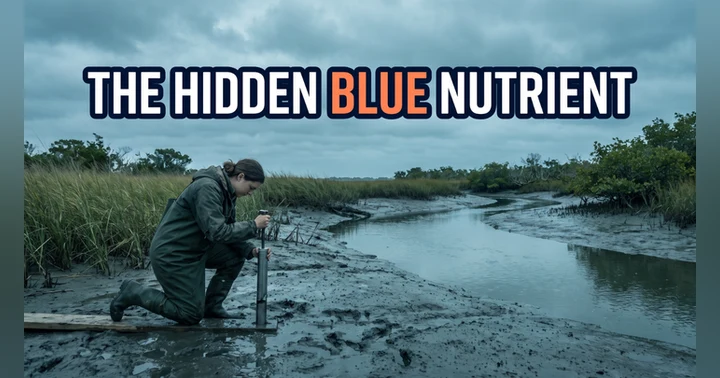
Blue Nitrogen: The Nutrient Story Coastal Wetlands Have Been Hiding


 Apple Podcasts

 Spotify

 YouTube

 Amazon Music

 PocketCasts

 Overcast
Every time this podcast talks about coastal wetlands, the conversation goes straight to carbon. Marshes, mangroves, and seagrasses pull carbon dioxide out of the atmosphere and lock it in soil for centuries, and that story has earned coastal ecosystems a real seat at the climate table. Dr. Adam Langley, a global change ecologist and professor of biology at Villanova University and a research associate at the Smithsonian Environmental Research Center, thinks there's a second story hiding in that same soil that could matter just as much, or more: nitrogen. Langley and 37 co-authors just published the first global estimate of how much nitrogen the world's marshes and mangroves actually bury, and the number is staggering.
Pulling from over 8,000 soil measurements across 255 tidal wetland sites worldwide, Langley's team calculated that coastal wetlands sequester roughly 3.2 teragrams of nitrogen every year, a figure Langley makes tangible by comparing it, loosely, to the mass of 700,000 African elephants or to the fertilizer applied to every cornfield in the United States. That's equal to somewhere between 13 and 15 percent of all the nitrogen buried in the world's oceans, a share nobody had managed to calculate on a global scale before this study. Nitrogen doesn't get the same climate spotlight as carbon, but its damage is intensely local: too much of it running off farmland and into estuaries fuels the algal blooms, oxygen dead zones, and red tides that can sicken and kill fish, manatees, and people. Coastal wetlands act, in Langley's words, like nature's kidneys, filtering that nitrogen out of the water and locking it away in oxygen-starved soil where it stays inert, as long as the wetland itself survives.
And that's the catch. These wetlands have kept pace with sea level rise for 5,000 to 10,000 years by building soil vertically, but Langley's research suggests they can only keep up with about 8 millimeters of sea level rise a year, a threshold the global rate, now roughly double what it was 75 years ago, is edging closer to. Andrew and Langley dig into what happens on the other side of that threshold: wetland loss, boat-wake erosion along Florida's Intracoastal Waterway, and mangroves creeping poleward into places like Georgia for the first time on record, possibly helping some marshes hold their ground in the process. They also talk dollars: blue carbon's global value has been estimated at $191 billion, and Langley's team calculates blue nitrogen could be worth even more, a case he hopes gets policymakers to start managing nutrients with the same urgency as carbon.
Takeaways:
- Coastal wetlands (marshes and mangroves) bury roughly 3.2 teragrams of nitrogen every year, drawn from a global database of over 8,000 soil measurements across 255 sites, the first estimate of its kind.
- That nitrogen burial equals 13 to 15 percent of the world's marine nitrogen burial.
- Human activity has more than doubled natural nitrogen inputs to ecosystems, arguably a bigger disruption to the nitrogen cycle than to the carbon cycle, even though nitrogen's damage shows up locally rather than globally.
- Blue carbon's global value has been estimated at $191 billion a year; blue nitrogen's could be even higher, an estimated $70 to $339 billion a year.
- Wetlands can generally keep pace with roughly 8 millimeters of sea level rise per year by building soil, but the global rate has already roughly doubled since the mid-20th century.
- Mangroves are expanding poleward, including a newly documented population in Georgia, which may help some marshes build soil and resist erosion better, though Adam expects overall coastal wetland area to keep shrinking as seas rise faster.
0:00 Most of the time on this podcast when we're talking about coastal wetlands, we talk about carbon sequestration. The fact that carbon dioxide can actually be sequestered and put into the soil of coastal wetlands like marshes and mangroves and seagrasses and salt marshes, all these different types of coastal wetlands which are great for the environment. And of course, you know, the destruction of these environments because of development or because of sea level rise or things like that can really cause problems for the release of carbon and carbon dioxide. Today we're gonna be talking about a different type of sequestration. We're talking about nitrogen sequestration and how much more important it could be than carbon when we're talking about making the environment healthy.
0:44 We're going to talk to Dr. Adam Langley, who's a global change ecologist in the biology department at Villanova University, located in Pennsylvania, where he is the director of the graduate program. His lab group studies carbon and nutrient cycling with a keen focus on sustainability of marshes and mangroves. He is also a research associate at the Smithsonian Environmental Research Center, where he conducts long-term global change experiments focused on predicting how future changes such as rising atmospheric CO2, rising sea levels, nutrient pollution, and exotic plant invasion will influence the ability of coastal wetlands to tolerate sea levels. We engage in a great conversation around why these coastal habitats are so important and how climate change is changing their distribution, sometimes for the good, sometimes for the bad, and how it's going to change places like Florida, the state of Florida, and what changes we're actually seeing already.
1:38 Some of it's not so great, some of it's really optimistic, uh, so we're gonna see what you think about this on this episode of the How to Protect the Ocean podcast, your place Monday to Friday to catch all the information on ocean news, ocean updates, science, ocean science, and ocean conservation, starting right here today with Dr. Adam Langley on global ecological change. Enjoy this interview, and we'll talk to you after. Hey, Adam. Welcome to the How to Protect the Ocean podcast. Are you ready to talk about blue nutrients and coastal wetlands? I'm very excited to do that. All right. I'm super excited because I know, like, a lot of times people would be like, "Why are you so excited about, you know, nutrients and wetlands? Why is that important?"
2:22 And we're gonna find out today why it's so important. If you don't like your water green, this is why it's so important to learn about how wetlands can sequester nutrients, just like we talk about how wetlands, mangroves, and other coastal habitats will sequester carbon dioxide. It's just as important to get those nutrients in that soil and keep them contained, as have they've done for, you know, decades and centuries and so forth that we've seen. But then when they get wrecked and they're not able to do that ecosystem service for us anymore, it kinda goes to the wayside and we get blooms and potentially red tides down the road and all that nasty stuff. So we are gonna talk about an important study that Adam did, uh, and we're gonna get to know Adam a little bit more.
3:04 So Adam, why don't you just let us know who you are and what you do? Okay. I'm Adam Langley. I'm a global change ecologist here at Villanova University. I come from the mountains and I did my graduate work actually in the high desert of Arizona. So it's a strange place- Nice … for a, a coastal wetland ecologist to be trained. Uh, but, you know, I consider myself an ecosystem ecologist, so I study the flows of energy and matter through ecosystems, carbon and nitrogen and water, heat, whatever. And so if you're an ecosystem ecologist, the particular setting isn't as important as the processes that you're studying.
3:47 So a lot of the processes- Mm-hmm … are, are universal to, uh, whether it's, uh, you know, the high plains or a coastal wetland. So in terms of looking at the different systems, what drives you as a scientist to really, like, what knowledge are you seeking when you seek this? Like I know, like, for certain people who look at sharks, they'll look at, you know, predator-prey relationships, and they wanna find out different predator-prey relationships. And sometimes they'll go outside of sharks and go to, like, tuna or salmon to look at different types of predator relationships- Mm-hmm within different animals, different types of species. For you, in terms of looking at, like, say, like a desert area or even a coastal wetland, is there something in the middle that really drives the question that you're looking for or has been driving the question that you've been looking for recently?
4:34 Coastal wetlands are really unique among all ecosystems. Some people consider them marine, some people consider them terrestrial. They're kind of in between, so they kind of fall through the cracks there a little bit. Um, but what's really unique about them is the biogeochemistry that happens there. Um, because they're getting, um, water from the ocean, um, they're getting runoff from land, they're p- partially saturated, sometimes fully saturated, so they're- Mm-hmm … kind of oxygen deprived. Um, you have a lot of mixing that goes on of things that don't mix elsewhere, so you get a lot of unique processes.
5:14 Um- They're very dynamic ecosystems, so from year to year things can really change there. To me, that alone makes them pretty fascinating. One of the big things that's very different is that in a forest you kind of hit an equilibrium. Mm-hmm. And this is one of the things that's important to this paper ultimately, where after so many centuries, the mass of that forest doesn't really change, and that forest is no longer, like, it has no net absorption of carbon from the atmosphere, say. So it's kind of maxed out. That doesn't really happen in coastal wetlands. They kind of adjust based on water level.
5:57 So as long as- Oh, interesting … since sea level has been rising for roughly the last 5 to 10,000 years, depending on where you are, they continue to build. So they're constantly growing to keep up with sea level. So it's almost, you know, you can think of it like this super organism that's hit this different kind of equilibrium that you don't see Yeah just anywhere else. Yeah. It's interesting, like, so, uh, like to kind of picture… What I'm picturing is, like, mangrove forests, so the mangrove trees, depending on the species, 5 to 10,000 years ago were, like, shorter in terms of height- Um … because they, the sea r- didn't r- rise to where it is now? Or is it just more- Yeah.
6:37 So I'm, I'm really talking about the whole ecosystem. Okay. So the soil was shallower. Ah. So you can… Yes. And so I should back up. When I say coastal wetlands, I'm talking in this paper specifically about marshes and mangroves. Gotcha. So I'm glad you mentioned mangroves. Right. Um, because that's one that people are, you know, sometimes familiar with. Sometimes they think- Yeah … I'm talking about a mango fruit. Um, but we're talking about the mangroves. Those are the, really tropical coastal wetlands that have trees, trees that are incredibly durable. Yeah. Um, they can tolerate flooding, they can tolerate salinity, and they can grow in some places hundreds of feet tall. Um, if you've been to Florida, you might have seen some tangled rooty trees- Mm-hmm … along the coast, and those are probably mangroves.
7:23 So I said the ecosystem can grow, and I mean there it's building soil. Gotcha. So you could take a core- Mm-hmm … and when you date that core we can see that the soils in some of these wetlands have been accumulating for, you know, 5,000 years- Yeah just building layer on layer on layer. Um, that's something you wouldn't see in a- No … in an upland forest. So as that layer continues to add on, you can put more nutrients, carbon dioxide in those layers because- Exactly … it continues to build up. And that's why these ecosystems can sequester or absorb much more carbon or nitrogen or soil, anything else- Yeah much more quickly than anywhere else on Earth.
8:09 Really? That's interesting. Yes. I didn't know that. It's, uh, let's say roughly 10 times the rate of the most productive forest. Right … it's really staggering. Yeah. Amazing. Amazing. You started to look at these coastal wetlands and you mentioned something earlier that a lot of times the understanding or even the study of these coastal areas kind of fall through the cracks. We know a lot more about land and a lot about the ocean. Mm-hmm. But these coastal wetlands kind of take a backseat. Is it because it can be so complex? Because they're facing both environments a lot of the time, and people just weren't interested in knowing about them before 'cause they were more complex?
8:51 I would almost think it's the opposite 'cause they're so special because they have that. Like, why do you think they fall through the cracks? Well, I think we're catching up now. Um, I- Yeah … you know, I think it's maybe kind of just a historical bias, um, that, you know, you get to your coast and the marsh smells bad. And people considered it a wasteland, right? Yeah. Um, and would dump dredge spoils there, whatever else, bodies you want to get rid of. Um, I kind of think that might have more to do with it. Um- Okay … but, you know, now in the recent decades, we've really come to recognize the inordinate importance- Yeah um, that these ecosystems have in not just our estuaries, but really in the biosphere.
9:39 Yeah. Yeah. No, no doubt. Now, um, so with that said, like this whole study, like you have a lab, the Global Change Ecology Lab, I believe is what it's called, right? Did I get the name right? You did. Okay. Perfect. Now this lab, it looks at all these different types of processes for… is it all coastal wetland systems or is it just mangroves and marshes or do you expand and depending on who's there and what type of project's coming up? Yeah, it kinda fluctuates a little bit, but we have had a strong coastal wetland focus for- Okay uh, 15 years or so. Okay. Yeah. Okay. Interesting. And then how many people are in this lab right now, like graduate students and maybe like research thesis undergrads that are currently in this?
10:20 Um, we have probably four or five grad students and- Okay … probably that many undergrads. I work closely with some other, um, professors here at Villanova as well. Okay. I got a lot of young researchers and students who are in the audience right now listening to this, if they got interested, they want to know more about these types of coastal wetlands and these type of biogeochemical processes, what type of, I guess, background education do a lot of the graduate students in your lab have or who have come through? Like what do they need or what kinda knowledge do they need to succeed in your lab? That's probably something that, you know, if you asked me that 10 years ago, I think that's changed too. Different. Um, but it's, you know, definitely some ecological experience, uh, field experience. We, some of the places we work in are, are very adverse too. I can imagine.
11:12 Yeah. Which is a, I think that's another reason that they were historically understudied. Right … They can be very difficult to access. I mean, we're slogging around waist-deep in mud a lot of the time. Um, and you know, I was just down in some of the more remote wetlands on the East Coast in the South Carolina on the coast and talking to some researchers down there, and they're like, " No one has studied these because they're really difficult to get to." Yeah. You can't quite get where you need by boat, and you can't get there by land. Um, so sometimes, you know, a lot of our work requires, like, you can't be afraid of mud.
11:53 Uh, that's- … definitely part of it. Gotta be willing to get dirty. Yeah. Um, you know, some technical expertise, like, we've done a little bit of, like, gas exchange. More and more, like I think more of my students have used some remote sensing as that data has gotten to be just an incredible resource. The coverage- Yeah … and the detail that you can see from space. That's had a big impact on our field 'cause these places you can't get to, well, now you can see them. Um- Right. Right … so my students all have much better, uh, GIS skills than I have.
12:33 That's huge. As they learn through it. Yes. Um- Yes … which is a great synergy that we have. Oh, yeah. I always find, I, like, I did a GIS diploma, advanced diploma after my- Mm … uh, undergraduate degree. My master's supervisor told me to do it. He's like, " You're gonna need this," like, for- Yeah … I was doing MPA work. Um, but I've always used it. Like, I've used it in a number of different jobs, whether it's in and out of science, like, you can always use it. I know I've done a couple side contracts with business owners on looking at- Mm … how to divide up things. You can use GIS remote sensing in pretty much anything. But speaking of which, with a lot of the way people are moving, like, whale sampling is moving to, like, drones and, you know, sampling, like, whale, uh, excrement from their blowholes and things like that.
13:17 Can you use, like, uh, more specified types of drones in these wetlands? I guess it'd be hard to do a core with a drone, but to sample anything else? Right. Uh, definitely. I spent some time this summer taking some imagery, some, um, drone imagery, and the algorithms for determining, you know, plant cover, which is, we spend a lot of time measuring this. Mm-hmm. Um, you know, the old ecologist in me is like, "Well, it's just not quite as good." Um, and it's not. If you have, like- Right … the plots that we're going to. But if you want full coverage of on your marsh, you can do this pretty well now. You can use algorithms to not just tell you we're interested in, like, how green is it, how much biomass is there, but also what plant species are there.
14:04 Yeah. Algorithms are getting really good at that, especially in coastal wetlands, where we tend to have few species. Mm-hmm. So they're pretty easy to distinguish, uh- With, you know, AI technology or whatever other algorithm you're using. Yeah. Um, so I think, and I have colleagues that, um, have used drones. I've probably used… And I've used some of the imagery myself. I don't fly them myself, but I think that's- Right … gonna be key. Um- Yeah … one of the key variables in our ecosystems is elevation. We need to know it to the centimeter because it just determines how flooded that site is, and everything else that happens there. And we can get really good elevation data, um, with drones.
14:45 Yeah. Um, it's a little tricky in tidal wetlands when you've got standing water, but it can be done. We're gonna see things that we haven't been able to see before. Absolutely. And we've seen, I guess, you know, drones as sophisticated, having LIDAR machines on them too, right? Yeah. And, and being able to get that, which is incredible, how fast the technology has come, you know, in terms of- Mm-hmm … like when I started GIS 20 years ago, we were just getting into digital GIS and out of the mapping- Mm-hmm … like paper maps, and now we're getting into drones that can do LIDAR, like up close and personal, so it's kinda cool. And it does make me a little nervous that people will do just that, um, uh, only re- you know- 100% … drone sensing. And I feel like- Yeah … we still need some on the ground measurements like you mentioned.
15:25 Absolutely. And of course anything happening in the soil, there's no magical technology for that. Nope. It's a lot of old-fashioned taking cores and we do that- Oh, yeah. And, and, and I'm, I'm a- Yeah … proponent of that. As, as a marine biologist, you know, knowing, like a, that did remote sensing and GIS in, in college, like the first things one, you have to ground truth. So you have to get on that ground. You still have to get dirty, you still have to get through, and then, yeah, there's still other information that you need to get. It only provides you, you know, one or two pieces of information, but to get the full picture of sampling and getting in there, you really have to do the cores, do everything, really get that, that- Mm-hmm three-dimensional kind of, or even four-dimensional kind of learning, which I love. Like, 'cause that's the fun part of field work though too, is getting dirty and going through the hardships.
16:08 It brings the team closer, uh, if you do it all together, right? There's no way to bond like being, you know, waist deep in a hole in a marsh with your colleagues. I love it. I love it. Okay. Um, so that's great. So, and within the lab, like you guys are looking at all different types of questions. We're gonna get into one of those specific questions with this paper in just a moment. Can you just talk about some of the different types of studies that are going on in the lab? Sure. So I did a postdoc at the Smithsonian Environmental Research Center. It's just, uh, outside of DC. It's on the- Yeah … Chesapeake Bay. Um, and so a lot of what's going on out there, well, it's-- we have this, uh, what we call the Global Change Research Wetland.
16:51 Um, it's probably the most experimented-on wetland in the world. We have, uh, experiments that have been running for over 40 years in some cases, um, where we're poking and prodding this marsh in every way possible. It looks like aliens have landed on this marsh. Um, but it's just scientists, and we've been there for a while. So we're adding, um, extra CO2 to the atmosphere. We're adding, um, extra nitrogen to some of the plots to simulate nutrient pollution. There's a big warming experiment, active warming, where we're trying to simulate climate change. Mm. We've manipulated sea level. We have a plant invasion, um, element.
17:35 Um, so that's one of the thrusts of my work is, is looking at these long-term experiments. And like I said, some of them have been running for decades, which allows us- Yeah … to look at these treatment effects that we're interested in, but also superimposed on the background change that's actually happening. The rate of sea level rise has accelerated there, um, probably doubled since we started the experiment. Mm-hmm. Um, so it makes this really fascinating interplay of these different factors. Yeah. , That's one element. A lot of what the lab is doing now is happening in Florida because we have several interesting things going on. We do have coastal wetland loss.
18:16 Um, at the same time, we have mangrove, uh, encroachment. I'll call it encroachment. I don't really call it invasion, but mangroves are moving northward- Hmm … in Florida, and this is kind of a general trend around the world. They tend to be moving poleward. And so while we're losing a lot of mangroves to development around the world, they're also, um, colonizing new areas. And in Florida, this seems like it's mostly driven by climate change, the declining frequency of deep freeze events Um, that's historically what's restricted, uh, mangrove range- Mm-hmm … on the north end.
18:57 Um, my colleagues though have recently found, um, mangroves in Georgia for the first time. That's been documented. I was about to ask. I was wondering, does it go as far as Georgia? Interesting. Okay. They do. Um- Yeah … And that's just in the last couple of years they found them. We knew the climate there probably would suit them. Mm-hmm. They just hadn't quite gotten there yet. Gotcha. So we're, asking a lot of questions down there about, like, what happens to these marshes when mangroves come in? Yeah. Um, so what happens to the carbon cycle? What happens to the nutrient cycle? Also, do these mangroves maybe, I mentioned, you know, we're losing coastal wetlands pretty rapidly up there, but these mangroves seem like they might give these wetlands a better chance at survival.
19:38 A little bit more stability? A little bit more stability. They can build soil, um, we think more rapidly- Mm-hmm … than the herbaceous marsh plants can. Yeah. They resist erosion maybe a little bit better. Um, we have a new paper out about that. Nice. Um, so that's, yeah, one of the other main topics that's happening there. And then interestingly, on top of all that, we did have one of these big freezes last winter, so it kind of caused some mortality in these mangroves that had just recently colonized. But it's looking like, we're just now learning, it's like it wasn't as severe as it seemed like. A lot of these mangroves that looked like they got- Yeah frozen to death are starting to re-sprout and come back, so.
20:24 Just took a little bit. Yeah. Yeah. It's just t- it took them longer. If you looked at one of these, it looks just crispy, and you're like, "Oh, that's definitely dead." But they start to, uh, re-sprout again. Okay. But working down there is like nowhere else because, I mean, I know of no ecosystems that have changed as dramatically as these in the last couple of decades. We're talking about in some cases, near complete conversion from a marsh to a mangrove. Um, and in a matter of, you know, five, 10 years, you have kind of a swampy, a forest colonize it with, you know, large mangrove trees. Yeah. It's just, which is pretty incredible to see them move up that much to look at how that's gonna change the landscape in Georgia from what a, you know, the marsh type to a mangrove type.
21:14 You said they're moving towards the pole, so I assume the same thing is happening south of the equator, too? They're starting to move down? Yeah. Yep. Wow. I think, you know, there's other forces that are driving mangrove expansion and retraction all over the world. Mm-hmm. And it's not always as clear that it's- Right … climate driven. Um, you can have sediment dynamics change- Mm-hmm … and that can cause, um mangrove invasion. There's sea level rise rates are different around the world. Mm-hmm. But yeah, in general, um, the range is expanding. And I don't think that anytime soon, uh, Georgia is gonna be dominated by mangroves.
21:55 Right. Right now it's just, it's literally a few individual trees. Yeah. Um, but they could be a bigger player in the ecosystem in 20 years. Yeah. Well, and it, it's interesting too, just talking about mangroves, I recently saw a story within the last month or two, um, where, you know, for a while the entire, like, global mangrove populations and cover were decreasing. I think they lost something around 12,000 square kilometers I think it was. Mm-hmm. And now recently there was a paper showing that it's actually increased, like, globally by about 2,000 square kilometers. So not nearly what they've lost, but we're starting to see that increase. And they're saying even in the face of climate change, um, like as you mentioned, there are other things at play here that will allow them to grow, but it could also just be the expansion of a new maybe type of habitat, or a new habitat- Right or growing habitat.
22:46 Right. Um, you know, I think of that kind of thing as it's like if you give Mother Nature a chance, um, that she can rebound, and that's- Right … that kind of seems like what's happening. Uh, mangroves, we've probably lost roughly half of mangroves, um, in the last century. Yeah, yeah. Um, mostly to development. Yeah. Um, but yeah, I saw that paper too, that we've made some gains in area. Yeah. Uh. Yeah. And there's some, you know, large scale restoration projects that have probably helped that as well, but there's a lot of natural, um, expansion and recolonization that's going on. Yeah.
23:27 Interesting. Uh, you mentioned, you know, sea level rise is playing a role in certain aspects of coastal ecology and how it's shaping coastal ecology. I always find sea level rise very similar to, like, something like getting people to care about biodiversity. They don't really get it, you know, when you say, "Oh, well, you know, sea level is rising by, like, a centimeter or a couple of inches," or, you know, depending on where you are in the world, people are just like, "Well, what does that matter? It's a very small amount. It's not gonna make a difference." Can you just talk about how, uh, sea level rise is affecting, uh, especially, like, because we're talking about mangroves and, marshes, how it's affecting those types of habitats, uh, either for the positive or for the negative?
24:10 Yeah. So, you know, marshes and mangroves are extraordinarily sensitive to sea level. They can keep up with some sea level rise, and in fact, they've been doing so for the last 5,000 years. Sea level has been rising over that timescale pretty steadily until the last, you know, 75 years or so. Mm-hmm. We've got an acceleration coming in. We know that these ecosystems have a limit of how much they can keep up with, and we've started to learn pretty well about what that limit is.
24:51 Um, it seems like several different, very different approaches have converged on a rate of about eight millimeters per year. They keep up by accumulating soil, exogenous sediment that passes through wetlands. They trap some of that. They build organic matter, so by photosynthesis, building plant tissues, and a lot of those tissues get buried in the soil. And because that soil's saturated, they just accumulate. They don't rot. Mm. There's no oxygen to support the decomposition, so it just builds up on top of itself. Um, but those mechanisms have a limit. That limit definitely varies with, like, how much sediment is around.
25:33 Mm-hmm. But we've learned from past, one way is they've learned from past sea level rise events. They can look at sediments and reconstruct when a wetland was no longer able to keep up. And- Hmm my team has used some modeling. You try to do this process model where you put all that stuff in a model, how much sediment's gonna accumulate, how much organic- Right … matter's gonna build, and we come up with roughly the same number. It's about eight millimeters per year. Now, that's important because, um, you know, if you ask an oceanographer, "50 years ago, what's the rate of sea level rise?" You know, they might say two and a half millimeters per year, but now we're closer to five- Hmm … millimeters per year globally.
26:21 Double. Yeah. And no one knows, you know, how much more there's gonna be in the future. You can g- you, you know, ask 100 different oceanologists- Yeah … you'll get 100 different answers. For sure. Um- Yeah … but the estimates, you know, we very well could pass that threshold in the next couple of decades, depending on what happens to, you know, ice- Yeah … at the poles- Well, absolutely … or Greenland. Yeah. So it's, um, alarming and- Yeah … you know, as a scientist, it's kind of an exciting time, right? Well, we'll see. We'll see how much- Yeah … we'll test our model- Yeah … um, with r- this massive uncontrolled experiment that we're doing. Yeah. No, exactly.
27:02 It's interesting from a scientific perspective, but also you don't wanna see the results of that getting you know, too much and so forth. Um- Now, you know, we talk a lot about climate change, we talk a lot about coastal wetlands. One of the things that coastal wetlands is known for is sequestration. I talk a lot about on the, on the podcast about how CO2 can be sequestered by mangroves, seagrasses, salt marshes, and so forth, at a much higher rate than a lot of, uh, land, trees, and forests. Um, and that's a, a really great thing, obviously, you know. And obviously with the loss of those wetlands, uh, there's a much more need for restoring those wetlands to bring some of that to help with that process.
27:43 Uh, but what a lot of times we don't talk about, especially on this podcast, is the fact that it's, that we call it blue carbon sort of, uh, wetlands, but there's also blue nutrients, uh, which is, is something you covered on, your newest paper with your co-authors, looking at how nutrients really play a role in coastal wetlands at a pretty high rate. Your database was pretty big in this situation. Um, so I wanna talk a little bit about that paper. Can you give us sort of the synopsis of the paper and just to kinda give us a, a little bit of a overview, and then we'll kinda get into the nuances of the paper? Okay. Yeah, I mean, I'll start with nitrogen itself. Well, we thought we coined this term blue nitrogen, um, to kinda piggyback on what people know about blue- Yeah … carbon.
28:26 Um, and so why are we interested in nitrogen? You know, nitrogen is a nutrient that is essential to life. Um, and that's exactly why we use so much of it, because it tends to make things grow. Mm-hmm. We have a lot of nitrogen in our bodies. Plants need a lot of nitrogen to grow Um, but you can have too much of a good thing. Mm-hmm. And this is what has happened. You know, our ability to, um, obtain nitrogen from different sources, including the atmosphere, is really what's fueled the green revolution in agriculture over the last hundred years. We're much more efficient. We can grow a lot more food per acre partly because we can take nitrogen out of thin air and add it- Yeah … to our crops.
29:14 Um, and so that, you know, you might consider that a good thing. More nutrients, that's a good thing. Until these nutrients, you know, they can get to a level where they cause problems, and that tends to happen as waters run off of agricultural fields. Mm-hmm. They wind up in our creeks, in our rivers, in our estuaries, and the amount of nitrogen ending up there can really build up to a high level. So for the exact same reason that we use it because this level is damaging because it can fertilize the growth of algae- Mm-hmm um, to a level that is deleterious to the ecosystem.
29:55 So it causes… It can kill off, uh, fish. It can… We've had, you know, manatee deaths in, down in Florida where they're just washing up in unnatural numbers. Um- You know, then there it's because the nitrogen is causing this algal bloom, which… Well, there's a couple things going on. So, uh, the algae grow and bloom, but then they die. And when they die, they decompose, and that sucks oxygen out of the water, so you get these oxygen dead zones in estuaries. Some of these algae also produce these other toxins that have these secondary effects, and that can also directly kill, uh, fish and manatees and humans.
30:40 I mean, it can really cause respiratory problems. Uh, we were talking earlier about, uh, a red tide, and if you've ever been around one of those, I think it's a really freaky thing to experience. I was sitting on the beach with some friends and family, and suddenly everyone… This is down on the Gulf of Mexico. Everyone started coughing. And you couldn't see anything. You couldn't see the red tide. You couldn't smell it. Um, but it got difficult to breathe, and so people started leaving the beach abruptly. Um, so that- Did they know what it was? Like, did they have an idea? I don't, I don't think people- Or they were just, like, everyone coughing? Um, I think someone I, I was there with looked it up and was like, "Oh yeah, there's a red tide right there." Oh, okay.
31:24 Yeah. And so they, you know, they monitor it, and they know. Yeah. So this nitrogen, we have an unnaturally high amount of nitrogen that's entering our waterways. This getting back to the paper, um, what we wanted to learn is how much can coastal wetlands, marshes and mangroves in particular, uh, sequester? Like you mentioned, blue carbon. These coastal wetlands take up a lot of carbon. They put it in organic matter. It sticks to soil, and that soil's accumulating, and that organic matter's accumulating. Um, but to take up that carbon, they also have a lot of nitrogen that goes with that. So we wanted to add that up for the first time.
32:05 People have done this many, many times for carbon. I think there just tends to be more economic interest in carbon. Um, but why not nitrogen? So we did it for nitrogen, You know, we came up with a number, a big number, is 3.2 teragrams of nitrogen per year that marshes and mangroves- Jeez … are taking up and sequestering in the soil. So you know, that's a hard number to wrap your head around because a teragram- Yeah. Well, that's one gram with 12 zeros behind it. Yeah. Um, so I, I was trying to think of, like, what's that equivalent to?
32:45 Well, it's roughly equivalent to the amount of fertilizer that we add to corn fields in the US. So that- Geez … I don't know if that's helpful. You could also say it's, um- That's kinda scary, though. Like, when you think about how much fertilizer is put down. Yeah. Yeah. You know, all that- And how much pollution that causes. Yeah … you know, right. Right. And I was just trying to visualize, like, what is a teragram? Um, so if you took 3.2 teragrams, that would be equivalent to the mass of 700,000 African elephants. And that's if they were made of pure nitrogen, which they're not. Right. Yeah. Um, so that's how much these wetlands are taking up and holding- Mm-hmm … in their soil. When they have it in the soil, as long as it stays there, it's pretty much inert.
33:28 So it's not gonna contribute to algal blooms at that point- Right if the wetlands are stable. Right. That's amazing. Now, so for this study that you did, Like, what did you wanna get out of this study? You wanted people to understand what role these wetlands play, and what's affecting them in their ability to continue to keep this nitrogen sequestered and continue to sequester more nitrogen? Right. We wanted to- Or nutrient, sorry … to get… Yeah, exactly. We've called these wetlands like nature's kidneys because of kind of this property before, that they tend to… I think people associate that with, like, other pollutants, but we're talking about a nutrient pollutant.
34:16 So we wanted to add that up globally for the first time. Yeah, we wanted to project, like, how might this change in the future? So this 3.2 teragrams of nitrogen per year that they're sequestering. That's happening in the background without us really knowing it or even thinking about it until now. Um, but as these coastal wetlands, I mentioned they're really dynamic. As they change in the future, how might that number change, and what consequences would that have? There's not actually, not much agreement on exactly what's gonna happen to coastal wetlands in the future. We could gain coastal wetland area, we could lose it. Um, and so we took some different scenarios.
34:57 If we gain coastal wetland, if we lose it, how much more nitrogen could they take up if we're gaining area? Or how much might they release if we lose it? So if these coastal wetlands erode and- that soil that was kind of sequestered and all the nutrients in there got recirculated in the ecosystem, you know, how much more could come back out? So we wanted to kind of pose that question. Um, you know, hopefully, yeah, we're you know, targeting policymakers ultimately. Mm-hmm. Mm-hmm. 'Cause we- For them to listen and be like, "Hey, this is what we need to do." Now, looking at the size itself, you got a lot of measurements.
35:40 I think it's over 8,000-plus measurements, 255 sites. How long did it take to bring in that amount of information? I want people to understand the scale of this study. That was a struggle. Um- It's a lot of mud But it's a lot of mud. Um, you know, so some of these cores I took myself. Most of them we were getting, uh, data that were available from other colleagues. A lot of the co-authors have taken these themselves, and I was like, "Okay, let's bring all this-" Yeah … "data together." A lot of it's already published. Some of it wasn't. Um, but yeah, You notice there's a very long author line on here. I wanted to acknowledge the blood, sweat, and tears that went into- Right to getting all those data.
36:23 'Cause it's- Yeah … not easy. You know, that's a lot of soil cores, yeah, taken in, uh, as many places as we could find. Um, so yeah, it took a while to bring all that together and- Yeah … comb through it. And so looking at studies, that probably ranged over quite a long timescale too, in terms of getting, like, bringing in all those different papers and samples and things like that, right? Yeah. And, luckily, I think what made this possible is how much interest there has been in carbon. Mm. Um, because a lot of these studies were targeting carbon. Ah, okay. It just… It's, it's a nice coincidence, or it really, um, worked out well for us that when you… The way we analyze carbon, or the way most people do it, you happen to get nitrogen at the same time if you use an elemental analyzer.
37:10 Mm. So I could go in and see, find some data, and I'd find the carbon data that they published, and there's, if I go to the raw data, sometimes there was another column of nitrogen data that they never published. Right. But they were- Um … just getting it because they could, because that's, that's the idea. They were getting it because they could. Yeah. Okay. And, and so we took advantage of that, and that really helped. This whole project really was, like I said before, piggybacking Mm-hmm … on blue carbon. You know, that was also kind of the motivation. Like, um, policymakers, you know, internationally are very aware of blue carbon. Mm-hmm. For sure. Um, and they're putting very hard dollar values on what it's worth.
37:50 Um, but they're not doing that for nitrogen, so we wanted to raise that. You know, that goes back to your previous question. That was really- Yeah … one of the motivations. Yep. Yeah. No, I love that. Can you talk a little bit about, you know, looking at blue nitrogen, like burial? Like, how does it actually work in soil, and does it differ between mangroves and marshes? And you don't have to go into, like, extreme detail, but just in- Yeah … terms of, like, how that works. Does it work the same… You k- kind of mentioned earlier with carbon and things, like as the soil grows you can have more space. But how does it actually get buried in there? Right. Yeah, that's a great question. It's largely two processes. I would say there's, uh, the biological side where plants absorb this nitrogen.
38:35 So the water infiltrates into the soil, and it's carrying some nitrogen with it. Um, some of this nitrogen is coming from nitrogen-fixing bacteria in the soil. Mm-hmm. But so then the plants take up that nitrogen, they grow, they die, they fall over into the soil, or the below ground structures just die in place. Mm-hmm. And it's key that these are saturated soils, so oxygen is consumed more rapidly than it can diffuse in. And that keeps this soil really anoxic and tends to preserve organic matter- Mm-hmm for long time.
39:16 You might have seen like the bog mummy from- Right. … Scotland. So in a wetland there was a- Yeah … a really old, I don't know how old, tens of thousands of years old human that fell in, and they're- Yeah … really well preserved because there's no oxygen in that bog- Right … um, to stimulate decomposition. Same thing happens here. So organic matter builds up. The other side, so there's the inorganic side where these wetlands, because they have vegetation that's sticking up into the water that floods through them, they tend to trap little particles of- Okay … silt. Right. And, you know, some amount of nitrogen will stick to those little particles as well.
40:00 Okay. Um, you know, there's a lot of work right now and a lot of interest on this very question. What is it that, um, helps stabilize especially carbon, but also nitrogen in these wetland soils? What are the mechanisms? And I think we still don't really know- Mm-hmm … you know, some… They can last for millennia down there. What is it that keeps any bacterium from trying to, uh, consume these for that long? It's, uh, it's, you know, anoxia is part of it. Sometimes you get some acidity in these soils and that might help a little bit. Yeah. Um, We're really trying to explore. I have some colleagues working on this, uh, Lisa Chambers down in Florida.
40:42 Um, there's some abiotic mechanisms where y- you just have carbon and nitrogen kinda stick in these little crevices to tiny little soil particles, and it's- Yeah … gets locked away. Yeah. That's so cool … inaccessible to microbes. Yeah. Yeah. No, that's so cool. Let's get into some of the results of the study. Um, 'cause you had this large database. Uh, one of the things that you guys saw, it was like, there's like a, a, like a th- I think this was one of the results, like a 13% to 15% marine nitrogen burial figure, right? How significant is that number in the context of, like, the global nitrogen cycle?
41:23 I keep saying nutrients. Nitrogen cycle. And what was it estimated before the study? , We dug and dug and it couldn't find any good-- any estimates for a global nitrogen burial rate in coastal wetlands. And I think it goes back to what we said before, like, kinda slipped through the cracks. Mm-hmm. You had people that were estimating, looking at the nitrogen cycle on land and that and the ocean. Um, and we could not find any good global estimate. So we can't say we increased or decreased it. There really wasn't one. Um, so marine burial, I have seen numbers for that.
42:04 Um, and so it turned out to be a pretty significant portion of that. Um, as far as the global nitrogen cycle, you know, there are some big fluxes in the global nitrogen cycle- Of course … and humans have tended to make them much larger. This is really staggering with nitrogen. You know, we've affected the carbon cycle, but we've really affected the nitrogen cycle. Um- More than the carbon cycle? Yeah, I would- Oh, wow. Yeah, that's, that's- Okay … that's a fact, because if you look at the natural fluxes of nitrogen into ecosystems, um, through deposition from the atmosphere and fixation, um, we've more than doubled the rate of nitrogen inputs through- Wow … fertilizer production, fossil fuel combustion.
42:57 So yeah, It is extreme. Um- Yeah … this rate of burial, y- you know, and it's probably, like, on the order of a couple of percent of some of these other large fluxes, like total input into ecosystems. So in that, in that sense, it's not huge. It's on par with, um, blue carbon. If you look at the rate of blue carbon burial, that is about 60 teragrams of carbon per year globally. That's a lot. Um, but global emissions are 10,000 teragrams.
43:38 In fact, it's so big we measure it in petagrams. It's about 10 petagrams. So what's that make? That's about, uh, a half a percent of emissions that is being buried in coastal wetlands. That's something. That's big. Um, but, you know, in the big scheme of things, it's a little smaller. And this is where nitrogen is fundamentally different from carbon. So it makes sense to talk about carbon on a global scale And it makes sense for nitrogen as well, but the effects of nitrogen are really magnified locally. So whereas, you know, we talk about carbon because one molecule of CO2 when it's emitted, it goes up and it warms in the atmosphere, but that warming isn't localized.
44:22 Right. That's really well mixed up there, so it can cause warming all around the globe. That's not the case with nitrogen the way we're talking about it, 'cause when it's taken up from an estuary or released into an estuary, its effects are manifested right there. Mm-hmm. So in a way, I'd say, the role of coastal wetlands is probably greater in terms of nitrogen than it is in terms of carbon- Mm-hmm because of these acute local effects that nitrogen has. Yeah. Wow. That's incredible. That's incredible. Now, we talked about sea level rise earlier, uh, but you found that sea level rise could increase nitrogen sequestration in wetlands, but only if the wetlands survive.
45:07 What is meant by that? Like, what determines whether a wetland survives in sea level rise? And if it does, then it's a big benefit. Right. Yeah, and this is what I said is really not very well resolved in my field. I've got colleagues on both sides that think, some think, sea level rise is going to drown wetlands. Uh, once- Right … we pass these thresholds, there's not one threshold, let's not kid ourselves. There's a range of thresholds. Right. But in some cases, the thresholds are being passed if the rate of sea level doubles, we're gonna lose more wetlands. Now wetlands are dynamic though. They can build vertically, and that has a limit, but they can also transgress laterally.
45:49 Mm-hmm. And so there have been papers that suggest, um, that as sea level rises, we could even gain wetland area because they just has to do with the topography of the inland area where they're transgressing. So when I say transgress, I mean- Yeah … move. Like move to the right or to the left- Landward or… Yeah, landward. Yeah. My hunch is that's not going to happen. We're gonna lose coastal wetland area with higher rates of sea level. But, for the purpose of this paper, we didn't wanna tackle that- Right. Of course … can of worms. Yeah. So we just took all these different scenarios. So we said in the rosiest scenario, say wet- sea level rise increases, and the area of wetlands expands.
46:34 The rate of sea level rise, so if wetlands keep up with that rate of sea level rise, well, that means they're burying soil more rapidly. Mm-hmm. Um, they have to, to keep up. Yeah, to keep up. Yeah. But, you know, it, I think more realistically, that scenario to me, a high rate of sea level rise and wetland area gain is not very realistic. I think if we have higher rates of sea level, we're gonna see more loss of- Makes sense … of coastal wetlands. Yeah. Yeah. It's like- 'Cause it would be, it would be hard to keep up with that soil rising- Mm-hmm with that, if sea level gets over, rates too high and it gets over the wetland, right?
47:14 I think of it like a conveyor belt and, like, if you're in a chocolate factory and you turn up the speed of the conveyor belt, well, that might help increase production for a while, but if you go too far- Mm-hmm you're gonna end up with a Lucy and Ethel situation and the- Mm-hmm … whole system breaks down. I like the reference. Awesome. Awesome. Um, yeah, that definitely, uh, makes sense. Um, like, are there real world examples showing, like, already showing, like, this source versus sink? Like where we see a, maybe a flip, or we see, um, you know, where wetlands actually survive? Have we seen that, again, with higher rates of sea level rise?
47:54 Or has it been the opposite? So I'm thinking on the other side, I feel like we've definitely seen cases where we feel like the wetlands have sunk and started to erode because of sea level rise. Um, there are some, probably some cases maybe in the Gulf, um, where I think that's where you see your highest rates of relative sea level rise, which can exceed a centimeter per year. We've been talking about millimeters, so- Mm-hmm … because you- Which is like, yeah, order of magnitude more, yeah. Yeah. Because you have a lot of, uh, subsidence of deep sediments, and so the whole area is sinking.
48:35 Plus you have, you know, whatever sea level rise rates. So if you add those two, that's how much relative sea level rise is. So you can get some really high rates. And there are are certainly cases of wetlands that are keeping up with that. I'd say it's- Mm-hmm … most likely where you have a lot of sediment available to be deposited and help build that soil. Um, but I think that the net effect that I see at my sites when I'm, especially in Florida, is just that we're losing, um, in this recent paper, it's about a linear meter per year off every coastline of every wetland, um, which is, yeah, it's extreme. That's significant. It's very significant.
49:16 And you can go yourself on Google Earth and look at the past, the older imagery compared to the current, and you'll see- Yeah this, this retraction that's happening. And there it is. It's definitely partly sea level rise and accelerating- Yeah … sea level rise. Um- Right … Our paper recently points to some other human influences like boats, boat- Mm-hmm … traffic along the coasts of these wetlands. So this study was centered on the Intracoastal Waterway- Mm-hmm in northeastern Florida. And there are more boats, they're moving faster, they're bigger, they're more frequent, and you get a lot of wave energy that's generated that just wasn't there in the past.
49:58 Mm-hmm. These all coastal wetlands they tend to form in lower energy environments. Yeah. Um, so when you add energy to the system, you're gonna tend to erode those edges. One twist on that was we did find that areas that had mangroves in Florida tended to have lower rates of erosion, so they seemed more, more resistant- Right the shoreline erosion. Yeah. Now, looking at all of this, you know, all the worry and, obviously this paper adds to the demonstration that people like policy makers and regulators should be looking at managing nutrients just as much as they're managing carbon in very similar ways.
50:42 From a regulation and policy standpoint, I assume that hasn't happened at this point, where it's not equal, or I assume carbon's taking the bigger attention span because of climate change and everything working on that. How can policymakers or regulators gain on this policy and make it equal if not more? Because, you know, obviously we've demonstrated here that it's got a huge effect on a lot of different things. You know, water quality, it's especially we're looking at erosion and security of coastlines. I mean, you're making me think that this prediction, the, this IPCC prediction of sea level rise with Florida losing, you know, half of its area at some point in time is gonna happen sooner than later, just with the way things are moving.
51:23 Um, how can regulators and policymakers really start to ramp up the work on looking at at nitrogen and blue nitrogen as a focal point? I think, um, what we point to is the potential monetary value and, you know, follow the money. For better or worse, um, when you can readily quantify the monetary value of an ecosystem service, it's more likely that you'll see action, and that's what's happened with blue carbon. We're not economists on this paper, but we did throw out some numbers just using some other people's values for how much is it worth to sequester a gram of nitrogen and to keep that out of your waterway.
52:08 So we took some numbers and then extrapolated using the 3.2 teragrams that we came up with, and the value could exceed the value of blue carbon, and so that's pretty big. So blue carbon is calculated by saying like how much damage can climate change cause if that carbon is in the air? Um, so if we store it in a wetland, you know, how much are we offsetting? So the global value of that blue carbon in coastal wetlands was estimated to be $191 billion. Um, we think blue nitrogen could be more. Wow. It's a little, it's a little more difficult to calculate because like I said, it's not as global in its effects.
52:54 Mm-hmm. Um, so storing, sequestering a gram of nitrogen in a really polluted estuary might be worth more than somewhere else. Um- Right. Right … whereas for carbon, it's just more fungible. You can probably come up with one number maybe that works for the globe. I don't know how these economists do this, but, um. Right. Yeah. So I do think it's a little more complicated with nitrogen, but I think those are complications that can readily be worked out, and once you have a value that we're getting by, um, protecting wetlands or restoring wetlands, I think it becomes much more clear to policymakers, to private interests, like, you know, this is why we should save these places or restore them.
53:38 Saving a wetland isn't as easy as it might sound. You can't just, like, put a fence around it and hope it survives. Um, you know, when you're talking about conserving an upland forest, maybe that's what you do. Just- Right … don't let- Yeah … someone bulldoze it. Um, or if you think about, like, marine protected areas, which I'm sure you've talked about a lot. Yeah. it's more about, like, surveying the area and, um, having some eyes on it and maybe regulating fishermen. Yeah. Yeah. In a wetland, you know, the, there are those threats. There are some… You know, your bulldozers are a threat.
54:21 That's a very acute one, but you've got this sea level rise, and, like, a fence won't keep that out. No. Um, so it's like, you know, ultimately, if you want to preserve the wetland, and not just the carbon and nitrogen, but everything else they do, like you mentioned, coastal protection, uh, habitat, um, sustaining our fisheries, we've kinda gotta deal with the sea level issue, that's a big one. A bigger … That's a bigger, that's a, a bigger solution, a bigger ask. Yeah. Right. Yeah. If your endpoint is trying to reduce, you know, nitrogen loads, you're like, I think wetlands are a big part of that.
55:01 If we can sustain healthy wetlands, I think they will really help us with our problems. But we've also got to just, um, manage our nitrogen better. Yeah. One thing we're seeing in Florida is that a lot of the nitrogen that's polluting the waterways is organic- Mm-hmm … which is different from elsewhere. It tends to be, um, you know, nitrate. Right. But here it's, a lot of it's organic. And we think that- the wetland erosion that we're seeing might very well be contributing to those higher loads of organic nitrogen in the estuary. That's one of the thrusts of what we're trying to work on is linking those two. Are we actually seeing already what we're predicting might happen in the future where we lose wetlands and they re-release all these nutrients- That they've been- … into the waterway sequestering for centuries?
55:52 Yeah. Right. And you're looking at Everglades, which covers a significant portion of Florida, and you lose that, that's a lot of nitrogen going back into the system, right? Oh, gosh. I haven't done- … that math on the Everglades, but that would be- Don't do that math. We don't wanna see that. We don- don't do that math. But I, I guess the, I guess the, the, the quote-unquote quicker fix would be restoration to ensure that we don't have this loss, but that doesn't necessarily replace the nitrogen that's been sequestered because those are gonna be very new systems. And if we lose the other systems, it becomes- Mm-hmm it becomes a little bit more difficult. The longer process is reduce climate change, and let's hope for the… Like, cross your fingers and hope for the best at this point, 'cause we're already past- Yeah … a lot of thresholds, uh, that we weren't supposed to pass.
56:40 Um- Right … and of course, you know, from a, from an action standpoint, I always say vote for, uh, better politicians who actually care about the environment, and this is worldwide, not just the US, but worldwide. And realizing that coastal ecosystems, although they might be difficult to tread on, they might be difficult to, you know, smell, like the smell's not the best when you're in those areas or, you know, things like that, but they're actually quite beautiful. Whole lot of biodiversity, whole lot of nutrients, uh, and nitrogen and carbon, and we literally need them. We need everything we can get right now, and, and it's, they've been saving our butts for a long time, and right now it may not be enough. Because of all that, I've learned to love the smell.
57:21 Yeah. Yeah. I like that. Who's had to deal with it? That's it. I love it. Yeah, it's great. I love that. I love that. Adam, I wanna thank you so much. You've given us so much, uh, to think about and to work. I guess, like, uh, for people who are listening to this podcast, I know there's a lot of like, uh, high-level stuff, like a lot of policy needs to be done and like tackling climate change is a difficult thing. But what could, what, like, action would you say, uh, people could take, or what would you suggest for them to do, uh, in regards to helping with this problem? Um, well, I mean, you know, I really think this comes down to this question with the same thing with carbon.
58:04 You know, you can calculate your carbon footprint. You can calculate your nitrogen footprint. You can Google that, and you can go look up and see. You know, everything we do, because nitrogen is so important to life, everything we do- Yeah generates some nitrogen waste. Regarding both those questions, it's like, can your personal actions matter- Mm-hmm … compared to policy actions? And, you know, it's like, yeah, I don't know. I don't know if- Yeah … if they can- It's true … directly, but I do know that they are at least symbolic. Mm-hmm. And when you take the action, you know, maybe reduce your nitrogen footprint, that's like eating lower on the food chain, um, reducing fossil fuel combustion- Mm-hmm … whatever you can do, I think that symbolically matters a lot.
58:56 For sure. Um, as far as saving, you know, coastal wetlands, uh, I'd say, like, one, don't buy a super yacht. Those are bad for wetlands in multiple ways. Right. Right. But like what you said, you know, voting is obviously- Yeah … a lot of it starts there because I really do believe, like, it takes collective action to make a difference on these issues. These are- Yeah … these are necessarily collective issues. These, you know, nitrogen, just like carbon, doesn't really know borders like we do. It's everybody's problem. Yep. And so it takes everybody to solve it. Absolutely. Absolutely. And one day we'll get it right, but there is a big election coming up in November in the United States.
59:36 Uh, a lot of elections going on in the United States that I think will hopefully, if, uh, certain people win, hopefully they'll make some decisions that'll be better for the environment and sort of bring back the funding, uh, for a lot of these situations that we're in right now that, uh, not necessarily in the last three years or in the last year or two, but, uh, hopefully help us get out of it, uh, in the future. So, uh, Adam, thank you so much for the work. Uh, appreciate everything you and your colleagues have done. I'll put the link to the paper so that people can take a look, uh, and your lab so people can take a look at what other stuff that you guys have been up to. And we really appreciate you coming here, and we'd love to have you back to talk more about wetlands and, and all the latest research that you guys have been doing. Thanks, Andrew. It's been a pleasure.
1:00:17 You bet. Thank you. Thank you, Adam, for joining us on today's episode of the How to Protect the Ocean podcast. It was great to have you on. To be able to have a discussion on coastal wetlands that we really haven't had before on this podcast is really special to me. I've always admired mangroves, salt marshes, mud flats, seagrasses, even coral reefs, all these different types of habitats. Not only are they great to dive on and dive in and just they're beautiful in nature and the way they actually, uh, just are, like, just the way they look, the way they act, and what they can do for the ecosystem, but it's also, it's really important to have these conversations to look at how climate change, how sea level rise, how development has changed the landscape, and to how sometimes that could be a good thing, and sometimes that can be a really bad thing.
1:00:59 And we talked a lot about looking at what happens when mangroves and salt marshes kind of release nitrogen into the water if they get flooded or if they die. Uh, it's just as like we see with wildfires and carbon. You know, if wildfires release as much carbon as they've been sequestering for years, it's really difficult. You can do restoration on, you know, forests as well as mangrove forests along the coast and marshes, but it's not the same because they haven't been spent decades and centuries just sequestering that carbon and that nitrogen, which is very important to our environment, very important to the changes in our environment that we could see in the future, which are a lot worse and can really accelerate the changes that we see with climate change.
1:01:40 So I wanna thank Adam for joining us, coming in and telling us all about his research. Looking forward to having him come back, talk more about wetlands, more about mangroves, more about marshes, and more about how sea level rise, as well as other things like invasive species, uh, like looking at, uh, whether they're, um, nutrient pollution, rising sea levels, at- rising atmospheric CO2 change the way everything happens with the coastal environments that we talked about today. So if you have any questions or comments for Adam or for myself, please let me know. If you're on Spotify, just hit me up in the comments. If you, uh, wanna go the social route, my social media links are in the show notes, and I'll put the links to Adam's website as well as lab site so that you can get to know more about him, and we'll get to know more about him when we ask him back on the podcast.
1:02:27 That'll be a lot of fun. But thank you again for joining us on today's episode of the How to Protect the Ocean podcast. I'm your host, Andrew Lewin. Have a great day. We'll talk to you next time, and happy conservation.