A Summer Internship, Thirty Years, and One Career for the Ages


 Apple Podcasts

 Spotify

 YouTube

 Amazon Music

 PocketCasts

 Overcast
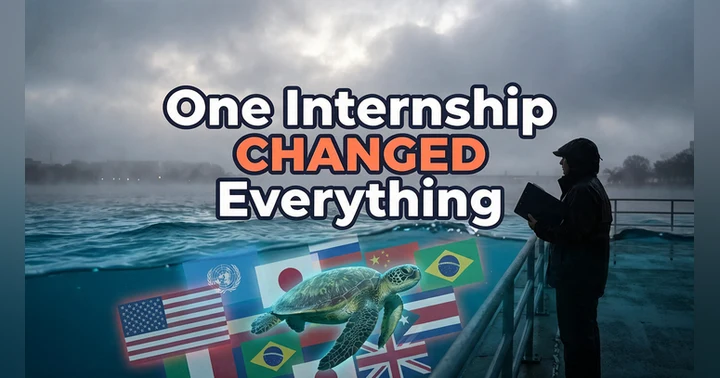
A grad student faces a simple choice: write another term paper, or take a summer internship. She takes the internship, gets assigned to sea turtles, and thirty years later she is in the room for some of the most consequential ocean policy agreements ever negotiated. This episode traces that career from the beginning, and it starts with a realization that shapes everything that follows: sea turtles do not read maps. They cross every border humans have drawn, which means protecting them requires countries to cooperate, not compete.
Andrew walks through the arc of this career step by step. It starts with an anthropology degree and a grad-school detour into public policy, an internship with an NGO in Washington, D.C., then called the Center for Marine Conservation, and a growing understanding that migratory ocean species force international cooperation whether countries want it or not. From there the story moves through the State Department, more than a decade on international tuna negotiations, and eventually a role at the International Sustainable Seafood Foundation (ISSF). Along the way, Andrew connects the story to his own winding path from marine biology researcher to ocean communications manager, and makes the case that careers in ocean conservation rarely move in a straight line.
This episode kicks off a five-part week on How to Protect the Ocean. Tuesday looks at corals nearly as old as the pyramids and the fight to save them. Wednesday covers the High Seas Treaty and the moment the gavel dropped. Thursday breaks down seafood policy and what retailers need to know about what shoppers actually want. Friday brings the full interview with the person at the center of this week's story.
Takeaways:
- Careers in ocean conservation rarely move in a straight line. This one started with choosing an internship over a term paper and grew into three decades of international policy work.
- Migratory species that ignore national borders, like sea turtles, are the practical reason international cooperation and multilateral ocean agreements exist at all.
- Green sea turtle populations are showing real improvement, a genuinely hopeful data point inside an episode that's otherwise about policy and negotiation.
- This is episode one of five leading into Friday's full interview with the guest whose career this episode traces.
Support Independent Podcasts: https://www.speakupforblue.com/patreon
Need help with your ocean non-profit, company, or project? Get the help you need with Pisces Oceans Inc.: https://www.piscesoceans.ca
Connect with Speak Up For Blue
Website: https://bit.ly/3fOF3Wf
Instagram: https://bit.ly/3rIaJSG
TikTok: https://www.tiktok.com/@speakupforblue
Twitter: https://bit.ly/3rHZxpc
YouTube: www.speakupforblue.com/youtube
1:00:00 I want to take you on a journey. This is of a career of a person who actually lived this journey. And I think it's incredible and I want to share it with you. I'm not going to name the name of the person. We're going to find out later on the week because that is the person I'm going to interview. But this person started off as a grad student. They take a summer internship instead of writing a term paper. That's the choice term paper or summer internship. And obviously she took the internship, gets assigned the sea turtle, and ends up spending the next 30 years deciding how the world is going to manage ocean species and how human impacts affect those ocean species. It's quite the journey that I want to share for you because this is what we're going to do on the How to Protect the Ocean podcast is we're going to tell stories.
1:00:43 We're going to give you hope in the ocean by showing you what people are doing for the ocean. And the goal really is here at How to Protect the Ocean to calm that ocean anxiety, calm that climate anxiety into knowledge, knowing what's happening with the ocean, to empower you to go talk about it to your family and friends. To be honest, it actually makes you feel better. Studies are showing it makes you feel better about the ocean to have more knowledge and have this as a resource for this podcast. Not the study that looked at this podcast, but a study said, hey, if you talk more about the ocean and you talk about the people, it'll make you feel better. Now don't combat and debate with people, but talk about the ocean and the two people who want to know more about the ocean.
1:01:24 I hope that you can take the stories that we tell on this podcast and humble people, and they will enjoy it just as much as you did listening to what I'm about to tell you. So if you enjoy this type of information and you want to share that information, hit that follow button right now. And of course, don't forget to share it with somebody that you think would do well with this kind of information. All right. So let's talk about this person. This person grew up in Michigan, went to school in Ohio and Indiana with no international degree. Grew up in the US, straight up US, knows what's in the US. Grew up in anthropology with anthropology degree. In grad school, decided to do public policy coursework. It's a weird step to take. Like you're in anthropology, you're going to have to policy because in anthropology, looking at how humans affect the environment.
1:02:08 So public policy is really how to manage humans in and around the environment. If you're looking at policy within the environment, the chosen internship over writing a term paper, which to be honest, I get that you want to experience, right? If you ever have the chance to choose between a paper, writing a paper and going for an internship, go for the internship. Getting that valuable experience is so, so important. So the internship placed this person with an NGO in Washington, DC. It was then called the Center of Marine Conservation, and then this person was working on sea turtles. That's pretty cool to come out of university or being in university in grad school and being able to work on sea turtles. Just as an aside, that is one of my favorite species. That is a species that I would probably study if I was studying a particular species in research.
1:02:49 Sea turtles is where I would go. They have a great community. Sea turtles are really fascinating. They need our help. It's working with the help that we've seen. We've seen the green sea turtles do better. It's pretty cool, like what we're able to see. Now, the one thing that really got to this person about sea turtles and what really hooked them into going further in this route, like into oceans, was that they realized that sea turtles, they don't read maps. They don't stay within borders. They don't respect any kind of boundaries. When they go into the ocean, when they are hatched and they incubate in their sand sort of den and they hatch and they get out when they go into the ocean. Now, if they survive getting to the ocean, when they get to the ocean, they start going everywhere.
1:03:33 They don't just stay within, say, the exclusive economic zone of the US or Canada or Mexico or anything like that, any country like that. They just go across borders. And we know this because we've tagged sea turtles before. Dr. Wallace J. Nichols, may he rest in peace, was one of the first people on a project tagged in a sea turtle in Baja, California, in Mexico, and it went all the way to Japan. That's how far the tag went. That's how far the turtle went. That's where they found the tag. This is an old school tag too, not like a tag that you can actually watch as you go like a satellite tag. This is a tag like somebody found the turtle with the tag and then reported it back on the listserv and they were able to say, "Oh my gosh, it's in Japan." Cool country, by the way. So we know that these sea turtles go very, very long distances.
1:04:17 And so knowing that where they don't respect boundaries and they migrate long distances and they run into different gear, different vessels flagged to different countries. They can get caught by whatever. They can get hit by a boat. They can get eaten by an animal. They can get caught in fishing nets. They can get caught in a lot of different things. So the question that became this person's entire career is how do you manage and protect a species that ignores every single border? And the answer for that person was international cooperation. So that internship put her in the same room as state department staff and it can't evolve from there. It grew her, it really showed her the light of where this person could be most effective.
1:05:02 And I think the interesting thing is like after that, working in the state department, working in the office of marine conservation, looking at international tuna negotiations until 2012, then working at the international sustainable seafood foundation starting in 2014, like almost a 30 year total. This is how we are looking at a career that takes you all these different places. It's not just on sea turtles at this point. It's as this person starts working on policy and starts working with a variety of different animals and a variety of different human actions in the ocean. The person realized that their career can go much bigger and should go much bigger in order to protect these species that live in this wonderful ocean.
1:05:48 And it's all connected. And so you can't just manage within the US easy economic exclusive zone. You can't just do that in Canada's easy. You can't do this in Mexico, you can't do it in Europe or Britain or any of those. The UK, you can't. You have to understand that it requires cooperation on an international level, depending on where these animals go. Countries can protect the animals that are within their border. They cannot protect animals that are outside the border in the high seas or elsewhere. When you start to realize how this connectedness works around the world, you start to get like in the mindset from a career perspective of like, how can I make a difference?
1:06:28 How can I be involved with protecting a species that goes over every border? And that's what this person did. This person went from place to place to place. It's quite fascinating in learning how this person you learn on Friday, how this person started being involved on major negotiations from negotiating in the UN General Assembly with deep sea trawling. So going into working with the UN General Assembly on working on managing deep sea trawling and looking at how the effect of deep sea trawling affected the bottom and how it affected these coral habitats that are like thousands of years old. And if they go one pass of a trawl, bottom trawl can destroy that area or that section for quite a long time or that pass through, whatever the width of that net is.
1:07:16 And this person is part of that negotiation. That is part of international fisheries negotiations. They're part of like seafood sustainability negotiations and policy. Part of the high seas treaty is in the room when the high seas treaty was agreed upon. When that gavel hit down and you saw everybody become emotional because it was 20 years of blood, sweat and tears that went into that negotiation. And the battles, the little battle that happened within these negotiations is what shapes the final products that might change in the future. But that's the product that people agreed upon. That becomes the regulation that the world agrees on.
1:07:59 Imagine being in a room with delegates from all around the world, over 150 countries, and you are negotiating to protect a species. You are speaking up for species, for habitats, for the ocean. You are there advocating for the ocean, but you're also advocating for the country that you're representing when you're there or the organization that you're representing. A lot of the NGOs are representing the environment, the ocean habitats. All that negotiation, there's compromise that has to be made. And you have to get like a base agreement for the information that is in those regulations or in that policy that will shape the policy for another 10, 20, 30 years until it gets small amendments as it gets made through.
1:08:40 It is incredibly difficult thing to do, especially when it comes down the ocean. Every country has their own agenda and they want to be heard and they want to felt like they were heard. Every indigenous group that are part of those countries want to be heard and they need to be heard. And then you can't just ignore one and expect them to like one country or one indigenous group and then put a policy through and expect them to vote yes on it. So imagine having to please over a hundred people that represents millions, if not billions of people around the world. And you have to make sure that you can do it. So it's almost like this, everybody's in the tent. You've got to keep staying the one tent, stay that base tent, and then you can go off and do other things later on. But it has to be in that one area that everybody agrees and everybody's okay with.
1:09:23 They're not all happy, but they're okay. We're like, you know what? We're looking at this policy as it stands and we're going forward. We're moving forward. And it doesn't necessarily mean that these international agreements are for one ocean. Like it's all every ocean. They could be for smaller management areas around the world. I mean small, I'm still talking about millions of square kilometers. But as the world gets divided up into these management areas, there's policies that go and various countries that are a part of that, that make up that management area because of geography or because of interest. And so there's a set of rules around each of those management areas where you can say, "Hey, this matters. This matters to us and we want to make sure that we are heard.
1:10:06 We want to make sure that we can still function within this and we are happy with it." It could be just based. Not everybody's going to be happy, but they could work with the negotiations. They can work with what's living there, the living document. And so imagine you start off as an intern. Because as a student, as a grad student, you're given a paper or an intern. You get assigned, you're an anthropology graduate, but you get assigned, I mean the public policy program that you're in, you get assigned sea turtles. So you start looking at sea turtles. You realize quickly that sea turtles don't follow borders. They go all over the place. So how do you manage, like from policy perspective, how do you manage those sea turtles if they start to go everywhere? You got to have international cooperation. You have to have these different management areas.
1:10:46 You have to be able to negotiate with multiple countries at a time and really be there for the animals, but also be there for your own country and other countries to ensure that they are happy with the outcome. This is not just a story about a career and how it develops. I mean, that's part of the journey. A lot of people that I talked to asked, "Hey, Andrew, my daughter's in high school. My son's in high school. My child's in high school. How do they become a marine biologist?" And I tell them, like, "What do they want to study?" What's their interest? Trying to get them to niche down. And they want to know what the next step is. They want to know how to grow. They want to know what kind of job to do and everything like this. And a lot of the times when you look at your idea, like an idea of a career, and you just look at what's available to you, just like this person in the story did, they went from graduate student, internship, public policy, international negotiations.
1:11:37 They followed their passion and what was important to them. So I think sometimes when we talk about careers, we get involved in the career and growing within that career. And we kind of have these blinders to everything else that's around us and shut the door on any other opportunities that we may or may not love in the future. As a marine biologist that started off as a marine biologist and wanted to do research, now I'm an ocean communications manager for a consulting firm that has the ability to scale my impact by working with a number of different clients on having positive ocean impact. That is a big change throughout my career. And the career wasn't a straight line. It just wasn't from one opportunity to another to another. I had to create my own opportunities. But I did that by following what I loved, by realizing what I loved and getting out of my own way in terms of like, I need to do this.
1:12:23 The only thing I was stubborn about is I need to do something for the ocean. That is my mission. And then as I went through, there were certain likes and dislikes that I have. And communication won out. And here I am at the age of 47 with a full-time job working as an ocean communications manager. The person who went from an internship to looking at sea turtles and public policy to going to a state department, then going international. Now that person is in a place where they're working on major international agreements. And now that person's ended up working with TUNA and looking at agreements with TUNA and seafood. Everybody has their own path. One of the points of the story is don't just pigeonhole yourself into one area. Be open to the different areas that you may or may not fall in love with as you grow older, as you evolve as a marine biologist, as a researcher, as a conservationist, as a public policy person, as a politician.
1:13:15 You may end up in any of those categories depending on what you feel is important at that point. At one point in my career, I looked at what I was doing as working with government, as working with nonprofits, as working with environmental consulting. And I finally said to myself, like the one thing that is really missing to me in conservation is the fact that the public, the people who are outside that are not being talked to about the ocean on a regular basis are the biggest gap that exists in ocean conservation. And so I decided to start some sort of communication, end up being a podcast after a couple of trials, as you know, that ends up being my path because that's what I feel is important. And there are a lot of other people who go different routes and that's great because we need the help in any way we can get. But the whole point is this career in this story, this person found it by looking at what was available to her and then followed it.
1:14:02 And we're going to be speaking to that person on Wednesday and we're going to be discussing some of the things that this person was a part of over the next couple of days. And I think that's important. We're going to talk tomorrow about how corals is almost as old as pyramids and the fight to save them. That's going to be tomorrow's episode. On Wednesday's episode, we're going to be talking about the high seas treaty and how that gavel that dropped made people weep and become emotional in the room because of all the work that they did and how important policy is to the high seas. And then on Thursday, we're going to be talking about the seafood policy and how seafood and how consumer driven markets really show what retailers need to know about what the public wants in terms of their seafood being sustainable. And then on Friday, we have an interview with the person I talked about today. I'm not going to reveal that person's name. I gave some clues as we went along, but we're going to be talking to that person on Friday about the policy and about Tuna.
1:14:57 And it's going to be a lot of fun. So that's it for today's episode. I hope you enjoyed the story about careers. I mean, it fits people who ask me about careers all the time, but it also fits the people who want to know what it's like to be in public policy and to have that kind of information. So I'd love to hear your thoughts on this podcast. And of course, I'd love to hear any kind of questions you have, any kind of subject materials that you want me to hear about. You can also check out Ocean Decoded Live where I go live every weekday, Monday to Thursday at 4pm Eastern between 4 and 6pm Eastern, depending on my day. We cover all the latest news that's happening in the ocean and some of the stuff that's on here as well, but you'll get a lot of new stuff and some visuals and stuff like that. It's a lot of fun. But anyway, that's it for today's episode. I really appreciate you listening.
1:15:38 If you haven't done so yet, follow this podcast so you don't miss any of the rest of the week's episodes. And of course, five days a week, Monday to Friday, that's when we post. And I want to thank you so much for joining me on today's episode of the How to Protect the Ocean podcast. Have a great day. We'll talk to you next time and happy conservation.