5,000 New Species Prove the "Ocean Desert" Deep Sea Mining Claim Is Wrong


 Apple Podcasts

 Spotify

 YouTube

 Amazon Music

 PocketCasts

 Overcast
In September 2021, Time magazine profiled Gerard Barron, CEO of The Metals Company (TMC), and his push to mine the Clarion Clipperton Zone (CCZ), a stretch of international seabed between Hawaii and Mexico. In that profile, Barron called the CCZ "the most desert-like place on the planet," arguing that mining the deep sea does less environmental harm than mining a rainforest because there's supposedly so little life down there to disturb. That single line has been repeated for years as justification for deep sea mining. Andrew puts it to the test.
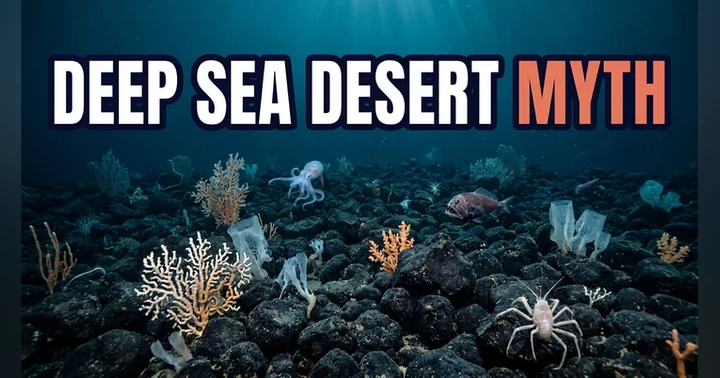
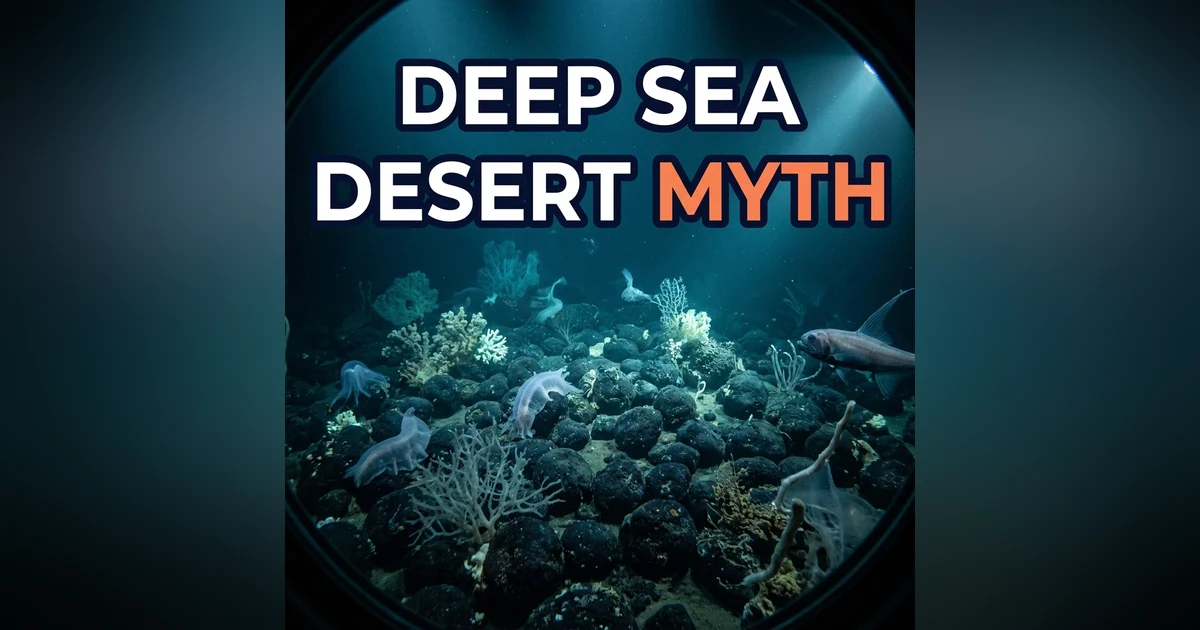
The science tells a very different story. A 2016 survey of the CCZ measured real, on-site abundance of larger seafloor animals and found meaningful densities of megafauna, plus hundreds of individuals per square meter of smaller sediment-dwelling species. A 2023 species inventory led by the UK's Natural History Museum and funded by the Pew Charitable Trusts documented more than 5,000 species in the CCZ, with the large majority entirely new to science. New species are still turning up, including a batch of amphipods described in 2026. And a landmark study on nodule-dependent species found that more than half of the megafauna living in these nodule fields rely directly on the nodules themselves, the very rocks TMC wants to extract, as the only hard surface available to grow on in an otherwise soft, muddy seafloor.
Andrew walks through what happens when the nodules are removed, why TMC appears to be pursuing a path through the Trump administration rather than the International Seabed Authority, and what's at stake for communities near the Northern Mariana Islands, where a new mining lease is moving forward despite more than 60,000 public comments in opposition. This is a fact-check episode: quote first, then the evidence, so listeners can judge for themselves whether "desert" is an accurate description of one of the most biodiverse deep-sea ecosystems studied to date.
Takeaways:
- Gerard Barron (CEO, The Metals Company) told Time magazine in September 2021 that the Clarion Clipperton Zone is "the most desert-like place on the planet."
- A 2023 Natural History Museum / Pew-funded inventory documented more than 5,000 species in the CCZ, with the large majority new to science.
- A 2016 study found meaningful abundance of both megafauna and smaller sediment-dwelling species across CCZ survey sites, not the near-absence of life the "desert" framing implies.
- More than half of the megafaunal species in CCZ nodule fields depend directly on the polymetallic nodules as a hard surface to grow on, the same nodules targeted for mining.
- A 2025 study of an actual industrial mining trial found significantly lower animal abundance at the disturbed site compared to untouched seafloor nearby.
- TMC is pursuing a mining pathway through the Trump administration rather than the International Seabed Authority.
- A proposed lease near the Northern Mariana Islands and the Mariana Trench marine protected area has moved forward despite more than 60,000 public comments opposing it.
Support Independent Podcasts: https://www.speakupforblue.com/patreon
Need help with your ocean non-profit, company, or project? Get the help you need with Pisces Oceans Inc.: https://www.piscesoceans.ca
Connect with Speak Up For Blue
Website: https://bit.ly/3fOF3Wf
Instagram: https://bit.ly/3rIaJSG
TikTok: https://www.tiktok.com/@speakupforblue
Twitter: https://bit.ly/3rHZxpc
YouTube: www.speakupforblue.com/youtube
0:00 I have a question for you. What happens when the person who is trying to convince you a place is empty has never actually gone and checked what's there? There's one man's quote that gets repeated in a major magazine versus what scientists actually found when they went and looked for themselves. So what this is telling us here is that when someone says a quote in a major magazine, it gets taken out of context, and it gets put all over the world. And everybody, your family members, your friends are like, "Oh, yeah, but isn't there anything? There's nothing there." There's like, this quote said this thing, and this guy's a professional. He is a business person, a CEO for a DC mining company, and he says that there's nothing there, so he's gotta be right.
0:42 Why would he lie? Why would he lie? What does he have to gain from lying? Well, apparently, millions and millions and millions of dollars, and that's essentially what's happened here. So today, on the How to Protect the Ocean podcast, we're gonna be talking about this quote that he made. We're gonna go through the quote. I mentioned it yesterday in the Gerard Barron pattern, what I call the CEOs of natural resource companies that want to exploit and don't really care about the ramifications. It's not just against him, but it's just, like, some of the things that these CEOs do that really tick me off because it just, like, whatever they say, people are assuming that they are experts and that they know what they're talking about in certain situations in which we really don't, 'cause some scientists, including myself, really don't know what's down there, you know, until we see the facts.
1:25 And today, that's exactly what we're gonna go through. After we talk about his quote and his claim, we're gonna talk about the facts. If you like this kind of stuff, follow the podcast to hear more 'cause we're gonna be covering stories like this a lot. Like, not necessarily where someone's making a claim that's not right, although that happens quite a bit, but we're gonna talk about the ocean, ocean news, ocean science, ocean conservation in a fun way. And this is a new style that I'm trying this week. I hope you enjoy it, storytelling style. and I really like it. I like doing it, so I'm gonna continue, but I'd love to hear your thoughts too. My links to socials are in the show notes. All right, here's the claim. In September 2021, in Time Magazine, they profiled Gerard Baron, the CEO of the Metals Company, it's TMC, and his push to mine the Clarion-Clipperton Zone, a stretch of international seabed between Hawaii and Mexico.
2:07 Barron told the Time Magazine directly, and this is a quote, "If we started mining over again, knowing what we know now, surely we could carry out extractive industries in parts of the planet where there was the least life. We wouldn't go to the rainforest; we would go to the deserts. That's exactly what we have here in the CCZ, the Clarion-Clipperton Zone, the most desert-like place on the planet. It just happens to be covered by 4,000 meters of water." End quote. That's a direct quote. He's basically calling the deep sea, the Clarion-Clipperton Zone, a desert. So is it a desert? If we sit here and read that, and I tell you that quote, and we sit here without challenging that sounds reasonable. Like, we know that the deep sea, from what we know of before, it's really few and far between that we see animals.
2:51 The anglerfish, deep sea sharks like sevengill sharks, and things like that are found at the bottom, goblin sharks, all these different species, the dumbo octopus. But they're not found all together in these habitats that we know of ' cause we always see them individually. We go based on what we see, what we know. But it's worth taking a serious look at the evidence of what has been found, especially in this area. 'Cause you know what? In 2016, there was a study that was done in the Clarion-Clipperton Zone, the CCZ, and we're gonna talk about that. Cause, like, here's what, like, real surveys in that zone have actually measured, not just estimates, not just saying, "Hey, there's nothing there." Like, the actual counts from images and physical samples taken on site. So for the larger animals, the megafauna, one major 2016 survey of the CCZ, the Clarion-Clipperton Zone, found an average abundance of 1.8 individuals per square meter of seafloor.
3:39 These are, like, larger animals. Like, the ones that you would see, so, like, 1.48 individuals per square meter, that means that's a pretty dense area for larger animals, like the larger fish and things like that. For the smaller animals living in the sediment, like the macrofauna, you're looking at typical abundance across the CCZ nodule regions, which is what's gonna be mined, runs between 200 and 500 individuals per square meter. We're looking at, like, macroinvertebrates and things like that, like worms and crabs and shrimp and all that kind of stuff. One specific Korean-led survey in the region documented 183 distinct macrobenthic species from just 36 core samples at a mean density of 257 individuals per square meter.
4:21 Does that sound like a desert? Like I'm not overselling it here. Like, these densities, they're generally low compared to coral reefs and rainforests, so you see that a lot more. But you're not looking at that comparison. We're looking at what's called a desert, which really implies like near absence of life. When somebody says, "Yeah, it's like a desert out there. If we mine there, we're not gonna bother anything." That's not true here. We're looking at pretty dense areas in the deep sea that we didn't really think was that dense. And what they show, instead of low density paired with exceptional diversity, hundreds of species identified from a small number of samples. The majority of them still undescribed in science. They're new. There are real direct before and after comparisons available now of this, right?
5:03 Not a hypothetical one. So 2025 study examined an actual industrial deep-sea mining trial conducted in the CCZ, found that the machine's track left behind 37% lower macrofaunal density and 32% lower species richness, that means number of species, compared to the nearby untouched seafloor. So we're looking at evidence now where there's been samples. We've seen that there is a density, not as high as like coral reefs, which is like one of the highest diverse habitats in the world. But we're seeing dense. This is not a desert. This is something where there's animals that are living, and they are there for a function of some sort. We just don't know yet, but they're there for a function. And we're doing these tests, and we're seeing that there's animals there, and we're seeing that these are like biologically productive areas and areas where we don't even know these species existed before.
5:49 Like insane to see, you know, that you're gonna be disturbing things. And the species that are there that we don't know about could be helping the human race at some point in time with vaccines or our health to help us get over like cancers and things like that. We have no idea, no idea what these things can do. Now, some people like thought the claim was believable. So the CCZ sits about 4,000 meters below the surface, so far past the reach of sunlight, so nobody can see. It's cold. There's high pressured water. And to the untrained eye and even early photography of the area, the sea floor looks like it's an endless plain of mud dotted with rocks. So like all they saw were these nodules. So for decades, deep abyssal plains like this one were assumed by many to be biologically sparse compared to shallower sunlit areas.
6:30 That's what it was. So like you had these older pictures that we couldn't do the sampling that we are doing now, and we just didn't have the technology to be down there to not cause a ruckus to see these animals. And so it looked like it was biologically a desert, right? I get it. I get it. But like in 2023, research at the UK's Natural History Museum funded by the Pew Charitable Trust, published the first comprehensive species inventory of the CCZ. This is the area that they're going to target for deep sea mining, so this is the area that has been focused on the most. The count came to more than 5,000 species documented in the zone, including sea cucumbers, corals, glass sponges, and various worms. Corals and glass sponges, these are habitat-forming species.
7:11 Somewhere between 88 and 92% of those species had never been recorded anywhere else before, meaning that they were completely new to science. So you're going from desert to 88 to 92% of the 5,000 species that were found had never been described by science. That's a pretty high percentage. Not a desert, that's for sure. The species discovery still haven't stopped. In 2026, researchers described 24 new amphipod species from the CCZ. This is the same region, including a species representing an entirely new super family and family, and a genuinely rare kind of discovery in modern taxonomy. Like, roughly 90% of all the species found in the CCZ remain formally unnamed even now, 'cause it takes a while to name them and describe them, years after the mining companies began pushing for the start of extraction.
7:57 Now, the International Seabed Authority itself launched an initiative called the 1000 Reasons, aiming to formally describe 1,000 new deep sea species by 2030, specifically because so much of what lives there is still undocumented. This is the Seabed Authority. This is the International Seabed Authority that is responsible for creating the regulations for deep sea mining, and now they want to be able to describe these species, at least 1,000 species, DC species, so that we can know what's there. The same agency that's responsible for regulating mining in the exact same zone is also running a campaign to acknowledge that there's little known about this area, and that's why, like tomorrow's episode, you're gonna hear from Matthew Gianni of why there is so much skepticism about whether deep sea mining is a good idea.
8:42 If it's economically viable, it's even worth it. But from an environmental standpoint, is it gonna be too damaging where we just can't recover? So now one of the things here is what's actually making deep sea mining possible, is like what lives in the CZ and why it all lives there. So the polymetallic nodules that Barron's company wants to mine, they're not just valuable rocks sitting on empty mud. They're not just there for them to be plucked so that we can use. They are themselves the reason so much life exists in that environment. Beyond that they produce oxygen study that happened. The sea floor in that zone is otherwise soft sediment, and most deep sea animals can't attach to the mud.
9:23 That's why a lot of these areas look like they're just quote unquote, deserts. So the nodule provides something rare in the deep abyss. It has a hard surface to grow on. So a 2016 study by friend of the podcast, Dr. Diva Amon and colleagues published in Scientific Reports that was led out of the University of Hawaii at Manoa, found that more than half of the megafaunal species living in these nodule fields depend on the nodules directly as a hard substrate to attach to and survive on. Like, now we're looking at the nodules that we're looking to take, these animals are literally living on them. So yes, you are going to be killing species. We know that for a fact, not only from the actual operations of these machines, but you're actually gonna be taking animals that need these nodules, and you're gonna be killing them 'cause you're gonna be taking them off as you bring them up to the surface.
10:07 So the same study found more than half of the species collected during the survey were entirely new to science. So again, more new to the science, more rare species, more damage to the environment. Now, a separate line of research measured raw abundance rather than species count and found nodule-dwelling animals can make up to 60 to 70% of the total number of individual creatures present in nodule fields. Now, all of these indications really start to point that we are going to damage the environment. The nodules that they're actually targeting in this area are the very habitat that is expected from many of the species, like 60 to 70% of those species in that area. That's just talking about, like, the animals that are there.
10:48 A follow-up food web modeling study estimated that removing the nodules could cause a loss of up to 18% of all species or taxa present in the CCZ. So the rocks he's, like the areas where he's calling a desert that these rocks sit on, far more than half of the animals living there, it's the only reason they can live there. So removing the nodules doesn't just disturb the area, it actually takes out all of the species, like the habitat itself for those species. And this is what they're there for. This is what they're gonna be grabbing. Now, scientific studies have specifically identified what are called nodule-dependent or nodule-obligate species. It's the animals that rely on those nodules for some essential part of their life history, whether it's their adult life or whether as they're developing into an adult.
11:30 And it cannot just simply relocate if the nodules are gone. So like they need to be, they need to have the nodules. All this puts like a number on what disappears if mining proceeds at a scale. So it's not just the claim of a desert, it's like this is what's gonna happen because if you take these nodules, which you're targeting for this money, then you are going to destroy the environment. We know this for a fact. It's not a small fraction, it's more than half of the larger animal species in these fields. And that's according to that Diva Amon study in 2016. Now, other research confirms that nodules provide the hard substrate that suspension feeding and stationary animals like sponges and cnidarians depend on, so corals. And these are the very animal groups that dominate the megafauna in Eastern CCZ.
12:13 So like again, we're seeing this hit every single time. A CEO comes in, so it's like my claim yesterday that these CEOs come in and they say, "Hey, you know what? We're not gonna do any damage. Don't worry about it. We're fine. Like it's a desert down there." And the scientist is like, "Well, we're gonna call your bluff on that and we're gonna go down there ' cause we think we wanna know what's there, and then we're gonna just take it all up and we're founding." So like if we go back to the Baron's own words from the opening of this episode, " The CCZ is the most desert-like place on the planet." And then now we have all the evidence, over 5,000 species documented and still climbing. Roughly 90% of them are entirely new to science, and more than half of the larger animal species there depend directly on the very nodules that the company wants to remove.
12:54 When I say that we don't know the damage that's gonna be done in the deep sea, in this particular case, we know the damage that's gonna be done in the deep sea. And it's probably why the Metals Company is not pursuing deep sea mining through the ISA, the International Seabed Authority. They decided to go with the Trump administration because everything they say, all the claims that they make have been debunked, especially in the Clarion-Clipperton Zone. So now they're going a different route. They're going to the Trump administration, who we know they don't care about the environment. All they care about is making money, and for the country, or for themselves, who knows? Allegedly. They're already showing that they're gonna pursue with these leases. TMC's got major investments going, and if they get this lease that's coming up in the Northern Mariana Islands, their stock is gonna go up.
13:37 Now again, I said yesterday, whether they decide to continue to mine, like to actually do the deep sea mine, or they just sell their stock because it's gone up, that's another story. But I guarantee you that if Barron can make money, he will make money from whatever he can do. And as the ISA, you're gonna hear tomorrow from Matthew Gianni, as the ISA kinda concluded, we don't really know if there's economic sustainability in deep sea mining. Because the way things are going, the claim for deep sea mining is to help perpetuate the EV market. Grow the EV market by making more batteries through critical minerals, and by taking the pressure off of land mining in rainforests like human rights violations. Yet these batteries are getting better and more efficient, and they're depending less on the metals that are being mined in these areas.
14:22 So what do we do? Right? What do we do? Is this really worth it? Is it really gonna be worth it? Not to mention that this US effort right now in the Northern Mariana Islands, they haven't really consulted with the local people and government of the Northern Mariana Islands. And this is happening right off of their shore, where there's a marine protected area called the Mariana Trench, right? Which is one of the deepest parts of the world. There's no consultation on how the people will benefit. There's no indication of sharing of profits to the local people. but they're gonna take the brunt of the consequences, just like I said yesterday Papua New Guinea did, if things don't work out. So really it's up to you. There's a lot of pressure on what's happening here. Deep sea mining doesn't look like it's gonna be economically viable, and that's according to the International Seabed Authority, not just scientists.
15:07 These are regulators, these are business like economists and things like that, that are all a part of this. It's a UN body. Yet the US government is like, "Hey, we can do this. We can make money. We can do this," although we don't even know if we can make money. We just know that the stocks will go up if there's an indication that we are going to do something. And so, we know that's gonna damage the environment, like a lot. In my opinion, there's really nothing to do but to vote this down. And for those of you who are in the US and you have a chance to vote this November or the elections that are ongoing as we speak, I highly recommend that you vote. If you are listening to this, you care about the environment, or you're interested at least. And it's really up to the policymakers. There have been lots of cases and lots of committee meetings, Senate and House committee meetings on deep sea mining, and there's a lot of information there that shows that this is not a very good idea or we don't even know the ramifications economically and socially for the people who are around these areas, the Northern Mariana Islands, the American Samoa.
16:00 Yet this government continues to ignore those people's concerns. And when they did the request for information and feedback from the public, over 60,000 people said, "We don't want this. We're concerned." And like three or four comments said that they're okay with it, and they doubled the actual size of the lease. It just doesn't make sense. And so the November elections, the midterms are coming up. There could be a significant change. I'm Canadian, I'm not here to manipulate or influence in any kind of way. But if you wanna save the environment, especially that, and you care about some territories in the US that, have become very important and take the brunt of the consequences from decisions that have been made over decades and decades and decades of bad decision-making by the US federal government, this is your chance.
16:43 So I'd love to hear your thoughts. Hit me up in my socials on TikTok, Instagram, Facebook. Love to hear your thought, or on LinkedIn if you can find me. But other than that, yeah, I'd love to hear your thoughts. Share this with somebody that you know would enjoy this, and don't forget to hit, hit the follow, and please vote. Please vote this year. And I wanna thank you so much for joining me on today's episode of the How to Protect the Ocean podcast. I am your host, Andrew Lewin. Have a great day. We'll talk to you next time, and happy conservation.