How 4ocean Turned Bracelets Into 50 Million Pounds of Ocean Trash Removed


 Apple Podcasts

 Spotify

 YouTube

 Amazon Music

 PocketCasts

 Overcast
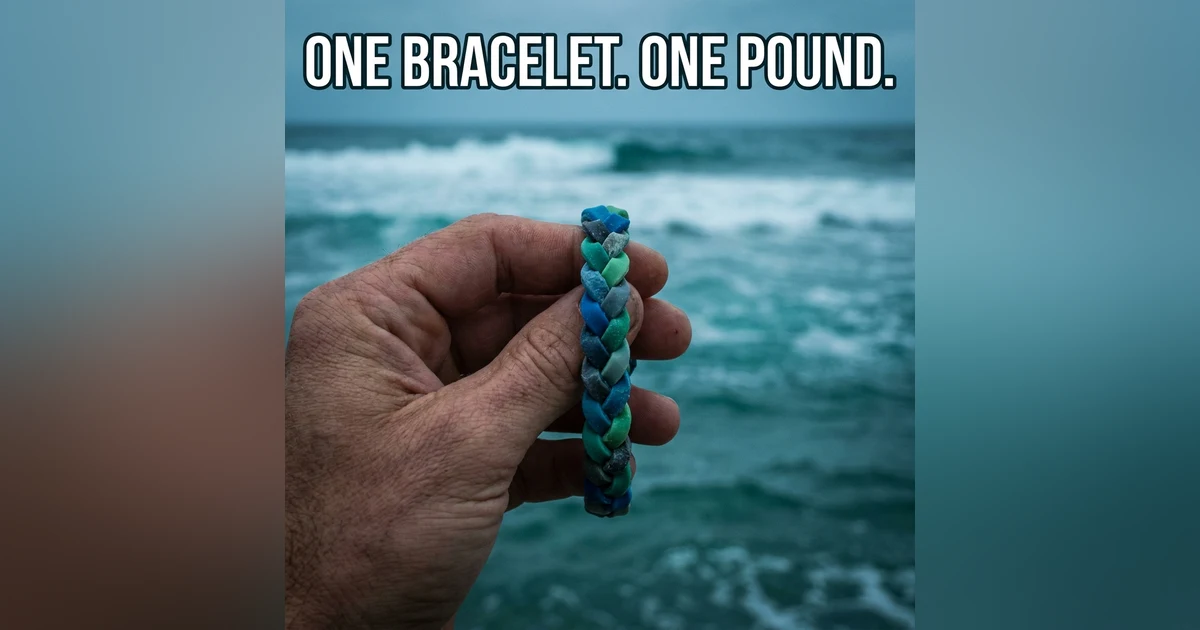
4ocean has removed more than 50 million pounds of plastic and trash from the world's oceans, rivers, and coastlines. That milestone did not come from a government program or a traditional nonprofit. It came from a for-profit business built around a single idea: every bracelet sold funds the removal of a pound of ocean trash.
In this episode, Andrew breaks down how 4ocean went from one viral video in Bali to a global cleanup operation, why founders Alex Schulze and Andrew Cooper chose a business model over a nonprofit, and how the company built local jobs, recycling infrastructure, and B Corp accountability into its growth. He also digs into the harder questions worth asking about any cleanup business, including the tension between extraction and prevention, the tradeoff of turning recycled ocean plastic into apparel, and why independently audited impact numbers matter more than self reported totals.
Whether you're building a career in ocean conservation, running a sustainability focused business, or just curious how a bracelet company ended up pulling 50 million pounds of trash out of the water, this episode gives you a clear look at what works, what's still unresolved, and what to look for the next time you're deciding where to put your money.
Takeaways:
- 4ocean was founded in 2017 by Alex Schulze and Andrew Cooper after they saw plastic pollution overwhelming the water while surfing in Bali
- The company has removed more than 50 million pounds of plastic and trash from oceans, rivers, and coastlines as of February 2026
- Every product sold ties directly to a measurable outcome, which makes the impact tangible for consumers
- 4ocean is a certified B Corp that hires and pays local workers in the regions where it operates, including Bali and Haiti
- The company is launching an Impact Dashboard in 2026 to give corporate partners traceable, verifiable insight into their funded impact
- Extraction models like 4ocean's remove existing trash, but prevention policies are still needed to stop plastic from entering waterways in the first place
- When evaluating any cleanup organization, look for independently audited impact numbers rather than self reported totals
Support Independent Podcasts: https://www.speakupforblue.com/patreon
Need help with your ocean non-profit, company, or project? Get the help you need with Pisces Oceans Inc.: https://www.piscesoceans.ca
Connect with Speak Up For Blue
Website: https://bit.ly/3fOF3Wf
Instagram: https://bit.ly/3rIaJSG
TikTok: https://www.tiktok.com/@speakupforblue
Twitter: https://bit.ly/3rHZxpc
YouTube: www.speakupforblue.com/youtube
0:00 Imagine you're a surfer and you're sitting along the beach in Bali, Indonesia, one of the, probably the primo hotspots for surfing. I'm not a surfer, but I've heard a lot of great things. I'm a diver, and I've heard that's a great place as well. But then you start to notice that while you're in the water, there's a crap ton of garbage and plastic floating around in the water. If you're a diver underwater, you'll also find that just kind of floating around. It takes away the beauty of surfing or even diving underwater of all the reefs and all the beauty that you see while you're sitting on your board waiting for the next wave or chatting with a friend who's on a board as well as you're about to, you know, take turns riding a wave.
0:40 Then you decide what could we do to help this? A lot of people are like, "I wonder if somebody's cleaning this up." And let's be honest, a lot of governments aren't cleaning up a lot of this plastic that's coming in. We don't know who's responsible for this plastic. It could be, anywhere from around the world where this plastic is coming from. They've been traced to go from Canada all the way to Asia and vice versa, and everywhere. And it really just depends on where the currents go. We heard of the Great Pacific Garbage Patch, and you hear like the five gyres and the plastic floats in these five gyres, and they kinda congregate there. But it still washes up on shore, and somebody's gotta clean it up at some point. In comes the 4Ocean founders, Alex Schulze and Andrew Cooper. In 2017, they founded 4Oceans and have now surpassed 50 million pounds of plastic and trash removed from oceans, rivers, and coastlines as of February 20, 2026.
1:32 That is a huge amount of plastic that's done, starting off from one video that went viral, and selling bracelets, and eventually apparel, and using corporate sponsorships and then some grants and donations, eventually, to pick up 50 million pounds of plastic. And that is an insane amount. That is wonderful. I remember a couple years ago, I interviewed Alex Schulze, who was phenomenal. He was fantastic. I will link to the show notes. But today on the podcast, we're gonna be talking about why it's so important that 4Oceans exists as a business, and what they've been able to accomplish in that business to show you that it is possible to turn something as gross, I guess, as picking up ocean plastic from the water, to make it into a profitable business that does a good thing.
2:18 And you have this social enterprise and B Corp that has really been able to build a great model and show people what you can actually do, and either replicate that model with plastic or something else where you can do some good for the ocean and good for the planet. So we're gonna talk about that on today's episode of the How to Protect the Ocean podcast, where we talk about ocean news and fun things that happen in the ocean, and some not so fun things that happen to the ocean, and the people who are finding solutions to do something on a daily basis right here, Monday to Friday, on this podcast. So if you are interested in this kinda stuff and this is your first time here, or you've been listening to this for a while and you actually haven't hit that follow button, now is the time to hit that follow button, because we're gonna be talking about businesses and electric motors on boats and how to earn a living wage using like doing something on a coastline all during this week, and next week we're gonna be talking something different, but it has to be all about ocean news.
3:09 So it's gonna be fun. I'd love for you to take part. Don't forget to follow so you don't miss any episode. If you wanna support the podcast and all the work that I do on YouTube as well as on TikTok and Instagram and Facebook, you can do so, and LinkedIn of course, you can do so by going to speakupforblue.com/patreon and join our Patreon community there. That would be wonderful. Okay, let's talk 4Ocean. So Andrew Schulz now is the sole owner and CEO of the business. Like I said, he surpassed 50 million pounds of plastic as of February 20th, 2026, and basically, him and his original founders basically showed how you can create a for-profit business and do something good for the ocean by picking up plastic. And this is not like where he promised he would clean up the ocean by 2030 or by 2050.
3:53 All he's doing is having one simple thing. He's like, "For every bracelet you buy, we're gonna pick up one pound of trash, or five pounds of trash depending on the product line that you buy and time of year." And so by being able to tying something tangible with each product makes it really worthwhile, and I know a number of people here in my local area of Burlington, Ontario, who have been able to purchase bracelets and have been proud to show me, a marine biologist, to be like, "Hey, look what I'm doing. I'm helping protect the ocean just by buying a bracelet." It democratizes cleaning up plastic in the ocean, just like 4Oceans is doing by saying, "Hey, I bought a bracelet just to make sure that we pick up one pound of plastic, and I'll buy more.
4:33 I bought some for the kids, I bought some for my wife, I bought whatever." That is a huge thing. That makes people feel like they're a part of something even though they're not actually doing the action, and I think that's a really important aspect. And 4Oceans is not just like a public benefit corporation, a certified B Corp. That's huge. That's great that they are. But what they are is they come in and they, say like they have a headquarters in Florida, but they have an office in Bali. And what they do is they don't just hire Americans to work there, they hire people from Bali, people who are going to benefit from not only taking out the plastic, 'cause they're gonna have to do it, that office is gonna have to do it, but also being paid livable wages so that they can continue to do that and they don't have to look for another job.
5:14 It's creating a business that can have their employees contribute to the economy by buying things and taking care of their family and all that kind of stuff. Plus, they put in infrastructure for recycling plants and everything so to divvy up and separate out the garbage from the recycling and what they can use to build the bracelets as well as any of the other apparel that they have. And it's great. And so they have this infrastructure there from offices and headquarters and all that kind of stuff, and I think it's really great. They do it in Haiti as well. They have other places around the world that they work, and they're working to essentially build up this infrastructure to pick up trash. And I think that's wonderful. And just like the story at the beginning of this episode, the founders were looking at beaches in Bali in 2015.
5:56 They noticed that while they were surfing is, there was a lot of plastic in there, and they said, "You know what? Can we do it in a business and not just a nonprofit?" ' Cause the thing is, like when you have like traditional nonprofit, the grant funding cleanup models struggle to sustain year-round daily operational funding. It's very difficult to do that. It's very difficult to be able to sustain those operations at the level that you need to do and be able to fulfill what you want to do. In this case, it's cleaning up coastlines and rivers and the ocean. So being able to have a for-profit business, being able to sell goods to pick up other things that are in the ocean, like plastics, it's amazing. And if you go on their social media site, you'll see videos of them going to different places in Indonesia, like in Bali or, around the US or in India and other places around the world where rivers are just congested with floating plastic.
6:44 Sometimes they're big pieces, sometimes they're little pieces, and you actually watch them complete, so you get that social proof that they're actually doing this work And you're actually looking at them taking a river that's completely congested with plastic pollution, and they clean it all up, and they show like how it goes in like within a certain time frame. So they kind of fast-forward everything, and you get to watch them clean it all up, and by the end it's all clean. Now, that could fill up again because the infrastructure still needs help. This shows that you can clean up a beach, that you can clean up a river, you can clean up a coastline, but you can't prevent the plastic from going in. And that's where it partners with other organizations to work on policies to ensure that waste management is done properly, not only in the US and in Canada, but also around the world, especially where they work.
7:26 'Cause there's a reason why they wanna continue to do this business. They wanted to create is like, is trying to purchase like a measurable, verifiable outcome, like a specific weight of plastic removed for everything that's bought. It gives consumers something to kind of sink their teeth into. Now, some of the interesting things that happened, like it took 18 months to reach the first million pounds removed, and the company is now roughly moving 1.2 to 1.3 million pounds per year because it's been able to grow and work in different places. And the model has scaled to 12-plus cleanup locations across the US, Guatemala, Indonesia, and previously Haiti. So that's huge to see how these areas are expanding. And when they expand, they have offices in these areas, so it's not just like they're coming in, taking it out once and then leaving and then watching it refill.
8:09 This is a constant thing that's happening. And now, like in 2026, 4Ocean is launching an impact dashboard platform that's supposed to give corporate partners traceable, verifiable insight into their funded impact. So an example of the transparency demands that consumers are placing on cleanup as a business model. It's not just to say, "Hey, we're gonna clean up a pound of trash." It's easy to say that. To do that is harder. But it's easy to say, "I can… I'll clean up a pound of trash. Sure, no problem. I'll just go in my neighborhood, pick it up." But to be able to film it, to be able to actually show the documentation of it happening, that's a huge thing. And look, let's be honest, like there's no government model or mandate that's driving this model. It exists because consumer demand and corporate sustainability partnerships, which raise a fair question around the limits of reliant on purchasing power rather than policy to fund the ocean cleanup.
8:57 Here's the thing. The bracelets fund it and, apparel fund it, but , I guess, the downside of it, is that they're recycling materials to make the apparel, but then the apparel will eventually go into the garbage, and then will it be contributing to more ocean pollution? But at least we're delaying it for a little bit, so there's still a problem with that. But even like, companies like Patagonia recognize that selling apparel causes more waste, even if they're recycling it. And so there is that pushback when I speak to people about these types of companies, and be like, "Well, yeah, but they're just delaying the inevitable of this stuff coming in." But we need to reuse a lot of this material. And to be able to reuse it and sell it where there's something good coming out of it, I think is worthwhile in this regard. And I would love to hear your thoughts on this, because it's important that we clean stuff up, but if it's putting it in bothers you, I completely understand, but I would love to hear your thoughts on that and why that's happening.
9:45 Now, if you wanna participate in this, you can go to 4 oceans, you can go to their website, you can buy a bracelet or other apparel, and you can participate in this. If you're gonna look for another cleanup organization, maybe a smaller one, just make sure that they publish independently audited impact numbers, so not just the self-reported totals. ' Cause it's really easy to fudge these things because there's money involved. You wanna make sure that, like, if you're starting that kind of business, you wanna make sure somebody, like, from a third party independent auditor actually looks at doing this kind of stuff, because I think that's really important. And of course, understand the difference between prevention models, and then extraction models. So removing after the fact, but also preventing, like, stopping plastic before it enters the waterways, stopping the use of plastic, policies that take away single-use plastic use.
10:26 All those kind of things really, really help. And it's worth knowing which company you should be donating or funding in that time frame when you look at that. And of course, consider buying a product is one form of support. But corporate partnerships and policy pressure will move volumes than individual purchases alone. So obviously, if you have companies like this, corporate sponsorship is what really moves the needle, but individual sponsorships and individual purchases really, really help. You just have to get to the volume that you need to be able to make a difference and really get to a point where you can be satisfied with what you want. But, you know, congratulations to Alex Schulze and all his founders, and the people who are working there now, because 50 million pounds of plastic and trash removed is huge from the oceans, and I really respect what they've been able to accomplish.
11:08 And the way they've been able to talk about it on social media, I think they've used social media and a lot of the social media platforms as they were growing in popularity. And I think that's an important aspect, and, you know, being in the right place at the right time and As someone who works as an ocean communications manager and works with a lot of startups and businesses, having a communications plan before you move forward, and talk to people and try and get donations or investment money and angel investors is really important. And that's what this company did. That's how they were able to sell out of bracelets after their first video. Don't expect to go viral, but definitely expect to have a communications platform and strategy to be able to talk about your business. So anyway, just a, little shop talk. And I've got an announcement next week where we're gonna be talking about this podcast not some changes you'll hear, but some changes for me that have benefited me.
11:56 So, we're gonna hear more about that next week. So stay tuned, follow if you can, if you want. Please do follow so you don't miss next week's episodes. We got one more episode before the interview with Alexander Mangione talking about EV motors on boats. So it's gonna be exciting. But stay tuned for tomorrow, because tomorrow we're gonna be talking about how living wages work on coastal conservation work. So that's gonna be a lot of fun to talk about that, something that's very dear to my heart. So yeah, stay tuned. Thank you so much for joining me on today's episode. If you wanna support us, go to speakupforblue.com/patreon. You've been listening to the How to Protect the Ocean podcast. I'm your host, Andrew Lewin. Have a great day. We'll talk to you next time, and happy conservation.


