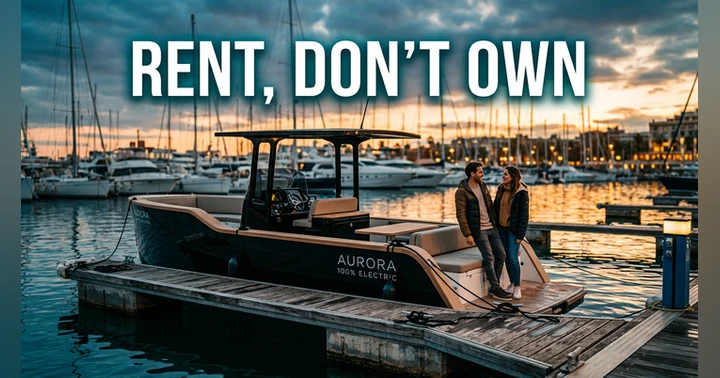
The Boat Sharing Economy Is Exploding, Here's Why You Shouldn't Buy a Boat


 Apple Podcasts

 Spotify

 YouTube

 Amazon Music

 PocketCasts

 Overcast
The boat rental market is bigger than most people realize, and it's growing fast. In this episode, Andrew shares a personal story about his dad, boats, and why he's spent the last few months considering buying one, before walking through the data that changed his mind about ownership altogether.
Andrew breaks down the numbers behind the boat sharing economy: a market valued between nineteen and twenty three billion dollars US, growing five to seven percent a year, with electric propulsion emerging as the fastest growing segment in boat rentals. Peer to peer platforms like Getmyboat, Boatsetter, Click and Boat, and Samboat are expanding access based boating, and membership and club models are outpacing traditional ownership. He also digs into why electric motors are becoming the preferred choice for rental fleet operators, from lower maintenance to fewer moving parts to a quieter, more pleasant experience on the water.
This episode sets up Friday's interview with Alexandra Manjon, who runs an electric boat sales business, for a deeper conversation on electric motors and where the industry is headed.
Takeaways:
- The global boat rental market is valued at roughly nineteen to twenty-three billion dollars US and growing five to seven percent annually
- Electric boats are the fastest-growing power source segment in boat rentals, projected at a compound annual growth rate near seventeen to eighteen percent through 2031
- Peer-to-peer platforms like Getmyboat, Boatsetter, Click and Boat, and Samboat are expanding access-based boating over ownership
- Electric propulsion means lower maintenance and fewer moving parts, making it attractive for rental fleet operators
- Renting lets you try a boat, including an electric one, without the upfront cost or ongoing maintenance burden of ownership
Support Independent Podcasts: https://www.speakupforblue.com/patreon
Need help with your ocean non-profit, company, or project? Get the help you need with Pisces Oceans Inc.: https://www.piscesoceans.ca
Connect with Speak Up For Blue
Website: https://bit.ly/3fOF3Wf
Instagram: https://bit.ly/3rIaJSG
TikTok: https://www.tiktok.com/@speakupforblue
Twitter: https://bit.ly/3rHZxpc
YouTube: www.speakupforblue.com/youtube
0:00 Have you ever thought about buying a boat? I'm gonna share a story today about why I've always been interested in boats and why I'm interested in purchasing a boat. But now, after learning about what we're gonna be talking about in today's episode of the boat-sharing economy, I have maybe changed my mind about boat ownership, but I'd still be able to get out on the boat whenever I need it. So we're gonna talk about that on today's episode of the How to Protect the Ocean podcast. This is a podcast where you find out everything about ocean news from what's happening in science, the latest trends, some of the advocacy things that are going on, and some of the business end trends that we're seeing in being able to have a sustainable business that is good for the environment, good for people, and good for the economy all in one.
0:42 About like a triple bottom line, and make some money of course. And so that'll always be good, and this is where we talk about Monday to Friday. So if you like this type of information, feel free to hit that follow button, because this is where you're gonna get it. And we have an interview, and we're talking about businesses and how people are making wages and sustainable decisions about businesses and having businesses that allow people to be better for the environment all week this week. And on Friday we have an interview with Alexandre Mongeon, who owns a boat-selling business, and he sells boats, and we're gonna hear about electric motors and why those are so great. We're gonna hear about it today too, 'cause in the boat-sharing economy, electric motors are actually really handy. So we're gonna talk about that today. Now first, a little story. Okay, so when I was a kid, I was always interested in being a marine biologist.
1:25 I would talk to my dad, I would talk to my mom about it. My dad was on a fishing boat briefly when he was a kid, right out of high school in Quebec City. And I remember him talking these stories and talking and talking about being on this boat and being fishing, and he says he'd always loved to get a big sailboat. And of course, you know, when I was a kid I'm like, "Dad, one day I'm going to buy you a boat. Like, that is my dream. I'm gonna get you that boat." And so it was almost like an on-running joke. I don't think my dad ever expected me to buy a boat. I think he would've been happy with a boat. I never did buy him a boat before he passed away, but we always talked about it. And of course, we would get lavish with a yacht, and he's like, "Well, I don't wanna drive the boat. I want a captain and I want a crew, and take your mom everywhere, and take you and your brother everywhere around the world," and all this kind of stuff like we were millionaires.
2:07 And we weren't but we, you know, we did all right. But not enough to get, like, a big yacht like that. But that's something that I valued. I wanted to get that for him, and deep down I still wanna get one. Like, over the last couple months I've been really looking at buying a boat because of those stories and because it reminds me of my dad now that he's gone. But also, I've always wanted to have a boat. But I don't always need a boat, 'cause the thing is, it's a big investment. You know, you're looking at tens of thousands of dollars, if not hundreds of thousands of dollars, almost like another mortgage. It's costly to maintain and it's a tough thing to have for a lot of people. So I'm always at that point where I'm like, "I want to be able to have a boat whenever I go to a cottage or if I wanna go out on the day to do something, and that would be kinda cool to do.
2:50 And to be honest, I never really thought you could rent boats, or I did know you could rent boats, but I thought it'd be extremely expensive. I didn't think there'd be a lot of people who did it. Apparently, the boat-sharing economy is growing. So apparently, as of, the last study in 2026, valued the boat-renting market between 19 and $23 billion US, depending on the research firm that you're looking at, but it's growing roughly 5 to 7% annually. And full electric boats are the fastest-growing power source segment in boat rentals, projected at about 17.62% compound annual growth rate through 2031, compared to gas-powered boats rentals, which will still dominate the current market.
3:33 So that's a pretty big deal. It's increasing. I'll be honest, I didn't hear much about the electric boating industry until this week, and I've done one other interview with an electric boating company. But they were like a smaller type company that were designing their own engines, just like Alexander's gonna talk about today, but he's got a bigger platform to work off, and we're gonna hear more about that this Friday. But you have these peer-to-peer platforms now called GetMyBoat or Boatsetter or Click&Boat and Sandboat. They're expanding access-based boating instead of ownership. So if I didn't want to own a boat and pay for all the maintenance, and I don't really know what I'm doing. Every time I hear about buying boats, people are like, "Well, if you buy a boat, you're always fixing the boat, so be prepared to have a budget to fix the boat."
4:16 So it's nice to have something that where it's like if I wanna go out on the water and I wanna be on the water, I wanna be in nature, I like hiking and everything, but I'd rather be on the water. I can actually rent a boat and go out. I don't have to invest the money to go out and do that. It's almost like cottaging in Ontario right now. If you want to go to a cottage, you can rent a cottage, and you can spend a good amount that week, but you can rent a cottage, and it'll feel good. Like, you'll have the amount of money that you need to have or you'll have what you need, and you can have fun, and you can return that boat. Maybe you'll be able to get that boat another time. In a cottage, you can do the same thing. You can rent the cottage, you can go stay at the cottage, and then you're done. You don't have to worry about maintenance. You don't have to worry about upkeep. You just enjoy. You pay a little bit more, but if you're only using it for the week, maybe two weeks, it's more like a vacation than anything else.
4:58 You're not gonna go out and buy a hotel room at a resort, or some people do, at a timeshare. But it's nice to be able to go and just not have to worry about the cottage that you're at. It's the same thing with boats. It's nice to be able to rent a boat, go out and enjoy that time, and then come back. When you're done, you just give it back. And as long as you keep it in good shape while you're using it, then it's pretty good. And so membership and boat club models are growing faster than traditional ownership and this is according to industry trend reports. So that's pretty cool. Because like, let's be honest, like I said, boat ownership has, like, they carry a high upfront cost, and the maintenance burdens, like, I don't wanna have to deal with or most people try to avoid. And then digital booking platforms have made peer-to-peer and short-term rental far more convenient than having to look it up on a website, send an email, wait for that to come back, and all that kind of stuff.
5:45 And then you got, from the boat rental position, you have electric propulsion that has a lower maintenance requirements 'cause like, my electric vehicle, I have a Tesla, my electric vehicle, when I bring it in, I bring it in once a year. And the maintenance is a lot lower than it would with my gas-powered car. So an electric propulsion boat would be the same as a gas-powered boat. It'd be less maintenance every year. And so when you have lower maintenance requirements than combustion engines, that makes electric boats a lot more attractive for rental fleet operators specifically. And then since like fewer moving parts means like less of that downtime, right? So you're not fixing that boat all the time. ' Cause let's be honest, like the one thing, if I were an owner and I was renting out boats, I would be worried about what people are doing to that boat, and all the little things in the motor that could go wrong that will allow for more upkeep on the boat and more maintenance on the boat.
6:36 You'd be paying a lot more maintenance fees. Whereas an electric boat, there are less parts, and it might be more expensive to fix if it needs fixing, but you'd probably have to do it less times. And so that's always a great thing. Now, of course, the interesting thing too about rentals, like with the shared use models, means fewer total boats and engines that are needed to serve same number of boaters. Not everybody could afford a boat, just like not everybody could afford a cottage. And reducing manufacturing demand and fuel use per person on the water would be a great advantage as more and more people are renting out cottages and they're going to cottages. They wanna be on the water. Like I see in my neighborhood, I don't know what it is, but a lot of boats are being bought. I think what happened is during COVID, a lot of people bought boats, and then now are selling them for cheaper because they don't need boats.
7:18 So I think that's kind of interesting in that respect. So I think electric motors are making a big push. And then, the first-time renters make up to close to 38% of the total customers in some of these markets. That suggests that like the access model is pulling new boaters rather than converting existing boaters. So people who are boaters, they may like the boat ownership 'cause they're used to it, they're used to that model. But for people like me who've never owned a boat, and I may not have the ability to buy a boat and then afford the maintenance, and I just only use it like once or twice a year, it doesn't make sense for that for me. So this is a way to really go out and get that information there, and I think that's really, really important. The politics around all of it is that marina infrastructure investment's gonna have to increase.
8:00 It's gonna have to include more shore charging stations, which is being driven by both private rental operators and in parts of Europe and North America, municipal waterfront upgrade programs, which is kinda nice. And there's no major federal regulatory push specifically for electric rental fleets yet, but the growth so far is market driven. At marinas, you're probably gonna start to see a charging station as well as gas stations. So I think that's gonna be real interesting of who plays that role, who's gonna be involved, and what goes into it when people are gonna be using it for marinas and stuff like that. And of course, with rentals like cottage rentals, are they gonna have an electric charging station on their docks if they're starting to have that so people can actually just charge right on the dock? That's a big thing. Or bring their electric charger from the house to the boat.
8:42 That'll be interesting as well. If you enjoy boats and you don't wanna buy a boat, you can consider renting it or joining a boat club instead of buying it, especially if you're just gonna use it a little bit. And then when renting, you ask operators whether electric options are available so you're not using as much gas. Let's be honest, if you use electric, as long as there's a charging station involved or somewhere you can charge, then you are looking at a much cheaper time because you're not gonna have to worry about gas, you're not gonna worry about moving gas. And let's be honest, electric motor compared to a gas-powered propulsion motor, you're gonna be able to drive the boat and still talk to your family. You're not gonna have to worry about the noise pollution, the smell, any worry about spillage or anything like that. And of course, you can support marinas that invest in shore power and charging infrastructure by charging the boats that you rent there.
9:27 There's a lot of things that you can do that are directly related to you doing the work. And then of course, you can always push for more charging stations at docks as well as marinas. So I think there's a lot of things that we can do here as individuals, which is great to know. That's it for today's episode. I think this is always interesting when we're talking about new businesses that are profiting off of the sustainability of the world, really. And this may not make huge changes in global climate change, but it's gonna help in just the way we, react. It helps us feel like we're doing something good for the ocean. It helps us save costs overall, and we don't have to own a boat, but you can rent a boat, so that's always great. And an electric motor, you can always try it out. If you wanna buy a boat, you can always try out an electric motor when you rent one for the weekend or for the week, and I think that's really cool.
10:10 All right. That's it for today's episode. If you have any questions and you wanna get a hold of me, you can do so by just reaching out on DM on Instagram or on TikTok. Social links in the show notes. And if you wanna support the show, as I said, you can go to the Patreon community. You can join it, speakupforblue.com/patreon. That's today's episode. I wanna thank you so much for joining me on today's episode of the How to Protect the Ocean podcast. I'm your host, Andrew Lewin. Have a great day. We'll talk to you next time, and happy conservation.