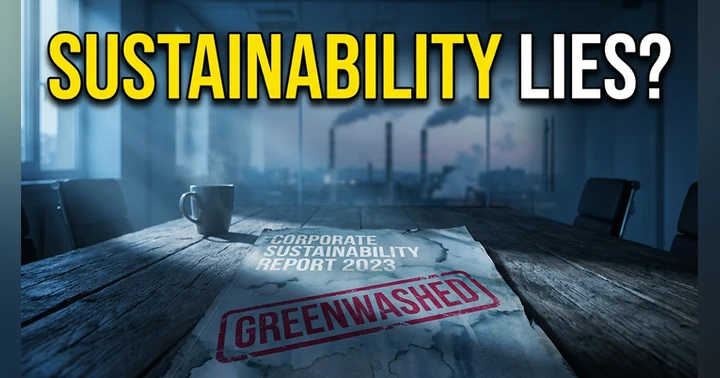
Greenwashing Exposed: Why 400+ Companies Got Caught Lying About Sustainability in 2026


 Apple Podcasts

 Spotify

 YouTube

 Amazon Music

 PocketCasts

 Overcast
Businesses love to say they are sustainable. Andrew breaks down why that word is no longer enough on its own. A new EU consumer protection regulation now requires companies to prove environmental claims with evidence, and it has helped drive more than 400 greenwashing-related enforcement actions across the US, UK, EU, Canada, Australia, and India in 2026 alone.
Andrew draws on his own university experience with food labeling regulation to explain how vague standards let companies technically comply while misleading the public, then walks through real cases including SEC fines against Goldman Sachs, DWS, and WisdomTree Asset Management, state attorney general lawsuits in New York, California, and Washington DC, and Canada's growing green hushing trend where companies quietly stop talking about sustainability to avoid legal risk.
The episode closes with practical advice for listeners on spotting greenwashing before it fools them, plus a preview of tomorrow's conversation with sustainability consultant Zena Harris on cleaning up the entertainment industry's environmental footprint.
Takeaways
- Over 400 greenwashing enforcement actions were recorded globally in 2026
- The EU's updated consumer protection regulation requires companies to substantiate environmental claims
- The SEC fined Goldman Sachs, DWS, and WisdomTree Asset Management for ESG-related misstatements
- State attorneys general in New York, California, and Washington, DC have filed greenwashing lawsuits
- Canada is seeing a rise in green hushing as companies scale back ESG statements to avoid litigation
- Vague terms like eco-friendly, green, and carbon neutral require evidence, not marketing language
- Third-party verification is more reliable than a company's own sustainability claims
- Tomorrow's episode features sustainability consultant Zena Harris on the entertainment industry
Support Independent Podcasts: https://www.speakupforblue.com/patreon
Need help with your ocean non-profit, company, or project? Get the help you need with Pisces Oceans Inc.: https://www.piscesoceans.ca
Connect with Speak Up For Blue
Website: https://bit.ly/3fOF3Wf
Instagram: https://bit.ly/3rIaJSG
TikTok: https://www.tiktok.com/@speakupforblue
Twitter: https://bit.ly/3rHZxpc
YouTube: www.speakupforblue.com/youtube
0:00 Did you ever wonder if when businesses were talking about sustainability that they were actually speaking the truth? They actually would do the ESG goals that they actually had? Well, apparently not a lot of them did. And there's a new regulation in the EU that is holding these companies accountable, and we've kind of seen about 400 greenwashing-related enforcement actions over a number of different countries already in 2026 over the US, the UK, across the EU, Canada, Australia, and India. We're gonna talk about those today on today's episode of the How to Protect the Ocean podcast, because this is where we talk about ocean news. And ocean news is about how businesses conduct themselves in and around the ocean and just even on land.
0:44 Because some of these businesses actually affect the ocean. And when they claim that they are being sustainable and that they are doing good things for the environment, they have to show what they are being good at. Why are they being good to the ocean, or why they are being good to the environment? They have to prove and provide evidence that they do so, ' cause if not, it's called greenwashing, and a lot of companies do it. Over 400 already companies that had enforcement action taken against them already in 2026. We're gonna talk about that on today's episode, so let's get into it. That's right, more than 400 greenwashing-related enforcement actions have already been recorded globally in 2026 across the US, the UK, EU, Canada, Australia, and India. And the EU's updated consumer protection regulation entered into force in 2026, creating legal obligations for companies to substantiate environmental claims made in marketing and in generic claims like sustainable or eco without proof are now being prohibited.
1:37 So, look, I wanna kind of use the analogy of food labeling. When I was first going to the University of Guelph for, what I wanted to do was marine biology, I couldn't get into the marine biology program, didn't have the marks to get in there. I had an 85 average. Like, let's be honest here, I was doing pretty well, but people were doing better than me when they got in, so I had to go through another program. It was the agricultural science program. And during that first year, I took a course that looked at the economy, looked at just, like, food labeling systems as part of the course. And food labeling in Canada was really interesting. It's always been interesting to me. And then looking at what they claim and what's real is really interesting. Fat-free in Canada doesn't actually mean fat-free. It's 1.5%, or at the time when I learned, it was 1.5% fat. Now, I'm not debating whether we should be having fat in our diet or non-fat in our diet or things like that, but what I am saying is if you put down that there's 0% fat in a food container, and there's actually 1.5% fat, that's not 0%.
2:29 1.5 does not equal 0%. So it always, like, it always made me wonder, like, how do these companies get away with this kind of stuff? The numbers don't add up, but it's just a label. And those labels have categories, and the numbers within those categories can fit within 0% when it's actually 1.5% fat. And there's a lot of things that go on in the labeling system, but this is the analogy of what companies can do. And actually, they weren't even held to these types of standards in the past when they were saying, "Yeah, well, we're actually doing great things for the environment." I remember, I remember in Canada, there were companies that were doing… And actually even the government, the Alberta government would put on these commercials. And these are the days where we were forced to watch commercials. Like if I was watching the "Seinfeld" episode in the '90, '80s and '90s, and I was waiting for like, you know, Jerry and George and Kramer and Elaine to come back on, and during a commercial break, I would see one of these commercials.
3:19 And it was Alberta, and it was a beautiful day. It was sunny skies, no cloud in sight. And you see these rolling hills of like just different types of grasses and plants and trees and everything. And you see an oil and gas exec or an actor that's playing an oil and gas exec talking about how, " Look, yes, not only are we providing energy for the environment or for the people of Canada, but we're also making sure that our environment is great." And it didn't have to be a scene where this was a tar sand site. Obviously it wasn't, because we would've seen the tar sands. Or it doesn't show the ponds that they empty all their chemicals into and that they refuse to clean up and the government doesn't hold them to clean up, and they could be like $100 million to clean up 'cause there's so much chemicals and so much sludge and they've destroyed everything in those waters.
4:06 Or they don't show how they fractured and cut up the land so much that migratory animals can't even migrate anymore because they just don't have the land, because it's been taken up by new spots for digging for oil and gas in the tar sands. but you would see this commercial of this beautiful scene, almost looked like "Little House on the Prairie" scene, where you just had rolling hills, beautiful grasses, diversity, all that kind of stuff. Yet in the reality of it was it's cloudy, there's digging, there's pollution, there's fires burning because they need to burn some stuff off. There's all this kind of stuff and industrial stuff and trucks and things like that, and cut up land and trees that have died and so forth. And that's just not the real thing.
4:47 That's greenwashing. And they were able to do that for decades. They were able to say that they were able to do this kind of stuff. And there are companies out there that are saying that they can do something good for the environment or that they're giving back to the environment or they're donating a certain amount or they're holding beach cleanups and things, and they don't. And they don't do anything. They don't give to charity, they don't do anything. They just keep all that money for themselves, and they're just greedy. And I think people are just sick of it happening. And unfortunately, it takes away from companies actually doing good work with the environment and like Philips Lighting, like we talked about a couple of episodes ago. Sustainability could turn into saving money as well as providing a benefit to the environment or impacting the environment less by less emissions and so forth.
5:29 But there's a lot of companies that are having that. And like, it was kind of interesting 'cause there was a surge in sustainable investment during the early 2020s that created the strong incentive to use sustainability language broadly while backing it up pretty thinly. And regulators are now correcting that. They now realize that these companies are really misrepresenting what they are doing to the environment. They could be ruining the environment in one place and helping the environment in another. But if they say they're helping and they're not, now they're just ruining the environment and maybe preventing something else from being helped. I have no idea 'cause people think that it's being helped. They're not donating for those efforts or anything like that. I have no idea if that's happening, but that could happen. Now, the SEC has already fined firms, including Goldman Sachs and DWS, multiple millions of dollars for misrepresenting ESG processes, and fined WisdomTree Asset Management $4 million for ESG-related misstatements.
6:20 And the states attorney general in New York, California, Washington, D.C., have filed greenwashing suits under consumer protection and false advertising laws. And in Canada, new penalties tied to environmental claims substantiation have led to some companies to scale back public ESG statements entirely to avoid litigation risk and a trend that we're now called green hushing. So they realize that these laws are coming in, and they're like, "Okay, we're just not gonna talk about it anymore Or we're gonna talk less about it because technically we're not doing anything for the environment. And we're actually doing worse. So, , it's better to not say anything at all than to say something and it's not, and you're putting the environment at risk, or you're saying something that's not true, and you're gonna get fined for it. You're gonna get some legal action taken against you.
7:02 So there's a divergent global approach. The EU and the UK regulators aggressively enforcing ad standards, and the US relying more on state AGs, so the attorney generals, and SEC litigation, Canada introducing a private right of action. So there are a lot of different actions that are happening because these governments are trying to crack down on this lying, essentially. Lying to say, "Hey, we're actually doing better for the environment," when they're not, or we're saying, " Our products can be recycled," when they can't be. Or, "We're taking back a lot of our products," or they don't. There's a lot of things that will happen and greenwashing take place, which unfortunately takes away from the significance of actually doing something good, like a business actually doing something good and putting sustainability in place and investing into that circularity part of business.
7:44 I think that's really what it comes down to. So now what you can do as a listener is you can be skeptical. Be skeptical of these vague claims like eco-friendly, green, carbon neutral, and without any evidence behind them, don't believe them. Make them show you the evidence. If they claim that they're reducing emissions, say, "Where on your website do you provide this report?" And is it true? Is it a true report? They will go, these companies will go at lengths, and now that there's litigation against it, they're probably gonna go at worse lengths to try and greenwash, they're gonna be sneaky about it. But also look for third-party verification rather than a company's own marketing language. You don't believe, like, a company coming out and saying, "Hey, we're doing this," without evidence. If you have a third party to say, "Actually, you know what? We're staying right in the middle, and we're gonna say whether you're doing it or not," that's who you believe.
8:30 Their skin in the game is to make sure that they are true and that to show that there's some that are doing it and some that aren't in terms of doing good things for the environment and being sustainable. Tomorrow we're gonna be talking to Zena Harris who actually makes sure that entertainment industries and production sites on, like, Hollywood movies and TV shows and so forth are actually sustainable. She works as a consultant. She works with them to make sure that they can find everywhere they can make better efficiencies for sustainability and add in some more sustainable workflows. She makes sure that they do that. Her company does. And I have a conversation with her tomorrow talking about that type of subject and why it's so important. Like, we're gonna summarize everything we talked about Monday through Thursday and why it's so important for these production companies and these big movie companies that are executive producing and funding a lot of these productions are making sure that these are being put in place because the people are demanding it, the regulations are demanding it.
9:22 They can't greenwash it. They gotta actually do it, and there are people like Zena who are in charge who are making sure and working with them to ensure that they are doing the right things and guiding them to make sure that they get to that avenue. And I think it's a great business to be in, and we're gonna talk to Zena Harris tomorrow, so don't miss out. You wanna follow this show right now on your favorite podcast app. And of course, if you wanna support the show, you can do so. Go to speakupforblue.com/patreon. That's the end of today's episode. Enjoy tomorrow's interview with Zena. Make sure you listen to that, and I would love to hear your thoughts on that. That's on this podcast called How to Protect the Ocean podcast, and you have been listening to the How to Protect the Ocean podcast. I'm your host, Andrew Lewin. Have a great day. We'll talk to you next time, and happy conservation.