American Samoa Said No to Deep-Sea Mining. The US Government Doubled The Area


 Apple Podcasts

 Spotify

 YouTube

 Amazon Music

 PocketCasts

 Overcast
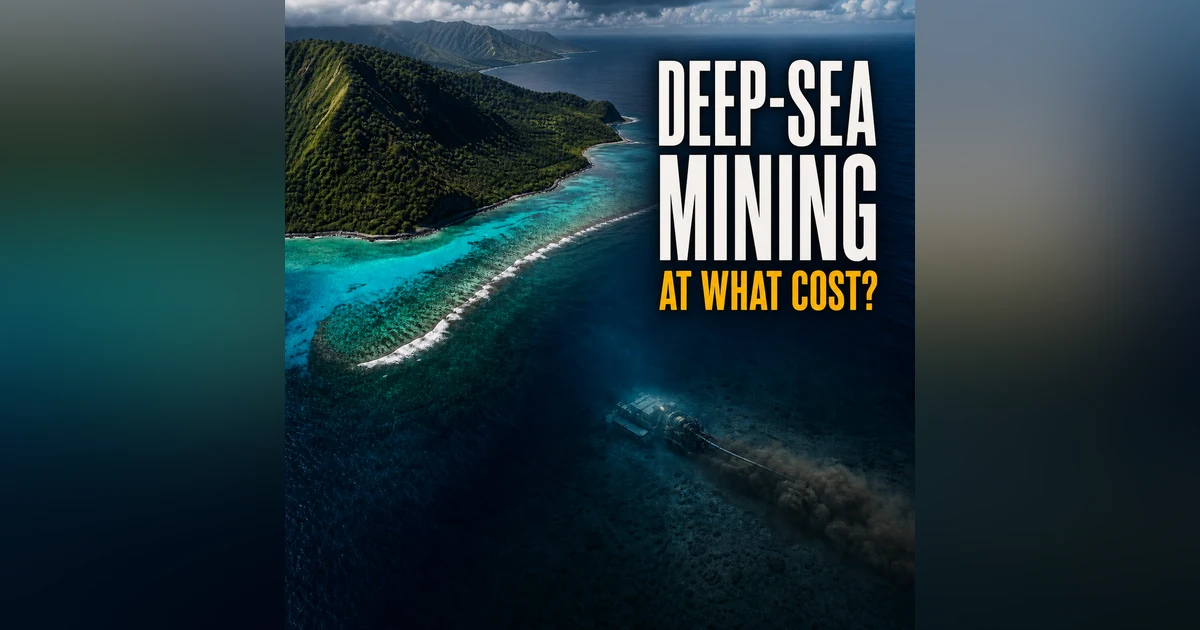
The US government is moving toward the world's first commercial deep-sea mining lease sale, and it's happening in federal waters off American Samoa. In this episode, Andrew breaks down how we got here: a California startup's 2025 request to mine polymetallic nodules, the Request for Information process that followed, and the 75,000-plus public comments that came in during the 30-day comment window, with 80 to 98% opposed to mining. Despite that opposition, and despite a standing moratorium from American Samoa's own governor, the federal government expanded the proposed mining area from 18 million to 33 million acres and pushed the lease sale forward, currently projected for August 2026.
Andrew walks through who's actually bidding on this, including Impossible Metals, The Metals Company, and a handful of smaller entrants, and digs into what the peer-reviewed science says about the risks. That includes a 2025 Nature Ecology & Evolution study showing a 37% drop in seafloor animal density after a single test mining pass, a Nature study finding measurable impacts still detectable four decades after a 1970s test site, and research on the socioeconomic stakes for Pacific fisheries and tuna-dependent economies.
The episode closes with the question that matters most: do American Samoans actually want this? Spoiler, no, based on every available measure of public sentiment, though the picture isn't entirely uniform. Andrew also unpacks the deeper pattern here, indigenous Pacific communities being asked to shoulder the risk of an untested industry with little say in the outcome.
Takeaways:
- Sign a petition opposing the lease sale
- Follow and support Earthjustice, Greenpeace, and NRDC as they track legal action
- Follow Future Swell for ongoing updates
- If you're a US voter, remember this fight runs through the midterms
Support Independent Podcasts: https://www.speakupforblue.com/patreon
Need help with your ocean non-profit, company, or project? Get the help you need with Pisces Oceans Inc.: https://www.piscesoceans.ca
Connect with Speak Up For Blue
Website: https://bit.ly/3fOF3Wf
Instagram: https://bit.ly/3rIaJSG
TikTok: https://www.tiktok.com/@speakupforblue
Twitter: https://bit.ly/3rHZxpc
YouTube: www.speakupforblue.com/youtube
0:00 How would you feel if you lived on an island in the Pacific and the federal government, the federal US government came out and said, "Hey, you know what? There's a company that's interested in doing deep sea mining in and around your island, and they would like to know if you're okay with it. We have to open up this public comment period. We'll call it a Request For Information, an RFI, and you put in your comment, you let me know if you like it or not." And then 80 to 98% after 30 days said, "Hey, you know what? We don't want this at all. In fact, our governor from two years ago said we're gonna put a moratorium on deep sea mining. So no, we don't want this actually at all And then they said, "Yeah, we're actually gonna increase the area, almost double the area size, and then we're just gonna put out the lease, like the lease sale anyway."
0:42 How would you feel about that? That's exactly what's happening to the American Samoa right now, and they are not happy. In fact, a lot of people aren't happy in and around the US and around the world that this deep-sea mining is going to happen. And in this episode of the How to Protect the Ocean podcast, we're gonna be talking about everything that went on, the whole situation, the overview, and then we're gonna find out all the details. This is gonna be an interesting episode, so you don't wanna miss it. So hit that follow button right now, so not only you get this episode, but you get all the rest of the episodes that we put out Monday to Friday, and you're not gonna wanna miss any of these episodes 'cause we're really digging deep into ocean conservation. So if you wanna know what's happening with the ocean, this is the podcast to follow. And if you really love the podcast and you've been following it for a while, or you're just following it and you love what I do, you see what I do on YouTube, you see what I do on TikTok and on Instagram, at How to Protect the Ocean, all these wonderful things, this is the time to help support the show 'cause we have editors, we have all that kind of stuff.
1:33 It helps support the cost of the show. You can go to speakupforblue.com/patreon to support us on Patreon. So speakupforblue.com/patreon. Got a small team. Love to make sure that they keep working and love for the support from you to help that out, and make some money on this as I work really hard on this kind of stuff. Anyway, let's talk about the situation. Here's the overview. The US government is moving toward the world's first commercial deep-sea mining lease sale located just off in the federal waters off the coast of American Samoa. So the agency in charge that's doing this is the Marine Minerals Administration, the MMA. Kinda interesting acronym, especially with martial arts and the UFC in being such an important role in the government these days.
2:13 But it's a newly formed agency which merges the Bureau of Ocean Energy Management, BOEM, and the Bureau of Safety and Environmental Enforcement, which I think is, again, very interesting because we don't know what the problem is gonna be with the environment, which we'll talk about later on in the show. So on July 16th, 2026, MMA and BOEM published a proposed leasing notice, a PLN, for the American Samoa Outer Continental Shelf mineral lease sale. The lease sale itself is projected to go August 2026 and will be live-streamed rather than open to the public. So I think that's interesting. It's not gonna be open to anybody who wants to do it, it's gonna be just be open to that area or just the upstream, whoever gets access to it, I assume it's not open to the public.
2:54 The area of auction is gonna be the roughly the size of 33 million acres of sea floor, roughly 51,560 square miles for my American friends. The target mineral is polymetallic nodules, which is like a potato-shaped rock on the sea floor containing nickel, cobalt, copper, manganese, and other critical minerals used in EV batteries and electronics, which is, as you know probably by now, that critical minerals are very in style these days. People need it for a lot of different things, you know, electronics, circuits and all that kind of stuff. The proposed mining area sits adjacent to the Rose Atoll Marine National Monument and borders the National Marine Sanctuary of the American Samoa, both protected for unique biodiversity.
3:35 So again, there's these protected areas that are around the area that's gonna be up for lease. That could go wrong. If this situation goes wrong, which probably will, let's be honest, we don't know what we're doing to the deep sea if we start mining the deep sea. We have no idea the processes, we have no idea what's going to happen, and now you have two protected areas, monuments, that are around there that could be in danger if something goes wrong. So that's something to think about. This part of the broader federal push, the MMA has also proposed lease sales off the Commonwealth of the Northern Mariana Islands and Alaska. I'll be honest, this is very frustrating. Both the American Samoa and Mariana Islands had a huge majority against wanting to do deep sea mining, and then this is what happens.
4:18 This is a really big slap in the face to the people of CNMI, the Northern Mariana Islands, and of course, the American Samoa. So let's talk about how we got there and looking at the RFI process, or Request for Information process. So the process started when a California-based company, Impossible Metals, formally asked BOEM in April 2025 to open a leasing process for nodules off of the American Samoa. BOEM responded by publishing a request for information and interest, so RFI, in the Federal Register on June 16th, 2025. This kicked off a 30-day public comment period closing August 2025. On June 23rd, 2025, American Samoa's government leaders, including the governor, legislature, and the territory's congressional delegate, issued a unified statement opposing the leasing process.
5:06 This built on a moratorium of American Samoa governor put in place in July 2024, banning mining extraction or exploration activity in the local waters. Though this only covers the three nautical miles offshore, federal waters go beyond that outside the territory's control. You can ban the deep sea mining from happening within three nautical miles, which probably wouldn't have happened anyway. But beyond that is federal water, so they can do whatever they want, unfortunately, like beyond that in the federal waters. So here's the comment results. So seventy-five thousand to seventy-six thousand comments were submitted to the RFI comment period. A reported opposition ranges from roughly from eighty percent to ninety-eight percent, depending on the source of the end analysis, which is still quite a majority of people. BOEM's own summary of the comment period acknowledged that most commenters cited America and Samoa's local moratorium and opposed leasing.
5:52 So it was all opposition. Community members, environmental groups like Greenpeace, Earthjustice, NRDC, and neighboring territories like Guams and CNMI, the Commonwealth Northern Mariana Islands, have all pointed to the same figure as evidence that the process disregarded the public will. Despite this, BOEM proceeded to the next stage, identifying the lease area. Now, the area, as I mentioned before, didn't shrink after the RFI process. It actually expanded. So despite the opposition, the area identified grew from about eighteen million acres to thirty-three million acres. So some of the drivers that were cited was the US Geological Survey mapping priorities and industry proposals for additional acreage.
6:33 BOEM has acknowledged it does not have a clear framework showing how community opposition was wedged against industry's interests in this decision. So June 2025, the RFI was published, 18 million acres. August 2025, comment period closes 75,000 plus comments, majority opposed, so 80 to 98%. November 2025, BOEM announces RFI process completed. And then on March 26th, BOEM releases analysis of comments areas like the area already growing. And then on July 16th, 2026, proposed leasing notice published area now 33 million acres. In August 2026, which is projected, the lease sale will take place So some of the companies involved, as I mentioned, Impossible Metals, they're California, San Jose-based startup.
7:15 The company that filed the original request that started this process, developing an AI-guided robotic vehicle designed to selectively pick nodules while avoiding visible marine life. Signed a memorandum of understanding with the American Samoa Economic Development Council in late 2023 to process nodules locally into battery-grade metals and use the Pago Pago Port infrastructure. The Metals Company widely seen as the deep sea mining industry's frontrunner globally, has tested equipment at scale, hauled up to three thousand metric tons of nodules in a 2002 trial in the Clarion-Clipperton Zone, which is in the Pacific. It's a very popular deep sea zone which has been the prize, I guess, for these types of nodules. And then several smaller or newer entrants have also expressed interest, including American Metal Resources, CX Deep Sea Minerals Corp., and a company that was planning to rename itself Eco Minerals.
8:06 Very surprising name. Notably, one report describes a firm that got its start hunting sunken treasure in a startup that grew out of an effort to locate Amelia Earhart's lost plane, now pivoting into seabed mining collection. I guess they have the infrastructure to do it. So the one thing we haven't talked about, we talked about this whole process. We talked about how people were against it because they didn't want it, because they cited a lot of times the governor's moratorium on the deep sea mining. But there are environmental consequences that scientists are really worried about it. A 2025 Nature Ecology and Evolution study on the actual industrial-scale test in the Pacific found macrofaunal seafloor animals' density dropped thirty-seven percent directly within like mining tracts, with a thirty-two percent reduction in species richness just two months after the single test mining pass.
8:50 So imagine if that happened a lot in that area. The effects could be devastating. A separate 2025 Nature study looking at a 1970s test mining site found that four decades later, biological impacts in many groups of organisms were still detectable, though some species had begun to reestablish. It's still not that great. We still see the effects four decades later. Now, a 2025 Frontiers in Marine Science review describes the anticipated impacts as long-lasting and potentially irreversible. Removal of seafloor substrate that supports marine life, sediment plumes that can disperse far beyond the mining site, toxic metals release, and of course, a noise and light pollution from mining equipment And then field simulation research in the Western Pacific found that sediment distribution from mining vehicles were 30 times greater than the natural wave or current disturbance, with turbidity effects and reduced dissolved oxygen persistent for hours after a single pass.
9:44 A widely cited estimate for every ton of nodules mined, 2.5 to 5.5 tons of sediment gets disturbed and suspended in the water column. I wanna talk a little bit as you kinda digest that, about what these structures are gonna look like. Dr. Andrew Thaler, who's been on the podcast a number of times, kind of put it, last time he was on, put it into perspective. It is not just gonna be vehicles on the ground just taking mines and then floating back up and going into it. There's gonna be a tube that goes from the surface of the boat, and then down to these vehicles where everything's being mined. And essentially, it's going to carry the nodules all the way from the sea floor all the way up. So there's gonna be all this tube that goes thousands of meters in the water column all the way up to the surface.
10:27 And then of course, on the surface, it's gonna be like a small city for each of these different outfits. Now, what that says is that the disturbance is not just gonna be on the ground, it's gonna be all throughout the water column. We have no idea how it's gonna affect migration routes. We have no idea how it's going to affect just natural fish and seabird and other sort of animals and organisms sort of behavior around these structures. We have no idea if these structures can rip or sediment plumes can go out from those if it leaks. Like think about like we can't even do a pipeline properly. Imagine a tube that has to face all this different pressure from the surface all the way down to the bottom, how that's gonna work. It's just gonna be a problem all around. And I want you to kinda understand this because a lot of times we see pictures of things on the bottom of the ground.
11:08 They're just on the surface, so it's like a vacuum, but there's still a lot of sediment on the ground. There's sand and all these different types of things. And if that goes up in the air, we have no idea the effects of what's gonna happen around it. As anybody who has a marine aquarium or even a freshwater aquarium, when sediment is disturbed, all the stuff that like the detritus, like all the poo and all that kind of stuff that's on the ground turns into nitrates and ammonia nitrates. When that bottom gets disturbed and it comes all up, that could be like an ammonia bomb is what we call in the aquarium industry. And so if we see this on a larger scale, this could be a big problem that I don't know I've never seen really anything looking at that, but that's a big problem. Plus, we have all these macrofauna and microfauna that are in the sediment, that are in the water column, and we have no idea the effect that's gonna happen.
11:53 We know some of it 'cause I've just read some of the stuff off of you of some of the studies, but it's, really not good. Some of the socioeconomic consequences that we're talking about, a 2023 study in the NPJ Ocean Sustainability found deep seabed mining lacks social legitimacy, noting Pacific fisheries provide revenue, nutrition, employment, and livelihoods for island communities that are already stressed by climate impacts. So the same study flagged the tuna fisheries as a specific concern since they can overlap with proposed mining areas and tuna access fees account for up to eighty-four percent of the GDP for some tuna-dependent Pacific Island states. A 2025 Nature commentary from Pacific Island leaders warn that sediment plumes can drift across hundreds of kilometers for decades, potentially diminishing catch rates, contaminating seafood, and crossing national jurisdiction lines.
12:39 A 2021 Frontiers in Marine Science paper on traditional Pacific seabed resource management stresses that the ocean is not just an economic resource for Pacific communities, but central to cultural identity, social relations, and a worldview, and argues current regulatory frameworks don't account for that connection. A review cited by the Ocean Foundation covering more than 250 peer-reviewed articles concluded that social and cultural impacts on Pacific communities remain largely unknown, while the economic benefits of mining remained questionable. This is one of the situations that we talk about in conservation when indigenous voices are not heard. Indigenous Pacific Islanders have had a history with colonialism and being affected by colonialism.
13:23 And because they don't really have a say in these types of situations. They didn't really have much of a say when they opened up the Pacific monuments, like the sanctuaries, and when industrial fleets wanted to fish it again. They didn't really have a say when they put it in. They had some say, like they were consulted, but they don't have a final say because they're a territory. The thing is that this impacts their lives. All the consequences impact their lives, and then the fruits of the labor that are actually used are just gonna get exported outside their territory. I talked a, number of episodes ago about how indigenous people in Canada are starting to take ownership of a lot of the major projects that are happening in Canada.
14:04 And they're taking ownership for a number of different reasons. Not only because they should benefit on the economic side, which will help benefit on their social side for the revenue that's generated on their land, 'cause a lot of times it crosses their land. But they also have a say in the environmental processes that are looked after from a regulatory process. They wanna make sure it is part of their culture, for many indigenous people, not only in Canada, but all over the world, to ensure that they are living in harmony with nature. And if they don't live in harmony with nature, that's a problem. That affects their livelihood. The CNMI and a lot of other communities recently just had their second super typhoon in 90 days. When I talked to Angelo Villagomez, who's from the CNMI, and now lives in Washington, DC, he commented and he said five years ago, before the second to last super typhoon in May, five years ago when another super typhoon came in, it took out all the schools.
14:56 They hadn't rebuilt the schools yet. That was in 2019. And now they're getting another one. They got another one in May and another one just recently in beginning of July, end of June. These are the people who pay the consequences of climate change, of deep sea mining, of mismanaged fisheries, and they are given opportunity to have a say, but nobody listens to them. So this deep-rooted colonialism is affecting unfortunately, the way these indigenous people are gonna live. It's super frustrating to have to watch that over and over and over again. I can't even imagine just living it. And so this is again, just another example of what this government thinks of their indigenous people. They're in the middle of the Pacific Ocean. Who cares about them? That's the feeling that everybody is getting from this process.
15:39 And like, do the American Samoans actually want this? No. Based on every available public measure of public sentiment so far, they don't want it. The American Samoas governor, territorial legislature, and congressional delegate have all publicly and formally opposed deep-sea mining in the territorial waters. Delegate Redwagan has been quoted, "As it stands, the people of American Samoa are opposed to deep-sea mining in and around the territory." I watched a live broadcast from a post-congressional hearing, where representatives from CNMI, from Guam, and from American Samoa came up and said, "We've had no say in the process. We have no benefit in the process. Why would we allow this to happen?" They have not been consulted other than the RFI, and even then they're not even listened to.
16:23 American Samoa's own government issued a moratorium in July 2024 banning mining extraction exploration activity within roughly three miles of the islands, a limit on the territory's own jurisdiction. And the community groups like Fa'aso America Samoa have criticized the federal government for what they describe as fast-tracking the lease sale while ignoring the voices of the very people whose waters, traditions, and livelihoods are on the line. One important nuance, the American Samoa Economic Development Council, a territorial economic development body, signed an MOU with Impossible Metals in late 2023 and has separately pursued an international seabed authority license application framing mining as a source of jobs and economic growth. Its executive director, John Wasco, has spoken in support of the industry.
17:07 This puts the Economic Development Council public's position at odds with the territory's elected government and legislature, and apparently the public. Here's the situation as Angelo put it into perspective. A lot of the places, like CNMI, American Samoa, not much, as much Guam, but the other two, they struggle economically. There's not a lot of industry, there's not a lot of stuff going on. And so when opportunities like this come along, they're short-lived, the benefits may not be great in the long term. But because the economic situation that they're in, sometimes there are people who are gonna wanna have it because they think it's gonna help build jobs, it's gonna help with, people who go out there are gonna have to stay on the island, like in the hotels and stuff like that before they can go offshore, all these types of things.
17:48 So there's gonna be more people there, but will it actually help the American Samoan people? Like, that's really what it comes down. So opposition is not universal. There is a difference between the elected government and general public opposition, and the more pro-development stance of the council and some industry-aligned local voices. So, the bottom line, though, that you really need to know, this is on track to be the first commercial deep sea mining operation anywhere in the world, not hypothetical that we've seen before, but actively moving through the federal process. The lease sale is currently projected for August 2026, with the governor of American Samoa given sixty days to comment once the leasing notice is finalized. The gap between what the public said, an overwhelming opposition, and what the government did, expanding the mining area, is a central tension of this story.
18:32 And worth flagging for you guys, for you listeners, you wanna verify all these stats, and you wanna make sure that everything's good when you look into this kind of thing. There are people and there are organization that are looking out for the American Samoan people. So look out for ways to sign petitions if you are against this, ways to support organizations like EarthJustice, Greenpeace, NRDC. These are the organizations that are gonna take the government to court based on the RFI, all this kind of stuff. And of course, if you really wanna take place, if you live in the US, vote, vote, vote for these midterms. And if you want this to be flipped, you wanna flip the House and the Senate or either or both because this is gonna matter in the future. And it's only the government that can really stop this, and the people need to be heard.
19:13 So if you wanna be heard, you can follow organizations like Future Swell, Greenpeace, NRDC, and Earth Justice to be able to find out what's happening and how you can help. That's it for the episode today. Unfortunately, a lot of the things that I talked about today is disappointing. I mean, unfortunately, this is happening, especially in this 2026 United States. And people are not on the forefront of the minds of this government administration. It's just too bad. It's something that we have to look out for and it's something that we need to be on track. And this is why we tell you on here, on this How to Protect the Ocean podcast, because it's something that I think it's important, I think it's valuable for you to know. So I'd love to hear your comments or questions. Please let me know. Go to speakupforblue.com, and you can check out any ways to get a hold of me.
19:53 You can go to the show notes, and look at Instagram, TikTok. You can DM me, or even on Facebook or LinkedIn. Always feel free to message me. I'd love to answer your questions or have a conversation, 'cause that's what we do here. We try and start the conversation, and you guys continue it, and we have a good time. And of course, if you wanna support the podcast, you can go to speakupforblue.com/patreon. I would love to have your support, be a part of the community. We'll put up some extra stuff on there, some vlogs and all that kinda stuff once we get people starting to go ahead and support the Patreon, and just start this community. So I wanna thank you so much for joining me on today's episode of the How to Protect the Ocean podcast. I'm your host, Andrew Lewin. Have a great day. We'll talk to you next time, and happy conservation.


