The Hidden Solar Power Plant Living on Coral Reefs


 Apple Podcasts

 Spotify

 YouTube

 Amazon Music

 PocketCasts

 Overcast
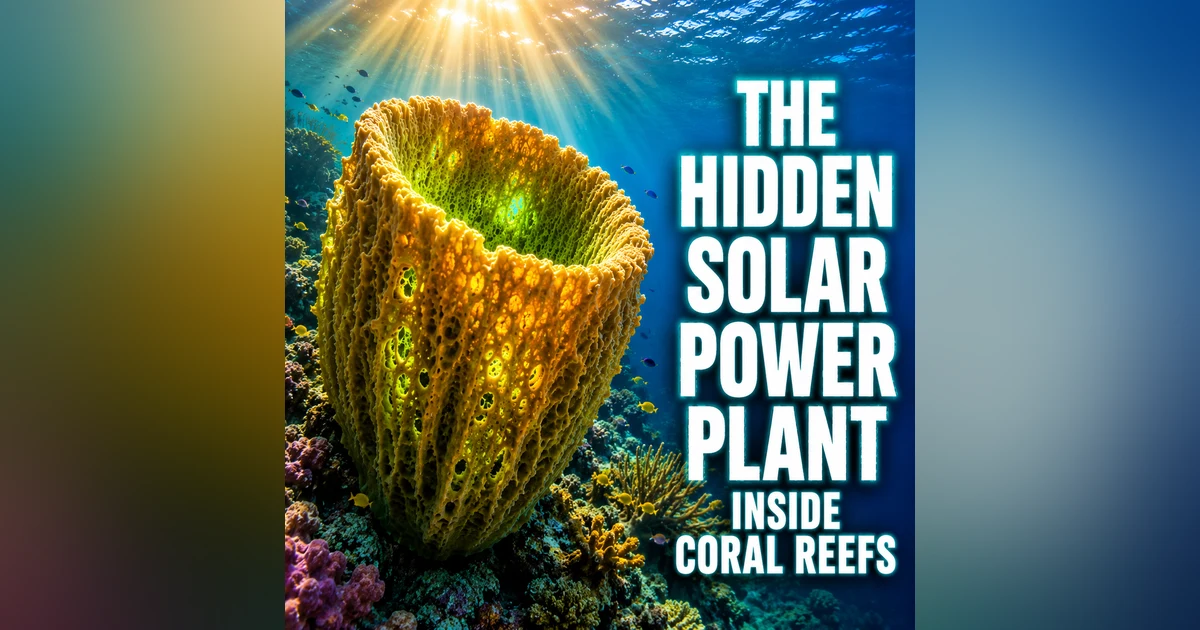
Scientists have uncovered an incredible secret hiding in plain sight on coral reefs. Some tropical sea sponges are able to harvest sunlight through microscopic algae living inside their tissues, giving them a surprising source of energy. It is a discovery that challenges what we thought we knew about one of the ocean’s oldest animals.
In this episode, we explore how these ancient filter feeders use a partnership with algae to survive and thrive in nutrient-poor tropical waters. You’ll learn why this relationship is similar to the one that helps corals build reefs and why researchers believe sponges play a much bigger role in reef ecosystems than previously recognized. Sometimes the most important discoveries come from the animals we pay the least attention to.
If we want to protect coral reefs, we need to understand every species that helps keep them functioning. This new research reminds us that even the simplest-looking organisms can have extraordinary abilities and may be far more important than we ever imagined. Follow the podcast for more weekday ocean news that helps you better understand our blue planet.
Support Independent Podcasts: https://www.speakupforblue.com/patreon
Need help with your ocean non-profit, company, or project? Get the help you need with Pisces Oceans Inc.: https://www.piscesoceans.ca
Connect with Speak Up For Blue
Website: https://bit.ly/3fOF3Wf
Instagram: https://bit.ly/3rIaJSG
TikTok: https://www.tiktok.com/@speakupforblue
Twitter: https://bit.ly/3rHZxpc
YouTube: www.speakupforblue.com/youtube
0:00 When you think of the engines that power a coral reef, you probably picture coral. But scientists have just discovered another animal that has been quietly harvesting sunlight and helping fuel tropical ecosystems all along. To find out what that is, listen to this episode. 'Cause this is the How to Protect the Ocean podcast, your weekday ocean news update. If you care about staying informed about the news of the ocean, Monday to Friday every weekday, hit that follow button right now so you don't miss next week's story. Today, we're answering one question. How can a simple sea sponge use sunlight, and why does that discovery change the way we think about tropical reefs? That's what we're gonna be talking about today. Coral reefs often get all the attention.
0:41 Like, they're colorful, they're packed with fish, they have a huge diode of biodiversity, fish, invertebrates, all that kind of stuff, and they're some of the most biodiverse ecosystems on Earth. But reefs are also home to another group of animals that rarely make the headlines, sponges. At a first glance, they don't look particularly exciting. They don't swim. They don't hunt. They don't even have a brain. But new research has revealed that some tropical sponges are doing something remarkable. Thanks to a partnership with microscopic algae living inside their tissues, these sponges can harness sunlight to generate much of the energy they need to survive. And that discovery doesn't just tell us something interesting about sponges. It tells us that we've been underestimating one of the most important players.
1:22 Because before, like, sponges were sponges. I mean, you have sponges. They come from sponges in the Earth. They hold a lot of water. They have, like, sponges, like the animal sponges in the reefs, or in the tropical waters, when they have this, like, siphon in the middle, and they, like, put out water. They bring in water, they put out water. It's really kind of a cool thing. But you never really know exactly what's happening with these sponges. So let's just start with the basics. Sponges are among the oldest animals on the planet. They've existed for hundreds of millions of years, long before dinosaurs walked the planet. Most people think of them as simple filter feeders. They pump enormous amounts of sea waters through their bodies capturing bacteria, tiny particles, and organic matter for food. And that's true.
2:02 But for some tropical sponge species, filtering water is only part of their story. Researchers found that certain sponges host microscopic algae inside their tissues. Those algae perform photosynthesis using sunlight to convert carbon dioxide into energy-rich compounds, just like algae that live inside reef-building corals zooxanthellae. But the difference is that scientists now have a much better understanding of how important this relationship is. The algae share a large portion of energy they produce with their sponge host, effectively acting as tiny solar panels embedded throughout the animal's body. That means these sponges aren't relying only on what they filter from the water. They're also being powered by the sun. And it's a partnership that's been evolving for millions of years, and it helps explain why these sponges thrive in nutrient-poor tropical waters where food could be surprisingly scarce.
2:52 So why should we care about a sponge? Because reefs are built on relationships. When people hear the word photosynthesis, they usually think about plants like trees and land plants. In the ocean, many animals depend on partnerships with microscopic organisms that perform the same job. Corals are a classic example. Without their symbiotic algae, coral reefs as we know them wouldn't exist. Now, scientists are showing that some sponges have developed a similar strategy. That matters because sponges already play several critical roles on reefs. They filter thousands of liters of water. They recycle nutrients. They provide habitats for countless small animals. They help keep reef ecosystems functioning.
3:33 If some of those sponges are also generating their own energy through sunlight, it changes our understanding of how energy moves through reef ecosystems. It also raises fascinating questions. Could these sponge algae partnerships make certain sponge species more resilient as ocean conditions change? Could they become even more important if coral communities decline? Scientists don't have all the answers yet, but these are exactly the kinds of questions that this research opens up. Another reason this matters is that healthy reefs depend on diversity. We often focus conservation on one iconic species: sea turtles, sharks, corals, whales. But ecosystems are resilient because many different species perform different jobs.
4:14 Sponges are not to be the stars of reef documentaries. We know that. But they could be some of the hardest working members of the community. This discovery is another reminder that we still have so much to learn about the ocean. Scientists are now investigating how widespread these sun-powered sponge partnerships really are. Do only a handful of species benefit, or is it much more common than we realized? Researchers also want to understand how these partnerships respond to marine heatwaves, ocean warming, and declining water quality. That's especially important because many reefs are already under pressure from climate change. If some sponge species prove more tolerant of warming conditions than corals, they could become increasingly important parts of future reef ecosystems.
4:58 This doesn't mean sponges replace corals. Nothing replace a healthy coral reef. But understanding every piece of the ecosystem helps us make better conservation decisions. One of the biggest lessons from marine science over the past decade is that ecosystems are often more connected than we imagine. The animals we overlook today may turn out to be essential tomorrow, just like sponges were in the reefs. And that's exactly why research like this matters. Every new discovery fills another piece of the puzzle. The more we understand how reefs actually work, the better equipped we'll be to protect them. Coral reefs aren't powered by coral alone. We've discovered that. They're powered by partnerships. This new research reminds us that even one of the ocean's simplest animals, sponges, can reveal a surprisingly sophisticated strategy for surviving, thriving, and supporting one of the most important ecosystems on the planet.
5:49 That's it for today's episode, and that's it for this week. I would love to hear your thoughts on these sponges, these new, like, partnerships that are happening with algae, and to find out, like, what that means to you for the future of coral reefs. Are we gonna see a change? We're already starting to see research come out, it has been coming out for a while now, about different heat-tolerant algae species and where they're found in specific corals, and how coral reefs will change over the years as climate change continues to change oceanic temperatures, and pH, and ranges, and so forth. And so these sponges may become, like, a really important part of what's gonna happen in the future, and finding out, like, how heat is going to mess with algae within these things. Are these algae providing energy like they do for corals to build skeletons?
6:31 Like, they provide, like, the calcium that they need? Or do these sponges need something different? It's gonna be really interesting to see how this research continues and how it grows. But I'm really looking forward to hearing from you. Hit me up on social media, Instagram, TikTok, whatever that might be. I would love to hear from you. My links are in the show notes. And of course, if you wanna support the work that we do, bringing you ocean resources, ocean news, all that kinda stuff, new research, and you wanna, listen to the podcast or YouTube, Instagram, TikTok, Facebook. If you appreciate all the stuff that I do for you guys, and you wanna support me, that'd be great. Go to speakupforblue.com/patreon. That's speakupforblue.com/patreon. I wanna thank you so much for supporting the podcast, for supporting the work that I do.
7:12 My name is Andrew Lewin, I'm the host of the How to Protect the Ocean podcast. Have a great day. We'll talk to you next time, and happy conservation.


