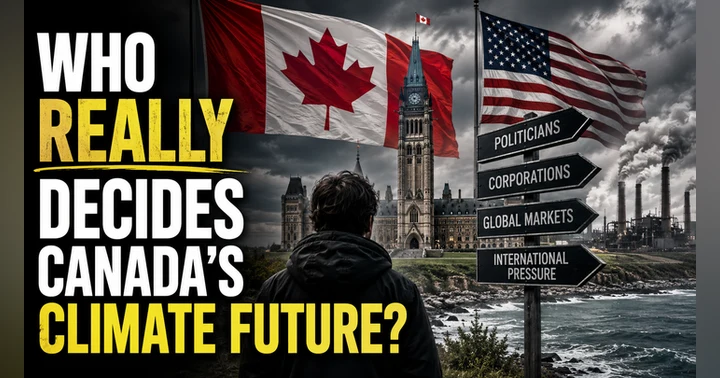
Who Really Decides Canada’s Climate Future?


 Apple Podcasts

 Spotify

 YouTube

 Amazon Music

 PocketCasts

 Overcast
Canada has admitted it is no longer on track to meet its 2030 climate targets, but the reasons go far beyond domestic politics. In this episode, we explore how changing economic priorities are reshaping Canada’s approach to climate action. The surprising twist is that many of these changes begin outside Canada’s borders.
New U.S. tariffs and shifting trade policies are putting pressure on Canada’s economy, forcing leaders to rethink where to invest and what to prioritize. As economic policy changes, climate policy often changes with it. We follow that chain of events to understand why Canada’s emissions outlook has changed and what it means going forward.
Finally, we connect the dots to the ocean. Slower climate progress means greater risks for marine ecosystems, coastal communities, and the industries that depend on healthy oceans. If you’ve ever wondered how international politics can influence ocean conservation, this episode brings the whole picture together.
Support Independent Podcasts: https://www.speakupforblue.com/patreon
Need help with your ocean non-profit, company, or project? Get the help you need with Pisces Oceans Inc.: https://www.piscesoceans.ca
Connect with Speak Up For Blue
Website: https://bit.ly/3fOF3Wf
Instagram: https://bit.ly/3rIaJSG
TikTok: https://www.tiktok.com/@speakupforblue
Twitter: https://bit.ly/3rHZxpc
YouTube: www.speakupforblue.com/youtube
0:00 What if Canada's climate targets are being reshaped, not just in Ottawa, but in Washington, D.C.? This is the How to Protect the Ocean podcast, your weekday ocean news update. If you care about staying informed on the ocean every weekday, hit that follow button right now so you don't miss tomorrow's story. And this week, we're gonna be talking all about ocean news Monday to Friday. There's no interview at the end of the week, but today until Friday, we are gonna be talking about some cool ocean news topics. Some good, some bad, and so we're gonna kinda continue with that. Today's question is this: How can the policies of a foreign government change Canada's economic priorities and then change Canada's environmental policies? That's what we're gonna be talking about today because that is the story unfolding right now.
0:44 We just got a recent release. On the day that I'm recording this, it is Canada Day, so happy Canada Day for those folks who are Canadian who are listening to this. Prime Minister Mark Carney just gave an acknowledgement. He sent out a video where he acknowledged that Canada is not on track to meet its twenty thirty climate targets. He's also said that emissions will likely be higher than previously projected over the next few years. Now, that matters because the bigger story here is not just that Canada may miss the target. The bigger story is why Canada's gonna miss the targets. And to be honest, when we're looking at targets, the original target was going to be, like, four hundred and thirty-some-odd megatons. It's gonna be up to six hundred megatons, which is about twenty-eight percent below two thousand five.
1:25 So we're still gonna get below the amount with two thousand five, but just not as much as we wanted to in the first place. Which, look, it's disappointing as a Canadian, as a marine biologist. It's disappointing to hear that the country had to change its priorities. Because Canada's facing pressure from outside of its borders, especially down south from the United States. US tariffs, protectionist policies and a stronger push to bring manufacturing and investment back to the American economy are forcing Canada to rethink its own economic strategy. And when the economy shifts, climate policy often shifts with it. So today, we're gonna follow the chain. Foreign policy affects Canadian economic policy. Canadian economic policy affects environmental policy, and environmental policy affects the ocean.
2:10 So let's start with what happened. Canada had a legal climate target to cut greenhouse gas emissions by forty to forty-five percent below two thousand five levels by twenty thirty. The federal government's own reporting says that is the goal. But recent projections show Canada is still not there. The parliamentary budget officer estimated Canada could be forty-nine to two hundred and two megatons above its twenty thirty target. Environment Canada's projection also show a significant gap. Now, Carney is signaling that Canada's path is changing. And you're probably wondering like, "Why is it changing so much?" Because Canada's economy is deeply tied to the United States. When the United States changes trade policy, Canada feels it pretty fast. If the US puts tariffs on steel, aluminum, autos, and other key sectors, Canadian industries become less competitive.
2:57 If the US rolls back clean energy incentives or changes industrial rules, Canadian companies have to respond. If the US prioritizes domestic manufacturing and energy security, Canada has to decide whether to match that strategy, resist it, or find a different path. Carney's government appears to be choosing a more economic security-first approach. That means protecting jobs. That means supporting industries under pressure. That means accelerating major energy and infrastructure projects. And that can mean softening, delaying, or reworking Canadian policies that industry says are too costly in the current economic climate. That is the pivot. It is not simply that Canada forgot about climate change.
3:38 It's more complicated than that. It is Canada is trying to respond to a changing global economy and climate policy is being adjusted as part of that response. Now let's talk about why this matters. The ocean does not care why emissions go up. It does not care if emissions rise because of domestic politics, US tariffs, oil and gas development, delayed EV rules, or weakened industrial carbon pricing. The ocean only responds to the physics. More greenhouse gases trap more heat. More heat means warmer oceans. Warmer oceans means stronger marine heatwaves, coral bleaching, shifting fish populations, melting sea ice, rising seas, and more stress on coastal communities. That is the ocean connection.
4:19 This is not just a Canada story. This is a climate and ocean story. When governments delay emissions reductions, the consequences show up in ecosystems. They show up in fisheries. They show up in coastal flooding. They show up in Arctic change. They show up in the future of marine life. And this is where the story gets uncomfortable. Economic policy and environmental policy are often treated like separate issues, even though they're not. If a country is worried about trade, jobs, inflation, tariffs, and competitiveness, those concerns can change what climate policies survive. A carbon price can become politically vulnerable. An electric vehicle mandate can be delayed. An oil and gas emissions cap can become uncertain. Industrial rules can soften, and that's happened all in this last couple of years.
5:05 And suddenly a country that still says it supports climate action is moving more slowly than the science requires. Now, this is the nuance. This is not a simple good guys versus bad guys type of story. Governments do have to think about jobs. They do have to think about affordability. They do have to think about trade. They do have to respond when a major trading partner changes the rules without telling anybody at the beginning. Canada cannot pretend the US economy does not matter. But here's the problem. Climate change does not pause while countries renegotiate trade relationships. The ocean does not wait for a better political moment. And emissions released today will keep affecting the planet for decades.
5:46 So the real question is not whether Canada should care about the economy. Of course, it should. The real question is whether Canada can protect its economy without weakening the policies needed to protect climate and the ocean. That is the tension, and that's what you should be looking out for. First, watch for updated emissions modeling. If the government is changing climate policy, Canadians need to know the emissions impact. How many more megatons are expected? Which policies are being weakened? What replaces them? Second, watch the industrial carbon pricing system. This may sound boring, but it's one of the most important climate tools in Canada. It affects heavy industry, oil and gas, and electricity. If that system weakens too much, the twenty-thirty target gets even harder to reach.
6:28 Third, watch oil and gas policy. If Canada expands energy exports while also promoting net zero by twenty-fifty, the government will need to explain how those two things fit together. That means methane rules, carbon capture, electrification, emissions caps, and actual accountability. And fourth, watch how often climate policy gets framed as an economic threat instead of an economic opportunity. We see this all the time because clean energy, clean transportation, building retrofits, grid expansion, and industrial carbonization are also economic policies. They create jobs too. They attract investment. They build resilience. So Canada has a choice. It can respond to foreign economic pressure by slowing climate action, or it can respond by building the kind of economy that is less vulnerable to fossil fuel volatility, trade shocks, and climate damage.
7:19 The second path is harder, but is also the one that gives the ocean a fighting chance. Climate policy does not exist in a bubble. It is shaped by trade, politics, jobs, and power. But no matter where the pressure comes from, the ocean still pays the bill when the emissions go up. That's it for today's episode. If you have any questions or comments or you wanna add something to this episode, I would love to hear from you. Hit me up in my DMs either on TikTok or on Instagram. Social links are in the show notes. And of course, if you want to follow the show, please do so. You'll get an update every single day. And if you wanna support the work that I do here on the podcast, on YouTube, on Instagram, on TikTok, all those places, please feel free to go to speakupforblue.com/patreon.
8:06 That's speakupforblue.com/patreon to support the work that I do for you so you can stay updated on the ocean. And I wanna thank you so much for joining me on today's episode of the How to Protect the Ocean podcast. I'm your host, Andrew Lewin. Have a great day. We'll talk to you next time, and happy conservation.