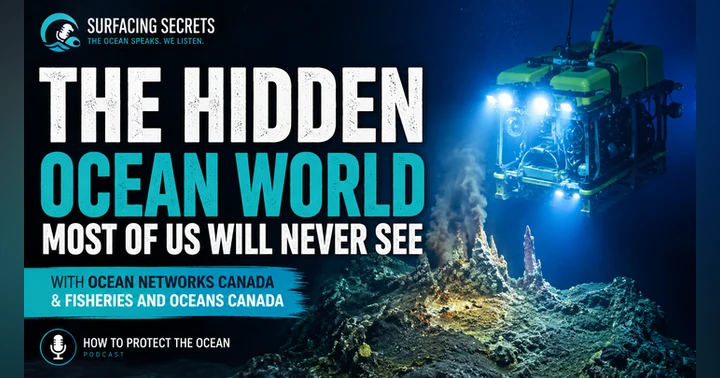
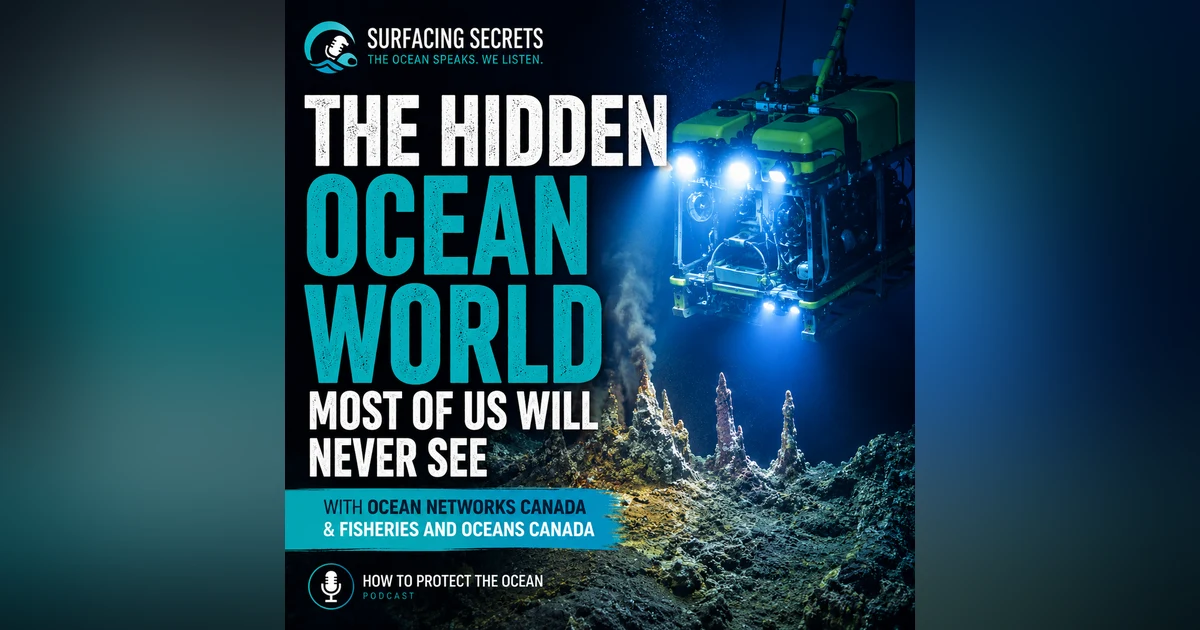
The Hidden Ocean World Most of Us Will Never See


 Apple Podcasts

 Spotify

 YouTube

 Amazon Music

 PocketCasts

 Overcast
Most of us will never visit the deep ocean, yet it covers the majority of our planet and supports life in ways we’re only beginning to understand. In this episode, Andrew Lewin wraps up the Surfacing Secrets series with Ocean Networks Canada by exploring why the deep sea remains one of Earth’s greatest frontiers. You’ll discover how scientists are uncovering hidden ecosystems that could reshape our understanding of the ocean.
Andrew is joined by Monica Peltz of Ocean Networks Canada and Heidi Gartner from Fisheries and Oceans Canada to discuss what it takes to study places thousands of meters below the surface. They share how cutting-edge technology, education, and collaboration are making deep-sea science more accessible than ever before. Their work is helping students, researchers, and the public experience discoveries that were impossible just a generation ago.
The conversation also explores why deep-sea exploration matters far beyond scientific curiosity. Understanding these hidden ecosystems helps inform conservation decisions, strengthens ocean stewardship, and reminds us how much of our planet is still waiting to be explored. By bringing these unseen worlds to light, we can make better choices about protecting the ocean for future generations.
Support Independent Podcasts: https://www.speakupforblue.com/patreon
Need help with your ocean non-profit, company, or project? Get the help you need with Pisces Oceans Inc.: https://www.piscesoceans.ca
Connect with Speak Up For Blue
Website: https://bit.ly/3fOF3Wf
Instagram: https://bit.ly/3rIaJSG
TikTok: https://www.tiktok.com/@speakupforblue
Twitter: https://bit.ly/3rHZxpc
YouTube: www.speakupforblue.com/youtube
0:00 When I was a kid, I never expected that there would be a program available in the future where I could watch as a student, I could watch scientists explore the deep sea. That was never a thing that ever crossed my mind and is happening right now. This is the How to Protect the Ocean podcast, your weekday ocean news update. If you are interested in finding out everything you need to know on the ocean every weekday, Monday to Friday, you can do that by following this podcast on your favorite podcast app. I'm your host Andrew Lewin. Welcome back to the How to Protect the Ocean podcast. Today, we are wrapping up our special series with Ocean Networks Canada called Surfacing Secrets, Explore the Ocean, Know the Planet.
0:43 Throughout the series, we've been looking at ocean technology, science, education, and storytelling come together to help us better understand the ocean and protect it. And for this final episode, we're going to be going deep, literally. I'm speaking with Monica Peltz from Ocean Networks Canada and Heidi Gartner from Fisheries and Nodes Canada about deep sea exploration in the Northeast Pacific. We talk about what it takes to study places most people will never see, why deep sea ecosystems matter and how scientists, educators, and communities are working together to bring these hidden ocean worlds to the surface. This is a great conversation to end a series because it captures exactly why ocean exploration matters.
1:28 The more we understand the ocean, the better equipped we are to protect it. So let's get into the final episodes of Surfacing Secrets, Explore the Ocean, Know the Planet, a collaboration between How to Protect the Ocean podcast and Ocean Networks Canada. Enjoy the interview and I will talk to you after. Hey, Heidi. Hey, Monica. Welcome to the How to Protect the Ocean podcast. Are you ready to talk about the Northeast Pacific deep sea exploration project? Absolutely. Right on. That's a mouthful. I have to admit, but it's a really just in the name. It causes a lot of interest. I'm looking forward to diving into this education project with Department of Fisheries and Oceans and ONC Ocean Networks Canada. It's going to be a lot of fun. We have Monica from ONC and Heidi from DFO here to talk about the project. We're going to dive into all the different aspects and what it's been able to do, what's been able to accomplish, and I can't wait to do so. Let's dive in.
2:20 But before we do, Monica, why don't we start with you? Can you just let us know who you are and what you do? Absolutely. Thank you. My name is Monica Peltz. I am a K-12 education coordinator with Ocean Networks Canada, another great mouthful. Basically what it means I get to do is I get to work with teachers and students and folks like Heidi on bringing the ocean into classrooms, sharing it with teachers and the general public and folks like you. There's really, really great work going on there. And I have the honor of being the facilitator or the conduit to all those audiences to share the ocean in new and exciting ways and hopefully get kids and other folks jazzed about what's happening under the waves.
3:03 Amazing. Amazing. And Heidi, how about yourself? Hi, I'm a biologist with the deep sea ecology program at Christian Sciences Canada. And yeah, my job is really cool. I study the deep sea and we're going to talk all about it today. Awesome. Can't wait. Now, just to start off, Monica, why don't you just let us know what the program is? So the Northeast Pacific Deep Sea Exploration Project, we've said it a number of times. What is it and what are the main goals behind it? That's a great question. And and I would sum up in an easy way. It's a great collaboration between scientists, communicators, marine planning professionals, federal and indigenous governments, nonprofit institutions and even academia to explore the ocean, discover new life, protect the new life and the life that's down there.
3:51 Document and be in all of these remarkable ecosystems and basically just kind of cultivate excellence through a partnership diversity, inclusivity and understand enhance our understanding of the deep sea and different ways of knowing. Amazing. Amazing. Now, Heidi, one thing that stood out when we first met is that you grew up near Ottawa. And so you didn't grow up necessarily near the ocean, just like just like I did. Like I like the were there were the same. I grew up in Ontario as well. Now, when you decide to become a marine biologist, how did that experience influence the way you think about connecting people to the deep sea today?
4:31 Yeah, I it does shape kind of what I think about science and outreach and how we communicate what we learn about the deep sea because I hadn't watched this documentary or film series called the voyage of the moon. I don't think I would have been as engaged and excited about science. And so as a biologist, that whole way communicate science through like publications and journal articles and not everybody reads that was so I think part of this project is trying to get out our science, our discoveries and various formats. And it's a fascinating place and it's important to tell the stories. And so having that experience myself, I think it's helped shape this further down the road. Very nice.
5:18 And I think that your role folk. Oh, sorry, go ahead. I'm sorry. I was just going to add to Monica's earlier part about the deep or the northern Pacific deep sea exploration project. We often refer to it as deep deep. And I just wanted to accidentally because if I figured out during this podcast and someone's like, what's deep deep? That's kind of the short acronym that we use for it so that we're not saying that no. And one of the ways that the project kind of became official is we went through a United Nations ocean decade in the project and we're kind of trying to address the goals within that. It's like protecting the store ecosystem.
5:59 And so we're trying to ensure skills, technology and knowledge and participation for all. So it's that included in the activity that Monica talked about. And then the last challenge we're addressing from the United Nations ocean decade is trying to restore society's relationship. So I just wanted to kind of add that part to that early question. Yeah. No, no, you're you're all good. That's perfect. We appreciate that. Now, Monica, your role focuses on helping students and the public connect with the ocean science with ocean science as well. Now, why is making the deep sea accessible and relatable such an important part of this project?
6:40 I think it's an important part of this project just because it's so amorphous and we want students to have a connection to the whole planet and to realize that it's all part of a system and it's all part of our ecosystem, our shared responsibility. I mean, it's really easy to forget about the things we don't see. I mean, out of sight, out of mind and there's really no place more truly out of sight than below the water and yet there's, you know, probably more biomass down there than there is anywhere else in on the planet biomass being the sheer weight and volume of animals that are available and there are resources and, you know, physics going on down there that we have just a very minimal understanding of and so it's it's a frontier. I mean, I know that that can be a really mixed term, but it's a really unusual place where new discoveries can happen, new explorations can happen and we have this really cool opportunity to do it together in the right way and to bring, you know, discovery to kids, you know, it's it's easy to look at a map and go, oh yeah, we've seen everything. No, we haven't even seen a section of the ocean.
7:55 Right. Yeah, it's it's amazing. Like, you know, everybody thinks about how vast the deep sea is, but also like people don't really think about what's what's down there. You know, a lot of people and I've heard, you know, the, you know, some people from different industries just like, oh, there's just worms down there. We don't really have to worry about ruining anything down there, but it's a lot more than that. And Heidi, like when people hear the deep sea, you know, they imagine empty, right? A lot of a lot of the kids, I would imagine they don't have that imagination or maybe they do have better imagination. A lot of adults, but they don't see those species, you know, come out. They think it's like dark and empty. Like, what's the reality when your team like sends ROVs down or to explore some of these habitats and what do you see? Like, what are the what's the reality of this of the vision? Well, I got one part right, which is dark.
8:45 Beautiful, the ocean, the yellow, like where light can penetrate. I mean, it is an extreme environment. So it's cold, it's dark. It's there's a lot of pressure from all the water above you. But what's fascinating is once we started using technology and studying the deep sea, when we turn the lights on, we could actually find a whole abundance and diversity of life and biomass, like Monica said, of life down there. And so what we found is that there's certain features that really do increase the biomass diversity of life. And they're called ecological and biologically significant areas. And what's super cool and not to toot our own horn, but Canada actually has a really incredible concentration of these features in our waters.
9:28 And they're largely due to things like tectonic plates and the actions of tectonic plates. We live on the smallest tectonic plate in the world. And when, you know, tectonic plates are moving towards each other or apart from each other, all this action is shaping the deep sea. So sea mounts are underwater, it's 12 kilos that rides over 1000 meters into the deep sea. And if you imagine just like went into the mountain currents that they see mountain and nutrient rich deep water up. And it has this whole cascading effect on beautiful ecosystems that build up with lots of plankton growing filters, like corals and sponges and then all the animals that live in amongst them come in.
10:16 There's really cool habitats called hydrothermal vents, which are going to sound crazy, but they're super hot geysers of hot water, mineralized water from where tectonic plates are moving apart from each other. And believe it or not, life can thrive there based on bacteria and standing up cold seats where the pressure of tectonic plates moving together creates these environments where gas bubbles are coming out of the sea floor. Again, life thrive there largely because of bacteria. And then there's a deep sea, a lot of like the salt, so old magma from the Earth's core. And it creates these hard structures for things to grow up on. So I think the big thing is when we go down, we turn on the lights of our ORO beams.
10:58 And it's just this magical world of an abundance University of life that we weren't expecting a long time ago, but we've learned a lot more as technology advances, as science advances. And it's a really magical and cool place. It's not just empty, barren and scary, but we always thought as a human society. Yeah, I can imagine now I have to I'm going to ask in a second. I'm going to ask Monica how the students react to some of this. But Heidi, I like every time you're part of these projects where you're going down, sending the ROVs down, is it like something new every time? Are you surprised? Like, are you in awe of the of even the things that you've seen before, but to be able to see them again live through this feed through the ROVs?
11:44 Yeah, I would say so like every time we go down, we are often saying everything from behaviors we probably never seen before in the deep sea to literally animals that we've never seen before like science. And a lot of this is because a long time ago we used to sample the ocean more deep sea through through events like falling or or or bottom contact with fishing. That's how we would gather information about the deep sea. And so being able to have this technology go down, see the animals in situ. It's really incredible. And I have to say, yeah, like I switched to deep sea study later in my career and I I love every time we go down and like, Whoa, that's me.
12:27 I've never seen that before or that very cool. So, yeah, it's it's incredible because we still have cited less than a percent of our ocean's like visually documented what life is doing here. Less than a percent. We fish the surface like see more on Mars than we have our own. Yeah. Wow. Incredible. Now, Monica, you know, when you're dealing a lot of times with with the students when they first see the footage of the deep sea animals or and or underwater exploration, like what kinds of reactions do you typically typically get? Well, the reactions are are exactly as you'd expect. And it seems it doesn't matter what age you are. It's always, wow, what is that? Wow. What is that creature doing? Can we see that? Can we look closer at that? And then the real wow comes in when you tell them where it's actually happening.
13:27 And then you go, well, actually, you know, it's closer than Alberta. It's closer than, you know, for some folks, the tip of Vancouver Island, right? Like it depends on where we are, of course. But really, it's actually happening, you know, within our waters and relatively close to where we are on land. And to emphasize that for students just makes that wow, that much cooler, that much more interesting. And the really, really cool thing that students do is the hey, come look at this. I can't wait to tell someone else. Hey, mom, do you see or hey, bud, do you see? And when you're experiencing something that you have to share with someone else, that means that it's really reached you, right? It's not just, yeah, okay, whatever. It's oh my goodness, I got to tell the person next to me.
14:08 But what I'm seeing, even though they're in the same room looking in the same screen, it's that that do you see that? Do you see that? That's just it's so cool to get kids engaged in that way. And then to have someone like Heidi and the crew talking at the same time, and the kids go, what is that? And the scientists go, we don't know. And they get so jazzed that that it's okay to not know, it's okay to be exploring these cool things. And then, of course, you get all the questions. Well, how many new animals have you found? How many new things are out there? What's the biggest new thing you found? And, you know, so they can get a real real jazz that there's cool things out there. That's awesome. That's so cool. I get envious when I hear this, because I've never been a part of like a live thing like that, especially with an RV going going down that far. Now, Heidi, you mentioned there are moments when your team like will be looking at organisms, and then you realize they're completely new to science. You know, there's there's two questions I have that with that. Now, like you and your colleagues that are looking at these organisms, you must be very familiar with a lot of these organisms, and to identify something like, well, I've never really seen that before. You must like, know a lot about the deep sea and a lot about the taxonomy, the deep sea. So like, what are your feelings? Like, how do you identify something like, well, I've never really seen that before.
15:23 And the rest of the crew is like, well, I've never seen that before. This could be new. Once you and when you do kind of realize that, what's the process after that? Like, what is the feeling to be like, Oh, this could be something, this could be something new, we could be describing it. Yeah, I was more of an intertidal biologist early in my career. And I was one of these people that like identify everything on the shore, you know, like, Oh, yeah, this is interesting. So when I went to the deep sea, the first couple times I went out, I was both like, kind of embarrassed, because I was like, I don't know what that is. Like, I don't recognize it. And then I started talking to people and a lot of people didn't know what it was. So we do have taxonomic experts, and we are learning, and we can often put things like in a category, but the specifics of trying to figure out if something is new to science is it's really complicated. And it's both exciting and frustrating. Because it's, you're staring at it. And this is, again, we're really good remotely operated vehicle. ROV technology has really changed the world for us, because we're watching this live live feed of a camera, we're looking at it, and we're starting to puzzle it out. We're starting to check our resources. We're actually streaming the dive live on the internet. So people are starting to chip in with their, their thoughts.
16:36 And that's really exciting. And then when we kind of got an idea that we don't have a handle, whether we can actually use the ROV manipulators or their hands, basically the arms to take samples of specimens. So we can take off a piece of something like it's a coral or sponge, or sometimes we do put animal. It has storage containers on the remote, the operating vehicle, and then we bring it up to the surface and then we go through this whole process on the ship when it comes up to the surface, where they photograph it, we relax it. So we give it other chemicals or some sort of treatment, a whole treatment to relax the animal. We can take tissue samples for like genetics, and then we can, and then we preserve it and we actually usually donate all of our specimens to a museum. So one of our partners is the Royal Museum Museum.
17:28 And then they have more taxonomic experts as well. And then even if they can't help answer the questions, that's when museums also have the bonus of being really important to the institution. So we'll loan it to like the global expert on, you know, blacks, corals, and that person will receive it. And so it is a long process. It can take many years, but it's a really important process for figuring out what is in the deep sea, what biodiversity we have in the deep sea. And so it's this exciting but extremely frustrating process because in about you know, five years from when you first saw this thing, you might figure out exactly what it is. But it's still really neat. And it's cool to have that feeling of, wow, this is something you need to do.
18:15 Oh, yeah, absolutely. Now, Monica, like how powerful is it for students when they realize that scientists may have just discovered something new? Like, what's their reaction on it? Like, do they just like, what do you mean? We've never seen this before? Like, how is that possible? That's actually, you know, that's, that's a quote, you know, what do you mean? That's, that's a quote that we get from kids, which is great. I do tend to fudge the timeline of, you know, it takes five years or more to know that, that it's a new species, because they just get so excited about this, that there's new things out there, which I don't want to dampen. So I shouldn't say I, you know, completely fudge it, but we do kind of get to that part delicately, that it takes a while to identify species 100%. You know, and I think part of it is that, you know, that it's, it's, it's simply discovery, right? Like, what, what is it?
19:03 Can I teach other people something new about it? You know, can I name it after myself? That one comes up a lot. So then we get to have really great questions about, you know, well, what should we call things? And what have people called things? And that's been great as well, because it allows you to have other conversations about like, you know, what is our relationship with animals, if we just name them after us, or if we name them after the environment, or, you know, is there a sense of, of ownership? And if so, maybe that's not bad that, you know, like, hey, that's, that's Canada's national tube word. Canada's national tube word. You know, it's, it's kind of, it's kind of fun that way. And of course, the new is always exciting. It's really great to show kids things. And it's also really amazing to show them why sometimes that identification is hard. I mean, as Heidi said, it might take five years because this creature either has features that are really hard to identify, or it looks like something we know, or it looks like something you've never seen before, right? Like begin to identify a purple sphere, you know, or a wiggly worm or, you know, like you it's, it's really cool to just engage in that.
20:18 That process of this is new, how do we gather information on it? And I think it's really validating for kids, especially today, to learn that you can't just Google it, you can't ask someone else, you have to apply all those speaking skills, all those science skills, because there is no one else to ask, you got to learn it, you got to be sure of it. True. True. And to be honest, it's like there's a lot of people who have, who have, you know, built their careers on identifying new species and in the deep sea and being able to be taxonomist like specialists in that. I mean, like identifying a polychaete worm in the deep sea is near impossible to me, but somebody would really know who really knows worms is great at that. Yes, Heidi.
21:02 Well, exactly to follow up on what you just said about worms, like sometimes you can get a sense from looking at it from the video, but I just wanted to build on what both of you Monica said and that the distinguishing features between different species of worms is often looking at, you know, this little feature on the side of its arm called the parapodia and then you've got a count how many crystals it has. And so all that deep sea tech tech is on me detailed work does have to happen and it's not something you can always tell them to know. And I also wanted to say the new discoveries can extend beyond new species often. We do things like you see new share new species range extensions, like say something from California and we didn't know it was that far up north and now we've changed that that range description and often also seen like new behaviors.
21:52 I just documented things that are just so rare in the deep sea, like one of our favorite states right now, it hadn't really been cited in our waters before. And now we've seen hundreds of hours. And so the new can be in lots of different ways. And when you talk about sort of like new discoveries like this and you mentioned when we talked a couple weeks ago, you mentioned that there was a story of deep sea octopus mothers guarding their eggs, you know, for years without feeding. Like imagine that like they're just so focused on guarding their eggs that they won't eat. Like why are discoveries like this so important in understanding deep sea environments? Think discoveries like this are really important for the deep sea because it explains that they're operating on different timescales. So the geological things that I mentioned earlier on that seems to make these incredible habitats.
22:46 You know, they've operated on geological timescales of thousands to hundreds of thousands of years. The animals sometimes can actually be these themselves like these corals and sponges old and slow growing. And then here we are coming along with our human activities which are changing the world rapidly. We've got, you know, the rise of deep sea fishing bottom contact crawling. We've got climate change. We've got all these things. And these animals aren't built to change on those fast timescales. And that's where the importance of providing the science by where these important places are, what their vulnerabilities are and, you know, looking towards conservation and for at least a sustainable management.
23:31 So I think that's what kind of like the biggest takeaway is from these really neat discoveries is just we've got to think on a different. No, absolutely. Now, Monica, we when we talk about stories like the octopus, like in what they do and having as an example, does that help students emotionally connect with their marine life and with marine life and conservation? I think so. You know, it's it's really hard not to anthropomorphize, you know, a mother and her her babies, right? Like it's really hard not to do that. And I think in this case, it's one where we should because, you know, having that empathy for these creatures and the fact that they're working so hard to take care of their little ones, I think is really relatable for anyone and probably any species, you know, to a degree.
24:20 And the other really important thing that I think it highlights, as I mentioned, as well as the environment is something that is so, so important. It's not just the creatures. It's how they're using that environment. And you know, you think about when we teach, you know, we teach about food chains or food webs. It always starts with the plants. Well, it should start before that. What's supporting the plants, the earth, the oceans, the water. And so here's an example where, you know, trawling the deep sea. You are doing destructive behaviors is going to ruin that environment, which is then going to make it difficult, if not impossible for these creatures to live. And so it's just widening that perspective that it's it's the whole earth. It's holistic. It's everything.
25:05 It's not just, you know, the players on the surface of the the analogy. It's actually, you know, what's happening down there. And I mean, who doesn't love baby animals? I mean, you know, maybe others and birds. I still I feel birds really are the same. I still I feel birds really missed the mark on cute baby animals. But that's just me. You know, baby octopus are pretty darn cute. Yeah, I could imagine. Just be careful. The birders don't hear that because I'm sure there's some right. Who might have a. Who might have some notes. I don't know. I've between an octopus, a kitten and a baby bird. Yeah, I totally. Yeah, totally understand. Now, now Heidi, like this project is all about collaboration. We mentioned that at the beginning. You know, DFO Ocean Networks Canada, indigenous, indigenous nations and other partners. Why is collaboration such an important foundation for this project in this world? It's so important because it's a big space.
25:58 So we have between either existing conservation measures or kind of plans or at least really important research areas over 160,000 square kilometers of like conservation area to study. And so that's a lot of work to do. So I mean, that to begin with is important. Yeah, I think also what's really important here is the main partners of the project are the Council of the Foundation and the New Chalmers Tribal Council. And they are part of our managing nations for two of our established marine protected areas. So it's a marine protected area is a marine protected area that has a chain of like sea mounts connected.
26:51 And this one sea mount is so special. It comes all the way up to almost the surface. So from the depth almost in surface, you could see that there is incredible. And it's co-managed with the Council of the Foundation. And then we have the Tonguan Sea B. Smearing Protected Area. It itself is over 130,000 kilometers squared. And it is co-managed with the Council of the Nation. And it's also really important for us in respect to our indigenous partners that they should have the opportunity involved in the science throughout the whole process to help be able to make informed decisions as we go along.
27:33 And that it's valuable for our indigenous partners to even think, yes, we could email with them, but I can't tell you how valuable it is to be at sea and have members and be able to talk about, do you think this is a priority or just to be involved? There's so much that happens at sea. And we saw a lot of value in that. And then I just wanted to highlight like our other partners, like our main goals really are I climb from this group and trying to change our relationship to the deep sea. So that's where Monica and her team comes in. And then we partner with the World Museum who accepts this specimen. So it's kind of a combination of this is the incredibly huge large space. It's going to take all of our shared work together.
28:16 And we all have strengths that we can contribute. And that's important part of all of science is the more you guys have the more robust designs. Absolutely. Absolutely. Now, Monica, you mentioned that one of the goals is to make sure exploration happens within the communities, not just around them. What does that look like in practice? In practice for us, it's it's looked like actually going to communities to engage with folks. So hosting local events where we actually connect with the ship in real time. So so being there so that, you know, eliminating that barrier of like, well, I don't know. Should I click on this link? Should I engage? Is it for me? When you're actually right there, it's like, absolutely, it's free. Yes, we want you engaged. Yes, we want you here.
29:01 And then and then with beyond that, too, like engaging with the summer camps as a priority. So, you know, if we have more than one request, being able to say, we prioritize working with the indigenous communities in nature, nations first and engaging with their youth first, I think is really it's nice to say, you know, you get to come first, it's nice to to do that. And it's also, I think, empowering and helpful. At least the feedback that we've gotten has has been shaped that way, which is really great. And it's also been really cool for to experience them seeing their peers and relations and and mentors at sea, you know, that's really cool, too, to see, oh, I know that who that is, or that's my my my family member or I talk to them, I see them all the time. I mean, that's cool for anybody to to see folks, you know, on the boat. And so to really be able to bring that into community and to help facilitate that is, you know, gives you those warm fuzzies.
30:04 Absolutely, absolutely. Now, Heidi, how does working alongside indigenous nations strengthen the scientific side of this project? Really strengthens this project and brings incredible value to this project. First of all, I just want to highlight some of the individuals that are part of our project are incredibly skilled biologists, mapping specialists, communicators, marine planners, and, you know, their individual efforts and excellence alone elevates their projects. Again, a fairly strong team is really important. But additionally, I wanted to frame that this project really was about providing a collaborative space for knowledge reproduction. So we're learning from each other. There's knowledge exchange happening.
30:51 But like instead already the DC, you're learning a lot every time you go out. So here we are co producing the knowledge together. And it's being worked out in that way. And with all things like during the learning period, the more perspectives that you have when you're taking data and interpreting data, it can just improve the understanding. And then last but not least, I will just say that like indigenous nations do bring strong foundations of, you know, marine stewardship on governance and often more holistic ecosystem understanding this, you know, critical for shaping research projects and priorities and like making sure we're working together and shares that we're aligning with like, and how things and decision making goals that might be for this.
31:40 Yeah, and Heidi, I'll just throw this back one at you as well. Like looking at the tools that you guys use to connect everybody with with the ocean and also just the scientific studies that you do use ROVs and other other tools. How has that changed an ability for a scientist to really be able to study these deep sea oceans that we probably couldn't have done? Like, I mean, there used to be, you know, people used to go in ROV, like, or not, or used to go in these these submarines, right, which could have been like at the beginning, quite dangerous as the technology was just developing and so forth and still quite expensive.
32:20 Now we have ROVs, which allows, you know, people sitting in the ships, multiple people sitting around. We've heard, you know, you've heard from your live feeds, like people talking and like kind of joking around and you get that feel that, you know, you're you're watching TV, but you're really there, you know, like, how has that changed from a scientific perspective? Yeah, it's really changed the way we understand the oceans and what we do in studying our oceans. And so it's everything from, yeah, I would have to say things like remotely operated vehicles or have. Sorry, I just told you a word. Yeah, no worries. What was I saying? Oh, yeah.
33:00 Sorry. Okay. No worries. Like, remotely operated vehicles or ROVs in particular have really changed how we do science. We used to learn about the deep sea a lot through the activities such as dredging and trawling and being able to have this like really visually orientated detail orientated tool that we can send you to the deep sea for no one's down there so long periods of time. And what the incredible technology we can figure out like placement and where this ROV is into like centimeters, you know, on the floor so we can make it repeatable we can make it really precise and accurate and be able to see all that.
33:44 So it's been a major breakthrough and like these are these they're essentially robots with high definition. They bought it arms. They've got a range of centers on this. They're telling us the temperature, the pressure, the oxygen, the salinity. And then fiber optic cables were like a major breakthrough because not only does this incredible tool have all this but it's feeding it up to us on the surface on the ship. And so we're watching in real time. And what's my favorite thing to watch is like 2000 meters below us. I can tell the ROV pilot and I want that thing on the sea floor picked up. They're watching pick up this joystick and start moving it around and then the arm on the ROV starts moving around and they can pick it up. We're getting my feeds and then someone who's watching it and you know, a different country or on the coast can be like, hey, I also want the thing beside it and they message us back if they're watching it in lifetime.
34:40 Like it's just absolutely incredible. And again, now not only is that technology incredible but as a result, scientists can now like document more fragile ecosystems and that's what's really important part of conservation. So things like cold water corals are and class punches and those sort of things in their natural state where they're able to better understand species interactions or better able to understand species behaviors. And then I just wanted to say it's kind of it's changed it. It's still exploratory and it's still new and exciting, but it's also making it more systematic, more, more interdisciplinary in a lot of ways and we can ask more questions and like higher quality data sets and more complex things.
35:35 And all of this is just really important because it's still the least understood place on our planet. So these technological advances have really changed. Yeah, we're learning so much. Absolutely. And I find too, you know, when when we look at how just technology has changed over over time, you know, like when I was a kid, we didn't have these remotely operated vehicles. We didn't have this technology that you can live stream it and you know, just so the world can see, you know, we did have like, like certain things that we were able to do like video games and stuff like that that we were able to play.
36:16 And I feel like our OVs kind of directly relate kids to this in terms of like you can just hide as you were saying, you can collect specimens, you can use the arms and stuff just with like a more sophisticated remote control, you know, that you can actually be able to to manipulate these things. Monica, you mentioned in our earlier pre interview, you know, that this is like a really good way to connect with the kids in terms of like, hey, look, you have video games, you know, you're, you know, building things in different like in Sims, I think I'm aging myself or there's another video game that I can't remember that my kids, you know, play all the time. And and but it's it's like you can almost directly see that how does this kind of show kids that, you know, marine bio, like the the study of science doesn't always have to be leading towards that marine biology as a science, but also you could be an engineer like many people at Ocean Networks Canada is and as well as as you know, people at DFO.
37:16 How does that broaden the sort of the spectrum in terms of what you can do within this field? Well, I think you touched on it very well. It shows that there's so much diversity of work. I mean, we've talked about how we've had different perspectives on on building knowledge. There's different ways of learning different things. But in order for these expeditions to get off the ground, so to speak, you need so many other types of expertise as well. Like we just you can't do this alone. You can't throw yourself in a rowboat and paddle out and do everything. And so to be able to show the peer diversity of of people and systems and teamwork that you need in order to make this happen, I think is really valuable for students. It's also really cool to show them that silence silence isn't excuse me.
38:04 No, you're okay. Let's say that again. Let's say it's really cool to show them that silence science isn't siloed. You can do things like video games, art, photography, and that contributes to science. You know, you're not going to know what a creature is if you can't take good photos of it. So, you know, your photography can help you become a really great, you know, maybe biologist, maybe taxonomist, whatever to identify this creature. Playing a video game means that you're actually really good at spatial awareness, hands eye coordination, machine response and learning. All of those things are needed in order for us to to learn anything, right? I mean, you know, think about a scientist in a lab. Well, who built the lab? Where does the classwork come from? Who's categorizing the equipment? And so the ROV and playing video games is just a really great example of that. And it also, I think, makes it really clear that science can be for anybody who's interested. That all paths, you know, they used to lead to Rome.
39:11 Now they lead to science. I love that. I love that. You know, one thing for me when I when I'm communicating through the podcast and talking to the audience and just saying, hey, you know what, as we discover more species, we learn more about these environments like the deep sea and other environments and we're able to protect it more. Now, how do you like how do you discoveries like, you know, sponge reefs and and glass sponge reefs and and skate nurseries like those kind of grounds and those types of environments, they can directly influence whether something is protected or not. So like, how does science from this project support conservation planning? Yeah, I can talk about this from the my lens specifically of scientists at the issue of missions in Canada. So I'm a biologist that is part of the science team. And then there's another team of mission scientists in the best of the mission management and policy.
40:07 Yeah. And so as part of the science team, we're going to take what we learned from all of these expeditions, these dives, all the amazing things we have. And we try to get it, analyze it, and find the patterns that describe where these habitats are, what the vulnerabilities are, whether they're key players to it, those sorts of things. And then we try and pass on that science advice about it towards the ocean management. And then from there, they go through their policy processes to potentially do things like establishing areas, which involves, you know, consulting with the public, with the stations, looking at the feasibility of trade off with stakeholders, say, like the fishing industry, those sorts of things.
40:54 So that's what the processes from the fishing and fishing, yeah, on the lens. And then there might be other processes, for example, there are indigenous conservation efforts, right. And that's another strength of this collaboration is that the knowledge is going up multiple channels for what we're finding. Yeah. And Monica, from an education standpoint, is that communicated to the communities and the students who are watching this, like, you know, from discovery to conservation, there are a number of different paths that, you know, conservation can be done and go through. Is that is that communicated towards the students and communities and how do they react to these types of processes?
41:37 Well, I sure hope it's being communicated to them, you know, you're never really sure, but you're so and you know, some of the evidence that that we have that that is the case is just how how action oriented the students are after we talk to them, you know, like, the conservation effort isn't just a lecture at someone, hey, you got to do this, you should behave this way, don't forget to. It's actually where the students go, well, I'm going to do this now, or I'm going to make this change, I'm going to do this action, or I can't wait to tell my my so and so about this or that or the next thing. And so it's more than just this, like, passive, do better. It's a, hey, that's really cool. I think I could do better, or I could do more, you know, it doesn't always have to be punitive.
42:21 So I think, you know, in that sense, it is working, we are able to communicate to them how, you know, exciting and important it is. And then they're able to take that and be at least a little bit empowered and at the very least inspired by it. Yeah, no, I love that. And just to add to this to like another question for you, Monica is, you know, it's, it's one thing I found interesting is when you like focus on turning data into stories as a storyteller myself, you know, I find that interesting, just so that people can understand a lot of the stuff that comes out of of the live streams and the RV sessions is can be complex for a lot of people to understand how do you turn that type of data that those type of of of discoveries and how do you turn that data into a of discoveries into, you know, something that's complex into something simple that people can understand and enjoy that that type of story, because there's nothing like talking about data in the table. I mean, to really get people interested. So how do you take that and be like, okay, like this is this is what the real story is here.
43:24 Well, I think that's, as you said, what's the real story that the data is telling us and using that as your as your point to to bring people in and I'll use an example specific to Ocean Networks Canada. We have instrumentation on BC ferries. And if you're an Islander or a Vancouver, right, you're familiar with BC ferries, at least a name. And we're all familiar with that back and forth and back and forth and back and forth. And what Ocean Networks Canada is doing is actually sampling the water as the ferries go back and forth and back and forth. And yeah, the individual water sample might tell you temperature salinity, maybe a bit of chlorophyll, which on its own, maybe isn't really anything. But in the whole story, we can see that the ocean has seasons just the same way that the land has seasons. There's a growth, there's a blooming of plants, there's a die off of plants, there's summer, there's winter, there's fall within the ocean.
44:18 And so to be able to make that connection that, you know, not only are we looking forward to a nice June summer coming some of the animals and creatures there as well to make that approachable or, you know, using the very example again, crossing from Vancouver Island to Vancouver, where you get to the Fraser and you get that that brown water hidden up in water, what's going on there, what's happening. And so, you know, taking a simple density tank and show it here's some freshwater, here's some salt water, look at how they interact. And all of a sudden, what was this kind of mystery like, oh, what is that? I don't know. Moving on. You all of a sudden feel like a total expert or at least the kids seem to feel like a total expert. And and that's that's, you know, data becoming real. And that's what is really fun is when it's not just numbers.
45:06 It's not just because it's, oh, that's the Fraser River, which is mostly fresh, hitting the ocean, which is mostly salty, and they don't interact right away. So that's that's when it the data becomes real, you know, I love that. I love that. Now, Heidi, if there's one thing, you know, you wish like every listener that's listening to this would understand about the deep ocean after hearing this episode, what would it be because like deep sea is all over the news these days for one reason or another, we don't have to get into that. But, you know, what do you hope that people really understand about the deep sea and kind of get from this episode? I hope that people get an understanding that it's not just this remote, dark, scary place that it is actually just writing incredible place on our planet.
45:54 on our planet. And that actually, I don't know if I've touched on in enough this episode, but not only is it important for its diversity of life, but the devotion really does a lot for us as humans and we're connected to it. So yes, it's everything from the, you know, connecting to the animals that we see and like loving them for being diverse and providing that, you know, these are related to our food sources. These are habitats in the deep sea that have done things for us like climate regulation are helping us fight climate change. And so we are really connected to the ocean, even things like genetics research has been incredible discoveries for the deep sea.
46:38 So, yeah, I just want people to feel connection to it. And I think that's the biggest goal of this program is that it's not just a website, a blind, we want it in the blinds and we actually want it in your hearts as well. Yeah, so yeah, I would love if people wanted to learn more, if you go to www.machin.com that's our website and a lot of videos, we have a lot of pictures, these are all up for grabs for people to see. And you can get a better understanding of the incredible life of the blind and the deaf. It's phenomenal.
47:18 Love it. Love it. Now, Monica, I'm going to ask you a slightly different question. It's more of if there's one thing that you hope like students take away from participating in this project, whether they're in person with you or even just online. What would you hope that would be? I hope it's what students take away from this is that not only do they have an opportunity to engage in science, they have a voice in science. They have a voice coming up that they can say to our leaders leadership, whoever it is, whatever time, know the deep sea is important. We've got to look after it. We need to take care of it. I hope that their career choices. And also promote like, you know, renewable energies. I want to learn renewable energy as my job skill and I want to look at what the ocean is doing because I'm into conservation. So I guess for me, the real actionable piece that I hope to take away from this is that they have a choice and they have a choice to shape what conservation looks like, to shape what their engagement in the ocean looks like. And that, you know, like Heidi said, we don't necessarily have to use what people have said before us. You know, the ocean, the deep ocean isn't a scary, deep, dark, achy place. It's an environment with really cool creatures that are just phenomenal.
48:36 I love that. I love that. Now, just for this is the ones for both of you. We'll start with you, Heidi. What gives both, like what gives you hope for the future of ocean exploration and ocean education in Canada? I have to say I'm excited because there are some government initiatives as my government representatives. Canada's 2030 Nature Strategy, it emphasizes that we are going to use the best available science and knowledge alongside indigenous leadership partnerships to help in the worst biotaverse sea loss. So this is really incredible momentum for the deep sea exploration. I think it recognizes that, you know, we can't effectively protect what we don't fully understand moving forward.
49:20 And that it's also incredible because we're committed to protecting 30% of our oceans by 2030. And so that's a cool, cool that's driving investment partnerships, innovation and also in education. And then last but not least, we also have Canada's ocean literacy. Last but not least, we also have Canada's ocean literacy strategy. I don't know why that's hard to say. I think that people to the ocean, the storytelling outreach, learning opportunities and it's really important. And that's what we're trying to do, but we're trying to build up our understanding and support.
50:02 And especially. That's fantastic. And Monica yourself. I think just I hope the future is one that is ocean looking at one that recognizes that Canada has the largest coastline in the world. I mean, we've got ocean everywhere. And so getting people to just engage in that in whatever way is accessible and appropriate for them is really amazing. If it's, you know, if it's not within travel distance, engaging with us online, either through ONC or projects like this. If it is within travel distance, you know, treating it like a relative, at least visiting once a year, you know.
50:45 Exactly. Ladies, this has been phenomenal. I really appreciate you taking the time and putting in the work like just to help us understand more about deep deep and and it's important. But also the work that you put into the project. It's wonderful to see people being able to be connected to the deep sea as as you guys as you both do and as your project and your and all your collaborators do and all the people who participate. So everybody involved. Thank you so much. And we appreciate you taking the time here to spend some time with us. Really appreciate it. On behalf of you, can I say thank you. Let go. I love and the best. Love it. Thank you. That's awesome. Thank you very much, ladies. Appreciate it. Thank you, Monica and Heidi, for joining us on today's episode of the How to Protect the Ocean podcast.
51:33 What a great way to close out the special series with Ocean Networks Canada. Look, the deep sea can feel distant, mysterious and disconnected from our everyday lives. But as we heard today, it plays a major role in how our planet works. And the more we explore it, the more we realize how much there still is to learn. I want to thank Ocean Networks Canada for collaborating with me on this series, Surfacing Secrets Explore the Ocean, Know the Planet. This series has been about showing how ocean observing technology, education and research help us better understand the ocean so we can make a better decision for the planet. And of course, thank you for listening to this episode of the How to Protect the Ocean podcast. If you enjoyed this series, please share it with someone who loves the ocean and works in ocean conservation and just wants to understand what is happening beneath the surface.
52:26 I'm Andrew Lewin. Thank you so much for joining me on today's episode of the How to Protect the Ocean podcast. Have a great day. We'll talk to you next time and happy conservation.