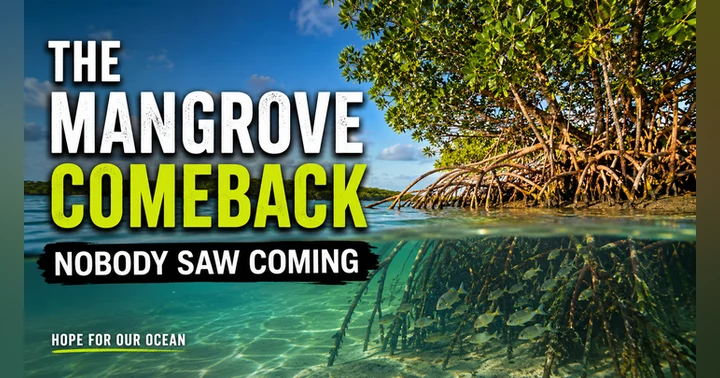
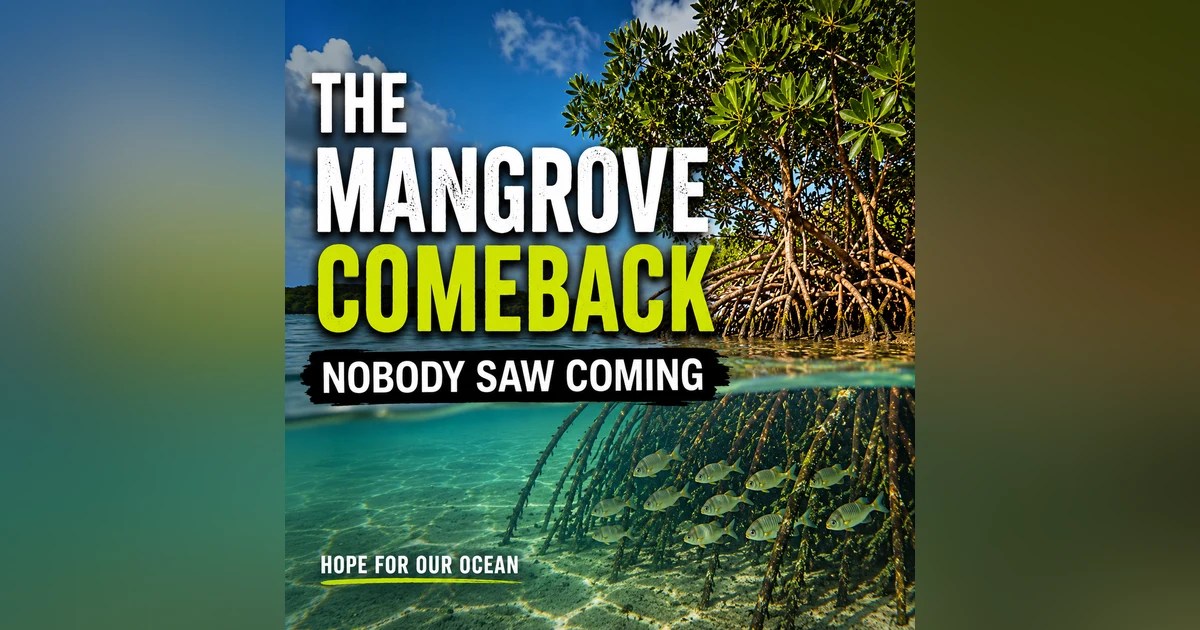
The Return of Mangroves Should Give You Hope


 Apple Podcasts

 Spotify

 YouTube

 Amazon Music

 PocketCasts

 Overcast
For years, mangrove forests were seen as one of the world’s fastest disappearing coastal ecosystems. Cleared for development, shrimp farming, and agriculture, these unique forests seemed locked in a steady decline. But a new global study tells a much more hopeful story. Researchers have found that mangroves are recovering in many parts of the world, offering one of the most encouraging conservation success stories in recent years.
In this episode, I break down why mangroves are so important for the health of our oceans and the people who depend on them. You’ll learn how these coastal forests protect communities from storms, provide critical nursery habitat for fish, and store massive amounts of carbon that help fight climate change. We’ll also explore why scientists believe nature can recover when we give it the opportunity.
Finally, we’ll look at what this recovery means for the future. While the findings are encouraging, mangroves still face threats from coastal development, pollution, and climate change. This episode is a reminder that conservation works, restoration can succeed, and protecting coastal ecosystems remains one of the smartest investments we can make for both people and the planet.
0:00 What if I told you that one of the most important ecosystems on Earth has quietly been making a comeback after decades of destruction? This is the How to Protect the Ocean podcast, your weekday ocean news update. If you care about staying informed on the ocean every single weekday, Monday to Friday, hit that follow button right now so you don't miss tomorrow's story, which is gonna be a really interesting one, where we're gonna talk about studying devil rays in Gaza, a war-torn area, which there's a lot of implications of that, so we're gonna get into a lot of stuff like that tomorrow. So hit that follow button so you don't miss tomorrow's episode. So today, we're answering a simple but important question: Can mangrove forests actually recover after deforestation? And what does their recovery mean for the future of the coasts, fisheries, and climate?
0:44 For years, mangroves have been one of the most cited examples of environmental loss. Across tropical coastlines around the world, these unique forests have been cleared for shrimp farms, agriculture, urban development, ports, and tourism infrastructure. Scientists often describe mangroves as one of the most threatened coastal ecosystems on Earth, and for good reason. Since the 1980s, thousands of square kilometers of mangrove forests disappeared worldwide. But according to new research highlighted by Mongabay and published in the Journal of Science, there is finally some good news. The world's mangrove forests may be bouncing back. And not just in a few isolated locations.
1:25 Researchers analyzed four decades of satellite data and found that global mangrove losses have slowed down dramatically, while gains over the last 16 years have actually outpaced losses. As a result, global mangrove coverage is now close to where it was decades ago, with only about 1% net decline since the 1980s. That's huge. That's remarkable. That's a huge find, especially when so many environmental stories seem to be on the move in the opposite direction. So what exactly happened? Let's start with the basics. What exactly are mangroves? Mangroves are forests that grow where land meets the sea. They're built from salt-tolerant trees that thrive in muddy coastal areas throughout the tropical and subtropical regions.
2:09 If you've ever seen a shoreline covered in tangled roots sticking out of the water, you've probably seen a mangrove forest. These roots do much more than just hold the trees upright. They trap the sediments, they reduce erosion, they slow storm surges, and they create a nursery habitat for countless fish and invertebrates. Now, I've been in mangroves before, and I've walked through them. I was in Singapore on the way back from the IMCC, I think it was five, in Malaysia, in Borneo, at Kuching in particular. And when we came back, Andrew Thaler and I and a friend of ours, went out to a marine protected area on an island, and we were walking through the mangroves. There was, like, a nice boardwalk in there.
2:51 And these mangroves are dense. They're thick, thick, thick. Like, not the trees, but the root systems are all over the place, and they intertwine with each other's trees but the mud that they just kinda keep together and that coastline they keep together secure that coastline from erosion. It's just absolutely phenomenal. It goes on land and into the water. So it's the home of a number of different species in different realms, ocean as well as intertidal as well as land. And it's really, really cool. And they're all, of course, for many commercially important seafood species, they spend part of their time in the mangrove habitats. So without mangroves, many coastal fisheries would struggle. Now, for decades, however, humans removed these forests faster than nature could replace them.
3:33 Large areas were converted into shrimp ponds and coastal developments. Scientists expected them to continue to decline. Instead, something surprising happened. In many places, mangroves began returning on their own. Researchers found that abandoned aquaculture ponds, newly formed mudflats, and protected coastlines create opportunities for mangroves to naturally regenerate. Restoration programs also played an important role. This doesn't mean that every mangrove forest is healthy, but it does mean that the mangroves appear to be far more resilient than many people realize, and they seem to come back a lot faster than many people realize. Now, this is where the story becomes really important because mangroves aren't just trees, they're an infrastructure, a coastal infrastructure, like a natural infrastructure.
4:17 Imagine a coastal community facing a hurricane or a cyclone or even a tsunami like the 2004 tsunami in the Indian Ocean. A healthy mangrove forest can absorb wave energy before it reaches homes and businesses. And in fact, areas where mangroves were intact in the 2004 tsunami in the Indian Ocean actually showed much more protection than areas that had that loss. So in areas where they were doing coastal development or they had like they removed the mangroves for shrimping like we just, shrimp farming like we just talked about, those areas had much more damage and much more lives lost than the areas where they had that protection. So it meant like less flooding, less erosion, less damage. Millions of people around the world benefit from this protection every year.
4:59 Mangroves are also climate allies. They store enormous amounts of carbon in their roots and sediments. In fact, mangroves are among the most effective carbon-storing ecosystems on the planet. When they are protected, they lock carbon away. When they're destroyed, much of that carbon can be released back into the atmosphere. That's why mangroves are often considered a powerful nature-based climate solution. When you hear oil companies and you hear a lot of conservatives like in Canada and the US talk about having carbon capture, the best carbon capture are a lot of these natural systems, whether it be mangroves, whether it be seagrass beds, whether it be kelp or other algae communities. These are the communities and habitats that actually help secure carbon.
5:42 And that if we restore, even though that can be quite expensive, it will actually help. And I feel as though a lot of the oil and gas companies should be made to actually be able to rebuild these and fund the restoration of a lot of these places, especially coastal development and coastal communities where there's, you see that coastal development happen and the taking away of those areas. They should be forced to be, put those back if they take it away. And of course, like we talk about security, then there's also food security. Many fish, crabs, shrimp, and other marine species depend on mangroves during critical parts of their life cycle. No mangroves often means no nursery habitats. Fewer nursery habitats mean fewer fish, and fewer fish can affect local fisheries and coastal livelihoods.
6:22 So when mangroves recover, the benefits ripple outward. The ecosystem benefits, the climate benefits, coastal communities benefit, and fisheries benefit. That's why researchers are calling this recovery one of the most encouraging conservation stories we've seen in recent years. And speaking of like encouraging conservation stories, if you like to hear these types of stories and you're getting value from this podcast, these quick ocean news updates, follow this show on your favorite podcast app so you don't miss tomorrow's episode or any other episode after this. And of course, you can go back into our back catalog of over 1,960 episodes so that you can listen to what's been happening in the past before you get to know what's gonna happen in the future or what's happening now.
7:06 Now, before we celebrate too much of this new mangrove resurgence, there are a few important caveats. The recovery is real, but it's fragile. Many of the new mangrove forests are still pretty young. Young forests don't provide the same level of protection, biodiversity, or carbon storage as mature forests that have developed over decades. And there are also ongoing threats. Coastal development continues in many regions, and pollution remains a problem. So just imagine a coastal city or a coastal area decides, "Hey," somebody comes in and says, "Hey, I wanna build a resort here," or, "I wanna build a shrimp farm here." And the people let it happen, or they don't know it's happening, and it just gets to happen on their watch. That whole area is taken away in months, or in days, or in weeks, and so you have to start that over again.
7:51 Even though we see the recovery of mangroves, a baby mangrove, like a small mangrove plant, is very, very small and doesn't provide the protection that it needs. And as it grows bigger and bigger, that's when the protection really comes in from coastal development, from pollution, and then of course climate change will introduce a few risks if it takes out through some storms and things like that. But this is where you really need to really protect these areas. Not just restore, but protect the restored ones and protect the ones that have always been there. One example highlighted by researchers occurred in Texas, in the States, where expanded mangrove populations suffered major losses after an extreme freeze event. A single climate-related event was able to reverse years of progress.
8:34 Now, researchers are also warning that sea level rise could become a major challenge in the future. Mangroves can adapt to changing coastlines, but only if they have space to migrate inland and conditions remain suitable. So if sea levels rise too quickly or development blocks their movement, some forests could struggle to survive. So think about it. You have this coastline, and there's like a certain thickness off the coastline, so distance from the coastline inland. If the sea level starts to rise, it's gonna take out that first level, those first trees that are exposed to the sea. So as those come in, they're gonna kill those plants, and it's gonna move inland. Now, it's still gonna provide protection because if the band is thick enough, like it goes from the sea inland quite a bit, then you're gonna have some protection there.
9:17 But if there's nowhere for it to develop, like nowhere for those plants to migrate more inland, so if there's paved roads or there's a highway or there's a community there It'll be difficult to restore that even though there's sea level rise. It's gonna be really hard to stop sea level rise because there's such pressure coming in from the ocean. But if you want to go back further inland, that would be easy. But if there's a housing community there or a highway or a road, that's gonna be harder for those plants and those mangrove trees to actually develop and move forward. So that's the problem that they're having with some of the areas that need to be restored. So the lesson isn't that mangroves are saved. The lesson is that the recovery is possible. Conservation works.
9:58 Restoration works, even though it's quite expensive. And sometimes nature can help itself when given the opportunity. In a world where environmental news often feels overwhelming, this matters because success stories show us what's possible when protection efforts are sustained over time. Now, the biggest lesson from this study is simple: nature is remarkably resilient, but only when it-- we give it the chance to recover. Mangroves are proving that conservation can work and that protecting coastal ecosystems is one of the smartest investments we can make for people, fisheries, and climate. It's so important that we follow these rules. It's so important that we look at how restoration and how protection, which is a lot cheaper, ' cause you protect what's there and not have to pay to put back, is such an important part and should be a priority, especially when our coastlines are at risk.
10:48 Sea level rise is happening, and it's gonna continue to happen as long as governments around the world do not do what they're supposed to do fast enough and reduce greenhouse gas effects. So we're seeing sea level rise happen whether you like it or not. Coastal communities are already feeling the pressure. So having coastal areas and coastal habitats to reduce that or to help that out and remediate that and provide more coastal resilience is going to help. Helping with storm surges, helping with winds, helping with wave energy, all these things can help with mangroves. Being able to sequester a lot more carbon, being able to help fisheries by having nursery habitats and protecting young animals of a variety of different species is such an important aspect.
11:30 So the fact is, conservation works. This is an example of conservation working. When we leave the planet alone, we can help restore it, and we can make it go faster, but we can also destroy it at a very rapid rate, and that's what we have to prevent. That's where we need to speak up for the blue. So that's it for today's episode. If you wanna get a hold of me, if you have a question or comment, you can comment on Spotify. You can also just go to my socials in the links in the show notes. You can also support me on Patreon if you like what I do and you like to listen and you find value in this. I do newsletters, I do podcasts, I do YouTube videos. I just post on social media. I do a lot of things. I'm also gonna start posting in Patreon, sort of like behind the scenes kinda stuff with what I'm doing. If you'd like to support that and you wanna talk to me and interact with me online there, you can go to speakupforblue.com/patreon.
12:15 That's speakupforblue.com/patreon. The reason why I'm advertising this more, a lot of people have said, "Andrew, you need to do this because people wanna support you." You're more than welcome to continue to listen to this without supporting me. But if you wanna support me, that'd be greatly appreciated. Speakupforblue.com/patreon. I wanna thank you so much for joining me on today's episode of the How to Protect the Ocean podcast. I'm your host, Andrew Lewin. Have a great day. We'll talk to you next time, and happy conservation.