The Shark Wasn't the Real Story. the Ocean Mystery Was.


 Apple Podcasts

 Spotify

 YouTube

 Amazon Music

 PocketCasts

 Overcast
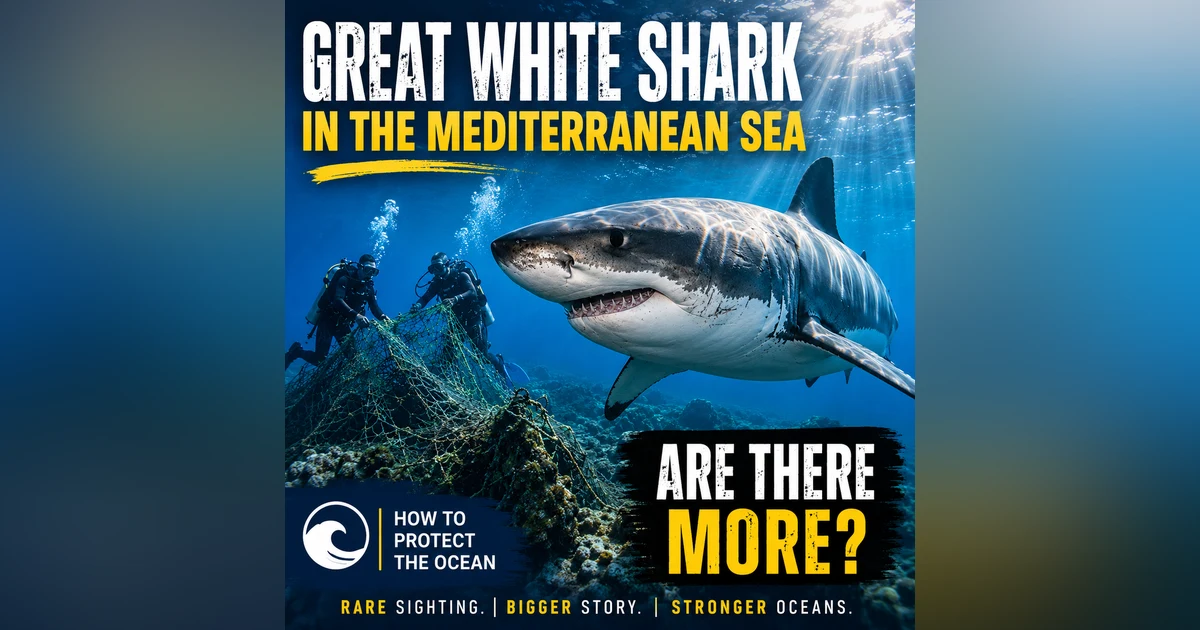
A viral underwater video of a great white shark in the Mediterranean Sea recently captured the attention of people around the world. For many viewers, the footage seemed to show a shark appearing in a place where it shouldn’t be. But the truth is much more interesting. Great white sharks have been documented in the Mediterranean for decades, yet they remain one of the most mysterious and least understood apex predators in the region.
In this episode of How to Protect the Ocean, Andrew breaks down why this sighting matters and what the public often gets wrong about stories like this. The shark was filmed by divers working with Healthy Seas while removing abandoned fishing gear from the seafloor. While the footage itself is remarkable, the bigger story is what it tells us about the challenges facing large predators in one of the busiest and most heavily used seas on Earth. From fishing pressure and habitat degradation to gaps in scientific knowledge, the Mediterranean remains a challenging place for sharks to survive.
You’ll also learn why conservationists were excited about the video for reasons that had nothing to do with discovering a new population. Andrew explores the concept of shifting baselines, how viral wildlife stories can sometimes distort public understanding, and why rare observations like this are still incredibly valuable for conservation. The episode highlights the importance of documenting marine life, supporting scientific research, and continuing efforts to reduce threats such as ghost fishing gear.
By the end of the episode, you’ll see that the shark wasn’t really the story. The real story is how much we still don’t know about some of the ocean’s most iconic animals, even in regions that humans have studied and used for thousands of years. Sometimes a single video can remind us that the ocean still holds mysteries worth exploring, understanding, and protecting.
Support Independent Podcasts: https://www.speakupforblue.com/patreon
Need help with your ocean non-profit, company, or project? Get the help you need with Pisces Oceans Inc.: https://www.piscesoceans.ca
Connect with Speak Up For Blue
Website: https://bit.ly/3fOF3Wf
Instagram: https://bit.ly/3rIaJSG
TikTok: https://www.tiktok.com/@speakupforblue
Twitter: https://bit.ly/3rHZxpc
YouTube: www.speakupforblue.com/youtube
0:00 Question I have for you today is, why are people acting like a great white shark suddenly appearing in the Mediterranean Sea is such a huge thing when scientists have known that they were there for decades? This is the How to Protect the Ocean podcast, your weekday ocean news update. If you care about staying informed about the ocean every single weekday, Monday to Friday, hit that follow button on your favorite podcast app because we are going to be talking about some great things today. So let's talk about a recent underwater video of a great white shark in the Mediterranean has gone viral, but that shark itself isn't actually the story. The video itself is. Because today I wanna explain why scientists are excited for the video, and why the public is so surprised, and why this moment tells us something important about ocean conservation.
0:47 So here's what we know of what happened. So divers that were removing ghost nets from the organization called Healthy Seas, they were removing ghost net fishing gear. They recorded a great white shark. Now, if you haven't checked out Healthy Seas, I'm gonna put it in the show notes. I've had actually people from Healthy Seas on before. They specialize in removing ghost nets, but not just any regular ghost netting. A lot of the times they specialize in removing aquaculture ghost nets. That's right. The people will start an aquaculture business, open pen anywhere in the Mediterranean. So a lot of the times they've been doing… When we had them on, it was in the Greek Islands. And somewhere in the Greek Islands, they would eventually just abandon that aquaculture net, and it would just sit there. And all the infrastructure that goes with the mechanics of the nets would actually just dissipate into the water.
1:32 And you'd be floating plastic and styrofoam and all this stuff, and it was awful. And so Healthy Seas actually works to get rid of all of that stuff, all that junk that's in there. And so they were also getting rid of ghost net fishing gear when they came across this great white shark. Because they video everything so that they can tell a story, which by the way, if you are not into communication for your nonprofit, that is the key to getting stuff like this as well as your own story out. So they video everything. They record everything. And the footage captured, in the Strait of Sicily, a great white shark in the Mediterranean. That's amazing. And of course, outlets treated it like it was a major discovery, like the first ever.
2:12 But great whites have been seen in the Mediterranean for decades. And that's something that I feel like, sometimes it gets caught up. And scientists were excited because it was underwater footage, and getting underwater footage is incredibly rare, especially in the Mediterranean. But we've known that there have been sightings. There was a paper in the 1960s that said, "Hey, you know what? There are great white sharks in the Mediterranean." There were sightings in the 1980s. But they've never actually had a recorded sighting, like a video recorded sighting. And this great white, if you watch the video, I highly recommend you go on the Healthy Seas YouTube channel. They'll have it there. If you watch the video, it's amazing. Like, you get to see this beautiful shark. It looks like it's in great health. There's a bunch of remoras and other fish that are swimming along with it.
2:53 And it's really exciting to see that there are great whites in the Mediterranean. But it's not something that should get blown up and we're sort of like, "We've never seen them there before." Because fishers have seen them for a long time and we just see this. Now, it is something to talk about. We gotta talk about how social media reacts to wildlife sightings, because it's all in the frame of reference. I was talking to my colleague and good friend, Dr. David Ebert, who I co-host the Beyond Jaws podcast. And we talked about it. I said, "Hey, did you hear about this news that a great white was videoed and things?" He's like, "Yeah." But he's like, "That's not really news. We don't see them often. They are rare, but that has been seen before." And I think when you talk about the frame of reference in where all this is going, I think you're looking at areas where we're saying, "Hey, you know what?
3:36 Like, just because a shark is there doesn't mean it hasn't been seen before." We tend to just look at the last 10 years or even in social media times, like even months or even days in some, in like news cycles. And whatever's gonna get the clicks, that's gonna get the clicks. And of course, the headlines that come out, they wanna make it as desperate or as urgent as possible so that you're gonna click on there. And like I said, I don't wanna take away from what this is, you know, the first video that we've seen in a long, long time, if not ever, of a great white shark. Healthy Seas did a fantastic job in getting it out there, and I'm sure they know that, hey, this is news, and this is good news to see that great whites coming back. That means there's food there, possibility and that kind of stuff. But just 'cause every time a shark shows up somewhere, people act like it's a huge invasion.
4:20 Some people are like, "Great white sharks shouldn't be there." It's not just following our assumptions, right? Just 'cause we don't see something doesn't mean it isn't there. The ocean is a huge place. The Mediterranean is a huge place. And there are a lot of different things that happen. It's very clear, so you can see a lot of stuff, but there's probably a lot of things that we don't know that are in there, new species and so forth, that we just haven't discovered 'cause we haven't gone exploring enough. You know, a lot of times, great white sharks, marine mammals, any other type of sharks, sometimes the fish and stuff, we see them because we either fish them out and when they get caught in fishing nets, or we see them on the surface every once in a while. I'm thinking more marine mammals, we'll see them as they… 'cause they have to come breathe. Sea turtles have to come breathe, breathe air at the surface. So we see those a little bit more often.
5:00 But just 'cause, like, great white sharks aren't seen all the time or other fish aren't seen all the time doesn't mean that they aren't there. And I think that's something that we need to really look at how we view these types of things. I was just out in Halifax this past week. The great whites were being talked about all over the place. We probably already had great whites out there for a number of years. But when more people are out on the water and more people are actually looking for these sharks, we're starting to see more. So the public perception of these sharks have just shown up. Maybe there's a little bit more because of the population increase along the East Coast and maybe, the one in the Mediterranean is interesting 'cause it's endangered in the Mediterranean and in that area. But, like, on the Atlantic Coast, we're starting to see this boom of great white sharks along the East Coast, even along the West Coast.
5:42 And that's a great thing. That's a conservation success. So the fact that there's more sharks out there, we know that they're coming more north because maybe it could be a cumulative impact of climate change being warmer up north, but also the fact that they're doing better, so they need more territory to hunt and so forth, is really a great thing. And I think we're starting to see that perception of, hey, great whites being shown in the Mediterranean. It's actually fun. It was actually a good news story, not a scary story, and I think that's really great to see, and we need to see more of that. So that's something that I'm interested in, it's kinda good and that's where this story really gets interesting, is when the shark wasn't really expected to be there, and I think that's really cool to see. And what was unexpected really was getting such a clear look at an animal that scientists rarely get to see, especially in the Mediterranean.
6:26 The video is on point. So like I said, check out the Healthy Seas YouTube channel because I'm sure it's on there, and it's gonna be something that's really good. Mediterranean great white population is thought to be really, really small. And because of the fishing pressures, especially along the southern border of the Mediterranean, we don't really see a lot of them because they've disappeared in the past, they've been caught in the past, and they just haven't replenished as much as we thought they would have or as much as we thought we weren't affecting them. So, there's only potentially a few hundred animals that remain in the area, and they're very difficult to study because we can't really see. So visual evidence will create this type of public excitement and even scientific excitement. Scientists are coming out being like, "Hey, this is not a huge deal, but it's a pretty big deal, but it's not like the biggest… It's not that we've never seen them there before," right?
7:07 But rare species often receive a lot of attention only when there's footage. But, beyond the news cycle, like, probably by the time you hear this, it's probably gonna be a little past this news cycle. But the fact that we've seen it, does it now or should be spurring on studies to look more for these types of species, because I think that's gonna be really important. So I'd love, like, what was the last ocean animal that you were surprised or you learned that lives somewhere? I would love to hear that. Let me know. If you're on Spotify you can hit me up in the comments, or if you wanna hit me up, just look at my socials in the show notes. But I think that's really important 'cause, like, how many people think great whites only live in South Africa or in California or off Cape Cod. Even Cape Cod, If you go on Ocearch, the organization that tags these sharks, you'll see where they go around the world, and you see that they're in much more places where I think people realize.
7:51 But because of the way media covers it, not necessarily the fault of media in this case, but the fact is we know there are great white sharks. Where there used to be a lot more great white sharks in South Africa, but we now we know there's some in California. There's a bunch in California. There's a bunch on the Atlantic coast, and we're gonna see probably more and more as we move along and great whites can be seen in Hawaii. They can be seen all over the place. But there's still so much of the ocean that remains unseen, and this video makes it exciting. And even if you look at organizations like Ocean Census that go out and are looking for species, they're looking for biodiversity. I think they just named a bamboo shark, which we should cover on this on How to Protect the Ocean. I should have Dave on because he talked. David Ebert also was part of that discovery. This is why video matters more than scientific reports sometimes for public awareness is because we need to be able to see what's out there as citizens, not just scientists and conservationists.
8:41 We need to see what's out there so that we can be like, "Oh yeah, there's proof." We can actually see that's happening. When you look at a video and you compare it to, like, a scientific paper, the scientific paper may get read by hundreds of people, but really the viral video will get seen by millions if not more. And I think that's where, when we start to talk about communication, I said at the beginning of the show, the fact that communication is such an important part of the ocean and of ocean conservation messages, I think this is really important to me as a science communicator because it's frustrating when you have a scientist who's like, "Oh, I m- made this major discovery. I'm gonna publish on it, so let's wait till we talk about it, like, publicly until we publish on it. But I wanna publish on it first, so we can talk about it in public after." Which is great because they want more people to see their paper, but let's be honest, other than people that live in the science world, and maybe the conservation world.
9:28 One, people don't have access to their papers, but they also wanna hear about it because the discovery, the paper may not come out for months or even years after the discovery's made, but the discovery can make news right then and there. Maybe it's even in the news cycle if it goes viral and maybe not very long. But then your paper can come out after and be like, "Yeah, look forward to the paper for all the other scientists." Because waiting for other scientists to read it is not the same as waiting for every people to see it and people to understand it and people to actually allow it to either go viral or even have a discussion on it. That's really important because most likely, most of those people are not going to read the scientific paper. So I think it's as a scientist, I get people… , it's important that people publish.
10:08 It's important that scientists publish because that's their incentive. That is how they are marked or they are evaluated as a scientist. Are you published? I'm a published author. Well, not necessarily a book, but, I'm a published author in the science journals, which is important to contribute to science. But let's be honest, the message needs to come out a lot faster. If you think about it, like imagine this. This project that's being done, say it was part of a scientific paper, and this discovery happens. Well, you can have that go out to the public with that video of the great white shark, and be like, "Hey, this is an ongoing project, and let's learn what the scientists and the conservationists were doing." And then people can start following along on their journey. That's an opportunity for great communication strategy of like, "Hey, you saw that great white shark video that we have.
10:51 We may or may not get that again. We don't know. But we're working on this project. It'd be really cool for you to follow us along on this journey." Imagine having that. You finish the project like years later. You publish on it. It does really well in the science magazines. Plus you probably had press on it, so you might get into a better paper or a better journal, like a higher standard journal or whatever they call it. They have all these ratings for it. But that's something that's really cool. I feel like that's something that you could really build upon and maybe help with funding, 'cause let's be honest, funding is kinda crazy. You need to really build up the publicity to get more funding. I think that's something that's really important. So communication strategy is something that is huge. And I just wanted to let you know, like I am part of a consulting firm now called Pisces Oceans, and I'm the ocean communications manager.
11:36 And we are looking to partner and collaborate with groups who want to build on their communication. They may not be able to pay us out of their own pocket, but if you partner on proposals and include Pisces Oceans as a collaborator to do their communications, help with their grant management and project management, you can get your stuff done faster and probably more efficiently and be able to get a bigger, no pun intended, bigger bite so that we can actually get this out into the public a lot faster. So if you have any questions around that, you can get ahold of me. Just reach out to me through my socials, or you can go to piscesoceans.ca and you can sign up there and be happy to help in any kind of way. Or you can just hit me up on LinkedIn and just message me.
12:17 But let's get back into the episode because I think it's something really interesting, this story, because, like, What happens next? Now that this video went viral, what happens next? Scientists will still have major questions about this small population of great white sharks. Are, like, are there nursery areas that remain poorly understood? Do we know if there are nursery areas? Do we know even the population size? Maybe this is a chance that questions start to get asked. We saw one great white shark in video. Are there ways to get others? Can we start putting stations, like these BRUVS, these baited, like, cameras where you can see if there's any sharks that come around and maybe study more? This is a way to really understand the population size because it does remain uncertain. And conservation depends on the understanding of where these sharks spend their time every single day.
13:01 And we got estimates of this population, but it'd be a great opportunity to get more estimates. I think that's something that could be done in the future. Because look, Conservation starts with knowing a species exists. We know great white sharks exist. We don't know their full extent to where they go. We have some historical sightings, we have some historical papers. We don't know what's affecting… We may know some things that are affecting the great white sharks from living in this area, maybe a lack of fish, maybe fisheries getting caught up in bycatch in some places. But there's a lot of studies that can happen. You can do social science studies, where you can talk to fishing communities in and around. Like, there's so many fishing communities along the Mediterranean, have like a huge project that looks at sharks, and other sharks that are around there too, not just great whites, but look at other sharks.
13:42 Like, I am always surprised, and people are surprised when I tell them, we know very little about sharks, like very, very little, especially the coverage around the world. We know very little about the ocean in general. I was just talking to people about seagrasses and eelgrass , along the coast of Nova Scotia. We just don't even know where they are. And so mapping is important just to know where they are. The baseline discovery system is so disconnected and underfunded that just understanding habitats and species is a huge thing, especially coastal ones, is a huge, huge need, and we can build on that in the future. So I think that's something that's really a great opportunity in the future. This is the best part of why I love science.
14:23 This is the best part of why I love conservation, is because we can actually have these conversations, we can actually have these discoveries, and then explore more. That's what I think is really important. And I think this, this is the reason I got into marine biology is because the ocean still surprises us each and every day. There's so much that remains unknown. Exploration is really one part of this whole conservation tool, but curiosity is, like, the biggest tool, is to say, "Hey, we need to conserve these species, but we need to know what's out there so that we need to conserve and protect the ocean." I think that's really important. And that's the most important part of the story. It isn't that the great white shark was found in the Mediterranean, because scientists already knew it was there. The important part is that a critically endangered population is still surviving in one of the busiest seas on the planet.
15:06 And sometimes just a single video can remind millions of people that the ocean still has mysteries worth protecting. And I think that's really the message here when we talk about this great white shark, this sighting in the Mediterranean. It's an opportunity to learn more. It's an opportunity to satisfy our curiosity. And it's an opportunity to follow people on this journey. Researchers out there communicate to the people about what you're doing and why you're trying to find these sharks, and maybe you'll see how this story develops into a lot of different branches and maybe having institutes where sharks are studied in the Mediterranean. That's it for today's episode. If you want to follow this podcast, you just discovered it or you haven't followed it yet on your favorite podcast app, hit that follow button right now.
15:50 We are providing an ocean weekday update, Monday to Friday. And this week is all about ocean news. I'm just back from a trip, so I haven't done an interview. I've got some interviews that I'm working on right now lined up, and we're gonna get to go for that. So stay tuned, but follow this podcast so that we can help expose the podcast to everybody else who wants to learn about the ocean, and plus you'll never miss another episode. I wanna thank you so much for joining me on today's episode of the How to Protect the Ocean. I am your host, Andrew Lewin. Have a great day. We'll talk to you tomorrow, and happy conservation.