Canada’s Ocean Promise Sounds Big, But Is It Enough?


 Apple Podcasts

 Spotify

 YouTube

 Amazon Music

 PocketCasts

 Overcast
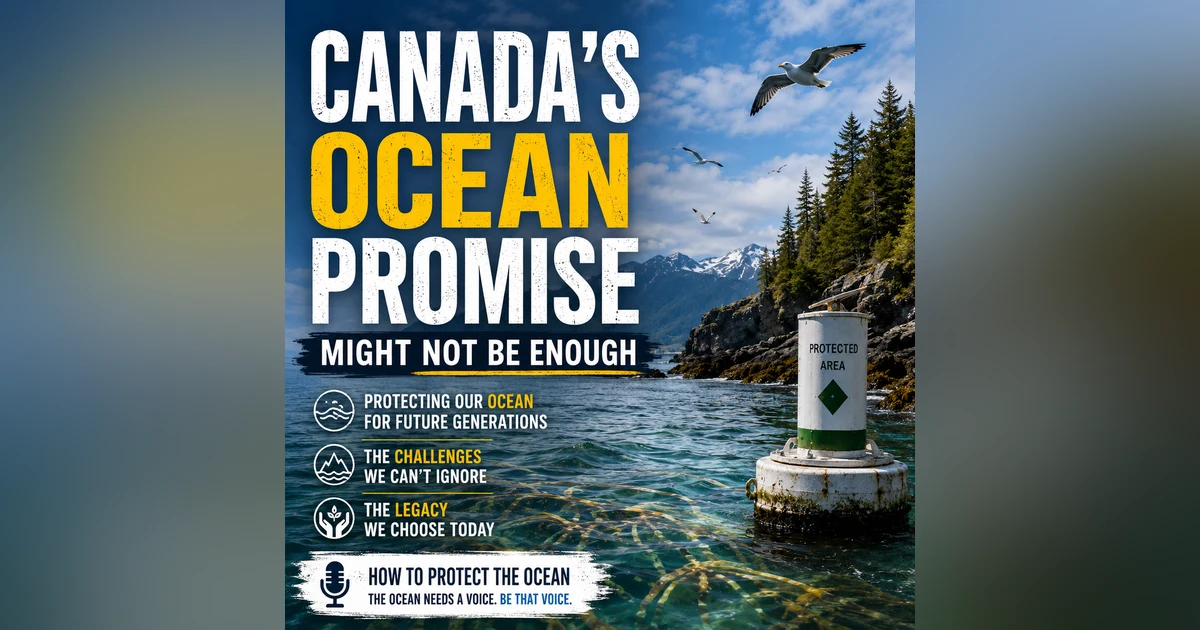
Canada has a rare chance to become a global ocean conservation leader, but the path is not simple. In this episode of How to Protect the Ocean, Andrew Lewin breaks down Canada’s proposed $3.8 billion nature strategy, what it could mean for marine protected areas, and why ocean protection matters as development pressures grow.
From pipelines and shipping to offshore oil and gas, fisheries conflicts, climate change, and Arctic access, Canada’s ocean future is being shaped right now. This episode looks at the promise, the risks, and the question every coastal nation should be asking: what kind of ocean legacy do we want to leave?
Support Independent Podcasts: https://www.speakupforblue.com/patreon
Need help with your ocean non-profit, company, or project? Get the help you need with Pisces Oceans Inc.: https://www.piscesoceans.ca
Connect with Speak Up For Blue
Website: https://bit.ly/3fOF3Wf
Instagram: https://bit.ly/3rIaJSG
TikTok: https://www.tiktok.com/@speakupforblue
Twitter: https://bit.ly/3rHZxpc
YouTube: www.speakupforblue.com/youtube
0:00 Canada has a rare chance in becoming a global ocean conservation leader, but we still have a lot of work to do as a fellow Canadian myself. But there's been a new proposal from Prime Minister Mark Carney, a $3.8 billion dollar nature strategy that was proposed in part of the development of 2030 to get 30 by 30. So they wanna increase the amount of protections by 2030 from land and water. We're gonna talk about that on this episode of the How to Protect the Ocean podcast, 'cause this is where you get your weekly ocean news updates. Monday to Friday, we talk all oceans. Sometimes we do an interview on Friday. We prep you for that interview with solo episodes. Today, this week is all solo episodes because it is Oceans Week.
0:40 Oceans Day was on Monday, June 8th. Some people call this Oceans Month in June. I mean, every day is Ocean Day when you listen to the How to Protect the Ocean podcast, which is great. But we're gonna be talking this week a lot about some positive news and some dedications and some commitments from a lot of these countries and like Canada, like my own. So we're gonna talk a little bit about that and why that is important. So look, here's the history in Canada with marine protected areas over the last, like, decade, decade and a half. When the Trudeau administration came in, Trudeau became prime minister in 2015, we had less than one percent protected of marine and land in Canada, especially on the marine side. And that was unacceptable because we had already committed to 30 by 30, 30% of the marine realm protected by 2030.
1:25 It was a part of the Convention of Biological Diversity, and that was an important mark for us, and it was an important mark as countries. When countries commit to these types of international agreements, like the Convention of Biological Diversity or the Paris Accord Climate Agreement, this is an important thing because they have to commit to that. They have to actually do the work to get that. If not, they get embarrassed when they committed and it doesn't work. That can go against that politician, that prime minister or president's voting when they say, "Okay, we said we were gonna do something about it." And so that is something that's important to them, and it's also just important from a pride perspective for the country in itself. And so for the Trudeau administration that came in, Prime Minister Trudeau was saying, "Hey, we wanna increase it. We are going to increase it before 2020 to 15%." And that's what they actually did.
2:07 In a matter of four years, they had marine protected areas that were in development and in sort of negotiations for quite a while that got protected. There was an expansion on the deep sea hydrothermal vents system along the West Coast. Many of the protected areas that were put in the Arctic, and there's still some that have been put in. And now there are more that are proposed. In fact, Ottawa will fund up to 14 new marine protected areas and conserved areas and at least 10 new national parks and freshwater national marine conservation areas, and it will also fund up to 10 new national marine conservation areas and 15 national urban parks with a $3.8 billion nature strategy. And this is all supposed to be in development by 2030.
2:48 This is great news because the news that has been coming out of this administration with Prime Minister Carney was the fact that, hey, we have some trouble with trade with our neighbors down south because of a particular person. So we are going to develop and divest some of our investments into other countries. And so that means we're gonna build pipelines. That means we're going to build trade agreements and things like that. Well, when you build pipelines or you build any kind of infrastructure 'cause you're trying to do new trade, because of the speed of that development that has to happen, a lot of the times the environmental regulations get rolled back. And that's been happening a lot with pipelines, with data centers, with mining, and that was disappointing to see, especially from a liberal government that just not long ago, but a year and a half ago, was very much in the point of like, "Hey, we wanna reach net zero by 2050.
3:35 We are protecting areas. We are trying to curb and tax carbon," which I know not popular, but that's what it was. So people were starting to get antsy about that, and so the new government came in. Of course, President Trump got in as well, or just before that. Our government was formed with Prime Minister Carney, who's got a lot of international and economic experience, and he has taken the country in a different route. And it sometimes it's good, and sometimes it's not so good, especially when it comes to the environment. So I was very surprised to see this. It's still a minimal in my opinion, a small contribution in terms of money, $3.8 billion, but we haven't really seen a lot of that money before if it was promised, and we haven't seen the action. So this is the fact that they're actually putting numbers on the number of marine protected areas and conserved areas and 10 national new parks and all this kind of stuff.
4:20 And there are different designations for marine protected areas and marine conservation areas and national marine conservation areas and urban parks and all this kind of stuff. So it all ranges in the types of protections that it could have and who is going to protect that. When a marine protected area in Canada gets designated, it's done by the Department of Fisheries and Oceans, DFO, and/or Fisheries and Oceans Canada, as it's now called, but I'll refer to it as DFO throughout this episode. That's significant. That means nothing can be extracted from those areas and other conservation areas have different regulations around that. But this is a pretty big commitment by Canada, especially with everything that's going on, which I mentioned that everything's going on. Canada is home to 20% of the world's total freshwater lakes, 37% of the lakes in the world, and 25% of the wetlands, and 24% of the boreal forest.
5:04 And it has the world's largest coastline, so it touches on the Atlantic, the Arctic, and the Pacific Oceans. It is 620,000 square miles of land and up to 700,000 square kilometers of oceans that's gonna be protected over the next four years. So last episode, I talked about how we are at 10% of global protection, and that's gonna increase, and I predict that's gonna be increased. This story here kind of proves that, where you're seeing a lot more commitments from countries that are gonna get to that 30%. Canada's just a little over halfway there in terms of its commitments from a marine perspective. I'm not sure from a land perspective. But that's a good thing. Especially with everything that's going on, these protections need to stay in place and be enforced, obviously, 'cause a lot of development that's going on in Canada.
5:45 But a lot of our coastlines are unreachable or smaller coastlines or smaller cities that are around those coastlines, so that's a benefit to us because there's not as much pressure. But also some companies like to get away with some stuff when nobody can see them, so you gotta be careful. And so you still have to have policies and regulations in place, and you have to hold them to that. Two episodes ago we talked about the data centers, which is a big push around the world, and we're seeing people stand up to those. People have to watch out because companies will continue to just pound and pound and countries will do that, governments will do that, pound and pound until they get what they want. That's happening in some countries like the US, where we're seeing oil and gas development being opened up, or sanctuaries being opened up to fishing, oil and gas development, some of the regulations being pulled back. They'll go to the courts, organizations will bring in lawsuits against them to say, "Hey, you can't do that." That will hold up in court, and now something else happens, and then something else happens.
6:32 Now there's deep sea mining, and then there's another proposal up in Alaska for oil and gas, and now it's over on the East Coast for oil and gas. And it's just constant, and it's done on purpose to kinda spread us all thin in terms of the people, the advocates, and the activists who are speaking out against these types of actions. And so you always have to be careful. That's why it's important to establish and be proactive and establish these marine protected areas to make sure that they stay in place. And it's something that needs to be done on a regular basis. And I'm glad that we're seeing this push because, you know, in Canada we got some very unique ecosystems. Like I mentioned before, we have Atlantic, Arctic, and Pacific Oceans, kelp forests, arctic waters, cold water corals, estuaries, seagrass meadows, salt marshes, mud flats.
7:13 We got all these wonderful habitats that are the home of these amazing species and a diverse set of species, which is a big thing. We also have a big push on, not only including, but having indigenous protected areas. So they're, leading this charge in their own areas, right? In their own treaty territories. And I think that's a really important aspect. That's something that's gonna be really great in the future. We're building a university up in Nunavut, up in the Arctic, which is gonna be its first ever. I think that's gonna be really important having a university dedicated to there, 'cause I know an environmental program will be great up there, and it'll teach a lot of the indigenous knowledge systems that we've had in the past that haven't been used in science-based decision-making, which I think we're seeing more and more happening, where indigenous decision-making is being put in place or in conglomerate with or collaboration with, which I think is great to see.
8:06 But we also have a lot of challenges. We have pipelines going in, oil and gas. Offshore oil and gas is huge. Shipping has become bigger even, especially with the melting in the Arctic. So the Northwest Passage is, they're seeing a lot more pressure than it ever has before. We have fisheries conflicts. We have fisheries ministers that are allowing for cod fishing when the cod stocks are not doing well, and they're giving in to pressure on this. And then of course, we have climate change, which is making everything worse. So there's a lot of challenge in that, and protected areas are helping with that. It's taking away some of those cumulative effects where fishing can't happen and where destruction of habitat can't happen within that area, where maybe shipping lanes have to be diverted around those protected areas, so it doesn't harm any animal or any ecosystem.
8:47 These are all things that are really important when we look at in the future. So look. Canada has everything it needs to lead. It hasn't signed on and ratified the high seas, which I hope it will. But within its national boundaries, within its economic zone, exclusive economic zone, the 200-nautical-mile EEZ, I think it's doing a really good thing. And I think from a Canadian standpoint, with the longest coastline in the world and with the maritime industry that we have, I think we have to ask ourselves, like, what type of ocean legacy do we want to leave? And I think this is a step in the right direction. And I know this government that we have now has not done a great job at protecting the environment steadily, but having this will help, especially with all the development that's going on. But I would love to hear from you.
9:27 If you're Canadian, non-Canadian, if you're having similar things happening in your country, I would love to hear from you. You can hit me up or join our community on Patreon. That's speakupforblue.com/patreon. If you wanna get access to the podcast and you just want the interviews that we do every week, or you just want the solo episodes, I'm gonna try and do two feeds in that. And those will be free. You don't have to join the community, which is gonna be a paid community. But, you know, the idea is let's get together once a month, let's have a chat, and let's talk some fun things in this community. So, that's it for today's episode. I wanna thank you so much for joining me on this episode of the How to Protect the Ocean podcast. I'm your host, Andrew Lewin. If you wanna get ahold of me, you can hit me up on my socials in the show notes, or you can also join the community.
10:08 Have a great day. We'll talk to you next time, and happy conservation.


