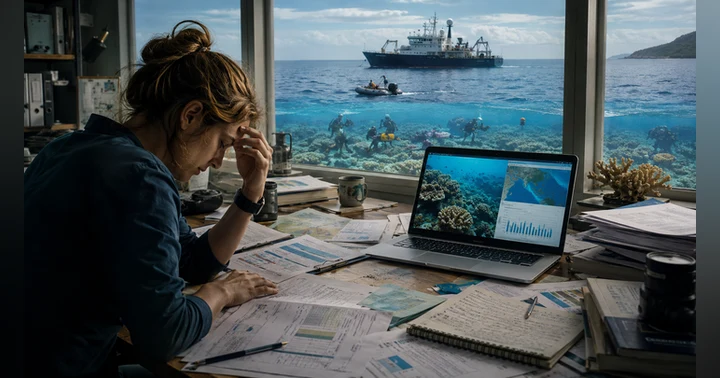
Are Ocean Scientists Becoming Fundraisers Just to Survive?


 Apple Podcasts

 Spotify

 YouTube

 Amazon Music

 PocketCasts

 Overcast
Ocean conservation depends on science, but what happens when marine scientists spend more time chasing funding than doing the research itself?
In this episode of How to Protect the Ocean, we look at the hidden financial pressure behind ocean conservation. Research vessels, field expeditions, monitoring programs, satellite tools, underwater robotics, staff, permits, and long-term analysis all cost money, and funding is becoming harder to secure.
We also explore why communication is becoming essential for scientists and conservation organizations. Storytelling, public trust, media, podcasts, social media, and digital strategy are no longer side projects. They may be the difference between a conservation project surviving or disappearing.
Support Independent Podcasts: https://www.speakupforblue.com/patreon
Need help with your ocean non-profit, company, or project? Get the help you need with Pisces Oceans Inc.: https://www.piscesoceans.ca
Connect with Speak Up For Blue
Website: https://bit.ly/3fOF3Wf
Instagram: https://bit.ly/3rIaJSG
TikTok: https://www.tiktok.com/@speakupforblue
Twitter: https://bit.ly/3rHZxpc
YouTube: www.speakupforblue.com/youtube
0:00 Many marine scientists are now spending almost as much time chasing funding as they are doing actual science. This is the How to Protect the Ocean podcast, your weekday ocean news update. If you care about staying informed about the ocean every weekday, hit that follow button right now so you don't miss tomorrow's story. Look, when most people think about marine scientists, they picture fieldwork. Research vessels, driving on coral reefs, tagging sharks, tracking whales. But behind the scenes, there's another reality most people never see. A huge amount of ocean science now depends on fundraising. Grant applications, donor meetings, partnership pitches, public communication.
0:40 And for many researchers, that pressure is growing. So today's question is this: Are scientists being pushed into becoming fundraisers just to keep ocean conservation alive? That's really what we're gonna dive into today. ' Cause ocean science is one of the most expensive fields in research. It's not easy to work in the ocean. Research vessels cost enormous amounts of money to operate. So some UNOLS fleets will cost up to $30,000 or more than $30,000 per day US, which for Canada, that's insane. Satellite systems are expensive. Underwater robotics are expensive. Field expeditions are even expensive. Even basic monitoring programs require staffing, travel, equipment, permits, and analysis.
1:23 And funding is limited. To be honest, there are some people who are doing some great things. Dr. Andrew Thaler, who's been on the podcast for quite some time, he always works on openCTD, which is a line of sampling products that he creates that you can use and buy at a cheaper price than what is normally done and still does the exact same thing. You can always check that out on his Patreon. But it's just amazing what people can do. But funding limitations are real. Government research budgets often shift with political priorities, like we see down south in the Trump administration. Even in Canada, we've seen a lot of reduction in the size of government, like actual public workers who are working on science and conservation projects all the time on behalf of the government. There's been a downturn in that, and there's been a shrinking of that workforce.
2:05 Economic downturns can also reduce granting opportunities, which we're kind of facing right now. And nonprofit organizations are competing for many of the same funding pools. This creates an environment where researchers are constantly searching for financial support. And honestly, it also creates a very competitive-natured workforce of nonprofit organizations where people are backstabbing each other 'cause they're trying to go after the same funding. They're kinda crap-talking everybody behind their backs. It's really not a great sight to see and witness for all this kind of stuff. And searching for funding takes time. And some scientists spend months every year writing proposals. There's a lot of times where I speak to people who have started their own projects, who have done amazing work so far on very limited budgets, yet they're still looking for funding all the time.
2:50 They complain that most of their time is spent on funding. If they can spend less time on funding, they can do a lot better, and but A lot of people can't afford someone who's just looking for funding and doing grant writing or a team of that because that's the hardest part. Others depend on short-term project funding that creates uncertainty around staffing and long-term planning. You can't go, like grants of six months that have a very limited budget. A lot of times they won't pay for overhead, so you can't pay for people permanently, but you can do a lot of contract hires, which makes it difficult to not only manage from a time and logistics perspective, but the training that goes involved in making sure that people who are long-term would actually be able to handle this work, right? And this pressure can influence what research gets prioritized because, like projects with strong public appeal may attract more support, less visible but equally important work may actually struggle.
3:37 This is where things really start to change. Scientists are no longer expected to only publish research. They are increasingly expected to communicate publicly. And honestly, many are very good at it. Like I get surprised at it because we don't do any training. We just go into science, and we're expected to do science stuff. But now you see marine scientists building audiences on TikTok, Instagram, YouTube, LinkedIn, podcasts, and documentaries. And some of that communication is educational. So we're starting to see like a bit of a secondary nature here. And when they get brought on to different organizations or companies, they tend to help that company or organization because they have all these connections, they have all these followers. So if some of it helps attract partnerships and funding, and also it can help build trust with the people because as you are having that public profile, people start to gain loyalty towards you.
4:28 Like, I have people who listen to me all the time and will always message me and stuff. And when I'm doing stuff, they're really happy that I'm in a new position or that I'm doing something new or working on a project because they trust the work that I've done because of the many years that they've been following me. But this shift, it also creates a lot of pressure because universities traditionally train scientists to communicate with other scientists, not the public, not donors, not policymakers, and certainly not algorithms of social media. There's also growing research showing that storytelling matters enormously in science communication That's huge. People respond emotionally to narratives, just like in that book, Don't Be Such a Scientist by Randy Olson.
5:09 This is one where it's like, hey, scientists speak logic, so they speak to each other's brain. But when you speak to an audience that may not be scientific, you're speaking to a non-scientific audience, you are go- attacking the gut because that's where the emotions happen, whether it be sadness, whether it be happiness, whether it be anger. That's where you want to get because that's what's really gonna pull people in. You don't wanna make people sad, but you want them to really identify with the story, and emotions is that, right? You don't wanna just do data, because they respond to narratives. That means scientists are increasingly competing in an attention economy. The only time I've heard the attention economy before is in, like, these marketing YouTube videos where creators are trying to teach people how to make YouTube, and they make money on teaching people how to make YouTube, and they're like, "You can do this on any platform, or you can do this with any niche."
5:57 And that's not true because a lot of people have done it in ocean, and they haven't been able to do it. Only a few selected people have been able to do it, and they work hard, and they do really do great. But not a lot of people have been able to do it in this attention economy. It's a very difficult economy to gain attention. And attention, though, once you get it, can directly affect opportunity. One example is Christian Parsons, who does the Shark Bytes podcast, I guess, show on YouTube. Shark Bytes is a very popular YouTube channel. I think it has over 184,000 subscribers, maybe even more by now. That was the last time I checked. He talks about sharks each and every week. He does these videos. He's a scientist, and he couldn't find a job, so he decided to go to do this YouTube show, and he's making money on the YouTube show to help him survive on his own, and he's able to do the science that he practically wants to do.
6:38 It's still expensive, but he gets to collaborate, he gets to still do science, and he can use that science in his communication. And I think that's a really important thing 'cause maybe that will help him lead towards his next big job or his next opportunity. 'Cause I know it certainly happened to me. When I started to build that public profile through podcasting and then all the other social media spaces, people are like, "Andrew, how are you doing all this work? That's amazing." Like, I'm not trying to toot my own horn here. I'm very humble in this kind of stuff. But when I start to get recruited by people, and this is how I got my recent job at Pisces Oceans, they were like, "Andrew, we love what you do. We love the fact that you can do all this as a one-person show and that you're out here doing the good work of speaking about the ocean How would you like to come on and help our clients do the same thing? And that's what I do at Pisces Oceans, which by the way, is the sponsor of the How to Protect the Ocean podcast.
7:22 You know, working with this team is fantastic. I get to work on a variety of different projects. So not just helping people amplify their message, but helping people look at how they can gain a bigger public attention, a bigger public profile online digitally, and then help them with that strategy, and then implement that strategy by doing social media campaigns or, you know, newsletter campaigns or policy newsletter campaigns to, like, hit that right target audience that's right for them and be able to tell their stories to help them get more funding. It's a wonderful opportunity, and I just love it. So I want you guys to check out. If you're an organization, a nonprofit organization that wants to work with somebody to help you out with your communication strategy, to help you get funding, go to piscesoceans.ca.
8:05 I'll put the link in the show notes, but piscesoceans.ca. And you can check out what we do, all the different services that we do. And if you wanna know more, you can hit me up on LinkedIn message or just hit me up on the socials that I have in the show notes, because I would love to work with you and help you with your organization or your project that you're working at. So let's talk about what happens next. I don't think this type of trend is going away, where individual scientists, individual conservationists are going to be having to fund their own thing and having to do their own communication and having to raise that public profile. In fact, I actually think the communication skills are becoming essential for modern conservation careers. That doesn't mean that every scientist needs to become an influencer. No, no, that's not the way it works.
8:47 But it does mean organizations may need stronger communication teams, media partnerships, and storytelling strategies through maybe consultants at the beginning before they can shape up their team. Because public understanding shapes political pressure, donor interest, conservation priorities, political momentum, along with long-term funding. And that's what's really important. Some of the most effective ocean advocates today are people who can bridge science and public understanding. That includes researchers, journalists, educators, podcasters, filmmakers, and community leaders. The future of conservation may depend on all of them working together Because great science still matters.
9:28 But in today's world, the ability to explain why the science matters may shape whether conservation efforts actually survive. If you want to know more, you like what you heard today, and you want to know more and you want to listen to tomorrow's episode and the day after and you don't want to miss an episode, follow this podcast. Check out piscesoceans.ca because we can help you with your communication plan for your nonprofit organization. And as well, tune in tomorrow because we're going to talk more nonprofit organization ways of raising funds and ways of just surviving as a company in this really, really hard time. And on Friday, we're going to be talking to James Meisner, who's a nonprofit consultant, who's going to be talking about how ocean nonprofits can do better and succeed in this type of climate or any climate.
10:08 So check that out. And until next time, I want to thank you so much for joining me on today's episode of the How to Protect the Ocean podcast. Have a great day. We'll talk to you next time and happy conservation.