Are We Ignoring the Best Climate Solution We Already Have?


 Apple Podcasts

 Spotify

 YouTube

 Amazon Music

 PocketCasts

 Overcast
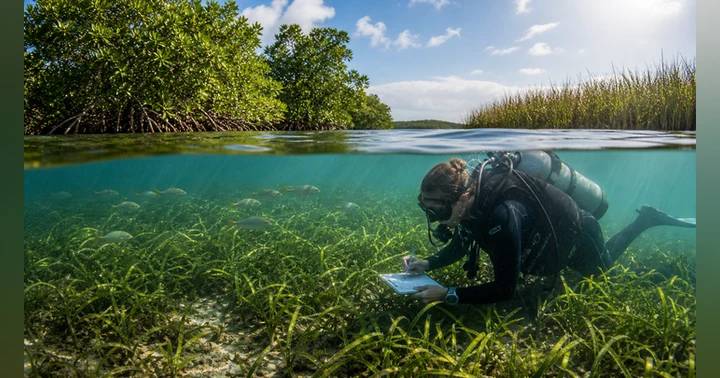
Blue carbon could be one of the most powerful climate solutions we already have, so why is it still missing from so many climate plans? In this episode of How to Protect the Ocean, we look at how mangroves, seagrasses, salt marshes, and other coastal ecosystems store carbon, protect coastlines, and support ocean health.
Ocean climate solutions are often treated as secondary to land-based actions like planting trees, but coastal habitats can store carbon in sediments for long periods of time. The problem is that many countries still do not fully include blue carbon ecosystems in their climate strategies, even though protecting and restoring them could help reduce climate risk.
Blue economy action is not just about new technology or future innovation. It is also about funding, restoring, and protecting the natural systems that already work. The ocean is not separate from climate change. The ocean is climate.
Support Independent Podcasts: https://www.speakupforblue.com/patreon
Help fund a new seagrass podcast: https://www.speakupforblue.com/seagrass
Connect with Speak Up For Blue
Website: https://bit.ly/3fOF3Wf
Instagram: https://bit.ly/3rIaJSG
TikTok: https://www.tiktok.com/@speakupforblue
Twitter: https://bit.ly/3rHZxpc
YouTube: www.speakupforblue.com/youtube
0:00 We may already know how to store carbon, so why aren't we using it? Why aren't we using these methods? That's what we're gonna talk about on this episode of the How to Protect the Ocean podcast. Because if you are here to find out more about the ocean and use this podcast as a resource to help you make better decisions in your daily life for the ocean, you've come to the right place. If you do not wanna miss tomorrow's episode, we publish five days a week, Monday to Friday, you should hit that follow button right now on your favorite podcast app because we are coming with the heat today. We are gonna be talking about the blue economy, and we are gonna be talking about something that we've been doing for a while. And the question really is: Are we ignoring one of the most effective climate solutions we already have?
0:40 Think about that. Like, we always talk... I remember here in Canada, Justin Trudeau comes out with a great plan. I'm not a hater of Justin Trudeau. I don't love everything he did as a prime minister being a Canadian citizen, but I did like a lot of the environmental stuff that he did. And at one time, he came out and he said, "We're gonna plant a billion trees." And that was great. It was great to hear that more trees are gonna be planted. It's a great program. But is that really the right solution? Are we really putting the right amount of money into planting these trees? Yes, we have to plant trees. We should always be planting trees, especially up here in Canada where we harvest trees. We always need to have some kind of recoup. We always need to have some kind of plan. We have this massive land mass that was once dominated by forests of all different types of species.
1:22 Now it's being depleted, not only because we've been harvesting a lot of it, but also because of forest fires, disease and everything like that. But tree planting is not the best solution that we have. The best solution is actually below the ocean surface in the aquatic plants that are in there. And that's where the real blue economy is and something that we've been ignoring. So a recent report that was highlighted on phys.org focused on something called blue carbon, and we've talked about blue carbon before. We've talked about how it includes ecosystems like mangroves, seagrasses, and salt marshes. These environments capture and store carbon and sediments many more times than an average tree would do in a forest on land.
2:04 That is the key. Often they are more efficient at storing this carbon than forests. And I think we get this to the situation where we know more about trees and we know less about these seagrasses, these mangroves, these salt marshes, kelp forests and so forth because they're above the surface of the ocean. We haven't studied these forests in a long time. And to be honest, like, when you put something down below the ocean, it just gets ignored. There's this famous meme that we've seen or a cartoon that we've seen where you have these two guys, these two cartoon characters that are stranded on a desert island. It's this tiny, tiny island in the middle of the ocean, and they're staring out, and the one comments, "Man, I wish there was something to eat out here." They're on this tiny, like, little, little, tiny island where you can see all around and everything.
2:44 And they look out into the ocean surface, and they see nothing. But below the ocean are all the animals that they can use to feed on and all that kinda stuff. And they just ignore it because all they can see is just flat surface of ocean, as far as the eye can see. And that happens a lot, I feel like. We just are not connected to the ocean as much because a lot of us are still afraid of going in the ocean. They're afraid of sharks. They're afraid of the unknown. People don't wanna put their feet in aquatic plants or any kind of a macroalgae because it feels funny, and they're just not used to it, and that's fine. If you're a little scared of the ocean, that's okay. That's understandable. But it doesn't mean we don't have to know much more or we just kind of ignore what's been going on in the ocean or ignore the benefits that the ocean can provide. And a lot of times, because of these areas, these habitats like mangroves, seagrass, and salt marshes are along the coastline, we have altered a lot of that coastline to match our own benefits, our own human benefits, and we don't do it where we are looking at, "Hey, how does this system actually play a role in our ecosystem to actually help us breathe?"
3:42 Just to breathe. And that's the problem. Here's the problem, like, only 20% of countries are including these ecosystems in their climate strategies. We're not even including in the climate strategies, let alone we're just ignoring it altogether. We're not including these climate strategies even though they store more carbon in sediments or down below the ocean than any other system on land. So imagine that. And you gotta remember, the ocean is what gives us every second breath, so we should be focusing more on the ocean, especially when it comes to climate. If only 20% of the countries are including these ecosystems in their climate strategies, that means most climate plans are missing a major opportunity. And it goes even as far as the climate weeks that we hear, Climate Week Toronto, Climate Week New York.
4:26 They have, like, one panel on the oceans or a couple of panels. So a whole full week, like, five days, seven days, however long it goes on. I've never been to one, but I've heard them go on. I don't go because there's no ocean stuff being talked about it. It's a huge complaint of mine. It's like, how do we have all these people who are coming together with a lot of money and a lot of savvy and, like, entrepreneurs, everything, and they don't know that the climate is oceans, oceans is climate? If we wanna stop climate change, we have to focus on the ocean. The ocean already absorbs a huge portion of the carbon that we emit. This is why I say that every second breath we take is because of the ocean. All this plankton, which is abundant in every ocean, are basically plant cells.
5:06 These plant cells will absorb the sun for energy and absorb the carbon dioxide that is in the atmosphere, bring it into their cells, so they can emit oxygen. That's what they do. Photosynthesis, absorb carbon and sunlight, produce oxygen. That's what they do. So when you have that many, that much plankton in the ocean, you're gonna get this huge system that absorbs carbon dioxide and actually returns oxygen. And these coastal systems that we're talking about today are some of the most powerful carbon sinks on the planet. We need to reduce greenhouse gases, which is carbon dioxide. These systems can help, not only plankton, but the systems like seagrasses, mangroves, kelp forests, salt marshes, all these different things.
5:48 And if I forget any, I'm not doing it on purpose or anybody who's gonna email me because of that. But the thing is too is, like, they're fragile ecosystems. When they are destroyed, they don't just stop storing carbon. They release it. So it's like when you have a forest fire. When you have a forest fire, you get more carbon dioxide released because of all that storage of carbon dioxide. So not only the tree is going and all the stuff that comes off the tree, but you're also getting all that stuff in the soil that is burning as well and all that carbon dioxide going out. So when you destroy a seagrass or you destroy a mangrove, you're gonna get the same thing. Everything that's stored in there kinda gets released. So keeping them intact, healthy is something that's really important 'cause they're both a risk and a solution. And so this is not just a discovery problem.
6:30 We've known this for a long time. It's an implementation problem. You've probably heard me say this a number of times if you've been listening to the podcast for any number of days, or weeks or months. And so I think it's really important to look at how we can not only protect the systems that are intact, but scale up the systems of not just protecting, but also restoring. Because we need to protect what exists, we need to scale that up, but we also need to restore what's been lost and include these systems in our climate policy because it's gonna help us. It's gonna make changing the climate back a lot easier when we include it into this climate policy. And it's just a matter of countries actually understanding, like taking inventory of how many seagrass systems they have.
7:12 'Cause seagrasses are temperate as well as tropical. You see seagrasses everywhere. Mangroves are tropical. You see them a lot of places. A lot of these systems actually perform more than just carbon sinks. They actually perform a lot of security functions for the coastline. I've talked about this before, but when tsunamis or big wave actions happen, they actually reduce the energy of that wave as it goes across, as it reaches land, it actually dissipates that. Areas in the 2004 tsunami in the Indian Ocean where it killed a lot of people in areas where it didn't kill a lot or didn't have much of an effect at all were areas that had mangroves, coral reefs, seagrasses all intact because those systems ended up dissipating the wave energy as it went across, and a lot more people survived.
7:56 So, we need to make sure that these are included in this policy for a number of different reasons. But when you start including these natural barriers, that will provide safety and that'll provide stability in our environment and our atmosphere. We know that the science is already there. The gap is really like funding and action. That's really where it comes down to. So when you go to a climate week or you go to any kind of climate action function, look for where the ocean is, like where the ocean people are. Are they bringing things to the table? Are they even there? Why aren't they there? And if you're somebody in ocean, you should be going to these weeks. You should be going to Climate Week New York, Climate Week Toronto. You should be going all over the place where there's a COP And you should be bombarding them with ways to take action.
8:38 Start businesses, start funding these places, these actions because that's something that we're gonna need. And get our politicians on track to be like, "Hey, stop destroying the environment and the ocean and start protecting it because it's gonna be a lot easier to do the things that we want down the road than not to." So we're not short on climate solutions. We're just ignoring the ones that we already have. That's the thing. We're just short on using them. So I wish that we could start really thinking about how we can do it better in the future. And that's what I really want you guys to do when we look forward. I would love to hear your comments, your feedback on this. You can hit me up on my socials, DM me. All the links are in the show notes, so you can check that out. I'd love to continue the conversation with you, ' cause that's why I started this podcast, was to start the conversation.
9:22 You continue it. Send me feedback. Go to speakupforblue.com/feedback. You can leave a voicemail. You can type something in, whatever you'd like to do. I would love to hear from you, or hit me up on my socials, whichever is easiest. Let's have a conversation on the ocean. Let's have some fun. Let's talk about something that we can do to really help. Your solutions are just as good as mine. There's no judgment. Love to hear from you. But until then, thank you so much for joining me on today's episode of the How to Protect the Ocean podcast. Have a great night. We'll see you tomorrow, and happy conservation.