March 21, 2026

Moon Rocket, Lost Spacecraft, and a Comet That Fell Apart on Camera
Moon Rocket, Lost Spacecraft, and a Comet That Fell Apart on Camera
Apple Podcasts podcast player iconSpotify podcast player iconiHeartRadio podcast player iconYoutube Music podcast player iconSpreaker podcast player iconPocketCasts podcast player iconDeezer podcast player iconJioSaavn podcast player iconRSS Feed podcast player icon

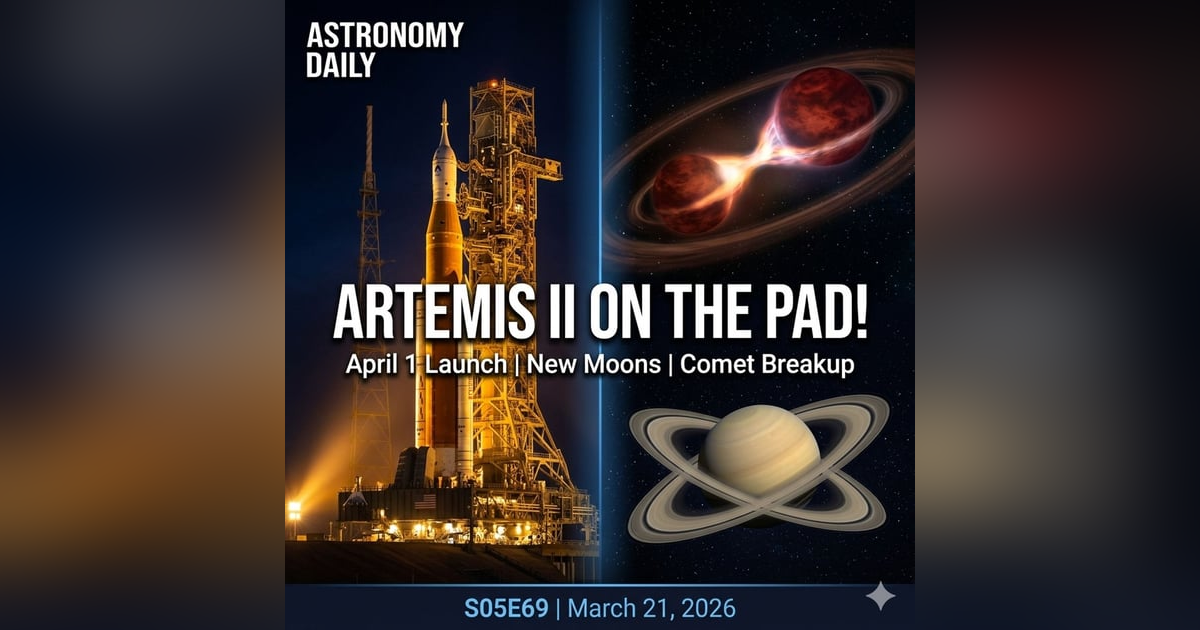
Today on Astronomy Daily: NASA's Artemis II moon rocket has arrived at Launch Pad 39B at Kennedy Space Center, with a launch target of April 1st — the first crewed mission beyond Earth orbit in over 53 years. Plus: astronomers have discovered the first-ever mass-transferring brown dwarf binary; Hubble accidentally caught a comet disintegrating in real time; 15 new moons have been confirmed around Jupiter and Saturn; our Moon is accumulating over 100 metric tons of human-made debris; and a dramatic spacecraft double-header — ESA's Proba-3 has been recovered from a month-long blackout, while NASA's MAVEN Mars orbiter remains missing after more than three months of silence.   Story 1: Artemis II Arrives at Launch Pad 39B NASA's Artemis II SLS rocket and Orion spacecraft completed an 11-hour overnight journey to Launch Pad 39B on March 20, 2026. Launch is targeted for no earlier than April 1. The crew — Reid Wiseman, Victor Glover, Christina Koch, and Jeremy Hansen — will fly a 10-day free-return trajectory around the Moon, making this the first crewed deep-space mission since Apollo 17 in December 1972. Source: https://www.nasa.gov/blogs/missions/2026/03/20/nasas-artemis-ii-rocket-arrives-at-launch-pad-39b/   Story 2: First Mass-Transferring Brown Dwarf Binary Researchers at Caltech have identified ZTF J1239+8347, a brown dwarf binary system with an orbital period of just 57.41 minutes in which one brown dwarf is actively pulling material from its companion — a first for this class of objects. The system, only ~1,000 light-years away, is a prime candidate for JWST follow-up observations. Published in The Astrophysical Journal Letters. Source: https://www.universetoday.com/articles/this-pair-of-brown-dwarfs-cant-get-enough-of-each-other   Story 3: Hubble Catches Comet C/2025 K1 Breaking Apart In a remarkable stroke of luck, NASA's Hubble Space Telescope captured comet C/2025 K1 (ATLAS) fragmenting into at least four pieces over three consecutive days in November 2025. The comet was not the original target of the observation. The findings, published in Icarus, reveal the comet is unusually carbon-depleted and raise new questions about the delay between fragmentation and visible brightening. Source: https://science.nasa.gov/missions/hubble/nasas-hubble-unexpectedly-catches-comet-breaking-up/   Story 4: 15 New Moons Confirmed for Jupiter and Saturn The Minor Planet Center announced on March 16, 2026 that four new moons have been confirmed around Jupiter (bringing its total to 101) and 11 new moons around Saturn (bringing its total to 285). All are small irregular moons, discovered by combining archival telescope data with new observations. With the Vera C. Rubin Observatory now operational, further discoveries are expected. Source: https://earthsky.org/space/more-moons-for-jupiter-and-saturn-total-satellite-discoveries/   Story 5: Human Debris on the Moon — Over 100 Metric Tons and Counting More than 100 metric tons of human-made objects now litter the lunar surface — spacecraft hardware, scientific instruments, and even waste from Apollo missions. With a wave of crewed and commercial lunar missions approaching under Artemis and beyond, space policy researchers are urging the development of international agreements to protect scientifically sensitive lunar sites before they are damaged or contaminated by human activity. Source: https://www.universetoday.com — lunar debris policy   Story 6: MAVEN Still Missing / Proba-3 Recovered NASA's MAVEN Mars orbiter, lost since December 6, 2025, remains uncontacted despite three months of recovery efforts using the Deep Space Network, Green Bank Observatory, and the Curiosity rover. An anomaly review board is assessing options. Meanwhile, ESA's Proba-3 coronagraph spacecraft — silent since February 14 after a power failure — has been successfully recovered after engineers exploited a brief window when the tumbling spacecraft's solar panels briefly faced the Sun. MAVEN source: https://www.space.com/space-exploration/launches-spacecraft/nasa-wont-give-up-hope-on-silent-maven-mars-probe-were-still-looking-for-it Proba-3 source: https://dailygalaxy.com/2026/03/europe-restores-contact-lost-spacecraft/

Become a supporter of this podcast: https://www.spreaker.com/podcast/astronomy-daily-space-news-updates--5648921/support.

Sponsor Details:
Ensure your online privacy by using NordVPN. To get our special listener deal and save a lot of money, visit www.bitesz.com/nordvpn. You'll be glad you did!

Become a supporter of Astronomy Daily by joining our Supporters Club. Commercial free episodes daily are only a click way... Click Here

This episode includes AI-generated content.

WEBVTT

1
00:00:00.160 --> 00:00:03.919
Hey, they're stargazers, and welcome to Astronomy Daily, your daily

2
00:00:04.000 --> 00:00:06.519
dose of what's happening out there in the cosmos.

3
00:00:06.759 --> 00:00:11.359
I'm Anna, and I'm Avery. Today is Saturday, March twenty first,

4
00:00:11.519 --> 00:00:15.679
twenty twenty six, and honestly, Anna, we've got another busy show.

5
00:00:15.439 --> 00:00:19.079
Today, We really do. A moon rocket has arrived at

6
00:00:19.120 --> 00:00:22.120
the launch pad for the first time in over fifty years,

7
00:00:22.199 --> 00:00:25.839
carrying astronauts. We've got a pair of weird, dying stars

8
00:00:25.879 --> 00:00:29.519
behaving in ways nobody's ever seen before. And a comment

9
00:00:29.600 --> 00:00:33.479
that basically fell apart while Hubble happened to be watching accidentally.

10
00:00:33.880 --> 00:00:37.759
Plus fifteen brand new moons in our Solar system, a

11
00:00:37.840 --> 00:00:41.479
growing garbage problem on our own moon, and the genuinely

12
00:00:41.560 --> 00:00:45.240
dramatic spacecraft story one lost, one found.

13
00:00:45.560 --> 00:00:47.200
It's a big one. Let's get into it.

14
00:00:47.439 --> 00:00:50.240
We're going to start with NASA's Artemis two, and this

15
00:00:50.320 --> 00:00:55.119
one feels different. After months of delays, repairs, and anxious waiting,

16
00:00:55.359 --> 00:00:57.479
the rocket is finally on the pad.

17
00:00:57.840 --> 00:01:01.840
At eleven twenty one am Eastern Time on Friday, March twentieth,

18
00:01:02.240 --> 00:01:06.120
NASA's Space Launch System rocket and Oryan spacecraft arrived at

19
00:01:06.200 --> 00:01:09.640
launch pad thirty nine b at Kennedy's Space Center in Florida,

20
00:01:10.040 --> 00:01:13.599
after an eleven hour overnight journey from the vehicle assembly

21
00:01:13.640 --> 00:01:17.239
building hauled by the Giant Crawler transporter at less than

22
00:01:17.280 --> 00:01:18.400
one mile per hour.

23
00:01:18.879 --> 00:01:21.799
A three hundred and twenty two foot tall moon rocket

24
00:01:21.920 --> 00:01:25.680
creeping through the night at jogging pace. And honestly, that's

25
00:01:25.719 --> 00:01:26.799
exactly how it should be.

26
00:01:27.120 --> 00:01:30.599
It really is, And the current target launch date is

27
00:01:30.680 --> 00:01:34.159
no earlier than Wednesday, April first, which means we could

28
00:01:34.159 --> 00:01:37.480
be watching the first humans leave Earth's orbit in over

29
00:01:37.599 --> 00:01:39.760
fifty years in less than two weeks.

30
00:01:40.000 --> 00:01:43.280
So who's on board the Artemis two crew is Commander

31
00:01:43.359 --> 00:01:48.120
Reid Wiseman, pilot Victor Glover, and mission specialist Christina Coach,

32
00:01:48.359 --> 00:01:52.280
all from NASA, along with Canadian Space Agency mission specialists

33
00:01:52.480 --> 00:01:53.359
Jeremy Hansen.

34
00:01:53.680 --> 00:01:57.400
And this mission is full of historic firsts. Victor Glover

35
00:01:57.519 --> 00:02:00.040
will become the first person of color to travel be

36
00:02:00.120 --> 00:02:03.359
yond Earth orbit, Christina Coach will be the first woman

37
00:02:03.439 --> 00:02:06.239
to do so, and Jeremy Hansen will be the first

38
00:02:06.280 --> 00:02:08.800
non American citizen to leave Earth orbit.

39
00:02:09.199 --> 00:02:12.240
They'll fly a free return trajectory around the Moon and

40
00:02:12.319 --> 00:02:16.319
back to Earth in approximately ten days, no landing. This

41
00:02:16.360 --> 00:02:19.159
is a test flight, but it's a crucial one now.

42
00:02:19.280 --> 00:02:22.680
The road to the pad was not smooth. Earlier this year,

43
00:02:22.759 --> 00:02:25.960
a helium flow problem in the rocket's upper stage forced

44
00:02:26.000 --> 00:02:28.199
the team to roll the whole stack back to the

45
00:02:28.280 --> 00:02:32.360
vehicle assembly building. That pushed the launch from February, then March,

46
00:02:32.479 --> 00:02:33.479
and now April.

47
00:02:33.759 --> 00:02:37.520
But the team fixed when needed fixing, including replacing batteries

48
00:02:37.560 --> 00:02:40.759
on the flight termination system, and now PAD teams are

49
00:02:40.759 --> 00:02:43.240
moving into final countdown preparations.

50
00:02:43.400 --> 00:02:46.599
The last time humans flew beyond Earth orbit was Apollo

51
00:02:46.800 --> 00:02:51.240
seventeen in December nineteen seventy two. That was over fifty

52
00:02:51.319 --> 00:02:55.000
three years ago. April first cannot come come soon enough.

53
00:02:55.360 --> 00:02:58.360
We will absolutely be following this one. Let's move on,

54
00:02:58.719 --> 00:02:59.159
all right.

55
00:02:59.360 --> 00:03:02.319
Story two is pure stellar science, and it's one of

56
00:03:02.360 --> 00:03:05.319
those discoveries that makes you realize how much of the

57
00:03:05.400 --> 00:03:07.439
universe we still haven't seen yet.

58
00:03:07.800 --> 00:03:11.319
Astronomers have found something that until now nobody was sure

59
00:03:11.360 --> 00:03:15.520
could even exist. A pair of brown dwarf stars orbiting

60
00:03:15.560 --> 00:03:19.080
each other so closely that one is actively pulling material

61
00:03:19.159 --> 00:03:19.639
from the other.

62
00:03:20.159 --> 00:03:24.000
Let's back up slightly, so, what is a brown dwarf?

63
00:03:24.439 --> 00:03:28.479
So Brown dwarfs are sometimes called failed stars, They're bigger

64
00:03:28.520 --> 00:03:31.639
than giant planets, but not massive enough to ignite and

65
00:03:31.719 --> 00:03:35.360
sustain hydrogen fusion the way our Sun does. They sort

66
00:03:35.360 --> 00:03:38.439
of sit in a strange no man's land between planet

67
00:03:38.520 --> 00:03:39.280
and star.

68
00:03:39.560 --> 00:03:42.199
And we know many of them exist in binary pairs,

69
00:03:42.439 --> 00:03:46.919
but this system, designated ztf J one two three nine

70
00:03:47.080 --> 00:03:51.520
plus eight three four seven, is something else entirely. These

71
00:03:51.560 --> 00:03:55.000
two brown dwarfs are in an incredibly tight orbit, completing

72
00:03:55.039 --> 00:03:57.879
a full loop around each other in fifty seven minutes.

73
00:03:58.439 --> 00:04:02.719
Fifty seven minutes, for context, our moon takes about twenty

74
00:04:02.800 --> 00:04:06.080
seven days to orbit Earth. These two are practically on

75
00:04:06.159 --> 00:04:07.159
top of each other.

76
00:04:07.319 --> 00:04:10.199
And because they're so close, the gravity of one is

77
00:04:10.280 --> 00:04:13.639
pulling material from the surface of the other, a process

78
00:04:13.680 --> 00:04:17.079
called mass transfer. This kind of behavior has been seen

79
00:04:17.160 --> 00:04:20.920
before in binary white dwarfs, the dense remnants of dead stars,

80
00:04:21.240 --> 00:04:24.480
but never in brown dwarfs. This is a first.

81
00:04:25.199 --> 00:04:28.959
The research team, led by Caltech graduate student Samuel Whitebook,

82
00:04:29.240 --> 00:04:32.000
actually had colleagues who didn't believe the finding at first.

83
00:04:32.519 --> 00:04:35.639
One co author said, and I love this. We've told

84
00:04:35.680 --> 00:04:38.079
some of our colleagues about them, and they didn't believe

85
00:04:38.120 --> 00:04:39.519
such a thing exists.

86
00:04:39.759 --> 00:04:43.480
Which is the best kind of science discovery. The system

87
00:04:43.560 --> 00:04:45.920
is only about a thousand light years away, which is

88
00:04:46.000 --> 00:04:49.240
close enough that follow up observations with the James Webbs

89
00:04:49.240 --> 00:04:50.839
telescope are being planned.

90
00:04:51.319 --> 00:04:54.399
And what's the eventual fate of these two Either they

91
00:04:54.480 --> 00:04:57.560
merge into a single brighter star or the one that's

92
00:04:57.600 --> 00:05:01.279
gaining mass eventually becomes massive and enough to trigger nuclear

93
00:05:01.319 --> 00:05:05.800
fusion and become a proper star. Either way, a fascinating, ending.

94
00:05:06.079 --> 00:05:09.879
Incredible stuff story. Three on a and this one involves

95
00:05:09.959 --> 00:05:12.120
Hubble being very, very lucky.

96
00:05:12.720 --> 00:05:15.800
So this story starts with a mishap and ends up

97
00:05:15.839 --> 00:05:19.240
as one of the most extraordinary observational luck stories in

98
00:05:19.319 --> 00:05:20.319
recent astronomy.

99
00:05:20.720 --> 00:05:21.879
Tell us all about it.

100
00:05:22.560 --> 00:05:26.720
Okay, So, researchers at Auburn University had won telescope time

101
00:05:26.759 --> 00:05:30.000
on the Hubble Space Telescope to study a specific comment,

102
00:05:30.360 --> 00:05:34.160
but then new technical constraints meant their original target wasn't viewable,

103
00:05:34.480 --> 00:05:38.160
so they quickly found a replacement, a different comment designated

104
00:05:38.279 --> 00:05:41.720
C slash twenty twenty five K one slash at lisk

105
00:05:42.120 --> 00:05:43.920
or just comment K one for short.

106
00:05:44.399 --> 00:05:45.800
Routine. Enough, so far.

107
00:05:46.319 --> 00:05:49.759
Routine until one of the team, co investigator John Nonan,

108
00:05:49.959 --> 00:05:52.040
sat down to look at the data the next morning,

109
00:05:52.399 --> 00:05:55.439
and he found not one comment in the images. He

110
00:05:55.560 --> 00:05:59.519
found four because Comment K one was falling apart right

111
00:05:59.560 --> 00:06:00.879
in front of Hubble's cameras.

112
00:06:01.480 --> 00:06:05.360
The commet had fragmented into at least four distinct pieces,

113
00:06:05.720 --> 00:06:08.759
each with its own coma that fuzzy envelope of gas

114
00:06:08.839 --> 00:06:12.680
and dust around the commentary nucleus, and Hubble's sharp eyes

115
00:06:12.759 --> 00:06:17.439
could clearly resolve each fragment separately, something ground based telescopes

116
00:06:17.439 --> 00:06:19.759
could barely make out as blurry blobs.

117
00:06:20.199 --> 00:06:25.439
The timing was extraordinary. The comet had passed closest to

118
00:06:25.480 --> 00:06:30.360
the Sun its perihelion just about a month before. That's

119
00:06:30.439 --> 00:06:35.079
the most intense heat and gravitational stress a comet experiences,

120
00:06:35.600 --> 00:06:39.199
and for long period comets like Cone, it's when they're

121
00:06:39.319 --> 00:06:41.759
most vulnerable to breaking up, and.

122
00:06:41.800 --> 00:06:44.920
Hubble just happened to be watching. The team was able

123
00:06:44.959 --> 00:06:47.800
to trace the history of each fragment back in time,

124
00:06:48.240 --> 00:06:52.959
essentially reconstructing exactly how and when the breakup happened. This

125
00:06:53.160 --> 00:06:55.839
is the first time Hubble has captured a comment this

126
00:06:56.079 --> 00:06:57.800
early in the fragmentation process.

127
00:06:58.399 --> 00:07:01.920
There's also an intriguing mystery buried in the data. There

128
00:07:02.000 --> 00:07:04.360
was a delay between when the comet broke up and

129
00:07:04.399 --> 00:07:08.000
when bright foutbursts were seen from the ground. Normally, when

130
00:07:08.040 --> 00:07:11.680
a comet fragments and exposes fresh ice to sunlight, you'd

131
00:07:11.680 --> 00:07:15.680
expect it to brighten almost immediately, but this one didn't. Why.

132
00:07:16.079 --> 00:07:17.759
Nobody knows yet, and.

133
00:07:17.720 --> 00:07:21.600
The initial analysis shows that comet K one is unusually

134
00:07:21.639 --> 00:07:24.759
depleted in carbon, which gives us new clues about the

135
00:07:24.800 --> 00:07:28.360
primorial chemistry of our early Solar system, all from a

136
00:07:28.399 --> 00:07:30.759
comet that wasn't even the intended target.

137
00:07:31.240 --> 00:07:35.240
Best accidents in science, honestly, onwards. Story four is a

138
00:07:35.360 --> 00:07:36.759
numbers came So.

139
00:07:37.040 --> 00:07:39.040
How many moons to Saturn have.

140
00:07:39.519 --> 00:07:42.279
As of this week two hundred and eighty five.

141
00:07:42.639 --> 00:07:45.959
Two hundred and eighty five and Jupiter.

142
00:07:45.920 --> 00:07:48.680
One hundred and one. The Minor Planet Center of the

143
00:07:48.680 --> 00:07:53.079
International Astronomical Union announced on March sixteenth that four new

144
00:07:53.120 --> 00:07:56.639
moons have been confirmed around Jupiter and eleven new moons

145
00:07:56.680 --> 00:07:57.439
around Saturn.

146
00:07:58.079 --> 00:08:01.839
Fifteen new moons just like that. I love this recurring story.

147
00:08:02.160 --> 00:08:04.319
It feels like somebody keeps going around the back of

148
00:08:04.360 --> 00:08:06.560
these planets and finding more hiding.

149
00:08:06.279 --> 00:08:10.600
There, sort of exactly what's happening. Actually, the Saturn moons

150
00:08:10.639 --> 00:08:13.399
were found by a team led by Edward Ashton from

151
00:08:13.439 --> 00:08:17.040
the University of British Columbia who combed through data from

152
00:08:17.079 --> 00:08:20.680
the Canada, France Hawaii telescope going back to twenty nineteen,

153
00:08:21.240 --> 00:08:23.839
and the Jupiter moons were spotted by a team led

154
00:08:23.879 --> 00:08:26.199
by Scott Shephard at the Carnegie Institution.

155
00:08:26.920 --> 00:08:30.160
All of these newly confirmed moons are tiny, barely a

156
00:08:30.160 --> 00:08:33.720
couple of miles across, with magnitudes around twenty five to

157
00:08:33.759 --> 00:08:37.120
twenty seven, meaning they're far too faint to see without

158
00:08:37.159 --> 00:08:39.360
some of the world's most powerful telescopes.

159
00:08:39.879 --> 00:08:45.000
Far what astronomers call irregular moons, captured objects orbiting far

160
00:08:45.080 --> 00:08:48.399
from the planet, often going the wrong way in retrograde.

161
00:08:48.840 --> 00:08:51.759
Most of the new Saturnian moons are doing just that,

162
00:08:52.240 --> 00:08:55.759
moving in the opposite direction to the planet's rotation, which

163
00:08:55.799 --> 00:08:59.320
is a strong sign they were probably captured from somewhere else,

164
00:08:59.679 --> 00:09:03.679
either asteroids snagged by Saturn's gravity or fragments from a

165
00:09:03.720 --> 00:09:07.159
collision that broke up a larger moon in the distant past.

166
00:09:07.399 --> 00:09:10.080
And this count is only going to keep climbing. The

167
00:09:10.200 --> 00:09:14.240
Veric Reuben Observatory went fully online last year, and it's

168
00:09:14.279 --> 00:09:17.159
going to be detecting these tiny, faint moons at a

169
00:09:17.240 --> 00:09:18.799
rate we haven't seen before.

170
00:09:19.360 --> 00:09:23.559
Poor Jupiter, though, still two hundred moons behind Saturn. It's

171
00:09:23.639 --> 00:09:25.360
like Jupiter just can't catch up.

172
00:09:26.080 --> 00:09:29.919
Jupiter just needs a try harder. Okay, story five, and

173
00:09:30.000 --> 00:09:32.159
this one's a little closer to home.

174
00:09:32.919 --> 00:09:35.960
So here's a question. What's on the Moon right now?

175
00:09:36.200 --> 00:09:38.960
Other than dust and rock, I mean.

176
00:09:39.320 --> 00:09:43.039
The flags, some rovers, U golf ball, I.

177
00:09:43.000 --> 00:09:47.759
Think more than one hundred metric tons of human made material,

178
00:09:48.120 --> 00:09:54.360
spacecraft parts, scientific instruments, cameras, landers, crash sites, and yes,

179
00:09:54.440 --> 00:09:59.080
actually bags of human waste left behind by Apollo astronauts.

180
00:09:59.399 --> 00:10:01.519
We left star rubbish on the Moon.

181
00:10:01.960 --> 00:10:05.879
We absolutely did. And that's just what's there now. We're

182
00:10:05.919 --> 00:10:09.200
on the verge of a completely new era of lunar activity,

183
00:10:09.480 --> 00:10:15.399
crude missions, commercial landers, scientific rovers, resource prospectors, and nobody

184
00:10:15.440 --> 00:10:18.600
has a comprehensive framework for what happens to all the

185
00:10:18.639 --> 00:10:20.360
stuff we're about to bring up there.

186
00:10:20.919 --> 00:10:25.120
There's no Lunar Environment Protection Agency, there's no international treaty

187
00:10:25.240 --> 00:10:29.759
specifically addressing lunar surface contamination. The Outer Space Treaty of

188
00:10:29.840 --> 00:10:33.480
nineteen sixty seven says countries are responsible for their national

189
00:10:33.480 --> 00:10:36.879
activities in space, but it doesn't get into the specifics

190
00:10:36.879 --> 00:10:40.840
of say a crash lander leaking propellant near a scientifically

191
00:10:40.879 --> 00:10:42.279
important site.

192
00:10:42.240 --> 00:10:45.799
And there are real concerns beyond aesthetics. Some of the

193
00:10:45.799 --> 00:10:49.840
most scientifically valuable areas of the Moon, like the permanently

194
00:10:49.919 --> 00:10:54.039
shadowed craters near the Poles, which may hold ancient ice deposits,

195
00:10:54.320 --> 00:10:58.240
could be contaminated by human activity before we've even finished

196
00:10:58.279 --> 00:11:00.000
studying them in their pristine style.

197
00:11:01.000 --> 00:11:05.320
Space policy researchers and planetary scientists are increasingly pushing for

198
00:11:05.480 --> 00:11:10.840
binding international agreements about lunar preservation zones, impacts, site protections,

199
00:11:10.879 --> 00:11:13.279
and responsible disposal of mission hardware.

200
00:11:13.840 --> 00:11:17.399
It's a conversation the space community needs to have urgently,

201
00:11:17.759 --> 00:11:20.879
because the missions are coming, whether the policy frameworks are

202
00:11:20.879 --> 00:11:23.799
ready or not. The Moon has been waiting four and

203
00:11:23.840 --> 00:11:26.799
a half billion years. The least we can do is

204
00:11:26.840 --> 00:11:28.759
think carefully before we trash it.

205
00:11:29.320 --> 00:11:31.919
All Right, We're ending today's show with a story that

206
00:11:31.960 --> 00:11:36.840
has two very different outcomes, one spacecraft recently lost and

207
00:11:36.879 --> 00:11:39.000
one spacecraft recently found.

208
00:11:39.720 --> 00:11:43.039
Let's start with the one that was found. ESA's Proba

209
00:11:43.080 --> 00:11:46.720
three mission, which we mentioned yesterday, has now been officially

210
00:11:46.799 --> 00:11:50.080
confirmed as recovered, and the details of how it happened

211
00:11:50.159 --> 00:11:52.120
are genuinely dramatic.

212
00:11:52.279 --> 00:11:56.159
So PROBA three is a fascinating mission. It uses two

213
00:11:56.240 --> 00:12:00.159
separate spacecraft flying in precise formation at an altitude of

214
00:12:00.200 --> 00:12:04.840
over sixty thousand kilometers to create an artificial solar eclipse.

215
00:12:05.320 --> 00:12:08.679
One satellite carries a disc that blocks the Sun, and

216
00:12:08.720 --> 00:12:11.679
the other carries a cornograph to study the faint outer

217
00:12:11.799 --> 00:12:14.879
atmosphere of the Sun, which is normally washed out by

218
00:12:14.879 --> 00:12:16.159
the Sun's blinding light.

219
00:12:16.639 --> 00:12:21.039
On February fourteenth, the Corona spacecraft, one of the two,

220
00:12:21.519 --> 00:12:24.559
suffered a chain of failures that caused it to lose

221
00:12:24.600 --> 00:12:28.440
its orientation. Its solar panels turned away from the Sun,

222
00:12:28.840 --> 00:12:33.639
its batteries drained, and it entered survival mode, tumbling silently

223
00:12:33.720 --> 00:12:35.759
through space for nearly a month.

224
00:12:36.440 --> 00:12:40.360
Engineers tracked it and waited for an opportunity. That opportunity

225
00:12:40.399 --> 00:12:44.000
came when the tumbling spacecraft briefly turned its solar panels

226
00:12:44.039 --> 00:12:47.320
toward the Sun just enough to generate a small amount

227
00:12:47.320 --> 00:12:51.279
of power. Teams in Spain acted immediately and contact was

228
00:12:51.320 --> 00:12:52.080
re established.

229
00:12:52.759 --> 00:12:57.399
LISA Director General Joseph Ashbacker said they saw that some

230
00:12:57.679 --> 00:13:01.320
sunlight was actually hitting the solar panels, and that was

231
00:13:01.360 --> 00:13:06.159
their moment. The spacecraft has now regained stable orientation and

232
00:13:06.320 --> 00:13:10.679
is charging its batteries. Engineers are carefully running checks before

233
00:13:10.759 --> 00:13:12.559
resuming science operations.

234
00:13:13.320 --> 00:13:16.799
Relief all around now. Contrast that with the story of

235
00:13:16.919 --> 00:13:21.679
NASA's Maven spacecraft, currently orbiting Mars, or at least it

236
00:13:21.720 --> 00:13:22.159
should be.

237
00:13:22.879 --> 00:13:26.919
NASA lost contact with Maven on December sixth last year,

238
00:13:27.320 --> 00:13:31.240
after the spacecraft was expected to emerge from behind Mars

239
00:13:31.559 --> 00:13:34.720
after a routine pass on the far side of the planet.

240
00:13:35.159 --> 00:13:39.840
Two days before contact was lost, telemetry showed everything was normal,

241
00:13:40.240 --> 00:13:41.639
no problems whatsoever.

242
00:13:42.320 --> 00:13:44.799
But then a fragment of tracking data from the day

243
00:13:44.919 --> 00:13:49.320
contact was lost suggested Maven was rotating unexpectedly as it

244
00:13:49.360 --> 00:13:52.240
came out from behind Mars and was no longer in

245
00:13:52.279 --> 00:13:56.000
its planned orbit. NASA immediately began recovery efforts.

246
00:13:56.600 --> 00:13:59.960
Those efforts have now been ongoing for over three months.

247
00:14:00.559 --> 00:14:04.960
DASA has used its deep space network, the Green Bank Observatory,

248
00:14:05.320 --> 00:14:09.720
even the Curiosity rover pointed skyward on the Martian surface

249
00:14:10.039 --> 00:14:13.440
in attempts to detect a signal. So far nothing.

250
00:14:14.120 --> 00:14:17.720
At a conference this week, NASA's Planetary Science Director Louise

251
00:14:17.759 --> 00:14:20.759
Procter said, and I thought this was a poignant quote.

252
00:14:21.080 --> 00:14:24.559
We haven't officially said Mavin is lost, yet we're still

253
00:14:24.600 --> 00:14:25.159
looking for it.

254
00:14:25.840 --> 00:14:30.399
Mavin has been orbiting Mars since twenty thirteen, twelve years

255
00:14:30.399 --> 00:14:35.000
of science studying how Mars lost its atmosphere over billions

256
00:14:35.000 --> 00:14:39.720
of years and transformed from a potentially habitable world into

257
00:14:39.799 --> 00:14:43.519
the cold desert we see today. It also handles about

258
00:14:43.559 --> 00:14:47.600
twenty percent of communications between Earth and the Mars rovers.

259
00:14:48.279 --> 00:14:52.879
Other orbiters, including Mars Reconnaissance Orbiter, Mars Odyssey, and issa's

260
00:14:53.000 --> 00:14:56.720
Trace Gas Orbiter, are taking up the relay duties for now,

261
00:14:56.799 --> 00:15:00.759
and NASA's exploring options for a replacement Telecommunicationations orbiter.

262
00:15:01.360 --> 00:15:05.600
One story of recovery one still unresolved. Will keep you

263
00:15:05.639 --> 00:15:06.600
posted on both.

264
00:15:07.279 --> 00:15:10.759
And that is your Astronomy Daily for Saturday, March twenty first,

265
00:15:10.919 --> 00:15:14.240
twenty twenty six. What a show today? A moon rocket

266
00:15:14.320 --> 00:15:19.399
on the pad, a comet in pieces, failed stars behaving unexpectedly,

267
00:15:19.919 --> 00:15:23.600
fifteen new moons, a moon covered in our junk, and

268
00:15:23.639 --> 00:15:26.240
two spacecraft with very different stories.

269
00:15:26.840 --> 00:15:29.919
As always, links to all our source articles are in

270
00:15:29.960 --> 00:15:33.279
the show notes. If you enjoyed today's episode, please leave

271
00:15:33.360 --> 00:15:36.840
us a review wherever you get your podcasts. It genuinely

272
00:15:36.879 --> 00:15:38.720
helps more people find the show.

273
00:15:39.000 --> 00:15:41.799
You can find us at Astronomy Daily dot io and

274
00:15:41.879 --> 00:15:45.720
on social media everywhere. At astro Dailypod, we are part

275
00:15:45.720 --> 00:15:48.360
of the Bytes dot com podcast network. Check them out

276
00:15:48.399 --> 00:15:49.519
for more great shows.

277
00:15:50.159 --> 00:15:53.320
Until next time, keep looking up clear skys.

278
00:15:53.320 --> 00:16:14.080
Everyone say, stars, Stars, the Soul, Stars, the Soul