Feb. 18, 2026
Moon Hides Mercury Tonight, Artemis II Tests Tomorrow, Saturn Ring Origin Revealed
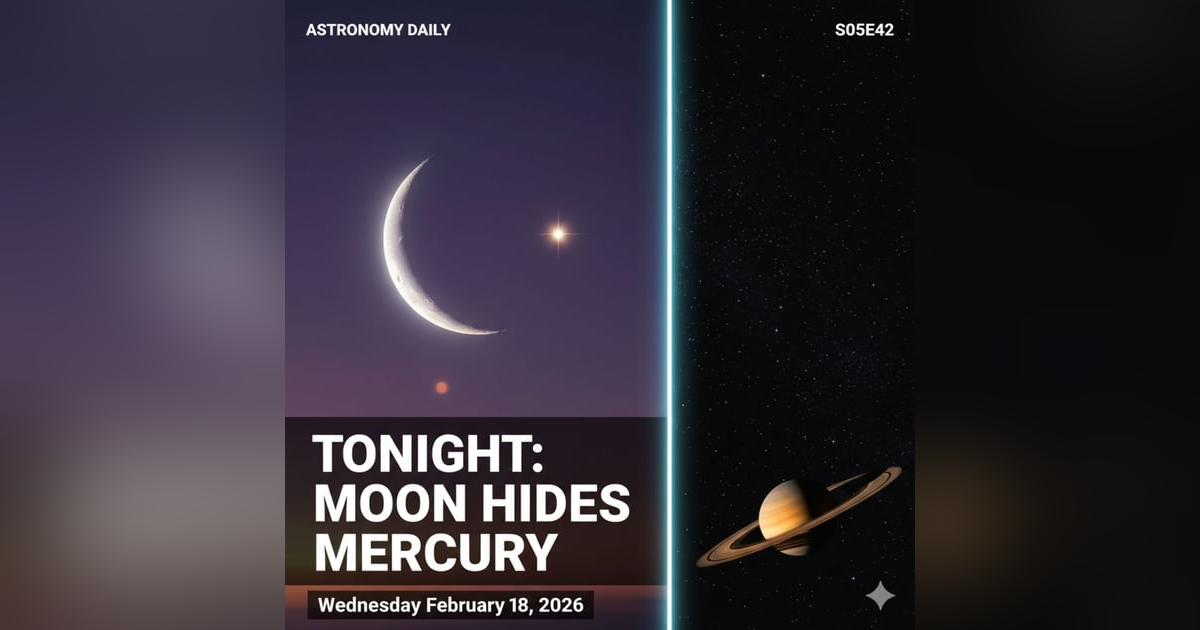


Episode: S05E42 — Wednesday, February 18, 2026 Hosts: Anna & Avery Network: Bitesz.com Podcast Network In today's episode of Astronomy Daily, Anna and Avery cover six unmissable stories from across the cosmos. Here's what we're talking about in S05E42: 1. Artemis II Wet Dress Rehearsal Round Two NASA begins fuelling the SLS moon rocket tomorrow (Feb 19) for a second critical practice countdown. Engineers have replaced two seals and a filter after hydrogen leaks forced the February launch window to be abandoned. A clean test is required before NASA will commit to a launch date — currently no earlier than March 6. The four-person crew includes Victor Glover, Christina Koch, and Jeremy Hansen, each of whom will make history on the flight. 2. Moon Occults Mercury Tonight — Plus a Ganymede Transit Tonight, February 18, a thin crescent Moon passes so close to Mercury that observers in Arizona, New Mexico, Texas, Louisiana, Mississippi, and Georgia will see the Moon hide Mercury in a rare occultation. For everyone else, a stunning close conjunction is visible in the western sky just after sunset. Simultaneously, Jupiter's moon Ganymede transits the gas giant's face through the night. Two events, one evening. 3. Ariane 6 Launches Amazon Kuiper Satellites Europe's most powerful Ariane 6 configuration successfully launched 32 satellites for Amazon's Project Kuiper broadband constellation today — a direct competitor to SpaceX's Starlink. The launch highlights both the commercial ambitions of Amazon's internet satellite programme and the ongoing resurgence of European launch capability. 4. 3I/ATLAS Update: JUICE Data Downlinking Now ESA's JUICE spacecraft is currently transmitting data it collected on interstellar comet 3I/ATLAS back to Earth — the downlink window runs February 18–20. If successful, this would be the closest-ever spacecraft observations of an interstellar object. Meanwhile, 3I/ATLAS heads toward a close Jupiter flyby in March that may trigger fresh outbursts. 5. How Titan Formed — And Why Saturn Has Rings New research from the SETI Institute proposes a single ancient catastrophe that explains multiple Saturn mysteries at once: a moon called proto-Hyperion collided with proto-Titan about 400 million years ago. The merger debris re-accreted into Saturn's inner moons and left behind the iconic ring system. The hypothesis also explains Saturn's unusual axial tilt, Iapetus's orbital inclination, and the surprising youth of Titan's surface. 6. Russia's 30-Day Mars Engine Rosatom's Troitsk Institute is ground-testing a nuclear-powered magnetoplasma engine that its developers claim could reach Mars in 30 days — compared to 8 months for chemical rockets. With a plasma exhaust velocity of 100 km/s, the system is part of a global race toward deep-space plasma propulsion also being pursued by NASA's VASIMR programme and Chinese researchers. A flight prototype is targeted for 2030.
Follow & Connect 🌐 astronomydaily.io 📱 @AstroDailyPod 🎙️ Available on all major podcast platforms 📺 YouTube — optimised for mobile viewing Astronomy Daily is part of the Bitesz.com Podcast Network.
Become a supporter of this podcast: https://www.spreaker.com/podcast/astronomy-daily-space-news-updates--5648921/support.
Sponsor Details:
Ensure your online privacy by using NordVPN. To get our special listener deal and save a lot of money, visit www.bitesz.com/nordvpn. You'll be glad you did!
Become a supporter of Astronomy Daily by joining our Supporters Club. Commercial free episodes daily are only a click way... Click Here
This episode includes AI-generated content.
Follow & Connect 🌐 astronomydaily.io 📱 @AstroDailyPod 🎙️ Available on all major podcast platforms 📺 YouTube — optimised for mobile viewing Astronomy Daily is part of the Bitesz.com Podcast Network.
Become a supporter of this podcast: https://www.spreaker.com/podcast/astronomy-daily-space-news-updates--5648921/support.
Sponsor Details:
Ensure your online privacy by using NordVPN. To get our special listener deal and save a lot of money, visit www.bitesz.com/nordvpn. You'll be glad you did!
Become a supporter of Astronomy Daily by joining our Supporters Club. Commercial free episodes daily are only a click way... Click Here
This episode includes AI-generated content.
WEBVTT
1
00:00:00.320 --> 00:00:03.040
Hello, and welcome to Astronomy Daily.
2
00:00:03.359 --> 00:00:07.080
I'm Anna and I'm Avery. You're listening to Season five,
3
00:00:07.240 --> 00:00:11.560
episode forty two for Wednesday, the eighteenth of February twenty
4
00:00:11.599 --> 00:00:14.359
twenty six, And what a day to be a spaceman.
5
00:00:14.839 --> 00:00:19.199
Absolutely tonight right now, in fact, the Moon is sliding
6
00:00:19.320 --> 00:00:22.519
so close to mercury that it's actually hiding it from
7
00:00:22.600 --> 00:00:26.039
view for skywatchers in parts of the southern United States.
8
00:00:26.399 --> 00:00:30.039
A genuine celestial magic trick happening as you listen.
9
00:00:30.480 --> 00:00:33.280
And that's just one of six stories we're bringing you today.
10
00:00:33.600 --> 00:00:36.159
We've got NASA's Artemis two on the verge of a
11
00:00:36.280 --> 00:00:40.119
crucial fueling test, a European rocket making a big move
12
00:00:40.200 --> 00:00:43.880
in the satellite broadband race, a genuinely new twist in
13
00:00:43.920 --> 00:00:47.880
the ongoing saga of our interstellar Visitor, and two stories
14
00:00:47.880 --> 00:00:50.200
that I promise will make you rethink some things you
15
00:00:50.359 --> 00:00:52.159
thought you knew about the Solar System.
16
00:00:52.399 --> 00:00:55.439
Big show, let's get into it, so Anna.
17
00:00:55.320 --> 00:00:57.560
Let's start with the biggest space story of the week,
18
00:00:57.600 --> 00:01:01.399
and honestly the one that could define the Artemis two.
19
00:01:01.920 --> 00:01:05.760
Yes, for anyone who needs a quick refresh, Artemis two
20
00:01:05.959 --> 00:01:09.439
is NASA's first crude mission around the Moon since Apollo
21
00:01:09.519 --> 00:01:15.079
seventeen in nineteen seventy two. Four astronauts Reed Wiseman, Victor Glover,
22
00:01:15.439 --> 00:01:19.599
Christina Cock, and Canada's Jeremy Hansen are preparing to fly
23
00:01:19.760 --> 00:01:22.719
a ten day loop around the Moon and back. No
24
00:01:22.879 --> 00:01:26.519
lunar landing, but a crucial proving flight before we put
25
00:01:26.560 --> 00:01:27.599
boots on the surface.
26
00:01:28.079 --> 00:01:31.079
And they are so close. The rocket is sitting on
27
00:01:31.120 --> 00:01:34.359
Path thirty nine B at Kennedy Space Center right now.
28
00:01:34.760 --> 00:01:37.280
But before NASA will commit to a launch date, they
29
00:01:37.400 --> 00:01:40.879
need to successfully do what's called a wet dress rehearsal,
30
00:01:41.359 --> 00:01:44.719
a full practice countdown where they actually load the rocket
31
00:01:44.719 --> 00:01:47.640
with fuel and take it right to the edge of launch,
32
00:01:47.799 --> 00:01:49.480
then drain it all out again.
33
00:01:49.920 --> 00:01:53.159
They did that once already on February third, and it
34
00:01:53.200 --> 00:01:56.959
didn't go smoothly. A liquid hydrogen leak cropped up, the
35
00:01:57.079 --> 00:02:00.120
exact same kind of problem that plagued Artemis one one
36
00:02:00.319 --> 00:02:03.959
three years ago. The countdown was terminated at T minus
37
00:02:04.120 --> 00:02:08.520
five minutes and fifteen seconds, close but not close enough.
38
00:02:08.719 --> 00:02:12.400
Which pushed the February launch window off the table entirely.
39
00:02:13.000 --> 00:02:17.159
NASA administrator Jared Isaacman was fairly philosophical about it. He
40
00:02:17.240 --> 00:02:19.840
said This is exactly why you do a rehearsal to
41
00:02:19.960 --> 00:02:23.479
find these issues before you're flying with crew. But the
42
00:02:23.599 --> 00:02:24.400
clock is ticking.
43
00:02:24.879 --> 00:02:28.439
Since then, engineers have replaced two seals and a clogged
44
00:02:28.479 --> 00:02:31.800
filter in the hydrogen fueling system. They ran a partial
45
00:02:31.879 --> 00:02:35.479
confidence test on February twelfth to check the repairs, and
46
00:02:35.560 --> 00:02:39.879
now tomorrow, February nineteenth, they begin tanking day for the
47
00:02:39.960 --> 00:02:41.919
second full wet dress rehearsal.
48
00:02:42.439 --> 00:02:45.400
This is the one that counts. If the test goes cleanly,
49
00:02:45.639 --> 00:02:49.840
no oud of limits, hydrogen concentrations countdown proceeds all the
50
00:02:49.879 --> 00:02:53.000
way to the terminal phase, NASA will analyze the data
51
00:02:53.080 --> 00:02:56.360
and set a launch date. The current earliest possibility is
52
00:02:56.479 --> 00:02:57.120
March six.
53
00:02:57.680 --> 00:03:01.439
It's worth noting just how historic mission is beyond the
54
00:03:01.479 --> 00:03:05.159
Moon return angle, Victor Glover will become the first person
55
00:03:05.199 --> 00:03:08.919
of color to travel beyond low Earth orbit. Christina Cock
56
00:03:09.039 --> 00:03:11.759
will be the first woman, Jeremy Hansen will be the
57
00:03:11.800 --> 00:03:15.520
first non American. Every single person on that crew is
58
00:03:15.599 --> 00:03:17.439
making history in their own right.
59
00:03:17.960 --> 00:03:20.639
So tomorrow is genuinely a day to watch. We'll be
60
00:03:20.719 --> 00:03:22.960
keeping a close eye on how the tanking goes, and
61
00:03:23.000 --> 00:03:24.520
we'll have updates as they come through.
62
00:03:24.879 --> 00:03:27.759
All right. Let's bring it back to Earth, or rather
63
00:03:27.840 --> 00:03:30.599
to the sky above Earth, because tonight is one of
64
00:03:30.639 --> 00:03:33.199
those rare evenings where if you happen to be in
65
00:03:33.280 --> 00:03:35.960
the right place and you look up at the right moment,
66
00:03:36.319 --> 00:03:38.879
you'll see something genuinely extraordinary.
67
00:03:39.280 --> 00:03:44.560
Two things actually, First, the moon and mercury. Tonight, February eighteenth,
68
00:03:44.639 --> 00:03:47.319
a slender, one and a half day old crescent moon
69
00:03:47.400 --> 00:03:50.479
is passing extremely close to Mercury in the western sky
70
00:03:50.759 --> 00:03:53.960
just after sunset, and I mean extremely close.
71
00:03:54.520 --> 00:03:58.159
For observers along a narrow band of southern US states.
72
00:03:58.479 --> 00:04:04.039
We're talking Arizona and New Mexico, Texas, Louisiana, Mississippi, and Georgia,
73
00:04:04.439 --> 00:04:07.879
the moon will actually pass directly in front of Mercury
74
00:04:08.159 --> 00:04:11.879
and block it from view entirely. That's called an occultation.
75
00:04:12.520 --> 00:04:17.279
Mercury literally disappears behind the moon's dark limb and reappears
76
00:04:17.279 --> 00:04:18.680
on the other side.
77
00:04:18.720 --> 00:04:21.800
For everyone else across North America and beyond, it won't
78
00:04:21.800 --> 00:04:24.920
be a full occultation, but you'll still see a dramatically
79
00:04:24.959 --> 00:04:28.720
close pairing. East Coast observers will see Mercury sitting just
80
00:04:28.879 --> 00:04:31.720
north of the moon as twilight falls. By the time
81
00:04:31.839 --> 00:04:34.959
darkness reaches the west coast, the Moon will have shifted
82
00:04:34.959 --> 00:04:38.399
to within about one degree of the planet. Venus hangs
83
00:04:38.439 --> 00:04:41.240
brilliantly below them as a helpful reference point.
84
00:04:41.399 --> 00:04:45.040
Now the window is tight. Mercury sets not long after
85
00:04:45.040 --> 00:04:47.519
the sun, so you want to get outside as soon
86
00:04:47.600 --> 00:04:51.120
as the sky darkens. Look low in the west southwest
87
00:04:51.560 --> 00:04:54.160
if you can spot Venus, and you'll have no trouble
88
00:04:54.199 --> 00:04:58.040
doing that. It's blazingly bright. Mercury will be nearby. The
89
00:04:58.079 --> 00:04:59.639
moon makes it easy tonight.
90
00:05:00.000 --> 00:05:02.720
And if that warn enough, Jupiter watchers have a tree
91
00:05:02.800 --> 00:05:07.399
two tonight. Ganymede, Jupiter's largest moon and the biggest moon
92
00:05:07.439 --> 00:05:11.360
in the entire Solar System, is transitting across Jupiter's face.
93
00:05:11.920 --> 00:05:14.519
East coast observers can see it underway as soon as
94
00:05:14.519 --> 00:05:17.160
it gets dark. It takes just over three hours to
95
00:05:17.240 --> 00:05:20.639
cross the disk, and then Ganymede's shadow follows it across,
96
00:05:20.959 --> 00:05:24.439
creating that striking black dot effect on Jupiter's cloud tops.
97
00:05:25.040 --> 00:05:28.160
So tonight really is a two for one skywatching event.
98
00:05:28.600 --> 00:05:31.439
Mercury and the Moon in the west at dusk, Jupiter
99
00:05:31.519 --> 00:05:34.480
and Ganymede in the southeast through the night. If you
100
00:05:34.560 --> 00:05:38.959
have binoculars or a small telescope. Even better, get outside,
101
00:05:39.360 --> 00:05:42.879
staying with today's news, and this one happened literally today.
102
00:05:43.360 --> 00:05:47.839
Europe's Arion six rocket has successfully launched thirty two satellites
103
00:05:47.839 --> 00:05:50.319
into orbit for Amazon's Project Kuiper.
104
00:05:50.959 --> 00:05:54.519
For those not familiar with Kuyper, Amazon has been quietly
105
00:05:54.560 --> 00:05:58.720
building a large constellation of broadband Internet satellites designed to
106
00:05:58.759 --> 00:06:02.519
take on space exist. This is a big commercial play.
107
00:06:03.040 --> 00:06:06.879
Darlink currently leads the market with thousands of operational satellites,
108
00:06:07.120 --> 00:06:10.279
but Amazon has the resources and ambition to make this
109
00:06:10.360 --> 00:06:11.560
a genuine competition.
110
00:06:12.199 --> 00:06:15.120
What's notable about today's launch is that it used the
111
00:06:15.160 --> 00:06:19.680
most powerful configuration of Airon six, flying with four strap
112
00:06:19.720 --> 00:06:23.399
on boosters rather than two. It was essentially a statement
113
00:06:23.439 --> 00:06:27.199
of capability from the European side of the commercial launch industry.
114
00:06:27.600 --> 00:06:30.079
This rocket can handle serious payloads.
115
00:06:30.720 --> 00:06:34.000
There's also a bigger picture here. Arion six has had
116
00:06:34.079 --> 00:06:37.360
somewhat of a turbulent road. It came in behind schedule
117
00:06:37.480 --> 00:06:41.279
and face some early technical hurdles, but launches like this,
118
00:06:41.519 --> 00:06:45.360
winning commercial contracts for a high profile constellation like hyper
119
00:06:45.720 --> 00:06:48.680
are exactly what Europe needs to keep its launch industry
120
00:06:48.680 --> 00:06:52.759
competitive in an era dominated by SpaceX and an increasingly
121
00:06:52.800 --> 00:06:54.399
capable Chinese launch sector.
122
00:06:54.959 --> 00:06:58.680
The broadband satellite race is one of the defining infrastructure
123
00:06:58.720 --> 00:07:02.600
stories of this decade. I'd argue Starlink has already changed
124
00:07:02.600 --> 00:07:06.199
what connectivity looks like in remote areas and conflict zones,
125
00:07:06.639 --> 00:07:11.160
hyper Amazon's one Web investments, the Chinese Go Wong constellation.
126
00:07:11.600 --> 00:07:14.240
They all point to a future where low Earth orbit
127
00:07:14.360 --> 00:07:17.199
becomes genuinely critical economic territory.
128
00:07:17.720 --> 00:07:21.160
Today's launch is one tile in that much larger mosaic
129
00:07:21.560 --> 00:07:23.879
thirty two satellites closer to that future.
130
00:07:24.399 --> 00:07:27.560
Now an update on our Interstellar Visitor, and I do
131
00:07:27.720 --> 00:07:32.240
mean update. There is genuinely new information here happening right now.
132
00:07:32.800 --> 00:07:35.240
I know we've given three i at Lists quite a
133
00:07:35.319 --> 00:07:38.920
run over recent episodes, but this one earns its place today.
134
00:07:39.120 --> 00:07:42.879
Completely for new listeners. Three i at Lists is only
135
00:07:42.920 --> 00:07:46.839
the third interstellar object ever confirmed to pass through our
136
00:07:46.839 --> 00:07:50.920
Solar System. It arrived from outside our stellar neighborhood, swung
137
00:07:50.959 --> 00:07:53.879
around the Sun last October, and is now heading back
138
00:07:53.920 --> 00:07:56.879
out into the galaxy forever. We will never see this
139
00:07:56.959 --> 00:07:57.639
object again.
140
00:07:58.519 --> 00:08:02.720
Here's what's happening right now. Issa's Juice spacecraft. That's the
141
00:08:02.839 --> 00:08:07.480
Jupiter icy Moons Explore currently en route to Jupiter pass
142
00:08:07.519 --> 00:08:10.839
with an observational range of three I atlas back in
143
00:08:10.920 --> 00:08:14.920
November last year. Due to the challenging thermal conditions during
144
00:08:15.000 --> 00:08:18.839
Juice's transit through the Inner Solar System, the data collected
145
00:08:18.879 --> 00:08:22.240
couldn't be downlinked straight away. That data is now being
146
00:08:22.279 --> 00:08:26.519
transmitted to Earth. The window is February eighteenth to the
147
00:08:26.560 --> 00:08:27.720
twentieth today.
148
00:08:28.199 --> 00:08:31.839
If successful, these would be the closest ever observations of
149
00:08:31.879 --> 00:08:35.799
an interstellar object by a spacecraft. Now, Juice didn't do
150
00:08:35.919 --> 00:08:39.720
a dedicated flyby, its trajectory is locked in for Jupiter,
151
00:08:40.039 --> 00:08:44.759
but even opportunistic observations from its suite of cameras, spectrometers,
152
00:08:44.759 --> 00:08:48.200
and particle detectors could give us a perspective on three
153
00:08:48.279 --> 00:08:52.240
I at lists that no Earth based telescope can provide.
154
00:08:51.960 --> 00:08:55.919
And the data would complement an extraordinary recent run of discoveries.
155
00:08:56.440 --> 00:08:59.559
Hubble has directly imaged the nucleus for the first time.
156
00:09:00.159 --> 00:09:05.039
JWST detected methane in its atmosphere, a molecule never before
157
00:09:05.120 --> 00:09:08.799
seen in an interstellar object, and the object is still
158
00:09:08.799 --> 00:09:12.000
spinning faster than it was before its solar encounter, a
159
00:09:12.080 --> 00:09:15.120
legacy of all that outgassing as it's swung close to
160
00:09:15.159 --> 00:09:15.759
the Sun.
161
00:09:16.080 --> 00:09:18.720
Three I atlass is now about three and a half
162
00:09:18.840 --> 00:09:23.279
astronomical units from the Sun in the constellation Gemini. It's fading,
163
00:09:23.360 --> 00:09:26.879
but still reachable with a decent amateur telescope, and it
164
00:09:26.960 --> 00:09:29.879
has one more big act to play, a close pass
165
00:09:29.919 --> 00:09:33.399
by Jupiter in March, which may trigger fresh outbursts as
166
00:09:33.480 --> 00:09:36.360
Jupiter's tidal forces stress the nucleus.
167
00:09:36.399 --> 00:09:39.360
An extraordinary object, and the fact that we have a
168
00:09:39.399 --> 00:09:42.759
spacecraft data downlink happening as we record today makes it
169
00:09:43.039 --> 00:09:46.320
entirely current. What report would Juce found as soon as
170
00:09:46.360 --> 00:09:48.960
the science teams release their analysis.
171
00:09:48.799 --> 00:09:52.879
Right deep time now. I genuinely love this next story
172
00:09:52.919 --> 00:09:56.480
because it takes something you thought you understood Saturn's rings
173
00:09:56.720 --> 00:09:59.879
and reframes the entire origin of the system.
174
00:10:00.080 --> 00:10:03.440
New research by mattia Chuk at the SETI Intitude, about
175
00:10:03.480 --> 00:10:06.840
to be published in the Planetary Science Journal, proposes a
176
00:10:06.919 --> 00:10:11.840
dramatic two stage catastrophe that reshaped the entire Saturturnian system
177
00:10:12.279 --> 00:10:17.200
roughly four hundred million years ago, and I mean reshaped everything. Titan,
178
00:10:17.440 --> 00:10:21.600
the rings, Iapetus, Hyperion, all of it connected to one
179
00:10:21.720 --> 00:10:22.639
ancient collision.
180
00:10:23.159 --> 00:10:27.440
Let's set the scene. Saturn has puzzled planetary scientists for
181
00:10:27.480 --> 00:10:31.279
a long time. Its axial tilt is an unusually steep
182
00:10:31.360 --> 00:10:35.360
twenty six point seven degrees. You don't expect gas giants
183
00:10:35.399 --> 00:10:38.960
to form that way. Titan is migrating away from Saturn
184
00:10:39.039 --> 00:10:42.679
at a surprisingly rapid rate. The moon Iapetus sits at
185
00:10:42.720 --> 00:10:46.360
an oddly inclined orbit, and the rings are far younger
186
00:10:46.399 --> 00:10:49.879
than the planet itself, only a few hundred million years old.
187
00:10:49.919 --> 00:10:53.960
Geologically speaking, one thing after another that didn't quite add up.
188
00:10:54.360 --> 00:10:57.639
Juke and colleagues ran simulations and found the scenario that
189
00:10:57.679 --> 00:11:00.919
explains it all at once. The key player is a
190
00:11:00.960 --> 00:11:04.559
moon they're calling Proto Hyperion. Saturn used to have this
191
00:11:04.639 --> 00:11:08.559
additional mid sized satellite orbiting in the Outer System. When
192
00:11:08.600 --> 00:11:11.360
saturn Spin orbit resonance with the other planets in the
193
00:11:11.360 --> 00:11:16.559
Solar System broke down, Proto Hyperion was destabilized, it drifted inward,
194
00:11:16.919 --> 00:11:19.320
and it collided with a Proto Titan.
195
00:11:19.799 --> 00:11:23.159
The merger of those two moons roughly four hundred million
196
00:11:23.240 --> 00:11:26.320
years ago set off a chain reaction. Some of the
197
00:11:26.320 --> 00:11:30.840
collision debris accreted around what would become today's Titan, explaining
198
00:11:30.840 --> 00:11:35.120
why Titan's surface looks surprisingly young despite the moon itself,
199
00:11:35.159 --> 00:11:40.480
being ancient, Titan absorbed new material and essentially reset its surface.
200
00:11:40.919 --> 00:11:44.159
Other debris from the collision perturbed the inner moon system.
201
00:11:44.600 --> 00:11:49.600
Titan's resonant gravitational interaction with Protodone and Proto Rhea caused
202
00:11:49.639 --> 00:11:54.600
further instabilities, more collisions, more debris. Most of that material
203
00:11:54.639 --> 00:11:59.639
eventually reaccreted into the inner moons we see today mimis Enceladus.
204
00:11:59.720 --> 00:12:04.320
Test this Dione Rhea, but a fraction of it stayed dispersed.
205
00:12:04.720 --> 00:12:07.000
That fraction became Saturn's.
206
00:12:06.639 --> 00:12:11.639
Rings and Hyperion, the small, oddly shaped, walnut like moon
207
00:12:11.759 --> 00:12:15.320
that looks like it survived a very bad day. According
208
00:12:15.360 --> 00:12:18.759
to the model, it actually did survive a very bad day.
209
00:12:19.200 --> 00:12:22.639
It formed from the debris of that Proto Hyperion and
210
00:12:22.720 --> 00:12:27.440
Prototitan collision and was captured into resonance with Titan. The
211
00:12:27.480 --> 00:12:31.480
researchers note that in most of their simulations, Hyperion was
212
00:12:31.559 --> 00:12:35.519
lost entirely. Its survival in a relatively small number of
213
00:12:35.600 --> 00:12:39.360
runs suggests the real system was genuinely close to being
214
00:12:39.480 --> 00:12:40.200
quite different.
215
00:12:40.720 --> 00:12:43.919
What I find compelling about this is how elegantly one
216
00:12:43.960 --> 00:12:47.879
event connects everything. The tilt of the whole planet, the
217
00:12:47.919 --> 00:12:51.679
age of the rings, the orbits of Iapetus and Hyperion.
218
00:12:52.039 --> 00:12:56.440
Titan's migration rate one ancient merger explains it all.
219
00:12:57.039 --> 00:13:01.000
Now, the researchers are careful to say this is a hypothesis,
220
00:13:01.039 --> 00:13:06.240
not a confirmed history. Simulations can be suggestive without being definitive.
221
00:13:06.639 --> 00:13:10.279
But NASA's Dragonfly mission is heading to Titan. It launches
222
00:13:10.320 --> 00:13:13.360
in twenty twenty eight and arrives in twenty thirty four.
223
00:13:13.960 --> 00:13:17.159
One of the things Dragonfly will investigate is the age
224
00:13:17.200 --> 00:13:21.200
and history of Titan's surface. If the surface shows evidence
225
00:13:21.240 --> 00:13:25.559
of that ancient resetting, that would be a powerful confirmation.
226
00:13:25.759 --> 00:13:29.799
Four hundred million years of cosmic history hiding in a
227
00:13:29.840 --> 00:13:32.720
walnut shaped moon. I love the stuff.
228
00:13:32.960 --> 00:13:36.279
And finally a story that will make you rethink just
229
00:13:36.399 --> 00:13:38.759
how long it takes to get to Mars, or at
230
00:13:38.840 --> 00:13:40.799
least how long it might take one day.
231
00:13:41.320 --> 00:13:45.679
Russia State Nuclear Corporation rose Adam, through its Troyice Institute
232
00:13:45.679 --> 00:13:50.480
near Moscow, has been developing a nuclear powered magna plasma engine,
233
00:13:50.559 --> 00:13:54.240
and they're making a bold claim that this technology could
234
00:13:54.240 --> 00:13:57.600
get a crude spacecraft to Mars in thirty days.
235
00:13:57.960 --> 00:14:01.360
To put that in context, a can ventional chemical rocket
236
00:14:01.440 --> 00:14:05.000
takes roughly eight months to reach Mars thirty days would
237
00:14:05.000 --> 00:14:09.360
be a transformation, not just an improvement. It would fundamentally
238
00:14:09.480 --> 00:14:14.000
change the feasibility of human Mars missions. Less radiation exposure
1
00:00:00.320 --> 00:00:03.040
2
00:00:03.359 --> 00:00:07.080
3
00:00:07.240 --> 00:00:11.560
4
00:00:11.599 --> 00:00:14.359
5
00:00:14.839 --> 00:00:19.199
6
00:00:19.320 --> 00:00:22.519
7
00:00:22.600 --> 00:00:26.039
8
00:00:26.399 --> 00:00:30.039
9
00:00:30.480 --> 00:00:33.280
10
00:00:33.600 --> 00:00:36.159
11
00:00:36.280 --> 00:00:40.119
12
00:00:40.200 --> 00:00:43.880
13
00:00:43.920 --> 00:00:47.880
14
00:00:47.880 --> 00:00:50.200
15
00:00:50.359 --> 00:00:52.159
16
00:00:52.399 --> 00:00:55.439
17
00:00:55.320 --> 00:00:57.560
18
00:00:57.600 --> 00:01:01.399
19
00:01:01.920 --> 00:01:05.760
20
00:01:05.959 --> 00:01:09.439
21
00:01:09.519 --> 00:01:15.079
22
00:01:15.439 --> 00:01:19.599
23
00:01:19.760 --> 00:01:22.719
24
00:01:22.879 --> 00:01:26.519
25
00:01:26.560 --> 00:01:27.599
26
00:01:28.079 --> 00:01:31.079
27
00:01:31.120 --> 00:01:34.359
28
00:01:34.760 --> 00:01:37.280
29
00:01:37.400 --> 00:01:40.879
30
00:01:41.359 --> 00:01:44.719
31
00:01:44.719 --> 00:01:47.640
32
00:01:47.799 --> 00:01:49.480
33
00:01:49.920 --> 00:01:53.159
34
00:01:53.200 --> 00:01:56.959
35
00:01:57.079 --> 00:02:00.120
36
00:02:00.319 --> 00:02:03.959
37
00:02:04.120 --> 00:02:08.520
38
00:02:08.719 --> 00:02:12.400
39
00:02:13.000 --> 00:02:17.159
40
00:02:17.240 --> 00:02:19.840
41
00:02:19.960 --> 00:02:23.479
42
00:02:23.599 --> 00:02:24.400
43
00:02:24.879 --> 00:02:28.439
44
00:02:28.479 --> 00:02:31.800
45
00:02:31.879 --> 00:02:35.479
46
00:02:35.560 --> 00:02:39.879
47
00:02:39.960 --> 00:02:41.919
48
00:02:42.439 --> 00:02:45.400
49
00:02:45.639 --> 00:02:49.840
50
00:02:49.879 --> 00:02:53.000
51
00:02:53.080 --> 00:02:56.360
52
00:02:56.479 --> 00:02:57.120
53
00:02:57.680 --> 00:03:01.439
54
00:03:01.479 --> 00:03:05.159
55
00:03:05.199 --> 00:03:08.919
56
00:03:09.039 --> 00:03:11.759
57
00:03:11.800 --> 00:03:15.520
58
00:03:15.599 --> 00:03:17.439
59
00:03:17.960 --> 00:03:20.639
60
00:03:20.719 --> 00:03:22.960
61
00:03:23.000 --> 00:03:24.520
62
00:03:24.879 --> 00:03:27.759
63
00:03:27.840 --> 00:03:30.599
64
00:03:30.639 --> 00:03:33.199
65
00:03:33.280 --> 00:03:35.960
66
00:03:36.319 --> 00:03:38.879
67
00:03:39.280 --> 00:03:44.560
68
00:03:44.639 --> 00:03:47.319
69
00:03:47.400 --> 00:03:50.479
70
00:03:50.759 --> 00:03:53.960
71
00:03:54.520 --> 00:03:58.159
72
00:03:58.479 --> 00:04:04.039
73
00:04:04.439 --> 00:04:07.879
74
00:04:08.159 --> 00:04:11.879
75
00:04:12.520 --> 00:04:17.279
76
00:04:17.279 --> 00:04:18.680
77
00:04:18.720 --> 00:04:21.800
78
00:04:21.800 --> 00:04:24.920
79
00:04:24.959 --> 00:04:28.720
80
00:04:28.879 --> 00:04:31.720
81
00:04:31.839 --> 00:04:34.959
82
00:04:34.959 --> 00:04:38.399
83
00:04:38.439 --> 00:04:41.240
84
00:04:41.399 --> 00:04:45.040
85
00:04:45.040 --> 00:04:47.519
86
00:04:47.600 --> 00:04:51.120
87
00:04:51.560 --> 00:04:54.160
88
00:04:54.199 --> 00:04:58.040
89
00:04:58.079 --> 00:04:59.639
90
00:05:00.000 --> 00:05:02.720
91
00:05:02.800 --> 00:05:07.399
92
00:05:07.439 --> 00:05:11.360
93
00:05:11.920 --> 00:05:14.519
94
00:05:14.519 --> 00:05:17.160
95
00:05:17.240 --> 00:05:20.639
96
00:05:20.959 --> 00:05:24.439
97
00:05:25.040 --> 00:05:28.160
98
00:05:28.600 --> 00:05:31.439
99
00:05:31.519 --> 00:05:34.480
100
00:05:34.560 --> 00:05:38.959
101
00:05:39.360 --> 00:05:42.879
102
00:05:43.360 --> 00:05:47.839
103
00:05:47.839 --> 00:05:50.319
104
00:05:50.959 --> 00:05:54.519
105
00:05:54.560 --> 00:05:58.720
106
00:05:58.759 --> 00:06:02.519
107
00:06:03.040 --> 00:06:06.879
108
00:06:07.120 --> 00:06:10.279
109
00:06:10.360 --> 00:06:11.560
110
00:06:12.199 --> 00:06:15.120
111
00:06:15.160 --> 00:06:19.680
112
00:06:19.720 --> 00:06:23.399
113
00:06:23.439 --> 00:06:27.199
114
00:06:27.600 --> 00:06:30.079
115
00:06:30.720 --> 00:06:34.000
116
00:06:34.079 --> 00:06:37.360
117
00:06:37.480 --> 00:06:41.279
118
00:06:41.519 --> 00:06:45.360
119
00:06:45.720 --> 00:06:48.680
120
00:06:48.680 --> 00:06:52.759
121
00:06:52.800 --> 00:06:54.399
122
00:06:54.959 --> 00:06:58.680
123
00:06:58.720 --> 00:07:02.600
124
00:07:02.600 --> 00:07:06.199
125
00:07:06.639 --> 00:07:11.160
126
00:07:11.600 --> 00:07:14.240
127
00:07:14.360 --> 00:07:17.199
128
00:07:17.720 --> 00:07:21.160
129
00:07:21.560 --> 00:07:23.879
130
00:07:24.399 --> 00:07:27.560
131
00:07:27.720 --> 00:07:32.240
132
00:07:32.800 --> 00:07:35.240
133
00:07:35.319 --> 00:07:38.920
134
00:07:39.120 --> 00:07:42.879
135
00:07:42.920 --> 00:07:46.839
136
00:07:46.839 --> 00:07:50.920
137
00:07:50.959 --> 00:07:53.879
138
00:07:53.920 --> 00:07:56.879
139
00:07:56.959 --> 00:07:57.639
140
00:07:58.519 --> 00:08:02.720
141
00:08:02.839 --> 00:08:07.480
142
00:08:07.519 --> 00:08:10.839
143
00:08:10.920 --> 00:08:14.920
144
00:08:15.000 --> 00:08:18.839
145
00:08:18.879 --> 00:08:22.240
146
00:08:22.279 --> 00:08:26.519
147
00:08:26.560 --> 00:08:27.720
148
00:08:28.199 --> 00:08:31.839
149
00:08:31.879 --> 00:08:35.799
150
00:08:35.919 --> 00:08:39.720
151
00:08:40.039 --> 00:08:44.759
152
00:08:44.759 --> 00:08:48.200
153
00:08:48.279 --> 00:08:52.240
154
00:08:51.960 --> 00:08:55.919
155
00:08:56.440 --> 00:08:59.559
156
00:09:00.159 --> 00:09:05.039
157
00:09:05.120 --> 00:09:08.799
158
00:09:08.799 --> 00:09:12.000
159
00:09:12.080 --> 00:09:15.120
160
00:09:15.159 --> 00:09:15.759
161
00:09:16.080 --> 00:09:18.720
162
00:09:18.840 --> 00:09:23.279
163
00:09:23.360 --> 00:09:26.879
164
00:09:26.960 --> 00:09:29.879
165
00:09:29.919 --> 00:09:33.399
166
00:09:33.480 --> 00:09:36.360
167
00:09:36.399 --> 00:09:39.360
168
00:09:39.399 --> 00:09:42.759
169
00:09:43.039 --> 00:09:46.320
170
00:09:46.360 --> 00:09:48.960
171
00:09:48.799 --> 00:09:52.879
172
00:09:52.919 --> 00:09:56.480
173
00:09:56.720 --> 00:09:59.879
174
00:10:00.080 --> 00:10:03.440
175
00:10:03.480 --> 00:10:06.840
176
00:10:06.919 --> 00:10:11.840
177
00:10:12.279 --> 00:10:17.200
178
00:10:17.440 --> 00:10:21.600
179
00:10:21.720 --> 00:10:22.639
180
00:10:23.159 --> 00:10:27.440
181
00:10:27.480 --> 00:10:31.279
182
00:10:31.360 --> 00:10:35.360
183
00:10:35.399 --> 00:10:38.960
184
00:10:39.039 --> 00:10:42.679
185
00:10:42.720 --> 00:10:46.360
186
00:10:46.399 --> 00:10:49.879
187
00:10:49.919 --> 00:10:53.960
188
00:10:54.360 --> 00:10:57.639
189
00:10:57.679 --> 00:11:00.919
190
00:11:00.960 --> 00:11:04.559
191
00:11:04.639 --> 00:11:08.559
192
00:11:08.600 --> 00:11:11.360
193
00:11:11.360 --> 00:11:16.559
194
00:11:16.919 --> 00:11:19.320
195
00:11:19.799 --> 00:11:23.159
196
00:11:23.240 --> 00:11:26.320
197
00:11:26.320 --> 00:11:30.840
198
00:11:30.840 --> 00:11:35.120
199
00:11:35.159 --> 00:11:40.480
200
00:11:40.919 --> 00:11:44.159
201
00:11:44.600 --> 00:11:49.600
202
00:11:49.639 --> 00:11:54.600
203
00:11:54.639 --> 00:11:59.639
204
00:11:59.720 --> 00:12:04.320
205
00:12:04.720 --> 00:12:07.000
206
00:12:06.639 --> 00:12:11.639
207
00:12:11.759 --> 00:12:15.320
208
00:12:15.360 --> 00:12:18.759
209
00:12:19.200 --> 00:12:22.639
210
00:12:22.720 --> 00:12:27.440
211
00:12:27.480 --> 00:12:31.480
212
00:12:31.559 --> 00:12:35.519
213
00:12:35.600 --> 00:12:39.360
214
00:12:39.480 --> 00:12:40.200
215
00:12:40.720 --> 00:12:43.919
216
00:12:43.960 --> 00:12:47.879
217
00:12:47.919 --> 00:12:51.679
218
00:12:52.039 --> 00:12:56.440
219
00:12:57.039 --> 00:13:01.000
220
00:13:01.039 --> 00:13:06.240
221
00:13:06.639 --> 00:13:10.279
222
00:13:10.320 --> 00:13:13.360
223
00:13:13.960 --> 00:13:17.159
224
00:13:17.200 --> 00:13:21.200
225
00:13:21.240 --> 00:13:25.559
226
00:13:25.759 --> 00:13:29.799
227
00:13:29.840 --> 00:13:32.720
228
00:13:32.960 --> 00:13:36.279
229
00:13:36.399 --> 00:13:38.759
230
00:13:38.840 --> 00:13:40.799
231
00:13:41.320 --> 00:13:45.679
232
00:13:45.679 --> 00:13:50.480
233
00:13:50.559 --> 00:13:54.240
234
00:13:54.240 --> 00:13:57.600
235
00:13:57.960 --> 00:14:01.360
236
00:14:01.440 --> 00:14:05.000
237
00:14:05.000 --> 00:14:09.360
238
00:14:09.480 --> 00:14:14.000