Feb. 6, 2026

Lunar Smartphones, Daytime Comet, and Jetty McJetface's Cosmic Show
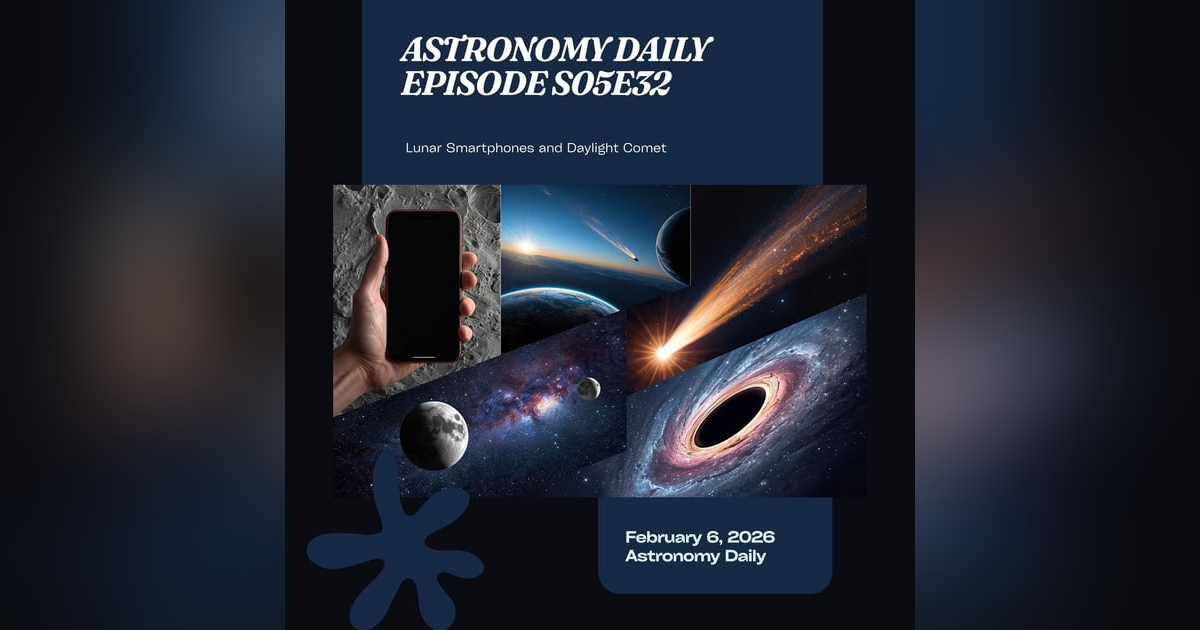
Lunar Smartphones, Daytime Comet, and Jetty McJetface's Cosmic Show

Episode S05E32 - Friday, February 6, 2026 Welcome to Astronomy Daily! Join hosts Anna and Avery as they bring you the latest space and astronomy news from across the cosmos. Episode Highlights Lunar Smartphones: NASA Approves Modern Tech for Space...

Apple Podcasts podcast player iconSpotify podcast player iconiHeartRadio podcast player iconYoutube Music podcast player iconSpreaker podcast player iconPocketCasts podcast player iconDeezer podcast player iconJioSaavn podcast player iconRSS Feed podcast player icon

Episode S05E32 - Friday, February 6, 2026
Welcome to Astronomy Daily! Join hosts Anna and Avery as they bring you the latest space and astronomy news from across the cosmos.
Episode Highlights
Lunar Smartphones: NASA Approves Modern Tech for Space
NASA astronauts will finally be allowed to bring their smartphones on missions, starting with Crew-12 to the ISS next week and the Artemis II lunar flyby in March. After years of using decade-old cameras, astronauts can now spontaneously capture and share moments with iPhones and Android devices, promising unprecedented behind-the-scenes documentation of historic missions.
Comet MAPS: A Potential Daylight Spectacle
Newly discovered Comet C/2026 A1 (MAPS) could become visible to the naked eye—possibly even in broad daylight—when it passes within 120,000 km of the sun in early April. This Kreutz sungrazer was spotted farther from the sun than any previous sungrazer, suggesting it might survive its close solar encounter and put on a spectacular show.
Mercury's Best Evening Show of 2026
The elusive planet Mercury is currently offering its best evening viewing opportunity of the year! Shining brightly at magnitude -1.1, Mercury will reach greatest elongation on February 19th, appearing 17 degrees above the western horizon after sunset. Don't miss the stunning pairing with a crescent moon on February 18th!
China Joins Space Data Center Race
China's state-owned aerospace corporation announced ambitious plans for space-based data centers as part of their five-year expansion program. This puts China in competition with SpaceX, Axiom Space, and Google in the race to build orbital computing infrastructure powered by abundant solar energy.
Dark Matter vs Black Hole: What Powers the Milky Way?
Groundbreaking research suggests the Milky Way's core might be powered by a dense clump of fermionic dark matter rather than the supermassive black hole Sagittarius A*. This controversial model explains both central star orbits and the galaxy's rotation curve while mimicking the black hole "shadow" captured by the Event Horizon Telescope.
Jetty McJetface: The Star-Shredding Phenomenon
A supermassive black hole nicknamed "Jetty McJetface" continues to astound scientists four years after shredding a star. The black hole's relativistic jet has grown 50 times brighter since 2019 and is predicted to peak in 2027, making it one of the most energetic events ever observed in the universe—over 100 trillion times more powerful than Star Wars' Death Star!
Resources & Links
NASA Administrator Jared Isaacman on X (social media)
Monthly Notices of the Royal Astronomical Society journal
Event Horizon Telescope Collaboration
Astrophysical Journal
Star Walk 2 app for comet tracking
Follow Astronomy Daily
Website: astronomydaily.io
Social Media: @AstroDailyPod on all platforms
Credits
Hosted by Anna & Avery
Produced by the Astronomy Daily team
Season 5, Episode 32
Keep looking up!

Become a supporter of this podcast: https://www.spreaker.com/podcast/astronomy-daily-space-news-updates--5648921/support.

Sponsor Details:
Ensure your online privacy by using NordVPN. To get our special listener deal and save a lot of money, visit www.bitesz.com/nordvpn. You'll be glad you did!

Become a supporter of Astronomy Daily by joining our Supporters Club. Commercial free episodes daily are only a click way... Click Here

This episode includes AI-generated content.

WEBVTT

1
00:00:00.360 --> 00:00:04.639
Welcome to Astronomy Daily, your source for the latest space

2
00:00:04.759 --> 00:00:06.040
and astronomy news.

3
00:00:06.519 --> 00:00:09.919
I'm Anna and I'm Avery. We're coming to you on Friday,

4
00:00:09.960 --> 00:00:13.800
February six, twenty twenty six, and today's show is packed

5
00:00:13.800 --> 00:00:17.160
with some truly incredible stories from across the cosmos.

6
00:00:17.440 --> 00:00:22.199
We've got everything from lunar smartphones to daytime visible comments.

7
00:00:22.760 --> 00:00:26.640
Let's dive into today's headlines. We're looking at NASA's new

8
00:00:26.719 --> 00:00:30.320
policy that let's astronauts bring their phones to the Moon,

9
00:00:30.920 --> 00:00:35.320
a newly discovered commet that might become visible in broad daylight,

10
00:00:35.799 --> 00:00:40.759
the best viewing opportunity for Mercury all year, China's ambitious

11
00:00:40.799 --> 00:00:45.079
plans for space based data centers, new theories about what

12
00:00:45.240 --> 00:00:49.439
really powers the Milky Way's core, and a star shredding

13
00:00:49.560 --> 00:00:53.320
black hole with an absolutely unforgettable nickname.

14
00:00:53.840 --> 00:00:57.320
That nickname is Pure Gold. Anna. But first, let's talk

15
00:00:57.320 --> 00:01:00.719
about something that might seem mundane but is act pretty

16
00:01:00.719 --> 00:01:02.479
revolutionary for space exploration.

17
00:01:02.840 --> 00:01:05.560
Avery. I have to admit, when I first saw this story,

18
00:01:05.719 --> 00:01:09.680
my first thought was, wait, they couldn't do that before, right?

19
00:01:10.120 --> 00:01:13.400
It seems so obvious in twenty twenty six. But here's

20
00:01:13.439 --> 00:01:16.959
the thing. Getting any new technology approved for spacefly is

21
00:01:17.000 --> 00:01:20.400
incredibly difficult. Everything has to be tested to make sure

22
00:01:20.439 --> 00:01:23.840
it won't interfere with critical systems or cause problems in

23
00:01:23.879 --> 00:01:25.840
the extreme environment of space.

24
00:01:26.000 --> 00:01:29.640
And NASA just announced that starting with the Crew twelve

25
00:01:29.719 --> 00:01:33.920
mission to the International Space Station next week, and more importantly,

26
00:01:34.200 --> 00:01:38.760
with the highly anticipated Artemis two lunar flyby mission in March,

27
00:01:39.200 --> 00:01:42.200
astronauts will be allowed to bring their smartphones.

28
00:01:42.519 --> 00:01:45.840
This is actually a pretty big deal from a documentation perspective.

29
00:01:46.280 --> 00:01:49.840
NASA administrator Jared Isaacman wrote on social media that they're

30
00:01:49.879 --> 00:01:52.879
giving crews the tools to capture special moments for their

31
00:01:52.920 --> 00:01:56.439
families and share inspiring images and video with the world.

32
00:01:56.840 --> 00:02:00.280
The timing is perfect too. Until now, the new TUST

33
00:02:00.319 --> 00:02:04.840
cameras approved for these missions were decade old Nikon DSLRs

34
00:02:04.959 --> 00:02:08.800
and GoPros. Those are great cameras, but there's something more

35
00:02:08.879 --> 00:02:12.080
spontaneous and accessible about using a smartphone.

36
00:02:12.240 --> 00:02:16.360
Absolutely think about it. With iPhones and Android devices at hand,

37
00:02:16.599 --> 00:02:20.360
astronauts can be much more spontaneous with image and video gathering.

38
00:02:20.759 --> 00:02:23.800
We might see more behind the scenes moments, more real

39
00:02:23.840 --> 00:02:25.800
time documentation of their experiences.

40
00:02:26.159 --> 00:02:29.719
I am already imagining the tiktoks from zero gravity, though

41
00:02:29.759 --> 00:02:32.759
I have to wonder if that's something NASA is prepared for.

42
00:02:33.960 --> 00:02:37.719
Well. Isaacman did mention that what's equally important is that

43
00:02:37.759 --> 00:02:41.759
they challenged long standing processes and qualified modern hardware for

44
00:02:41.840 --> 00:02:46.479
spaceflight on an expedited timeline. That operational urgency, he says,

45
00:02:46.560 --> 00:02:49.800
will serve NASA well as they pursue high value science

46
00:02:49.800 --> 00:02:50.400
and research.

47
00:02:50.719 --> 00:02:53.960
Now I should mention this isn't technically the first time

48
00:02:54.080 --> 00:02:57.719
smartphones have gone to space. SpaceX allowed them for their

49
00:02:57.759 --> 00:03:01.319
private astronaut missions, but this is the first time NASA

50
00:03:01.439 --> 00:03:04.240
is officially approving them for their own crude.

51
00:03:04.039 --> 00:03:07.879
Flights and for Artemis two, this is huge. We're talking

52
00:03:07.879 --> 00:03:10.680
about the first time humans will orbit the Moon since

53
00:03:10.719 --> 00:03:15.080
the Apollo era, having modern smartphones to document that historic journey.

54
00:03:15.319 --> 00:03:18.280
That's going to give us perspectives we've never had before.

55
00:03:18.639 --> 00:03:21.840
Ultra wide angle selfies with the Moon in the background.

56
00:03:22.000 --> 00:03:24.759
I'm here for it, though I do hope Mission Control

57
00:03:24.840 --> 00:03:28.879
sets up some kind of social media guidelines first, no doubt.

58
00:03:29.159 --> 00:03:32.960
All right, from lunar smartphones to cosmic visitors, let's talk

59
00:03:32.960 --> 00:03:36.199
about something that's got the astronomy community really excited.

60
00:03:36.560 --> 00:03:38.879
Avery This is the kind of story that makes you

61
00:03:38.919 --> 00:03:42.599
want to mark your calendar. A newly discovered comet has

62
00:03:42.639 --> 00:03:46.319
the potential to become one of the brightest astronomical events

63
00:03:46.400 --> 00:03:47.039
of the year.

64
00:03:47.439 --> 00:03:50.759
I'm at c Slash twenty twenty six, a one nickname

65
00:03:50.840 --> 00:03:55.439
maps after the four astronomers who discovered it, Mari, Attard, Parrot,

66
00:03:55.439 --> 00:03:59.560
and Signorette, was spotted on January thirteenth using a remotely

67
00:03:59.599 --> 00:04:02.319
operated telescope in Chile's Atacama Desert.

68
00:04:02.759 --> 00:04:06.439
And what makes this discovery so exciting is that it's

69
00:04:06.479 --> 00:04:10.400
a member of the Kreut's sungrazing comet family. These are

70
00:04:10.439 --> 00:04:14.639
comets that pass extremely close to the Sun, and historically

71
00:04:14.680 --> 00:04:18.839
they've been responsible for some of the most spectacular celestial

72
00:04:18.879 --> 00:04:20.360
displays ever witnessed.

73
00:04:20.839 --> 00:04:24.160
We're talking about comments that in the past became bright

74
00:04:24.279 --> 00:04:27.759
enough to be seen in broad daylight. The Great Comet

75
00:04:27.800 --> 00:04:31.240
of eighteen eighty two was reportedly one hundred times brighter

76
00:04:31.319 --> 00:04:34.240
than the full moon, and the Great Comet of nineteen

77
00:04:34.319 --> 00:04:38.279
sixty five I Kaseeki was easily visible with the naked

78
00:04:38.279 --> 00:04:39.360
eye during the day.

79
00:04:40.000 --> 00:04:45.040
Now here's the crucial detail. All Kreut's sungrazers are believed

80
00:04:45.079 --> 00:04:48.079
to be fragments of a much larger comet that broke

81
00:04:48.079 --> 00:04:52.040
apart hundreds or even thousands of years ago. Each time

82
00:04:52.199 --> 00:04:55.279
one of these fragments makes its close pass by the Sun,

83
00:04:55.680 --> 00:04:59.680
there's a chance it could fragment further or even completely disintegrate.

84
00:05:00.240 --> 00:05:04.079
Right, so there's a big if here. Comet Maps will

85
00:05:04.120 --> 00:05:07.680
pass within just one hundred and twenty thousand kilometers of

86
00:05:07.720 --> 00:05:11.240
the Sun's surface in early April twenty twenty six. That's

87
00:05:11.319 --> 00:05:15.160
incredibly close. If it survives that encounter, it could become

88
00:05:15.199 --> 00:05:16.759
a spectacular site.

89
00:05:17.120 --> 00:05:21.399
What's particularly promising is that Maps was discovered much farther

90
00:05:21.480 --> 00:05:25.199
from the Sun than any previously discovered sun grazer. It

91
00:05:25.279 --> 00:05:29.360
was spotted at about three hundred and eight million kilometers out.

92
00:05:29.680 --> 00:05:34.040
The previous record holder for farthest discovery was comet Ikiya Seki,

93
00:05:34.399 --> 00:05:36.879
which turned out to be the brightest comet of the

94
00:05:36.920 --> 00:05:37.839
twentieth century.

95
00:05:38.439 --> 00:05:42.759
That said, technology has advanced significantly since nineteen sixty five,

96
00:05:43.240 --> 00:05:47.000
so we're better at detecting fainter objects earlier. That means

97
00:05:47.040 --> 00:05:50.480
Maps probably isn't as large as the Kiyoseki, so it's

98
00:05:50.600 --> 00:05:52.480
unlikely to be quite as bright.

99
00:05:52.720 --> 00:05:55.360
But the fact that we caught it so early is

100
00:05:55.399 --> 00:05:58.800
still a good sign. It suggests maps is either a

101
00:05:58.839 --> 00:06:04.600
reasonably large or it's currently an outburst. Recent observations show

102
00:06:04.600 --> 00:06:08.240
it steadily brightening, which points toward it being a larger

103
00:06:08.279 --> 00:06:10.759
fragment rather than already falling apart.

104
00:06:11.360 --> 00:06:15.120
So what can skywatchers expect? Well, the best viewing will

105
00:06:15.120 --> 00:06:17.680
be in early April as a comet approaches the Sun.

106
00:06:18.000 --> 00:06:20.959
If it survives its close pass, it could become visible

107
00:06:20.959 --> 00:06:24.480
to the naked eye, possibly even during daylight hours as

108
00:06:24.480 --> 00:06:26.000
it swings closest to the Sun.

109
00:06:26.519 --> 00:06:30.199
Observers in the southern hemisphere will have better viewing opportunities,

110
00:06:30.439 --> 00:06:33.839
with the comet appearing higher in the sky during morning twilight.

111
00:06:34.319 --> 00:06:37.839
Northern hemisphere observers will have a more challenging view with

112
00:06:37.959 --> 00:06:40.920
the comet staying very close to the Sun and low

113
00:06:41.000 --> 00:06:41.759
on the horizon.

114
00:06:42.360 --> 00:06:46.000
I love that the astronomy community is already tempering expectations

115
00:06:46.079 --> 00:06:49.639
while still allowing for optimism. This could be amazing, or

116
00:06:49.680 --> 00:06:53.560
it could fizzle out. That's the unpredictable nature of comets.

117
00:06:53.639 --> 00:06:57.480
And that unpredictability is part of what makes them so exciting.

118
00:06:57.800 --> 00:07:00.680
We'll definitely be keeping our eyes on common maps as

119
00:07:00.720 --> 00:07:01.639
April approaches.

120
00:07:02.040 --> 00:07:05.199
Speaking of things to watch in the sky, there's another

121
00:07:05.319 --> 00:07:09.279
elusive celestial object that's putting on its best show right now.

122
00:07:09.879 --> 00:07:13.319
You know, Avery, Mercury gets a bad reputation as the

123
00:07:13.560 --> 00:07:16.920
elusive planet, but I think that's a bit unfair.

124
00:07:17.519 --> 00:07:21.360
I completely agree. Most astronomy books make it sound like

125
00:07:21.439 --> 00:07:24.680
Mercury is almost impossible to see. But the truth is

126
00:07:24.879 --> 00:07:26.920
you just need to know when and where to.

127
00:07:26.839 --> 00:07:31.480
Look exactly, And right now we're entering the best evening

128
00:07:31.560 --> 00:07:34.720
viewing window for Mercury and all of twenty twenty six

129
00:07:34.959 --> 00:07:37.639
for observers in the Northern Hemisphere observers.

130
00:07:38.160 --> 00:07:41.439
Mercury began its best evening apparition of the year today

131
00:07:41.560 --> 00:07:44.839
February sixth, even though it was only twelve degree from

132
00:07:44.879 --> 00:07:47.959
the Sun, initially, it was shining at a bright minus

133
00:07:48.040 --> 00:07:51.560
one point one, nearly as bright as Serious, the brightest

134
00:07:51.560 --> 00:07:52.680
star in the night sky.

135
00:07:53.120 --> 00:07:56.399
What's great is that on each of the next thirteen evenings,

136
00:07:56.720 --> 00:08:00.399
Mercury gets progressively higher in the sky. And that's a

137
00:08:00.399 --> 00:08:05.959
bit later. By February nineteenth, it reaches what's called greatest elongation,

138
00:08:06.360 --> 00:08:10.519
its maximum angular separation from the Sun at eighteen degrees.

139
00:08:10.920 --> 00:08:13.920
And here's what makes this appearance so special for mid

140
00:08:13.959 --> 00:08:18.240
northern latitude observers. Almost all of that separation is vertical.

141
00:08:18.680 --> 00:08:22.800
Mercury will stand nearly seventeen degrees above the horizon at sunset,

142
00:08:23.000 --> 00:08:26.399
and it won't set until after astronomical twilight ends.

143
00:08:26.800 --> 00:08:30.199
So we're talking about being able to see Mercury in

144
00:08:30.240 --> 00:08:33.440
a truly dark night sky more than an hour and

145
00:08:33.440 --> 00:08:38.279
a half after sunset, jining at magnitude minus zero point four.

146
00:08:38.720 --> 00:08:41.039
That's brighter than the star Arcturus.

147
00:08:41.679 --> 00:08:44.440
Now, there's a really nice celestial alignment coming up on

148
00:08:44.519 --> 00:08:49.039
February eighteenth. A slender, waxing crescent moon only about two

149
00:08:49.120 --> 00:08:53.120
percent illuminated, will appear very close to Mercury. The moon

150
00:08:53.159 --> 00:08:56.240
will be this beautiful smile in the western sky, with

151
00:08:56.440 --> 00:08:59.440
Mercury hovering right above it like a brilliant star.

152
00:09:00.080 --> 00:09:06.639
Here's something special. If you live in Texas, Arkansas, Louisiana, Mississippi, Alabama, Georgia,

153
00:09:06.759 --> 00:09:10.399
or Florida, you might actually see the moon pass directly

154
00:09:10.480 --> 00:09:14.320
in front of Mercury around seven thirty seven pm Eastern

155
00:09:14.360 --> 00:09:17.039
time and seven thirty pm Central time.

156
00:09:17.639 --> 00:09:21.600
That's called an occultation, and it's quite rare even if

157
00:09:21.639 --> 00:09:23.919
you're not in those states. The close pairing of the

158
00:09:24.000 --> 00:09:27.200
crescent moon and bright Mercury will make for a stunning

159
00:09:27.279 --> 00:09:30.120
view about forty five minutes after sunset.

160
00:09:30.399 --> 00:09:35.600
Now, after its peak on February nineteenth, Mercury fades rapidly.

161
00:09:36.120 --> 00:09:39.559
Remember we talked about how Mercury shows phases like the moon.

162
00:09:40.120 --> 00:09:43.879
While at the beginning of February, Mercury's disc was ninety

163
00:09:44.000 --> 00:09:48.240
seven percent illuminated, by the time it reaches greatest elongation,

164
00:09:48.679 --> 00:09:52.559
it's only fifty percent illuminated, like a half moon, and.

165
00:09:52.480 --> 00:09:56.279
In the following days that rapidly decreasing phase results in

166
00:09:56.320 --> 00:10:00.240
a dramatic loss in brightness. By February twenty fourth, it'll

167
00:10:00.279 --> 00:10:04.120
have faded from magnitude minus zero point four to magnitude

168
00:10:04.159 --> 00:10:07.960
plus zero point six, losing more than a full magnitude

169
00:10:07.960 --> 00:10:08.600
and brightness.

170
00:10:08.960 --> 00:10:13.039
By February twenty sixth, it'll be down to magnitude plus

171
00:10:13.120 --> 00:10:17.240
one point three, just slightly brighter than the star Regulus

172
00:10:17.519 --> 00:10:22.240
and appearing as a slender crescent only seventeen percent illuminated.

173
00:10:22.679 --> 00:10:25.639
That's probably going to be the last good chance to

174
00:10:25.679 --> 00:10:29.080
spot it before it disappears into the sunset glow.

175
00:10:29.480 --> 00:10:31.799
So the message is clear. If you want to see

176
00:10:31.840 --> 00:10:35.159
Mercury at its best, don't wait the next two weeks

177
00:10:35.200 --> 00:10:38.919
offer the best viewing opportunity of the entire year. Find

178
00:10:38.960 --> 00:10:43.080
a clear western horizon, look about forty five minutes after sunset,

179
00:10:43.279 --> 00:10:46.320
and you'll be rewarded with a bright star that's actually

180
00:10:46.360 --> 00:10:48.440
our Solar System's innermost planet.

181
00:10:49.039 --> 00:10:52.720
And honestly, once you see it, you'll wonder why people

182
00:10:52.799 --> 00:10:56.480
ever called it elusive. All Right, shifting gears now to

183
00:10:56.559 --> 00:11:00.799
some developments in space technology and infrastructure. The race to

184
00:11:00.840 --> 00:11:04.720
build data centers in space is heating up, and China

185
00:11:04.879 --> 00:11:08.039
just announced they're joining the competition in a big way.

186
00:11:08.679 --> 00:11:12.519
The state owned China Aerospace Science and Technology Corporation has

187
00:11:12.559 --> 00:11:15.360
announced that space based data centers will be part of

188
00:11:15.399 --> 00:11:18.759
their new five year plane for expanding China's presence in space.

189
00:11:19.480 --> 00:11:23.000
This is part of a larger initiative that also includes

190
00:11:23.120 --> 00:11:28.399
asteroid mining, space debris monitoring, and even space tourism. But

191
00:11:28.519 --> 00:11:32.759
the data center component is particularly interesting because it puts

192
00:11:32.840 --> 00:11:37.279
China in direct competition with several US companies already working

193
00:11:37.320 --> 00:11:38.120
on this concept.

194
00:11:38.720 --> 00:11:42.320
According to the China Global Television Network, the plan will

195
00:11:42.360 --> 00:11:47.080
target an integrated space system architecture and combining cloud, edge

196
00:11:47.120 --> 00:11:51.000
and terminal technologies. The goal is to enable computing power

197
00:11:51.200 --> 00:11:53.799
storage and transmission capabilities from space.

198
00:11:54.519 --> 00:11:59.080
Now, why are so many countries and companies suddenly interested

199
00:11:59.120 --> 00:12:02.480
in putting data centers in orbit? Well, it comes down

200
00:12:02.519 --> 00:12:08.039
to resources. Data centers, especially those powering AI systems, require

201
00:12:08.399 --> 00:12:11.720
enormous amounts of energy and real estate, and.

202
00:12:11.679 --> 00:12:14.759
Both of those are becoming more expensive and limited on Earth.

203
00:12:15.240 --> 00:12:19.120
In space, solar power is abundant and reliable, the sun

204
00:12:19.159 --> 00:12:22.399
is always shining, Plus there's no shortage of real estate

205
00:12:22.440 --> 00:12:22.879
in orbit.

206
00:12:23.679 --> 00:12:28.320
Several US companies are already working on this. SpaceX plans

207
00:12:28.360 --> 00:12:33.519
to launch space based data centers, initially using modified Starlink satellites.

208
00:12:33.919 --> 00:12:38.120
Elon Musk's long term plans even include building AI satellite

209
00:12:38.200 --> 00:12:42.039
factories on the Moon that would launch satellites viel railguns.

210
00:12:42.799 --> 00:12:48.200
That's very Elon. Meanwhile, Houston based Axiom Space already launched

211
00:12:48.200 --> 00:12:51.159
the first components for its orbiting data center last year,

212
00:12:51.600 --> 00:12:54.639
and Google is looking into launching data centers to support

213
00:12:54.639 --> 00:12:56.279
its own AI infrastructure.

214
00:12:56.879 --> 00:13:00.720
The concept was even discussed at the World Economum and

215
00:13:00.799 --> 00:13:05.759
Davos last month. A panel including European Space Agency Director

216
00:13:05.840 --> 00:13:11.279
General Joseph Ashbacker talked about ensuring that fast moving technological

217
00:13:11.320 --> 00:13:15.399
developments like Internet infrastructure are properly protected.

218
00:13:15.919 --> 00:13:19.240
There is one significant concern that was raised, though. With

219
00:13:19.399 --> 00:13:22.480
so many satellites and data centers being planned for orbit,

220
00:13:23.000 --> 00:13:25.440
we're looking at a dramatic increase in the number of

221
00:13:25.480 --> 00:13:30.639
objects in space. That raises questions about orbital debris, satellite collisions,

222
00:13:30.960 --> 00:13:33.720
and the long term sustainability of the space environment.

223
00:13:34.279 --> 00:13:38.840
Right we already have issues with space debris. Adding thousands

224
00:13:38.879 --> 00:13:43.159
more satellites for data centers could exacerbate that problem. It's

225
00:13:43.200 --> 00:13:47.840
going to require careful planning and international cooperation to make

226
00:13:47.879 --> 00:13:51.440
sure we don't create an unsustainable situation in orbit.

227
00:13:51.960 --> 00:13:54.320
The next five years are going to be really interesting

228
00:13:54.519 --> 00:13:57.720
as we see how this unfolds. Will space spased data

229
00:13:57.759 --> 00:14:00.279
centers become the norm, or will we find find that

230
00:14:00.320 --> 00:14:03.159
the challenges outweigh the benefits. Time will tell.

231
00:14:03.399 --> 00:14:06.639
From the future of computing to the very heart of

232
00:14:06.679 --> 00:14:10.679
our galaxy. Our next story challenges something we thought we

233
00:14:10.799 --> 00:14:15.000
knew for certain. Avery This story is fascinating because it

234
00:14:15.120 --> 00:14:18.559
challenges one of the fundamental assumptions about our galaxy.

235
00:14:18.879 --> 00:14:22.759
For decades, the astronomical community has accepted that there's a

236
00:14:22.840 --> 00:14:27.000
super massive black hole called Sagittarius, a star at the

237
00:14:27.039 --> 00:14:30.320
center of our Milky Way. This black hole, with a

238
00:14:30.399 --> 00:14:33.840
mass of about four million sons, was thought to govern

239
00:14:33.879 --> 00:14:38.039
the orbits of nearby stars and shape the gravitational environment

240
00:14:38.159 --> 00:14:39.200
of our galactic core.

241
00:14:39.600 --> 00:14:43.240
But now a new study published in Monthly Notices of

242
00:14:43.279 --> 00:14:48.279
the Royal Astronomical Society is proposing something radical. What if

243
00:14:48.360 --> 00:14:50.919
it's not a black hole at all? What if it's

244
00:14:51.000 --> 00:14:54.360
actually an enormous, dense core of dark matter.

245
00:14:54.919 --> 00:14:58.200
This is a pretty bold claim. The research was conducted

246
00:14:58.200 --> 00:15:02.440
by an international team from our Argentina, Italy and other institutions.

247
00:15:02.919 --> 00:15:06.039
They're suggesting that what we've been calling a super massive

248
00:15:06.080 --> 00:15:09.840
black hole could actually be an exotic structure composed of

249
00:15:09.879 --> 00:15:11.120
fermionic dark matter.

250
00:15:11.600 --> 00:15:15.600
Let me explain what that means. Fermionic dark matter is

251
00:15:15.679 --> 00:15:19.840
composed of light particles called fermions that follow the poly

252
00:15:20.080 --> 00:15:23.879
exclusion principle. This type of dark matter could form a

253
00:15:24.039 --> 00:15:29.360
highly dense but non singular structure, in other words, incredibly compact,

254
00:15:29.639 --> 00:15:31.559
but not technically a black hole.

255
00:15:32.000 --> 00:15:34.639
What's clever about this model is that it proposes a

256
00:15:34.759 --> 00:15:38.159
dual component system. There would be a dense inner core

257
00:15:38.240 --> 00:15:41.519
at the galactic center, but it would transition smoothly into

258
00:15:41.600 --> 00:15:45.399
an extended, diffuse halo that envelops the entire galaxy.

259
00:15:45.919 --> 00:15:49.440
And this is where it gets really interesting. This same

260
00:15:49.600 --> 00:15:53.080
dark matter structure could explain both the violent orbits of

261
00:15:53.159 --> 00:15:56.799
stars very close to the galactic center and the gentle

262
00:15:56.919 --> 00:15:59.799
rotation of stars in the outer regions of the galaxy,

263
00:16:00.200 --> 00:16:01.960
all without needing a black hole.

264
00:16:02.480 --> 00:16:04.919
The team looked at the s stars. These are stars

265
00:16:04.960 --> 00:16:08.399
that orbit the galactic center at incredible speeds up to

266
00:16:08.559 --> 00:16:12.399
thousands of kilometers per second. The traditional explanation is that

267
00:16:12.440 --> 00:16:14.519
they're orbiting a super massive black.

268
00:16:14.320 --> 00:16:18.399
Hole, but the fermionic dark matter model can also explain

269
00:16:18.440 --> 00:16:22.000
these orbits. The dense core would be compact and massive

270
00:16:22.080 --> 00:16:25.519
enough to create the same gravitational pull that we've been

271
00:16:25.559 --> 00:16:27.000
attributing to a black hole.

272
00:16:27.480 --> 00:16:30.639
Now here's a crucial point. In twenty twenty two, the

273
00:16:30.720 --> 00:16:34.279
Event Horizon telescope captured the first image of what we've

274
00:16:34.320 --> 00:16:37.960
been calling the shadow of Sagittarius, a star. You'd think

275
00:16:38.000 --> 00:16:39.600
that would prove it's a black hole.

276
00:16:39.440 --> 00:16:43.279
Right, you'd think, But the researchers point out that the

277
00:16:43.320 --> 00:16:47.240
dense dark matter core can also mimic this shadow. It

278
00:16:47.360 --> 00:16:50.879
bends light with such intense force that it creates a

279
00:16:50.960 --> 00:16:55.039
central darkness surrounded by a bright ring, the same visual

280
00:16:55.080 --> 00:16:57.360
signature we'd expect from a black hole.

281
00:16:57.879 --> 00:17:01.440
Lead author Valentina Crespy noticed that their model explains the

282
00:17:01.519 --> 00:17:05.599
star orbits the galaxy's rotation, and it's consistent with that

283
00:17:05.640 --> 00:17:07.559
famous black hole shadow image.

284
00:17:07.759 --> 00:17:11.640
The team statistical analysis shows that with current data, we

285
00:17:11.680 --> 00:17:15.880
can't yet decisively distinguish between the traditional black hole scenario

286
00:17:16.200 --> 00:17:19.119
and the fermionic dark matter one. But what makes the

287
00:17:19.200 --> 00:17:23.279
dark matter model attractive is that it provides a unified framework.

288
00:17:23.799 --> 00:17:26.160
Instead of having the black hole as one thing and

289
00:17:26.319 --> 00:17:29.720
dark matter as something separate, this model suggests they could

290
00:17:29.759 --> 00:17:32.799
be two manifestations of the same continuous substance.

291
00:17:33.400 --> 00:17:37.200
PO author doctor Carlos Argueez made an important point. This

292
00:17:37.359 --> 00:17:40.119
is the first time a dark matter model has managed

293
00:17:40.160 --> 00:17:44.519
to reconcile such vastly different scales. They can explain everything

294
00:17:44.559 --> 00:17:48.319
from the central star orbits to the galaxy's overall rotation

295
00:17:48.480 --> 00:17:51.279
curve using the same dark matter structure.

296
00:17:51.839 --> 00:17:55.279
So what's next. Well, the team says that more precise

297
00:17:55.319 --> 00:17:59.680
observations will be crucial. Instruments like the gravity interparometer on

298
00:17:59.759 --> 00:18:03.119
chi is very large telescope could help distinguish between the

299
00:18:03.160 --> 00:18:03.960
two scenarios.

300
00:18:04.480 --> 00:18:07.920
They're also looking for the unique signature of photon rings,

301
00:18:08.200 --> 00:18:11.039
a key feature of black holes that would be absent

302
00:18:11.160 --> 00:18:15.000
in the dark matter core scenario. If future observations don't

303
00:18:15.039 --> 00:18:18.359
find these photon rings, that would be strong evidence for

304
00:18:18.400 --> 00:18:19.480
the dark matter model.

305
00:18:20.039 --> 00:18:22.920
This is such a great example of how science works.

306
00:18:23.200 --> 00:18:26.799
We have this well established theory about Sagittarius a star

307
00:18:27.000 --> 00:18:30.039
being a black hole, and it might still be. But

308
00:18:30.119 --> 00:18:33.319
it's important that scientists are willing to challenge these assumptions

309
00:18:33.319 --> 00:18:35.279
and explore alternative explanations.

310
00:18:35.759 --> 00:18:39.839
Absolutely and regardless of which model turns out to be correct,

311
00:18:40.079 --> 00:18:43.359
We're learning more about dark matter, black holes, and the

312
00:18:43.400 --> 00:18:46.759
fundamental nature of what sits at the heart of our galaxy.

313
00:18:47.160 --> 00:18:48.319
It's exciting stuff.

314
00:18:48.880 --> 00:18:52.240
And speaking of black holes, our final story today features

315
00:18:52.279 --> 00:18:57.119
one with an absolutely delightful name that's doing something truly unprecedented.

316
00:18:57.720 --> 00:19:02.599
Okay, Avery, I have to start by saying, jettymcjetface might

317
00:19:02.640 --> 00:19:06.240
be the best astronomical object name I've ever heard.

318
00:19:06.759 --> 00:19:11.599
It's amazing, right. University of Oregon astrophysicist doctor Vet Kendis

319
00:19:11.640 --> 00:19:14.640
coined the nickname as a reference to body MC boat Face,

320
00:19:15.079 --> 00:19:18.119
that British research vessel that became Internet famous when a

321
00:19:18.160 --> 00:19:19.599
public poll chose its name.

322
00:19:20.079 --> 00:19:24.279
But the name might be playful, the phenomenon is dead serious.

323
00:19:24.680 --> 00:19:27.720
We're talking about one of the most energetic and brightest

324
00:19:27.720 --> 00:19:29.960
events ever detected in the universe.

325
00:19:30.480 --> 00:19:33.720
Let's back up and explain what's happening here. In twenty eighteen,

326
00:19:34.000 --> 00:19:37.839
astronomers detected what's called a title disruption event. That's when

327
00:19:37.880 --> 00:19:40.119
a star gets too close to a black hole and

328
00:19:40.160 --> 00:19:43.200
gets torn apart by its immense gravitational forces.

329
00:19:43.480 --> 00:19:47.279
The technical term for what happens to the star is spaghettification.

330
00:19:47.839 --> 00:19:51.160
The star literally gets stretched out like spaghetti by the

331
00:19:51.200 --> 00:19:53.000
extreme gravitational gradient.

332
00:19:53.599 --> 00:19:58.480
Now, title disruption events aren't uncommon. Astronomers have documented plenty

333
00:19:58.480 --> 00:20:00.799
of cases where a star gets sh b's redded without

334
00:20:00.880 --> 00:20:04.079
actually crossing the event horizon the point of no return.

335
00:20:04.559 --> 00:20:08.720
But what makes this particular event, officially designated at twenty

336
00:20:08.839 --> 00:20:13.440
eighteen hyz, so unusual is what happened after the star

337
00:20:13.559 --> 00:20:14.119
was destroyed.

338
00:20:14.599 --> 00:20:17.960
For a few years, nothing much happened. Then in twenty

339
00:20:18.000 --> 00:20:22.240
twenty two, doctor Kendace noticed something strange. The black hole

340
00:20:22.440 --> 00:20:26.200
was suddenly emitting a huge amount of energy in radio waves,

341
00:20:26.559 --> 00:20:29.319
even though the star had been destroyed years earlier.

342
00:20:29.920 --> 00:20:33.000
That peaked her curiosity, and she and her team started

343
00:20:33.039 --> 00:20:37.440
monitoring it closely. What they found is absolutely remarkable. The

344
00:20:37.559 --> 00:20:41.559
radio emissions have continued to increase exponentially. The black hole

345
00:20:41.640 --> 00:20:44.400
is now fifty times brighter in radio waves than it

346
00:20:44.480 --> 00:20:46.519
was when they first detected it in twenty nineteen.

347
00:20:47.039 --> 00:20:50.559
To put that energy output in perspective, the researchers say

348
00:20:50.599 --> 00:20:53.759
it's at least a trillion times more powerful than the

349
00:20:53.799 --> 00:20:57.279
fictional Death Star from Star Wars. Some estimates put it

350
00:20:57.319 --> 00:21:00.000
closer to one hundred trillion times more powerful.

351
00:21:00.599 --> 00:21:04.279
Doctor Kenda said, this is really unusual. I'd be hard

352
00:21:04.319 --> 00:21:06.920
pressed to think of anything rising like this over such

353
00:21:06.960 --> 00:21:08.079
a long period of time.

354
00:21:08.680 --> 00:21:12.480
So what's creating all this energy? Well, the black hole

355
00:21:12.559 --> 00:21:16.400
is producing what's called a relativistic jet, a stream of

356
00:21:16.519 --> 00:21:20.519
charged particles moving at nearly the speed of light, all

357
00:21:20.559 --> 00:21:22.079
shooting out in one direction.

358
00:21:22.759 --> 00:21:25.599
The leading theory is that after the star was shredded,

359
00:21:25.720 --> 00:21:28.359
it took some time for that stellar material to form

360
00:21:28.400 --> 00:21:32.440
an accretion disk around the black hole. Once that disc formed,

361
00:21:32.720 --> 00:21:36.319
magnetic fields began channeling some of that material away from

362
00:21:36.319 --> 00:21:39.359
the black hole as this incredibly powerful jet.

363
00:21:39.799 --> 00:21:43.359
And here's the crazy part. The team has collected enough

364
00:21:43.480 --> 00:21:46.680
data now to predict that the jet will keep increasing

365
00:21:46.720 --> 00:21:50.200
in brightness before peaking sometime in twenty twenty seven.

366
00:21:50.799 --> 00:21:54.400
The energy output is comparable to gamma y bursts, which

367
00:21:54.400 --> 00:21:58.160
are generally considered among the most energetic events in the universe.

368
00:21:58.599 --> 00:22:01.400
But what makes Jetty mcjet face special is that it's

369
00:22:01.400 --> 00:22:05.240
been building for years, rather than being a brief flash.

370
00:22:05.640 --> 00:22:08.640
Doctor ken Days made an interesting point about why this

371
00:22:08.759 --> 00:22:11.200
might be the first time we're seeing something like this.

372
00:22:11.839 --> 00:22:16.839
G noted that securing time on international telescopes is extremely competitive.

373
00:22:17.279 --> 00:22:20.279
If you observe an explosion, why would you expect there

374
00:22:20.279 --> 00:22:22.480
to be something years after it happened?

375
00:22:23.079 --> 00:22:23.279
Right?

376
00:22:23.480 --> 00:22:23.599
So?

377
00:22:23.680 --> 00:22:27.079
There could be other black holes exhibiting similar behavior. But

378
00:22:27.160 --> 00:22:30.359
astronomers haven't been looking for long term effects from tidal

379
00:22:30.440 --> 00:22:33.480
disruption events because they had no reason to expect them.

380
00:22:34.000 --> 00:22:37.160
Now, doctor Kendays is on the hunt for other examples.

381
00:22:37.480 --> 00:22:40.680
She wants to know if Jetti mcjetface is truly unique,

382
00:22:41.160 --> 00:22:43.920
or if this is actually a common phenomenon that we've

383
00:22:44.000 --> 00:22:44.680
just been missing.

384
00:22:45.200 --> 00:22:47.200
The good news for Earth is that we're in no

385
00:22:47.359 --> 00:22:51.640
danger from this particular cosmic event. Dettie mcjet face is

386
00:22:51.759 --> 00:22:55.160
far enough away that its incredible energy output poses no

387
00:22:55.319 --> 00:22:57.880
threat to us. We just get to observe one of

388
00:22:57.920 --> 00:23:01.279
the universe's most spectacular show from a safe distance.

389
00:23:01.920 --> 00:23:04.759
It's discoveries like this that remind us how much we

390
00:23:04.920 --> 00:23:08.400
still have to learn about the universe. Black holes continue

391
00:23:08.400 --> 00:23:11.240
to surprise us even after decades of study.

392
00:23:11.759 --> 00:23:14.880
Absolutely, and I love that doctor ken Day's gave it

393
00:23:14.960 --> 00:23:18.279
such a memorable name. Jeddiemikjetface is going to be in

394
00:23:18.319 --> 00:23:20.519
astronomy textbooks for years to come.

395
00:23:20.880 --> 00:23:24.519
And that wraps up another incredible day of space and

396
00:23:24.599 --> 00:23:28.920
astronomy news. From smartphones going to the Moon to star

397
00:23:29.079 --> 00:23:33.920
shredding black holes with unforgettable nicknames, It's been quite a journey.

398
00:23:34.160 --> 00:23:36.960
Don't forget to mark your calendars for Mercury viewing over

399
00:23:37.039 --> 00:23:39.119
the next two weeks, and keep an eye on the

400
00:23:39.119 --> 00:23:42.599
sky in April for what could be a spectacular daytime comment.

401
00:23:43.079 --> 00:23:45.160
Thanks for joining us on Astronomy Daily.

402
00:23:45.359 --> 00:23:48.559
I'm Anna and I'm Avery. Keep looking up and we'll

403
00:23:48.559 --> 00:23:49.400
see you next time.

404
00:23:49.759 --> 00:23:51.240
Clear skies, everyone.

405
00:23:51.400 --> 00:24:10.680
Sunday Stars. The story is the soul. The story is

406
00:24:10.759 --> 00:24:11.240
the soul.