March 11, 2026

Gold From a Galactic Collision — Neutron Star Crash Stuns Astronomers | Astronomy Daily S05E60
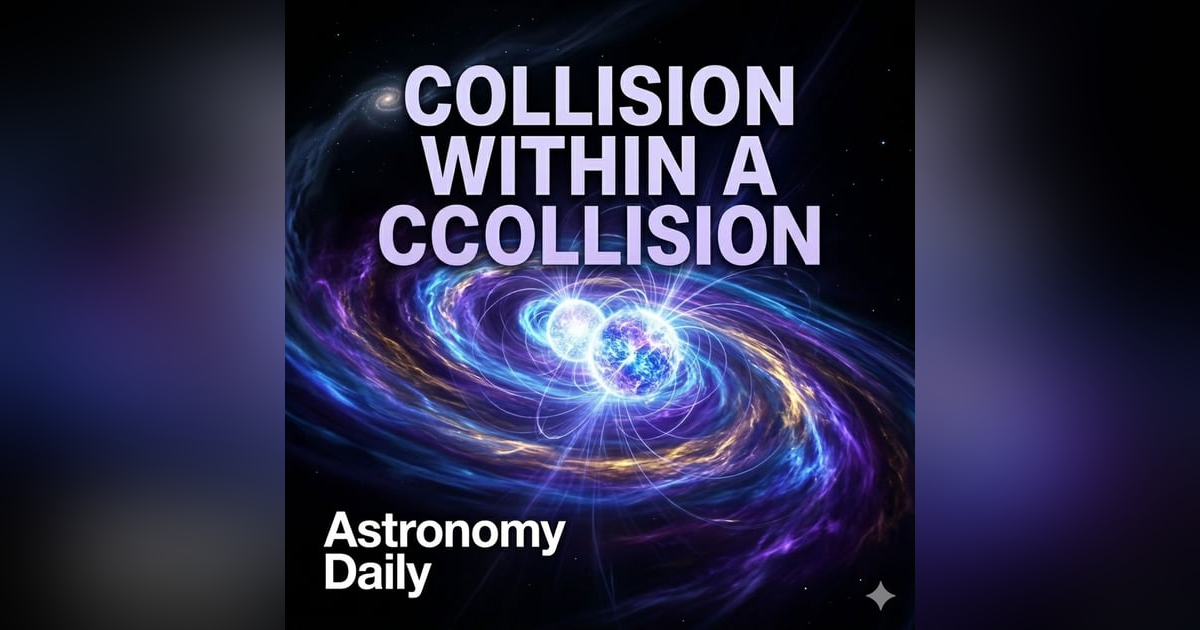
Gold From a Galactic Collision — Neutron Star Crash Stuns Astronomers | Astronomy Daily S05E60
Apple Podcasts podcast player iconSpotify podcast player iconiHeartRadio podcast player iconYoutube Music podcast player iconSpreaker podcast player iconPocketCasts podcast player iconDeezer podcast player iconJioSaavn podcast player iconRSS Feed podcast player icon

Welcome to Episode 60 of Astronomy Daily Season Five! In today's episode, Anna and Avery cover six major stories from the world of space and astronomy — including a neutron star collision in an unprecedented location, the latest Artemis II news, and a cosmic mystery solved after decades.   Stories covered in this episode:   1. NASA Discovers Neutron Star Crash in Unexpected Location A fleet of NASA telescopes — including Chandra, Fermi, Swift, and Hubble — has detected a neutron star merger inside a tiny galaxy buried in a vast stream of gas, 4.7 billion light-years away. It's the first time this type of collision has been spotted in such an environment, and it may explain why gamma-ray bursts sometimes appear outside any galaxy — and how precious metals like gold and platinum ended up in distant stellar regions. Published in The Astrophysical Journal Letters.   2. Artemis II Flight Readiness Review NASA will host a Flight Readiness Review press conference on Thursday 12 March at Kennedy Space Center, covering progress toward the first crewed Artemis mission. The rocket is currently back in the Vehicle Assembly Building following a helium issue, with rollout to the launchpad expected around 19 March and a launch target of no earlier than 1 April 2026.   3. Firefly Alpha 'Stairway to Seven' Scrubbed Again Firefly Aerospace's Alpha rocket — attempting its return to flight after a 10-month grounding — has been scrubbed three times in 10 days. The latest scrub occurred on 10 March during fluid loading after off-nominal readings. A new launch date will be confirmed following engineering review. This mission is the final Block I Alpha flight, with the upgraded Block II debuting on Flight 8.   4. DART Mission Reveals 'Cosmic Snowball Fight' Between Asteroids Researchers at the University of Maryland have found the first direct visual proof of material transfer between two asteroids — fan-shaped streaks on the surface of asteroid moon Dimorphos, left by debris thrown off its parent asteroid Didymos at just 30.7 cm/s. The discovery provides visual confirmation of the YORP effect and has implications for planetary defence modelling. ESA's Hera mission arrives at Didymos in December 2026. Published in The Planetary Science Journal.   5. Starship Flight 12 — About Four Weeks Away SpaceX is approximately four weeks from the launch of Starship Flight 12, which will be the first flight of the upgraded V3 configuration — the most powerful version of the already record-breaking vehicle. Engineers have completed propellant system tests on Ship 39 at Starbase, Texas, and preflight preparations are continuing.   6. Giant Cosmic Sheet Discovered Around the Milky Way Astronomers from the University of Groningen, publishing in Nature Astronomy, have used advanced computer simulations to discover that the matter surrounding our Local Group is arranged in a vast, flat sheet — dominated by dark matter — stretching tens of millions of light-years across. This structure, flanked by enormous empty voids, explains why nearby galaxies are moving away from us rather than being pulled inward. It's the first detailed map of dark matter distribution in our cosmic neighbourhood.   
  Astronomy Daily is part of the Bitesz.com Podcast Network. Website: astronomydaily.io | Social: @AstroDailyPod on all major platforms

Become a supporter of this podcast: https://www.spreaker.com/podcast/astronomy-daily-space-news-updates--5648921/support.

Sponsor Details:
Ensure your online privacy by using NordVPN. To get our special listener deal and save a lot of money, visit www.bitesz.com/nordvpn. You'll be glad you did!

Become a supporter of Astronomy Daily by joining our Supporters Club. Commercial free episodes daily are only a click way... Click Here

This episode includes AI-generated content.

WEBVTT

1
00:00:00.320 --> 00:00:04.040
Hello, and welcome to Astronomy Daily, your daily dose of

2
00:00:04.040 --> 00:00:07.879
what's happening in the cosmos. I'm Avery and I'm Anna.

3
00:00:08.320 --> 00:00:11.400
It is Wednesday, the eleventh of March twenty twenty six,

4
00:00:11.519 --> 00:00:15.800
and this is Season five, Episode sixty, which means sixty

5
00:00:15.880 --> 00:00:19.239
episodes of bringing you the Universe one day at a time.

6
00:00:19.879 --> 00:00:23.519
Sixty episodes this year. That's a lot of space news,

7
00:00:23.760 --> 00:00:27.160
and today's lineup is not letting up. We've got neutron

8
00:00:27.239 --> 00:00:32.320
stars colliding in places nobody expected, a potential cosmic snowball

9
00:00:32.399 --> 00:00:36.679
fight between asteroids, and a giant invisible sheet of dark

10
00:00:36.759 --> 00:00:40.320
matter that explains one of Astronomy's longest running mysteries.

11
00:00:40.840 --> 00:00:45.119
Plus the latest on Artemis two starship's next giant leap,

12
00:00:45.479 --> 00:00:47.920
and a rocket that can't seem to get off the ground,

13
00:00:48.280 --> 00:00:49.719
but not for lack of trying.

14
00:00:50.320 --> 00:00:52.240
Day with us. It's a big one.

15
00:00:52.399 --> 00:00:55.759
We start today with one of the most remarkable astronomy

16
00:00:55.759 --> 00:00:59.960
announcements in recent memory, and it literally involves gold.

17
00:01:00.359 --> 00:01:03.960
That's right. NASA has just published a major new finding.

18
00:01:04.239 --> 00:01:07.359
A fleet of its space telescopes has likely detected a

19
00:01:07.439 --> 00:01:11.200
collision between two neutron stars and the location where this

20
00:01:11.280 --> 00:01:13.680
happened has stunned researchers, though.

21
00:01:13.879 --> 00:01:16.400
Let's back up for listeners who might not be familiar

22
00:01:16.439 --> 00:01:19.719
with neutron stars. These are the remnants left behind when

23
00:01:19.760 --> 00:01:24.280
a massive star burns out, collapses on itself, and explodes

24
00:01:24.280 --> 00:01:29.040
in a supernova. What's left is this tiny, unbelievably dense ball,

25
00:01:29.400 --> 00:01:32.359
about the width of a city, but containing more mass

26
00:01:32.400 --> 00:01:33.640
than our entire sun.

27
00:01:34.200 --> 00:01:36.799
And when two of those collide, which is called a

28
00:01:36.840 --> 00:01:40.519
neutron star merger, it produces one of the most violent

29
00:01:40.640 --> 00:01:45.079
events in the universe. We're talking gamma ray bursts, gravitational

30
00:01:45.120 --> 00:01:49.920
waves rippling through spacetime, and something called a killinova explosion.

31
00:01:50.359 --> 00:01:54.359
That's the process that forges heavy elements things like gold, silver,

32
00:01:54.480 --> 00:01:57.920
and platinum, through a chain of nuclear reactions that can't

33
00:01:57.959 --> 00:01:59.959
happen anywhere else in the cosmos.

34
00:02:00.439 --> 00:02:04.120
We've seen these mergers before, but always inside large or

35
00:02:04.239 --> 00:02:09.000
moderately sized galaxies. That's what makes this discovery so jaw dropping.

36
00:02:09.479 --> 00:02:13.960
This one was found inside a tiny, faint galaxy, barely there,

37
00:02:14.120 --> 00:02:17.719
tucked inside a vast stream of gas four point seven

38
00:02:17.840 --> 00:02:21.280
billion light years away, a location nobody thought to look.

39
00:02:21.680 --> 00:02:26.000
The lead researcher, Simone Dichiara of Penn State University called

40
00:02:26.039 --> 00:02:29.759
it quote game changing, saying it may unlock not one,

41
00:02:29.960 --> 00:02:34.159
but two important questions in astrophysics. One is why gamma

42
00:02:34.240 --> 00:02:37.240
ray bursts sometimes appear in the middle of nowhere, not

43
00:02:37.360 --> 00:02:40.159
near any galaxy at all, And the other is how

44
00:02:40.199 --> 00:02:43.280
precious metals ended up in stars at the very outer

45
00:02:43.439 --> 00:02:44.639
fringes of galaxies.

46
00:02:45.120 --> 00:02:48.840
The answer, it seems, is that small, wandering galaxies like

47
00:02:48.879 --> 00:02:52.199
this one can form from the debris of larger galactic

48
00:02:52.240 --> 00:02:56.919
collisions and eventually produce their own neutron stars, which then merge.

49
00:02:57.319 --> 00:03:00.719
Co author Eleanora Troja of the University of Rome put

50
00:03:00.759 --> 00:03:04.719
it beautifully. We found a collision within a collision. The

51
00:03:04.759 --> 00:03:09.120
galaxy collision triggered star formation, which over hundreds of millions

52
00:03:09.120 --> 00:03:12.639
of years, led to the neutron star merger we just detected.

53
00:03:13.159 --> 00:03:17.800
Four space telescopes were involved in making this discovery, Chandra Fermi,

54
00:03:18.039 --> 00:03:22.080
the Neil Garrels, Swift Observatory, and Hubble. It took all

55
00:03:22.120 --> 00:03:25.439
of them working together to pinpoint the location and confirm

56
00:03:25.520 --> 00:03:28.319
what they were seeing. The paper has just been published

57
00:03:28.360 --> 00:03:30.319
in the Astrophysical journal Letters.

58
00:03:30.879 --> 00:03:33.879
Though the gold in your jewelry it may have come

59
00:03:33.919 --> 00:03:36.960
from a tiny galaxy in a gas stream after a

60
00:03:37.080 --> 00:03:41.159
chain of collisions spanning billions of years. I think that's

61
00:03:41.159 --> 00:03:44.360
one of the most extraordinary facts in all of science.

62
00:03:44.800 --> 00:03:47.319
Puts a new spin on where did this come from?

63
00:03:47.360 --> 00:03:51.439
Doesn't it okay? Coming up next an update on Artemis two,

64
00:03:51.759 --> 00:03:55.360
the mission that is almost almost almost ready to fly.

65
00:03:56.080 --> 00:03:59.520
So Artemis two, if you've been following the show, you

66
00:03:59.639 --> 00:04:02.280
know that this mission has had quite a journey just

67
00:04:02.319 --> 00:04:04.800
to get to the launch pad, and today there's a

68
00:04:04.840 --> 00:04:06.120
significant development.

69
00:04:06.800 --> 00:04:09.840
NASA has announced it will hold a flight readiness press

70
00:04:09.879 --> 00:04:14.240
conference tomorrow Thursday, March twelfth, at Kennedy Space Center in Florida.

71
00:04:14.800 --> 00:04:17.920
This is the formal milestone where engineers and mission leaders

72
00:04:17.920 --> 00:04:21.600
assess whether everything is technically ready to fly. It's a

73
00:04:21.639 --> 00:04:23.399
big deal just to.

74
00:04:23.319 --> 00:04:26.360
Bring everyone up to speed. Artemis two is the first

75
00:04:26.439 --> 00:04:31.399
crude mission of NASA's Space Launch System. Four astronauts Reid Wiseman,

76
00:04:31.759 --> 00:04:36.519
Victor Glover, Christina Coach, and Canadian Space Agency astronaut Jeremy

77
00:04:36.519 --> 00:04:39.680
Hansen will fly around the Moon and back on a

78
00:04:39.720 --> 00:04:42.600
ten day journey. It will be the first time humans

79
00:04:42.600 --> 00:04:46.759
have reached the Moon's vicinity since Apollos seventeen in nineteen

80
00:04:46.920 --> 00:04:47.920
seventy two.

81
00:04:48.199 --> 00:04:51.639
The mission has had a series of delays. Back in February,

82
00:04:51.720 --> 00:04:54.720
a hydrogen leak was found during a wet dress rehearsal.

83
00:04:55.199 --> 00:04:59.199
Then after a second successful rehearsal, a helium flow issue

84
00:04:59.240 --> 00:05:01.839
was discovered in the upper stage, which caused the rocket

85
00:05:01.879 --> 00:05:05.199
to be rolled back into the Vehicle assembly building for repairs.

86
00:05:05.680 --> 00:05:08.120
That pushed to launch out of March entirely.

87
00:05:08.680 --> 00:05:11.879
The current target is April first at the earliest, with

88
00:05:12.079 --> 00:05:15.800
rollout back to Launch Complex thirty nine B expected around

89
00:05:15.879 --> 00:05:20.079
March nineteenth. Bassa has also announced a major restructuring of

90
00:05:20.120 --> 00:05:24.040
the broader Artemis program, adding a new mission, increasing launch

91
00:05:24.079 --> 00:05:28.240
cadence and targeting annual lunar missions with the first crude

92
00:05:28.319 --> 00:05:29.800
landing in twenty twenty eight.

93
00:05:30.519 --> 00:05:33.759
So tomorrow's press conference will be really telling. We'll know

94
00:05:33.879 --> 00:05:36.279
more about the state of the rocket, the official launch

95
00:05:36.319 --> 00:05:40.160
readiness verdict, and possibly more details on that April launch window.

96
00:05:40.560 --> 00:05:43.240
Will of course have full coverage as the story develops.

97
00:05:43.720 --> 00:05:46.639
Fingers crossed for April. The crew has been in training

98
00:05:46.680 --> 00:05:48.839
for years. They deserve their moonshot.

99
00:05:49.519 --> 00:05:52.720
They absolutely do. Let's take a short break and come

100
00:05:52.759 --> 00:05:55.399
back with a story about a rocket trying very hard

101
00:05:55.399 --> 00:05:58.839
to leave the ground and a cosmic snowball fight nobody

102
00:05:58.920 --> 00:05:59.839
saw coming.

103
00:06:00.000 --> 00:06:04.160
All right. Firefly Aerospace, the small launch company, has been

104
00:06:04.199 --> 00:06:06.639
trying to get its Alpha rocket back into the sky

105
00:06:06.759 --> 00:06:10.079
for weeks, and once again the mission has been delayed.

106
00:06:10.680 --> 00:06:13.519
The mission is called Stairway to seven, which refers to

107
00:06:13.560 --> 00:06:17.920
this being Alpha's seventh flight overall. It was originally scheduled

108
00:06:17.920 --> 00:06:21.319
for March first, but high wind scrubbed that attempt. Then

109
00:06:21.480 --> 00:06:25.240
on March ninth, a censor reading outside the expected range

110
00:06:25.319 --> 00:06:29.439
caused another standown, and last night, March tenth, a third

111
00:06:29.480 --> 00:06:33.000
attempt was scrubbed during fluid loading after off normal readings

112
00:06:33.000 --> 00:06:33.639
were detected.

113
00:06:34.199 --> 00:06:37.160
No new launch date has been announced yet. Firefly says

114
00:06:37.199 --> 00:06:39.959
they're reviewing the data and will confirm a new window

115
00:06:40.240 --> 00:06:42.240
once the investigation is complete.

116
00:06:42.600 --> 00:06:46.439
Now it's worth understanding why this mission matters. Alpha has

117
00:06:46.480 --> 00:06:49.920
had a rough run. The sixth flight, called Message In

118
00:06:49.959 --> 00:06:53.319
a Booster, ended when the first stage broke apart just

119
00:06:53.439 --> 00:06:57.720
after separation, destroying the payload. Then in September, a booster

120
00:06:57.879 --> 00:07:02.079
intended for flight seven exploded during ground testing. The company

121
00:07:02.120 --> 00:07:04.879
has been working for nearly ten months to get back

122
00:07:04.879 --> 00:07:05.680
to the launch.

123
00:07:05.399 --> 00:07:09.920
Pad and Stairway to seven is carrying significant symbolic weight.

124
00:07:10.319 --> 00:07:13.279
It's the last flight of the Alpha Block one configuration.

125
00:07:13.800 --> 00:07:17.360
After this, Firefly moves to the upgraded Block two, which

126
00:07:17.360 --> 00:07:21.360
is seven feet taller, uses new in house avionics and batteries,

127
00:07:21.680 --> 00:07:26.720
improved thermal protection, and stronger carbon composite structures. Block two

128
00:07:26.759 --> 00:07:30.360
systems are actually flying on this mission in shadow mode,

129
00:07:30.600 --> 00:07:33.720
testing quietly in the background without controlling the flight.

130
00:07:34.360 --> 00:07:37.720
Firefly also had a big success recently. Their Blue Ghost

131
00:07:37.839 --> 00:07:41.800
lander completed the first ever private lunar surface mission last March.

132
00:07:42.199 --> 00:07:45.560
So the company's in an interesting position. Proven on the Moon,

133
00:07:45.879 --> 00:07:49.199
but still working through reliability challenges with their launch vehicle.

134
00:07:49.759 --> 00:07:53.279
Small launch is hard. We're reading for them. When Stairway

135
00:07:53.279 --> 00:07:56.079
to seven eventually gets off the ground, we'll give it

136
00:07:56.120 --> 00:07:57.680
the full coverage it deserves.

137
00:07:58.279 --> 00:08:02.360
Absolutely now, Cosmic snowballs, you heard that right.

138
00:08:02.920 --> 00:08:07.759
So you might remember NASA's Dart mission, the spacecraft that

139
00:08:08.000 --> 00:08:12.199
intentionally smashed into an asteroid in twenty twenty two to

140
00:08:12.319 --> 00:08:15.639
test whether we could deflect one that might threaten Earth.

141
00:08:16.160 --> 00:08:19.600
It worked beautifully, as we reported last week.

142
00:08:19.839 --> 00:08:23.120
But scientists are still finding new surprises in the data

143
00:08:23.120 --> 00:08:27.160
from that mission and this one. Is genuinely delightful. A

144
00:08:27.240 --> 00:08:30.199
team at the University of Maryland has just published a

145
00:08:30.240 --> 00:08:33.720
study revealing that asteroids can throw slow moving chunks of

146
00:08:33.759 --> 00:08:36.720
debris at each other in what they're calling and I

147
00:08:36.759 --> 00:08:39.159
love this a cosmic snowball fight.

148
00:08:39.879 --> 00:08:44.039
So here's what happened. The Dart spacecraft hid an asteroid

149
00:08:44.080 --> 00:08:48.679
moon called Dimorphous, which orbits a larger asteroid called Ditamos.

150
00:08:49.240 --> 00:08:52.600
In the images captured by the spacecraft, in the moments

151
00:08:52.639 --> 00:08:58.720
before impact, researchers noticed something odd, faint, fan shaped streaks

152
00:08:58.799 --> 00:08:59.960
across Dimorphos.

153
00:09:00.600 --> 00:09:04.039
Lead author Jessica Sunshine said, and this quote is great.

154
00:09:04.480 --> 00:09:07.320
At first we thought something was wrong with the camera,

155
00:09:07.679 --> 00:09:10.000
and then we thought it could have been something wrong

156
00:09:10.039 --> 00:09:14.080
with our image processing. But after months of paint staking work,

157
00:09:14.240 --> 00:09:18.279
stripping away boulder shadows and correcting for lighting, the streaks

158
00:09:18.320 --> 00:09:21.000
became clear, not fainter, they were real.

159
00:09:21.679 --> 00:09:24.919
What the team discovered is that these streaks are the

160
00:09:24.960 --> 00:09:29.159
imprint of debris thrown off Dinamos by something called the

161
00:09:29.320 --> 00:09:34.519
Yorp effect, where sunlight gradually spins a small asteroid faster

162
00:09:34.720 --> 00:09:39.159
and faster until loose material flies off the surface. Some

163
00:09:39.320 --> 00:09:43.399
of that material then drifts across to dimorphous and lands

164
00:09:43.399 --> 00:09:46.840
on it, leaving these distinctive ray patterns.

165
00:09:46.840 --> 00:09:50.519
And the speed of this material transfer just thirty point

166
00:09:50.600 --> 00:09:55.240
seven centimeters per second. That's slower than a leisurely human walk.

167
00:09:55.679 --> 00:09:59.039
These are the gentlest cosmic snowballs imaginable.

168
00:09:59.600 --> 00:10:03.200
It's the the first direct visual proof that material can

169
00:10:03.240 --> 00:10:07.200
travel naturally from one asteroid to another, and it has

170
00:10:07.360 --> 00:10:12.879
real implications for planetary defense. If binary asteroids are constantly

171
00:10:12.960 --> 00:10:17.799
exchanging material and reshaping each other, scientists need to account

172
00:10:17.799 --> 00:10:20.200
for that when modeling how to deflect one.

173
00:10:20.600 --> 00:10:24.120
There's also a follow up mission on the way. Eesa's

174
00:10:24.240 --> 00:10:27.399
Harris spacecraft is set to arrive at the Denamo system

175
00:10:27.519 --> 00:10:30.720
in December this year and maybe able to see whether

176
00:10:30.799 --> 00:10:34.440
those fan shaped streaks survive the dart impact or whether

177
00:10:34.519 --> 00:10:37.759
new ones have formed. More cosmic forensics to come.

178
00:10:38.360 --> 00:10:42.639
A snowball fight spanning millions of years between two rocks

179
00:10:42.679 --> 00:10:43.759
in the dark of space.

180
00:10:44.320 --> 00:10:47.840
I love this job. After this break, Starship is getting

181
00:10:47.879 --> 00:10:51.120
even bigger, and we go looking for the giant, invisible

182
00:10:51.120 --> 00:10:54.519
sheet of matter that may be holding our cosmic neighborhood together.

183
00:10:55.200 --> 00:10:59.799
Basex's Starship program is marching on, and the next milestone

184
00:10:59.919 --> 00:11:01.320
is approaching.

185
00:11:00.879 --> 00:11:05.200
Fast Elon Musk announced this week that SpaceX is approximately

186
00:11:05.279 --> 00:11:09.240
four weeks away from launching Starship Flight twelve, which will

187
00:11:09.240 --> 00:11:12.960
be the first flight of the upgraded Starship V three configuration,

188
00:11:13.480 --> 00:11:15.919
the most powerful version of the vehicle yet.

189
00:11:16.759 --> 00:11:20.879
FACEX engineers have been working through propellant system tests on

190
00:11:21.080 --> 00:11:24.519
Ship thirty nine, that's the newest vehicle, and some of

191
00:11:24.559 --> 00:11:28.840
those tests produced some spectacular imagery this week. The team

192
00:11:28.960 --> 00:11:33.600
is moving methodically through pre flight preparations at Starbase in Texas.

193
00:11:34.279 --> 00:11:38.120
Now, Starship V three is described as a significant step up.

194
00:11:38.440 --> 00:11:41.480
The rocket already holds the title of the most powerful

195
00:11:41.559 --> 00:11:45.399
launch vehicle ever built, and the V three configuration pushes

196
00:11:45.440 --> 00:11:48.960
that capability further, which is critical for the missions ahead,

197
00:11:49.159 --> 00:11:53.519
including NASA's Artemis lunar landings, where a Starship variant will

198
00:11:53.559 --> 00:11:56.200
be used as the human landing system.

199
00:11:56.399 --> 00:12:00.200
Light twelve won't carry the Artemis lander, of course, that's

200
00:12:00.279 --> 00:12:04.000
further down the road, but each integrated flight test builds

201
00:12:04.039 --> 00:12:09.279
toward that goal, demonstrating reliability, reusability, and the ability to

202
00:12:09.360 --> 00:12:12.240
handle increasingly complex mission profiles.

203
00:12:12.799 --> 00:12:15.200
So if all goes to plan, we're looking at mid

204
00:12:15.279 --> 00:12:18.399
to late April for Flight twelve. Liftoff. We'll keep a

205
00:12:18.440 --> 00:12:20.600
close eye on that timeline and give you the full

206
00:12:20.720 --> 00:12:22.600
launch preview when the date firms up.

207
00:12:23.039 --> 00:12:27.600
The pace of development at SpaceX is extraordinary. And now,

208
00:12:27.639 --> 00:12:31.080
to cap off today's show, a cosmic mystery that's been

209
00:12:31.120 --> 00:12:35.240
puzzling astronomers for decades, and it might finally be solved.

210
00:12:35.600 --> 00:12:38.600
Here's a question that sounds simple. If our galaxy is

211
00:12:38.639 --> 00:12:42.559
so massive and has such a powerful gravitational pull, why

212
00:12:42.600 --> 00:12:46.279
are most nearby galaxies flying away from us rather than

213
00:12:46.320 --> 00:12:47.279
being pulled inward.

214
00:12:47.720 --> 00:12:52.240
It's something that's bugged astronomers for decades. Edwin Hubble established

215
00:12:52.279 --> 00:12:56.360
almost a century ago that the universe is expanding. Galaxies

216
00:12:56.399 --> 00:13:00.159
are receding from each other as space itself stretches. But

217
00:13:00.240 --> 00:13:04.120
the galaxies right next to us, just outside our local group,

218
00:13:04.320 --> 00:13:07.799
seemed to be moving away faster than they should. Even

219
00:13:07.840 --> 00:13:11.399
accounting for that expansion, something wasn't adding up.

220
00:13:11.679 --> 00:13:14.320
A team from the University of Groningen in the Netherlands,

221
00:13:14.399 --> 00:13:17.919
working with collaborators in Germany, France, and Sweden, may have

222
00:13:18.080 --> 00:13:21.120
cracked it. They built what they call a virtual twin

223
00:13:21.279 --> 00:13:25.240
of our cosmic neighborhood, running advanced simulations starting from the

224
00:13:25.320 --> 00:13:29.360
early universe based on conditions measured in the cosmic microwave

225
00:13:29.440 --> 00:13:31.720
background all the way through to today.

226
00:13:32.159 --> 00:13:36.240
What they found is remarkable. The matter surrounding the local group,

227
00:13:36.440 --> 00:13:40.120
our cluster of galaxies, including the Milky Way and Andromeda,

228
00:13:40.559 --> 00:13:43.720
isn't spread out evenly in a sphere the way scientists

229
00:13:43.720 --> 00:13:48.120
had assumed. Instead, it's organized into a vast flat sheet

230
00:13:48.159 --> 00:13:51.720
of matter stretching tens of millions of light years across.

231
00:13:52.200 --> 00:13:56.320
Above and below this sheet lie enormous empty voids where

232
00:13:56.360 --> 00:13:58.200
there's essentially nothing.

233
00:13:58.200 --> 00:14:00.799
And when they included this flat structure in their models,

234
00:14:00.919 --> 00:14:04.679
the motion of thirty one nearby galaxies matched almost perfectly

235
00:14:04.759 --> 00:14:08.480
with what astronomers actually observe. The sheet's mass, which is

236
00:14:08.519 --> 00:14:13.559
mostly invisible dark matter, counterbalances the local group's gravitational poll,

237
00:14:13.919 --> 00:14:17.320
so galaxies within the plane drift outward in an orderly

238
00:14:17.360 --> 00:14:20.840
way while nothing falls in from the voids above and below.

239
00:14:21.200 --> 00:14:25.080
Bead researcher ewad Wemp said this is the first detailed

240
00:14:25.080 --> 00:14:28.600
attempt to map the distribution and motion of dark matter

241
00:14:28.919 --> 00:14:32.159
in the region around the Milky Way and Andromeda, and

242
00:14:32.279 --> 00:14:35.559
co researcher Professor Amina Helmy, who has worked on this

243
00:14:35.679 --> 00:14:38.600
problem for years, said She was thrilled to see that

244
00:14:38.720 --> 00:14:43.080
galaxy motions alone could reveal the mass distribution shaping our

245
00:14:43.159 --> 00:14:44.720
local cosmic neighborhood.

246
00:14:45.039 --> 00:14:47.759
What I find incredible about this is that we're essentially

247
00:14:47.840 --> 00:14:51.600
embedded in a cosmic structure we couldn't see. The Milky

248
00:14:51.639 --> 00:14:54.919
Way isn't floating freely in space. It's sitting on a

249
00:14:55.039 --> 00:14:58.360
vast flat sheet of dark matter, surrounded by emptiness on

250
00:14:58.440 --> 00:15:00.080
either side in equilibri.

251
00:15:00.559 --> 00:15:03.279
It's like being a grain of sand on a giant

252
00:15:03.360 --> 00:15:07.679
cosmic beach and only just realizing the beach exists. The

253
00:15:07.720 --> 00:15:11.200
paper is published in Nature Astronomy, and we expect it

254
00:15:11.279 --> 00:15:14.960
to generate significant follow up work as astronomers look to

255
00:15:15.039 --> 00:15:17.759
confirm the structure with additional observations.

256
00:15:18.120 --> 00:15:20.720
Amazing. What a lineup for episode sixty.

257
00:15:21.039 --> 00:15:23.559
And that's our show for today. Let's do a quick

258
00:15:23.600 --> 00:15:25.279
recap of what we covered.

259
00:15:25.360 --> 00:15:28.799
Asad discovered a neutron star collision in a tiny galaxy

260
00:15:28.879 --> 00:15:31.440
buried in a gas stream, the first time this has

261
00:15:31.480 --> 00:15:33.840
been seen in such an unlikely location.

262
00:15:34.320 --> 00:15:38.320
The Artemis two flight readiness review is happening tomorrow. We're

263
00:15:38.360 --> 00:15:41.200
watching closely ahead of the April launch window.

264
00:15:41.679 --> 00:15:45.159
Firefly Alphas Stairway to seven mission is still on hold

265
00:15:45.200 --> 00:15:47.840
after a third scrub. A new launch date will be

266
00:15:47.879 --> 00:15:49.600
announced after engineering review.

267
00:15:50.039 --> 00:15:54.039
DART mission data revealed the first ever direct visual proof

268
00:15:54.080 --> 00:15:59.080
of material transfer between two asteroids, the most gentle cosmic

269
00:15:59.120 --> 00:16:00.960
snowball fight us you can imagine.

270
00:16:01.200 --> 00:16:04.960
SpaceX is about four weeks from launching Starship Flight twelve,

271
00:16:05.120 --> 00:16:09.000
the first flight of the more powerful V three configuration.

272
00:16:08.840 --> 00:16:12.639
And astronomers have discovered a vast flat sheet of dark

273
00:16:12.720 --> 00:16:17.879
matter surrounding our local group, finally explaining why nearby galaxies

274
00:16:17.960 --> 00:16:19.159
behave the way they do.

275
00:16:19.519 --> 00:16:22.759
As always, you can find us at astronomydaily dot io

276
00:16:22.879 --> 00:16:26.720
and on all major podcast platforms. Joe Notes, episode archive

277
00:16:26.759 --> 00:16:28.279
and more are all there for you.

278
00:16:28.639 --> 00:16:32.320
If you're enjoying the show, please subscribe, leave us a review,

279
00:16:32.519 --> 00:16:36.159
and share us with a fellow space enthusiast. It means

280
00:16:36.200 --> 00:16:39.240
the world to us and genuinely helps the show grow.

281
00:16:39.799 --> 00:16:42.960
We'll be back tomorrow with more from the universe. Until then,

282
00:16:43.200 --> 00:17:05.079
keep looking up clear skies, everyone. Sunday Stars Stars story

283
00:17:05.160 --> 00:17:05.759
is ConTroll