March 23, 2026
Europe's Rocket Moment, A Hidden Cosmic Explosion, and Brown Dwarfs in Love
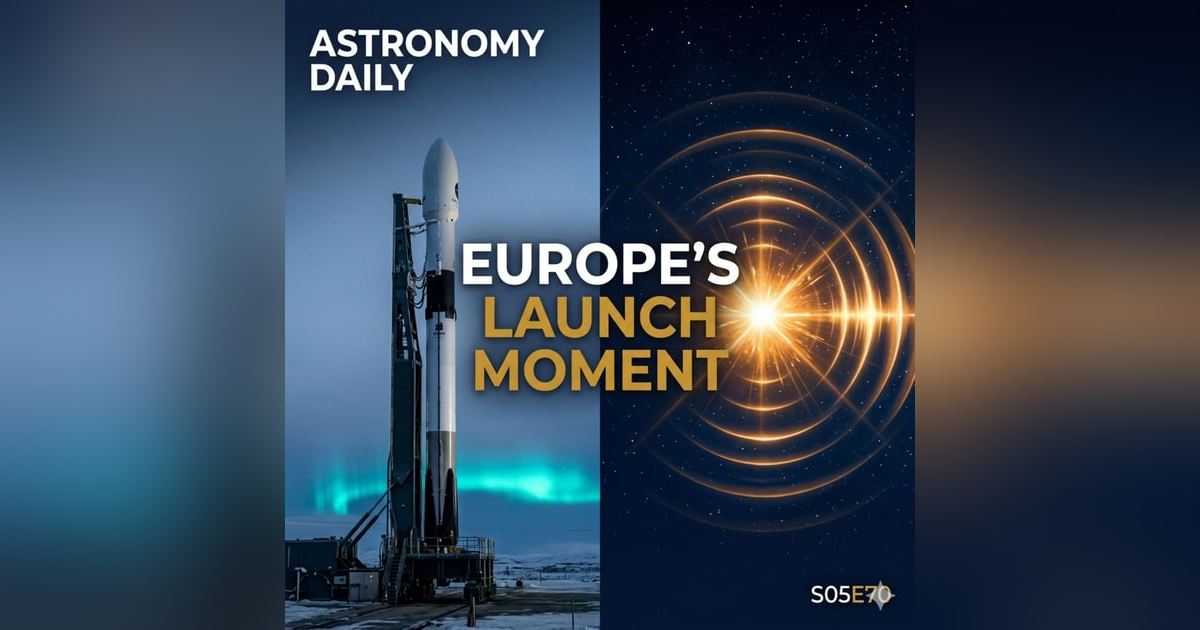


Astronomy Daily — Season 5, Episode 70 Monday, March 23, 2026 In today's episode, Anna and Avery cover six stories spanning a live European rocket launch attempt, a sixty-year-old NASA emergency brought back to life through newly surfaced photographs, a cosmic explosion caught only by its echo, the fight to preserve the night sky, a supply run to the ISS with an unexpected complication, and a first-of-its-kind discovery involving brown dwarf stars.
Story 1: Europe's Spectrum Rocket — Bid for Orbit Today Isar Aerospace's Spectrum rocket is attempting its second test flight today — its qualification mission for ESA's European Launcher Challenge. Launching from Andøya Spaceport in Norway, the mission carries five CubeSats and one experiment from European universities and companies, all supported by ESA's Boost! program. If successful, it would mark a landmark moment for European sovereign access to space. Source: ESA — Spectrum's Qualifying Second Launch Story 2: Neil Armstrong — The Gemini 8 Emergency Sixty years ago this month, Neil Armstrong and David Scott survived one of NASA's most dangerous pre-Apollo emergencies aboard Gemini 8. A spacecraft malfunction sent the capsule into an uncontrolled spin reaching one revolution per second. Never-before-seen photographs of Armstrong's recovery have been donated to the Armstrong Air and Space Museum in Wapakoneta, Ohio. Source: Phys.org — Space News Story 3: Astronomers Catch the Echo of a Billion-Sun Explosion Using the ASKAP radio telescope in Western Australia, astronomers identified ASKAP J005512-255834 — a radio signal representing the most convincing "orphan afterglow" of a gamma-ray burst ever detected. The original explosion went unseen because its jet wasn't aimed at Earth, but the lingering radio echo has been detectable for over 1,000 days. Research published in The Astrophysical Journal. Source: The Conversation — A Cosmic Explosion With the Force of a Billion Suns Story 4: The Fight to Save the Night Sky The Royal Astronomical Society, ESA, and the International Astronomical Union have filed formal objections to the FCC over two proposed satellite constellations: SpaceX's application for up to one million orbiting AI data centre satellites, and Reflect Orbital's proposal for 50,000 space mirrors each four times brighter than the full Moon. Experts warn the proposals could permanently transform humanity's view of the night sky. Source: Space.com — Astronomers Protest Giant Orbiting Mirror Project Story 5: Progress 94 Launches to ISS — With a Glitch Russia's Progress 94 cargo spacecraft launched successfully from Baikonur on March 22, carrying around three tonnes of food, fuel, and supplies to the ISS. One of its KURS automated docking antennas failed to deploy after launch. Docking at the Poisk module is scheduled for March 24. If the antenna issue isn't resolved, commander Sergei Kud-Sverchkov will conduct a manual docking. Source: NASA — Progress Cargo Craft Launches to Resupply Station Crew Story 6: First-Ever Brown Dwarf Pair Caught in Mass Transfer Caltech researchers using the Zwicky Transient Facility have discovered ZTF J1239+8347 — the first-ever observed brown dwarf binary undergoing mass transfer. The pair orbit each other every 57 minutes at a separation smaller than the Earth-Moon distance. The system will eventually either merge into a single star or one dwarf will accrete enough mass to ignite fusion. Research published in The Astrophysical Journal Letters. Source: Universe Today — This Pair of Brown Dwarfs Can't Get Enough of Each Other
Find us everywhere: astronomydaily.io | @AstroDailyPod
Become a supporter of this podcast: https://www.spreaker.com/podcast/astronomy-daily-space-news-updates--5648921/support.
Sponsor Details:
Ensure your online privacy by using NordVPN. To get our special listener deal and save a lot of money, visit www.bitesz.com/nordvpn. You'll be glad you did!
Become a supporter of Astronomy Daily by joining our Supporters Club. Commercial free episodes daily are only a click way... Click Here
This episode includes AI-generated content.
Story 1: Europe's Spectrum Rocket — Bid for Orbit Today Isar Aerospace's Spectrum rocket is attempting its second test flight today — its qualification mission for ESA's European Launcher Challenge. Launching from Andøya Spaceport in Norway, the mission carries five CubeSats and one experiment from European universities and companies, all supported by ESA's Boost! program. If successful, it would mark a landmark moment for European sovereign access to space. Source: ESA — Spectrum's Qualifying Second Launch Story 2: Neil Armstrong — The Gemini 8 Emergency Sixty years ago this month, Neil Armstrong and David Scott survived one of NASA's most dangerous pre-Apollo emergencies aboard Gemini 8. A spacecraft malfunction sent the capsule into an uncontrolled spin reaching one revolution per second. Never-before-seen photographs of Armstrong's recovery have been donated to the Armstrong Air and Space Museum in Wapakoneta, Ohio. Source: Phys.org — Space News Story 3: Astronomers Catch the Echo of a Billion-Sun Explosion Using the ASKAP radio telescope in Western Australia, astronomers identified ASKAP J005512-255834 — a radio signal representing the most convincing "orphan afterglow" of a gamma-ray burst ever detected. The original explosion went unseen because its jet wasn't aimed at Earth, but the lingering radio echo has been detectable for over 1,000 days. Research published in The Astrophysical Journal. Source: The Conversation — A Cosmic Explosion With the Force of a Billion Suns Story 4: The Fight to Save the Night Sky The Royal Astronomical Society, ESA, and the International Astronomical Union have filed formal objections to the FCC over two proposed satellite constellations: SpaceX's application for up to one million orbiting AI data centre satellites, and Reflect Orbital's proposal for 50,000 space mirrors each four times brighter than the full Moon. Experts warn the proposals could permanently transform humanity's view of the night sky. Source: Space.com — Astronomers Protest Giant Orbiting Mirror Project Story 5: Progress 94 Launches to ISS — With a Glitch Russia's Progress 94 cargo spacecraft launched successfully from Baikonur on March 22, carrying around three tonnes of food, fuel, and supplies to the ISS. One of its KURS automated docking antennas failed to deploy after launch. Docking at the Poisk module is scheduled for March 24. If the antenna issue isn't resolved, commander Sergei Kud-Sverchkov will conduct a manual docking. Source: NASA — Progress Cargo Craft Launches to Resupply Station Crew Story 6: First-Ever Brown Dwarf Pair Caught in Mass Transfer Caltech researchers using the Zwicky Transient Facility have discovered ZTF J1239+8347 — the first-ever observed brown dwarf binary undergoing mass transfer. The pair orbit each other every 57 minutes at a separation smaller than the Earth-Moon distance. The system will eventually either merge into a single star or one dwarf will accrete enough mass to ignite fusion. Research published in The Astrophysical Journal Letters. Source: Universe Today — This Pair of Brown Dwarfs Can't Get Enough of Each Other
Find us everywhere: astronomydaily.io | @AstroDailyPod
Become a supporter of this podcast: https://www.spreaker.com/podcast/astronomy-daily-space-news-updates--5648921/support.
Sponsor Details:
Ensure your online privacy by using NordVPN. To get our special listener deal and save a lot of money, visit www.bitesz.com/nordvpn. You'll be glad you did!
Become a supporter of Astronomy Daily by joining our Supporters Club. Commercial free episodes daily are only a click way... Click Here
This episode includes AI-generated content.
WEBVTT
1
00:00:00.200 --> 00:00:02.799
Hello, and welcome to Astronomy Daily.
2
00:00:03.200 --> 00:00:07.240
I'm Anna and I'm Avery. It is Monday, March twenty third,
3
00:00:07.440 --> 00:00:10.240
twenty twenty six, and we are back for another week
4
00:00:10.279 --> 00:00:11.960
of space and astronomy news.
5
00:00:12.119 --> 00:00:14.679
And what a way to kick off the week, because
6
00:00:14.759 --> 00:00:17.839
right now, as you're listening to this, a rocket is
7
00:00:17.920 --> 00:00:21.839
sitting on a launchpad in Norway waiting to make history.
8
00:00:22.239 --> 00:00:24.519
We'll have all the details in just a moment.
9
00:00:24.920 --> 00:00:27.600
We also have the story of a cosmic explosion so
10
00:00:27.839 --> 00:00:31.600
powerful it would dwarf a billion suns that nobody saw coming.
11
00:00:31.960 --> 00:00:35.399
We've got a docking drama unfolding at the International Space Station,
12
00:00:35.799 --> 00:00:38.520
and a pair of so called failed stars that are
13
00:00:38.759 --> 00:00:40.840
rather brilliantly refusing to fail.
14
00:00:41.200 --> 00:00:43.840
Plus, we're going to take a little trip back in
15
00:00:43.960 --> 00:00:47.920
time sixty years to one of NASA's most heart stopping
16
00:00:48.000 --> 00:00:52.159
emergencies and the extraordinary photos that have only just come
17
00:00:52.200 --> 00:00:52.600
to light.
18
00:00:53.119 --> 00:00:55.719
Dick stories, zero filler, Let's go.
19
00:00:55.920 --> 00:00:58.840
All right, Story one, and we want to say right
20
00:00:58.920 --> 00:01:02.039
up front, this one one is live, as in the
21
00:01:02.119 --> 00:01:05.439
launch window for this mission opened just a few hours
22
00:01:05.480 --> 00:01:08.040
before many of you are listening to us right now.
23
00:01:08.359 --> 00:01:11.560
That's right today, Monday, the twenty third of March twenty
24
00:01:11.560 --> 00:01:15.599
twenty six, Germany's Esar Aerospace is attempting the second flight
25
00:01:15.680 --> 00:01:19.200
of its Spectrum rocket from Andoja Spaceport in northern Norway.
26
00:01:19.519 --> 00:01:22.120
And this is not just another locket launch. This is
27
00:01:22.200 --> 00:01:25.120
potentially a landmark moment for European spaceflight.
28
00:01:25.519 --> 00:01:30.120
For context, until very recently, no orbital rocket had ever
29
00:01:30.200 --> 00:01:33.760
launched from the European continent. None. If you were a
30
00:01:33.840 --> 00:01:37.439
European company or agency that wanted to put something in orbit,
31
00:01:37.719 --> 00:01:40.920
you had to go elsewhere. That changed just under a
32
00:01:41.000 --> 00:01:44.000
year ago when Spectrum flew for the first time, But
33
00:01:44.120 --> 00:01:48.280
that first flight ended roughly thirty seconds after liftoff when
34
00:01:48.280 --> 00:01:51.519
a vent valve issue caused a loss of attitude control
35
00:01:51.760 --> 00:01:53.799
and the rocket came down into the sea.
36
00:01:54.200 --> 00:01:58.280
So today's flight, titled Onward and Upward, is the comeback.
37
00:01:58.439 --> 00:02:02.200
It's esar's qualification, and it's the first time Spectrum will
38
00:02:02.200 --> 00:02:06.680
carry actual customer payloads. We're talking five CubeSats from European
39
00:02:06.760 --> 00:02:10.599
universities and companies, including teams from t U Berlin, the
40
00:02:10.719 --> 00:02:14.560
University of Meraborg and the Technical University of Vienna, all
41
00:02:14.599 --> 00:02:17.159
flying through ESA's BOOST program.
42
00:02:16.680 --> 00:02:21.199
And the stakes are real. ESA's European launcher challenge requires
43
00:02:21.240 --> 00:02:25.520
participating companies to reach orbit no later than twenty twenty seven.
44
00:02:26.120 --> 00:02:30.360
If Spectrum succeeds today, ESAR takes a massive step toward
45
00:02:30.439 --> 00:02:34.960
proving European commercial launch is a genuine independent capability.
46
00:02:35.280 --> 00:02:38.520
The launch window opened at nine pm Central European time,
47
00:02:38.639 --> 00:02:43.000
that's eight UTC, and ESAR CEO Daniel Metzler has described
48
00:02:43.039 --> 00:02:46.840
this flight as quote a deliberate step toward delivering sovereign
49
00:02:46.919 --> 00:02:49.479
access to space for Europe and allied nations.
50
00:02:49.919 --> 00:02:54.000
So fingers crossed everyone, we will absolutely be covering the
51
00:02:54.039 --> 00:02:58.000
outcome tomorrow. Spectrum fly straight and fly far.
52
00:02:58.599 --> 00:03:01.879
Story two, and we're going going back sixty years because
53
00:03:01.919 --> 00:03:05.800
sometimes the most remarkable stories are the ones history almost forgot.
54
00:03:06.199 --> 00:03:09.439
Most people know Neil Armstrong as the first human to
55
00:03:09.520 --> 00:03:13.080
walk on the Moon, but before Apollo eleven, before the
56
00:03:13.159 --> 00:03:16.560
Sea of Tranquility, there was a moment in March nineteen
57
00:03:16.719 --> 00:03:21.840
sixty six, sixty years this month, when Armstrong came extraordinarily
58
00:03:21.919 --> 00:03:24.719
close to not surviving a mission at all.
59
00:03:25.159 --> 00:03:29.240
Armstrong was commander of Gemini eight alongside pilot David Scott.
60
00:03:29.680 --> 00:03:33.319
The mission successfully docked with an unmanned a Gina target vehicle,
61
00:03:33.520 --> 00:03:36.759
the first ever docking of two spacecraft in orbit, a
62
00:03:36.800 --> 00:03:40.560
critical milestone for the Apollo program, But shortly after docking,
63
00:03:40.639 --> 00:03:43.479
the joint spacecraft began to roll uncontrollably.
64
00:03:43.879 --> 00:03:47.360
Armstrong undocked from the aegina, thinking it was the source
65
00:03:47.400 --> 00:03:50.840
of the problem, but that actually made things worse. The
66
00:03:50.919 --> 00:03:55.400
Gemini capsule went into a violent spin, reaching one revolution
67
00:03:55.560 --> 00:03:59.199
per second. The crew were on the verge of losing consciousness.
68
00:03:59.439 --> 00:04:04.520
Armstrong managed to regain control using the re entry attitude thrusters,
69
00:04:05.080 --> 00:04:09.080
but using those meant the mission had to be aborted immediately.
70
00:04:09.960 --> 00:04:13.759
Demini eight came down in a secondary recovery zone in
71
00:04:13.800 --> 00:04:17.639
the Pacific, where Armstrong and Scott were retrieved by the
72
00:04:17.800 --> 00:04:21.360
USS Mason after several rough hours at.
73
00:04:21.199 --> 00:04:25.759
Sea, and now sixty years on, never before seen photographs
74
00:04:25.800 --> 00:04:29.959
of Armstrong's return, his rescue from the Pacific, his arrival,
75
00:04:30.199 --> 00:04:32.879
the relief on the faces of those around him, have
76
00:04:32.959 --> 00:04:37.959
been donated to the Armstrong Air and Space Museum in Wapacanetta, Ohio,
77
00:04:38.240 --> 00:04:39.959
the museum that bears his name.
78
00:04:40.560 --> 00:04:43.519
These aren't widely known images, they capture a moment of
79
00:04:43.600 --> 00:04:47.600
pure human relief, the calm after one of NASA's closest
80
00:04:47.600 --> 00:04:50.800
calls in the pre Apollo era, and they serve as
81
00:04:50.839 --> 00:04:53.279
a beautiful reminder that the path to the Moon was
82
00:04:53.319 --> 00:04:56.360
paid with moments of extraordinary courage under pressure.
83
00:04:56.959 --> 00:04:59.480
We'll link to more on this story in the show notes.
84
00:04:59.560 --> 00:05:02.480
If you're a space history fan, this one is well
85
00:05:02.519 --> 00:05:03.079
worth a read.
86
00:05:03.879 --> 00:05:06.959
Story three and this one genuinely blew our minds when
87
00:05:06.959 --> 00:05:10.399
we came across it. It involves an explosion so powerful
88
00:05:10.519 --> 00:05:13.759
it released the equivalent of the total radio energy output
89
00:05:13.839 --> 00:05:18.759
of billions of suns, and astronomers completely missed it until
90
00:05:18.839 --> 00:05:19.720
they found the echo.
91
00:05:20.279 --> 00:05:23.399
So let's set the scene. Gamma ray bursts are the
92
00:05:23.439 --> 00:05:27.759
most energetic explosions in the known universe. They happen when
93
00:05:27.959 --> 00:05:32.240
massive stars collapse and form black holes, firing jets of
94
00:05:32.360 --> 00:05:37.319
high energy radiation into space. Within seconds, they release more
95
00:05:37.480 --> 00:05:40.879
energy than our Sun will produce over its entire ten
96
00:05:41.000 --> 00:05:42.360
billion year lifetime.
97
00:05:42.560 --> 00:05:46.439
The catch is those jets are incredibly narrow. We only
98
00:05:46.480 --> 00:05:49.399
detect gammay bursts when the jet happens to be pointing
99
00:05:49.519 --> 00:05:53.160
directly at Earth. If it's aimed elsewhere, the initial flash
100
00:05:53.199 --> 00:05:58.120
goes completely onzeene. These are sometimes called orphin afterglows, and
101
00:05:58.120 --> 00:06:02.560
they've been theorized for decades, but almost never caught until now.
102
00:06:03.120 --> 00:06:07.920
Using the Australian Square Kilometer Array Pathfinder ASKAP based in
103
00:06:07.959 --> 00:06:12.959
Western Australia, astronomers detected a radio signal designated as GAP
104
00:06:13.160 --> 00:06:17.279
JAY zero zero five five one two DASH two five
105
00:06:17.439 --> 00:06:21.160
five eight three four. It brightened rapidly over a period
106
00:06:21.199 --> 00:06:24.839
of weeks, then began a slow, steady fade, and it's
107
00:06:24.879 --> 00:06:27.360
still detectable more than a thousand days later.
108
00:06:27.759 --> 00:06:31.279
Left almost no trace at visible light or X ray wavelengths,
109
00:06:31.319 --> 00:06:33.639
which is exactly what you'd expect from a jet that
110
00:06:33.800 --> 00:06:37.639
wasn't pointed at us. The researchers, led by Ashna Gulati
111
00:06:37.759 --> 00:06:41.040
and Tara Murphy from the University of Sydney, described this
112
00:06:41.120 --> 00:06:45.040
as the most convincing orphan afterglow candidate ever identified.
113
00:06:45.600 --> 00:06:50.319
There is one other explanation, and it's arguably just as wild.
114
00:06:50.839 --> 00:06:53.720
This signal could be the echo of a star being
115
00:06:53.759 --> 00:06:58.120
torn apart by an intermediate mass black hole, a category
116
00:06:58.160 --> 00:07:01.160
of black hole that sits between the stellar mass black
117
00:07:01.199 --> 00:07:06.399
holes born in supernova explosions and super massive monsters at
118
00:07:06.399 --> 00:07:12.319
the centers of galaxies. Extraordinarily rare, extraordinarily hard to detect.
119
00:07:12.959 --> 00:07:15.759
Either way, the discovery opens a new window on some
120
00:07:15.839 --> 00:07:19.439
of the universe's most extreme events. The team hopes to
121
00:07:19.519 --> 00:07:21.959
use the same approach to find many more of these
122
00:07:22.000 --> 00:07:26.639
hidden explosions, cosmic blasts that never announced themselves with a flash,
123
00:07:26.879 --> 00:07:29.839
but lingered quietly as ghosts in the radio.
124
00:07:29.519 --> 00:07:33.800
Sky, ghosts in the radio sky. I love that the
125
00:07:33.839 --> 00:07:37.360
paper is published in the Astrophysical Journal, and it's well
126
00:07:37.399 --> 00:07:38.000
worth reading.
127
00:07:38.680 --> 00:07:43.079
Story four, and this one's genuinely alarming. The global astronomy
128
00:07:43.079 --> 00:07:46.680
community is raising the alarm over two proposed satellite projects
129
00:07:46.680 --> 00:07:51.439
that experts say could fundamentally and permanently alter humanity's view
130
00:07:51.519 --> 00:07:52.279
of the night sky.
131
00:07:52.839 --> 00:07:57.519
The first is SpaceX. In January this year, SpaceX applied
132
00:07:57.560 --> 00:08:02.319
to the US Federal Communications Commission the FCC for approval
133
00:08:02.399 --> 00:08:06.120
to launch up to one million satellites as orbiting data
134
00:08:06.120 --> 00:08:12.120
centers designed to power artificial intelligence systems from space. One million.
135
00:08:12.680 --> 00:08:15.839
To put that in perspective, right now, there are approximately
136
00:08:15.920 --> 00:08:20.639
fourteen thousand active satellites and Earth orbit. BaseX is proposing
137
00:08:20.680 --> 00:08:23.839
to increase that by a factor of over seventy and
138
00:08:23.920 --> 00:08:27.399
according to astronomers, even a fraction of that constellation would
139
00:08:27.439 --> 00:08:30.319
add thousands of naked eye visible objects to the night
140
00:08:30.399 --> 00:08:34.200
sky at any given moment, in some cases outnumbering the
141
00:08:34.240 --> 00:08:35.360
stars themselves.
142
00:08:35.960 --> 00:08:40.120
The second proposal comes from a startup called reflect Orbital.
143
00:08:40.600 --> 00:08:43.919
They want to launch up to fifty thousand mirrors into
144
00:08:43.960 --> 00:08:47.879
low Earth orbit, each one about fifty five meters wide,
145
00:08:48.320 --> 00:08:52.279
designed to reflect sunlight back to Earth to power ground
146
00:08:52.320 --> 00:08:57.799
based solar installations. Each reflected beam, astronomers worn, would be
147
00:08:57.919 --> 00:09:01.320
around four times brighter than a f full moon, and
148
00:09:01.519 --> 00:09:03.320
it wouldn't stay in one place.
149
00:09:04.000 --> 00:09:07.919
Robert Massey, the Deputy executive director of the British Royal
150
00:09:08.000 --> 00:09:13.679
Astronomical Society, described the situation as quote really intolerable, saying
151
00:09:13.759 --> 00:09:17.240
it would be quote absolutely the destruction of a central
152
00:09:17.279 --> 00:09:18.759
part of human heritage.
153
00:09:19.120 --> 00:09:24.200
The Royal Astronomical Society, the European Southern Observatory, and the
154
00:09:24.360 --> 00:09:29.840
International Astronomical Union have all filed formal objections to the FCC.
155
00:09:30.399 --> 00:09:36.440
The ESO estimates that SpaceX's proposed constellation alone could contaminate
156
00:09:36.559 --> 00:09:39.360
up to ten percent of data from the Very Large
157
00:09:39.360 --> 00:09:43.440
Telescope in Chile, and potentially up to thirty percent for
158
00:09:43.559 --> 00:09:45.240
certain kinds of observations.
159
00:09:45.799 --> 00:09:49.440
The concern is compounded by the FCC's approach to evaluating
160
00:09:49.440 --> 00:09:54.360
these applications, fast tracking them without requiring environmental impact assessments,
161
00:09:54.679 --> 00:09:57.200
and the public common period has already closed.
162
00:09:57.799 --> 00:10:00.960
This is a story we'll be watching very closely. The
163
00:10:01.080 --> 00:10:04.279
night sky has been a shared human heritage for as
164
00:10:04.399 --> 00:10:07.799
long as our species has existed. The idea that it
165
00:10:07.799 --> 00:10:12.320
could be fundamentally transformed, not by a natural event but
166
00:10:12.360 --> 00:10:17.120
by commercial interests is something the astronomical community feels very
167
00:10:17.159 --> 00:10:19.919
strongly about, and honestly so do we.
168
00:10:20.679 --> 00:10:23.279
Story five and the quick heads up, this one is
169
00:10:23.399 --> 00:10:27.799
also an evolving situation. The docking is scheduled for tomorrow morning.
170
00:10:28.399 --> 00:10:33.639
Yesterday, Sunday, March twenty second, Russia's Progress ninety four cargo
171
00:10:33.720 --> 00:10:38.120
spacecraft launched from the Baikanor Cosmodrome in Kazakhstan on a
172
00:10:38.200 --> 00:10:42.360
Soyuz rocket. It's carrying about three tons of supplies to
173
00:10:42.440 --> 00:10:48.240
the International Space Station, food, fuel, scientific equipment, and medical
174
00:10:48.279 --> 00:10:51.039
supplies for the expedition's seventy four crew.
175
00:10:51.559 --> 00:10:55.240
The launch itself went smoothly, but shortly after separating from
176
00:10:55.240 --> 00:10:59.360
the rocket, engineers noticed a problem. One of Progress ninety
177
00:10:59.360 --> 00:11:03.159
four's two TU curse automated rendezvous antennas, the system the
178
00:11:03.200 --> 00:11:06.200
spacecraft uses to home in on the ISS for docking,
179
00:11:06.600 --> 00:11:08.200
failed to deploy. As planned.
180
00:11:08.679 --> 00:11:12.720
Trouble shooting is ongoing and all other systems are reported
181
00:11:12.759 --> 00:11:16.480
to be working normally. The spacecraft is continuing its two
182
00:11:16.559 --> 00:11:20.120
day journey to the station regardless. Docking at the Poisk
183
00:11:20.200 --> 00:11:24.639
module is scheduled tomorrow morning, Tuesday March twenty fourth, at
184
00:11:24.679 --> 00:11:26.600
around nine thirty Eastern time.
185
00:11:27.120 --> 00:11:30.399
If the antennas still can't be deployed by then, Expedition
186
00:11:30.519 --> 00:11:35.840
seventy four Commander Sergei Kutzwershkov will take manual control, highlighting
187
00:11:35.919 --> 00:11:40.159
the spacecraft to dock using the tellerobotically operated rendezvous system,
188
00:11:40.559 --> 00:11:44.720
essentially a backup control panel located in this Viesta service module.
189
00:11:45.240 --> 00:11:48.679
Manual docking of a cargo spacecraft is not something that
190
00:11:48.759 --> 00:11:52.279
happens every day. It's a demanding procedure, but it's been
191
00:11:52.360 --> 00:11:57.159
done before. Commander Kudzverrshkov is an experienced cosmonaut and the
192
00:11:57.200 --> 00:11:59.480
situation is being monitored carefully.
193
00:12:00.080 --> 00:12:03.600
We'll have an update on how this one resolved intomorrow's episode.
194
00:12:03.840 --> 00:12:06.360
For now, fingers crossed for a smooth arrival.
195
00:12:06.840 --> 00:12:10.639
And finally, story six, and this is our favorite one
196
00:12:10.639 --> 00:12:15.279
of the day. It involves brown dwarfs sometimes called failed stars,
197
00:12:15.679 --> 00:12:20.000
and a discovery that even the researchers themselves struggled to believe.
198
00:12:20.639 --> 00:12:24.879
Brown dwarfs occupy a strange middle ground between planets and stars.
199
00:12:25.240 --> 00:12:28.519
They're more massive than gas giants like Jupiter, but not
200
00:12:28.639 --> 00:12:32.240
quite massive enough to ignite and sustain the nuclear fusion
201
00:12:32.320 --> 00:12:35.960
that powers a proper star. They glow a little, mainly
202
00:12:36.000 --> 00:12:39.360
from deuterium fusion in their earlier years, but they fade
203
00:12:39.399 --> 00:12:42.240
over time, hence the nickname failed stars.
204
00:12:42.879 --> 00:12:47.080
Now, binary systems where two objects orbit each other, are
205
00:12:47.120 --> 00:12:49.960
common in the cosmos, and we've long known that in
206
00:12:50.039 --> 00:12:54.840
certain binary systems, mass can transfer from one object to another.
207
00:12:55.360 --> 00:12:58.559
A white dwarf stealing matter from a companion, for instance,
208
00:12:58.799 --> 00:13:02.720
can eventually trigger a supernova, but this kind of mass
209
00:13:02.759 --> 00:13:07.679
transfer had never been observed between two brown dwarfs until now.
210
00:13:07.960 --> 00:13:12.159
A team at Caltech led by graduate students Samuel Whitebook
211
00:13:12.399 --> 00:13:15.919
was searching through data from the Ziggy Transient Facility, a
212
00:13:15.960 --> 00:13:20.759
sky survey telescope, when they noticed something unusual. An object
213
00:13:20.840 --> 00:13:25.200
designated ztf J one thousand, two hundred and thirty nine
214
00:13:25.519 --> 00:13:28.960
plus eight thousand, three hundred and forty seven was changing
215
00:13:29.080 --> 00:13:32.600
dramatically in brightness roughly every fifty seven minutes.
216
00:13:33.039 --> 00:13:36.120
What they'd found was a pair of brown dwarfs orbiting
217
00:13:36.159 --> 00:13:40.759
each other at astonishing proximity the entire system. Both objects
218
00:13:40.960 --> 00:13:43.799
would fit within the distance between the Earth and the Moon.
219
00:13:44.279 --> 00:13:47.720
They're spinning around each other once every fifty seven minutes,
220
00:13:48.159 --> 00:13:51.879
and one is actively stealing mass from the other through
221
00:13:51.960 --> 00:13:55.440
what the researchers describe as a kind of gravitational nozzle,
222
00:13:55.960 --> 00:13:59.600
creating a hotspot that blazes in blue and ultraviolet light.
223
00:14:00.440 --> 00:14:04.240
Coole author Thomas Prince put it simply, these are very
224
00:14:04.279 --> 00:14:07.799
exotic objects. We've told some of our colleagues about them,
225
00:14:07.879 --> 00:14:10.320
and they didn't believe such a thing exists.
226
00:14:10.559 --> 00:14:13.720
The system is about one thousand light years away in
227
00:14:13.759 --> 00:14:17.320
the constellation ursa Major, close enough to make it an
228
00:14:17.360 --> 00:14:21.159
excellent candidate for follow up observations with the James Webbs
229
00:14:21.159 --> 00:14:25.240
Space Telescope. And as for what happens next, well, there
230
00:14:25.240 --> 00:14:29.759
are two possibilities. Either the thieving brown dwarf gains enough
231
00:14:29.799 --> 00:14:33.559
mass to ignite fusion and become a real star, or
232
00:14:33.679 --> 00:14:38.480
the two eventually spiral together and merge into one brighter object.
233
00:14:38.919 --> 00:14:42.080
Either way, as white Book puts it, the failed stars
234
00:14:42.279 --> 00:14:43.279
get a second chance.
235
00:14:43.720 --> 00:14:47.080
The paper is published in the Astrophysical journal letters and
236
00:14:47.159 --> 00:14:49.120
it's a genuinely wonderful read.
237
00:14:49.759 --> 00:14:53.159
And that is your Astronomy Daily for Monday, March twenty third.
238
00:14:53.639 --> 00:14:57.120
Six stories, one live launch to watch, and one pair
1
00:00:00.200 --> 00:00:02.799
2
00:00:03.200 --> 00:00:07.240
3
00:00:07.440 --> 00:00:10.240
4
00:00:10.279 --> 00:00:11.960
5
00:00:12.119 --> 00:00:14.679
6
00:00:14.759 --> 00:00:17.839
7
00:00:17.920 --> 00:00:21.839
8
00:00:22.239 --> 00:00:24.519
9
00:00:24.920 --> 00:00:27.600
10
00:00:27.839 --> 00:00:31.600
11
00:00:31.960 --> 00:00:35.399
12
00:00:35.799 --> 00:00:38.520
13
00:00:38.759 --> 00:00:40.840
14
00:00:41.200 --> 00:00:43.840
15
00:00:43.960 --> 00:00:47.920
16
00:00:48.000 --> 00:00:52.159
17
00:00:52.200 --> 00:00:52.600
18
00:00:53.119 --> 00:00:55.719
19
00:00:55.920 --> 00:00:58.840
20
00:00:58.920 --> 00:01:02.039
21
00:01:02.119 --> 00:01:05.439
22
00:01:05.480 --> 00:01:08.040
23
00:01:08.359 --> 00:01:11.560
24
00:01:11.560 --> 00:01:15.599
25
00:01:15.680 --> 00:01:19.200
26
00:01:19.519 --> 00:01:22.120
27
00:01:22.200 --> 00:01:25.120
28
00:01:25.519 --> 00:01:30.120
29
00:01:30.200 --> 00:01:33.760
30
00:01:33.840 --> 00:01:37.439
31
00:01:37.719 --> 00:01:40.920
32
00:01:41.000 --> 00:01:44.000
33
00:01:44.120 --> 00:01:48.280
34
00:01:48.280 --> 00:01:51.519
35
00:01:51.760 --> 00:01:53.799
36
00:01:54.200 --> 00:01:58.280
37
00:01:58.439 --> 00:02:02.200
38
00:02:02.200 --> 00:02:06.680
39
00:02:06.760 --> 00:02:10.599
40
00:02:10.719 --> 00:02:14.560
41
00:02:14.599 --> 00:02:17.159
42
00:02:16.680 --> 00:02:21.199
43
00:02:21.240 --> 00:02:25.520
44
00:02:26.120 --> 00:02:30.360
45
00:02:30.439 --> 00:02:34.960
46
00:02:35.280 --> 00:02:38.520
47
00:02:38.639 --> 00:02:43.000
48
00:02:43.039 --> 00:02:46.840
49
00:02:46.919 --> 00:02:49.479
50
00:02:49.919 --> 00:02:54.000
51
00:02:54.039 --> 00:02:58.000
52
00:02:58.599 --> 00:03:01.879
53
00:03:01.919 --> 00:03:05.800
54
00:03:06.199 --> 00:03:09.439
55
00:03:09.520 --> 00:03:13.080
56
00:03:13.159 --> 00:03:16.560
57
00:03:16.719 --> 00:03:21.840
58
00:03:21.919 --> 00:03:24.719
59
00:03:25.159 --> 00:03:29.240
60
00:03:29.680 --> 00:03:33.319
61
00:03:33.520 --> 00:03:36.759
62
00:03:36.800 --> 00:03:40.560
63
00:03:40.639 --> 00:03:43.479
64
00:03:43.879 --> 00:03:47.360
65
00:03:47.400 --> 00:03:50.840
66
00:03:50.919 --> 00:03:55.400
67
00:03:55.560 --> 00:03:59.199
68
00:03:59.439 --> 00:04:04.520
69
00:04:05.080 --> 00:04:09.080
70
00:04:09.960 --> 00:04:13.759
71
00:04:13.800 --> 00:04:17.639
72
00:04:17.800 --> 00:04:21.360
73
00:04:21.199 --> 00:04:25.759
74
00:04:25.800 --> 00:04:29.959
75
00:04:30.199 --> 00:04:32.879
76
00:04:32.959 --> 00:04:37.959
77
00:04:38.240 --> 00:04:39.959
78
00:04:40.560 --> 00:04:43.519
79
00:04:43.600 --> 00:04:47.600
80
00:04:47.600 --> 00:04:50.800
81
00:04:50.839 --> 00:04:53.279
82
00:04:53.319 --> 00:04:56.360
83
00:04:56.959 --> 00:04:59.480
84
00:04:59.560 --> 00:05:02.480
85
00:05:02.519 --> 00:05:03.079
86
00:05:03.879 --> 00:05:06.959
87
00:05:06.959 --> 00:05:10.399
88
00:05:10.519 --> 00:05:13.759
89
00:05:13.839 --> 00:05:18.759
90
00:05:18.839 --> 00:05:19.720
91
00:05:20.279 --> 00:05:23.399
92
00:05:23.439 --> 00:05:27.759
93
00:05:27.959 --> 00:05:32.240
94
00:05:32.360 --> 00:05:37.319
95
00:05:37.480 --> 00:05:40.879
96
00:05:41.000 --> 00:05:42.360
97
00:05:42.560 --> 00:05:46.439
98
00:05:46.480 --> 00:05:49.399
99
00:05:49.519 --> 00:05:53.160
100
00:05:53.199 --> 00:05:58.120
101
00:05:58.120 --> 00:06:02.560
102
00:06:03.120 --> 00:06:07.920
103
00:06:07.959 --> 00:06:12.959
104
00:06:13.160 --> 00:06:17.279
105
00:06:17.439 --> 00:06:21.160
106
00:06:21.199 --> 00:06:24.839
107
00:06:24.879 --> 00:06:27.360
108
00:06:27.759 --> 00:06:31.279
109
00:06:31.319 --> 00:06:33.639
110
00:06:33.800 --> 00:06:37.639
111
00:06:37.759 --> 00:06:41.040
112
00:06:41.120 --> 00:06:45.040
113
00:06:45.600 --> 00:06:50.319
114
00:06:50.839 --> 00:06:53.720
115
00:06:53.759 --> 00:06:58.120
116
00:06:58.160 --> 00:07:01.160
117
00:07:01.199 --> 00:07:06.399
118
00:07:06.399 --> 00:07:12.319
119
00:07:12.959 --> 00:07:15.759
120
00:07:15.839 --> 00:07:19.439
121
00:07:19.519 --> 00:07:21.959
122
00:07:22.000 --> 00:07:26.639
123
00:07:26.879 --> 00:07:29.839
124
00:07:29.519 --> 00:07:33.800
125
00:07:33.839 --> 00:07:37.360
126
00:07:37.399 --> 00:07:38.000
127
00:07:38.680 --> 00:07:43.079
128
00:07:43.079 --> 00:07:46.680
129
00:07:46.680 --> 00:07:51.439
130
00:07:51.519 --> 00:07:52.279
131
00:07:52.839 --> 00:07:57.519
132
00:07:57.560 --> 00:08:02.319
133
00:08:02.399 --> 00:08:06.120
134
00:08:06.120 --> 00:08:12.120
135
00:08:12.680 --> 00:08:15.839
136
00:08:15.920 --> 00:08:20.639
137
00:08:20.680 --> 00:08:23.839
138
00:08:23.920 --> 00:08:27.399
139
00:08:27.439 --> 00:08:30.319
140
00:08:30.399 --> 00:08:34.200
141
00:08:34.240 --> 00:08:35.360
142
00:08:35.960 --> 00:08:40.120
143
00:08:40.600 --> 00:08:43.919
144
00:08:43.960 --> 00:08:47.879
145
00:08:48.320 --> 00:08:52.279
146
00:08:52.320 --> 00:08:57.799
147
00:08:57.919 --> 00:09:01.320
148
00:09:01.519 --> 00:09:03.320
149
00:09:04.000 --> 00:09:07.919
150
00:09:08.000 --> 00:09:13.679
151
00:09:13.759 --> 00:09:17.240
152
00:09:17.279 --> 00:09:18.759
153
00:09:19.120 --> 00:09:24.200
154
00:09:24.360 --> 00:09:29.840
155
00:09:30.399 --> 00:09:36.440
156
00:09:36.559 --> 00:09:39.360
157
00:09:39.360 --> 00:09:43.440
158
00:09:43.559 --> 00:09:45.240
159
00:09:45.799 --> 00:09:49.440
160
00:09:49.440 --> 00:09:54.360
161
00:09:54.679 --> 00:09:57.200
162
00:09:57.799 --> 00:10:00.960
163
00:10:01.080 --> 00:10:04.279
164
00:10:04.399 --> 00:10:07.799
165
00:10:07.799 --> 00:10:12.320
166
00:10:12.360 --> 00:10:17.120
167
00:10:17.159 --> 00:10:19.919
168
00:10:20.679 --> 00:10:23.279
169
00:10:23.399 --> 00:10:27.799
170
00:10:28.399 --> 00:10:33.639
171
00:10:33.720 --> 00:10:38.120
172
00:10:38.200 --> 00:10:42.360
173
00:10:42.440 --> 00:10:48.240
174
00:10:48.279 --> 00:10:51.039
175
00:10:51.559 --> 00:10:55.240
176
00:10:55.240 --> 00:10:59.360
177
00:10:59.360 --> 00:11:03.159
178
00:11:03.200 --> 00:11:06.200
179
00:11:06.600 --> 00:11:08.200
180
00:11:08.679 --> 00:11:12.720
181
00:11:12.759 --> 00:11:16.480
182
00:11:16.559 --> 00:11:20.120
183
00:11:20.200 --> 00:11:24.639
184
00:11:24.679 --> 00:11:26.600
185
00:11:27.120 --> 00:11:30.399
186
00:11:30.519 --> 00:11:35.840
187
00:11:35.919 --> 00:11:40.159
188
00:11:40.559 --> 00:11:44.720
189
00:11:45.240 --> 00:11:48.679
190
00:11:48.759 --> 00:11:52.279
191
00:11:52.360 --> 00:11:57.159
192
00:11:57.200 --> 00:11:59.480
193
00:12:00.080 --> 00:12:03.600
194
00:12:03.840 --> 00:12:06.360
195
00:12:06.840 --> 00:12:10.639
196
00:12:10.639 --> 00:12:15.279
197
00:12:15.679 --> 00:12:20.000
198
00:12:20.639 --> 00:12:24.879
199
00:12:25.240 --> 00:12:28.519
200
00:12:28.639 --> 00:12:32.240
201
00:12:32.320 --> 00:12:35.960
202
00:12:36.000 --> 00:12:39.360
203
00:12:39.399 --> 00:12:42.240
204
00:12:42.879 --> 00:12:47.080
205
00:12:47.120 --> 00:12:49.960
206
00:12:50.039 --> 00:12:54.840
207
00:12:55.360 --> 00:12:58.559
208
00:12:58.799 --> 00:13:02.720
209
00:13:02.759 --> 00:13:07.679
210
00:13:07.960 --> 00:13:12.159
211
00:13:12.399 --> 00:13:15.919
212
00:13:15.960 --> 00:13:20.759
213
00:13:20.840 --> 00:13:25.200
214
00:13:25.519 --> 00:13:28.960
215
00:13:29.080 --> 00:13:32.600
216
00:13:33.039 --> 00:13:36.120
217
00:13:36.159 --> 00:13:40.759
218
00:13:40.960 --> 00:13:43.799
219
00:13:44.279 --> 00:13:47.720
220
00:13:48.159 --> 00:13:51.879
221
00:13:51.960 --> 00:13:55.440
222
00:13:55.960 --> 00:13:59.600
223
00:14:00.440 --> 00:14:04.240
224
00:14:04.279 --> 00:14:07.799
225
00:14:07.879 --> 00:14:10.320
226
00:14:10.559 --> 00:14:13.720
227
00:14:13.759 --> 00:14:17.320
228
00:14:17.360 --> 00:14:21.159
229
00:14:21.159 --> 00:14:25.240
230
00:14:25.240 --> 00:14:29.759
231
00:14:29.799 --> 00:14:33.559
232
00:14:33.679 --> 00:14:38.480
233
00:14:38.919 --> 00:14:42.080
234
00:14:42.279 --> 00:14:43.279
235
00:14:43.720 --> 00:14:47.080
236
00:14:47.159 --> 00:14:49.120
237
00:14:49.759 --> 00:14:53.159
238
00:14:53.639 --> 00:14:57.120