Dark Matter Mapped: Webb's Unprecedented Universe Discovery


Welcome to Astronomy Daily! Join hosts Anna and Avery as they explore today's most fascinating space and astronomy stories.
IN THIS EPISODE:
🌌 NASA's Dark Matter Map
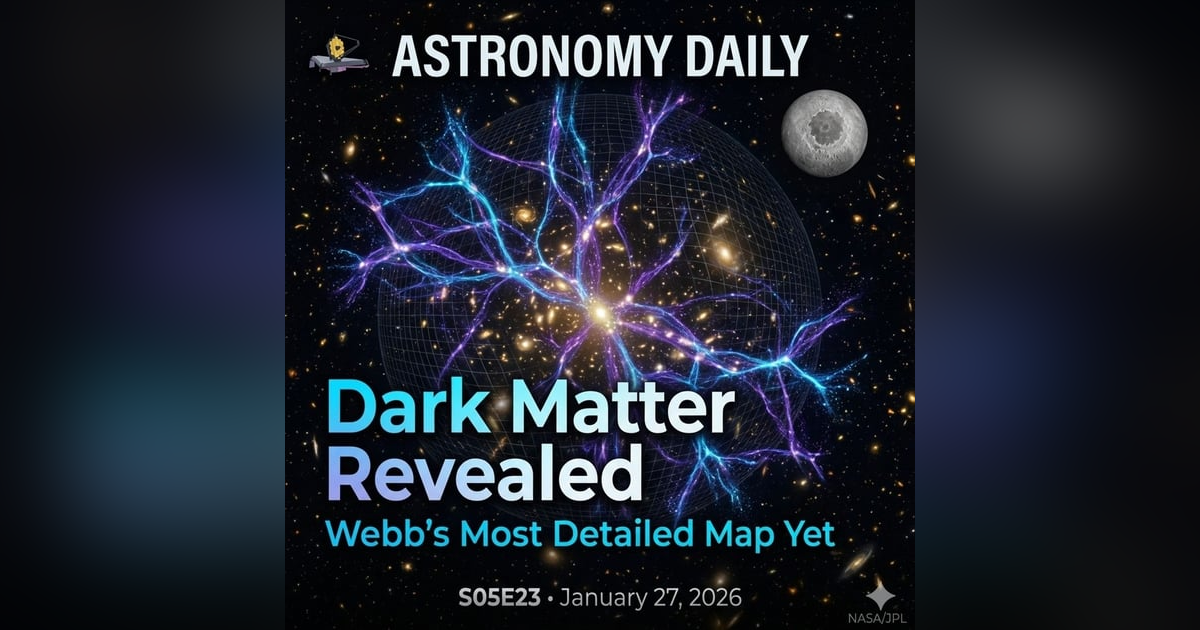
NASA's James Webb Space Telescope has created one of the most detailed dark matter maps ever produced, revealing the invisible scaffolding of the universe in unprecedented detail. Scientists mapped nearly 800,000 galaxies, showing how dark matter and regular matter have grown together throughout cosmic history - and how dark matter's influence may have been essential for creating the conditions necessary for life on Earth.
🚀 Weekly Launch Roundup
A busy week in orbital spaceflight with multiple missions planned from Florida, California, and New Zealand. SpaceX prepares to launch GPS III SV09 named after fallen Challenger astronaut Ellison Onizuka, while Rocket Lab readies its "Bridging the Swarm" mission carrying South Korea's NeonSat-1A satellite. Plus updates on multiple Starlink flights and possible Chinese launches.
🌙 Artemis II's Far Side Adventure
The Artemis II crew - Reid Wiseman, Victor Glover, Christina Hammock Koch, and Jeremy Hansen - are training to become the first humans to see parts of the Moon never before observed by human eyes. Learn about their planned three-hour observation session focusing on Mare Orientale and other hidden lunar features, and how their geology training in Iceland is preparing them for this historic mission.
🪐 Jupiter's Hidden Depths
NASA's Juno spacecraft continues to revolutionize our understanding of Jupiter, revealing that the planet's iconic cloud bands extend 1,900 miles below the surface. Discover recent findings about Jupiter's diluted core, mysterious green lightning flashes, and the remarkably persistent polar cyclones that form octagonal and pentagonal patterns at the planet's poles.
☀️ Antarctica's Exclusive Eclipse
Only about 16 people might witness one of 2026's most spectacular celestial events - a "ring of fire" annular solar eclipse crossing Antarctica on February 17th. Find out about the two research stations in the path of totality, the extreme conditions observers will face, and where else partial views of the eclipse will be visible.
🛸 Starship V3 Update
SpaceX's upgraded Starship rocket test has been rescheduled for mid-March following a November explosion during testing. Learn about the new capabilities of Starship V3, including plans to launch next-generation Starlink satellites and dock with other Starships in orbit - plus how Blue Origin's New Glenn is emerging as competition in the heavy-lift market.
EPISODE LINKS:
• NASA Dark Matter Discovery: https://www.jpl.nasa.gov/news/nasa-reveals-new-details-about-dark-matters-influence-on-universe/
• Launch Schedule Details: https://www.nasaspaceflight.com/2026/01/launch-roundup-012626/
• Artemis II Far Side Views: https://dailygalaxy.com/2026/01/artemis-first-humans-see-hidden-side-moon/
• Antarctica Eclipse Information: https://dailygalaxy.com/2026/01/2026-ring-of-fire-eclipse/
• Starship Development Update: https://techcrunch.com/2026/01/26/spacex-eyes-mid-march-for-first-test-of-upgraded-starship-rocket/
CONNECT WITH US:
🌐 Website: astronomydaily.io
📱 Twitter/X: @AstroDailyPod
📷 Instagram: @AstroDailyPod
📘 Facebook: @AstroDailyPod
Become a supporter of this podcast: https://www.spreaker.com/podcast/astronomy-daily-space-news-updates--5648921/support.
Sponsor Details:
Ensure your online privacy by using NordVPN. To get our special listener deal and save a lot of money, visit www.bitesz.com/nordvpn. You'll be glad you did!
Become a supporter of Astronomy Daily by joining our Supporters Club. Commercial free episodes daily are only a click way... Click Here
This episode includes AI-generated content.
0
00:00:00.480 --> 00:00:03.320
Anna: Welcome to Astronomy Daily, your source for
1
00:00:03.320 --> 00:00:06.040
the latest space and astronomy news. I'm
2
00:00:06.040 --> 00:00:06.560
Anna.
3
00:00:06.560 --> 00:00:09.360
Avery: And I'm avery. Today's Tuesday, January
4
00:00:09.520 --> 00:00:12.480
27, 2026, and we've got some
5
00:00:12.480 --> 00:00:14.320
fascinating stories lined up for you.
6
00:00:14.640 --> 00:00:17.640
Anna: We certainly do. On today's episode, we're
7
00:00:17.640 --> 00:00:20.360
diving into NASA's groundbreaking new Dark
8
00:00:20.360 --> 00:00:23.000
matter map, getting the latest updates on
9
00:00:23.000 --> 00:00:25.440
this week's orbital launch schedule, and
10
00:00:25.440 --> 00:00:28.040
learning about what the Artemis II crew might
11
00:00:28.040 --> 00:00:29.920
see on the far side of the Moon.
12
00:00:30.240 --> 00:00:32.900
Avery: Plus, we'll explore stun new insights into
13
00:00:32.900 --> 00:00:35.260
Jupiter's complex cloud systems,
14
00:00:35.660 --> 00:00:38.100
find out about a rare solar eclipse that only
15
00:00:38.100 --> 00:00:40.900
a handful of people will witness, and get the
16
00:00:40.900 --> 00:00:43.340
latest on SpaceX's upgraded Starship
17
00:00:43.340 --> 00:00:43.660
development.
18
00:00:44.140 --> 00:00:44.940
Anna: Let's get started.
19
00:00:45.180 --> 00:00:46.300
Avery: Take it away, Anna.
20
00:00:46.380 --> 00:00:49.140
Anna: Our top story today comes from NASA's
21
00:00:49.140 --> 00:00:51.780
Jet Propulsion Laboratory, where scientists
22
00:00:51.780 --> 00:00:54.340
have created one of the most detailed dark
23
00:00:54.340 --> 00:00:57.300
matter maps ever produced using data from
24
00:00:57.300 --> 00:00:59.260
the James Webb Space Telescope.
25
00:00:59.730 --> 00:01:02.170
Avery: This is really exciting stuff, Anna. Uh, the
26
00:01:02.170 --> 00:01:04.930
map shows how dark matter, that invisible,
27
00:01:05.090 --> 00:01:07.610
ghostly material that makes up most of the
28
00:01:07.610 --> 00:01:09.970
universe's mass, overlaps and
29
00:01:09.970 --> 00:01:12.730
intertwines with regular matter like stars
30
00:01:12.730 --> 00:01:13.570
and galaxies.
31
00:01:13.890 --> 00:01:16.770
Anna: Published Monday in Nature Astronomy, this
32
00:01:16.770 --> 00:01:19.410
map is twice as sharp as any previous
33
00:01:19.490 --> 00:01:22.050
dark matter map made by other observatories.
34
00:01:22.370 --> 00:01:25.250
Diana Skogni Aglio, the lead author and
35
00:01:25.250 --> 00:01:28.170
astrophysicist at jpl, described it
36
00:01:28.170 --> 00:01:30.570
as seeing the invisible scaffolding of the
37
00:01:30.570 --> 00:01:33.190
universe in stunning detail for the first
38
00:01:33.190 --> 00:01:33.550
time.
39
00:01:33.950 --> 00:01:36.430
Avery: What's particularly fascinating is how the
40
00:01:36.430 --> 00:01:38.990
map confirms that dark matter and regular
41
00:01:38.990 --> 00:01:41.470
matter have essentially grown up together.
42
00:01:41.950 --> 00:01:44.150
Wherever you see a massive cluster of
43
00:01:44.150 --> 00:01:46.790
thousands of galaxies, there's an equally
44
00:01:46.790 --> 00:01:49.070
massive amount of dark matter in the same
45
00:01:49.070 --> 00:01:51.910
place. When you see strings of regular matter
46
00:01:51.910 --> 00:01:54.630
connecting clusters, dark matter strings are
47
00:01:54.630 --> 00:01:55.150
there, too.
48
00:01:55.390 --> 00:01:58.030
Anna: The team used Webb's unprecedented
49
00:01:58.030 --> 00:02:00.030
sensitivity to observe nearly
50
00:02:00.030 --> 00:02:02.950
800,000 galaxies in a region of
51
00:02:02.950 --> 00:02:05.810
SK about 2.5 times larger
52
00:02:05.810 --> 00:02:08.730
than the Full Moon. They detected dark matter
53
00:02:08.730 --> 00:02:11.610
by observing how its mass curves space
54
00:02:11.610 --> 00:02:14.170
itself, which bends light from distant
55
00:02:14.170 --> 00:02:16.170
galaxies as it travels to Earth.
56
00:02:16.410 --> 00:02:18.970
Avery: Here's something to ponder. Without dark
57
00:02:18.970 --> 00:02:21.890
matter, we might not even be here. Dark
58
00:02:21.890 --> 00:02:24.210
matter began clumping together first in the
59
00:02:24.210 --> 00:02:27.090
early universe, and those clumps then pulled
60
00:02:27.090 --> 00:02:29.330
regular matter together, creating the
61
00:02:29.330 --> 00:02:31.930
conditions for stars and galaxies to form
62
00:02:32.010 --> 00:02:33.770
earlier than they would have otherwise.
63
00:02:34.280 --> 00:02:36.840
Anna: That earlier star formation was crucial
64
00:02:36.840 --> 00:02:39.400
because those first generations of stars
65
00:02:39.400 --> 00:02:41.880
turned hydrogen and helium into the rich
66
00:02:41.880 --> 00:02:44.520
array of elements that now make up planets
67
00:02:44.520 --> 00:02:47.320
like Earth. So in a very real sense,
68
00:02:47.480 --> 00:02:50.159
dark matter influenced the creation of the
69
00:02:50.159 --> 00:02:51.960
elements necessary for life.
70
00:02:52.600 --> 00:02:55.560
Avery: Looking ahead, the upcoming Nancy Grace Roman
71
00:02:55.560 --> 00:02:58.360
Space Telescope will map dark matter over
72
00:02:58.360 --> 00:03:01.360
an area 4,400 times bigger than this
73
00:03:01.360 --> 00:03:04.080
Webb study, though it won't match Webb's
74
00:03:04.080 --> 00:03:06.680
incredible resolution. For even more
75
00:03:06.680 --> 00:03:08.880
detailed looks, we'll have to wait for next
76
00:03:08.880 --> 00:03:11.000
generation telescopes like the proposed
77
00:03:11.000 --> 00:03:12.680
Habitable Worlds Observatory.
78
00:03:13.240 --> 00:03:15.480
Anna: Fascinating research that's literally
79
00:03:15.480 --> 00:03:18.080
revealing the invisible foundation of our
80
00:03:18.080 --> 00:03:18.679
universe.
81
00:03:19.160 --> 00:03:21.440
Avery: Moving on to this week's launch schedule,
82
00:03:21.440 --> 00:03:23.640
it's shaping up to be, uh, a busy last week
83
00:03:23.640 --> 00:03:25.960
of January with flights from Florida,
84
00:03:25.960 --> 00:03:28.720
California and New Zealand on the manifesto.
85
00:03:29.030 --> 00:03:31.630
Anna: That's right, SpaceX is planning to close out
86
00:03:31.630 --> 00:03:33.920
the month with the GPS 3
87
00:03:34.100 --> 00:03:36.790
SV09 mission along with up to three
88
00:03:36.870 --> 00:03:39.670
Starlink launches. The GPS launch is
89
00:03:39.670 --> 00:03:42.110
scheduled for late Monday evening from cape
90
00:03:42.110 --> 00:03:42.790
Canaveral.
91
00:03:43.110 --> 00:03:45.790
Avery: The GPS 3 SV09
92
00:03:45.790 --> 00:03:48.790
satellite, named Ellison Onisuka after one of
93
00:03:48.790 --> 00:03:51.150
the fallen Challenger astronauts, will be
94
00:03:51.150 --> 00:03:53.510
launched to medium Earth orbit. This
95
00:03:53.510 --> 00:03:56.190
spacecraft offers improved accuracy and
96
00:03:56.190 --> 00:03:58.590
jamming resistance over previous versions of
97
00:03:58.590 --> 00:03:59.030
gps.
98
00:03:59.690 --> 00:04:02.370
Anna: Meanwhile, Rocket Labs ELECTRON is preparing
99
00:04:02.370 --> 00:04:04.690
for the Bridging the Swarm mission from New
100
00:04:04.690 --> 00:04:06.970
Zealand's Mahia Peninsula on Wednesday.
101
00:04:07.530 --> 00:04:10.490
This launch will carry South Korea's Neonsat
102
00:04:10.490 --> 00:04:12.970
1 a observation satellite to sun
103
00:04:12.970 --> 00:04:14.090
synchronous orbit.
104
00:04:14.170 --> 00:04:16.850
Avery: The Neonsat constellation is designed to
105
00:04:16.850 --> 00:04:19.210
provide near real time disaster monitoring
106
00:04:19.210 --> 00:04:21.970
capability for the Korean Peninsula. The
107
00:04:21.970 --> 00:04:24.970
100 kilogram Neonsat 1A features
108
00:04:24.970 --> 00:04:27.290
a high resolution optical camera and will
109
00:04:27.290 --> 00:04:30.010
join an existing NEONSAT satellite already in
110
00:04:30.010 --> 00:04:30.410
orbit.
111
00:04:30.410 --> 00:04:33.030
Anna: This miss already faced a couple of delays.
112
00:04:33.270 --> 00:04:35.710
It was originally scheduled to launch back in
113
00:04:35.710 --> 00:04:38.190
December, but was scrubbed after sensor
114
00:04:38.190 --> 00:04:39.350
issues during Countdown.
115
00:04:39.670 --> 00:04:42.430
Avery: SpaceX also has multiple Starlink missions on
116
00:04:42.430 --> 00:04:44.710
the schedule this week from Both coasts,
117
00:04:44.950 --> 00:04:47.750
Group 1719 from Vandenberg
118
00:04:47.750 --> 00:04:49.910
Space Force Base in California on Thursday,
119
00:04:50.310 --> 00:04:53.150
and Group 6101 from Cape
120
00:04:53.150 --> 00:04:54.870
Canaveral later that same day.
121
00:04:54.950 --> 00:04:57.550
Anna: And looking ahead to early February, the
122
00:04:57.550 --> 00:04:59.910
first Starlink mission of next month, Group
123
00:04:59.910 --> 00:05:02.910
6 103, is currently scheduled
124
00:05:02.910 --> 00:05:04.530
for Sunday, February 1.
125
00:05:04.850 --> 00:05:07.370
Avery: China also has two possible flights on the
126
00:05:07.370 --> 00:05:10.130
manifest a Chang Zhang 7A from
127
00:05:10.130 --> 00:05:13.050
Hainan island and a Jielong 3 from the
128
00:05:13.050 --> 00:05:15.370
South China Sea. Though neither has a
129
00:05:15.370 --> 00:05:16.410
confirmed launch date.
130
00:05:16.410 --> 00:05:18.530
Anna: Yet, it's worth noting that China's year in
131
00:05:18.530 --> 00:05:20.970
spaceflight has already been eventful with
132
00:05:20.970 --> 00:05:23.770
two launch failures within 12 hours in mid
133
00:05:23.770 --> 00:05:26.650
January, so they may be proceeding cautiously
134
00:05:26.650 --> 00:05:27.890
with these upcoming missions.
135
00:05:28.370 --> 00:05:31.350
Okay, moving on, our next story takes us to
136
00:05:31.350 --> 00:05:34.190
preparations for NASA's Artemis 2 mission,
137
00:05:34.270 --> 00:05:36.670
where four astronauts are training to become
138
00:05:36.670 --> 00:05:39.270
the first humans to see parts of the moon
139
00:05:39.270 --> 00:05:41.510
that have remained hidden from view even
140
00:05:41.510 --> 00:05:42.830
during the Apollo missions.
141
00:05:42.990 --> 00:05:45.630
Avery: The Artemis 2 crew Reid Wiseman,
142
00:05:45.790 --> 00:05:48.750
Victor Glover, Christina Hammock Coach, and
143
00:05:48.750 --> 00:05:51.270
Jeremy Hansen won't land on the lunar
144
00:05:51.270 --> 00:05:53.710
surface, but they'll fly around the far side
145
00:05:53.710 --> 00:05:56.310
of the Moon and potentially observe regions
146
00:05:56.310 --> 00:05:58.270
never before seen by human eyes.
147
00:05:58.430 --> 00:06:01.110
Anna: Among the most significant targets is Mari
148
00:06:01.110 --> 00:06:04.090
oriental, a vast 600 mile
149
00:06:04.090 --> 00:06:06.850
wide impact basing that sits along the edge
150
00:06:06.850 --> 00:06:09.770
of the lunar far side. Its location makes it
151
00:06:09.770 --> 00:06:12.490
nearly impossible to view from Earth, despite
152
00:06:12.570 --> 00:06:13.770
its massive scale.
153
00:06:13.850 --> 00:06:16.210
Avery: The crew will spend a dedicated three hour
154
00:06:16.210 --> 00:06:18.490
segment of their mission focusing on direct
155
00:06:18.650 --> 00:06:21.330
lunar observation. NASA exploration
156
00:06:21.330 --> 00:06:23.770
scientist Jacob Bleacher emphasizes that
157
00:06:23.770 --> 00:06:26.210
human vision can detect subtle surface
158
00:06:26.210 --> 00:06:28.820
differences, Variations in brightness or
159
00:06:28.820 --> 00:06:31.300
texture that indicate differences in rock
160
00:06:31.300 --> 00:06:33.220
composition and geological age.
161
00:06:33.380 --> 00:06:35.500
Anna: What's fascinating is that the astronauts
162
00:06:35.500 --> 00:06:37.700
have been training extensively in geology,
163
00:06:38.100 --> 00:06:40.900
including simulated exercises in Iceland
164
00:06:40.980 --> 00:06:43.740
where they practiced identifying volcanic and
165
00:06:43.740 --> 00:06:46.260
impact related features in environments
166
00:06:46.260 --> 00:06:47.300
resembling the Moon.
167
00:06:47.380 --> 00:06:49.740
Avery: The far side of the moon holds a geologic
168
00:06:49.740 --> 00:06:52.020
record less disturbed than the near side.
169
00:06:52.260 --> 00:06:54.220
While much of the near side is covered with
170
00:06:54.220 --> 00:06:57.170
maria, the vast plains of ancient lava that
171
00:06:57.170 --> 00:06:59.810
have erased older surface features, the far
172
00:06:59.810 --> 00:07:02.370
side remains heavily cratered and relatively
173
00:07:02.370 --> 00:07:02.810
intact.
174
00:07:03.130 --> 00:07:05.850
Anna: Because of tidal locking, the moon always
175
00:07:05.850 --> 00:07:08.690
shows the same face to Earth. Until the
176
00:07:08.690 --> 00:07:11.530
Soviet Luna 3 mission in 1959,
177
00:07:11.770 --> 00:07:14.610
no one had any idea what the far side looked
178
00:07:14.610 --> 00:07:17.450
like. Even the Apollo missions only had brief
179
00:07:17.450 --> 00:07:18.810
views and poor lighting.
180
00:07:18.810 --> 00:07:21.170
Avery: Artemis 2 breaks that pattern by taking
181
00:07:21.170 --> 00:07:23.770
advantage of a launch window and flight path
182
00:07:23.770 --> 00:07:26.210
that ensures better visibility of the hidden
183
00:07:26.210 --> 00:07:28.080
hemisphere. The mission is currently
184
00:07:28.080 --> 00:07:30.800
scheduled for no earlier than February 6,
185
00:07:30.960 --> 00:07:32.320
and astronaut Christina.
186
00:07:32.320 --> 00:07:34.960
Anna: Koch noted that the mission may help shift
187
00:07:34.960 --> 00:07:37.480
public understanding away from the outdated
188
00:07:37.480 --> 00:07:40.000
phrase the dark side of the moon, which
189
00:07:40.000 --> 00:07:42.560
falsely implies the region lacks sunlight.
190
00:07:42.640 --> 00:07:44.520
Avery: An exciting mission that will give us
191
00:07:44.520 --> 00:07:47.200
unprecedented views of lunar territory that
192
00:07:47.200 --> 00:07:49.760
remained largely mysterious for all of human
193
00:07:49.760 --> 00:07:50.080
history.
194
00:07:50.320 --> 00:07:52.320
Anna: Now let's turn our attention to Jupiter,
195
00:07:52.480 --> 00:07:55.320
where NASA's Juno spacecraft continues to
196
00:07:55.320 --> 00:07:58.120
reveal the gas giant's secrets from beneath
197
00:07:58.120 --> 00:07:59.580
its dense cloud layers.
198
00:07:59.740 --> 00:08:02.700
Avery: Juno has been orbiting Jupiter since 2016,
199
00:08:03.100 --> 00:08:05.900
peering through storms and cyclones to unveil
200
00:08:05.900 --> 00:08:08.380
the planet's hidden complexity. And recent
201
00:08:08.380 --> 00:08:10.780
observations are showing just how much more
202
00:08:10.780 --> 00:08:13.260
intricate Jupiter is than we ever imagined.
203
00:08:13.580 --> 00:08:16.060
Anna: One of the most fundamental questions
204
00:08:16.140 --> 00:08:19.100
scientists have debated for decades is how
205
00:08:19.100 --> 00:08:21.700
deep Jupiter's distinctive cloud bands
206
00:08:21.700 --> 00:08:24.340
actually go. By measuring Jupiter's
207
00:08:24.340 --> 00:08:26.900
gravity field, Juno discovered that these
208
00:08:26.900 --> 00:08:29.660
belts and zones, which are alternating
209
00:08:29.660 --> 00:08:32.040
east and west flowing jet streams,
210
00:08:32.120 --> 00:08:34.680
extend about 1900 miles,
211
00:08:34.760 --> 00:08:37.680
or 3000 kilometers below the cloud
212
00:08:37.680 --> 00:08:38.280
tops.
213
00:08:38.840 --> 00:08:41.360
Avery: That's incredible depth. And Juno's
214
00:08:41.360 --> 00:08:43.640
discoveries have completely upended our
215
00:08:43.640 --> 00:08:46.120
understanding of Jupiter's interior structure
216
00:08:46.120 --> 00:08:49.120
too. Scientists long thought Jupiter had a
217
00:08:49.120 --> 00:08:52.080
small solid core surrounded by hydrogen and
218
00:08:52.080 --> 00:08:54.760
helium. But Juno's data suggests the
219
00:08:54.760 --> 00:08:57.520
planet has a larger, more diluted core than
220
00:08:57.520 --> 00:08:58.440
previously believed.
221
00:08:59.130 --> 00:09:01.610
Anna: The spacecraft has also provided the first
222
00:09:01.690 --> 00:09:04.170
detailed views of Jupiter's north pole.
223
00:09:04.250 --> 00:09:06.770
Revealing massive cyclonic storms
224
00:09:06.770 --> 00:09:09.570
arranged in fascinating eight
225
00:09:09.570 --> 00:09:12.090
storms in an octagonal pattern in the north
226
00:09:12.330 --> 00:09:14.930
and five in a pentagonal pattern in the
227
00:09:14.930 --> 00:09:17.450
south. These storms are extremely
228
00:09:17.450 --> 00:09:19.850
resilient and have persisted for years.
229
00:09:20.490 --> 00:09:22.570
Avery: And here's something really intriguing.
230
00:09:22.890 --> 00:09:25.490
Juno recently captured images showing a
231
00:09:25.490 --> 00:09:27.850
mysterious green glow near Jupiter's north
232
00:09:27.850 --> 00:09:30.520
pole. The flash of light was traveling at
233
00:09:30.520 --> 00:09:33.200
breakneck speed, which makes capturing it
234
00:09:33.200 --> 00:09:34.360
even more remarkable.
235
00:09:34.920 --> 00:09:37.400
Anna: Scientists believe this could be lightning,
236
00:09:37.400 --> 00:09:39.800
but Jupiter's lightning is vastly different
237
00:09:39.800 --> 00:09:42.360
from Earth's. It's caused by clouds
238
00:09:42.360 --> 00:09:45.200
containing ammonia water solution and can
239
00:09:45.200 --> 00:09:47.400
be much more powerful than terrestrial
240
00:09:47.400 --> 00:09:47.800
lightning.
241
00:09:47.960 --> 00:09:50.880
Avery: Juno's mission has been extended multiple
242
00:09:50.880 --> 00:09:53.560
times and was scheduled to end in September
243
00:09:53.560 --> 00:09:56.550
2025, but appears to still be
244
00:09:56.550 --> 00:09:58.950
operational, with no new end date being
245
00:09:58.950 --> 00:10:01.830
promoted. During this extended phase,
246
00:10:01.830 --> 00:10:04.070
the spacecraft is conducting close
247
00:10:04.150 --> 00:10:07.110
flybys of Jupiter's intriguing Galilean
248
00:10:07.110 --> 00:10:09.590
moons Ganymede, Europa and
249
00:10:09.590 --> 00:10:11.750
IO Eventually, Juno.
250
00:10:11.750 --> 00:10:14.350
Anna: Will meet its end by burning up in Jupiter's
251
00:10:14.350 --> 00:10:17.270
atmosphere. But until then, it continues to
252
00:10:17.270 --> 00:10:19.830
revolutionize our understanding of the solar
253
00:10:19.830 --> 00:10:21.350
system's largest planet.
254
00:10:22.080 --> 00:10:24.480
Avery: Our next story involves a celestial event
255
00:10:24.480 --> 00:10:27.120
that very few people will witness. A
256
00:10:27.120 --> 00:10:29.960
rare annular solar eclipse set to occur
257
00:10:29.960 --> 00:10:32.480
over one of the most remote places on Earth.
258
00:10:32.960 --> 00:10:35.600
Anna: On February 17, 2026,
259
00:10:35.840 --> 00:10:38.720
a spectacular ring of fire eclipse
260
00:10:38.720 --> 00:10:41.000
will be visible from a narrow stretch of
261
00:10:41.000 --> 00:10:43.800
Antarctica. The phenomenon will only be
262
00:10:43.800 --> 00:10:46.440
fully visible from an uninhabited region of
263
00:10:46.440 --> 00:10:48.720
the continent, with just two research
264
00:10:48.880 --> 00:10:51.280
stations falling within the event's path.
265
00:10:51.930 --> 00:10:54.530
Avery: The antumbral shadow of the Moon, the area
266
00:10:54.530 --> 00:10:56.970
where the full annular eclipse can be seen,
267
00:10:57.290 --> 00:10:59.518
will travel across a, uh, 26,
268
00:10:59.702 --> 00:11:02.210
61 mile stretch of mainland
269
00:11:02.210 --> 00:11:04.970
Antarctica. Only two inhabited locations
270
00:11:05.050 --> 00:11:07.850
fall within this narrow Concordia
271
00:11:07.850 --> 00:11:10.330
Station, a AH French Italian base, and
272
00:11:10.330 --> 00:11:12.810
Mirny Station, operated by Russia.
273
00:11:13.290 --> 00:11:16.170
Anna: At Concordia, annularity will last 2
274
00:11:16.170 --> 00:11:19.130
minutes and 1 second with the sun positioned
275
00:11:19.130 --> 00:11:21.700
5 degrees above the horizon. At
276
00:11:21.700 --> 00:11:24.300
Mirny, it will experience 1 minute and
277
00:11:24.300 --> 00:11:27.140
52 seconds of annularity, with the sun
278
00:11:27.300 --> 00:11:29.140
slightly higher at 10 degrees.
279
00:11:29.860 --> 00:11:32.260
Avery: Given the extreme location and limited
280
00:11:32.260 --> 00:11:34.940
infrastructure, eclipse meteorologist Jay
281
00:11:34.940 --> 00:11:37.500
Anderson noted that it's a challenge to
282
00:11:37.500 --> 00:11:39.620
reach, and neither of the two inhabited
283
00:11:39.620 --> 00:11:41.860
locations is set up to welcome Taurus.
284
00:11:42.420 --> 00:11:44.940
Anna: However, a partial eclipse will be visible
285
00:11:44.940 --> 00:11:47.460
over a much larger region, including
286
00:11:47.700 --> 00:11:50.680
several Antarctic research bases, parts of
287
00:11:50.680 --> 00:11:53.240
southeastern Africa, the southern tip of
288
00:11:53.240 --> 00:11:55.880
South America, and stretches of the Pacific,
289
00:11:55.960 --> 00:11:57.800
Atlantic and Indian oceans.
290
00:11:58.440 --> 00:12:00.440
Avery: For example, Poland's AB
291
00:12:00.520 --> 00:12:03.400
Dobrolansky station will see 92%
292
00:12:03.400 --> 00:12:06.360
of the sun covered, while McMurdo station in
293
00:12:06.360 --> 00:12:09.280
the US will see 86%. Even
294
00:12:09.280 --> 00:12:11.480
distant cities like Durban in South Africa
295
00:12:11.480 --> 00:12:13.880
will witness about 16% coverage.
296
00:12:14.440 --> 00:12:17.000
Anna: Weather could be a significant factor, though
297
00:12:17.320 --> 00:12:20.120
mirny station averages 65%
298
00:12:20.120 --> 00:12:23.040
cloud cover in February, while Concordia has
299
00:12:23.040 --> 00:12:25.600
a clearer profile with about 35%
300
00:12:25.600 --> 00:12:28.400
coverage, and temperatures can drop as low
301
00:12:28.400 --> 00:12:31.160
as -112 degrees
302
00:12:31.160 --> 00:12:31.960
Fahrenheit.
303
00:12:32.360 --> 00:12:34.960
Avery: Interestingly, the eclipse itself might
304
00:12:34.960 --> 00:12:37.480
improve viewing conditions. The sudden
305
00:12:37.480 --> 00:12:39.800
temperature drop from the eclipse can disrupt
306
00:12:39.800 --> 00:12:42.520
local cloud formation, potentially causing
307
00:12:42.520 --> 00:12:44.360
convective clouds to dissipate.
308
00:12:44.840 --> 00:12:46.720
Anna: Though if you're one of the handful of
309
00:12:46.720 --> 00:12:49.200
researchers stationed in Antarctica next
310
00:12:49.200 --> 00:12:51.920
month, you might be in for a spectacular
311
00:12:51.920 --> 00:12:54.760
show, assuming the clouds cooperate and
312
00:12:54.760 --> 00:12:56.600
you can brave the extreme cold.
313
00:12:57.160 --> 00:12:59.840
And finally, in some late breaking news, we
314
00:12:59.840 --> 00:13:02.440
have an update on SpaceX's Starship
315
00:13:02.440 --> 00:13:03.400
development program.
316
00:13:03.960 --> 00:13:06.800
Avery: According to a post from CEO Elon Musk, the
317
00:13:06.800 --> 00:13:09.480
delayed first test of SpaceX's upgraded
318
00:13:09.480 --> 00:13:12.280
Starship rocket, version 3, is now
319
00:13:12.280 --> 00:13:13.560
slated for mid March.
320
00:13:14.370 --> 00:13:17.130
Anna: This third version of Starship is larger and
321
00:13:17.130 --> 00:13:19.250
more powerful than previous iterations.
322
00:13:19.650 --> 00:13:22.050
Crucially, SpaceX plans to use
323
00:13:22.050 --> 00:13:24.730
Starship V3 to launch its next
324
00:13:24.730 --> 00:13:27.450
generation Starlink satellites, which will be
325
00:13:27.450 --> 00:13:30.410
capable of faster data speeds but are heavier
326
00:13:30.410 --> 00:13:31.170
and larger.
327
00:13:31.570 --> 00:13:33.890
Avery: It's also the first version designed to dock
328
00:13:33.890 --> 00:13:36.490
with other starships in Earth orbit, a
329
00:13:36.490 --> 00:13:38.610
capability the company needs to reach the
330
00:13:38.610 --> 00:13:41.330
Moon or Mars. This comes as SpaceX
331
00:13:41.330 --> 00:13:43.170
faces pressure from the Trump administration
332
00:13:43.330 --> 00:13:46.290
to return US astronauts to the lunar surface
333
00:13:46.370 --> 00:13:48.130
before the end of a second term.
334
00:13:48.690 --> 00:13:51.450
Anna: SpaceX was making progress toward a launch of
335
00:13:51.450 --> 00:13:54.290
Starship V3 in late 2025,
336
00:13:54.450 --> 00:13:57.170
but in November, the booster stage suffered a
337
00:13:57.170 --> 00:14:00.050
major explosion during testing that blew out
338
00:14:00.050 --> 00:14:02.290
an entire side of the steel rocket.
339
00:14:02.770 --> 00:14:05.010
Avery: The company said it was performing gas system
340
00:14:05.010 --> 00:14:07.210
pressure testing when the explosion happened,
341
00:14:07.210 --> 00:14:09.810
but hasn't offered a more detailed breakdown
342
00:14:09.810 --> 00:14:10.830
of what went wrong.
343
00:14:11.460 --> 00:14:13.780
Anna: The second version of Starship was a mixed
344
00:14:13.780 --> 00:14:16.740
bag. The program successfully reached orbit,
345
00:14:16.740 --> 00:14:19.300
deployed dummy versions of next generation
346
00:14:19.300 --> 00:14:21.820
Starlink satellites, and caught multiple
347
00:14:21.820 --> 00:14:24.220
booster stages after they returned to the
348
00:14:24.220 --> 00:14:24.900
launch pad.
349
00:14:25.220 --> 00:14:28.020
Avery: But Starship V2 also suffered several
350
00:14:28.020 --> 00:14:30.820
explosions and setbacks. Some resulted from
351
00:14:30.820 --> 00:14:33.420
SpaceX's developmental approach of pushing
352
00:14:33.420 --> 00:14:36.020
test vehicles to or past their limits.
353
00:14:36.590 --> 00:14:38.590
Others were more unexpected, like when a
354
00:14:38.590 --> 00:14:40.670
starship vehicle erupted in a massive
355
00:14:40.670 --> 00:14:42.910
fireball during ground testing last June.
356
00:14:43.470 --> 00:14:46.110
Anna: Meanwhile, competition is emerging. Jeff
357
00:14:46.110 --> 00:14:48.990
Bezos's new Glenn rocket successfully
358
00:14:48.990 --> 00:14:50.990
launched for the first time in January
359
00:14:51.230 --> 00:14:53.990
2025 and completed its first
360
00:14:53.990 --> 00:14:56.910
booster landing in November. Blue Origin
361
00:14:56.910 --> 00:14:59.750
is planning a third new Glenn launch in late
362
00:14:59.750 --> 00:15:01.110
February and ah.
363
00:15:01.150 --> 00:15:03.510
Avery: Late last year, Blue Origin revealed it's
364
00:15:03.510 --> 00:15:06.190
developing a larger super heavy variant of
365
00:15:06.190 --> 00:15:08.260
new Glenn M, which more directly compare
366
00:15:08.330 --> 00:15:09.370
competes with starship.
367
00:15:09.850 --> 00:15:12.770
Anna: So while SpaceX continues to dominate the
368
00:15:12.770 --> 00:15:15.210
global launch market, other players are
369
00:15:15.210 --> 00:15:17.250
starting to close the gap. It'll be
370
00:15:17.250 --> 00:15:20.010
interesting to see how the Starship V3 test
371
00:15:20.010 --> 00:15:21.770
goes in March, and.
372
00:15:21.770 --> 00:15:24.249
Avery: That wraps up today's episode of Astronomy
373
00:15:24.249 --> 00:15:24.649
Daily.
374
00:15:25.050 --> 00:15:27.290
Anna: Thanks for joining us for another journey
375
00:15:27.290 --> 00:15:29.890
through the cosmos. Remember to check out our
376
00:15:29.890 --> 00:15:32.890
website at astronomydaily IO
377
00:15:32.970 --> 00:15:35.050
for more space and astronomy news.
378
00:15:35.800 --> 00:15:37.720
Avery: And don't forget to follow us on social media
379
00:15:37.880 --> 00:15:40.280
astrodaily Pod for updates between
380
00:15:40.280 --> 00:15:40.920
episodes.
381
00:15:41.400 --> 00:15:43.320
Anna: Until next time, keep looking up.
382
00:15:43.720 --> 00:15:44.760
Avery: Clear skies, everyone.


