S03E92: Mars Habitat Crew's Return & Starlink's Direct-to-Cell Leap

In this episode of Astronomy Daily, we take you on an exhilarating journey through some of the most groundbreaking developments in space exploration. Hosted by Anna, this episode is packed with stories that highlight the incredible strides humanity is making in its quest to understand and explore the cosmos.
First up, we delve into the extraordinary journey of NASA's Mars habitat crew. Imagine spending over a year in isolation, simulating life on Mars to help humanity prepare for its next giant leap. That's exactly what Kelly Hasten, Anka Soleriu, Ross Brockwell, and Nathan Jones have done. This Saturday, they will step out of the Mars Dune Alpha habitat at the Johnson Space Center after 378 days in simulated Martian conditions. Their mission has provided invaluable insights into the challenges and solutions for future Mars missions, contributing significantly to NASA's Artemis campaign, which aims to return astronauts to the moon and eventually send crewed missions to Mars.
Next, we turn our attention to SpaceX and its latest Starlink launch. Despite a two-hour delay due to technical issues, the Falcon 9 rocket successfully deployed 20 new Starlink satellites, 13 of which are equipped with direct-to-cell capability. This cutting-edge technology promises to revolutionize connectivity by delivering high-speed, low-latency Internet directly to users' phones, even in remote areas. With this launch, SpaceX continues to push the boundaries of global communication, bringing us closer to a world where everyone is connected, no matter where they are.
NASA is also making headlines with its call for feedback on the requirements for new commercial space stations. This initiative is part of NASA's strategy to transition low Earth orbit operations from government-controlled frameworks to commercially owned and operated space destinations. By seeking input from industry leaders, NASA aims to ensure that these new commercial stations meet stringent human rating requirements while being cost-effective and innovative. This collaborative effort is crucial for the future of space exploration, as it will allow NASA to focus on its Artemis missions and crewed missions to Mars, while the private sector takes the lead in low Earth orbit operations.
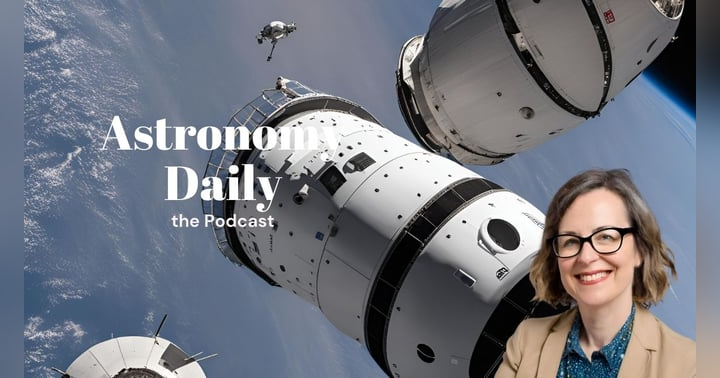
Finally, we explore the ambitious Polaris Dawn mission, funded by billionaire Jared Isaacman. This mission is set to achieve the first-ever private spacewalk, marking a new chapter in commercial space exploration. Slated for launch no earlier than July 31, Polaris Dawn will take its crew to an altitude of about 435 miles above Earth, the highest since the Apollo moon missions. The mission will also conduct a series of scientific and technical experiments, expanding our understanding of space travel and its impacts on the human body.
Join us as we dive into these fascinating stories and more on Astronomy Daily. Whether you're a seasoned space enthusiast or just curious about the cosmos, this episode offers something for everyone. Tune in now and embark on this cosmic adventure with us!
S03E135: Starliner vs. Crew Dragon, Polaris Dawn's Delay, and Chandrayaan-3's Lunar Revelations