S03E75: Voyager 1's Revival & ISS Spacewalk Setback

Have you ever wondered what’s happening beyond our planet? The latest episode of Astronomy Daily is here to satisfy your cosmic curiosity. Hosted by Anna, this episode is packed with thrilling updates from the world of space exploration.
First up, we delve into the remarkable comeback of NASA's Voyager One. This resilient spacecraft, which has been journeying through space for over 45 years, recently overcame a technical glitch that had been affecting its science operations since November 2023. Now, Voyager One is back to collecting invaluable data from its four science instruments. These instruments are providing us with unprecedented insights into the nature of interstellar space, including measurements of plasma waves, magnetic fields, and particles. As Voyager One continues its journey over 15 billion miles from Earth, it remains one of NASA's most historic missions, shedding light on the mysteries of space far beyond our solar system.
Next, we discuss a recent hiccup on the International Space Station (ISS). A planned spacewalk was canceled due to a spacesuit discomfort issue. The spacewalk, which was supposed to be a routine six-hour mission involving astronauts Tracy C. Dyson and Matt Dominick, was called off at the last minute. NASA assured the public that there was no emergency and that the mission would be rescheduled. This incident highlights the ongoing challenges with the ISS's aging spacesuits, which are in need of significant upgrades.
On Mars, NASA's Perseverance rover has reached a new area of scientific interest called Bright Angel. After navigating through a challenging dune field, the rover has arrived at an ancient river channel full of potential geological treasures. Scientists are particularly excited about the discovery of Atoko Point, a unique boulder whose composition and origin are currently under investigation. Perseverance continues to be a key player in NASA's mission to search for signs of ancient microbial life and to prepare for future human exploration.
In other exciting news, new research suggests that some planets orbiting white dwarfs may retain their water and potentially support life. These findings open up exciting possibilities for discovering habitable exoplanets around white dwarfs, providing a new roadmap for future telescope missions.
Lastly, the James Webb Space Telescope has made a stunning revelation, discovering that a star long believed to be a single entity, known as WL 20s, is actually a pair of twin stars. This discovery adds a new layer of understanding to the processes of stellar formation and evolution. Webb's unparalleled resolution has once again proven its transformative power in enhancing our knowledge of the universe.
Don't miss out on these fascinating stories and much more. Tune in to Astronomy Daily to stay informed and inspired by the wonders of space. Visit our website at astronomyDaily.io for more stories, past episodes, and to sign up for our free daily newsletter. Until tomorrow, keep looking up—you never know what you might see!
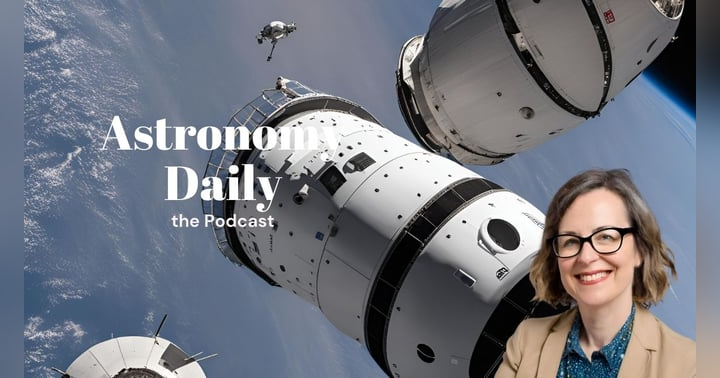
S03E135: Starliner vs. Crew Dragon, Polaris Dawn's Delay, and Chandrayaan-3's Lunar Revelations