S03E73: Starliner's Return Delay & SpaceX's Genetic Revelations
Explore the Mysteries of Space with the Latest Episode of Astronomy Daily
Welcome back to another captivating episode of Astronomy Daily, your go-to podcast for all things celestial! I'm your host, Anna, and today, we're diving into some of the most exciting updates and fascinating stories from the world of astronomy and space exploration. Whether you're a seasoned space enthusiast or just someone curious about the cosmos, this episode has something for everyone.
First up, we delve into the latest news from NASA and Boeing. The much-anticipated return of the Starliner spacecraft and its first astronaut crew from the International Space Station has been postponed. Originally scheduled to undock sooner, the mission is now tentatively set for June 18. This delay allows mission analysts and engineers to address multiple technical issues, including a sticky oxidizer valve and a new helium leak. These issues need to be thoroughly examined and resolved to ensure a safe return. The Starliner mission represents a significant step towards Boeing's goal of securing NASA certification for future routine flights. If all goes according to plan, the Starliner will land roughly six hours after undocking, targeting the White Sands Missile Range in New Mexico or other predetermined locations.
Next, we explore some remarkable genetic findings from SpaceX's Inspiration4 mission, the first-ever all-civilian space expedition. Launched in September 2021, this historic mission revealed that the crew members' DNA markers appeared younger during their short stint in space. This phenomenon is linked to the elongation of telomeres, the protective caps at the end of chromosomes. However, this youthfulness was fleeting, as the crew's telomeres quickly reverted to their preflight conditions upon returning to Earth. Despite these transient effects, the data gathered provides invaluable insights into how space environments can influence human biology.
We also uncover groundbreaking research on the growth of supermassive black holes. Conducted by a team led by Penn State astronomers, this research provides the most complete picture yet of how these cosmic giants have evolved over the past 12 billion years. By integrating data from powerful X-ray facilities and cutting-edge supercomputer simulations, the researchers were able to construct the most realistic growth history of supermassive black holes to date. This research not only sheds light on black hole formation but also on the evolution of the galaxies they inhabit.
Fast radio bursts (FRBs) have puzzled scientists since their discovery in 2007. These short bursts of radio waves have sparked numerous theories, with some suggesting they could be signals from extraterrestrial life. A new study utilizing data from the Canadian Hydrogen Intensity Mapping Experiment (CHIME) is helping to bring these cosmic mysteries into focus. By analyzing the properties of polarized light from 128 non-repeating FRBs, researchers have gleaned that these bursts likely originate from galaxies with conditions similar to our own Milky Way.
Lastly, we discuss the significant challenges faced by astronauts in keeping their kidneys healthy during long-duration space missions. A study led by University College London revealed that prolonged exposure to galactic radiation could cause permanent kidney damage, posing a critical concern for the feasibility of long-term space travel. This research underscores the necessity of addressing these biomedical challenges before embarking on missions to Mars.
Tune in to this episode of Astronomy Daily for these stories and more as we journey through the latest in astronomical science and space exploration. Don't forget to visit our website at astronomydaily.io for the latest news and past episodes. Follow us on social media by searching for AstroDailyPod on YouTube, TikTok, and Facebook. Subscribe to our podcast on Apple Podcasts, Spotify, iHeartRadio, YouTube Music, or stream directly from our website. Until next time, keep looking up!
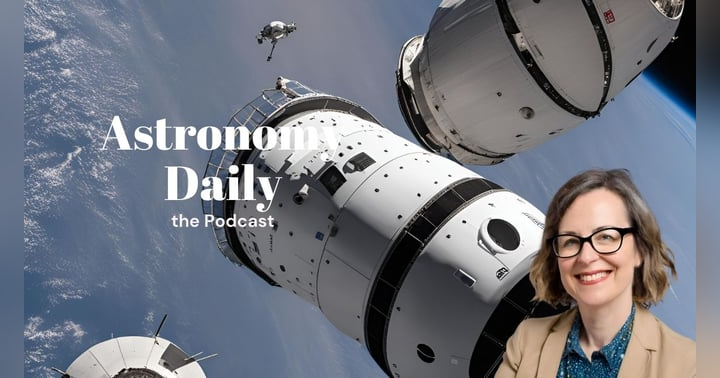
S03E135: Starliner vs. Crew Dragon, Polaris Dawn's Delay, and Chandrayaan-3's Lunar Revelations