March 13, 2026

Artemis II Gets Its Launch Date: April 1 | Magnetar Born | Planets Collide | S05E62
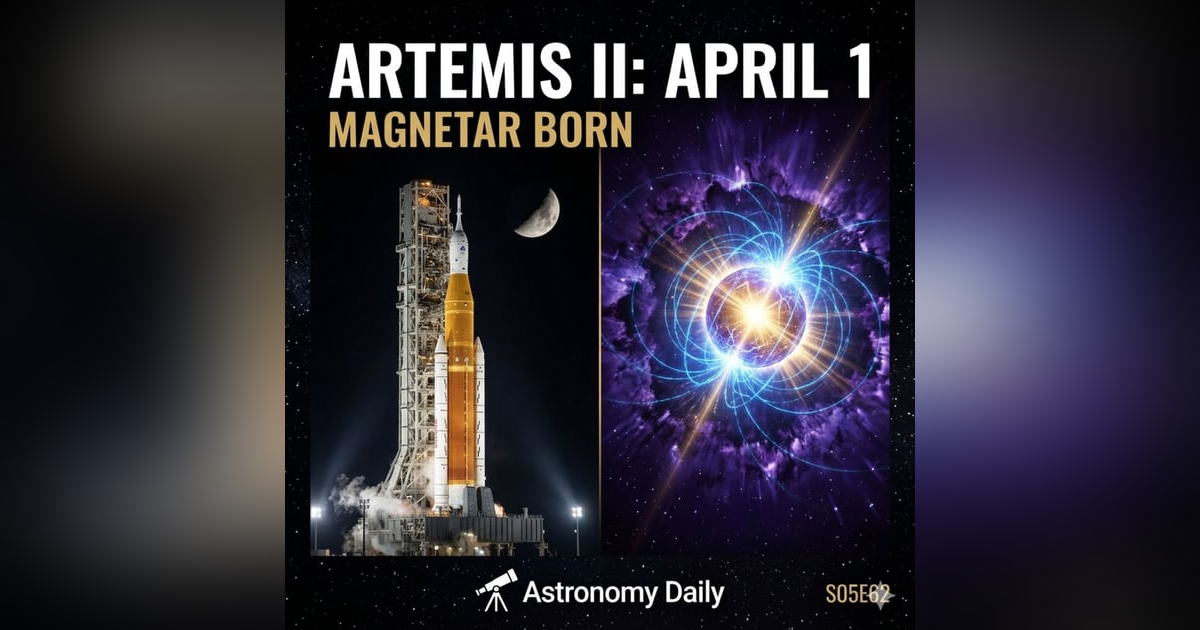
Artemis II Gets Its Launch Date: April 1 | Magnetar Born | Planets Collide | S05E62
Apple Podcasts podcast player iconSpotify podcast player iconiHeartRadio podcast player iconYoutube Music podcast player iconSpreaker podcast player iconPocketCasts podcast player iconDeezer podcast player iconJioSaavn podcast player iconRSS Feed podcast player icon

It’s a bumper Friday edition of Astronomy Daily. NASA gives Artemis II the official green light to launch on April 1st, marking the first crewed lunar mission in over 53 years. Astronomers witness the birth of a magnetar for the very first time, confirming a decade-old theory and demonstrating Einstein’s general relativity in a supernova. A star 11,000 light-years away shows evidence of two planets catastrophically colliding in real time. A bus-sized asteroid buzzed past Earth last night closer than the Moon, discovered just five days ago. A fast solar wind stream from a coronal hole could bring auroras to higher latitudes tonight. And scientists may have identified the source of the most energetic neutrino ever recorded. 
Story 1: Artemis II — Green Light for April 1 Launch NASA completed its Flight Readiness Review on 12 March 2026, with all mission teams voting unanimously ‘go’ for launch. The Space Launch System and Orion capsule will roll out to Launch Complex 39B on 19 March, with the primary launch window opening on 1 April at 6:24pm ET. Backup windows exist on 2–6 April and 30 April. The crew of four — Reid Wiseman, Victor Glover, Christina Koch, and Jeremy Hansen — will fly a 10-day figure-eight loop around the Moon. It will be the first crewed mission beyond low Earth orbit since Apollo 17 in December 1972. The previously planned Moon landing on Artemis III has been moved to Artemis IV, though NASA’s 2028 goal for a lunar landing remains unchanged. •       NASA Artemis II Mission Page: https://www.nasa.gov/mission/artemis-ii/ •       CNN coverage of FRR outcome: https://www.cnn.com/2026/03/12/science/nasa-artemis-2-launch-date-risk-assessment 
Story 2: First-Ever Observed Birth of a Magnetar Astronomers have for the first time directly observed the birth of a magnetar — a highly magnetized, rapidly spinning neutron star — confirming it as the power source behind some of the universe’s brightest stellar explosions. The discovery, published in Nature on 11 March 2026, centres on superluminous supernova SN 2024afav, located approximately one billion light-years from Earth. Graduate student Joseph Farah at UC Santa Barbara, working with Las Cumbres Observatory’s global telescope network, detected a distinctive ‘chirp’ pattern in the supernova’s fading light — four oscillations with shortening intervals. This pattern is explained by a wobbling accretion disc around the newborn magnetar, driven by Lense-Thirring precession — a general relativistic effect. The finding confirms a 2010 theory by UC Berkeley physicist Dan Kasen, and marks the first time general relativity has been required to explain supernova mechanics. •       Berkeley News: https://news.berkeley.edu/2026/03/11/astronomers-capture-birth-of-a-magnetar-confirming-link-to-some-of-universes-brightest-exploding-stars/ •       Space.com: https://www.space.com/astronomy/stars/astronomers-witness-colossal-supernova-explosion-create-one-of-the-most-magnetic-stars-in-the-universe-for-the-first-time 
Story 3: Two Planets Caught Colliding 11,000 Light-Years Away Researchers at the University of Washington have published evidence of a catastrophic planetary collision observed in real time around star Gaia20ehk, located approximately 11,000 light-years from Earth near the constellation Puppis. The star began flickering erratically from 2016, before its light output went ‘completely bonkers’ around 2021 — the signature of a massive debris cloud from two colliding worlds passing in front of the star. The debris orbits at roughly one astronomical unit from the star — the same as Earth’s distance from the Sun — and may eventually coalesce into new planetary bodies resembling an Earth-Moon system. The paper was published 11 March in The Astrophysical Journal Letters. •       University of Washington: https://www.washington.edu/news/2026/03/11/uw-astronomers-spot-planet-collision-evidence/ •       ScienceDaily: https://www.sciencedaily.com/releases/2026/03/260311213429.htm 
Story 4: Asteroid 2026 EG1 Flies Past Earth A bus-sized asteroid designated 2026 EG1 made its closest approach to Earth at 11:27pm EDT on 12 March 2026, passing just 197,466 miles away — closer than the Moon. Estimated at 32–72 feet (10–22 metres) across and travelling at over 21,500 mph, it posed no threat. Notably, the asteroid was only discovered on 8 March — five days before its flyby — highlighting the ongoing challenge of detecting small near-Earth objects with short warning times. NASA’s Vera Rubin Observatory has already catalogued over 2,000 previously unknown solar system bodies since beginning operations. •       Space.com: https://www.space.com/stargazing/bus-sized-asteroid-will-fly-past-earth-tonight-mere-days-after-being-discovered-heres-what-to-expect-march-12-2026 
Story 5: Solar Wind & Aurora Alert A fast-moving stream of solar wind from a large coronal hole on the Sun is expected to reach Earth on 13 March 2026, potentially triggering G1 (minor) geomagnetic storm conditions. Auroras may be visible from higher latitudes including Edinburgh and the Scottish Highlands, Reykjavik, northern Scandinavia, Seattle, Minneapolis, and Hobart (Tasmania) during local nighttime hours. The Moon is a waning crescent at approximately 34% illumination, making for reasonably dark skies. Observers can check real-time aurora forecasting at spaceweather.com or SpaceWeatherLive. •       EarthSky solar wind update: https://earthsky.org/sun/sun-news-activity-solar-flare-cme-aurora-updates/ •       Real-time aurora forecasts: https://spaceweatherlive.com/ 
Story 6: KM3NeT & the Record-Breaking Neutrino Scientists working with the KM3NeT neutrino detector on the floor of the Mediterranean Sea off Sicily believe they may have identified the source of the most energetic neutrino ever recorded. Detected three years ago, the particle had energy levels exceeding anything previously observed of its kind. Researchers now believe a population of blazars — galaxies with supermassive black holes firing particle jets directly towards Earth — is the most likely source. Blazars are among the most violent and energetic phenomena in the observable universe. The finding represents a significant step in multi-messenger astronomy. •       Universe Today: https://www.universetoday.com/

Become a supporter of this podcast: https://www.spreaker.com/podcast/astronomy-daily-space-news-updates--5648921/support.

Sponsor Details:
Ensure your online privacy by using NordVPN. To get our special listener deal and save a lot of money, visit www.bitesz.com/nordvpn. You'll be glad you did!

Become a supporter of Astronomy Daily by joining our Supporters Club. Commercial free episodes daily are only a click way... Click Here

This episode includes AI-generated content.

WEBVTT

1
00:00:00.200 --> 00:00:04.839
Happy Friday the thirteenth, space fans, and if you're superstitious,

2
00:00:05.040 --> 00:00:07.759
I'm afraid We've got nothing but good luck today.

3
00:00:08.080 --> 00:00:11.199
That's right, We've got astronauts heading to the Moon, the

4
00:00:11.240 --> 00:00:14.199
birth of one of the most extreme objects in the universe,

5
00:00:14.640 --> 00:00:18.359
planets smashing into each other, an asteroid that buzzed right

6
00:00:18.399 --> 00:00:22.160
past us while we were sleeping, possible auroras tonight.

7
00:00:22.399 --> 00:00:26.199
And a neutrino so powerful that scientists have been trying

8
00:00:26.239 --> 00:00:28.800
to figure out where it came from for three years.

9
00:00:29.199 --> 00:00:30.879
They may finally have the answer.

10
00:00:31.280 --> 00:00:32.840
I'm Avery and I'm Anna.

11
00:00:33.240 --> 00:00:37.000
This is Astronomy Daily, your daily dose of what's happening

12
00:00:37.039 --> 00:00:39.399
in space and beyond. Let's get into it.

13
00:00:39.719 --> 00:00:43.840
Okay, let's start with the big one. After years of delays, setbacks,

14
00:00:44.000 --> 00:00:47.479
hydrogen leagues, and a very stressful few months of repairs,

15
00:00:48.000 --> 00:00:51.759
NASA has officially given Artemis two the green light to launch.

16
00:00:52.359 --> 00:00:56.520
The agency completed its flight readiness review on Thursday. That's

17
00:00:56.560 --> 00:00:59.679
the big final meeting where all the mission managers get

18
00:00:59.679 --> 00:01:03.679
together and essentially ask the question, are we ready to

19
00:01:03.719 --> 00:01:06.319
put four people on top of a rocket and send

20
00:01:06.319 --> 00:01:07.359
them around the Moon.

21
00:01:07.879 --> 00:01:11.760
And the answer was a unanimous yes. Every team voted go,

22
00:01:12.239 --> 00:01:15.120
no dissenting opinions, no last minute holdouts.

23
00:01:15.680 --> 00:01:19.079
The target launch date is April first, and no that's

24
00:01:19.159 --> 00:01:22.239
not a joke, with a window opening at six twenty

25
00:01:22.280 --> 00:01:25.959
four pm Eastern Time. They've also got backup windows on

26
00:01:26.040 --> 00:01:31.280
April second, third, fourth, fifth, sixth, and thirtieth if anything

27
00:01:31.359 --> 00:01:32.560
causes a delay.

28
00:01:32.640 --> 00:01:35.799
So for anyone who needs a refresher. Artemis two is

29
00:01:35.840 --> 00:01:39.319
the first crude flight of NASA Space Launch System, the

30
00:01:39.519 --> 00:01:43.359
SLS and the Orion capsule. It's going to carry four

31
00:01:43.439 --> 00:01:46.439
astronauts around the Moon in a figure eight loop and

32
00:01:46.519 --> 00:01:48.159
bring them back to Earth safely.

33
00:01:48.760 --> 00:01:53.319
The crew is Commander Red Wiseman, pilot Victor Glover, mission

34
00:01:53.359 --> 00:01:58.319
specialists Christina Cock and Jeremy Hanson. Hanson is Canadian, so

35
00:01:58.400 --> 00:02:01.439
this will be the first time an American astronaut has

36
00:02:01.519 --> 00:02:03.400
traveled beyond low Earth orbit.

37
00:02:03.920 --> 00:02:06.680
The mission lasts ten days in total. They won't be

38
00:02:06.799 --> 00:02:09.439
landing on the Moon. This is a test flight proving

39
00:02:09.439 --> 00:02:12.639
that o'rian can handle deep space travel and bring its

40
00:02:12.680 --> 00:02:17.159
crew home safely. Specifically, the heat shield performance during reentry

41
00:02:17.360 --> 00:02:19.719
is one of the things are watching very carefully.

42
00:02:20.280 --> 00:02:24.000
So what caused all the holdups? The short version after

43
00:02:24.039 --> 00:02:27.759
the rocket's wet dress rehearsal, a full practice countdown and

44
00:02:27.800 --> 00:02:31.599
fueling test, engineers found a problem with helium flow in

45
00:02:31.639 --> 00:02:34.639
the upper stage. The whole stack had to be rolled

46
00:02:34.680 --> 00:02:37.599
back into the Vehicle assembly building for repairs.

47
00:02:37.919 --> 00:02:40.759
The good news is that problem has been fixed. It

48
00:02:40.800 --> 00:02:43.199
turned out to be a blocked seal and a cable

49
00:02:43.240 --> 00:02:47.199
connecting the rocket to the ground systems, a relatively small fix,

50
00:02:47.319 --> 00:02:49.960
but one that took time to diagnose and sort out.

51
00:02:50.159 --> 00:02:53.599
Bassa also confirmed they won't be doing another wet dress

52
00:02:53.639 --> 00:02:56.840
rehearsal before launch, so the rollback to the launch pad

53
00:02:56.879 --> 00:02:59.680
on March nineteenth will be the beginning of the final

54
00:02:59.719 --> 00:03:00.960
put now.

55
00:03:01.000 --> 00:03:04.120
There was also a notable update to the broader Artemis

56
00:03:04.159 --> 00:03:08.800
program during Thursday's press conference. Artemis three, which was previously

57
00:03:08.840 --> 00:03:12.960
going to attempt a lunar landing, is no longer doing that. Instead,

58
00:03:13.039 --> 00:03:15.840
it's going to focus on rendezvous and docking maneuvers, with

59
00:03:15.879 --> 00:03:19.360
the lunar landers being developed by SpaceX and Blue Origin.

60
00:03:19.919 --> 00:03:23.759
The actual first lunar landing has now moved to Artemis four,

61
00:03:24.159 --> 00:03:27.360
but NASA is still targeting twenty twenty eight for boots

62
00:03:27.439 --> 00:03:30.800
on the lunar surface, so the goal hasn't shifted, just

63
00:03:30.879 --> 00:03:34.039
the way they're getting there, and it's worth stepping back

64
00:03:34.120 --> 00:03:37.479
and appreciating what April first would mean if it all

65
00:03:37.520 --> 00:03:40.879
goes to plan. The last time humans left Low Earth

66
00:03:41.000 --> 00:03:46.000
orbit was December nineteen seventy two, the final apolloition. That's

67
00:03:46.039 --> 00:03:49.639
over fifty three years ago. Artemis two would be the

68
00:03:49.639 --> 00:03:53.759
first time humans have ventured beyond our planet's immediate neighborhood

69
00:03:53.879 --> 00:03:55.639
in more than half a century.

70
00:03:56.080 --> 00:03:58.039
April cannot come soon enough.

71
00:03:58.319 --> 00:04:02.599
Okay, let's talk about one of the most extreme objects

72
00:04:02.599 --> 00:04:04.759
in the universe, the magnetar.

73
00:04:05.280 --> 00:04:09.120
A magnetar is a type of neutron star, already one

74
00:04:09.120 --> 00:04:11.840
of the densest things that can exist, but with a

75
00:04:11.879 --> 00:04:16.959
magnetic field so powerful it makes normal neutron stars look mild.

76
00:04:17.319 --> 00:04:20.759
We're talking fields hundreds to one thousand times stronger than

77
00:04:20.800 --> 00:04:24.480
a regular neutron star, which is already billions of times

78
00:04:24.480 --> 00:04:26.560
stronger than anything we have on Earth.

79
00:04:27.120 --> 00:04:30.040
They're only about ten miles across, but they can spin

80
00:04:30.160 --> 00:04:32.639
more than a thousand times per second when they're young.

81
00:04:33.160 --> 00:04:35.160
They're also thought to be behind some of the most

82
00:04:35.199 --> 00:04:38.959
powerful and mysterious signals we see in the cosmos, including

83
00:04:39.079 --> 00:04:41.160
fast radio bursts, and.

84
00:04:41.199 --> 00:04:44.160
For the first time ever, a team of astronomers has

85
00:04:44.279 --> 00:04:46.199
actually watched one being born.

86
00:04:46.920 --> 00:04:50.120
The paper was published in Nature on Wednesday. The team

87
00:04:50.199 --> 00:04:54.600
was studying a supernova called SN twenty twenty four AFAV,

88
00:04:55.040 --> 00:04:58.560
discovered back in December twenty twenty four, located about a

89
00:04:58.639 --> 00:05:01.720
billion light years from Earth. It's what's called a super

90
00:05:01.800 --> 00:05:05.800
luminous supernova, at least ten times brighter than a typical

91
00:05:05.839 --> 00:05:09.160
stellar explosion, and it stays bright for much longer too.

92
00:05:09.839 --> 00:05:14.040
These super luminous supernovae have puzzled astronomers since the early

93
00:05:14.079 --> 00:05:18.160
two thousands. Normal supernovae are powered by the shockwave of

94
00:05:18.199 --> 00:05:21.519
a collapsing stellar core, but these things are just too

95
00:05:21.639 --> 00:05:23.879
bright for that explanation to work on its own.

96
00:05:24.519 --> 00:05:27.839
Back in twenty ten, a physicist at UC Berkeley named

97
00:05:27.920 --> 00:05:31.680
Dan Cassen proposed that a magnetar hiding at the center

98
00:05:31.720 --> 00:05:35.639
could be the power source. It's spinning magnetic field accelerating

99
00:05:35.680 --> 00:05:39.480
particles into the surrounding debris, keeping the whole thing lit up.

100
00:05:39.879 --> 00:05:42.759
It was an elegant theory, but there was no direct

101
00:05:42.800 --> 00:05:43.879
evidence to prove.

102
00:05:43.639 --> 00:05:48.959
It until now. Graduate student Joseph Farrah at UC Santa Barbara,

103
00:05:49.079 --> 00:05:52.199
working with a global network of telescopes at Los Cumbers

104
00:05:52.199 --> 00:05:57.439
Observatory tracked SN twenty twenty four AFAV for over two

105
00:05:57.519 --> 00:06:01.160
hundred days, and they noticed something very strange.

106
00:06:01.199 --> 00:06:05.560
Instead of fading smoothly, the supernova's light oscillated on its

107
00:06:05.600 --> 00:06:09.120
way down, not just one or two bumps, four of them,

108
00:06:09.480 --> 00:06:13.360
and crucially, the time between each bump got shorter and shorter.

109
00:06:13.839 --> 00:06:16.319
The team called it a chirp, and it's the same

110
00:06:16.360 --> 00:06:19.360
word used for the signal from merging black holes detected

111
00:06:19.360 --> 00:06:21.360
by gravitational wave observatories.

112
00:06:21.600 --> 00:06:25.360
The explanation that fits perfectly is a magnetar with a

113
00:06:25.480 --> 00:06:29.160
wobbling accretion disc around it. Some of the material from

114
00:06:29.199 --> 00:06:33.560
the explosion fell back towards the newborn magnetar, forming an

115
00:06:33.639 --> 00:06:38.240
asymmetric disc. Because a magnetar is spinning so fast and

116
00:06:38.319 --> 00:06:42.279
is so massive, it warps spacetime around it, an effect

117
00:06:42.319 --> 00:06:48.040
predicted by Einstein's general theory of relativity called lens fearing precession,

118
00:06:48.600 --> 00:06:52.519
causing the disc to wobble. As a disc spirals inward

119
00:06:52.600 --> 00:06:56.240
and shrinks, the wobble gets faster and the light pulses

120
00:06:56.319 --> 00:06:58.319
speed up. That's your chirp.

121
00:06:58.560 --> 00:07:01.839
The team estimates the mag natar's spin period at four

122
00:07:01.879 --> 00:07:05.519
point two milliseconds, meaning it's spinning about two hundred and

123
00:07:05.639 --> 00:07:09.160
forty times per second, and its magnetic field at around

124
00:07:09.240 --> 00:07:12.680
three hundred trillion times that of Earth. Both of those

125
00:07:12.720 --> 00:07:14.639
are classic magnetar signatures.

126
00:07:15.439 --> 00:07:18.839
Joseph Farah put it brilliantly, this is the science I

127
00:07:18.959 --> 00:07:21.839
dreamed of as a kid. It's the universe telling us

128
00:07:21.920 --> 00:07:24.759
out loud and in our face that we don't fully

129
00:07:24.839 --> 00:07:25.959
understand it yet.

130
00:07:26.199 --> 00:07:29.199
This is also the first time that general relativity has

131
00:07:29.240 --> 00:07:32.519
been needed to explain the mechanics of a supernova. That's

132
00:07:32.600 --> 00:07:36.879
a remarkable statement. Einstein's equations, written over a century ago

133
00:07:37.199 --> 00:07:40.560
describing something happening a billion light years away and a

134
00:07:40.639 --> 00:07:42.000
billion years in the past.

135
00:07:42.800 --> 00:07:46.360
Science is genuinely incredible, sometimes, from the.

136
00:07:46.319 --> 00:07:49.160
Death of a star to the death of two planets.

137
00:07:49.519 --> 00:07:53.519
This week, astronomers published evidence of watching two worlds smash

138
00:07:53.600 --> 00:07:56.920
into each other in real time eleven thousand light years

139
00:07:56.959 --> 00:07:57.399
from Earth.

140
00:07:58.199 --> 00:08:01.319
This one comes from the University of Water Washington. Doctoral

141
00:08:01.360 --> 00:08:06.079
candidate Anastasios to Zanidyx was combing through archival telescope data

142
00:08:06.160 --> 00:08:10.319
when he noticed a star called Gaya twenty EHK, a

143
00:08:10.360 --> 00:08:16.199
perfectly ordinary, stable sun like star, doing something very strange.

144
00:08:16.240 --> 00:08:20.360
From about twenty sixteen, the star showed three dips in brightness,

145
00:08:20.879 --> 00:08:25.399
unusual but not completely unheard of. Then around twenty twenty one,

146
00:08:25.800 --> 00:08:29.839
its light output went haywire. As to Xanadix himself put it,

147
00:08:30.160 --> 00:08:32.840
stars like our sun don't do that. So when we

148
00:08:32.919 --> 00:08:35.799
saw this one, we were like, hello, what's going on here?

149
00:08:36.159 --> 00:08:39.399
What was going on was an enormous cloud of rocks

150
00:08:39.399 --> 00:08:41.879
and dust passing in front of the star from our

151
00:08:41.919 --> 00:08:45.799
line of sight, atchually blocking its light, and the source

152
00:08:45.840 --> 00:08:50.120
of all that debris a catastrophic collision between two planets.

153
00:08:50.360 --> 00:08:53.960
The analysis suggests the two worlds have been spiraling towards

154
00:08:53.960 --> 00:08:57.440
each other for years. Those initial dips in brightness from

155
00:08:57.519 --> 00:09:01.679
twenty sixteen were likely caused by a series of grazing impacts,

156
00:09:02.039 --> 00:09:06.200
like two ships sideseswiping each other at increasing speed. Then

157
00:09:06.360 --> 00:09:10.360
around twenty twenty one they had their final catastrophic collision,

158
00:09:10.679 --> 00:09:14.440
and the infrared signature from all that superheated debris lit up.

159
00:09:15.120 --> 00:09:18.840
Here's a part that really captures the imagination. The debris

160
00:09:18.840 --> 00:09:23.840
cloud is orbiting Gaya twenty ehk at roughly one astronomical unit,

161
00:09:24.200 --> 00:09:27.159
the same distance as Earth is from our Sun, and

162
00:09:27.240 --> 00:09:31.120
at that distance over millions of years, that material could

163
00:09:31.120 --> 00:09:36.080
cool and solidify into new planetary bodies, possibly something resembling

164
00:09:36.120 --> 00:09:37.480
an Earth Moon system.

165
00:09:37.960 --> 00:09:40.559
Because that's how our moon was thought to have formed.

166
00:09:40.879 --> 00:09:43.919
A planetary body about the size of Mars struck the

167
00:09:44.039 --> 00:09:48.399
early Earth, and the resulting debris eventually coalesced into our Moon.

168
00:09:48.919 --> 00:09:52.679
The collision around Gaya twenty ehk may be the closest

169
00:09:52.759 --> 00:09:54.960
real time analog we've ever observed.

170
00:09:55.320 --> 00:09:59.080
The paper was published in the Astrophysical Journal Letters on Wednesday.

171
00:09:59.399 --> 00:10:02.879
The research note that while these collisions are probably common

172
00:10:02.919 --> 00:10:06.399
in the early stages of Solar system formation, catching one

173
00:10:06.519 --> 00:10:09.919
in the act requires a very specific alignment and a

174
00:10:09.960 --> 00:10:13.679
lot of patients. Their hope is that the VERA Reuben Observatory,

175
00:10:13.799 --> 00:10:16.799
which has just come online, could find as many as

176
00:10:16.919 --> 00:10:19.879
one hundred more such events over the next decade.

177
00:10:20.240 --> 00:10:23.159
How rare is the event that created the Earth and Moon?

178
00:10:23.679 --> 00:10:27.159
That question is fundamental to understanding whether life is we

179
00:10:27.240 --> 00:10:30.679
know it could exist elsewhere. Every collision like this one

180
00:10:30.879 --> 00:10:32.919
brings us a little closer to the answer.

181
00:10:33.399 --> 00:10:36.320
Right, So, while you were asleep last night, a bus

182
00:10:36.360 --> 00:10:38.879
size asteroid flew closer to Earth.

183
00:10:38.639 --> 00:10:42.480
Than the Moon, completely harmless, but The timing and the

184
00:10:42.519 --> 00:10:45.679
discovery circumstances are what make this story interesting.

185
00:10:46.039 --> 00:10:51.080
Asteroid twenty twenty six EG one, that's its official designation,

186
00:10:51.639 --> 00:10:55.080
made its closest approach to Earth at eleven twenty seven

187
00:10:55.159 --> 00:10:59.399
pm Eastern Time last night, passing about one hundred ninety

188
00:10:59.440 --> 00:11:03.519
seven thousand miles away. The Moon sits at roughly two

189
00:11:03.679 --> 00:11:07.919
hundred thirty nine thousand miles, so this thing flew inside

190
00:11:07.960 --> 00:11:11.879
the Moon's orbit. It was traveling at around twenty one thousand,

191
00:11:12.039 --> 00:11:15.240
five hundred miles per hour and is estimated to be

192
00:11:15.320 --> 00:11:19.960
somewhere between thirty two and seventy two feet across, roughly

193
00:11:20.039 --> 00:11:22.159
the size of a bus or small lorry.

194
00:11:22.480 --> 00:11:25.000
At that size, even if it had hit Earth, it

195
00:11:25.039 --> 00:11:28.840
would have mostly burned up in the atmosphere. No global catastrophe,

196
00:11:28.960 --> 00:11:31.519
but it's a reminder that space is a busy place

197
00:11:31.600 --> 00:11:33.279
and these things happen regularly.

198
00:11:33.679 --> 00:11:38.240
What's particularly noteworthy is how recently it was discovered. Astronomers

199
00:11:38.279 --> 00:11:41.840
first spotted twenty twenty six EG one on March eighth,

200
00:11:41.960 --> 00:11:45.519
just five days before it flew past. That's an incredibly

201
00:11:45.559 --> 00:11:48.639
short warning window, and it illustrates a real challenge in

202
00:11:48.720 --> 00:11:53.200
planetary defense. Small, fast moving objects can be very hard

203
00:11:53.200 --> 00:11:55.240
to detect until they're almost upon us.

204
00:11:55.799 --> 00:11:59.279
NASA's Center for Near Earth Object Studies has confirmed that

205
00:11:59.440 --> 00:12:03.039
no major where asteroid strikes capable of causing serious damage

206
00:12:03.240 --> 00:12:06.320
are expected in the next one hundred years, but major

207
00:12:06.519 --> 00:12:09.279
is doing a lot of work. In that sentence, small

208
00:12:09.320 --> 00:12:12.159
objects like this one pass close to Earth all the time.

209
00:12:12.919 --> 00:12:16.120
The silver lining here is that the VERA. Reuben Observatory,

210
00:12:16.240 --> 00:12:18.360
which his name is coming up a lot in space

211
00:12:18.399 --> 00:12:22.000
news right now and rightly so, has already discovered two

212
00:12:22.080 --> 00:12:26.759
thousand previously unknown Solar System bodies since beginning operations. It's

213
00:12:26.799 --> 00:12:30.080
going to transform our ability to find these things early.

214
00:12:30.559 --> 00:12:34.000
There are currently forty one thousand near Earth asteroids being

215
00:12:34.120 --> 00:12:37.080
tracked by NASA and its partners, and that number is

216
00:12:37.159 --> 00:12:38.200
only going to grow.

217
00:12:38.639 --> 00:12:40.759
So the good news is we're getting better at it.

218
00:12:41.080 --> 00:12:44.559
The slightly unsettling news is there's still plenty we're not

219
00:12:44.679 --> 00:12:45.879
seeing yet, but.

220
00:12:46.000 --> 00:12:48.279
Rest assured we are getting better at it.

221
00:12:48.600 --> 00:12:52.559
Now for something a little more immediate and potentially beautiful,

222
00:12:52.799 --> 00:12:55.360
If you live at a higher latitudes and you're listening

223
00:12:55.360 --> 00:12:58.360
to this before tonight, you might want to look up.

224
00:12:58.759 --> 00:13:01.440
A stream of fast moving solar wind from a large

225
00:13:01.480 --> 00:13:04.440
coronal hole on the Sun is expected to reach Earth

226
00:13:04.440 --> 00:13:08.799
today around midday UTC, and that arrival could trigger minor

227
00:13:08.840 --> 00:13:13.039
geomagnetic storm conditions what's classified as a G one.

228
00:13:12.960 --> 00:13:17.519
Storm great question. Coronal holes are regions in the Sun's

229
00:13:17.559 --> 00:13:21.320
outer atmosphere where the magnetic field lines open out into

230
00:13:21.360 --> 00:13:25.399
space rather than looping back. Through these openings, the solar

231
00:13:25.440 --> 00:13:29.279
wind streams out much faster and more concentrated than usual.

232
00:13:29.879 --> 00:13:33.200
When a coronal hole faces Earth, as the Sun rotates,

233
00:13:33.600 --> 00:13:36.879
that fast moving stream of charged particles heads our way.

234
00:13:37.279 --> 00:13:39.960
It typically takes two to three days to arrive after

235
00:13:39.960 --> 00:13:43.080
the coronal hole aligns with Earth, and this one has

236
00:13:43.120 --> 00:13:45.919
been tracking in our direction for the past few days.

237
00:13:46.480 --> 00:13:50.120
During g one conditions, auroras can become visible from higher

238
00:13:50.240 --> 00:13:55.600
latitude locations. We're talking places like Edinburgh and the Scottish Highlands, Reikyevik,

239
00:13:55.840 --> 00:14:01.440
northern Scandinavia, Seattle, Minneapolis, and in the southern hemisphere Hobart

240
00:14:01.440 --> 00:14:02.240
in Tasmania.

241
00:14:03.080 --> 00:14:05.600
If you're in or near any of those areas tonight,

242
00:14:05.840 --> 00:14:08.519
get away from city lights, find a dark spot with

243
00:14:08.600 --> 00:14:12.000
a clear northern or southern horizon, depending on where you are,

244
00:14:12.440 --> 00:14:15.600
and give your eyes about twenty minutes to adjust. The

245
00:14:15.639 --> 00:14:19.360
best of reviewing is usually in the hours around local midnight.

246
00:14:19.919 --> 00:14:23.399
There's also a handy detail here for sky observers. The

247
00:14:23.440 --> 00:14:26.679
moon is currently a waning crescent at about thirty four

248
00:14:26.720 --> 00:14:29.960
percent illumination, so it won't be washing out the sky

249
00:14:30.120 --> 00:14:33.919
for most of the night. Conditions could be pretty good, and.

250
00:14:33.960 --> 00:14:37.480
Even if the geomagnetic activity stays mild and the auroras

251
00:14:37.519 --> 00:14:41.759
don't materialize, Europa is currently transiting Jupiter. You can catch

252
00:14:41.799 --> 00:14:44.360
the little moon crossing the face of the giant planet

253
00:14:44.440 --> 00:14:47.360
through a telescope this week. There's always something to see

254
00:14:47.399 --> 00:14:47.759
up there.

255
00:14:47.919 --> 00:14:51.039
And finally, to close out what has been a genuinely

256
00:14:51.120 --> 00:14:54.279
extraordinary news day, we're going to the floor of the

257
00:14:54.320 --> 00:14:55.399
Mediterranean Sea.

258
00:14:55.879 --> 00:14:59.679
There's a detector down there called KM three and NET,

259
00:15:00.000 --> 00:15:03.159
which sits off the coast of Sicily. It's built to

260
00:15:03.240 --> 00:15:08.679
catch neutrinos, those ghostly near massless particles that barely interact

261
00:15:08.720 --> 00:15:12.080
with anything passing through the Earth as if it weren't there.

262
00:15:12.399 --> 00:15:15.919
Three years ago, KM three NET recorded a neutrino with

263
00:15:16.039 --> 00:15:19.440
more energy than any of its kind ever detected before,

264
00:15:19.919 --> 00:15:24.919
a genuinely extraordinary particle. The question was where on Earth,

265
00:15:25.120 --> 00:15:28.360
or rather where in the universe did it come from?

266
00:15:28.519 --> 00:15:32.879
Scientists have been puzzling over that ever since Neutrinos travel

267
00:15:33.000 --> 00:15:36.320
in straight lines and aren't deflected by magnetic fields the

268
00:15:36.360 --> 00:15:40.080
way charged particles are, so, in principle, you can trace

269
00:15:40.120 --> 00:15:43.799
their path back to the source. The challenge is correlating

270
00:15:43.879 --> 00:15:46.480
that direction with known objects in the sky.

271
00:15:47.000 --> 00:15:49.879
The team now believes the most likely source is a

272
00:15:49.919 --> 00:15:53.960
population of blazars. A blazar is a type of galaxy

273
00:15:54.039 --> 00:15:56.919
with a super massive black hole at its center that

274
00:15:57.080 --> 00:16:01.200
is actively firing a jet of plasma directly towards Earth.

275
00:16:01.600 --> 00:16:05.000
They're among the most violent and energetic objects in the

276
00:16:05.039 --> 00:16:06.240
observable universe.

277
00:16:06.720 --> 00:16:10.600
The idea is that as particles get accelerated to extreme

278
00:16:10.720 --> 00:16:14.879
velocities in these jets, they can produce neutrinos with truly

279
00:16:15.039 --> 00:16:19.240
staggering energies, energies that dwarf anything we can achieve in

280
00:16:19.279 --> 00:16:22.039
the most powerful particle accelerators on Earth.

281
00:16:22.399 --> 00:16:25.240
Now, the team is being careful to say this is

282
00:16:25.279 --> 00:16:29.679
the most likely explanation rather than a confirmed one. Penning

283
00:16:29.720 --> 00:16:32.600
down the exact source of a single particle is a

284
00:16:32.759 --> 00:16:37.639
fiendishly difficult problem, but the correlation between the neutrino's arrival

285
00:16:37.679 --> 00:16:40.759
direction and known blazar positions is compelling.

286
00:16:41.200 --> 00:16:45.879
It's a beautiful example of multi messenger astronomy using different

287
00:16:45.919 --> 00:16:49.759
types of signals, in this case particle physics and traditional

288
00:16:49.919 --> 00:16:53.240
light based observations to build up a picture of what's

289
00:16:53.320 --> 00:16:57.480
happening in the most extreme environments in the cosmos.

290
00:16:56.919 --> 00:16:59.080
From the bottom of the sea to the edge of

291
00:16:59.120 --> 00:17:03.000
the observable universe. Never a dull day in astronomy.

292
00:17:03.440 --> 00:17:07.039
That is your Astronomy Daily for Friday, March thirteenth, twenty

293
00:17:07.079 --> 00:17:09.559
twenty six. What a lineup.

294
00:17:09.880 --> 00:17:13.680
Artemis two cleared for launch on April first, the first

295
00:17:13.680 --> 00:17:17.359
observed birth of a magnetar, two planets caught in the

296
00:17:17.400 --> 00:17:21.039
act of colliding, an asteroid buzzing past in the night,

297
00:17:21.519 --> 00:17:26.480
potential auroras tonight, and a record breaking neutrino traced back

298
00:17:26.519 --> 00:17:29.400
to some of the most violent objects in the universe.

299
00:17:30.039 --> 00:17:32.319
If you want to go deeper on any of today's stories,

300
00:17:32.400 --> 00:17:34.400
the links are all in the show notes, and if

301
00:17:34.400 --> 00:17:37.079
you saw any auroras tonight, we want to know. Tag

302
00:17:37.160 --> 00:17:39.799
us on social media as at Astro Daily.

303
00:17:39.640 --> 00:17:44.799
Pod, new episodes every weekday and Saturdays. Subscribe wherever you

304
00:17:44.839 --> 00:17:47.759
get your podcasts, and we'll see you back here tomorrow

305
00:17:48.359 --> 00:17:54.640
Until then keep looking up clear skies. Everyone, Sunday.

306
00:17:54.920 --> 00:17:55.480
Star is.

307
00:18:02.720 --> 00:18:03.440
The story is.

308
00:18:03.519 --> 00:18:12.200
The Soul Store is control

309
00:18:15.039 --> 00:18:15.079
H