Artemis 2 Setback, SpaceX's Trillion-Dollar Orbital Vision & X8.3 Solar Flare
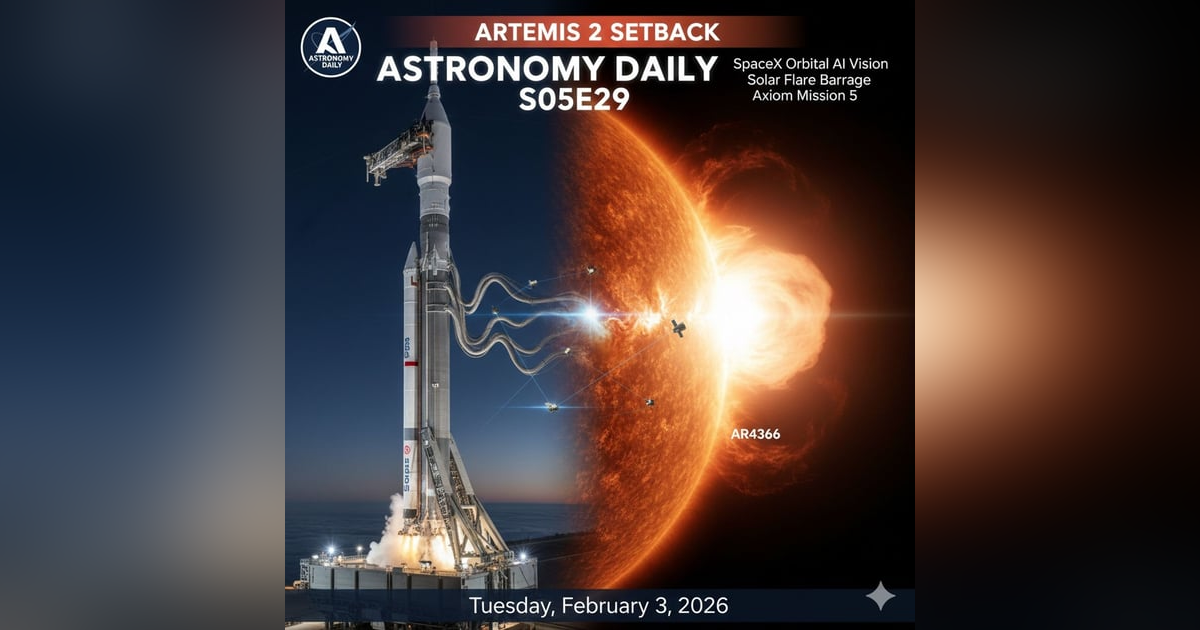


Welcome to Astronomy Daily! Join hosts Anna and Avery for Tuesday, February 3rd's space news roundup. Today we're covering a critical setback in NASA's Artemis 2 wet dress rehearsal, Elon Musk's controversial vision for orbital AI data centers following SpaceX's acquisition of xAI, NASA's announcement of Axiom Mission 5 to the ISS, extraordinary solar flare activity from a volatile new sunspot, the start of NASA's IMAP mission to map our heliosphere, and exciting opportunities through ESA's Graduate Trainee Programme.
Episode Highlights: - https://jobs.esa.int/
• Artemis 2 wet dress rehearsal terminated at T-5:15 due to hydrogen leak
• SpaceX acquires xAI with plans for million-satellite orbital data center constellation
• NASA books fifth Axiom private astronaut mission for January 2027 launch
• Sun unleashes 18 M-class and 3 X-class flares including X8.3 eruption
• NASA's IMAP begins mapping boundaries of our solar system
• ESA opens applications for 2026 Graduate Trainee Programme https://jobs.esa.int/
Featured Stories:
ARTEMIS 2 SETBACK
NASA's critical wet dress rehearsal for the Artemis 2 mission was terminated at the T-5 minute 15 second mark due to a liquid hydrogen leak at the tail service mast umbilical interface. The launch control team worked to safe the Space Launch System rocket and drain its tanks. This rehearsal represents one of the final major tests before the historic mission that will send the first crew around the Moon in over 50 years.
SPACEX ORBITAL DATA CENTERS
Elon Musk announced SpaceX's acquisition of xAI and unveiled plans for up to one million satellites serving as orbital data centers. The proposal addresses ground-based data center challenges including electricity demands and water cooling needs by harnessing continuous solar power in space. Industry experts express skepticism about technical feasibility and suggest the timing may relate to SpaceX's potential IPO.
AXIOM MISSION 5
NASA ordered a fifth private astronaut mission from Axiom Space targeting launch no earlier than January 2027. The 14-day mission continues NASA's commercial space strategy, with Axiom proposing four crew members for approval. The mission includes service exchanges with NASA acquiring cold-return capability for scientific samples while Axiom purchases consumables and cargo services.
SOLAR FLARE BARRAGE
Sunspot region 4366 produced at least 18 M-class and three X-class solar flares in 24 hours, including the year's strongest X8.3 eruption. The February 1st flare triggered R3 radio blackouts across eastern Australia and New Zealand. Scientists monitor for coronal mass ejections with possible glancing Earth impact around February 5th that could produce high-latitude auroras.
IMAP MISSION START
NASA's Interstellar Mapping and Acceleration Probe officially began its two-year primary science mission on February 1st. The spacecraft's 10 instruments will map heliosphere boundaries and study particle energization and solar wind interactions. IMAP data feeds the I-ALiRT system providing near-real-time space weather observations to protect spacecraft and astronauts.
ESA OPPORTUNITIES
The European Space Agency opened applications for its 2026 Graduate Trainee Programme for recent graduates in engineering, science, IT, and business. The one-year positions with possible second-year extension offer monthly tax-exempt salaries, travel reimbursement, installation allowances, and comprehensive benefits. Candidates can submit up to three applications through jobs.esa.int.
Connect With Us:
Website: astronomydaily.io
Social Media: @AstroDailyPod on X/Twitter, Facebook, Instagram, TikTok, YouTube, Tumblr
Become a supporter of this podcast: https://www.spreaker.com/podcast/astronomy-daily-space-news-updates--5648921/support.
Sponsor Details:
Ensure your online privacy by using NordVPN. To get our special listener deal and save a lot of money, visit www.bitesz.com/nordvpn. You'll be glad you did!
Become a supporter of Astronomy Daily by joining our Supporters Club. Commercial free episodes daily are only a click way... Click Here
This episode includes AI-generated content.
00:00:00,000 --> 00:00:06,160
Welcome to Astronomy Daily, your source for the latest space and astronomy news. I'm Anna.
2
00:00:06,160 --> 00:00:11,600
And I'm Avery. We're bringing you Tuesday, February 3rd's biggest stories from across the cosmos.
3
00:00:11,600 --> 00:00:16,480
Today we're covering a setback in NASA's Artemis II preparations,
4
00:00:16,480 --> 00:00:21,520
a bold new vision from Elon Musk that's raising eyebrows across the space industry,
5
00:00:21,520 --> 00:00:27,120
and NASA's announcement of a fifth private astronaut mission to the International Space Station.
6
00:00:27,120 --> 00:00:31,680
We'll also explore some dramatic solar activity that's lighting up our sun.
7
00:00:31,680 --> 00:00:35,440
NASA's newest mission to map the boundaries of our solar system,
8
00:00:35,440 --> 00:00:39,120
and an exciting opportunity for aspiring space professionals in Europe.
9
00:00:39,120 --> 00:00:42,800
Let's dive right in with our top story today.
10
00:00:42,800 --> 00:00:48,240
NASA's Artemis II mission hit a snag during a critical pre-launch test over the weekend.
11
00:00:48,240 --> 00:00:53,120
The wet-trest rehearsal countdown was terminated at the T-5 minute and 15th
12
00:00:53,120 --> 00:00:55,760
second mark due to a liquid hydrogen leak.
13
00:00:56,400 --> 00:01:01,760
For anyone not familiar, a wet-dress rehearsal is essentially a full-launch stimulation
14
00:01:01,760 --> 00:01:06,400
where they load the rocket with propellant and run through the entire countdown sequence,
15
00:01:06,400 --> 00:01:08,480
stopping just short of ignition.
16
00:01:08,480 --> 00:01:11,600
It's one of the final major tests before an actual launch.
17
00:01:11,600 --> 00:01:16,160
Exactly. And this particular leak occurred at the interface of the
18
00:01:16,160 --> 00:01:21,840
Tale's Service Mass Dumbillical, which had already experienced high concentrations of liquid hydrogen
19
00:01:21,840 --> 00:01:27,760
earlier in the countdown. The launch control team had to work to ensure the space-launch system rocket
20
00:01:27,760 --> 00:01:31,120
was in a safe configuration and begin draining its tanks.
21
00:01:31,120 --> 00:01:37,200
Now, it's worth putting this in perspective. Hydrogen leaks are notoriously challenging to deal
22
00:01:37,200 --> 00:01:43,280
with in rocketry. Hydrogen is the smallest molecule, which means it can escape through incredibly
23
00:01:43,280 --> 00:01:49,360
tiny gaps. NASA actually dealt with similar issues during the Artemis I countdown back in 2022.
24
00:01:49,920 --> 00:01:55,520
That's a good point. And while this is definitely a setback, it's exactly why we do these rehearsals,
25
00:01:55,520 --> 00:01:59,120
to catch problems and fix them before astronauts are on board.
26
00:01:59,120 --> 00:02:04,640
The Artemis II crew of Reed Weissman, Victor Glover, Christina Koch and Jeremy Hanson
27
00:02:04,640 --> 00:02:08,960
are scheduled to become the first humans to fly around the moon in over 50 years.
28
00:02:08,960 --> 00:02:13,840
The team at Kennedy Space Center will now need to analyze what went wrong,
29
00:02:13,840 --> 00:02:17,920
make repairs and potentially schedule another wet-dress rehearsal.
30
00:02:17,920 --> 00:02:23,040
This could impact the launch timeline, though NASA hasn't announced any official changes to the
31
00:02:23,040 --> 00:02:28,240
mission schedule yet. We'll definitely be keeping a close eye on this one. Moving on to our next
32
00:02:28,240 --> 00:02:34,240
story, which involves some pretty ambitious claims from SpaceX. Elon Musk has announced that SpaceX
33
00:02:34,240 --> 00:02:40,000
has acquired his artificial intelligence company XAI, and with that acquisition comes a vision
34
00:02:40,000 --> 00:02:44,960
that sounds like something straight out of science fiction, orbital data centers.
35
00:02:45,520 --> 00:02:51,520
The numbers here are staggering, Anna. The information quoted unnamed sources saying XAI was
36
00:02:51,520 --> 00:02:58,960
valued at $250 billion, while SpaceX was valued at a trillion dollars. That would make SpaceX the
37
00:02:58,960 --> 00:03:04,640
most valuable private company in the world. Though, as one investment advisor quipped,
38
00:03:04,640 --> 00:03:10,320
Musk essentially had a short negotiation with himself since he held controlling interests in both
39
00:03:10,320 --> 00:03:16,400
companies, but the real story here is what Musk plans to do with this combined entity. Right,
40
00:03:16,400 --> 00:03:22,080
Musk is proposing to put up to a million satellites in low-earth orbit to create a constellation of
41
00:03:22,080 --> 00:03:27,520
orbital data centers. The idea is that these would address the major challenges facing ground-based
42
00:03:27,520 --> 00:03:32,000
data centers, the massive electricity requirements and the water needed for cooling.
43
00:03:32,000 --> 00:03:38,080
His pitch is compelling from an engineering standpoint. In space, you have mere constant solar
44
00:03:38,080 --> 00:03:44,560
power with no nighttime interruptions, no atmospheric interference, and no need for water cooling.
45
00:03:44,560 --> 00:03:50,320
As Musk wrote, "It's always sunny in space." He's framing this as a step towards becoming a
46
00:03:50,320 --> 00:03:56,400
Kardashev Type 2 civilization, one that can harness the Sun's full power. He even suggested that
47
00:03:56,400 --> 00:04:02,160
future AI satellites could be built on and launched from the moon using electromagnetic mass drivers.
48
00:04:02,160 --> 00:04:07,920
But here's where the skepticism comes in. Industry observers are raising serious
49
00:04:07,920 --> 00:04:14,000
questions. Jim Cashel, author of the Greek Connecting, suggested the million satellite figure
50
00:04:14,000 --> 00:04:20,480
might be more about publicity and the potential SpaceX IPO than realistic planning. And Martin
51
00:04:20,480 --> 00:04:26,640
Pears from the information pointed out the head-spinning array of technical and financial impediments.
52
00:04:26,640 --> 00:04:32,800
Those challenges include protecting computers from radiation, maintaining hardware in orbit,
53
00:04:32,800 --> 00:04:38,240
the enormous expanse of getting everything into space, and competing with tech giants like Google
54
00:04:38,240 --> 00:04:44,160
and Meta who have cast-generating advertising businesses. Some analysts suggest this move is
55
00:04:44,160 --> 00:04:50,800
financially motivated, a way to throw a lifeline to XAI, which merged with X last year and has been
56
00:04:50,800 --> 00:04:57,120
facing financial troubles. The timing ahead of a possible SpaceX IPO is certainly interesting.
57
00:04:57,760 --> 00:05:03,200
It's definitely an ambitious vision, whether it's brilliant foresight or science fiction remains to be
58
00:05:03,200 --> 00:05:08,400
seen. Either way, it sparked a fascinating debate about the future of space-based infrastructure.
59
00:05:08,400 --> 00:05:14,640
Speaking of space infrastructure, let's talk about something that's actually happening right now.
60
00:05:14,640 --> 00:05:20,240
NASA's Commercial Crew Program. NASA has ordered a fifth private astronaut mission to the
61
00:05:20,240 --> 00:05:26,000
International Space Station from Axiom Space, with a launch targeted for no earlier than January
62
00:05:26,000 --> 00:05:32,400
2027 from Kennedy Space Center in Florida. This continues the series of commercially sponsored
63
00:05:32,400 --> 00:05:38,560
crewed missions to the orbital laboratory under NASA's Commercial Space Strategy. NASA Administrator
64
00:05:38,560 --> 00:05:44,800
Jared Isaacman emphasized that commercial space activity has become a present reality rather than
65
00:05:44,800 --> 00:05:51,840
a distant prospect. This mission, designated Axiom Mission 5, is expected to spend up to 14 days
66
00:05:51,840 --> 00:05:57,280
aboard the station. The final launch date will depend on overall spacecraft traffic and other
67
00:05:57,280 --> 00:06:02,320
operational planning factors, basically coordinating the busy schedule of visiting vehicles.
68
00:06:02,320 --> 00:06:08,480
Dana Weagle, Manager of NASA's International Space Station Program, noted that these private
69
00:06:08,480 --> 00:06:14,160
astronaut missions allow the station to serve as a proving ground for new markets and technologies,
70
00:06:14,160 --> 00:06:19,520
while supporting science, research, and outreach that contribute to a growing space economy.
71
00:06:20,000 --> 00:06:25,120
Under this mission order, Axiom Space will propose four crew members for review by NASA and its
72
00:06:25,120 --> 00:06:30,880
international partners. Once approved, though undergo joint training with NASA, partner agencies,
73
00:06:30,880 --> 00:06:36,480
and the launch provider. What's particularly interesting about this arrangement is the exchange
74
00:06:36,480 --> 00:06:43,120
of services. Axiom Space will purchase mission services from NASA, like crew consumables, cargo
75
00:06:43,120 --> 00:06:49,760
delivery, and storage. In return, NASA will acquire from Axiom Space the capability to return
76
00:06:49,760 --> 00:06:56,240
scientific samples that must remain cold during transit. Jonathan Certain, President and CEO of
77
00:06:56,240 --> 00:07:02,160
Axiom Space, said the fort earlier Axiom missions have expanded the global community of human space
78
00:07:02,160 --> 00:07:06,560
explorers, and yielded insights supporting development of the planned Axiom Station.
79
00:07:06,560 --> 00:07:12,720
That's the key here. Axiom Station is intended to succeed the International Space Station as a
80
00:07:12,720 --> 00:07:18,240
next-generation commercial platform once the current laboratory is retired. These missions are
81
00:07:18,240 --> 00:07:24,000
helping build towards that future. It's a great example of NASA's strategy to transition low-earth
82
00:07:24,000 --> 00:07:29,520
orbit services to private providers, while the agency concentrates on deep space exploration,
83
00:07:29,520 --> 00:07:35,520
like the Artemis missions to the moon. Absolutely. Now let's turn our attention to some dramatic
84
00:07:35,520 --> 00:07:42,080
activity happening much closer to home on our own star. The sun has been putting on quite a show
85
00:07:42,080 --> 00:07:49,760
over the past 24 hours. A rapidly growing sunspot has fired off at least 18 M-class flares,
86
00:07:49,760 --> 00:07:57,440
and three X-class flares, including an intense X-8.3 eruption. The strongest solar flare of
87
00:07:57,440 --> 00:08:04,320
2026 so far. To put that in perspective for our listeners, solar flares are ranked from A, B,
88
00:08:04,320 --> 00:08:10,640
and C up to M and X, with each letter representing a 10-fold increase in energy.
89
00:08:10,640 --> 00:08:15,280
So X-class flares are the most powerful explosions the sun can produce,
90
00:08:15,280 --> 00:08:19,520
and the number after the X tells you how intense it is within that class.
91
00:08:19,520 --> 00:08:28,400
The culprit is Sunspot Region 4366, which SpaceWeather.com described as a solar flare factory.
92
00:08:28,400 --> 00:08:33,760
This region has grown rapidly in just a few days and shows no signs of slowing down.
93
00:08:34,320 --> 00:08:43,040
The X-8.3 flare peaked at 6.57 pm Eastern time on February 1, unleashing a blast of extreme
94
00:08:43,040 --> 00:08:50,000
ultraviolet and X-ray radiation that ionized Earth's upper atmosphere. This triggered strong R-3
95
00:08:50,000 --> 00:08:56,160
radio blackouts across parts of the South Pacific. Eastern Australia and New Zealand reported
96
00:08:56,160 --> 00:09:02,160
shortwave radio disruptions. These blackouts happen because the intense radiation from the flare
97
00:09:02,160 --> 00:09:07,360
alters the ionosphere, which radio signals bounce off of for long-distance communication.
98
00:09:07,360 --> 00:09:13,520
Now, what everyone wants to know is, will we see auroras from this? Scientists are watching
99
00:09:13,520 --> 00:09:19,680
for coronal mass ejections that could follow these flares. Early analysis of a CME linked to the
100
00:09:19,680 --> 00:09:25,760
X-8.3 eruption suggests most of the solar material will pass north and east of Earth.
101
00:09:25,760 --> 00:09:31,760
There's a possibility of a glancing blow around February 5, which could briefly elevate
102
00:09:31,760 --> 00:09:37,920
geomagnetic activity and increase the chances of auroras at high latitudes. But forecasters stress
103
00:09:37,920 --> 00:09:45,280
it's too early to know for certain. The bigger concern is that some spot AR-4366 remains highly
104
00:09:45,280 --> 00:09:51,520
active and continues to rotate into an Earth-facing position. That raises the chance that future
105
00:09:51,520 --> 00:09:58,320
eruptions could launch CMEs more directly toward our planet. Noah forecasters expect more exciting
106
00:09:58,320 --> 00:10:03,520
space weather activity from this region in the coming days. So aurora casers should definitely
107
00:10:03,520 --> 00:10:09,040
keep an eye on space weather forecasts over the next week. It's a great reminder that we're still in
108
00:10:09,040 --> 00:10:15,760
solar maximum, the period of greatest solar activity in the sun's 11-year cycle. We can expect more
109
00:10:15,760 --> 00:10:22,640
of these dramatic events over the next year or so. Absolutely. From watching the sun, let's zoom out
110
00:10:22,640 --> 00:10:28,880
to the boundaries of our entire solar system. DASA's IMAP mission, that's the Interstellar
111
00:10:28,880 --> 00:10:35,280
mapping and acceleration probe, officially began its two-year primary science mission on February 1st.
112
00:10:35,280 --> 00:10:41,840
IMAP's job is to explore and map the boundaries of our heliosphere, which is the protective bubble
113
00:10:41,840 --> 00:10:48,480
created by the solar wind that encapsulates our entire solar system. Think of it as our cosmic shield
114
00:10:48,480 --> 00:10:55,600
against interstellar radiation. The mission launched on September 24th, 2025, and relies on 10
115
00:10:55,600 --> 00:11:01,120
scientific instruments to chart what's happening in space. That includes high energy particles from
116
00:11:01,120 --> 00:11:08,240
the sun, magnetic fields in interplanetary space, and even dust from exploded stars in interstellar space.
117
00:11:08,240 --> 00:11:14,080
What makes this particularly exciting is that IMAP is investigating some of the most important
118
00:11:14,080 --> 00:11:20,480
questions in heliophysics, how charged particles from the sun get energized, and how the solar wind
119
00:11:20,480 --> 00:11:26,400
interacts at its boundary with interstellar space. And there's a practical benefit, too. Some
120
00:11:26,400 --> 00:11:33,440
of IMAP's data is being fed into the eyelert system, which stands for IMAP active link for real time.
121
00:11:33,440 --> 00:11:37,920
This broadcasts near real-time observations of space weather headed toward Earth.
122
00:11:37,920 --> 00:11:43,680
That data can inform forecasters who issue warnings about potential adverse space weather
123
00:11:43,680 --> 00:11:49,680
effects on spacecraft and astronauts. Though IMAP is both advancing our scientific understanding
124
00:11:49,680 --> 00:11:55,440
and providing practical benefits for space operations. The mission is led by David McComis,
125
00:11:55,440 --> 00:12:01,200
a principal investigator and professor at Princeton University with an international team of 27
126
00:12:01,200 --> 00:12:06,800
partner institutions. Don's Hopkins Applied Physics Laboratory, Manage Development, and Operates
127
00:12:06,800 --> 00:12:12,320
the Mission. It's the fifth mission in NASA Solar Terrestrial Probe's program, and it's going to
128
00:12:12,320 --> 00:12:17,200
give us unprecedented insights into the edge of our solar neighborhood over the next two years.
129
00:12:17,200 --> 00:12:22,880
Beaking of opportunities to advance our understanding of space, let's wrap up with some news for
130
00:12:22,880 --> 00:12:28,400
aspiring space professionals. The European Space Agency has opened applications for its
131
00:12:28,400 --> 00:12:34,800
2026 graduate trainee program, offering an incredible opportunity for recent graduates passionate
132
00:12:34,800 --> 00:12:41,360
about engineering, science, IT, or business. This is a unique professional experience,
133
00:12:41,360 --> 00:12:47,520
where trainees become part of teams of scientists, engineers, and business professionals from all
134
00:12:47,520 --> 00:12:54,240
over Europe, working together on inspiring space missions in an international multicultural environment.
135
00:12:54,240 --> 00:12:59,520
The positions are one-year contracts with possible extension to a second year.
136
00:12:59,520 --> 00:13:05,280
Trainees get 2.5 days of paid leave per month and receive a monthly salary that's exempt
137
00:13:05,280 --> 00:13:11,200
from national income tax in ESA member states. ESA also reimburses travel expenses
138
00:13:11,200 --> 00:13:16,880
at the beginning and end of the contract, provides an expatriation or installation allowance for
139
00:13:16,880 --> 00:13:22,960
those moving from another country, and includes affiliation to ESA's comprehensive social security
140
00:13:22,960 --> 00:13:28,880
and pension schemes. To be eligible, you need to be a student in the final year of a master's degree,
141
00:13:28,880 --> 00:13:33,680
or a recent graduate. You must have graduated by the time you start your traineeship,
142
00:13:33,680 --> 00:13:37,520
and be able to provide a copy of your diploma within three months of starting.
143
00:13:38,080 --> 00:13:44,080
Important note, you shouldn't have more than one year of professional experience after graduation,
144
00:13:44,080 --> 00:13:48,960
and you must be a citizen of one of the ESA member states, associate members,
145
00:13:48,960 --> 00:13:53,120
European cooperating states, or Canada as a cooperating state.
146
00:13:53,120 --> 00:13:58,960
ESA is holding three information sessions in early February, where prospective applicants can
147
00:13:58,960 --> 00:14:03,840
learn more about the program and ask questions. The first one is February 5th,
148
00:14:03,840 --> 00:14:10,240
there is another on February 12th, and a third on February 17th. Each candidate can submit up to
149
00:14:10,240 --> 00:14:15,760
three applications, so it's worthwhile exploring multiple opportunities that match your academic
150
00:14:15,760 --> 00:14:22,800
background and aspirations. All the details in application portal can be found at jobs.esa.int.
151
00:14:22,800 --> 00:14:28,880
I'll be sure to add that link in the show notes. This is genuinely a fantastic opportunity for anyone
152
00:14:28,880 --> 00:14:34,640
looking to start a career in Europe's space sector. ESA has a long history of groundbreaking missions
153
00:14:34,640 --> 00:14:40,000
and continues to be at the forefront of space exploration, earth observation, and space science.
154
00:14:40,000 --> 00:14:45,360
It's programs like this that help develop the next generation of space professionals
155
00:14:45,360 --> 00:14:49,920
who will be working on tomorrow's missions to explore our solar system and beyond.
156
00:14:49,920 --> 00:14:55,680
And that wraps up today's episode of Astronomy Daily. We've covered everything from challenges
157
00:14:55,680 --> 00:15:00,560
with Artemis II preparations to ambitious visions for orbital data centers.
158
00:15:00,560 --> 00:15:06,800
ongoing commercial space station missions, dramatic solar activity, the start of a new NASA mission
159
00:15:06,800 --> 00:15:12,000
mapping our cosmic neighborhood and opportunities for the next generation of space professionals.
160
00:15:12,000 --> 00:15:18,080
As always, there's never a dull moment in space exploration. If you want to stay connected with us
161
00:15:18,080 --> 00:15:23,520
and get more space news throughout the week, visit our website at astronomydaily.io.
162
00:15:24,000 --> 00:15:28,160
You can also find us on social media at astrodaleapod on x,
163
00:15:28,160 --> 00:15:31,760
facebook, instagram, tiktok, youtube, and tumblr.
164
00:15:31,760 --> 00:15:38,320
Thanks for joining us today. Keep looking up and we'll see you tomorrow with more news from the cosmos.
165
00:15:38,320 --> 00:15:40,720
Until then, clear skies everyone.
166
00:15:40,720 --> 00:15:46,800
Astronomy day, the star is the toe.
167
00:15:46,800 --> 00:15:54,480
The star is the toe.
168
00:15:54,480 --> 00:16:01,920
The star is the toe.
169
00:16:01,920 --> 00:16:04,000
(upbeat music)


