Artemis 2 Delayed, SpaceX Unveils Stargaze Safety System
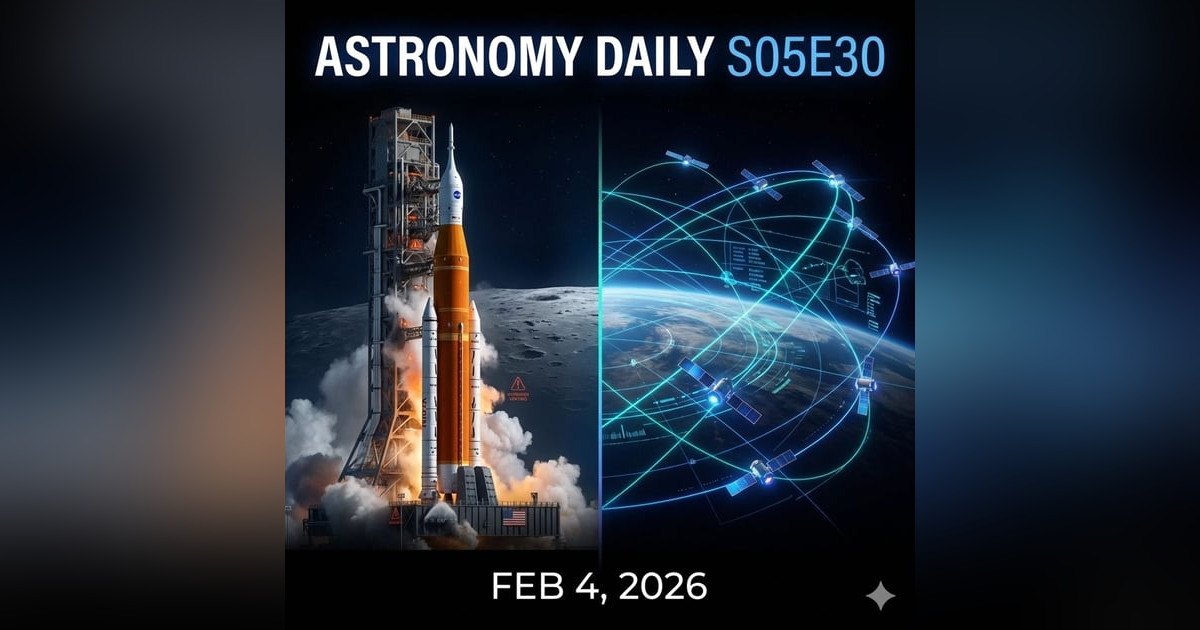


Welcome to Astronomy Daily, bringing you the latest space and astronomy news. I'm Anna, joined by my co-host Avery, with today's cosmic headlines for Wednesday, February 4th, 2026.
Episode Highlights:
🚀 ARTEMIS 2 DELAYED - NASA's historic moon mission pushed to March after hydrogen leak during wet dress rehearsal. Four astronauts await their journey around the Moon as teams address familiar technical challenges.
🛰️ SPACEX UNVEILS STARGAZE - Revolutionary space traffic management system uses 30,000 star trackers to detect 30 million orbital transits daily. Free conjunction data offered to all satellite operators starting this spring.
⚠️ FALCON 9 GROUNDED - SpaceX temporarily halts launches after upper stage deorbit issue. Critical Crew-12 astronaut mission scheduled for February 11th hangs in the balance.
🌌 JWST'S RARE DISCOVERY - Five-way galaxy merger spotted in early universe challenges cosmic evolution models. System formed just 800 million years after Big Bang shows unexpected complexity.
🌠 LOCAL VOID MYSTERY SOLVED - 50-year puzzle resolved as scientists map flat sheet of matter beyond Local Group. Milky Way fleeing massive cosmic void at 600,000 mph.
⭐ RUNAWAY STARS MAPPED - Largest study reveals dual mechanisms ejecting massive stars from the galaxy. 214 O-type stellar speedsters analyzed, some exceeding 700 km/s.
For more space news, visit astronomydaily.io and follow us @AstroDailyPod on all major platforms.
Become a supporter of this podcast: https://www.spreaker.com/podcast/astronomy-daily-space-news-updates--5648921/support.
Sponsor Details:
Ensure your online privacy by using NordVPN. To get our special listener deal and save a lot of money, visit www.bitesz.com/nordvpn. You'll be glad you did!
Become a supporter of Astronomy Daily by joining our Supporters Club. Commercial free episodes daily are only a click way... Click Here
This episode includes AI-generated content.
0
00:00:00.480 --> 00:00:03.440
Anna: Welcome to Astronomy Daily, your source for
1
00:00:03.440 --> 00:00:06.200
the latest space and astronomy news. I'm
2
00:00:06.200 --> 00:00:06.720
Anna.
3
00:00:06.880 --> 00:00:08.840
Avery: And I'm Avery. We're here to bring you
4
00:00:08.840 --> 00:00:10.960
today's cosmic headlines on this Wednesday,
5
00:00:11.200 --> 00:00:13.200
February 4, 2026.
6
00:00:13.600 --> 00:00:15.600
Anna: We've got a packed show today with some
7
00:00:15.600 --> 00:00:18.440
significant developments. NASA's Artemis
8
00:00:18.440 --> 00:00:20.760
2 mission has hit another speed bump with
9
00:00:20.760 --> 00:00:23.360
their moon rocket, experiencing some familiar
10
00:00:23.360 --> 00:00:24.640
issues during testing.
11
00:00:25.040 --> 00:00:27.640
Avery: SpaceX is making headlines on two fronts
12
00:00:27.640 --> 00:00:29.840
today. Launching an innovative new space
13
00:00:29.840 --> 00:00:32.340
safety system while also deal with a
14
00:00:32.340 --> 00:00:34.860
temporary grounding of their Falcon 9 rocket.
15
00:00:35.180 --> 00:00:37.900
Anna: The James Webb Space Telescope has spotted
16
00:00:37.900 --> 00:00:39.820
something extraordinary in the early
17
00:00:39.820 --> 00:00:42.660
universe. A rare five way galaxy
18
00:00:42.660 --> 00:00:44.620
merger that's challenging our understanding
19
00:00:44.620 --> 00:00:45.820
of cosmic evolution.
20
00:00:46.300 --> 00:00:48.740
Avery: Scientists have finally cracked a 50 year
21
00:00:48.740 --> 00:00:51.500
mystery about why nearby galaxies seem to be
22
00:00:51.500 --> 00:00:54.020
fleeing from us. And it involves a massive
23
00:00:54.020 --> 00:00:55.020
cosmic void.
24
00:00:55.340 --> 00:00:57.660
Anna: And we'll wrap up with fascinating new
25
00:00:57.660 --> 00:01:00.460
research on runaway stars. Massive
26
00:01:00.460 --> 00:01:02.940
stellar objects racing through the Milky Way
27
00:01:02.940 --> 00:01:04.520
at incre speeds.
28
00:01:04.680 --> 00:01:05.560
Avery: Let's dive in.
29
00:01:05.880 --> 00:01:08.800
Anna: Our top story today comes from NASA's Kennedy
30
00:01:08.800 --> 00:01:11.280
Space center in Florida, where Artemis 2
31
00:01:11.280 --> 00:01:13.640
mission has been delayed by at least a month
32
00:01:13.640 --> 00:01:16.200
following issues during a critical wet dress
33
00:01:16.200 --> 00:01:17.080
rehearsal test.
34
00:01:17.480 --> 00:01:19.240
Avery: This is the mission that will send four
35
00:01:19.240 --> 00:01:21.840
astronauts on a flyby of the moon, the first
36
00:01:21.840 --> 00:01:24.200
crewed lunar mission in over 50 years.
37
00:01:24.600 --> 00:01:26.920
The crew includes NASA astronauts Reid
38
00:01:26.920 --> 00:01:29.760
Wiseman, Victor Glover, Christina Koch
39
00:01:29.760 --> 00:01:32.200
and Canadian Space Agency astronaut Jeremy
40
00:01:32.200 --> 00:01:32.760
Hansen.
41
00:01:33.320 --> 00:01:35.960
Anna: So what happened during this test? NASA
42
00:01:35.960 --> 00:01:38.840
concluded a 49 hour practice countdown on
43
00:01:38.840 --> 00:01:41.320
Tuesday after loading 700,000
44
00:01:41.400 --> 00:01:44.280
gallons of liquid hydrogen and liquid oxygen
45
00:01:44.280 --> 00:01:46.920
into the massive Space Launch System rocket.
46
00:01:47.160 --> 00:01:49.520
Avery: And early in the tanking process, as we
47
00:01:49.520 --> 00:01:52.160
reported yesterday, they detected a hydrogen
48
00:01:52.160 --> 00:01:54.680
leak from the interface that routes cryogenic
49
00:01:54.680 --> 00:01:56.760
propellant into the rocket's core stage.
50
00:01:57.000 --> 00:01:57.880
Sound familiar?
51
00:01:58.120 --> 00:02:00.980
Anna: Unfortunately, yes. These hydrogen leaks
52
00:02:00.980 --> 00:02:03.020
are reminiscent of the issues that plagued
53
00:02:03.020 --> 00:02:06.020
the Artemis I launch attempts back in 2022.
54
00:02:06.420 --> 00:02:08.620
However, there's some good news. They did
55
00:02:08.620 --> 00:02:10.620
resolve the issue during this test and
56
00:02:10.620 --> 00:02:13.180
actually achieved full tanking on the first
57
00:02:13.180 --> 00:02:15.780
try, which NASA considers a tremendous
58
00:02:15.780 --> 00:02:16.179
success.
59
00:02:16.740 --> 00:02:19.140
Avery: That's actually quite significant progress.
60
00:02:19.220 --> 00:02:21.740
The resolution involved stopping the hydrogen
61
00:02:21.740 --> 00:02:24.100
flow, allowing the interface to warm up so
62
00:02:24.100 --> 00:02:26.780
the seals could reseat and then adjusting the
63
00:02:26.780 --> 00:02:29.540
flow of propellant. It worked, but it raised
64
00:02:29.540 --> 00:02:31.460
concerns about launch day operations.
65
00:02:31.860 --> 00:02:34.660
Anna: NASA Administrator Jared Isaacman announced
66
00:02:34.660 --> 00:02:37.180
they're moving off the February launch window
67
00:02:37.180 --> 00:02:39.700
and targeting March for the earliest possible
68
00:02:39.700 --> 00:02:42.380
launch. The first opportunity next month is
69
00:02:42.380 --> 00:02:44.260
Friday, March 6th at
70
00:02:44.260 --> 00:02:47.140
8:29pm Eastern Time, with the window
71
00:02:47.140 --> 00:02:48.740
extending through March 11th.
72
00:02:49.140 --> 00:02:51.740
Avery: There were other issues too, weren't there? I
73
00:02:51.740 --> 00:02:53.780
read about problems with a valve and some
74
00:02:53.780 --> 00:02:55.060
communication dropouts.
75
00:02:55.670 --> 00:02:57.990
Anna: Right, a, uh, valve associated with the Orion
76
00:02:57.990 --> 00:03:00.790
crew Module hatch pressurization had to be re
77
00:03:00.790 --> 00:03:03.510
torqued and closeout operations took longer
78
00:03:03.510 --> 00:03:05.990
than planned. Cold weather affected several
79
00:03:06.070 --> 00:03:08.910
cameras and other equipment. And perhaps most
80
00:03:08.910 --> 00:03:11.350
concerning, there were dropouts in audio
81
00:03:11.350 --> 00:03:12.990
communication channels that have been
82
00:03:12.990 --> 00:03:14.710
recurring over the past few weeks.
83
00:03:15.190 --> 00:03:16.950
Avery: What's the crew saying about all this?
84
00:03:17.350 --> 00:03:20.230
Anna: Commander Reid Wiseman posted on social media
85
00:03:20.310 --> 00:03:23.030
expressing immense pride in seeing the rocket
86
00:03:23.030 --> 00:03:25.610
reach 100% fuel loading. Especially
87
00:03:25.690 --> 00:03:27.890
knowing how challenging the scenario was for
88
00:03:27.890 --> 00:03:30.090
the launch team. He said they're jumping back
89
00:03:30.090 --> 00:03:32.370
into training tomorrow to start preparations
90
00:03:32.370 --> 00:03:32.890
for March.
91
00:03:33.450 --> 00:03:35.490
Avery: And uh, NASA's planning another wet dress
92
00:03:35.490 --> 00:03:37.450
rehearsal before the actual launch, correct?
93
00:03:37.690 --> 00:03:39.810
Anna: That's right. Launch Director Charlie
94
00:03:39.810 --> 00:03:42.170
Blackwell Thompson confirmed they'll conduct
95
00:03:42.170 --> 00:03:44.570
another wet dress before proceeding with the
96
00:03:44.570 --> 00:03:47.370
actual launch. The team needs to fully review
97
00:03:47.370 --> 00:03:49.890
all the data from this test, mitigate each
98
00:03:49.890 --> 00:03:52.450
issue and return to testing before setting an
99
00:03:52.450 --> 00:03:53.930
official target launch date.
100
00:03:54.340 --> 00:03:57.060
Avery: It's a delay, but safety has to come first,
101
00:03:57.140 --> 00:03:59.140
especially with a crewed mission to the moon.
102
00:03:59.620 --> 00:04:02.020
Anna: From the Moon to low Earth orbit.
103
00:04:02.180 --> 00:04:04.300
SpaceX has just unveiled a
104
00:04:04.300 --> 00:04:07.100
revolutionary new space safety system called
105
00:04:07.100 --> 00:04:09.860
stargaze that could fundamentally change
106
00:04:10.020 --> 00:04:12.700
how we manage the increasingly crowded space
107
00:04:12.700 --> 00:04:13.700
around our planet.
108
00:04:14.100 --> 00:04:16.480
Avery: This is fascinating technology, Anna. Uh,
109
00:04:16.480 --> 00:04:19.180
stargaze is a space situational awareness
110
00:04:19.180 --> 00:04:21.860
system that uses data From M nearly 30,000
111
00:04:21.860 --> 00:04:24.380
star trackers across the Starlink satellite
112
00:04:24.380 --> 00:04:27.200
constellation to continuously monitor objects
113
00:04:27.200 --> 00:04:28.320
in low Earth orbit.
114
00:04:28.640 --> 00:04:31.160
Anna: 30,000 star trackers, that's an
115
00:04:31.160 --> 00:04:33.600
incredible network. And they're detecting
116
00:04:33.600 --> 00:04:36.160
approximately 30 million transits
117
00:04:36.240 --> 00:04:38.960
daily across the fleet. That's uh, a several
118
00:04:39.040 --> 00:04:41.320
order of magnitude increase in detection
119
00:04:41.320 --> 00:04:43.800
capability compared to conventional ground
120
00:04:43.800 --> 00:04:44.720
based systems.
121
00:04:45.040 --> 00:04:47.120
Avery: The need for this kind of system has never
122
00:04:47.120 --> 00:04:49.280
been more urgent. Practices like leaving
123
00:04:49.280 --> 00:04:51.800
rocket bodies in LEO operators,
124
00:04:51.800 --> 00:04:53.440
maneuvering satellites without sharing
125
00:04:53.440 --> 00:04:56.080
trajectory predictions and anti satellite
126
00:04:56.080 --> 00:04:58.300
tests have all heightened collision risks.
127
00:04:58.540 --> 00:05:00.420
Conventional methods typically observe
128
00:05:00.420 --> 00:05:02.460
objects only a limited number of times per
129
00:05:02.460 --> 00:05:04.940
day, causing large uncertainties in orbital
130
00:05:04.940 --> 00:05:05.500
predictions.
131
00:05:05.900 --> 00:05:08.820
Anna: What makes Stargaze particularly powerful is
132
00:05:08.820 --> 00:05:10.700
that it provides conjunction screening
133
00:05:10.700 --> 00:05:13.140
results within minutes compared to the
134
00:05:13.140 --> 00:05:15.500
current industry standard of several hours.
135
00:05:16.060 --> 00:05:18.380
That speed can be the difference between a
136
00:05:18.380 --> 00:05:21.140
successful collision avoidance maneuver and
137
00:05:21.140 --> 00:05:22.700
a catastrophic impact.
138
00:05:23.470 --> 00:05:25.950
Avery: Basics actually shared a real world example
139
00:05:25.950 --> 00:05:27.830
that demonstrates just how critical the
140
00:05:27.830 --> 00:05:30.590
system is. In late 2025, a
141
00:05:30.590 --> 00:05:32.320
Starlink satellite encountered a uh,
142
00:05:32.390 --> 00:05:34.710
conjunction with a third party satellite that
143
00:05:34.710 --> 00:05:37.070
was performing maneuvers, but whose operator
144
00:05:37.070 --> 00:05:38.750
wasn't sharing ephemeris data.
145
00:05:38.910 --> 00:05:41.310
Anna: Ephemeris data, that's the trajectory
146
00:05:41.310 --> 00:05:42.750
prediction information, right?
147
00:05:43.070 --> 00:05:45.910
Avery: Exactly. So initially the close approach was
148
00:05:45.910 --> 00:05:48.510
anticipated to be about 9,000 meters away,
149
00:05:48.590 --> 00:05:50.990
considered a safe missed distance with zero
150
00:05:50.990 --> 00:05:53.940
probability of collision. But then just five
151
00:05:53.940 --> 00:05:56.380
hours before the conjunction, the third party
152
00:05:56.380 --> 00:05:58.700
satellite performed a maneuver that Collapsed
153
00:05:58.700 --> 00:06:01.540
the anticipated missed distance to just 60
154
00:06:01.540 --> 00:06:02.020
meters.
155
00:06:02.580 --> 00:06:05.580
Anna: 60 meters. That's terrifyingly close
156
00:06:05.580 --> 00:06:06.580
in space terms.
157
00:06:07.060 --> 00:06:09.460
Avery: Stargaze quickly detected this maneuver and
158
00:06:09.460 --> 00:06:11.460
published an updated trajectory to the
159
00:06:11.460 --> 00:06:13.500
screening platform, generating new
160
00:06:13.500 --> 00:06:15.300
conjunction data messages that were
161
00:06:15.300 --> 00:06:17.740
immediately distributed. The Starlink
162
00:06:17.740 --> 00:06:19.980
satellite was able to react within an hour of
163
00:06:19.980 --> 00:06:22.300
detecting the maneuver, planning an avoidance
164
00:06:22.300 --> 00:06:25.120
maneuver to reduce coll back down to zero.
165
00:06:25.520 --> 00:06:28.360
Anna: And here's the really important part. SpaceX
166
00:06:28.360 --> 00:06:30.520
is making this data available to all
167
00:06:30.520 --> 00:06:33.480
satellite operators free of charge. Starting
168
00:06:33.480 --> 00:06:36.040
this spring, satellite operators who submit
169
00:06:36.040 --> 00:06:38.040
their own trajectory predictions to the
170
00:06:38.040 --> 00:06:40.239
platform will receive conjunction data
171
00:06:40.239 --> 00:06:42.400
messages against stargaze data.
172
00:06:42.640 --> 00:06:44.880
Avery: It's been in closed beta with over a dozen
173
00:06:44.880 --> 00:06:46.920
participating satellite operators, and the
174
00:06:46.920 --> 00:06:49.720
response has been positive. SpaceX is drawing
175
00:06:49.720 --> 00:06:52.080
a parallel to commercial aviation. There are
176
00:06:52.080 --> 00:06:54.520
hundreds of thousands of sites daily, but
177
00:06:54.520 --> 00:06:57.500
they avoid collision broadcaster location and
178
00:06:57.500 --> 00:06:59.020
flight plans to other aircraft.
179
00:06:59.340 --> 00:07:02.180
Anna: SpaceX is calling on all spacecraft operators
180
00:07:02.180 --> 00:07:04.620
to follow this same minimal standard of
181
00:07:04.620 --> 00:07:07.260
sharing predicted trajectories, Starlink
182
00:07:07.260 --> 00:07:09.780
updates and shares their ephemeris publicly
183
00:07:09.780 --> 00:07:11.260
every hour as an example.
184
00:07:11.500 --> 00:07:13.420
Avery: This is the kind of collaborative approach we
185
00:07:13.420 --> 00:07:16.060
need. As space becomes more congested, it's
186
00:07:16.060 --> 00:07:18.260
not just about protecting SpaceX's massive
187
00:07:18.260 --> 00:07:20.860
constellation. It's about creating a safer
188
00:07:20.860 --> 00:07:22.220
orbital environment for everyone.
189
00:07:22.990 --> 00:07:25.030
Anna: Speaking of SpaceX, the company has
190
00:07:25.030 --> 00:07:27.590
temporarily grounded its Falcon 9 rocket
191
00:07:27.590 --> 00:07:30.030
following an issue with the upper stage on a
192
00:07:30.030 --> 00:07:32.390
recent Starlink launch. And the timing
193
00:07:32.390 --> 00:07:33.550
couldn't be more critical.
194
00:07:33.870 --> 00:07:36.300
Avery: This happened on Monday, February 2nd. A UH
195
00:07:36.430 --> 00:07:38.990
Falcon 9 successfully delivered 25
196
00:07:38.990 --> 00:07:41.470
Starlink satellites to low Earth orbit as
197
00:07:41.470 --> 00:07:44.110
planned. But after deploying the payloads,
198
00:07:44.110 --> 00:07:46.270
the rocket's upper stage failed to perform
199
00:07:46.350 --> 00:07:47.550
its deorbit burn.
200
00:07:47.710 --> 00:07:50.190
Anna: That deorbit burn is designed to bring the
201
00:07:50.190 --> 00:07:52.390
spent upper stage down for controlled
202
00:07:52.390 --> 00:07:55.200
destruction in Earth's atmospher. Without it,
203
00:07:55.200 --> 00:07:57.920
we have another piece of debris in orbit,
204
00:07:58.160 --> 00:08:00.920
exactly the kind of problem that stargaze is
205
00:08:00.920 --> 00:08:02.160
designed to help monitor.
206
00:08:02.480 --> 00:08:05.000
Avery: The good news is the upper stage did manage
207
00:08:05.000 --> 00:08:07.560
to passivate itself by venting propellant,
208
00:08:07.560 --> 00:08:09.400
which lowered its perigee to about
209
00:08:09.400 --> 00:08:11.960
110km, according to
210
00:08:11.960 --> 00:08:14.560
satellite tracker Jonathan McDowell. It will
211
00:08:14.560 --> 00:08:16.960
re enter quickly, but SpaceX.
212
00:08:16.960 --> 00:08:19.320
Anna: Has grounded the Falcon 9 fleet while teams
213
00:08:19.320 --> 00:08:21.360
review data to determine root cause and
214
00:08:21.360 --> 00:08:23.620
corrective actions. And here's where the
215
00:08:23.620 --> 00:08:26.500
timing gets tricky. The Crew 12 astronaut
216
00:08:26.500 --> 00:08:28.620
mission to the International Space Station is
217
00:08:28.620 --> 00:08:31.180
currently scheduled to launch on February 11,
218
00:08:31.340 --> 00:08:32.700
just eight days from now.
219
00:08:33.020 --> 00:08:35.620
Avery: Crew 12 is particularly important because it
220
00:08:35.620 --> 00:08:38.459
will restore the ISS to its normal complement
221
00:08:38.459 --> 00:08:41.220
of seven crew members. The station has been
222
00:08:41.220 --> 00:08:43.620
operating with a skeleton crew of just three
223
00:08:43.620 --> 00:08:46.620
astronauts since January 15, when the four
224
00:08:46.620 --> 00:08:49.340
crew 11 astronauts departed in the first
225
00:08:49.340 --> 00:08:51.500
ever medical evacuation from the ISS.
226
00:08:52.550 --> 00:08:54.220
Anna: NASA Associate Administrator Amit uh
227
00:08:54.430 --> 00:08:56.830
Kshatriya confirmed that NASA teams from the
228
00:08:56.830 --> 00:08:58.910
commercial crew program are embedded in the
229
00:08:58.910 --> 00:09:01.670
investigation alongside SpaceX and the FAA.
230
00:09:01.990 --> 00:09:04.030
He said they're pressing towards the Crew 12
231
00:09:04.030 --> 00:09:06.350
window, but the launch will be contingent on
232
00:09:06.350 --> 00:09:07.830
the return to flight rationale.
233
00:09:08.230 --> 00:09:10.430
Avery: It's worth noting that the Falcon 9 has an
234
00:09:10.430 --> 00:09:13.270
incredible safety record. Last year alone, it
235
00:09:13.270 --> 00:09:16.070
launched a record breaking 165
236
00:09:16.070 --> 00:09:18.950
times, with all missions successful. Just
237
00:09:18.950 --> 00:09:20.950
a single mission experienced a significant
238
00:09:21.190 --> 00:09:24.070
anomaly, a Starlink launch where a booster
239
00:09:24.070 --> 00:09:25.750
toppled after landing at Sea.
240
00:09:26.230 --> 00:09:28.870
Anna: That March 3rd incident was traced to a fuel
241
00:09:28.870 --> 00:09:30.910
leak in one of the booster's nine Merlin
242
00:09:30.910 --> 00:09:33.390
engines, which led to a fire that weakened a
243
00:09:33.390 --> 00:09:36.110
landing leg. SpaceX halted launches for a
244
00:09:36.110 --> 00:09:37.270
week at that time as well.
245
00:09:37.670 --> 00:09:39.710
Avery: The question now is whether they can resolve
246
00:09:39.710 --> 00:09:41.870
this upper stage issue quickly enough to meet
247
00:09:41.870 --> 00:09:44.390
the February 11th crew 12 launch date.
248
00:09:44.790 --> 00:09:46.790
If not, those three astronauts on the ISS
249
00:09:46.950 --> 00:09:48.670
will have to wait a bit longer for
250
00:09:48.670 --> 00:09:51.550
reinforcements from orbital mechanics to.
251
00:09:51.550 --> 00:09:54.070
Anna: The deepest reaches of space. The James Webb
252
00:09:54.070 --> 00:09:55.830
Space Telescope has spotted something
253
00:09:55.910 --> 00:09:58.790
extraordinary. A five way galaxy merger
254
00:09:58.790 --> 00:10:00.990
in the early universe that's challenging our
255
00:10:00.990 --> 00:10:02.710
understanding of cosmic evolution.
256
00:10:03.190 --> 00:10:05.750
Avery: This is remarkable. Anna, uh, the system
257
00:10:05.750 --> 00:10:08.390
consists of five compact, actively star
258
00:10:08.390 --> 00:10:10.430
forming galaxies that were emerging when the
259
00:10:10.430 --> 00:10:13.150
universe was only about 800 million years
260
00:10:13.150 --> 00:10:16.090
old. That's just 6% of the universe's
261
00:10:16.090 --> 00:10:16.810
current age.
262
00:10:17.210 --> 00:10:19.530
Anna: And the level of complexity is what's really
263
00:10:19.530 --> 00:10:22.210
stunning astronomers. These five galaxies are
264
00:10:22.210 --> 00:10:24.450
packed into a remarkably small region of
265
00:10:24.450 --> 00:10:26.890
space. They're separated by only tens of
266
00:10:26.890 --> 00:10:28.890
thousands of light years. To put that in
267
00:10:28.890 --> 00:10:31.050
perspective, that's far closer together than
268
00:10:31.050 --> 00:10:32.890
most neighboring galaxies in the modern
269
00:10:32.890 --> 00:10:33.450
universe.
270
00:10:33.770 --> 00:10:36.570
Avery: Dr. Wada H. Yu from Texas A and M University,
271
00:10:36.730 --> 00:10:39.210
the study's lead author, explained that what
272
00:10:39.210 --> 00:10:41.210
makes this remarkable is that a merger
273
00:10:41.210 --> 00:10:43.850
involving such a large number of galaxies was
274
00:10:43.850 --> 00:10:46.150
not expected so early in the universe's
275
00:10:46.150 --> 00:10:48.750
history. At that time, galaxy mergers were
276
00:10:48.750 --> 00:10:50.990
thought to be simpler, usually involving only
277
00:10:50.990 --> 00:10:52.310
two to three galaxies.
278
00:10:52.710 --> 00:10:54.830
Anna: But it's not just the number of galaxies
279
00:10:54.830 --> 00:10:57.150
that's impressive. These five galaxies are
280
00:10:57.150 --> 00:10:59.550
producing stars at a combined rate of roughly
281
00:10:59.550 --> 00:11:02.150
250 solar masses per year.
282
00:11:02.390 --> 00:11:04.710
That's far exceeding typical star formation
283
00:11:04.710 --> 00:11:05.670
rates for that era.
284
00:11:05.910 --> 00:11:08.230
Avery: And this rapid stellar production has already
285
00:11:08.230 --> 00:11:10.190
enriched the system with heavier elements
286
00:11:10.190 --> 00:11:13.020
like oxygen, materials forged in stellar
287
00:11:13.020 --> 00:11:15.100
interiors and dispersed through galactic
288
00:11:15.100 --> 00:11:17.540
interactions. The presence of these elements
289
00:11:17.540 --> 00:11:20.020
indicates that multiple generations of stars
290
00:11:20.020 --> 00:11:21.660
had already lived and died.
291
00:11:22.140 --> 00:11:24.340
Anna: The really fascinating part is that gas
292
00:11:24.340 --> 00:11:26.860
containing oxygen and hydrogen extends
293
00:11:26.860 --> 00:11:29.660
beyond the galaxies themselves. This suggests
294
00:11:29.660 --> 00:11:31.940
that gravitational interactions are pushing
295
00:11:31.940 --> 00:11:34.780
enriched material into intergalactic space,
296
00:11:35.100 --> 00:11:37.460
showing how early mergers may have shaped not
297
00:11:37.460 --> 00:11:39.780
just galaxies, but the larger cosmic
298
00:11:39.780 --> 00:11:40.060
environment.
299
00:11:40.810 --> 00:11:42.810
Avery: This discovery really disrupts the standard
300
00:11:42.810 --> 00:11:45.650
model of galaxy assembly. That model proposes
301
00:11:45.650 --> 00:11:47.970
a, uh, gradual buildup where small galaxies
302
00:11:47.970 --> 00:11:50.490
merge over long periods to form larger
303
00:11:50.490 --> 00:11:52.770
systems. But this five way merger
304
00:11:52.770 --> 00:11:55.490
demonstrates that complex multi galaxy
305
00:11:55.490 --> 00:11:57.650
interactions were already underway less than
306
00:11:57.650 --> 00:11:59.530
a billion years after the Big Bang.
307
00:11:59.930 --> 00:12:02.610
Anna: Professor Casey Popovich, a UH co author on
308
00:12:02.610 --> 00:12:05.050
the study, emphasized the implications
309
00:12:05.530 --> 00:12:08.330
by showing that a complex merger driven
310
00:12:08.330 --> 00:12:11.320
system exists so early. It tells us
311
00:12:11.320 --> 00:12:14.120
our theories of how galaxies assemble and
312
00:12:14.120 --> 00:12:17.120
how quickly they do so need to be updated to
313
00:12:17.120 --> 00:12:17.960
match reality.
314
00:12:18.520 --> 00:12:20.640
Avery: This adds to the growing body of evidence
315
00:12:20.640 --> 00:12:23.480
from JWST that the early universe
316
00:12:23.480 --> 00:12:26.120
was capable of producing massive mature
317
00:12:26.120 --> 00:12:28.440
looking galaxies at astonishing speed.
318
00:12:28.840 --> 00:12:31.040
Matter in the early universe appears to have
319
00:12:31.040 --> 00:12:33.280
clustered more rapidly and efficiently than
320
00:12:33.280 --> 00:12:34.600
our simulation suggested.
321
00:12:35.080 --> 00:12:37.800
Anna: The study was published in Nature Astronomy,
322
00:12:38.210 --> 00:12:41.010
and it's another example of how JWST
323
00:12:41.330 --> 00:12:43.930
is fundamentally changing our understanding
324
00:12:43.930 --> 00:12:44.850
of the cosmos.
325
00:12:45.330 --> 00:12:47.770
Avery: Sticking with cosmic mysteries, Scientists
326
00:12:47.770 --> 00:12:50.250
have finally solved a 50 year old puzzle
327
00:12:50.250 --> 00:12:52.530
about why nearby galaxies appear to be
328
00:12:52.530 --> 00:12:54.970
fleeing from our own Milky Way. And the
329
00:12:54.970 --> 00:12:57.610
answer involves a massive cosmic void right
330
00:12:57.610 --> 00:12:58.530
in our neighborhood.
331
00:12:59.010 --> 00:13:00.970
Anna: This is one of those mysteries that's been
332
00:13:00.970 --> 00:13:03.650
nagging at astronomers for decades. Avery
333
00:13:04.090 --> 00:13:06.970
most large galaxies near the Milky Way, with
334
00:13:06.970 --> 00:13:09.690
the exception of Andromeda, appear to be
335
00:13:09.690 --> 00:13:12.370
moving away from us and seem largely
336
00:13:12.370 --> 00:13:15.330
unaffected by the gravitational pull of our
337
00:13:15.330 --> 00:13:16.810
Local Group of galaxies.
338
00:13:17.370 --> 00:13:19.530
Avery: The Local Group being the Milky Way,
339
00:13:19.609 --> 00:13:22.170
Andromeda and dozens of smaller galaxies.
340
00:13:22.570 --> 00:13:23.690
So what's the solution?
341
00:13:24.330 --> 00:13:27.250
Anna: Led by Ewood Wempe at the Captain Institute
342
00:13:27.250 --> 00:13:30.090
in Gronigan, an international research team
343
00:13:30.090 --> 00:13:32.820
used advanced computer simulations and
344
00:13:32.820 --> 00:13:35.340
discovered that matter just beyond the Local
345
00:13:35.340 --> 00:13:37.780
Group forms a broad flat
346
00:13:37.780 --> 00:13:40.660
structure stretching tens of millions of
347
00:13:40.660 --> 00:13:42.940
light years across. And here's the
348
00:13:43.500 --> 00:13:46.140
vast empty regions lie above and
349
00:13:46.140 --> 00:13:47.420
below this structure.
350
00:13:47.900 --> 00:13:50.740
Avery: So we're basically living on a cosmic pancake
351
00:13:50.740 --> 00:13:51.900
surrounded by voids.
352
00:13:52.540 --> 00:13:55.460
Anna: That's actually a pretty good analogy. This
353
00:13:55.460 --> 00:13:58.260
flat distribution of matter is the only way
354
00:13:58.260 --> 00:14:01.100
to accurately account for both the combined
355
00:14:01.100 --> 00:14:03.980
mass of the Milky Way and Andromeda and
356
00:14:04.440 --> 00:14:06.680
unexpected motions of nearby galaxies.
357
00:14:07.240 --> 00:14:10.040
Avery: But how does this flat structure explain why
358
00:14:10.040 --> 00:14:11.720
galaxies are moving away from us?
359
00:14:12.280 --> 00:14:14.960
Anna: It comes down to the Local Void, a
360
00:14:14.960 --> 00:14:17.440
vast empty region discovered back in
361
00:14:17.440 --> 00:14:20.000
1987 by Brent Tully and Rick
362
00:14:20.000 --> 00:14:22.560
Fisher. The Local void extends
363
00:14:22.560 --> 00:14:25.400
approximately 60 megaparsecs, or
364
00:14:25.400 --> 00:14:28.280
about 200 million light years. Beginning
365
00:14:28.280 --> 00:14:29.440
at the edge of the Local.
366
00:14:29.440 --> 00:14:32.270
Avery: Group, The Local Void is growing because
367
00:14:32.270 --> 00:14:34.630
there's very little matter inside it to exert
368
00:14:34.630 --> 00:14:37.510
gravitational pull. Our Milky Way sits in
369
00:14:37.510 --> 00:14:40.070
what's called the Local Sheet, a flat array
370
00:14:40.070 --> 00:14:42.550
of galaxies that, um, bounds the void. And
371
00:14:42.550 --> 00:14:44.750
this Local Sheet is Rushing away from the
372
00:14:44.750 --> 00:14:47.590
void's center at 260 kilometers
373
00:14:47.590 --> 00:14:48.110
per second.
374
00:14:48.750 --> 00:14:51.070
Anna: How fast is that affecting the Milky Way?
375
00:14:51.550 --> 00:14:54.030
Avery: The Milky Way's velocity away from the local
376
00:14:54.030 --> 00:14:56.590
void is 970,000
377
00:14:56.670 --> 00:14:59.610
kilometers per hour. That's 600,000
378
00:14:59.690 --> 00:15:02.410
miles per hour. It's astonishingly fast.
379
00:15:03.130 --> 00:15:05.970
Anna: So the new simulations show that this hidden
380
00:15:05.970 --> 00:15:08.730
geometry, the flat plane of dark matter
381
00:15:08.730 --> 00:15:11.490
beyond the Local Group, with voids above and
382
00:15:11.490 --> 00:15:14.289
below, is what's driving these galactic
383
00:15:14.289 --> 00:15:14.730
motions.
384
00:15:15.370 --> 00:15:17.770
Avery: Exactly. When researchers included this
385
00:15:17.770 --> 00:15:20.130
configuration in their simulations, they
386
00:15:20.130 --> 00:15:22.370
closely matched the observed positions and
387
00:15:22.370 --> 00:15:25.030
speeds of nearby galaxies. It provides a
388
00:15:25.030 --> 00:15:27.350
coherent explanation for motions that have
389
00:15:27.350 --> 00:15:29.470
puzzled astronomers for half a century.
390
00:15:30.030 --> 00:15:32.070
Anna: This is connected to research about the
391
00:15:32.070 --> 00:15:34.230
Hubble tension, too, isn't it? The
392
00:15:34.230 --> 00:15:36.670
discrepancy in measurements of the universe's
393
00:15:36.670 --> 00:15:37.550
expansion rate?
394
00:15:38.110 --> 00:15:40.309
Avery: That's right. Some researchers have proposed
395
00:15:40.309 --> 00:15:43.110
that if we're inside a large local void, it
396
00:15:43.110 --> 00:15:45.630
could affect how we measure cosmic expansion,
397
00:15:45.950 --> 00:15:47.950
making the local universe appear to be
398
00:15:47.950 --> 00:15:50.720
expanding faster than it actually is. Though
399
00:15:50.720 --> 00:15:53.280
that particular idea remains controversial
400
00:15:53.280 --> 00:15:54.480
and needs more evidence.
401
00:15:54.960 --> 00:15:57.280
Anna: What's remarkable is that we're learning Our
402
00:15:57.280 --> 00:15:59.840
immediate cosmic neighborhood is far more
403
00:15:59.840 --> 00:16:02.240
structured and dynamic than we previously
404
00:16:02.240 --> 00:16:04.760
understood. We're not just floating in a
405
00:16:04.760 --> 00:16:07.760
uniform sea of galaxies. We're on a sheet
406
00:16:07.760 --> 00:16:10.160
of matter bordering a massive void.
407
00:16:10.720 --> 00:16:13.320
Avery: And that void is shaping our galaxy's journey
408
00:16:13.320 --> 00:16:15.040
through space in fundamental ways.
409
00:16:15.520 --> 00:16:18.080
Anna: For our final story today, we're turning to
410
00:16:18.080 --> 00:16:20.640
some of the fastest objects in our galaxy,
411
00:16:21.110 --> 00:16:23.390
Runaway stars that are racing through the
412
00:16:23.390 --> 00:16:25.510
Milky Way at incredible speeds.
413
00:16:25.990 --> 00:16:28.470
Avery: Researchers from institutes across Spain have
414
00:16:28.470 --> 00:16:30.230
just completed the most extensive
415
00:16:30.390 --> 00:16:32.910
observational study to date of these stellar
416
00:16:32.910 --> 00:16:35.910
speedsters, analyzing 214 O
417
00:16:35.910 --> 00:16:38.550
type stars, the brightest and most massive
418
00:16:38.550 --> 00:16:39.990
class of stars in our galaxy.
419
00:16:40.230 --> 00:16:42.790
Anna: These aren't just fast moving stars, Avery.
420
00:16:42.870 --> 00:16:45.390
We're talking about stars with velocities
421
00:16:45.390 --> 00:16:48.270
that often exceed 700 kilometers per
422
00:16:48.270 --> 00:16:51.010
second. That's fast enough to escape the
423
00:16:51.010 --> 00:16:52.890
Milky Way's gravity entirely.
424
00:16:53.290 --> 00:16:56.210
Avery: The term runaway stars was first used back
425
00:16:56.210 --> 00:16:59.050
in the early 1960s by Dutch astronomer
426
00:16:59.050 --> 00:17:01.930
Adrian Blau. He observed stars moving at
427
00:17:01.930 --> 00:17:04.290
unusually high speeds and proposed they
428
00:17:04.290 --> 00:17:06.810
originated in binary systems and were
429
00:17:06.810 --> 00:17:09.490
ejected when the companion star collapsed and
430
00:17:09.490 --> 00:17:10.970
exploded in a supernova.
431
00:17:11.210 --> 00:17:14.170
Anna: By 2005, astronomers discovered even
432
00:17:14.250 --> 00:17:16.370
faster runaway stars, Leading to the
433
00:17:16.370 --> 00:17:19.320
designation hypervelocity stars. These
434
00:17:19.320 --> 00:17:21.360
objects are fascinating because of the
435
00:17:21.360 --> 00:17:23.720
influence they have on galactic evolution.
436
00:17:24.120 --> 00:17:26.520
Avery: By escaping their systems of origin, these
437
00:17:26.520 --> 00:17:28.720
stars irradiate gas and dust in the
438
00:17:28.720 --> 00:17:31.360
interstellar medium, eventually seeding it
439
00:17:31.360 --> 00:17:33.960
with heavy elements after they go supernova.
440
00:17:34.120 --> 00:17:36.400
This affects how future stars and planets
441
00:17:36.400 --> 00:17:36.920
will form.
442
00:17:37.400 --> 00:17:40.040
Anna: So what did this new study reveal? The team
443
00:17:40.040 --> 00:17:42.480
used data from ESA's Gaia
444
00:17:42.480 --> 00:17:45.000
observatory and the IACOB
445
00:17:45.000 --> 00:17:47.600
Spectroscopic Database to analyze these
446
00:17:47.600 --> 00:17:49.800
214o type stars.
447
00:17:50.170 --> 00:17:52.610
Avery: They found that most runaway stars rotate
448
00:17:52.610 --> 00:17:55.210
slowly, while those that rotate faster are
449
00:17:55.210 --> 00:17:57.170
more likely to be linked to supernova
450
00:17:57.170 --> 00:17:59.970
explosions in binary systems. And here's an
451
00:17:59.970 --> 00:18:02.250
interesting finding. The highest velocity
452
00:18:02.250 --> 00:18:04.650
stars tend to be single, suggesting they were
453
00:18:04.650 --> 00:18:06.570
ejected from young clusters through
454
00:18:06.570 --> 00:18:07.930
gravitational interactions.
455
00:18:08.490 --> 00:18:10.330
Anna: So there are actually two different
456
00:18:10.330 --> 00:18:12.490
mechanisms creating runaway stars.
457
00:18:12.810 --> 00:18:15.690
Avery: Exactly. Some are explosively ejected by
458
00:18:15.690 --> 00:18:18.450
supernovae in binary systems, while others
459
00:18:18.450 --> 00:18:20.690
are gravitationally ejected from close
460
00:18:20.690 --> 00:18:23.070
encounters with star clusters. The study
461
00:18:23.070 --> 00:18:25.390
helps clarify the relative contributions of
462
00:18:25.390 --> 00:18:27.510
these two mechanisms. Lead author
463
00:18:27.590 --> 00:18:30.590
Marcro Castrillo, now at the European
464
00:18:30.590 --> 00:18:33.030
Southern Observatory, called this the most
465
00:18:33.030 --> 00:18:35.430
comprehensive observational study of its kind
466
00:18:35.430 --> 00:18:38.190
in the Milky Way. By combining information on
467
00:18:38.190 --> 00:18:40.510
rotation and binarity, they're providing
468
00:18:40.510 --> 00:18:42.470
unprecedented constraints on how these
469
00:18:42.470 --> 00:18:43.990
runaway stars are formed.
470
00:18:44.390 --> 00:18:46.990
Anna: The team also identified 12 runaway
471
00:18:46.990 --> 00:18:49.740
binary systems, including three X ray
472
00:18:49.740 --> 00:18:52.420
binary sources that contain neutron stars or
473
00:18:52.420 --> 00:18:54.780
black holes, and three additional systems
474
00:18:54.780 --> 00:18:56.820
that are likely candidates for hosting black
475
00:18:56.820 --> 00:18:57.220
holes.
476
00:18:57.540 --> 00:18:59.900
Avery: Perhaps the strongest evidence for multiple
477
00:18:59.900 --> 00:19:02.820
ejection mechanisms was Virtually
478
00:19:02.820 --> 00:19:05.300
no stars in the study exhibited both high
479
00:19:05.300 --> 00:19:08.260
velocities and rapid rotation. If all
480
00:19:08.260 --> 00:19:10.180
runaway stars came from the same process,
481
00:19:10.500 --> 00:19:12.420
you'd expect to see some with both
482
00:19:12.420 --> 00:19:13.220
characteristics.
483
00:19:13.790 --> 00:19:16.110
Anna: Future Gaia data releases and ongoing
484
00:19:16.110 --> 00:19:18.590
spectroscopic studies will help astronomers
485
00:19:18.590 --> 00:19:20.870
trace these stars back to their birthplaces
486
00:19:20.870 --> 00:19:23.150
within the Milky Way, which will confirm
487
00:19:23.150 --> 00:19:25.710
which mechanism was responsible in each case.
488
00:19:26.030 --> 00:19:28.230
Avery: And there might be another fascinating angle
489
00:19:28.230 --> 00:19:30.750
to this research. Understanding these systems
490
00:19:30.750 --> 00:19:32.870
could shed light on another role they may
491
00:19:32.870 --> 00:19:35.150
play in galactic evolution, potentially
492
00:19:35.150 --> 00:19:37.190
distributing the basic ingredients of life
493
00:19:37.190 --> 00:19:38.630
throughout the Milky Way as they.
494
00:19:38.630 --> 00:19:41.560
Anna: Travel cosmic messengers carrying the seeds
495
00:19:41.560 --> 00:19:44.440
of life across the galaxy. That's a beautiful
496
00:19:44.440 --> 00:19:45.320
thought to end on.
497
00:19:45.560 --> 00:19:47.360
Avery: And that wraps up today's episode of
498
00:19:47.360 --> 00:19:48.280
astronomy daily.
499
00:19:48.520 --> 00:19:51.520
Anna: From NASA's moon mission delays to SpaceX's
500
00:19:51.520 --> 00:19:54.400
new safety innovations, from ancient galaxy
501
00:19:54.400 --> 00:19:56.400
mergers to mysteries in our cosmic
502
00:19:56.400 --> 00:19:58.400
neighborhood, it's been quite a journey
503
00:19:58.400 --> 00:19:59.480
through the cosmos today.
504
00:19:59.800 --> 00:20:02.120
Avery: Thanks for joining us. For more space news,
505
00:20:02.120 --> 00:20:05.080
visit our website at astronomydaily IO
506
00:20:05.160 --> 00:20:07.240
where you can explore our full archive and
507
00:20:07.240 --> 00:20:08.880
stay updated on the latest cosmic
508
00:20:08.880 --> 00:20:09.480
discoveries.
509
00:20:09.880 --> 00:20:11.560
Anna: You can also find us on social media
510
00:20:11.800 --> 00:20:14.280
astrodaily POD across all major
511
00:20:14.280 --> 00:20:16.920
platforms. Until next time, keep looking up.


