March 9, 2026

Are We Missing Alien Signals? Space Weather, Brain Changes and the Mars Life Question
Are We Missing Alien Signals? Space Weather, Brain Changes and the Mars Life Question
Apple Podcasts podcast player iconSpotify podcast player iconiHeartRadio podcast player iconYoutube Music podcast player iconSpreaker podcast player iconPocketCasts podcast player iconDeezer podcast player iconJioSaavn podcast player iconRSS Feed podcast player icon

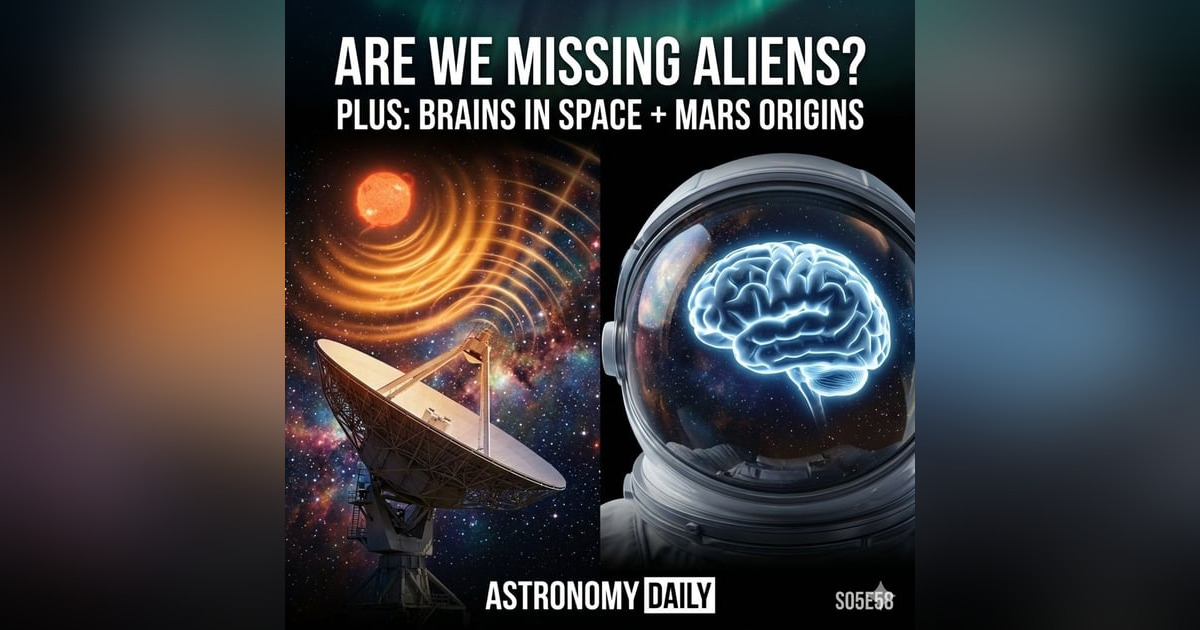
In today's episode, Anna and Avery explore five of the week's most compelling space and astronomy stories: a new SETI Institute study suggesting stellar space weather could be scrambling alien radio signals before they even leave their home systems; groundbreaking research revealing that spaceflight physically shifts and deforms the human brain inside the skull; the impressive engineering story behind Roscosmos restoring Baikonur's launch pad in record time ahead of the Progress MS-33 mission; a surprising new finding from Nature that Earth's elliptical orbit plays a much bigger role in shaping El Niño and global weather patterns than previously thought; and the endlessly fascinating question of whether asteroid impacts could allow microbes to travel between planets — including the possibility that life on Earth may have originated on Mars.   Stories Covered •       Why SETI may be missing alien radio signals — space weather around distant stars could be smearing narrowband signals beyond the reach of current detectors (SETI Institute, March 2026) •       Spaceflight physically shifts and deforms the brain inside the skull — new MRI study of 26 astronauts published in PNAS reveals extent of microgravity's neurological impact (University of Florida, March 2026) •       Baikonur's Site 31/6 launch pad fully restored after November 2025 damage — over 150 workers complete repairs in under two months, clearing path for Progress MS-33 on March 22 (NASASpaceFlight, March 2026) •       Earth's distance from the Sun found to dramatically alter seasons — new Nature study shows orbital eccentricity drives its own annual cycle in the Pacific cold tongue, influencing El Niño over millennia (UC Berkeley, March 2026) •       Did Earth life begin on Mars? New research examines how asteroid impacts could allow microbes to travel between planets via ejected rock (Universe Today, March 2026)   Connect With Us Website: astronomydaily.io Twitter/X, Instagram, TikTok, YouTube, Tumblr: @AstroDailyPod Part of the Bitesz.com Podcast Network

Become a supporter of this podcast: https://www.spreaker.com/podcast/astronomy-daily-space-news-updates--5648921/support.

Sponsor Details:
Ensure your online privacy by using NordVPN. To get our special listener deal and save a lot of money, visit www.bitesz.com/nordvpn. You'll be glad you did!

Become a supporter of Astronomy Daily by joining our Supporters Club. Commercial free episodes daily are only a click way... Click Here

This episode includes AI-generated content.

WEBVTT

1
00:00:00.360 --> 00:00:02.200
Welcome to Astronomy Daily.

2
00:00:02.439 --> 00:00:06.200
I'm Anna and I'm Avery. It's Monday, March ninth, and

3
00:00:06.240 --> 00:00:08.439
if you've been following the news this past week, the

4
00:00:08.560 --> 00:00:10.839
universe has been spectacularly busy.

5
00:00:11.400 --> 00:00:14.880
We've got alien signals going missing in the cosmic static

6
00:00:15.279 --> 00:00:20.160
astronaut brains getting physically rearranged in space, a dramatic launch

7
00:00:20.199 --> 00:00:23.320
pad rescue stories straight out of a thriller, and a

8
00:00:23.440 --> 00:00:27.920
genuinely mind bending discovery about why Earth seasons work the

9
00:00:27.960 --> 00:00:28.559
way they do.

10
00:00:29.239 --> 00:00:33.320
LUs we're asking one of astrobiology's most provocative questions, did

11
00:00:33.359 --> 00:00:37.240
life on Earth actually start on Mars? It's a packed episode,

12
00:00:37.359 --> 00:00:38.119
let's get into it.

13
00:00:38.640 --> 00:00:40.640
Here's a thought that's going to sit with you for

14
00:00:40.719 --> 00:00:43.759
a while. What if we're not alone in the universe,

15
00:00:43.880 --> 00:00:47.359
but we've been tuning to the wrong frequency this whole time.

16
00:00:47.840 --> 00:00:50.679
That's essentially what a new study from SETI is suggesting.

17
00:00:51.200 --> 00:00:55.399
Researchers Vishal Goadjar and Grace Brown have published work showing

18
00:00:55.439 --> 00:00:58.920
that stellar space weather, the kind of turbulent plasma and

19
00:00:59.000 --> 00:01:03.479
solar activity that stars constantly turn out, could physically distort

20
00:01:03.560 --> 00:01:07.120
alien radio signals before they even leave their home solar system.

21
00:01:07.640 --> 00:01:12.120
So here's how SETI searches typically work. For decades, scientists

22
00:01:12.200 --> 00:01:15.760
have been scanning the sky for very tightly focused, narrow

23
00:01:15.840 --> 00:01:20.760
band radio signals, extremely specific frequencies that nothing natural in

24
00:01:20.799 --> 00:01:23.920
the universe should produce. If you detect one of those,

25
00:01:24.159 --> 00:01:29.760
the thinking goes, it's almost certainly artificial, it's almost certainly someone.

26
00:01:29.799 --> 00:01:32.439
And that logic is still sound. But the new research

27
00:01:32.519 --> 00:01:35.439
highlights a gap in the reasoning. Even if an alien

28
00:01:35.480 --> 00:01:40.040
civilization sense a perfectly clean narrowband signal, their own stars,

29
00:01:40.159 --> 00:01:44.159
environment might smear it out before it escapes plasma density,

30
00:01:44.159 --> 00:01:47.640
Fluctuations in stellar winds or a burst from a coronal

31
00:01:47.680 --> 00:01:51.200
mass ejection can spread that tight signal across a much

32
00:01:51.280 --> 00:01:55.120
wider range of frequencies, reducing its strength that any single

33
00:01:55.200 --> 00:01:57.439
point below what our detectors can pick up.

34
00:01:58.040 --> 00:02:01.799
The team ran simulations of the billion closest sunlike and

35
00:02:01.920 --> 00:02:05.239
red dwarf stars and found that seventy percent of stars

36
00:02:05.280 --> 00:02:08.560
would broaden a signal by more than one hurtz, thirty

37
00:02:08.599 --> 00:02:11.560
percent by more than ten herts, and if a coronal

38
00:02:11.599 --> 00:02:15.080
mass ejection happened to fire off at the moment of transmission,

39
00:02:15.360 --> 00:02:19.240
the broadening could exceed one thousand herts, making the signal

40
00:02:19.400 --> 00:02:23.240
essentially invisible to the way we currently search and Red.

41
00:02:23.159 --> 00:02:26.639
Dwarf stars are the biggest culprits here, and that's particularly

42
00:02:26.680 --> 00:02:29.960
significant because red dwarfs make up about three quarters of

43
00:02:30.039 --> 00:02:32.360
all the stars in the Milky Way. A lot of

44
00:02:32.360 --> 00:02:36.240
our SETI attention has focused on those systems precisely because

45
00:02:36.280 --> 00:02:39.479
they're so common, and it turns out they may also

46
00:02:39.520 --> 00:02:42.439
be the most likely to garble any messages being sent

47
00:02:42.479 --> 00:02:43.240
from their planets.

48
00:02:43.759 --> 00:02:46.639
The good news is that identifying the problem is the

49
00:02:46.680 --> 00:02:49.840
first step to solving it. The team says this gives

50
00:02:49.919 --> 00:02:54.000
us a framework for redesigning searches to remain sensitive even

51
00:02:54.039 --> 00:02:57.599
one signals are broadened to look for what actually arrives

52
00:02:57.639 --> 00:03:00.479
at Earth rather than what was originally transmitted.

53
00:03:01.000 --> 00:03:03.599
It's a bit like realizing you've been trying to tune

54
00:03:03.599 --> 00:03:06.439
into a radio spation, but the signal had passed through

55
00:03:06.439 --> 00:03:09.319
a foggy atmosphere on its way to you. It's not

56
00:03:09.360 --> 00:03:12.120
that the station isn't broadcasting, it's that we need a

57
00:03:12.120 --> 00:03:14.039
better aerial and that's.

58
00:03:13.840 --> 00:03:17.199
A much more hopeful framing than nobody's out there. The

59
00:03:17.360 --> 00:03:20.719
universe might be full of voices, we just haven't learned

60
00:03:20.719 --> 00:03:21.680
to hear yet.

61
00:03:21.879 --> 00:03:23.879
Now, if you're planning a trip to space, or if

62
00:03:23.919 --> 00:03:26.560
you're just a big Artemis fan, this next story is

63
00:03:26.599 --> 00:03:29.120
worth paying attention to, though we want to say upfront

64
00:03:29.120 --> 00:03:31.159
that it's fascinating rather than alarming.

65
00:03:31.680 --> 00:03:34.439
A new study published in the Proceedings of the National

66
00:03:34.479 --> 00:03:38.599
Academy of Sciences has found that spaceflight doesn't just change

67
00:03:38.639 --> 00:03:42.719
your perspective on life, it literally shifts the physical position

68
00:03:42.879 --> 00:03:44.960
of your brain inside your skull.

69
00:03:45.280 --> 00:03:48.280
A team led by Rachel Seidler at the University of

70
00:03:48.319 --> 00:03:53.120
Florida analyzed MRI scans from twenty six astronauts taken before

71
00:03:53.240 --> 00:03:56.719
and after missions to the ISS missions ranging from a

72
00:03:56.719 --> 00:04:00.319
few weeks to over a year, to measure the brain's

73
00:04:00.400 --> 00:04:04.080
actual movement. They aligned each person's skull across the two

74
00:04:04.199 --> 00:04:07.599
scans so they could track the brain's position relative to

75
00:04:07.639 --> 00:04:09.039
the bone itself.

76
00:04:09.000 --> 00:04:13.080
And what they found was striking. The brain shifts upward

77
00:04:13.159 --> 00:04:17.759
and backward inside the skull. It also physically deforms, stretching

78
00:04:17.839 --> 00:04:21.639
and compressing in different directions. The sensory and motor regions

79
00:04:21.720 --> 00:04:25.639
show the largest shifts, and crucially, the longer someone spent

80
00:04:25.720 --> 00:04:28.519
in space, the more pronounced these changes were.

81
00:04:28.920 --> 00:04:33.040
The underlying cause is what you'd expect from microgravity on Earth.

82
00:04:33.199 --> 00:04:37.800
Gravity constantly pulls fluids, including the cerebral spinal fluid surrounding

83
00:04:37.800 --> 00:04:43.240
your brain, downward. In space, that force disappears fluid redistributes

84
00:04:43.279 --> 00:04:46.240
towards the head. The brain effectively floats in the skull,

85
00:04:46.600 --> 00:04:49.480
and it responds to different forces from surrounding tissues.

86
00:04:49.879 --> 00:04:53.120
Previous research already knew the brain shifts upward in space.

87
00:04:53.360 --> 00:04:56.240
What makes this study important is the level of detail.

88
00:04:56.639 --> 00:04:59.399
Instead of treating the brain as one object, the team

89
00:04:59.480 --> 00:05:02.759
divided it into more than one hundred regions and tracked

90
00:05:02.839 --> 00:05:07.439
each individually. That revealed patterns like opposing lateral shifts on

91
00:05:07.480 --> 00:05:09.920
each side of the brain that had been canceling each

92
00:05:09.959 --> 00:05:13.439
other out and going unnoticed in whole brain averages.

93
00:05:13.959 --> 00:05:17.560
The reassuring news most of the changes recover within six

94
00:05:17.680 --> 00:05:21.079
months of returning to Earth, and the astronauts themselves didn't

95
00:05:21.120 --> 00:05:25.399
report symptoms like headaches or cognitive fog. The researcher stressed

96
00:05:25.399 --> 00:05:28.279
that this doesn't mean people shouldn't go to space, but

97
00:05:28.319 --> 00:05:31.839
as missions get longer and as Artemis starts taking humans

98
00:05:31.879 --> 00:05:35.439
back to the Moon and eventually towards Mars, understanding these

99
00:05:35.480 --> 00:05:38.759
effects will be important for designing proper countermeasures.

100
00:05:39.120 --> 00:05:42.600
It's a reminder that space is a genuinely alien environment

101
00:05:42.639 --> 00:05:45.800
for the human body. We evolved under one gravity, and

102
00:05:46.000 --> 00:05:49.240
every time we leave it, we're running an experiment on ourselves.

103
00:05:49.560 --> 00:05:52.680
The more we understand those experiments, the safer we can

104
00:05:52.720 --> 00:05:54.279
make long duration spaceflight.

105
00:05:54.680 --> 00:05:57.759
Now for a story that is, in the best possible way,

106
00:05:57.879 --> 00:06:01.439
a bit of a thriller. In November last year, something

107
00:06:01.480 --> 00:06:04.879
went wrong at the historic bikan Or Cosmodrome in Kazakhstan,

108
00:06:05.319 --> 00:06:08.319
and nobody was entirely sure it could be fixed in time.

109
00:06:08.759 --> 00:06:12.079
It started. On November twenty seventh, twenty twenty five, a

110
00:06:12.120 --> 00:06:15.360
Soyuz rocket lifted off from launch Site thirty one, carrying

111
00:06:15.399 --> 00:06:19.480
the Soyuz MS twenty eight spacecraft, with two Rose Cosmos

112
00:06:19.519 --> 00:06:24.160
cosmonauts and NASA astronaut Christopher Williams aboard. The launch was successful.

113
00:06:24.439 --> 00:06:27.160
The crew docked with the ISS without incident.

114
00:06:27.160 --> 00:06:31.079
But post launch inspection footage revealed significant damage to the

115
00:06:31.120 --> 00:06:35.240
pad itself. A component called the service cabin, which retracts

116
00:06:35.279 --> 00:06:38.759
into a protective cavity to shield it from engine exhausting ascent,

117
00:06:39.279 --> 00:06:43.800
hadn't been properly secured. The powerful rocket exhaust dislodged it

118
00:06:43.879 --> 00:06:46.800
and the structure fell several meters into the launch trench,

119
00:06:47.199 --> 00:06:51.240
deforming bridges, access walkways and other critical infrastructure.

120
00:06:51.600 --> 00:06:54.720
The space community was skeptical this could be fixed quickly.

121
00:06:55.079 --> 00:06:59.160
These are heavy, complex structures, but Rose Cosmos committed to

122
00:06:59.199 --> 00:07:02.040
the repair, and it turns out their long history with

123
00:07:02.079 --> 00:07:06.199
the soyuse system gave them an unexpected advantage. Bear service

124
00:07:06.240 --> 00:07:09.839
cabins had been sitting in storage leftover from refurbishment plans

125
00:07:09.920 --> 00:07:11.759
dating back to the nineteen seventies.

126
00:07:12.319 --> 00:07:16.079
The restoration effort was enormous. Over one hundred and fifty

127
00:07:16.079 --> 00:07:19.519
personnel worked on the project. They completed over two hundred

128
00:07:19.560 --> 00:07:23.120
and fifty meters of welding, painted nearly twenty four hundred

129
00:07:23.120 --> 00:07:27.279
square meters of structures, replaced all fastening units, and fully

130
00:07:27.360 --> 00:07:31.519
updated the electrical systems. The replacement cabin, originally built for

131
00:07:31.600 --> 00:07:36.399
an older SOYZ variant, needed modifications to work with modern hardware.

132
00:07:36.240 --> 00:07:39.120
And in under two months from the initial damage assessment,

133
00:07:39.519 --> 00:07:43.720
far faster than most observers anticipated, Rose Cosmos announced the

134
00:07:43.759 --> 00:07:46.839
pad was fully restored and declared ready for operations.

135
00:07:47.360 --> 00:07:51.680
That means progress MS thirty three and uncrewed cargo ship

136
00:07:51.839 --> 00:07:54.519
is now cleared to launch from Site thirty one on

137
00:07:54.560 --> 00:07:58.319
March twenty second. It will deliver around two point five

138
00:07:58.439 --> 00:08:04.439
tons of supplies to the ISA propellants, water, food, scientific equipment,

139
00:08:04.680 --> 00:08:05.839
and crew parcels.

140
00:08:06.079 --> 00:08:10.399
It's a genuinely impressive piece of engineering under pressure, and

141
00:08:10.439 --> 00:08:13.199
it's a good reminder that behind every rocket launch is

142
00:08:13.240 --> 00:08:17.199
an enormous amount of groundwork literally in this case, that

143
00:08:17.319 --> 00:08:20.160
never makes headlines until something goes sideways.

144
00:08:20.759 --> 00:08:23.720
Okay, pop quiz. Why do we have seasons?

145
00:08:24.199 --> 00:08:27.600
Earth's axial tilt. We all learned this in school. When

146
00:08:27.639 --> 00:08:30.519
the northern hemisphere is tilted toward the Sun, it's summer

147
00:08:30.600 --> 00:08:32.960
up here. When it's tilted away, it's winter.

148
00:08:33.600 --> 00:08:37.120
Exactly right. And most people also know that Earth's orbit

149
00:08:37.159 --> 00:08:40.679
around the Sun is slightly elliptical. We're a bit closer

150
00:08:40.679 --> 00:08:43.240
to the Sun in January and a bit farther away

151
00:08:43.240 --> 00:08:46.720
in July. But we're usually told that effect is minor

152
00:08:46.879 --> 00:08:51.039
and it doesn't significantly change our seasons. Well, a new

153
00:08:51.120 --> 00:08:54.679
study published in Nature suggests we may have been under

154
00:08:54.759 --> 00:08:57.399
selling that distance effect quite significantly.

155
00:08:57.799 --> 00:09:01.080
The research, led by John Chiang at UC Berkeley, focuses

156
00:09:01.120 --> 00:09:04.240
on a specific feature of the Pacific Ocean called the

157
00:09:04.279 --> 00:09:07.799
cold Tongue, a strip of cooler water that stretches westward

158
00:09:07.840 --> 00:09:11.480
from South America along the equator. This cold tongue is

159
00:09:11.559 --> 00:09:14.799
closely tied to Almino and La a Ninia cycles, which

160
00:09:14.840 --> 00:09:19.080
influence rainfall, drought, and weather patterns across huge swaths of

161
00:09:19.120 --> 00:09:19.600
the planet.

162
00:09:20.120 --> 00:09:23.200
What Chang and his colleagues found is that the changing

163
00:09:23.279 --> 00:09:26.960
Earth sun distance creates its own separate annual cycle in

164
00:09:27.000 --> 00:09:30.360
the cold tongue, distinct from the tilt driven one, and

165
00:09:30.440 --> 00:09:33.919
the two cycles are slightly out of sync. The distance

166
00:09:33.960 --> 00:09:37.240
based one runs about twenty five minutes longer than the

167
00:09:37.279 --> 00:09:40.600
tilt based one. That doesn't sound like much, but it

168
00:09:40.720 --> 00:09:44.600
means that over about eleven thousand years, the two effects

169
00:09:44.759 --> 00:09:48.360
drift from being perfectly in phase to perfectly out of phase.

170
00:09:48.799 --> 00:09:51.720
When they're in phase like they are roughly today, the

171
00:09:51.759 --> 00:09:54.879
effects reinforce each other. When they're out of phase, as

172
00:09:54.879 --> 00:09:58.480
they were around six thousand years ago, they partially cancel,

173
00:09:58.759 --> 00:10:01.960
producing a much weaker seasonal cycle in the cold tongue.

174
00:10:02.080 --> 00:10:05.039
And since the cold tongue drives el Nino, that means

175
00:10:05.120 --> 00:10:08.919
el Nino patterns themselves would have been dramatically different in

176
00:10:08.960 --> 00:10:09.639
the deep past.

177
00:10:10.320 --> 00:10:14.879
The mechanism works in a counterintuitive direction too. While axial

178
00:10:14.919 --> 00:10:19.559
tilt creates north south temperature differences, the distance effect creates

179
00:10:19.559 --> 00:10:23.600
an east west contrast between the continental hemisphere of the

180
00:10:23.639 --> 00:10:29.200
America's Africa and Eurasia and the ocean dominated Pacific side.

181
00:10:29.240 --> 00:10:32.480
That contrast drives trade winds, which in turn shape the

182
00:10:32.519 --> 00:10:33.200
cold tongue.

183
00:10:33.440 --> 00:10:37.039
It's worth noting the study is entirely model based. It's

184
00:10:37.080 --> 00:10:40.759
a prediction that will need observational verification, but it opens

185
00:10:40.919 --> 00:10:45.679
fascinating questions for paleoclimate science. If Earth's orbital shape was

186
00:10:45.799 --> 00:10:49.320
changing the cold tongue over twenty two thousand year cycles,

187
00:10:49.720 --> 00:10:52.639
some ancient climate records may need reinterpretation.

188
00:10:53.240 --> 00:10:56.559
And there's something wonderfully humbling about it. We've been telling

189
00:10:56.559 --> 00:11:00.840
school children for generations exactly why seasons have happen, and

190
00:11:00.919 --> 00:11:04.279
it turns out the full picture involves a subtle cosmic

191
00:11:04.320 --> 00:11:06.519
clockwork we hadn't fully accounted for.

192
00:11:07.000 --> 00:11:10.039
And now for our final story today and honestly, one

193
00:11:10.039 --> 00:11:12.679
of the most mind bending things you can contemplate on

194
00:11:12.679 --> 00:11:15.679
a Monday, what if you're not from Earth?

195
00:11:17.000 --> 00:11:19.480
In a very literal biological sense.

196
00:11:19.759 --> 00:11:23.919
Possibly a new study is revisiting the concept of panspermia,

197
00:11:23.960 --> 00:11:28.240
the idea that life doesn't necessarily originate independently on each planet,

198
00:11:28.519 --> 00:11:32.559
but can travel between worlds and the vehicle asteroid impacts.

199
00:11:33.000 --> 00:11:36.120
Here's the premis. We know that when a large asteroid

200
00:11:36.200 --> 00:11:39.559
or comet slams into a planet within a force, it

201
00:11:39.600 --> 00:11:44.559
can blast material into space, rocks, dust, and potentially anything

202
00:11:44.600 --> 00:11:48.639
living inside those rocks. We've actually found meteorites on Earth

203
00:11:48.679 --> 00:11:53.080
that originated on Mars, blasted off by ancient impacts, so

204
00:11:53.240 --> 00:11:55.679
the physical pathway definitely exists.

205
00:11:56.120 --> 00:11:59.919
The question has always been could anything survive that journey?

206
00:12:00.399 --> 00:12:04.840
You're talking about the ejection itself, an enormous shockwave, then

207
00:12:05.000 --> 00:12:08.600
exposure to the vacuum and radiation of space for potentially

208
00:12:08.759 --> 00:12:13.399
millions of years, then a fiery atmospheric entry and high

209
00:12:13.440 --> 00:12:15.120
speed impact at the destination.

210
00:12:15.879 --> 00:12:18.960
The new research suggests the answer might be yes. Under

211
00:12:19.000 --> 00:12:22.919
the right conditions, some microbes, particularly those that form hardy

212
00:12:22.960 --> 00:12:26.879
spores or live deep within rocks, could potentially survive all

213
00:12:26.919 --> 00:12:30.519
of those stages. The rock itself provides shielding from radiation

214
00:12:30.639 --> 00:12:34.039
during transit, and the numbers game matters. Even if only

215
00:12:34.120 --> 00:12:37.879
a tiny fraction of ejected material survives, the sheer volume

216
00:12:37.919 --> 00:12:41.519
of material blasted around the early Solar system means some

217
00:12:41.759 --> 00:12:43.840
viable biology could have made the crossing.

218
00:12:44.399 --> 00:12:49.080
The Mars connection is particularly intriguing. Early Mars was, by

219
00:12:49.120 --> 00:12:52.679
many accounts a better candidate for life to emerge first

220
00:12:52.879 --> 00:12:57.120
than early Earth. It cooled faster, it had liquid water earlier,

221
00:12:57.399 --> 00:13:01.159
and it had a gentler gravitational well, making it easier

222
00:13:01.159 --> 00:13:05.120
for material to escape. If life arose on Mars billions

223
00:13:05.159 --> 00:13:08.000
of years ago and hitched a ride on an impact

224
00:13:08.039 --> 00:13:11.879
ejected rock, Earth could effectively have been seated.

225
00:13:11.960 --> 00:13:14.519
Which would mean that if we ever find microbial life

226
00:13:14.519 --> 00:13:17.799
on Mars or evidence of ancient life there, we'd face

227
00:13:17.840 --> 00:13:22.480
a fascinating interpretive challenge. Did life arise independently on both

228
00:13:22.519 --> 00:13:26.799
worlds or are we all in some deep ancestral sense Martians.

229
00:13:27.399 --> 00:13:31.879
The study emphasizes this is still highly speculative, hence bermia

230
00:13:32.039 --> 00:13:36.440
remains a hypothesis rather than established science, But as our

231
00:13:36.480 --> 00:13:41.200
ability to study Martian samples improves, especially with future sample

232
00:13:41.240 --> 00:13:44.679
return missions, we may eventually be in a position to

233
00:13:44.799 --> 00:13:45.840
test it directly.

234
00:13:46.399 --> 00:13:49.679
Either way, the question is deeply fascinating, and it gives

235
00:13:49.720 --> 00:13:52.559
a whole new flavor to the phrase out of this world.

236
00:13:53.120 --> 00:13:57.799
That's Astronomy Daily from Monday, March ninth. From scrambled alien

237
00:13:57.879 --> 00:14:02.399
signals to astronaut brains, from a launchpad resurrection, to the

238
00:14:02.480 --> 00:14:06.559
hidden clockwork of Earth seasons and the possibility that we're

239
00:14:06.600 --> 00:14:08.240
all secretly from Mars.

240
00:14:08.639 --> 00:14:11.200
It's been a great episode. If you're enjoying the show,

241
00:14:11.279 --> 00:14:14.120
please leave us a review. Wherever you listen. It genuinely

242
00:14:14.159 --> 00:14:17.000
helps new listeners find us and share an episode with

243
00:14:17.039 --> 00:14:18.879
a friend who's curious about the universe.

244
00:14:19.320 --> 00:14:23.159
You can find us at Astronomydaily dot io and we're

245
00:14:23.200 --> 00:14:28.159
at astro Daily pod on x, Instagram, TikTok, YouTube, and Tumbler.

246
00:14:28.639 --> 00:14:31.679
We'll be back tomorrow with more of the Universe's greatest hits.

247
00:14:31.879 --> 00:14:33.519
Until then, keep looking up.

248
00:14:33.759 --> 00:14:37.480
Bye for now, Sunday.

249
00:14:37.799 --> 00:14:46.799
Starsz. Starz