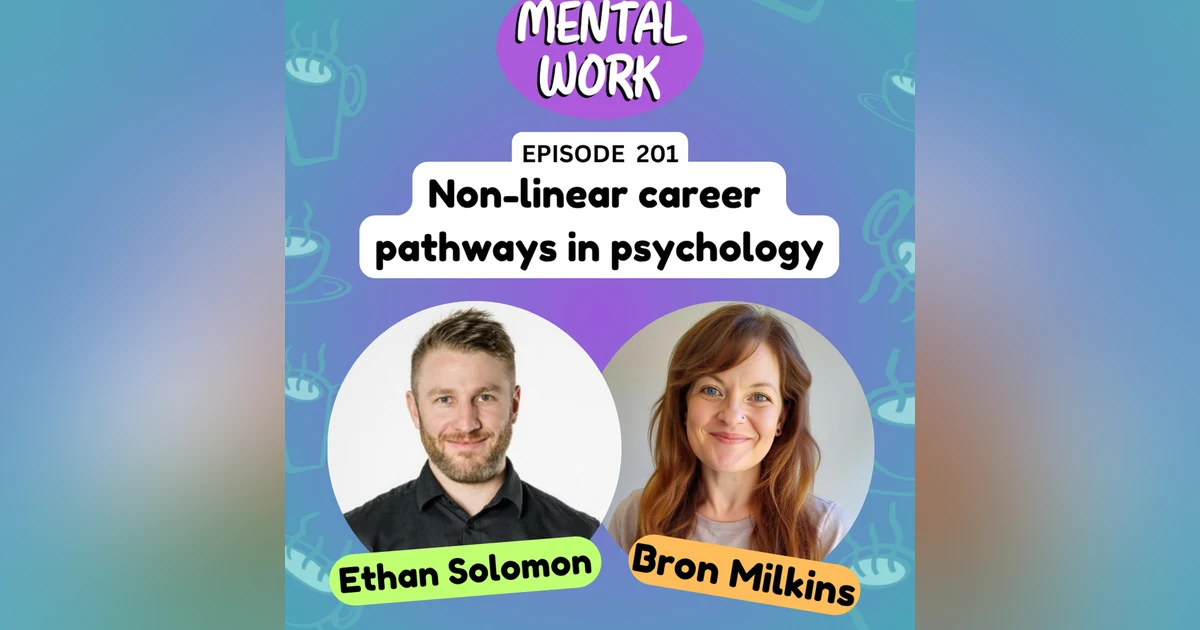
Bron is joined by Ethan Solomon (organisational psychologist and private practice therapist) to chat about building a career that blends both therapy and corporate work. Ethan shares how he went from wanting to be a clinical psychologist to specialising in psychometric assessment, leadership development, and coaching, while keeping one foot firmly in private practice therapy.
They chat about:
👉🏽 What organisational psychology actually involves day-to-day
👉🏻 The transferable skills that connect therapy and org psych work
👉🏿 Why knowing your values is the best career compass you have
👉🏾 The misconceptions early-career psychs hold about what their career can look like
👉🏼 Why the human element in psychology will always matter, even in a world of AI
Thank you for sharing your story, Ethan! 😊
Guest: Ethan Solomon, Organisational Psychologist and Therapist
LINKS
THE END BITS
Mental Work is the Australian podcast for early-career psychologists about working in mental health. Hosted by psychologist/researcher Dr Bronwyn Milkins.
Support the show by buying me a virtual coffee ☕🍵
Have a question, episode idea or just want to say hi? DM Bron on Instagram, leave a comment on the Spotify episode, or email mentalworkpodcast@gmail.com
Apply to be a guest / YouTube (with captions & transcript) / Website
CREDITS
Producer: Michael English
Music: Home
Commitment: Mental Work believes in an inclusive and diverse mental health workforce. We honour the strength, resilience, and invaluable contributions of mental health workers with lived experiences of mental illness, disability, neurodivergence, LGBTIQA+ identities, and diverse culture and language. We recognise our First Nations colleagues as Traditional Custodians of the land and pay respect to Elders past, present, and emerging. Mental Work is recorded on unceded Whadjuk Noongar boodja.
Disclaimer: Mental Work provides informational content. Mental Work is not a psychological service and being a listener or guest does not establish a therapeutic relationship. Content should not be considered a replacement for professional consultation or therapy. All views expressed are personal, subject to change, and do not represent those of any affiliated employer, service, or organisation past or present. Efforts are made to ensure accuracy, but opinions may not always align with fact. Listeners are encouraged to thoughtfully assess the information presented and report any inaccuracies or concerns via email. Further information can be found here.
See omnystudio.com/listener for privacy information.
[00:00:05] Bronwyn: Hey, mental workers. You're listening to the Mental Work podcast, the podcast about working in mental health for early career mental health workers. As always, I'm your host, Bronwyn Milkins, and today we are talking about building a meaningful career across both therapy and organisational psychology.
It can feel like you have to pick a single career lane once you leave uni. Like just keep on doing clinical or keep on staying in private practise. In this episode, we're going to explore how you can blend your passions, walk in multiple professional worlds, and create a career path that truly reflects your strengths and values. Here to help us out today as our guest, Ethan Soloman. Hi, Ethan.
[00:00:40] Ethan: Hi Bronwyn, How you going?
[00:00:41] Bronwyn: I'm going really well. I'm really glad that you could join us today. Could you please start off by telling listeners who you are?
[00:00:47] Ethan: Yep. So my name's Ethan Solomon. I'm a consultant, an organisational psychologist at a talent management company. But really what I do is I specialise in psychometric assessment usually for people who have been recruited into high stakes roles. Other contacts usually around leadership development, coaching, mental health and wellbeing as well.
I guess on the other side of that, I'm also a therapist in private practise that's more where the mental health comes in. And on weekends, I'm Ethan, Dachshund lover, um, and my deepest core values are curiosity and love, and those are the things that drive me in both my personal and my work life.
But really, I'm not those two people, I'm all of those things at once and I try to blend my work together with that to be as authentic as possible, and I think people can get a good, good part of their needs met very well through that. So I think people can get their needs met quite well, when they are blending both their work, and personal life together, with their values.
[00:01:47] Bronwyn: That's a really lovely philosophy. I must admit the dog stood out to me.
[00:01:51] Ethan: Oh yeah.
[00:01:52] Bronwyn: What's your dog's name? How old is the dog? Tell us about the dog.
[00:01:55] Ethan: I've got two dogs. So I've got one Dachshund, Cosmo, he's a young fella, almost two. Lots of energy, really obedient, but very impulsive, so it's a funny combination, and very loving and sweet. And then I have Dippy who's a rescue, she's about five years old. She's got, I would assume a pretty, pretty decent trauma background. I think she was a, a, breeder's dog.
[00:02:19] Bronwyn: Oh, poor baby.
[00:02:20] Ethan: She's a little bit tentative, but she loves going for walks, like that's her thing. She just likes hiding under my table, she's at home or running in the park, so that's what we do.
[00:02:30] Bronwyn: So she's living her best dog life now.
[00:02:31] Ethan: Yeah, she's living the best dog life that she can and yeah, it's, it's awesome to see her become more of a dog the more she sort of settles into the house, which is nice.
[00:02:39] Bronwyn: Oh, that's lovely. We love dogs. I'm not sure if listeners love dogs, and when I say we, I mean me. But I'm just gonna, I own it as, as a general thing on the podcast.
[00:02:49] Ethan: Yeah.
[00:02:49] Bronwyn: So thanks for the intro. Can you please take us back to the beginning? So I, I would like to know what got you interested in psychology, I think first of all, what led you to studying psych?
[00:02:59] Ethan: Yeah. The first thing that it was, was, it, it's pretty typical pathway I think that most people would have, I really wanted to be a clinical psychologist. The reason I got there, I was sitting at home, I was like 15, 16, and I was watching this TV series called Wire in the Blood, about a guy who solves murders with psychology, he's a clinical psych. And that got me really interested and I was like, okay, I could use that to really help people. That's, it's fascinating and you could actually help people. And putting those two things together got me really interested. So that's how I kinda got started.
And then I also sort of met a few people along the way that I could see their profession and how they were not just sort of doing something that was, I guess corporate, but actually bringing people into that, and that got me fascinated in that area of the world as well.
[00:03:51] Bronwyn: That's so cool. So what did your career journey look like? So did you do undergrad, psych, and then honours? Was it relatively like one after the other? What happened there?
[00:04:00] Ethan: Yeah. So I did undergrad psychology, and then I did honours and then I applied for one master's programme of organisational psychology. And I was like, I'm gonna do a four plus two. I don't wanna study, I'm done with it, but if I do, it would be that, and lo and behold, I got it. So yeah, that's where I went and, and did my masters of organisational psychology. And from there obviously placements and things happened, and then I moved into the world of psychometrics.
[00:04:29] Bronwyn: Wow. So what led you to psychometrics? Was that your choice to go into it or were you kind of led there?
[00:04:37] Ethan: I guess another story to tell is this, there was this cool guy that I heard about through my dad who had come to his organisation. My dad's like a really technical project manager, and this guy came in, had a really nice car, and he did this profiling of my dad and was able to tell him some really, really useful insights to help him develop his career. So really helped him to get outta his shell a little bit more, be a bit more people focused and maybe be a little bit less sceptical about things as project managers tend to be.
So that, that was something that was really cool and that kind of got me interested in this, this area, and, and of psychometrics, so that profiling tool. And ended up having a conversation with him at some point when I started my masters, and that sort of got me, um, yeah, really interested and that, that point there was opportunities to sort of get accredited and different psychometric tools used in organisations. And so I was just picking all of 'em that I could do like candy, in a candy store and yeah, that, that sort of, that kept building the curiosity. The first one I learned was called the Saville Wave and that's just a really cool model. And that got me, yeah, that got me hooked.
[00:05:44] Bronwyn: I'm just interested in like your personality characteristics that make this interesting to you. Like are you a detail focused person or like quite analytical?
[00:05:52] Ethan: Hmm, uh, that's an interesting, interesting hypothesis. Uh, no, I'm very high Openness, so I am very curious. It's like my number one thing. I'm really interested in new ways of doing things, new approaches and that that's what gets me driven to use these insights. And it's not so much about the data, it's about taking this piece of data and making sense of that in someone's context, and it's a really great discussion point, and starting point for a conversation about things that people really care about in their work. And people might be more introverted in nature for example, but in a leadership position and you can kind of work with them and help them develop, learn strategies, around things like that that might be a little bit more challenging, being up and in front of people all day, right. And that can be very meaningful to people 'cause they spend so much time at work.
[00:06:40] Bronwyn: Yeah, totally. So would you say your role is interactive with people? Because maybe people do have a misconception that Org Psychs do sit in their little office and they analyse the data, but they don't actually interact with people.
[00:06:53] Ethan: Yeah, I think we do sit in the office a lot. The thing is like your, your day to day is probably gonna look different to a therapist or psychologist in private practise for sure. In terms of people focus, you won't do, for example, six coaching sessions a day. You might, that that would be very, very, um, intense though, 'cause there's a lot of considerations and things that go into that. But you might do one or two, then you might debrief a hiring panel on a psychometric assessment. You might go out and do some leadership development work, in a organisation, maybe a mining company or it might be a government company that's, you know, trying to build leadership capability for a very specific population. And that, that is where you get to have all that variety that comes in.
So there's this sort of like group level stuff, there's the one-to-one stuff, there's going out and doing things out in the world. And there is also that time spent in the office, which I cherish and love while I listen to rock, sort of emo music.
[00:07:55] Bronwyn: Sounds great. So it sounds like there's a lot of variety in your role.
[00:07:59] Ethan: Yeah, yeah. Massive variety person. That's a big theme of my career. I've done a lot of different things. So I, I, I think I've kind of learned about myself that having variety is a pretty, pretty big need for me in my work. And being intellectually stimulated is really important, but also having like a caring concern and focus for people in my work.
So org psych gives me the best of all of those worlds, but I also have this sort of other, other part of me that really wants to work one-on-one deeper with people. I don't always get to do that in org psych. I'm getting to do more of it. But yeah, that's where therapy's come in and been really important for me too.
[00:08:36] Bronwyn: Yeah. And the reason why I ask as well is because I've just noticed a general trend, maybe anecdotal, that I think a lot of clinically focused psychs are wanting more variety in their work. And so they're like, how can I get into these a psych works or these alternative roles, maybe in combination with clinical work? And so I was just wondering like, how did you get your job? Did you, was it like Seek or like... I don't know!
[00:09:00] Ethan: Yeah, that, that's, it's a great question, I think. So there's a lot of connections that you do make through the university from organisational psychology. Yeah, so there's that. I, and I, I've, I had to think about like, it's the, if where it's the other way around where it's, you know, people that want to get more into that work, we'll talk about transferable skills, I'm sure. But, uh, yeah, I think it's really just about getting the different skillset. Like the way I got back into the therapy world is I already had a bit of a set, but I built more of it. And then I could come in.
If you think about what is a career trajectory generally of a clinical psychologist or someone who is in a mental health role generally, you know, you might sort of upgrade to a more senior role management and then you start looking at business management. So it actually becomes a leadership business role. So I think as you start to build those skills, as you move through kind of the ranks, if you do. If you go to private practise, that's, you are also probably managing your own business at that point or working deeply with someone else's. Those skills and things can help you to understand things a little bit more deeply from an organisational level, and it's just kind of about the expanding the thinking I think as well.
[00:10:02] Bronwyn: No, that's really helpful. So I wanted to ask you about the therapy, because my understanding of the org psych Masters is that it doesn't typically involve much therapy. Is that right?
[00:10:11] Ethan: Yes, that's very true. Um, I think I remember having some element of like, what would you do in these situations and like in coaching and the sort of boundaries there. That being said though, that you some, there's a lot of EAP organisations, right? So they're organisations that support organisations with mental health, or their wellbeing, so directly or indirectly.
So you talk about training, design and resilience and if there's people that do share things and how do you support them and um, yeah, what those boundaries are. They can get very blurry at times, um, that they definitely can, but it's kind of just coming back to the company, the organisation, as well as this person.
So it's, there's kind of another thing in the room that stops you going full mental health discussions, if that makes sense.
[00:11:01] Bronwyn: Yeah, it does. And maybe this comes back to transferable skills, because like you said, you're very curious, you're very open to learning. When you approach therapy for many people, that can be quite overwhelming, was it overwhelming for you, or did you feel like you had some transferable skills to provide a foundation?
[00:11:16] Ethan: Yeah. I should probably preface before I became an organisation psychologist, like I was following that journey, clinical psych undergrad, loved this, started volunteering at a crisis helpline. I'm sure you can all figure that out.
[00:11:29] Bronwyn: Yep.
[00:11:30] Ethan: And then I also started doing some youth work, disability work and yeah, so those sort of things, that's kind of partly how I knew, okay, maybe I'm not gonna be a clinical psychologist, I can get pretty drained by this work. So I need to find something that's sustainable, but also people focused, and that's how I ended up with org psych.
So I think that's kind of how I ended up moving that way in into, yeah, those, those transferable skills were kind of already, a lot of it already existed, so I, I'd learned active listening very early on, it was something I, I've used for a long time. And I had done some counselling and things like vocational rehabilitation where you're working with people returning to work. So you get, get a bit of a taste there. But yeah, had had done some counselling in the past because of that experience and, and that helped me a lot too.
[00:12:15] Bronwyn: Yeah, and the helpline training, like I haven't done it myself, but from people I've spoken to, it's excellent.
[00:12:20] Ethan: Yeah, it's, it's very intense and very in depth. I don't think any uni degree gave me that level of like actual practical skill application. So I completely endorse how, how they teach, how they teach active listening and those basic counselling skills. It's phenomenal.
[00:12:36] Bronwyn: So you moved into the psychometric world, and then you were like, I'm gonna do some therapy as well?
[00:12:41] Ethan: Yeah, so I've been in the psychometric world for a while. I, I'd sort of started off in this little report writing role for about six months and then moved into something a bit more, I, I guess, sort of strategic, it would be the way you'd look at it. So I was kind of sat back from the psychometrics and I was teaching teams to use them, hiring teams.
And I was very much in this recruitment space, so people using personality, emotional intelligence, cognitive ability assessments to help sort of inform things like graduate programmes or, uh, again, sort of those higher stakes roles.
And I was feeling like a bit of a disconnect from that people side of things. So I did some work in, uh, the development space where I was using some of those things. And again, I found myself project managing, I was a bit removed. And then I, I wanted to move and, and do therapy essentially. I needed to get that need met. I'd always wanted to do it, and I felt like that skill set was starting to slip. So I just went and started researching and reading what I needed to know, what I needed to do to, I guess, be a psychologist in the room, not just doing the, the regular counselling, but getting a conceptualization together, having a model to work from and be skillful with, and obviously getting the right supervision.
So that's how I found myself moving back into that world. I, I, I found that I, I needed to get that need met. Um, and then I moved into full-time work, which, almost full-time work and was, was pretty draining. And so I did come back to the org psych world, and I still do the therapy on the side just to find that right balance.
[00:14:02] Bronwyn: It doesn't sound like you had any internal resistance to this combining of the two worlds. I'm just wondering if you encountered any external resistance, people being like, that's a bit weird to combine these two interests, I guess.
[00:14:13] Ethan: I, the, the resistance was all internal actually. Yeah, it was a hundred percent internal. So the way this went, like, I thought, okay, like I need to need to know these things. I need to be like this person. I need to, you know, know all the diagnoses. And then I, I sort of approached some other people and they're like, yeah, get on board, like, let's go. And because of the counselling background, 'cause I had those skills, I think they knew with the supervision and the support and with the passion, I was explaining all the things I was reading and doing and learning so I could do the job effectively, they're like, this guy's got this.
So I think it's kind of just that attitude that kind of, they saw. But for me, I was like, I, I've got this attitude because, and I'm doing all this stuff 'cause I, you know, I feel some of this nervousness and, you know, should I really be doing this? And it's a career change and all those things that were going on. But yeah, people were super supportive and, and supervision was like, yeah, it was phenomenal. Getting that support really helped as well.
So yeah, I felt more comfortable once I got into the room. I started doing what I used to do and listening and just started, okay, I've got a template here I can work with that there's good resources. I can, you know, if issues come up, I'm not as familiar with like sleep or grief, I've got things there I can start to use, and that, and then talk about that in supervision. So once I kind of got into that flow, I think I, I started feeling a lot more comfortable.
[00:15:33] Bronwyn: You mentioned there was lots of support from other people. I do think that a lot of early career psychs, so they do feel really nervous and they have a lot of internal resistance to undertaking different career paths. I'm just wondering what supports maybe from supervisors or mentors that you had for you?
[00:15:51] Ethan: Yeah, that's a really good question. I suppose I didn't really know anyone that had taken that journey that I'd taken. I think I'd met a couple of org psychs along the way that had done it and I'd thought-, but it was usually the other way round. They'd usually been a clinical psych. Then they, you know, wanted to, to do more organisational psychology work. Often they start with doing wellbeing things in workplaces and organisations or groups. And then that sort of translates into, um, yeah, more company work.
But I, I think, yeah, it was, it, when I stepped back, it was more the, I guess that interest that put me in, in that, in those shoes and led me to feel more comfortable. I think PESI was awesome, like as a, if you've ever heard of that training platform
[00:16:35] Bronwyn: Yeah!
[00:16:36] Ethan: Or if you're a listener and you haven't, I highly recommend just for getting a really-
[00:16:39] Bronwyn: It's very comprehensive.
[00:16:41] Ethan: There's really good deals and things on, certain learnings and all the foundational stuff. They've got great content from some of the best trainers in the world. Like, come on, that's what you want. Sorry, I, I'm not endorsed by Pesi!
[00:16:53] Bronwyn: Neither!
[00:16:53] Ethan: I just rate them!
[00:16:55] Bronwyn: But it is really good. I've heard their, I mean, just to prove we're not endorsed. I've heard their mailing lists, so real pain in the ass to get off.
[00:17:01] Ethan: There you go.
[00:17:02] Bronwyn: Yeah. So, there you go. Okay, so it was like your own passion for learning, following that, having internal conflicts, but being able to resolve that. And then when you did put yourself out there, you were met with so much support.
[00:17:16] Ethan: Lots of support. Um, and, and way more than I thought would be there. Like I'm telling them, you know, I've, I've never done a case conceptualization before, I'll need to know that. They're like, yep, we'll teach you that, and, and that was it. You know, you just be really honest and forthright about who you are, what your needs are, and people... I think psychologists are so valuable at the moment. People will look at potential, um, and they will, if you're willing and you have a strong attitude, they will, they'll invest in growing you for sure.
[00:17:43] Bronwyn: That's really good for folks to hear. What do you find are the transferable skills across therapy in a psych work?
[00:17:50] Ethan: It is all transferable. So if I put it into like therapy terms, um, active listening, like number one, just hearing what this client's saying, um, usually they were representative of the organisation, it might be the HR leader, for example, and they're dealing with issues day to day, and you have to deal with what they're kind of coming to you with and really try to understand their world. You have to sort of look a bit deeper and, and, and think about, okay, that's their world and what does that mean? And maybe even do some research on the side to understand their context. So it's really about just getting to know them. It just looks a bit different. So if you just stay curious and you listen and you're, you're actually interested, that will help you to really actively listen and, and understand them.
And then there's assessment. So you will assess what they're telling you, you might ask really pointed questions to understand, well, is it, is it this or is it actually this, to really get the data. And then you can make an evidence-based intervention or formulation, essentially a diagnosis and then what you do about it and evaluation as well.
So all of those skills that interpersonal, the assessment focus skills, the analytical skills, and the ethics, the evidence-based decision making, all of that comes into play in the organisational world, all of it, and it's just as much as you would day to day in the, in the therapy room, it just looks different, that's all.
[00:19:12] Bronwyn: That's really good to hear. And I think reassuring to people who do want a bite of both worlds. You've carved out a career for yourself, and I think you're a good example of what's possible for your career. It's like you've got these interests, you've set yourself up with the training with the support, and you've gone out and you've put yourself out there. do you think might be some misconceptions that early career psychs might hold about what's possible for their career?
[00:19:38] Ethan: I think people might think, you know, I need to be this thing. And I, I know, I feel like most psychs I've talked to have thought, you know, at some stage and almost all org psychs I've talked to, yeah, "I'm gonna be a clinical psych". The only other thing I hear is more like a researcher, kind of research psychologist. Very few people tell me, you know, I, I always wanted to be a forensic psychologist unless they watch a lot of criminal shows like I did.
[00:20:01] Bronwyn: It's always the crime!
[00:20:02] Ethan: Yeah, I know. I don't know how I didn't end up there.
[00:20:05] Bronwyn: Yeah.
[00:20:06] Ethan: Somehow I figured it out. Maybe it's a, a late career move for me, Bron.
[00:20:10] Bronwyn: Mm. Maybe, maybe that's the next one!
[00:20:11] Ethan: Yeah, but I think it's just not being,you know, you don't need to be this thing. You don't need to have this niche. Like you can be a generalist, you can have lots of skills, you can have a specialty in and or endorsement, in a particular area, and you can still stay pretty high level. Like Org Psych is so broad. I think that's a misconception as well. It's hard to think about what I thought about org psych, but you know, it is corporate, it's kind of boring, it's HR... there is so much out there that you can do, it's probably one of the broadest, um, most diverse groups I've ever met from a professional level. So there's, there's that sort of misconception as well.
But I think for early career psychs, like you can do so many other things. Like you, you can become a clinical leader. You can open a business, you can become a clinical director, you can start to collaborate with other organisations and build, you know, I know psychologists that have like programmes that run worldwide.
There's so much that you can do, and you can also do some training, get your head around what you need to do and try something completely different, there's a lot of transferable skills that you have. So you might think you get pigeonholed by therapy or assessment or whatever it is, but all of it is gonna come round and help you have a very diverse career whenever you want it.
[00:21:26] Bronwyn: Wow. That's such an awesome, promotion for Org Psych. As you were talking, I was trying to think back about what my conception and image of a psych was, and I recognised that it was definitely HR and it was definitely like recruitment and selection. And then I had this other image in my head of a HR org psych being like, no, you can't have compassionate leave, and then that was my negative view.
[00:21:48] Ethan: Oh, that's not nice!
[00:21:51] Bronwyn: Not a personal experience!
[00:21:52] Ethan: But it was, it's just that image, just that projection, yeah.
[00:21:56] Bronwyn: But from what you've explained, it is not that, it is not that at all. So it sounds like a really exciting field.
[00:22:02] Ethan: Yeah, and like anything you, you can end up in positions that aren't right for you based on your values, you can definitely do that. I know, I think with vocational rehab, I think there's a lot of insurance involvement, it wasn't for me, and I figured it out very quick, that wasn't for me. There's just too much, too many different motivations.
So I need to step back and find things that, I, I really connected with that I liked, that I loved where ethics weren't gonna be compromised. So, that to me was, was really important. And it's maybe more morals I think in that world, like ethically, sure, everything was fine, but for me it wasn't. So yeah, you kinda have to know yourself as well. If, if you have a good understanding of your values and your preferences at work, I can help with that if you ever have a question about that...
[00:22:49] Bronwyn: it does sound like a lot of your decisions are based on knowing yourself and are based on your values and what's important to you. Could you just speak about how that does guide your career choices?
[00:22:59] Ethan: Yeah. I think, so. If I come back to sort of those core values, right, um... curiosity. I'm always gonna need a role that's got a lot of stimulation where I'm doing something new. It's kind of different. I think the way that sort of shapes my work right now, it's, I'm still learning. Like even as far along in my career as I am, I'm still learning so much.
I like to be around people that make me smarter. I'm only like average intelligence. But the people I'm around are so smart. I know some of the smartest people I think I've ever met in my job, and that makes me better, makes me smarter. And that helps me get more competent in my work. And it helps me to ask more questions of my clients, to understand and look beyond symptoms, right, to get to causes.
And I think we've, you know, that sort of core value again, of love, and that's really about, you know, strong trusting relationships. I've always been someone who felt comfortable in a room one-to-one with someone, and that's where that tension was of like this big recruitment organisational work.
So I think that's how it shapes my work now, is like I get to have both worlds. And I get to use those best parts of me in them. I think when it was earlier, probably not as much though, I always enjoyed like learning new things and looking out for people, and that sort of just led me here.
[00:24:10] Bronwyn: Cool. I'm wondering about challenges. Is there any drawbacks or difficulties that you've had during org psych work or even therapy work that you want to instil or impart some guidance or advice to our early career listeners about?
[00:24:27] Ethan: Ooh, great question. In the org psych world, yeah, that's a, that's a really small world. It's good to have a great network and to be focusing on that early. Like, that's so important. It's probably important in, in therapy in different ways too. I think early career psychs, like if you, you find yourself in an organisation that's not so values aligned to you, like knowing people that you can talk to about that you may be able to help. It's not even about, it's like you can help them too. If you're at somewhere that's really cool and someone that you really like and thinks a great therapist is struggling, it's like, come over here. Have, have a network, that's really, really important. I, I think that's, that's underrated overall as an early career psych.
[00:25:05] Bronwyn: So do you have supervision or mentors now? I know you said like maybe in the past you didn't, but has that changed?
[00:25:11] Ethan: Yeah, I definitely do. It, it's taking a bit of time, but yeah, one of my supervisors from university I just sort of kept in touch with. That, helped a lot, yeah, so she's been really great. Someone that I, I kind of collect-, connect to more on a personal level as well, so that always helps. Actually I connect with my mentors more on a personal level in general. As you know Chris, shout-out, that's Chris Long.
I generally have that sort of relationship with people that, and I can go back to and consult with them. I think it's just meeting people that you feel you gel with. It's not always about someone who has all the best knowledge, but someone who can step back and ask you questions and knows you. And maybe people that do know a little bit more than you can be helpful, or different things than you. I think that space to reflect is the most important part though.
[00:25:56] Bronwyn: Yeah, that's such a great point. And I think sometimes supervision with somebody who doesn't know you on a personal level, sometimes it can feel a bit performative. It's like, oh, I have to demonstrate this, or it's like you're not really addressing the core things or the feelings that you're having about yourself or your work that that might be getting in the way or, and if you had somebody help you with that, things would be better.
[00:26:15] Ethan: Mm wow, that sound like it came from personal experience, Bronwyn, that's something that that happened to you?
[00:26:22] Bronwyn: I don't think it was. No, it is! I'm just thinking of my great supervisor who I have a lot of trust and respect for, and it's not necessarily... is it that he knows me on a personal level? It's that I can talk about my thoughts and feelings to him and I know that he is not gonna judge me and he is gonna be helpful. I do feel like having supervisors that you can share your thoughts and feelings with honestly has been a great way to progress my therapy work and my career for me.
[00:26:48] Ethan: Yes. I, I, I can totally see that. Actually, that brings me back to another, another thing like that was a challenge was burnout. Like, I definitely hit that, because I always do, right? Like full-time therapy's probably not for me. Like, I need, need, need to be doing something that's probably more positive psych to feel like more comfortable. I just, I don't know. I don't take things on, I don't overthink too much, but it just, it, I have a little level of drain. I think sort of moderately extroverted kind of talking all day gets you.
I think that really helped a lot. There was having a, I guess a more personal connection. 'Cause I can't imagine talking to a supervisor who I don't know that well, about something so deeply personal that does affect both your personal and work life, it absolutely does. Um, and, and that was, that was a real challenge, but it, yeah, it really helped with managing it.
[00:27:40] Bronwyn: Good to hear. And yeah, it runs to a theme that we've had going throughout the podcast, which is, yeah, the importance of finding good people and like you say, good supports. And yeah, they're just so invaluable and indispensable.
[00:27:51] Ethan: And go to therapy yourself. Definitely do that, yeah. Like your supervisor shouldn't just be giving you therapy. Like they should not be doing that, they should be supporting you with and then guiding it back to the work, yeah.
[00:28:02] Bronwyn: A good reminder and something that I'm sure supervisors listening to this podcast are grateful to hear you say.
[00:28:07] Ethan: Go to therapy and get a supervisor, a good one!
[00:28:10] Bronwyn: Yeah!
[00:28:10] Ethan: In both realms!
[00:28:12] Bronwyn: is there anything that I haven't asked you about your career journey that you would like to share with listeners?
[00:28:19] Ethan: One of the things that I think stands out for early career people is just thinking more broadly, being comfortable, early career psychs, early career people, and mental health, I think when you look more broadly, when you think not just about this one thing, you, it takes a lot of the pressure off if you can be flexible and comfortable.
We're also in a pretty advancing world at the moment. There is a lot of change going on and it's gonna be so much more... the human element is gonna be so important as we go through that. And I think supporting people in all realms, whether that's at work or in personal lives, there's gonna be massive changes. And I think being someone who is perfectly imperfect human is always gonna be relevant. So I think you're in a pretty good position.
[00:28:59] Bronwyn: Mm, I completely agree. And yeah, it reminds me of all the AI talk that's been coming and how AI is gonna take our jobs and stuff, and I do think what remains is that we build relationships with people. Real, real human relationships, therapeutic relationships, and that is incredibly important.
[00:29:15] Ethan: If AI made the Mona Lisa, no one would care about it. It's gotta be this pain you know, and, and, um, Vincent Van Gogh, right. Like, there's so much pain in that. And I think that's something that, yeah, like knowledge is so powerful and so useful, I think that will be so helpful for our therapeutic practise and for whatever, whatever area of psych you have. I think all the technology we have is only gonna make us better, but it's that sort of imperfection, authentic connection that's always gonna be there.
[00:29:43] Bronwyn: Mm. Love it. What does the future look like for you, Ethan? Like, where are you going with your career?
[00:29:47] Ethan: I would say that long term, um, I'm probably gonna do about 10 years good consulting work ahead of me, I think full time. I wanna work overseas. The organisation work out is global. So that's something I'm pursuing.
I think long term it will be about coming back and contracting and having my own business. That that's where I really want to end up, really wanna be. I don't have a very clear process in place at the moment 'cause I am around so many smart people that make me better, that I'm just gonna keep getting better until I'm like, okay, I'm teaching other people now for a long time, maybe it's time for me to go do this thing.
[00:30:23] Bronwyn: Wow, sounds amazing. I hope you get there and maybe we can speak to you again from overseas somewhere.
[00:30:30] Ethan: Netherlands or something. That's a dream.
[00:30:34] Bronwyn: Ethan, we've had a great conversation today. What do you hope that listeners will take away from it?
[00:30:38] Ethan: Just that you are valuable, like, so valuable in, in, in this world. Right now, like you, you look at Seek, you look at LinkedIn, you look at the jobs... psychologists, psychologists, please come help come work with us, we need you. And we genuinely need good people that can help people, and that's not gonna stop anytime soon.
So your skills and your knowledge are so valuable and they're also so valuable in context outside of whatever world that you exist in, whether that's therapy, forensic org, psych, there's so much more you can do.
I think one thing I'd like any listeners that are an Org Psych background that are curious to take away, I'm always happy to have a conversation and support that as well.
[00:31:15] Bronwyn: Mm, that's so awesome and so generous. Thank you. If listeners do wanna get in touch, how can they find you?
[00:31:20] Ethan: Uh, yeah. Your best opportunity is LinkedIn. So if you look up Ethan Solomon, E-T-H-A-N-S-O-L-O-M-O-N, you'll see like a photo that kind of looks like Barney Stinson when he went into the corporate world that from how I Met Your mother, that's, that's me. So you're welcome to connect with me there and send me a message. I'd say that's the best way to do it.
[00:31:41] Bronwyn: Lovely. I'll make sure that link is in the show notes as well so that everybody can see the picture and connect.
[00:31:45] Ethan: Cool. It's my one corporate photo.
[00:31:49] Bronwyn: Yeah, we've all got one! And Ethan, thank you so much again. It's been really valuable to speak with you and I think listeners will have learned a lot from hearing from you.
[00:31:57] Ethan: Yeah. Back at you Bron, thanks for doing what you do.
[00:31:59] Bronwyn: No worries. Listeners, if you enjoyed today's episode, and I hope you did, please make sure to share it with somebody else. The easiest way to do that is to put it in somebody else's ear or share the link with them.
You've been listening to Mental Work. I'm Bronwyn Milkins, have a good one to catch you next time, bye!


