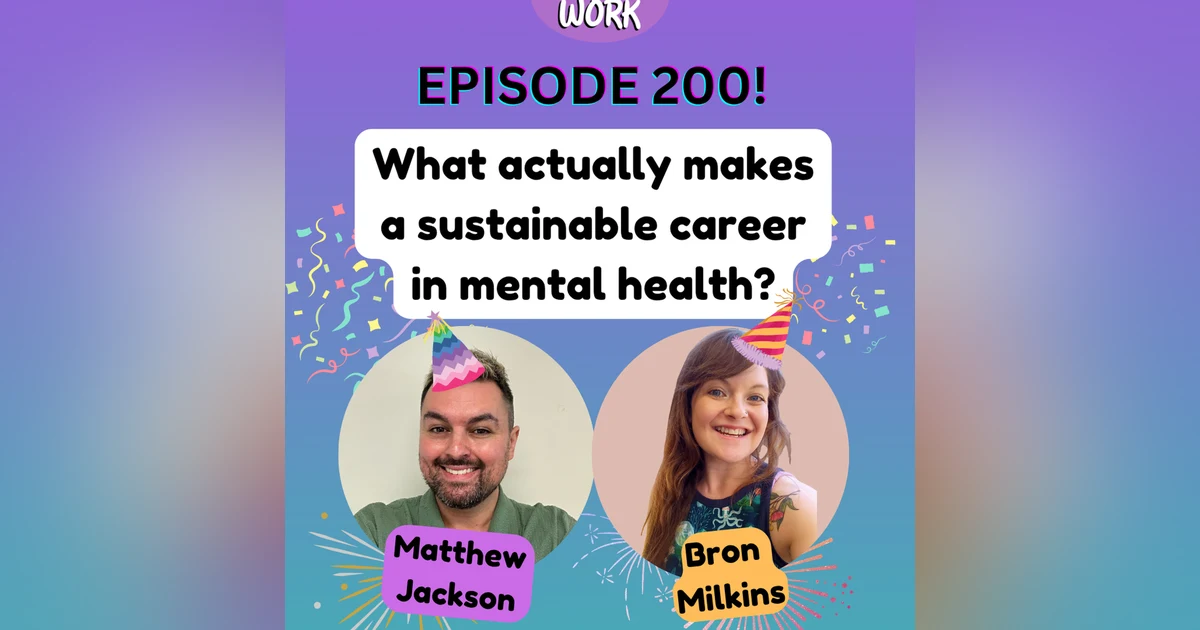
Bron is joined by returning guest Matthew Jackson to celebrate episode 200 with a live recording about one of the most important questions in early-career psychology: how do you actually make this career sustainable?
They chat about:
👉🏽 What hasn't worked for their own sustainable practice, including poor work/life boundaries, rescuer complexes, and placement scarcity
👉🏻 How time-blocking psychology roles (and building a life outside them) changed everything for Matthew
👉 Why "stints" in different roles are not a red flag on your CV but a sign of healthy self-knowledge
👉🏿 What has kept them both in the field, even when quitting felt very close
Guest: Matthew Jackson, Registered Psychologist and Board-Approved Supervisor
THE END BITS
Mental Work is the podcast for psychologists about the realities of working in mental health, with an early-career focus. Hosted by psychologist/researcher Dr Bronwyn Milkins.
Support the show by buying me a virtual coffee ☕🍵
Have a question, episode idea or just want to say hi? DM Bron on Instagram, leave a comment on the Spotify episode, or email mentalworkpodcast@gmail.com
Apply to be a guest / YouTube (with captions & transcript) / Website
CREDITS
Producer: Michael English
Music: Home
Commitment: Mental Work believes in an inclusive and diverse mental health workforce. We honour the strength, resilience, and invaluable contributions of mental health workers with lived experiences of mental illness, disability, neurodivergence, LGBTIQA+ identities, and diverse culture and language. We recognise our First Nations colleagues as Traditional Custodians of the land and pay respect to Elders past, present, and emerging. Mental Work is recorded on unceded Whadjuk Noongar boodja.
Disclaimer: Mental Work provides informational content. Mental Work is not a psychological service and being a listener or guest does not establish a therapeutic relationship. Content should not be considered a replacement for professional consultation or therapy. All views expressed are personal, subject to change, and do not represent those of any affiliated employer, service, or organisation past or present. Efforts are made to ensure accuracy, but opinions may not always align with fact. Listeners are encouraged to thoughtfully assess the information presented and report any inaccuracies or concerns via email. Further information can be found here.
See omnystudio.com/listener for privacy information.
[00:00:00] Bronwyn: Hello mental workers. Welcome to the Mental Work podcast, the podcast about working in mental health for early career psychologists, and today is a very special episode of the Mentor App podcast, it is episode 200 and our very first live recording. Thank you so much for being here, I really appreciate it. Now, I genuinely did not expect the podcast to get to this point when I started it back in December 2021, it has been a while. And before we jump into this episode, I just wanna take a moment to reflect on what this podcast has become.
[00:00:36] Bronwyn: So as of today, it's 200 episodes published. We've almost got 180,000 downloads, which is awesome for such a niche podcast. When I started out podcasting, I did a podcast course, and the, the facilitator of the course, she was like, yeah, if you get more than 30 people an episode, you're in the top 10%. And I was like, oh, cool, well, we're doing good then!
We've had a hundred plus guests sharing their expertise and experiences. They've all been unpaid, they're generously donating their time. We've also had three international guests. The first time I had somebody international reach out to me, I was like, whoa, this is so cool. They have come from London, the US and Sweden.
We have lost two episodes, unfortunately, that sucked. Maybe we'll get around to recording them one day.
And we've also received lots of love. So I would say over the past few years I've had around 150, that's just my best guesstimate, messages, emails, support from listeners all over Australia and abroad. I've had about 50 plus donations on the buy me a coffee platform with our largest single donation being $125. Thank you so much. And at one point we had around 30 Patreon subscribers, so thank you.
Most importantly, we've stayed true to the mission of the podcast. My mission is just to have honest conversation about the real parts of this work, of being in mental health that are under discussed, left out of training or avoided because they're a little bit too messy. I'm really grateful to each of the listeners for listening.
So today's milestone episode is about one central question that has followed me the whole way through, through my career so far, and I think it's relevant to everyone. The question is, how do you actually make this career sustainable? And that's what we're going to explore today. Looking back on what we thought early on and looking forward at what we think now.
I just said we. So, yes, there is a special guest today to help with this question, and we've got a guest that always brings good insight, great energy, good vibes, it's Matthew Jackson. Hi Matthew.
[00:02:38] Matthew: Hi. I am back, back, back, back, back, back, back again.
[00:02:42] Bronwyn: Yep, you are so back. You've been on many episodes, have appreciated you very much, and I am stoked to have you here. Can you just introduce yourselves for listeners who have never had the pleasure of listening to you.
[00:02:55] Matthew: And the pleasure is all theirs. My name is Matt. I am a registered psych. I've been practising since 2018, so if you can do math, let me know how long that is. I'm also a Board approved supervisor and I also secretly do a few other jobs, which we'll talk about today. But that's me in a nutshell.
[00:03:14] Bronwyn: Oh, I'm very excited to hear the secret. Good, um, good sprinkling of things to come. Nice work, builds anticipation.
[00:03:21] Matthew: I'm such a carrot dangler, like I do this to my clients too.
[00:03:25] Bronwyn: Stay tuned for what's happening at minute 50 of your, of your session.
[00:03:29] Matthew: Literally on season three, let's talk about it.
[00:03:33] Bronwyn: Okay, so let's start with the big question. Have you found the secret to working sustainably as a psychologist? And I'd like to start with what doesn't work, what you found hasn't worked, and then we'll get to what has worked.
[00:03:48] Matthew: Yeah, I think, I think I have kind of cracked the code for myself, right? So I imagine this will be different for everybody and I'm excited to hear your perspective as well? 'cause I think it'll be slightly different to mine. So that should be interesting. But I think I have cracked the code.
So something that I know, um, I guess it doesn't work... uh, and I've experienced kind of everything. I think being a psych I've experienced burnout, systemic issues, bullying by senior clinicians, that's a separate topic, we need to talk about that one day. Um, oh, directors and managers who like have used me as their own therapist, all these different types of things.
I think for me, some of the things that don't work is like getting too involved in those position titles, right? Maybe like getting too close to managers and, um, team leaders and senior psychs and allowing them to view me as more of a friend rather than a colleague? That blurring of boundaries has really not worked for me at all.
Also like just working in psych purely, right? So being a psych five days a week, at one point I was a psych seven days a week.
[00:05:05] Bronwyn: Really?
[00:05:06] Matthew: Yeah, lockdown was unhealthy, let's be really honest. But, um, working as a full-time psych five days a week, nine to five does not work for me, right, at all. I'm sure I've got more to say to that as well. Um, but I think, uh, just working as a psych in general, right? So one of the things I've kind of cracked, I think is that psychs do need variability. Like we need to be able to do different psych roles and then we also need to be able to do other roles that are also not psychology related, right?
And this is something that like I even talk about with some of the students that I teach at a university, but even my supervisees, like, okay, it's great that you're enjoying psych, that's really cool, and so what do you do outside of psychology? Like, not just like interest related and going to the gym and self care, like what do you do outside of psychology? There's gotta be something else there. I'm curious to know what it's like, what hasn't worked for you?
[00:06:05] Bronwyn: Yeah, you mentioned a lot of themes that I also resonated with. So when you were talking about boundaries with supervisors and managers, I wrote down something that was similar to that. And the thing that I wrote down specifically was being with supervisors who, I guess appear to think that they can be more casual or even just a little bit more emotionally dysregulated with you, because... I don't know, I don't know if their perception is that this is quite a different relationship? But I wrote down that supervisors, they're also delivering a professional psychological service to supervisees, and they need to be behave professionally at all times, it's not like you can just relax and be friends and be kind of collegial that way.
And having gone through the supervisor training myself, this is very much emphasised in that training, which I appreciated because it helped me to understand that it's- maybe some of the relationships that I've had in the past haven't been entirely, I guess, a- above board really. So I think having those professional boundaries with everybody in your workplace works really well. And so the, the don't of what's not sustainable is having relationships that don't make much sense.
And for me, I'm coming from a neurodivergent perspective as well, but when people have different boundaries that are not clarified or they're kind of messy or they're porous, it's confusing, it's confusing. So it's, it's not good for non neurodivergent people, but it's not great for neurodivergent folks either, and there's a lot of us in the profession. So I think that was a really important thing.
I totally agree with you about doing therapy work all the time. That's definitely something that I've worked out that is not sustainable for me. And I know this is so individual, so all the things we're gonna talk about on this episode are so individual and learned through experience. I know folks that just can do therapy five days a week and they see six clients five days a week, and I think they're more or less fine... I don't know that's what they say, but... but if that's, if that's somebody, if that is your, your passion and you feel that you have capacity to do that and you can do that well and sustainably, there's no issues with that. But I think what you and I are pointing to that, it's like, look, we know ourselves and that's not the most sustainable way for our career moving forward. So having that variety is, is what I'm gunning for now these days.
[00:08:27] Matthew: Oh, I love this. And I think that's kind of like one of the important takeaways, right? Is that if you can do therapy five days a week, eight clients a day, back to back, amazing. Like I love that for you. But as you've just said, you and I, we are not that type of person. And if you are not, that's also fine. Like make the career work for you rather than making you work for the career.
[00:08:50] Bronwyn: Yeah. And I have to say like it has improved over time. I think earlier as a provisional or more early career psych. I think I was still learning to have that nice balance between being invested in my clients and having that detachment, not carrying the work home. And I think it's just-, I've learned over time that it's just a practise and experience thing because now I feel that I can do good work with my clients and I can be in the room with them and very present, and then when I go outside of that room, that's my time. So I don't bring stuff home anymore. And I find it quite easy these days. And it's not that I don't care about my clients, I care about them very deeply, but I find that having these protected boundaries between their time and my time work so much better for sustainable practise.
[00:09:32] Matthew: Oh God, yeah. Sometimes I, I think back to like, um, a similar time of like, well, how, how was I able to not take my client stuff home? And really I think it was just 'cause I got burnt out so I think I had no other choice. And there's something kind of protective in, you know, in your early years, maybe over caring for your clients. There is something really protective in that. And I think it's okay to get to a point, maybe it's unfortunate that it might be burnout, especially in my case, but it is also okay to get to a point where you're like, yeah, I'm good. Like I'm, I, I know I can care for you all maybe over care in a protective way. But I'm good, I'm, I'm not taking this in the car ride home with.
[00:10:13] Bronwyn: Yeah, exactly. And that's something else that I wrote down on my little list of what doesn't work for sustainable practise. And the title that I gave it was "Don't Be a Rescuer". So I think a lot of psychologists, we do have this natural rescuer complex and that that can come from our personal lives, like maybe we were the ones in the family that needed to rescue or in romantic relationships, we were the rescuer, and sometimes we can bring that into our therapeutic relationships as well.
But I think everybody needs a way in their head of working this out. So the way that I've worked it out for me is that I say to myself, clients don't need us to rescue them. They need a contained, emotionally safe space where they can move closer to the life that they want to lead, and I'm delivering the therapy that can help take them there. So that's how I say it to myself. I'm like, they don't need me to be a rescuer. I don't need to be a rescuer here. But you know, that's not as easy as A to B. It's taken a few years.
[00:11:04] Matthew: Yeah... I think that's probably something like, I don't know, 99% of psychologists experience, right? Is that we, we do have a tendency to like rescue, but also we do that in our friendships too, right? Um, relationships with family, personal relationships, whatever we do tend to rescue everybody, and that's a really good way to like reduce your sustainability as a psychologist as well, is not only rescuing or trying to help and support clients, but also maybe like becoming a psych when you're not a psych and shouldn't be a psych.
[00:11:39] Bronwyn: And we covered that on our Friend episode. We did a whole episode on this about how to not be a therapist to your friends. It was a great episode, yeah. But it's so true.
The only other thing I had on my list was something quite specific, which was just talking about placement scarcity. And I don't know if, I don't know if you can relate to this, but I'll just share it anyway. So sometimes with five plus one, so your internship programme or if you're a registrar, or in my case, I was recently doing the post registration clinical master's programme, sometimes because you really need a placement, you can go into a workplace that has psychosocial hazards like bullying or other exploitative practises because you need the hours and the placements are scarce and sometimes there's literally no other opportunities available. And I, I don't really know how to fix this, but my only thing that I wrote down was that if you work out, if a, a workplace is exploitative, then don't try and save it, just leave.
[00:12:33] Matthew: Get out! Run! Run! I think, uh, yeah, this is like rampant within psychology especially, um, within, you know, placements for students for sure. Um, but even, even just in like a, an everyday clinic or whatever type of setting, this is rampant in psychology. I mean, this was kind of on my list somewhere that I wanted to talk about, was a lot of psychs needing their own therapy, right? And I see this a lot in like senior clinicians and directors who really do need to do the work, and because they don't, it makes the workplace really toxic.
And as you said, when you are a student, it can feel like there is no other choice. Sometimes there actually is no other choice, as you also said, but it can really feel like that. Sometimes I do wonder, uh, you know, if you are like remote and there isn't the options, really, then what are your like problem solving solutions. But if you are in the city, oh, we might be able to problem solve that one. Is it really worth the psychological distress and then, you know, potentially physical distress, et cetera, et cetera, that you're going to take on board? Probably not.
[00:13:44] Bronwyn: It's really, I mean, it's depending on the workplace, and I've covered this before in my harmful supervisor episode actually, because I was saying like, if you feel safe and able do bring it up with your supervisor, they genuinely may not be aware. And the same as with your workplace, they may genuinely not be aware of what this system is creating; pressure and stress for you.
So it's good to bring that up, but you can only go as far as they are willing to listen. And I've brought things up and recently, uh, I was, I was shocked when, uh, somebody senior was like, to me, we really hear what you say Bronwyn, and we're going to do something different. And I was like, what? Like, first time!
But so-, it's really, it's really the workplace. But I just wanted to name that because I think from people who have sent me messages over the years and what I've seen, there can be a lot of crappy workplaces that early career psychs find themselves in, and it definitely doesn't help with a sustainable career.
[00:14:39] Matthew: Oh God no. I feel like psychology needs some healing... like some really deep healing. I think one of the things as well, um, just reflecting to myself is around availability, right? So, um, like some, there's something that I've been known to say to clients in a really blunt way, 'cause when you work with personality disorders, you actually have to communicate quite bluntly sometimes. Something that I'm known for saying is that I'm not oxygen. I'm not with you 24/7.
And so I think as a psychologist it's actually important to take that or something along those lines on board that you actually aren't available 24/7. Your compassion, it is finite. You can kind of burn it. So it is important to, you know, turn off the phone or say no to that extra person or move an appointment, take breaks. It actually is really important to do those things and not be available all the time. You're not oxygen.
[00:15:37] Bronwyn: I couldn't agree more, and that's a really lovely way of putting it. And I think it also comes back to your earlier point about therapy, 'cause I can imagine that there may be some cognitions that get in the way of that. Like, if I'm not available, it means that I'm selfish. If I'm not available, it means that I'm an uncaring professional, I'm unprofessional. And those are the sorts of things that are really interfering with our wellbeing that could be addressed through therapy.
[00:16:00] Matthew: And do you know what? It might not even be a cognition? What if it's the client, right? Like for me, I notice all it takes is like one of my favourites, 'cause like, yes, hello, I have favourites, I think all psychs do they just bullshit. Um, like if it's one of my favourites who are like, oh, but can't I see you next week? And I get that low tone immediately my brain goes, oh, okay, yeah, let's do it. Do you want like a 6:00 AM? Sure.
[00:16:24] Bronwyn: Yes.
[00:16:26] Matthew: Right? Like we, we do have to be aware of whether it's like an internal cognition or something external to us and how that prompts um, that response of like always being on, 'cause you're not.
[00:16:37] Bronwyn: True, and it can lead to creep before you know it. Like when you just said like, can I do a 6:00 PM or something? I've, I've been there and I've done that and I've been like, of course we can meet at six. Of course we can meet at seven. Saturday? Of course.
Um, and then it's like, it's, it's past Bronwyn screwing over future Bronwyn. And then I have to go back and be like, mm-hmm you did the wrong thing. And like, how are we gonna learn from this? And what are we gonna do next time? And what have we done wrong? And now we're seeing like 40 clients this week. Whose fault is that? It's yours!
[00:17:07] Matthew: It is our fault!
[00:17:08] Bronwyn: It can creep up before you know it.
[00:17:11] Matthew: Yeah, good point.
[00:17:12] Bronwyn: Have you got any other points to make about what doesn't work for sustainable careers?
[00:17:19] Matthew: I think like... I think kind of checking yourself on expectations and I'm actually talking about others' expectations, I'm not really talking about self expectations here. Not that that's not important. And in my experience, the amount of senior clinicians or directors of whatever who have said to me, um, like, you should be able to take on another day. Or, I know you're already seeing eight clients on a Wednesday, but I need you to see two more.
Like, I think actually kind of getting really honest with yourself around, oh, that person has that expectation of me, can I fulfil that? Do I want to fulfil that? And if I don't, then what's the consequence gonna be of that for me? Like, do I need to go, do I need to have an open conversation? If I don't feel comfortable having an open conversation, then what are my options? So I feel like just kind of checking other people's expectations so people with power, right? Checking their expectations of you, I think is really important as a psych as well in, um, sustainability in this career.
[00:18:25] Bronwyn: That is such a big topic and such an important thing, I'm so glad you spoke to that. We should an episode separately on that. Coincidentally, I was talking with a school psychologist a few weeks ago and she said to me that that's something that school psychologists really struggle with. So for example, the principal will say to this new early career psychologist, oh, you can do a whole of school suicide prevention strategy. You can do this, you can do that. And the school psychologist early career is like, oh, is that what I'm supposed to do? Of course I could do that? Not knowing that they can actually say no to the principal, be like, no, this is my scope of practise. This is what I feel capable of doing. This is what I don't feel.
And you're right. It's people in those positions of power who we feel, oh, I maybe I should be meeting this expectation, but it's actually good... well, actually, what do you recommend in that situation? Like, is it checking in with yourself? Is it checking in with somebody else? How do we get real with ourselves and speak back to those expectations?
[00:19:23] Matthew: Yeah, good question. I think it's totally checking in with someone else, right? Because I think if you are questioning if it's normal or not, then checking in with yourself isn't probably gonna do too much, right? Otherwise you wouldn't be questioning it, you'd be like, I know that's bullshit next. Whereas I think if you're questioning it, it might be a sign to check in with someone else who you really trust though, right? Because there are people in clinics, psych businesses, hospitals, whatever... there are people who, because of their position of power, they are a bit more concerned about the business. They are, that's their position. They're paid to think about how many clients are there and who's paying and blah, blah, blah, right? So that's fine. And if you were to check in with those people, the message that they're most likely gonna give you is, yeah, 12 clients a day is normal. You need to suck it up, right?!
So I think we need to kind of like actually use our biases for our own benefit here. I think sometimes we do have to lean into the colleague or even the friend, and this is usually me who is quite mouthy, right? Who is the person who's like, are you serious? That's not normal, that is so unhealthy, you should not, I would actually slap you if you do that. Don't do that.
[00:20:39] Bronwyn: We need that friend, yeah. That's, that's, that's good. Somebody can give us a reality check about what's normal and what's not, because sometimes we can get so isolated and insular that we're like, oh, maybe it's normal to see 12 clients a day. I once outta somebody doing that. Like I should be able to do that, right?
[00:20:54] Matthew: Mm-hmm. And do you know what... maybe it is normal if you are doing like one day of psych work. If you are maybe seeing 12 clients on a Wednesday and that's it for the entire week, maybe that is normal and maybe that's sustainable for you. But I have literally had a senior clinician say to me, I will never forget this, on purpose, a senior clinician said to me that I should be seeing 10 to 12 clients a day Monday to Friday.
[00:21:22] Bronwyn: That would make me cry.
[00:21:24] Matthew: Right! So for me, I just, I just kind of verbally attacked them because I was like, no, fuck you. Like, who are you to tell me what to do? I'm a grown adult, no way. And uh, I think a lot of it again, is that like power struggle... but anyway, that's a separate convo. Coming back, Matt, come back. So I think, um, we do need to kind of check other people's, um, expectations of us within our own role.
[00:21:52] Bronwyn: Completely agree. Okay, I wanted to move on to what does work for a sustainable career? I think you've had some changes recently, but I think, I think we've both been on discoveries of what sustainable careers look like for us. I'm super keen to hear what you feel a sustainable career looks like for you in psychology.
[00:22:12] Matthew: Okay. I love this. So you're gonna have to keep me to time.
[00:22:15] Bronwyn: Okay.
[00:22:17] Matthew: I'm extremely passionate about this. Um, so I've cracked the code, right? As I said, I've cracked this for me. Now, this might not work for you, but trust me, this works for me. I've worked out, I can only do psychology roles three days a week. So I have to split my week into psychology roles and nons psychology roles.
So what I currently do, 'cause you're right, I've made changes, um, I actually, I've made changes on the changes because we've gotta constantly review these things. So I'm currently doing psychology roles three days a week. So I work in private practise, um, uh, someone else's as well as my own. Um, I also, under psychology roles, I do supervision. So if anyone wants supervision, hit me up. Um, I also, consult for private clinics. So whether they want someone to come in and help them with like DBT stuff or, you know, sometimes in group supervision there's some things that are kind of being left unsaid, I'm typically the person in the room who's like, oh, there's an elephant and I'm gonna out it.
So I'll kind of, you know, um, do some consultation with private clinics around maybe setting up some group supervision or I do a lot of like self care and sustainability presentations for clinics, things like that. So that's like my psychology role.
Then two to three depending on a weekend. Um, I do nons psychology stuff. So, um, outside of psychology, I'm a professional and soon to be famous, thank you TV, drag queen. So, um, that takes up a good like maybe day of my week and is incredibly creative, right? I get to like be funny and silly and all that stuff. And I actually don't have to think about therapy at all. So I will always kind of start my like bingos and stuff with like, we are here for fun. If you get insulted, go tell your therapist, 'cause I'm not them and I kind of love it 'cause they don't know I'm a therapist,
[00:24:19] Bronwyn: Saucy!
[00:24:20] Matthew: Right? Um, but do you know what? I also do mindfulness breath work classes at my local gyms.
[00:24:26] Bronwyn: Oh, amazing.
[00:24:27] Matthew: And I don't see that as psychology work, 'cause I'm actually not entering the space as a therapist, I'm, I'm not here for any of that. I'm purely just here for mindfulness practise, and I do that outside of psychology in my actual like, real day to day life. So for me it fits into that category quite well. But I'm also starting two businesses, right? I'm starting a business with my partner around 3D printing, and I'm starting a bus-. Yeah, thank you. And I'm starting a business with my mum around soaps, like natural organic soaps.
So, um, for me, psychology has like, it has to be contained to three days a week. I really can't extend it any more than that. It's too much. Oh, and I also teach at a uni, so there's like marking involved in that too, that takes up a lot of time. So I have to be really aware, like when I'm planning my, like, my weeks that like it's only three days, Matt, the other four have some fun.So
[00:25:25] Bronwyn: Mm.
[00:25:26] Matthew: that's how I've kind of worked out sustainability in regards to like psychology and non-psychology.
[00:25:32] Bronwyn: So it sounds like your energy across a variety of things that feel deeply meaningful to you.
[00:25:40] Matthew: Yes, 'cause I think that's something that I've definitely experienced. But a lot of people who I've supervised have also said this in their own experiences that like psychology has become their identity. And I definitely felt that it became all of me and I was not able to take off the hat at all. I almost didn't want to 'cause then who the hell was I? So for me, I've had to restrict myself, what's that phrase? Time keeping or whatever it's called?
[00:26:07] Bronwyn: Time blocking.
[00:26:07] Matthew: Time block! Thank you, yes, that's, thank you. Thank you. So I've had to use that, right? That's typically used with like diaries and organisation, I've had to use that for psychology. I'm like time blocking myself into a certain amount of days or hours per week, and outside of that, then I have to work on the other parts of my identity. Like who else am I outside of this? Which has totally changed me as a therapist, by the way. Like that's a whole another topic. But being a nons psych has totally impacted me as a psych in really positive ways. I've had to not only diversify my work, but make it really varied, super varied to keep it interesting.
[00:26:48] Bronwyn: I loved hearing about that. You do so many amazing, like things which, uh, which really give to a, a wide variety of sections of the community as well. Like even being a drag, like you give people a really fun and enjoyable time, like with you and their friends. It's just, it's really lovely.
[00:27:04] Matthew: And do you know what, you can do it. Like I remember being told by a supervisor, uh, and if you listen, you're gonna know who you are! I remember being told by a supervisor, don't do drag. Yeah, I remember being told directly to my face, don't do drag. 'cause if Ara finds out about it, they're not gonna be happy. Like, why won't they be happy? I'm not doing anything psychology related. I'm not, you know, bringing down the name. I'm not like, um, I'm not talking poorly or badly about psychology, I don't wanna do anything psychology related when I'm in drag, yuck! And I think I just had to like fire that supervisor and come to realise that like, I've been doing this since 2019. I've been doing drag for a long time, like nine years or something. AHPRA have never emailed me about it.
[00:27:50] Bronwyn: Yeah, it sounds like a really stigmatising attitude towards it.
[00:27:54] Matthew: A hundred percent! And so I think like, I, I really hope that if there's any take home that anybody listening is able to really understand that, yes, psychology can be scary, especially when you're first starting out, everyone just like piles AHPRA on top of you, it's terrifying, um, and maybe rightfully so in certain contexts. But you can actually have other careers, jobs, um, interests outside of psychology and like, I'm nine years into drag AHPRA don't care. They don't care. So I think it's fine people.
[00:28:27] Bronwyn: Yeah. No, it's really good to hear that, I think.. I think a lot of therapists, they have this creative side of them and they want to do something like the soap making or like the furniture making, I don't know what people do, you know, stuff like that. They wanna do it, but they're like, oh, will somebody come after me? I think that's really natural and normal to feel that way.
So it's really heartening to hear from you that, look, I'm doing my passion. I've separated the psychological work from the nons psychological work. It's not like I'm bringing anybody into disrepute or behaving in a way that is, uh, like discriminatory or like, you know, like, poor conduct sort of thing. Um, because sometimes AHPRA can be unhappy if you do poor conduct outside of psychological therapy, like harass people and stuff. Um, yeah, don't do that. Um, but you're not doing that, so all good!
[00:29:12] Matthew: It's simple people!
[00:29:13] Bronwyn: Yeah. Be a good human and you'll be okay!
[00:29:16] Matthew: Yeah, now, tell me what works for you, I'm so keen.
[00:29:21] Bronwyn: Yeah, I find it really diff, I find it really interesting our different approaches. So like you, I had a bit of a crisis when I stopped doing therapy for a bit and I was like, who am I? Am I still a psychologist? And I felt like my identity was very much tied into being a therapist who does therapy, and I was like, oh, oh... So I had a bit of a crisis there.
But, um, what I've done is, so I'm a psychologist, but I also got my PhD in like my twenties as well, that was the first thing I did. And then I became a psychologist afterwards, so I was like, huh, I actually have another career that I could fall back onto, the research one, which I thought I wasn't very good at, to be honest, that's why I didn't pursue it, 'cause I was like, I don't actually think I'm a very good academic. Turns out I'm okay at it.
So what I do now full-time is I just finished up clinical work. So I just did like a nine month stint of clinical work and now I'm back to research full-time, literally as of this week. And I'm really happy doing research. It's such a, there's a lot of variety in research itself. So for example, I'm doing a lot of community involvement and that involves like..., re- so my research focuses on trauma and dissociation. I recruit people who have lived experience of dissociation and I'm creating advisory groups right now. I'm seeking their input. I'm wondering how we can co-create resources together. And I find that really rewarding because people with dissociative disorders typically haven't been involved in research, and they're also the people who have been really vulnerable to systems abusing them or people in power abusing them. And they developed dissociation as a coping response, as a genius survival strategy. So it feels deeply meaningful to me to involve them in research. So that's one aspect of it. And then I conduct some other studies and I create studies and I apply for grants. And I, I think of ways to improve mental health. So I find that really satisfying.
And what I've worked out is that I still love doing therapy, I actually do really enjoy doing therapy. I know there are some people in our profession who love doing therapy and then they want to, um, get into like a clinical lead and then stop doing therapy. I thought about-, I was like, could I do this pathway of like therapy, clinical lead, running, a group practise? And then I was like, no, I actually really enjoy doing the therapy. I enjoy being there and developing the skills that way. I feel like it's directly impactful. Some, you know, some days I don't feel like I'm helping anybody at all, um, but you know, you give and take.
But what I've worked out is that I think I'm gonna do best when I have stints of therapy separated by non-stints And then for me as well, I've been told from day dot that I need to niche and I've worked out. I'm not going to niche, I'm not going to niche in anything. I'm , happy not niching. And as an ADHDer, um, I should never have been told to niche!
[00:31:57] Matthew: No! Can senior clinicians and supervisors stop telling people what to do?
[00:32:03] Bronwyn: Yeah! Yeah, it's like I'm so much happier being-, so my next plans are like, you know, I've always been really interested in OCD, but I've never had the opportunity to really focus and work on it. So I'd love to do, like, go work at an OCD clinic. I've also been interested in SARC, which is a Sexual Assault Resource Centre, and working with folks who have been sexually assaulted and helping them with EMDR and other therapies. So I think I'm going to like, be like, okay, I'm gonna do a bit of OCD and then I'm gonna go into like SARC and then I'm gonna do a bit more hospital work, and that feels exciting and meaningful to me.
In the meantime, I, I'll focus back on research. I was thinking of doing some university lecturing, 'cause I look at the criteria and I'm like, oh, okay... I meet some of these criteria. But then I hear other lecturers be like, a lot of their work involves now reporting students who use AI. And I'm like, oh, that doesn't sound enjoyable to me.
[00:32:52] Matthew: A lot of it is like I'm doing some marking for students right now and I'm like, oh God, I have to do a whole thing about AI for every person, come on.
[00:32:59] Bronwyn: It was bad enough, I did some university marking, this was probably a, a decade ago, and I remember reporting somebody for copying word for word from Wikipedia, and I'm like, it must be like a hundred times worse right but I, I love, I love teaching and so I'll probably do that in the future.
So anyway, that's sort of worked out. For me it's, it's having lots of things. It's having that variety and it's doing things that feel, um, impactful and I guess following my values around that.
[00:33:23] Matthew: Oh my God, can we also just briefly talk about stints?
[00:33:27] Bronwyn: Yeah!
[00:33:28] Matthew: This is something that I think, um, I've noticed it within society, so like, not just psychologists, but within society. There's definitely like old school belief of, you know, you, you join a workplace and you're there for life kind of thing, very old school. And I actually don't think it works within psychology. It might work within certain professions, but not psychology. I think you actually do need stints in order to stay interested. And I think you described that really well, right? That like when you do need a break from therapy, because we kind of all do actually. I'm sure there's maybe one or two who don't, like, amazing, love that for you, but I do too.
[00:34:07] Bronwyn: Yeah.
[00:34:08] Matthew: It is actually so okay to take stints, right? To like, stop doing that work and find this type of work or that type of work. Go into research, go into teaching, whatever it is. Like it really is okay to take stints and stay at workplaces like short periods of time if that's what you're needing, rather than like pushing through and staying somewhere for like 10 years and you're completely miserable. Not worth it.
[00:34:32] Bronwyn: I completely agree. And, you know, um, being in a position where hiring is now a part of my job, I think sometimes other people are like, oh, but they've, they've been between like three or four different workplaces in the past few years. And I'm like, no biggie, it might've been a shitty workplace or they just had a different interest.
[00:34:48] Matthew: Yeah, why does that say anything about the person who's applied for the job? Like, aren't we taught as psychs to be curious and to ask questions?
[00:34:56] Bronwyn: Completely agree. So Matthew, I'm looking at the time and, um, you know, we are, we are literally halfway through my episode plan, so we'll have to do a part two of this episode. But I reckon if we actually-, was there anything else on sustainable practise that you wanted to add?
[00:35:12] Matthew: No, no, go for it.
[00:35:13] Bronwyn: So with, with kind of wrapping up, I reckon we can do this final segment, which I think is a good one, but I've titled it as, We Almost Quit. And, um, I think my final round of questions will be around what's keeping you in the field, why haven't you left?
[00:35:29] Matthew: Oh gosh. Okay, I feel like why I haven't left. Let's start with that. I haven't left for multiple of reasons. The first one is super practical. Psychology pays well and I have a mortgage.
[00:35:47] Bronwyn: True.
[00:35:48] Matthew: Point blank period. It is what is, suck it up if you don't like it.
[00:35:51] Bronwyn: I relate.
[00:35:51] Matthew: No, I'm kidding!
[00:35:53] Bronwyn: Yeah, though. It's so true, money-
[00:35:56] Matthew: It's practical. I'm sorry, but in 2026 with the cost of living and everything, et cetera, et cetera, I'm not playing games. So, um, psychology pays well and I do quite like that part so practically love that.
One of the other things that has kind of kept me, uh, in psychology is actually my clients winning. I fucking love it, right? Had a massive win this morning. Can't really tell you more 'cause it would massively break confidentiality, unfortunately, but had such a massive win with this client who's been seeing me for probably four, four and a half years. Long-term client, and it was such a dramatic win that I was like, I'm gonna cry, so let's cry together 'cause I can't take this.
Third answer to it is, I also do really like the flexibility. I've gotta be honest, I like that we can have stints, so that's a tick for me. Like, I love drag, love making soaps, love all of that. I don't, I don't see myself doing anything for like three or more days a week, I don't. And so I think it's really important for me to help people in the way that I am. That's super important for like, my life and what I think will happen to, like, spiritually speaking, what'll happen to like my soul when it's my time.
So, um, yeah, there's quite a lot keeping me there. What's keeping you in psychology?
[00:37:16] Bronwyn: it's very similar. It's interesting to hear you talk about it. What I heard from you was that it connects with something very deeply important. And when you see that your work is translating to changes in people's lives that can just feel to the point where you just feel like crying, you can just be amazing.
Yeah, like I have, I think we've both been very close to quitting at some point. And I've literally had tearful discussions with my supervisor about it. And then I realised, yeah, what I needed to do to make this sustainable for me. And I think why I stay is because I think good therapy can be very impactful. And so I try and be as helpful as I can in therapy, and I think my skills have gotten better over time as well. I noticed that I can, uh, be more challenging, with clients in the service of helping them get to where they want to be in a deeply empathic way. And I feel like I can do that more skillfully these days. Um, I feel I was like, honestly, I felt like I was a bit crap at it when I first started out, which is everything. Like, you know, you start out a new skill, you're not gonna be great at it. Um, and I think seeing the, the changes and genuinely working together with a client can just be really, really awesome.
Um, and yeah, I've just left a workplace and you can, when you close up therapy with clients, you can really see how much the therapeutic relationship means to your clients, um, and what you've brought them. And it might not be expressed during your sessions, but yeah, at the end it just becomes so apparent about what is happening with the therapeutic relationship.
I also feel it's just deeply meaningful to work in mental health. I think because of psychologists we're in mental health all the time, we don't realise how mental health is still perceived by the community. And whilst awareness has increased, stigma can be still really prevalent in the general community. So like, people can be like, oh, you see crazies, or like, you know, say other stuff. It's like, oh, they're, they're pretty hopeless, or they're doing it to themselves and why are you working with them? So there can be some pretty nasty attitudes that people can have.
And so I feel a psychologist, sometimes it, you know, it's like swimming through water. You don't realise it's water, but it's like a psychologist, we work in mental health and we don't realise that we have excellent attitudes towards people who are in mental distress. And that can be deeply helpful to them. So that keeps me in as well, 'cause I'm like, you know, it's bringing this attitude of being non-discriminatory, of realising that there's societal structures, including racism and classism and ableism and sexism, that can stop people from thriving in the world, that I can acknowledge and help with in some way. Like, I can't remove those structures, but acknowledging them can sometimes be helpful. Um, so yeah, I just wanna keep on being part of that. That's why, that's why I stay and money.
[00:40:06] Matthew: My favourite thing about psychs is that we can be so compassionate, loving, caring, and then we can be so to the point and realistic and practical - money.
[00:40:17] Bronwyn: Yeah.
[00:40:18] Matthew: I love psychs!
[00:40:19] Bronwyn: Okay, so, I think we'll go to our final question, which is usually the last one for every episode. What do you hope that listeners will take away from today's episode?
[00:40:28] Matthew: I, I hope that what people will take away is to give themselves time and permission to not know how to make psychology sustainable for them right now. Like it, it's taken you and I quite a, like, quite a long time and it's okay if it takes shorter, it's okay if it takes longer. Like, I just wanna acknowledge for people that that's really okay. It'll take as long as it needs to take for you. And also just keep experimenting because like, I, I like, I keep using this phrase, I've cracked the code, I cracked the code. But also two minutes ago I also said that I've had to like, review my changes because we're constantly doing that as human beings, but also as psychs, hello experiments. But, um, it's, it's okay to, like, when you're thinking about sustainability, get it wrong. It's really okay to mess up and then be like, oh God, okay, lemme start from the start. Watch what I know works, what doesn't work. So just give yourself time and permission in working it out. You don't have to have the answer right now.
[00:41:25] Bronwyn: I think, yeah, what you said, is, is my final message as well, 'cause I don't think there's a straight single answer to having a sustainable career, it really is you and what works for you and finding out what you thrive in and to the workplaces that you do well in. It, it honestly is incredibly individual and, but I do think the more that we talk about it honestly, about what sustainable careers can look like, the better informed we are to be able to go through that process of self-discovery.
Well this has been a delight, what a great 200th episode, thank you so much, Matthew.
[00:42:00] Matthew: Thank you for having me.
[00:42:02] Bronwyn: Yeah, thank you so much for being part of this and listeners, thank you for being part of the podcast. It's been a pleasure to have you listen along. I've been incredibly grateful for everybody that has reached out for everybody that has listened for everybody that has told a colleague about the podcast, I really appreciate it. And here's to many more episodes. I really enjoy doing this, so yeah, no plans to give it up, keep on going and, yeah!
Okay, so you've been listening to Mental Work. I'm Bronwyn Milkins. Have a good one and catch you next time!


