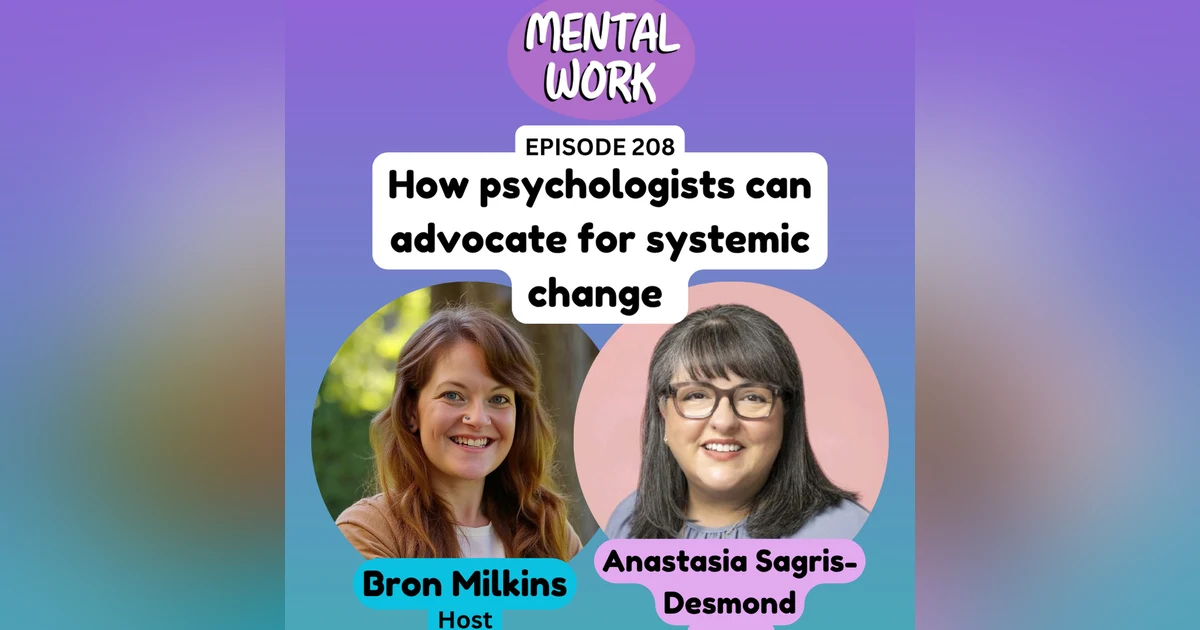
Bron is joined by Anastasia Sagris-Desmond (psychologist and graduate of the Pathways to Politics Program) about advocacy beyond the therapy room. Anastasia shares how three decades working in gambling harm and family violence led her into politics, union leadership, and co-authoring a book on coercive control and financial abuse.
They chat about:
👉🏽 Why early-career psychologists often feel pressure to "stay small" and avoid advocacy
👉🏻 How gambling harm is treated as a mitigating factor in the justice system
👉 What coercive control and financial abuse actually look like
👉🏿 Practical first steps for psychologists who want to get involved in advocacy or policy
Guest: Anastasia Sagris-Desmond, Psychologist and AHPRA-Approved Supervisor
LINKS
- Book authored by Tammy Casselson on surviving domestic violence: The Grimmest of Fairy Tales: A Lived Experience Voice That Offers Hope, Exposes Red Flags and Empowers Allies
- Pathways to Politics program (active in every Australian state and territory)
- Centre for Women's Economic Safety
- "Compulsion, convergence or crime?" A report from the Centre for Innovative Justice on contact with the criminal justice system as a form of gambling harm.
- Medical Scientists Association of Victoria (MSAV)
- The Adolescent Man Box Report
THE END BITS
Mental Work is the podcast for psychologists about the realities of working in mental health, with an early-career focus. Hosted by psychologist/researcher Dr Bronwyn Milkins.
Support the show by buying me a virtual coffee ☕🍵
Have a question, episode idea or just want to say hi? DM Bron on Instagram, leave a comment on the Spotify episode, or email mentalworkpodcast@gmail.com
Apply to be a guest / YouTube (with captions & transcript) / Website
CREDITS
Producer: Michael English
Music: Home
Commitment: Mental Work believes in an inclusive and diverse mental health workforce. We honour the strength, resilience, and invaluable contributions of mental health workers with lived experiences of mental illness, disability, neurodivergence, LGBTIQA+ identities, and diverse culture and language. We recognise our First Nations colleagues as Traditional Custodians of the land and pay respect to Elders past, present, and emerging. Mental Work is recorded on unceded Whadjuk Noongar boodja.
Disclaimer: Mental Work provides informational content. Mental Work is not a psychological service and being a listener or guest does not establish a therapeutic relationship. Content should not be considered a replacement for professional consultation or therapy. All views expressed are personal, subject to change, and do not represent those of any affiliated employer, service, or organisation past or present. Efforts are made to ensure accuracy, but opinions may not always align with fact. Listeners are encouraged to thoughtfully assess the information presented and report any inaccuracies or concerns via email. Further information can be found here.
See omnystudio.com/listener for privacy information.
[00:00:05] Bronwyn: Hey, mental workers. You're listening to the Mental Work podcast, the podcast about working in mental health for early career mental health workers. As always, I'm your host, Bronwyn Milkins, and today we are talking about leadership in psychology and domestic violence advocacy.
Early career psychologists often feel like they have to stay small or avoid speaking up even about issues they care deeply about. In this episode, we'll explore how to navigate a career in psychology while engaging in meaningful advocacy, breaking from the mould and supporting survivors of domestic violence. Here to help us out with this topic is our guest, Anastasia Sagris-Desmond. Hi, Anastasia.
[00:00:39] Anastasia: Hi, how are you going?
[00:00:40] Bronwyn: It's so good to have you on the podcast today. I'm doing well. Could you please start us off by telling listeners who you are?
[00:00:47] Anastasia: Okay. Well, I'm a psychologist that's been working for the last 30 years, predominantly in community health. The majority of my work has been supporting people with gambling, addiction and family violence. And I've worked across mainly community health, a little bit in private practise. It's very, very rewarding and very challenging work, and things have changed quite a lot over the last three decades, as you can imagine.
[00:01:15] Bronwyn: Yeah, totally. It's really good to have a little bit about your background. The reason why I reached out to you as well was because you're a recent graduate of the Pathways to Politics Programme. So this is a programme which aims to increase the number of women involved in Australian politics. How did you come to be interested in politics and doing the programme?
[00:01:34] Anastasia: I guess I've had an interest for a while, particularly in feminist issues, uh, women's health, family and domestic violence, things like that. But for me, something really ignited in me around the time that Brittany Higgins came out and spoke about her assault in parliament. And the March for Justice movement was born. I actually got involved with March for Justice and one was one of the Melbourne organisers and have been quite a active advocate since then.
I realised even through my work as a psychologist, that there are ways to empower people to think outside the square to make systemic and bigger changes that are really required to make life better for people, whether it's in gambling harm or family and domestic violence.
So I got involved with a political party locally and I've found that my progressive values and my interests were supported. And I've really just been reaching out to people and trying to make connections to try and improve policies and service delivery in the community.
When I met a couple of female friends along the way who have completed the Pathways to Politics course, and they raved about how amazing it was, and when I looked into it, I, I realised what a amazing opportunity it could be... I applied the first time, didn't quite make it. I was, um, recommended to apply again and between the first and second try, actually did a bit more in the political sphere running for council, aiding in campaigns, state and federal electoral campaigns, and I think it helped my application and so I was selected this year and have just gone through the course and it's mind blowing how much you learn about the various components of politics and leadership, things to do, things not to do... it's, I've just learned so much and we just finished in October with our speech night in the Victorian Parliament, which was very exciting.
[00:03:44] Bronwyn: Wow, that's incredible. I think I saw a photo of you as well. Did you go visit Federal Parliament House recently?
[00:03:50] Anastasia: Yes, through the Pathways to Politics course, we were offered the opportunity to be sponsored up there by a federal politician. And I was selected in a group of four from my year and we went up and spent the day with Sally Sitou the member for Reid. And she organised this amazing day where we did a tour of Parliament and went to question time as well, which is pretty exciting 'cause I usually just watch it from home like a nerd. But we were gathered in this room with alumni from the course from all over Australia and women who'd completed it in different years, not just this year, and we got to meet amazing female politicians and people who staff politicians, people involved in the party and people who have worked to assist others to run the machine of government. It was amazing. We even had a drop-in visit from the Prime Minister at one stage, which is a little bit unexpected!
But you know, women who are real trailblazers in politics, who, people like Penny Wong who said when she came along, she was really the only person that looked like her in that parliament, and now how wonderful it is to see our community represented by so many women leaders in the Parliament making decisions that are important for women and relevant for women, having conversations that we wouldn't have had decades ago when not many women were elected.
So it was an amazing opportunity, I was really, really grateful. And actually I was able to stay an extra day and go to the Press Club address and see the Jesuit services, Matt Tyler and Kate Fitzgibbon give the report on the Adolescent Man Box as well. So obviously being interested in domestic violence and male violence, that was quite a privilege also.
[00:05:40] Bronwyn: Huge privilege. So I can see you're really involved in this space and you're really passionate about reducing gambling harm and improving outcomes for domestic violence and supporting survivors. Many psychologists feel pressure to shrink, to avoid scrutiny, judgement , I guess they just feel like they can't speak up. What's your feelings about this and how have you managed Any thoughts like that?
[00:06:03] Anastasia: I think I'd agree with you that perhaps early on in one's career, there's a, a real focus on your client work, particularly. It's your world can be a little bit small in terms of helping the people, which is the most important work you're doing, helping the people who come along to see you... supporting them through various methods to, to reach their goals, to improve their lives and their wellbeing.
Over the years, you tend to notice that people might talk about similar kind of systemic issues that are holding them back, or psychologists as a group, we've always had, I suppose we've always had issues about people accessing mental health support. Things like Medicare sessions, availability of, of mental health services in the community, private and public... and I think there comes a time where you start pushing against things a little bit. You can see that perhaps with your lived experience from the professional side, you can offer the powers that be some advice about perhaps how things could work better, or you could empower your clients to reach out to their local member or reach out to various other support services to advocate for themselves. To increase their confidence and to increase their agency, and not just to be dependent on you as the therapist, but also to, to see more broadly how they can change life for themselves as well.
So I think... people are different. I didn't have the confidence to do that until later in my career, but some early career psychologists might feel really passionate about things and, you know, do that earlier. But I think that if it's something you're passionate and driven by, you do tend to really use your strengths and enjoy what you're doing as well through the advocacy piece. And you learn a lot, I think, which contributes to your practise as a psychologist too. So things like gambling harm, obviously I've, I started one of the first gambling support services here in Victoria 30 years ago, and so things have changed a lot.
[00:08:22] Bronwyn: Yeah.
[00:08:22] Anastasia: Gambling is so much more accessible, electronic gaming machines here in Victoria, you know, pretty much in every pub and club. But now we have sports betting as well, and it really is affecting a new generation of young men. Particularly, we see a lot of tradies, a lot of young boys sort of being groomed into this gambling behaviour on their phones and it's very dangerous and very predatory.
So we can be involved. In submissions to governments, sometimes, making suggestions. The Peta Murphy, 'You Win Some, You Lose More' report, the federal report, we were able to give a submission from the organisation that I work for, and I know that some of my clients actually gave evidence and gave submissions as well about their lived experience of how gambling has harmed their lives.
[00:09:16] Bronwyn: The amount of impact you can make is a lot. Or do you feel like you are contributing? Like do you feel the work is meaningful that you're doing?
[00:09:24] Anastasia: Absolutely, absolutely. I, it's one thing to be able to give face-to-face, one-to-one support to someone, but it just gives an additional layer to have that other input into potentially the way that policies are set or the way that industry might be changed. Like here in Victoria where we've reduced the opening hours of gambling venues and we're looking at introducing mandatory 'carded play', so people need to pre-commit how much they're willing to lose. So that kind of insight into the fact that you are going to lose money is a real change for people and will help them. It might prevent people developing gambling addictions as well. So, you know, we wanna work in the prevention space, not only in the tertiary space as well.
[00:10:20] Bronwyn: Yeah. So just returning to something you said a little bit earlier, I just wanna make sure I understand. So it sounds like, it wasn't necessary that you felt like you shouldn't get involved in politics, it was like, look, I'm noticing these systemic issues and this is the natural next step for me. Does that sound about right?
[00:10:39] Anastasia: Yeah, I think that's a nice way of describing it. Yeah, it, it felt like it was time to kind of ramp up my involvement and also to use my expertise and my privilege to be able to, sometimes on behalf of clients, make contributions, but in other instances, encouraging them, empowering them to make their own attempts at advocacy. And a lot of them have joined lived experience groups and those who have gone through their journey of recovery, now go and give talks to other people about what they did and how not, you know, how to try and protect yourself from developing a gambling addiction. So yeah, there's so many ways that we could really input into people's lives being better.
[00:11:28] Bronwyn: Absolutely. I'm curious to know whether you think psychologists can play a unique role in shaping public policy. Like do we offer anything that is perhaps unique in that space?
[00:11:39] Anastasia: I do. it's interesting... We are funded through the state government here in Victoria, and I think I'd like to see, particularly in the health space, the mental health space and, and gambling help as well... I'd like to see more people working in the space who've got the lived experience of the psychology background or the counselling background more broadly. I think sometimes some of the policies might be set by people who perhaps don't understand the nuance of how long it takes to, to treat or work with someone who has an addiction or any mental health issue.
We are fortunate that we can work long term with people. Um, in our, in other industries like alcohol and drugs, there's a, like a succession limit for publicly funded programmes. Now, really, you don't get much done in six sessions. Really, you're just getting to know each other and starting the work. Even in the Medicare system, 10 sessions a year really is not enough. I'd really love to see more people perhaps with, with the experience of how long it takes to work with someone to really be influencing those decisions about how we can care for people better.
[00:12:58] Bronwyn: Mm-hmm. You raise a really good point because I think like we know what psychologists do, but I think a lot of people, black politicians in the general public don't really understand the work that we do.
[00:13:07] Anastasia: I think they perhaps don't understand the complexity of the, of the work. Particularly in the area of gambling harm. I think it's convenient for partic-, oh, possibly this is gonna be controversial, I think it's, it's convenient for the gambling industry to talk down the impact of gambling addiction, and maybe to victim blame sometimes also. That it's, you know, it's the person's responsibility they really need to make sure that they don't overdo it.
You have access to gambling on every corner, you know, it's, it's very accessible. There's lots of enticements, it's open a lot of hours of the day, so it suits a lot of people, whether you're a shift worker or a, a mum dropping kid off at school, or anyone really after work, a tradie, a salesman. It's not only that people might be making the decision to spend more. Once you're in there, your brain's really offline, you know? And particularly if you've had a drink as well, you're not making the best decisions.
But a lot of people are going there to try and cope with other underlying issues. There's a lot of depression, a lot of, a lot of trauma, a lot of anxiety, relationship issues, other addictions. When people come and see us, it's not ever straightforward. There's a lot of, lot of complex issues that take time to untangle if people are ready. And it's quite, it can be quite confronting and threatening, you know, you have to go gently with people. But it is a complex issue that needs time, a lot of time to, to unpack and to work on practical strategies as well as emotional strategy.
[00:14:48] Bronwyn: So I'm hearing from you that a key role psychologists can play is raising the alarm on how harmful say gambling is for people and really sticking to that because we see it, we know it, we know from the evidence, and I feel- that resonates a lot with me. Labor's inaction on gambling harm was like a top three reason why I didn't vote for them at the last federal election. I was very disappointed in that because I'm really passionate about reducing gambling harm as well. The accessibility of gambling and the harms that it can create, not only for the individual but for the community as a whole is, deeply concerning to me.
[00:15:24] Anastasia: I think we've got a-, I think we have made some improvements, but we do have a, a long way to go to protect people from, from gambling harm, the way that we did to, you know, from tobacco.
[00:15:37] Bronwyn: Yeah!
[00:15:38] Anastasia: And, even, you know, tobacco and, and climate denial... They, it's like the gambling industry is kind of reading from the same playbook, you know? I think that we need to prioritise people's wellbeing and protect our commun, you know, people who we are all vulnerable, but particularly some, some people are more vulnerable than others to addiction. And I think I'd really like to see those recommendations implemented in full.
[00:16:06] Bronwyn: Yes, definitely. So I guess just changing track for a moment, you are in a quite a unique role I feel, in terms of the things that you do. There's not many psychologists I know in this space, who, I guess, engage in the amount of advocacy that you do. And another role that you engage in is as a union delegate. And I just wanted to ask you if you could tell listeners a bit more about that?
[00:16:28] Anastasia: Yeah, sure. Well, here in Victoria, um. Psychologists can belong to the Victorian Psychology Association, which is the union that covers us. And we are part of the Medical Scientists Association of Victoria through their Health Services Union. I first became aware of the union and what it could do for me, unfortunately when there was some problems in, in a workplace I was at, and, I joined the union and we were able to have them come out and advocate for us in a in a conflict situation.
When I found out about the possibility of contributing to the union and enterprise bargaining and working out ways that we could improve conditions for psychologists working in community health, which is my area, I got excited about becoming a committee member a few years ago, so I did that. I was nominated and, and got onto the committee and this year I'm actually been elected treasurer of my committee.
[00:17:26] Bronwyn: Oh, congratulations!
[00:17:28] Anastasia: But, um, we're always on the lookout for ways to improve working conditions, and particularly I think for me, things like health and reproductive leave for women, domestic violence leave, these are things that... domestic violence leave is already in our enterprise bargaining agreement. But things like reproductive leave, menopause related leave. These are things that really need to be factored into women's working lives, 'cause we are half of the population and it's not, you know, it's something that affects a lot of us. Even for younger women who might delaying their, starting their families and might need some leave to do egg retrieval and things like that, like those kind of things really need to be factored into any kind of leave that's required so that we can still work, and have our, personal lives as well and you know, not have to choose between the two sometimes.
So yeah, I got interested in the advocacy side of things from from the union and have supported some staff members with various concerns. And I'm always out in the lunchroom putting out posters or, you know, spruiking the benefits of being part of a union and being part of a collective 'cause we are stronger together.
[00:18:52] Bronwyn: Yes, definitely. Psychologists can often feel a bit isolated in their work, and I wondered whether you feel a sense of community within your union and within the other advocacy work that you do, and whether you could speak to that?
[00:19:04] Anastasia: I do feel solidarity with the other psychologists, you know, in the union, but I think... I guess the workplace that I'm in, being in community health, the team is made up of a whole lot of disciplines. So there's psychologists, social workers, counsellors, mental health nurses, I think. So we are all sort of doing the same work, but from different backgrounds.
So, yeah, I guess, there's a, there's a sense of collegiality because we're all working towards the same purpose, but with the psychologists in particular, I think the work that we do in community health is slightly different to what, perhaps how it plays out in a private practise or in a hospital psychology unit. I'm not sure that the way that psychology was taught or set out many moons ago when I completed my master's degree is the same way that it operates. I think we have more of a... more of a community advocacy feel in the work that we do. I can't speak for other settings where perhaps they work with chronic illness or, or maybe the more severe end of some of the disorders... I kind of feel like it's a more grassroots kind of connection with people in the way that we work and we, we might be a bit more diverse in the way that we offer services too.
[00:20:30] Bronwyn: With your work in community health, maybe over a long period of time the emotional demands get less, but it still is a significant cognitive and I guess an emotional load of working in community health with vulnerable populations. Working to change systems can also be quite cognitively and emotionally demanding, and I just wonder how you go about navigating the too.
[00:20:53] Anastasia: Oh, that's a good question. I think I'm very lucky in my clinical work that I get great supervision, individual and group supervision with the complex clinical work that I do. Outside of that, I think one of the things that drives me and that nurtures me is this, want to make things better. I think it's a, it's a passion and it's a drive that I strive toward. I don't, I don't want to get discouraged or put down or put back, you know, I just always, if there's any setbacks, I just think, okay, well how can I tackle this a different way? Or who else can I talk to? Or surely that's the o that's not the only door in, must be a different way.
So I try and I think having the balance of the working, the clinical work and then the advocacy is a nice mix for me. I like to work on the big picture stuff when I'm out of the more direct service provision. And if I can see that there are some improvements or some gains made, it kind of then buoys me in the other area too.
One of the other things I, I also do outside of work is I'm a AHPRA approved supervisor, so I like to work with other psychologists and support them in their practise as well.
[00:22:15] Bronwyn: So there's a few things that fill your bucket.
[00:22:17] Anastasia: Yeah, I, I do-, I've always enjoyed having a diverse role. Like even when I work for Gambler's Help, I do training as well of other health professionals in awareness about what constitutes a gambling addiction, gambling is a public health issue, how we can screen for it in other settings and, how we can intervene and, and how we can treat it.
One of the things I'm very passionate about is treating gambling as a mitigating factor in offending as well. I've done some training with lawyers and magistrates about recognising gambling disorder as a legitimate mental health issue and something that needs to be considered in cases where people have stolen money or misappropriated funds to gamble, and how it can be considered in, maybe more of a therapeutic court, to give people support that they need with their gambling addiction and see that there's a connection between their addiction and, and the offence that was committed. Not to treat us as an excuse, but to see that there was a, a mitigating factor there. So, yeah, there's, there's that kind of advocacy piece as well in justice.
[00:23:36] Bronwyn: Yeah, and that's really important as well, because some people might just wave it off. Like magistrates might be like, oh yeah, and they've got a gambling addiction. Okay, next thing kind of thing, and they might not treat it as a mitigating factor, like you say. So it's really important role that you serve and saying, Hey, there's a link between these two things.
[00:23:54] Anastasia: Yes, for a very long time it's been seen as an aggravating factor. You know, they're, uh, what do they say? That they're greedy or it's a lifestyle factor, or there's no consideration... They know more now because they know more about other mental health issues, but when we went to train a group of judges and magistrates, they were really open to the fact that, "oh, okay, so this is in the DSM now, or this is in the ICD. Oh, all right. Well now we know about it now. Thank you very much".
So it's not that they're not open, it's just maybe that they haven't had the refresher training that they need along the way just to keep up to speed with, you know, what's happening in the, in the psychiatric and psychological world.
[00:24:34] Bronwyn: That's really encouraging to hear and it's, it's a tangible outcome that you've got in there, so well done!
So I'm willing to bet there are listeners who are like, "I'd love to get involved more in policy or advocacy" and doing the kinds of things that you've done. What practical advice would you give to other psychologists who want to make an impact outside the therapy room?
[00:24:53] Anastasia: I think, find something that lights a fire in you find an area perhaps that you're working in, that you're really passionate about. Or consider something that might be personal to you, your own lived experience or that of a family member, and do some digging around, you know, what's involved in how's the area currently being managed? What could be improved? What are your, what are your thoughts about improvement? Talk to people, other people who work in the area. Talk to your local member, you know, where you live, your state or federal member. Put your, put your thoughts in writing, write to someone, I know it's very old fashioned. I don't know, put it on X or blog about it something. But get into for other forums with other people's, other people also.
And, I think there's, there's a power in numbers as well, I think you'd find that... One of the, the, I'm in the Australian Association of Psych-, the AAPI? Yep.
[00:25:53] Bronwyn: Yep. AAPI.
[00:25:54] Anastasia: I always forget I what the I stands for!
[00:25:56] Bronwyn: Yeah. Uh, uh, Incorporated?
[00:25:58] Anastasia: Maybe. Okay. Yeah. Could be.
[00:26:00] Bronwyn: it could be, but it could be something else.
[00:26:03] Anastasia: They've often got online forums that you can get involved in, you know, asking questions or putting out ideas, and then people come together around certain issues and they can form little interest groups or little advocacy groups that way as well.
I find that a lot of people get a lot of... they get a lot out of things that mean something to them. So one of the things that happened for me recently over the, one of, you know, over the last four years is that one of my friends spoke to me about her journey of being a victim survivor of domestic violence. And I, I've known her for over 20 years and it's not something that she's ever spoken about, and it's not something that I've ever asked about. I didn't see any clues.
And during the pandemic, like everyone else, we were having catch ups on, on Zoom and Teams and whatever else was around at the time. And um, yeah, she told me about what had happened and she'd recently escaped a family violence situation and, I felt so silenced and so gagged with various intervention orders and it was just, it was just horrific. And she said, I, you know, I just wanna tell my story. I just wanna help another woman, you know, with the lessons that I've learned. And I said to her, well. Let's do it. I'll support you. Let's tell your story.
So over four years, she put down a lot of thoughts and a lot of experiences, and I kind of added a psychological lens to things giving, giving name to a few issues. It sort of legitimised a lot of the topics that we were talking about. I think people dunno a lot about family and domestic violence, but once you start hearing of terms like coercive control and gaslighting and, and other things, they, they think, oh, that's actually happening to me.
[00:27:56] Bronwyn: Hmm.
[00:27:57] Anastasia: Oh, I recognise that, yeah. And for my friend, the big issue was financial abuse, 'cause her ex took out a million dollars of loans without, without her knowledge. She's been doing a lot of advocacy work through the Centre for Women's Economic Safety to actually work with institutions to stop them being able to do things like give a loan to a couple when only one person comes into the bank, or being able to sign off mortgage after mortgage, after mortgage without the other party knowing like, you know, they're perpetrating this financial abuse.
So we wrote a book called The Grimmest of Fairytales, and we launched it earlier this year and we've been using it as a vehicle to advocate to politicians and to community groups, uh, to spread the word about coercive control and financial abuse. To teach people about red flags. And also to try and get a sense of community building around allyship and how we can help people... the kind of things that are helpful to say and the kind of things that aren't.
But also understanding the concepts around why people, particularly women who are the, the biggest victims of, of family and domestic violence, why they don't leave. You know that question? Why didn't she just leave? Well, it's actually more accurate to say why couldn't she escape? And often people don't have the means or it's not the right time, or really the biggest issue is it's not safe 'cause you're at the biggest risk because you're about to plan to go and leave or when you're pregnant as well.
So we are doing a lot of myth busting. We are doing a lot of demystifying about who victims are, victim survivors are, and who perpetrators are, because they just look like you and me. They're not monsters, they're not anything unusual, but I think we need to change a lot of the ways that the media and society understands this issue. And I think that goes a long way to helping people in the wrong, in the long run.
And one of the other issues that we're really keen on is to try and help young men. That's why I was interested in the Adolescent Man Box Report, to try and help young men shift away from these unhelpful stereotypes about what it is to be masculine and to be a man and to encourage them to experience all different kinds of emotions and that it's okay and that you're not weak if you're sensitive or if you cry or all those kind of things. And to really shake some of the societal stereotypes about our roles in relationships.
You know, one of the things that my colleague, um, and friend Tammy is really passionate about is financial transparency, and financial literacy. Why do we assume that the male in the relationship needs to take care of the finances in a lot of cases? Why is the case? Why do we need to put our money together? Why can't we have our money separate? And what's the big deal? Like, you know, people don't talk about these issues and maybe these are some of the expectations and stereotypes that set young men up to be like overburdened , with these roles and it puts a lot of pressure on the, on their mental health and wellbeing as well. Whereas if couples were equal and open, then you're setting up a much more healthy dynamic.
[00:31:34] Bronwyn: Yeah, I completely agree. Wow, it sounds like, um, you've done some amazing work in this area with that book that you mentioned, the Grimmest of Fairytales. Is that available for public purchase?
[00:31:43] Anastasia: It is, it is available on Amazon and um, in some local bookstores. And I can also include Tammy's website perhaps in any, information, and you can go directly there and order it from her as well.
[00:31:58] Bronwyn: Yeah, amazing. I'll make sure those links are in the show notes. I think a lot of listeners would be interested. Um, and yeah, it's awesome that you're raising awareness of financial abuse. My local federal member is actually really interested in financial abuse, Zaneta Mascarenhas, um, and yeah, so it's really awesome, it seems to be permeating.
[00:32:13] Anastasia: Mm mm, it's very important, yeah.
[00:32:16] Bronwyn: Yeah, yeah. 100%.
Anastasia, thank you so much for coming on the podcast today. I've been really inspired to hear about the work that you're doing, it's really awesome. I do think, for whatever reason, there are psychologists who do wanna speak up, but they feel like they need to shrink, and so it's really admirable to hear the work that you've done in the various spaces that you're passionate about. What do you hope that listeners will take away most from our conversation today?
[00:32:40] Anastasia: Oh, well first thank you very, very much, you're very kind. I'd like people to take away from today that there's no pressure about whether you do anything early in your career or later in your career. There's no right or wrong time, I think use your gut. And you'll, there'll be a moment where something comes to you and if the time's right, pursue it, go for it. You know, have a try, whether it's a, you know, something political or whether it's something to do with advocacy in the area that you're working with.
Trust your gut, I think particularly for, for females, that's a tricky one. I think we all have imposter syndrome, men and women across the board, but I think with a lot of women, we kind of... we wanna wait until we're more experienced or we've got more skills on board or, you know, like, give it a whirl. If it doesn't work out, you come round to it again in a little bit, in, in some more time. Or go off and do some study, go and learn more, go and talk to more people, be open and curious, I guess is, is the message. And be brave.
[00:33:47] Bronwyn: Awesome. Thank you so much. And I heard you say before as well that you're a Board approved supervisor. Are you open to new supervisees? Is there a way that people get in contact with you if they wanna talk about politics or anything else?
[00:33:58] Anastasia: Uh, yes, well, I'm registered with AHPRA as a board approved supervisor, but, um, people can reach me on my LinkedIn as well. Happy to take any questions or queries or anyone wants to connect, I'm always open to do that.
[00:34:13] Bronwyn: Awesome, great. Well, thank you so much, Anastasia. Again, it was a real delight to speak with you and thanks for coming on the podcast.
Listeners, thank you so much for tuning into this episode of Mental Work. If you enjoyed this conversation, please follow the podcast, leave a rating or a review and share it with a colleague. It really helps us reach more early career mental health workers. That's a wrap. I'm Bronwyn Milkins. Catch you next time, bye!


