"Murdaugh" Episode Twenty | Alex Takes The Stand
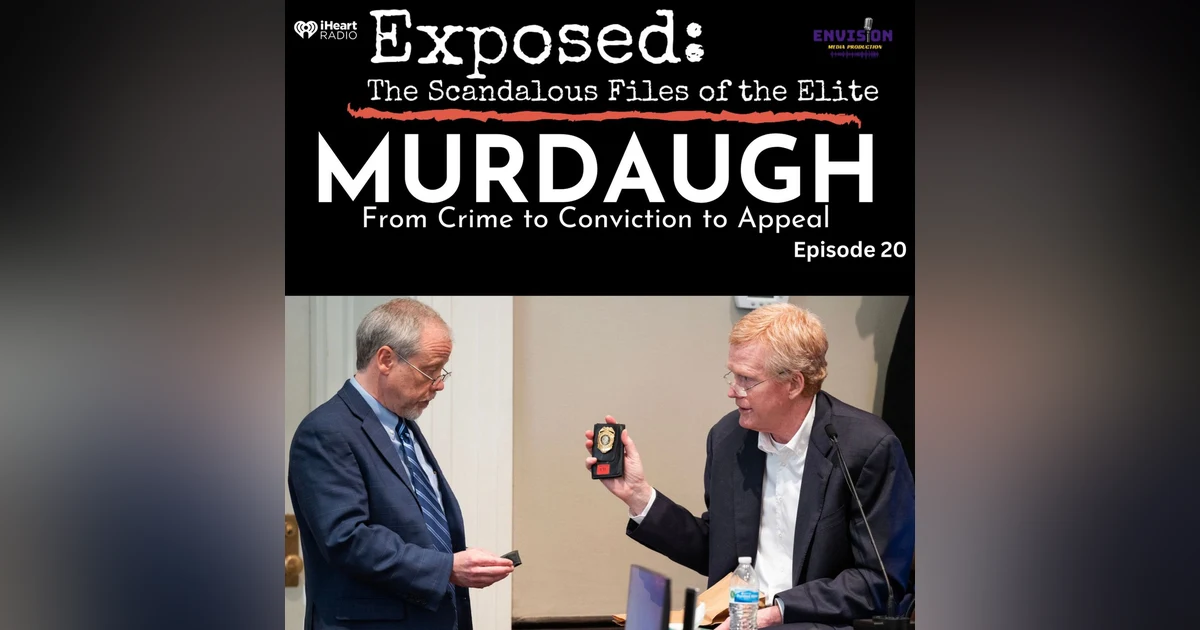

Host Jim Chapman guides you through the testimony of Alex Murdaugh as he takes the stand in his own defense, facing off against seasoned prosecutor Creighton Waters during his murder trial.
“Murdaugh” is a series brought to you by Exposed:Scandalous...


Host Jim Chapman guides you through the testimony of Alex Murdaugh as he takes the stand in his own defense, facing off against seasoned prosecutor Creighton Waters during his murder trial.
“Murdaugh” is a series brought to you by Exposed:Scandalous Files of the Elite podcast and is a produced by Envision Podcast Productions.
#murdaugh #AlexMurdaugh #creightonwaters #exposed #podcast #Southcarolina
Timestamps
00:15 Alex Murdaugh Takes the Stand
25:31 Badge and Benefits
30:27 Unraveling the Truth
31:55 The Weight of the Badge
36:12 Legacy of the Murdochs
50:25 Accusations and Confessions
57:02 Investigation Insights
1:05:21 Stolen Money and Legal Fees
1:38:37 Falsifying Recovery Amounts
1:47:55 Conversations with Victims
1:52:36 Reflection and Recess
For collaborations, promotions, or appearances email Jim at: https://www.exposedpodcastfiles@gmail.com
Become a supporter of this podcast: https://www.spreaker.com/podcast/exposed-scandalous-files-of-the-elite--6073723/support.
0:11 Hey everyone, and welcome back to Exposed Scandalous Files of the Elite. I am your host, Jim Chapman, and we are back with this twentieth installment in the Murdall series. And if you were to ask me at the start of this series, what part did I want to get to so bad I could taste it? It's this episode right here, So let me set the stage. Alex Murdall does something that I sure did not predict at the start of this trial. He takes the stand in his own defense. And if you've been around a little while, you know, like I do that, in almost one hundred percent of cases, the worst thing that you can possibly do is take the stand in your own defense. It's a quick way to incriminate yourself. And remember the burden of proof is all on the prosecution. When someone is defending themselves on the stand themselves, they are typically losing.
1:23 So why did he do it? Well? I think it's twofold. First, I think everyone on the defense side of this trial, including Alex, they knew they were pretty much getting their asses kicked and if they didn't do something drastic, Alex was screwed. But even more importantly to them, I feel was that Alex he was a highly skilled lawyer, and with all his faults, Alex knew how to relate to a jury. And remember how dumb Alex sounds in those jeilhouse phone calls that I drop every now and then. Well, let's just say this right here, this testimony you're about to hear is proof positive that he definitely has split personality.
2:15 There's no doubt about it. I mean, he sounds articulate, for the most part, almost likable during his testimony, and he definitely does a masterful job of resonating with the jury. But he had something very integral in this trial going against him, which was the absolute emergence of prosecutor Creating Waters, who not only held his own in the questioning of mrdal, but at least in my view, annihilated the master. It is really something special you're about to listen to out of this seasoned prosecutor. So we'll pick up with the first clip right at the start of the questioning. And here's what that sounded like, mister.
3:06 MURDI going to start with a few things I think we can agree on, all right, sir, you agree that the most important part of your testimony here today is explaining your life for a year and a half that you were never down to those kennels at eight forty four? Would you agree with that? I think all of my testimony is important. Would you agree that that's an important part of your testimony? Sure? All right? And would you also agree that the first time that law enforcement officers that you've talked to, and the prosecution and here an open court ever heard you say that you lied about being in the kennels was today in this court.
3:55 Yes, I'm aware of that. You would agree with that, yes, sir? All right, all this time later, this is the first time you've ever said that, yes, sir, And you would agree to me with me that for years you were stealing money. From clients, Yes, sir, I agree with that. And that you were stealing from your law firm. Yes, sir, I agree with that. And that had been going on since at least twenty ten. I'm not sure the exact date, but it's been going on a long time. I agree with that. What's your best guest of other day? I'm not sure. I don't take a dispute with twenty ten.
4:36 I just don't know that for sure. All Right, I'm sure about a lot of things, but you don't know that exact correct. I'm fine with that date, mister Waters. I don't have any reason to dispute it. I'm just not certain of it. All right. Let's just keep on things that we may be able to agree about, and let's talk first about your family's legacy here in the legal profession. Okay, so a bet anything you want to? Good? Uh, tell me about your great grandfather. Was he the solicitor for the very circuit that we're in, yes, sir?
5:19 And what was his name? Randolph A. Meurdic Senior? All right? What did he go by it? You know, Randolph Randolph? And did you ever get to know him or did he pass before? Oh? No, sir, he got killed in nineteen forty. And how long was he solicitor? Twenty years? Twenty years, yes, sir? And then your grandfather, who. Was that, Randolph A. Meurdic Junior? All right? And did he go by what did he go by? Buster? That's who Buster is named after him? And was he solicitor? Yes, sir, he was the solicitor for forty six forty six years from nineteen forty he took over with my great granddaddy got killed and he served until nineteen eighty six.
6:04 He was the longest serving prosecutor in the country. And you knew him obviously well, he was your grandfather, correct. Oh, I knew him extremely well and loved him. Dearly, idolized him, did you not, Yes, you know, so he was a JEF prosecutor for all that time as well. Is that correct, yes, sir. And then your father, mister Randolph, he became solicitor not long after that, is that correct? When my grandfather retired because you weren't allowed to be solicitor after age seventy two, my dad took over filled his unexpired term and then he ran.
6:47 And he became the chief prosecutor for this area right here as well, yes, sir. And how long was he solicitor. From nineteen eighty six until two thousand and six? Till two thousand and six, Yes, sir, I actually worked a case with them by a guy who killed a trooper. It's a fine, fine, fine man, Yes, what excellent lawyer. Yes he was, and he was an excellent lawyer, right, Yes, sir. That's a big part of your family legacy and your heritage. That's so ingrained around here. Is that history of being the chief prosecutor and being part of the central part of the legal community. Is that correct? Would you agree with that?
7:33 Did my family's been a central part of the legal community, Yes, sir, I agree with that. And not only just the central part of the legal community, but the chief prosecutor for this area since nineteen ten. I think up until two thousand and. Six, nineteen twenty, nineteen, twenty, twenty six. Nineteen ten is when my great grandfather started the law. The law firm, Yes, sir, all right, soneen twenty to two thousand and six. Correct, that's correct. An unbroken chain of being the chief prosecutor here, correct, that's correct. And then you went to law school as well, is that right? Yes, sir?
8:13 And when did you graduate from law school? Nineteen ninety four, nineteen ninety. Four, And did you ever become a full time solicitor? No, sir? And you so you went into private practice to think with Mawson Kuhn. Is that right, yes, sir, nineteen ninety four to the. Former law firm that no longer exists because of your activities. Correct, I started in nineteen ninety. Question, if you would please first, what was your question. My question was that you started first with Mawson Couhn. Go ahead and answer to that one. Yes, that's correct. And then you went to the law firm that doesn't exist anymore. That started in nineteen but it doesn't exist anymore because of your activities. Correct, that's correct, and it's part of that of your practice. You were a trill yer.
9:01 Correct, that's correct. Successful trial order. I don't know about your adjective, but I was you know, I guess so, yes, sir. Did you make millions of dollars in legal fees? Yes, sir, but you won't tell this jury that's successful. If if that's the criteria, Yes, sir, I was successful. Well you won cases, correct, I did win cases, subtle cases, sure, settled cases. Heard your former law partners say that you were a successful lawyer. I did hear some of them say that. I think you even became president of the Tralllawyers Association.
9:44 Is that right? That's correct? And when was that? I'm not sure of the exact year, but it would have been in the two thousand and fifteen range, twenty fourteen, fifteen, sixteen, somewhere in there. And in that role you were kind of the president of the Association of People who do Trial planets work right, yes, sir, to do jury trials correct? Well, that part of it, right, yes, sir, that's that's part of it. That's part of sitting down looking jurors in the eyes and giving a clothing off. Is that right? Yes? And what kind of cases did you normally do? Just generally what subject matter?
10:28 I did all kinds of cases. I did cases that I mean, I handled some very big cases. You know. I had a lot of cases where you know, somebody their cable company was billing them twenty dollars more than they should have been. And I handled everything from that to the big cases and everything in between. All right, So the big cases, tell me about those? Those were typically plants work, All plaintffs work correct for your big cases. Yes, okay? And planet's work is where or they would be, say, for example, automobile or truck accidents correct or that some of it?
11:14 All every big case I ever had was automobile. I mean no, sir, Not all of them were automobile. Wrecks were many of them, sure, And if they, let's say it, your plaintiff collided with like a ups truck or tractor trailer or something like that. You've had cases like that, correct, and they led to very big recoveries. Is that correct? The UPS case did I handle? Yeah, yes, sir. All right. And as a part of that developing those types of cases, you were involved in investigating the facts of the case. Correct. Yes, And you were involved in gathering let's say, telemetry data from automobiles.
12:02 Correct, telemetry data like you presented in this courtroom this week. Yeah, you never did that. I've never had a case specifically where the type data that y'all are presented in this case that I've used. But I've had data from automobiles. I've had from their essentially their computer. And Star data. I've had data from the black box, you know, but specifically telemetry data. I don't believe that I've ever had one of those. But on Star and black Box data. Correct. More so the black box event recorder. I mean, many times in a wreck, the event recorder will go back and tell you things leading up to the wreck.
12:43 Sure. So, And I've been in numerous cases where those were involved. And you've had cases where cell phone evidence was relevant to your case. Sure, people's colleagues were relevant to your case, I have had those. Cell tower location was relevant to your case? Yes, computer evidence was relevant to your case. I'm sure I have. Yes. And when did you start with the law firm? August of September of nineteen ninety eight.
13:27 And you've been doing essentially that kind of work more or less up until September of twenty twenty one. That's correct, to the point where you rose to be the president of the Trial Lawyers Association. I was the president of Trial Lawyers Association in around twenty fifteen. As we discussed, can we agree now on successful? I mean, by those criteria I was successful, certainly. I mean we've talked about a lot of my flaws here today too. I feel like I was successful, No, sir, not sitting here today, I don't. But if you want to use that term and on those criterias, I don't have any problem with you saying at that time it looked like I was successful.
14:11 Do you think people viewed you as a successful order. I'm sure there were a lot of people that did. Do you think people viewed your family as very prominent? I believe that there were a lot of people that did, yes, sir. And did you think that a lot of people viewed you, and your family is very prominent in the legal community here. I never thought of myself as prominence to. You, if you thought people viewed you that way. At the time, Did I think people viewed me that way? Yeah, prior to everything happened. No, I don't think that. I thought people viewed me as prominent. No, sir, I mean like a big shot. No, sir, I don't think that. What about your family that.
14:53 My family thought we were big shots? No, sir. I definitely known family is prominent in this community. I'm gonna as in, it's not a hard question. Well, I'm just not sure, you know. I think my family was very well thought of. I think my family was respected. I think my family helped a lot of people. I'm not challenging you on any of that. I'm just getting you to agree what seems to be a basic fact. Would you agree with that? With what did my family helped a lot of people and was well thought of the problem If that's what you mean by that, yes, sir. And that your family had a very long association with law enforcement. Yes, sir, And you had a long association with law enforcement.
15:42 Yes, yes, by association, I assume you're talking about friendships. Yeah, but not only not only just friendships, but also professional as well. Correct as a process, associations with law enforcement. As a prosecutor or as a civil attorney. Okay, let's talk about civil Did you have associations with them in civil case? Sure? I mean, as we discussed, a lot of cases that I handled were wreck cases or might be a train wreck or track and trailer, but there were a lot of highway patrolmen involved, there were a lot of local law enforcement involved. So yeah, we dealt with a lot of law enforcement in the civil practice.
16:22 And then you also mentioned that you were a prosecutor. As well, right, I was a volunteer assistant solicitor. Did you did you or your family or your law firm ever have events or parties or social affairs in which the law enforcement community in this area was invited. I mean, sure, the law firm itself didn't really sponsor things like that, but there would be occasions where one of us in the law firm, and certainly we we all had a lot of friends in law enforcement and they were always invited.
17:04 Okay, And it's a simple point. You had a lot of friends in law enforcement, your family and you had a long association with the law enforcement community in this circuit. Is that correct association being friendships and working relationships? Absolutely? All right, let's talk about being a prosecutor. When did you become an assistant solicitor? I believe that I became an assistant solicitor when I moved from Beaufort to Hampton, so that would have been September sometime around September nineteen, nineteen ninety eight. Might have been a little bit after that, but sometime. Did you get a badge when you came an assistant. Solicitor at some point I did, Yes, sir.
17:46 And who gave you that badge? My father, mister Randolph, Yes, sir. And over the years, did you prosecute criminal cases as much as what's going on here today? Yes, sir, at times I did, And I believe that I prosecuted from nineteen ninety eight to two thousand and one. I believe that I one keep going, I'm sorry, I mean twenty twenty one, I'm sorry until twenty twenty one. For nineteen ninety eight twenty twenty one. I believe I was involved in five jury I believe I believe there were five trials five trials is the best that I can remember. And now my all with my dad. That was really the purpose of me being assistant solicitor was get to spend time with him, do things with him.
18:36 Sure, and you five jury trials over all that time, But you had a badge that entire time. Is that correct? I had a badge for a big part of that time. Yes, sir, you actually had two badges, right. I had one badge. But when my granddad became an assistant solicitor for my dad, when my dad became the solicitor, he had an assistant solicitor's badge. When he passed away, I had his badge, and that was one of At some point in time, you were asking somebody about two badges, and that was the other badge I got you. You said you did five criminal jury trials as a prosecutor?
19:20 Correct assisted in those? Or was doing a messr? I believe I was actually the lead lawyer in one of them. I helped my dad and the other. Four Still part of preparing the case, yes, sir, Still for part part of gathering the evidence and putting it together for trial. In a criminal case, we didn't do much of a gathering of the evidence. We took what law enforcement had gathered, but. But putting any putting it together for the criminal trial. Correct, Yes, sir, presenting evidence in court, Yes, sir, giving jury argument. I didn't. I did the close an argument in one of them. Yes.
20:00 Did you ever have any cases that you prosecuted that when short of a jury trial either plat out or were dismissed for some reason? You know, I'm sure that at some point over between nineteen ninety eight and twenty twenty one that I took some plea, But as we sit here today, I can't specifically remember that, and I don't ever remember working the case up for trial that didn't go to trial. But I'm sure at some point in time I was involved in some level on a guilty plea or guilty please. And you'd agree with me that the civil system man the criminal system have a lot of differences, correct.
20:44 A lot of differences, and a lot of similarities. And a lot of similarities. And that's where I was going next. The fundamentally, it's about analyzing the evidence, preparing for trial, presenting that case, and making your argument to the jury correct. That's a big part of it. Okay, And would you agree with me that as cases go on, or as you are preparing for trial, that you analyze the evidence that's been gathered by law enforcements and present the evidence that that supports your case. Correct, that's just marred of. It presenting evidence that you deem favorable for your position.
21:27 That you analyze the evidence and then you put in the evidence that supports your case. It's an ongoing process. You agree with That's that's part of what you do. And same thing in the civil case. Right as you go along, you may have evidence, but you ultimately analyze that evidence, and some evidence makes the cut and some of it does not. Is that fair to say. As far as what you're trying to POSI I think that we would agree on that. I think so. I'm not exactly sure what your question is, but I think I understand it. I'm just asking you that as a lawyer, as you've been since nineteen ninety four, is that right? That's correct? It's a simple question. You analyze the evidence that's been gathered, whether civil or criminal, and then present that in court.
22:12 Is that correct? Yes, that's part of it. Is an ongoing process as you prepare for a case. Is that correct? An ongoing process as you prepare for in criminal court for civil court, either one. Well, I mean there's a distinction because in civil court you have the deadlines, and so you aren't allowed to gather evidence during a trial or a week before a trial, or you know, for instance, if this was a civil trial and we found that on STAR data during the third or fourth week of trial, you wouldn't be able to use it because you're passed deadlines. But in a criminal case you are able to use it.
22:53 But you would agree that none of that was the fault of anyone on this side of the table. That GM initially respond that they had nothing and then responded all of a sudden that they did. I don't have an opinion, and there's certainly not anything I'm intending to convey. You talk to this jury a lot about that, but you know nothing about that. Particular part of it is that what you're telling us, you talked to the jury a lot about the GM data, but you're telling me that you're unaware that GM initially responded to law enforcement's timely request and said they didn't have that, but then in the course of the trial, all of a sudden came up and said, you know what, we found something and that's the reason why it arrived late. You're saying you don't know anything about that after talking to this jury about that.
23:35 I don't know a single thing about that. I know that y'all represented that to the court, and I don't have any reason to doubt it. But I don't and you would agree that that's generally consistent with the telemetry data that the FBI did correct the on Star. Data to own Star. I think the own Star data and the telemitry data are totally different. All right. You don't think they're generally consistent with one another. Is that what you're telling this jury. No, I'm not telling the jury anything about that. I'm just saying, do I think they're consistent? I think they're telling I think the on Star data tells one gives you one set of information, and the telemitary data gives you another set of information.
24:24 But you don't think they're consistent. I mean, you talk back to this jury. I think we're struggling on what seems to be a fairly simple point, don't you agree, Miss Warden. I'm just trying to answer your question, and so I'm not trying to be difficult. I just my understanding of what you're referring to is the telemetry data is when the car goes into park and drive and that sort of thing. Is that what you're referring to. Yes, And the GPS information is telling you where vehic lives on a certain path, correct, in what direction is going? So I think that they're they're just too there are two different types of information.
25:10 The question was were they consistent with one another? I don't, I guess so, I don't think they contradict each other. All right, thank you? All right? You were the bread winner for your family, correct, for your immediate family? Yes, and. That included obviously from Maggie. Correct. I'm sorry, that included from Maggie. Correct, absolutely, and in large measure for Buster and Paul as well. Would you agree with that? Did I I was to bread breadwinner? Yes? No, I was. I was their source of I was the source of income from Maggie, Buster and Paul.
26:00 M Okay, I mean me. I guess as they got older. I mean there's some point where Buster had a job, But I mean I I would still consider myself the provider for for them at that time. Kay. And again that's I'm not there's no trick here. I'm just trying to ask a simple question. Mister Wads, I don't think you. I don't think that was a tricky. So so you were the primary breadwinner, we can agree on that. Yes, sir, I'm go ahead, give me one second, alright, I'm gonna show you what from March.
26:58 Is uh, States five seventy, and see if you recognize this particular I I'm even go ahead and take it out of the badge, uh the badging. Alright, sir, you. Know where that is? Yes, sir, that's five seventy one, Yes, sir. All right, and then I'm gonna show you what was in the bag in five seventy. Can you tell me what about it? I can, all right? What is that which one five seventy? What is that? Alright? Five seventy one is what I would consider to be my badge? All right? And then what is this one right here which is five seventy?
27:39 Okay, five seventy would be the one I told you about was my grandfather's badge after he retired, when he became an assistant for my dad. You're right this time, I'd offer States five, seven, one and five seventy in the evenues. Alright, wow, where did you keep five seventy one? That was your grandfather's. It didn't have a single place that it was kept. You know, where it was recovered by law enforcement? No, sir, would it? Would you dispute if it was recovered out of the Mercedes you were driving on September fourth day of the side of the road incident. No, I believe that.
28:19 Not the only place, not a screen place. And five seventy one? Where did you? Where'd you keep this one? Usually in my car? Where in your car? It could be all of it could be on the dash like you were talking to Mark Ball about. It could be in the center console. It could be in the cup holder, It could be on the seat, be on it usually in the front seat. But in my car is where I tried to keep it.
29:01 Right And when you had it in your dash? Would you have it face up or face down? I didn't have any particular manner in which I stored it anywhere. Did There was no rhyme or reason to it. Is what you're telling, Duram, how you had it in the dash. There may be occasions where I had it in the dash for some particular reason. But there were a lot of times where it probably was in the dash for no particular reason other than that's where I put it, just like I might put it on the seat or in the cup holder.
29:45 You said there were particular reasons why you might put it in the dash. What would those reasons be? Mean? It could be any number of things. If I'm going somewhere where I want somebody to see it, then I would put it in the dash. If there's another reason for some somebody to see it, like, for instance, if I get pulled over, I might have it in the cup holder so an officer could see it when he walked up. Now, why would you do that? Why would you have it in the cupolder? You're not saying you were an official business, are you? No, I'm not saying I'm on official business.
30:27 Why would you want in a cup holder if you got pulled over? Because I've found that law enforcement oftentimes is friendlier when you're in law enforcement. When you're law enforcement, So you considered yourself law enforcement? Uh no, sir, I I can't say that I considered myself law enforcement. Well, you carried a badge on you as a assistant solicitor for two decades, roughly. From around ninety eight, so yes, or for two decades. And you would ride with it, sometimes sitting in the front dish facing out.
31:08 Correct, that's correct. And you would put it in the cup holders so that law enforcement would see you if you got pulled over. Right, that's correct. Okay, So you didn't consider yourself law enforced. I personally didn't consider myself to be law enforcement, no. Sir, all right, So you were just using having dispatch to your advantage and taking license with it. Is that correct? I guess in some circumstances that is accurate. See if you could use it to get away with something correct, your better treatment if you got pulled out.
31:51 Get better treatment if I got pulled over. I mean that's probably a fair statement. Yeah. If somebody in law enforcement saw that, yeah, i'd say that's true. Did you have to take an oath when you got that badge? No, sir, you didn't, not that I remember. I don't. I certainly don't recall taking one like so going somewhere and raising my hands. Ran and saying I promised to do my duty barely and with integrity. You never had to do. That, Mster Waters. If I did. I sure don't recall it.
32:34 I mean it was a very informal process when I became a volunteer assistant solicitor for my dad, and then when I continued with Duffy. I mean, at some point, you know, if I took any oath at all that I can remember, it would be on some paper that I may have had to sign up. I don't specifically remember doing that. All right, let's talk about it. Let's go back to five to seventy one. And on the inside of it, what are those right there? There's the an ID card with your picture on Uh, yes, sir, that is all right.
33:21 And at the top, well, on that top leave it in there, if you would, please? Can you not see it? I can, but I was just gonna see what's on the back, all right, sir? All right? And it's got your picture on it, got your name on it. Yes, sir, that does have my picture in my name? All right? Put that one back from it, please, all right? So you want to look at this top one. Look at the top one. Okay, what what office does it say that you are on that top one right there? I hope they're at the top. State of South Carolina solicitor the solicitor of the fourteenth Youjudicial Circuit. It says that I, as Solicitor the fourteenth Judicial Circuit, I do hereby certify that it has your name right, then it has all that data.
34:13 What position does it say that you're appointed. To as the okay? It says that, as Solicitor of the fourteen Judicial Circuit, I do certify that Richard A. Murderck was on July first, twenty thirteen, appointed as the deputy solicitor of Allendale, Beaufort, Collington, Hampton, and Jasper Counties in and is authorized to enforce the laws in the fourteenth Judicial Circuit of South Carolina. All about yes, sir, signed by duffy. Stone, Signed by duffy Stone. So deputy solicitor, is that correct? I was never a deputy solicitor, mister Waters, That's what that says. But I've never been to a deputy solicitor unless deputy solicitor is I was a volunteer assistant solicitor.
35:02 And as far as I know, Sean Thornton has been the only deputy solicitor that duffy Stone had. And it's a simple point, it says, deputy silister. But deputy slister is a higher rank than assistant slister. Correct to your understanding. That's what I think, And and that was Sean Thornton. I've never been deputy solictor, even though that does say that, all right, I agree with And that was signed by duffy Stone, not by me. I understand. This is what was given to you. That's what was given to you. If there's this whole long thing at the beginning about whether or not you have an association with law the law enforcement community, but this was given to you, not by your father but by a successor. Correct. Well, no, sir, I believe we got to this because you were talking asking me if I took an oath, and I don't remember taking an oath, and then you started asking me about these things.
35:48 Okay, And you agree that this card says deputy silister. Right, I agree that card says deputy solicitor. All right. Would you agree with me that it says on the back that it is reposing special trust and confidence in your ability, care, prudence and integrity. Is that what it says on the back of this? I mean, if you're no, sir, I mean I trust if you're reading that off the back of that, I assume that it does. You were reading off of the one that the one that Duffy Stone gave me.
36:53 Correct, Yeah, and then the one at the tie. Where did that one come from? Wanting to bring it back to you, No, sir, I think I can see it. That would be. That's okay. I mean I know what it is. I looked at it when you hinted it to me. So the card on the bottom is what I got from Duffy Stone. The one on the top, and the one on the top should give you a better There we go, all right. So the one on the top was what came from my dad when he was solicitor. The one on the bottoms what came from Duffy Stone when he was solicitor. And Duffy Stone took over after my dad retired in two thousand and six.
37:40 Duffy Stone filled my dad's unexpired the rest of his unexpired four year term, much like my dad filled my granddad. So and then Duffy became the solicitor. Did you ever have lights in your vehicle. In the particular vehicle, now, yes, sir, I did. Was that a government vehicle? I know, sir, it was not. When did you have lights like blue lights and stuff? Yes, sir, I had some blue lights. When did you have blue lights? And let me remember you did five cases over twenty years and you had blue lights in your vehicle. But it was a probably it was your private vehicle, correct, well, it was.
38:21 The vehicle that I drove. It was law firm owned. Vehicle, the law firm's owned vehicle. So how'd you get blue lights in there? I had them installed? And who installed them? I believe that Eddie Gibson installed them? And who is that? He's the guy who apparently does blue light work for most of the sheriff's departments in the fourteenth circuit and a lot of the police departments. And did you when did you have that installed? You recall one vehicle or more than one, devil, I'll start with that.
39:02 I believe I had it, and I believe I had blue lights in one vehicle. And when did you have that installed? Do you think? I'm not sure? It would have been five years, ten years? Now Here here I can give you a timeframe the vehicle that I was in on that that that got uh taken in on June seventh. I got that vehicle sometime around late December or January, so I'd had it for six months. I would have had the previous vehicle for five years. That's how long we kept vehicles in the law firm, So I would have had it for five years, and it and and sometime during that five year period, I had lights installed.
39:47 Did you, as the sheriff of the time, if you could do that? I did. Who was that? I believe it was TC Small's and I believe in Collington that. Was Andy and Andy Strickland, and I. Believe in Allendale it was Tom Carter. Were you friends with Andy Strickland? Yeah, I was friends with Andy Strickland. And you said, Hey, I'm gonna get some blue lights and all my vehicle. And he said that's cool, or words to that effect. I mean, that doesn't sound like the words that he would have used or I would have used. But I certainly asked him, and he certainly said it was okay.
40:29 It was okay, alright, along with Sheriff Smalls, and I believe Sheriff Carter. I'm not positive about Sheriff Carter, but I believe. So letna show you just real quick what's been marked in State's five h seven. See if you reconize that. I believe this is my suburban, Yeah, this is this is my suburban. That that y'all have, kay? Was that? Does that look like where your badge was on the day of the incident? I have no idea. You don't recall another. No, but I don't take issue with the fact that it's I don't take issue with the fact that it's there.
41:14 If that's up, you know, if that's what how they say it was. Now let's talk about what we just heard. Water starts off easy enough, kind of gives a history of the Murdall family, and there's a reason for that. The hope here is that the jury will see, hey, he's not like one of us. He's above us, at least he thinks he is. Waters even brings up a large lawsuit as a matter of fact, several large lawsuits that Alex wins in the attempt there is to paint a picture of wealth that no one on that jury can relate to. Even asking Alex directly if he thought his family was prominent, but I can't take anything away from Alex. He answered those questions pretty damn good, and with every question. Waters asked every question Alex would start answering by staring directly at the jury, turning is almost his whole body. It's really something watching these two battle.
42:21 He also brought up that solicitor's badge and the reason for that is twofold. First, when he brought it up, remember that badge was not Alex's badge. It was his dad's badge and his grandfather's badge. But Alex would leave it on the dashboard of his truck and make sure it was visible, and he was wanting to garner special privileges with that. Waters made a big point of bringing that up because he's trying to prove that Alex Murdall has always kind of skated by and got special privileges, right. And the second reason he brought that up as Alex had that hanging off his belt when he accessed the hospital after that boat wreck where Mallory Beach was killed, and he wasn't a solicitor at that time. So it speaks to the lengths he will go to just masterful stuff right there.
43:19 So we'll continue on with this next clip. You testified some about the boat case and we'll talk more about that. Uh, the boat rack case. Can we agree that. That's what we're talking about when we say the boat case. February twenty nineteen. Well, there's two things. You you referring to the civil case when you say the boat case. But when I think about the boat case, I think about the charges that y'all brought against paupaulk So, but there also the civil case. All right, Paul Paul. That's what that was your name name for Paul.
44:00 I mean that I called him Paupaul. Maggie called him Paul. Paul. Bus calls ing Papaul. Roro calls in Papaul who that's Rogan Gibson. And this jury, of course, has heard multiple recorded statements of you during the course of this. Did you ever refer to Paul as Paul Paul during that? I don't know. You don't. Do you recall. How I refer to I can say Paul if you prefer that. No, you can call him whatever you want. I'm just asking you if you ever called him that during the course of that entire investigation, or is that also the first time today, at least publicly, is.
44:42 Today the first time I've called my son Paul Pau Paul? No, sir, that is not correct. Have you ever called him that on all the recorded statements that this jury is heard. I don't know you ever called. Rogan ro rolled him recording statements all the time and the recorded statements, did you ever call him that? I don't know. I mean I called him Rogan also, So I don't know. But I'm happy to call him Rogan, and I'm happy to call Paul Paul. All right, Well, let's talk about and I'll be I'll be specific with the boat race wreck criminal case and the boat wreck civil case. Okay, that's fair, Yes, sir, all right, we've talked a little bit about your badge.
45:25 Did you have your badge with you on the night of the boat wreck? On the night of the the night of the boat wreck, did I have it with me? When did you go to the hospital that night? I did go to the hospital that night. Did you have it with a U? Then? I don't know, but I don't believe so. But I really don't know. I sir, but when you went to the hospital on the night of the boat wreck, were you acting in any official capacity. The night of the when I went to the hospital, was acting an official capacity? Yes, we'll shoe what's been marked as States five sixty nine.
46:08 And do you recognize a person on the right in that image? No, sir, you don't recognize that. I don't recognize him. No, I'm asking about that me? Is that you? Yeah? It looks like me? All right? What's hanging out of your pocket in playing goog? Looks like a badge? You didn't recall that until I just showed that picture? No, sir, I did not. You're right all for States five sixty nine in the evidence? Okay, go ad minute, that's you in the white shirt. Is that right? Yes, sir, it is? And this is the badge hanging out of your pocket? You remember which is that? Correct?
46:49 Looks to be? Yes, sir? Which badge is that? Which one of the two? Do you remember? N You can't tell from here? Okay? And why'd you have it hanging out of your pocket like that? I don't remember having that. I don't know. You don't remember that. I don't remember that. No, sir. Did you generally walk around with your badge hanging out. Of your pocket generally speaking? No, sir, I did not, or only when you wanted some advantage from it? Did you want some advantage from wearing it? Like that did I hanging out in my pocket when I wanted an advantage? Yes, I. May have. I certainly may have a right.
47:31 What advantage did you want when? Then? I don't even recall this, mister Waters, But if I was wanting some advantage as you say it, I guess and I don't remember this, but I guess I would want uh You know, as I said, a badge has a warming effect with other law enforcement, and so if I was seeking any advantage, as you say, then I guess that would be what it was. Do you ever want to be the solictener? Yeah, there was a time period where I did. Did you ever want to be the solicitor? Yeah, there was a time period when I absolutely did.
48:13 When was that, uh. A prior to around the time prior to my dad retiring. Prior to two thousand and six, Yes, sir? How long did you explore that? I mean, I really I wanted to be I wanted to be a solicitor for a long time. But you know, at the time when my dad retired, I was already struggling with pills and I knew I couldn't do it.
49:00 In two thousand and six, yes, sir, And we'll talk more about the pills and the bit that you say you're already struggling with pills in two thousand and six. Correct, that's correct. But over that next fifteen years you still were able to maintain a lucrative law practice. Would you agree with that? Yes, sir, And you've. Already testified that all your law partners had no idea of this pill problem that you had all that time. Correct, I'm testifying that I believe, In fact, I'm certain that none of my partners knew I had an addiction.
49:44 That night of the boat rack, you say you don't remember putting your badge out, correct. No, I don't remember. I don't even remember having my badge. Do you remember going around talking to the kids the other kids are on the boat. Yeah, I talked to some of them. You remember going to do that? Yes? Then was your badge hanging out when you did that as well? You know, I wouldn't think so, mister Waters, But like I said, I didn't, I don't think so. Right, So it just comes naturally to put your badge out on something like this that generally remember why you did that? No, I don't even remember having my badge, and I specifically know that I didn't use the badge, you know, did I mean to do this. I'm not saying that I didn't, but I don't know if I was putting it in my pocket and the flap, you know, you noticed that that flap is not velcrow down. I don't know.
50:34 I don't have a specific memory of that. And I never went around, you know, acting like I was on official business. So you're saying it might be an accident that your badge was hanging out there. I'm saying that I have no memory of that whatsoever. Right, well, did you ever you never use these badges as. Like a wallet? Right? No? I did? You did? I did? So you're saying you had your your credit cards and all your stuff in there. No, no, sir, I'm not saying that, and I'm not saying that on that night. You just asked me if I ever used it as a wallet, And there were times when I used it as a wallet. Were you're using it as a wallet that night? I don't remember, but I don't think so. I didn't use it as a wallet very often, and I didn't use it as a wallet for very long when I did use it as a wallet.
51:17 So let's say if we can get back to what we agree on. So you would agree that you had to make a conscious decision to grab that badge and when you went into the hospital. Correct, would you agree with that? Yeah, at some point I had to make a conscious decision pick it up. Okay. But you're saying you don't know if you hung it out like that on purpose while you're talking to that law enforcement officer, or if it's just an accident that is hanging out of your pocket in full view of everyone. Well, I am saying that because that is not how I would normally carry a badge. And even if I wanted to give somebody an impression to me, that's got kind of an obnoxious look to it. That is not something that uh, I mean, that's not something I would typically do. But I may have done it that night.
52:00 I have no memory of. That, Okay, all right, So you're saying that just could be an accident that is hanging out like that. I'm saying it could be or I could have put it there like that, all right, I don't remember. Did you generally just walk around with it in your pocket or was you only carry it when you wanted to use it for something? Now, I wouldn't generally carry it around in my pocket just any time. Okay, all right, all right, so we got the badge that maybe accidentally hang out of your pocket. You won't conceive that you did that purpose. For I mean, mister Waters, if you want me to say I did that on purpose, I don't have a problem with that. I'm saying, I don't remember that, all right.
52:41 So can I tell you that I did that on purpose? No, sir, I can't. Can I say that that this happened by accident, No, sir, I can't. What I can say is I don't remember it. And that's not how I would normally. That's just not how I would normally. You know. That's that's just not That's not something I did. That's not a normal thing. So I don't know. Okay, that's fine. What say to this jury that there was any intention or purpose to you doing that at the hospital on the night of the boat ride. I'm saying, I don't remember using that badge, and I specifically remember, you know. I'm sorry. Go ahead, and you.
53:24 Ask youically remember what that like. When I when I went into the room with the kids, that I pulled my badge out and I know that I did not do that. No, because it was on your pocket like that. Correct, it's on my pocket like that, right then? Did you use that to get into areas that shouldn't be accessed by a non official personnel? Absolutely not. I mean there was nowhere that I went that that was not truly public domain. I mean, basically the places that I went to were when I got there.
54:04 I went to Pau Paul. When I left Paul Paul, I went to Morgan Dowdy, who was like a daughter to Maggie and I had dated Paul for a long time. And I went to Morgan. Morgan had an injury to her hand that was that was bad, and she was very upset about Mallory and they were working on her. So I left her room. I went back to Paupaul. At some point in time. I know that I went to Connor's room, and I believe those are the only rooms I went to. But again I don't, I can't. I can't tell you that with certainty. While you're wearing that badge like that, did you tell any of the kids who are in the boat ragging now to cooperate with law enforcement?
54:48 I never told anybody not to cooperate with law enforcement, whether I had a badge hanging out my pants, didn't have a badge, or any point time did I tell anybody don't cooperate with law enforcement. Did you become aware in March or April or May of twenty one, twenty twenty one, shortly before June that an investigation into the investigation of that night had begun as well as your conduct. Yes, I did learn. I did learn of that. I don't know the status of that investigation being it. I've been charged with so many things and haven't been charged with that. I'm assuming that there may not be charges.
55:43 Whether or not you were aware that that had begun in the spring of twenty twenty one. Yes, sir, I was aware. Well, at some point in time I became aware of it was that the sprint? Was it, you know, February, March, April. I know it was after after and I know it was after that night, and it was. Before June seventh, before June seventh. I'm pretty sure that I already I'm pretty sure that I already knew.
56:24 That Strickland you know what happened to him? Do I know what happened to him when. How he lost his job, that's sheriff. I believe that when he was charged. I can't I don't know if he resigned or he was suspended. Okay, do you remember if that was a few months prior to you becoming aware of an investigation and to the investigation of the spoatcase, including you do I know what any Strickling was charged and lost his job? Was that a few months prior to you becoming aware of the investigation and to this incident that's on the screen.
57:16 A few months prior. I don't really know this for a fact, but I believe, as I'm sitting here today, I believe that Andy was charged back in the fall. And like I said, we learned about when I've testified about when I understood there was an investigation into whether or not I was acting in a public manner or whatever whatever it was, y'all were investigating public corruption or so if it was a couple of months, if it was a month or two when Andy Strickland got charged, then I mean, if you showed me that, I'd be surprised, because I think it was. I think he was charged before that.
58:17 But you're this was a friend of yours, correct, the guy who you asked if you could put lights in your car in a private vehicle? Correct, Well, I mean Andy, Yeah. I considered Andy a friend. I considered TC a friend, and I considered Tom Carter a friend. Sure, all of whom I asked if I could put lights in the vehicle? All right? And so yes, sir, I mean and I considered Andy a friend. Would you at least agree with me that in at least the fall of twenty twenty, your friend Andy Strickland was indicted and lost his job for a financial in corruption investigation Projectionian irrelevant response, Jer Honor, I think there's a link between his knowledge of that and what he's admitted that there was an investigation going on in the months prior to the murders.
59:17 I found further, I mean, the question is something about Andy Strickland being indicted. I just don't see the relevant trin I sustain the adduction. All right, We can at least agree that you were aware prior to the murders that there was this investigation, correct, the one on the screen, the one related to the boat, the investigation into the boat case. Was I aware that y'all have started an investigation into what I did in the hospital prior to the June seventh. Yes, I believe that to be all right. And if it wasn't before that, it was shortly after it.
1:00:11 You I testified that you've had a pil addiction for approximately twenty years, correct. I think that's I think that's about right. And so when did you start stealing money from clients? How long did it take before he started doing that? I'm not sure when the first time I did that is. You don't know, no, sir, not I was going back and thought about that. Oh, sure, I've thought about it. But to be able to sit here, I mean, you got to understand, I've been in rehab and I've been in jail, and I don't have access. You know, all my telephone calls were put on the media, so I haven't had a lot of phone access. I haven't had a lot of acts.
1:01:00 So as we sit here today, I cannot tell you the exact time. I don't deny that I did it, but I can't tell you the exact time that I first did it. And you're you told this jury that's the cause of your financial problems. Did I say that the. Eurospiate addiction was the cause of your financial problem. It was certainly a cause. Yes, a cause, not the only cause, though, correct. I know I wouldn't think it was the only cause. But yeah, it was certainly a cause. You were called testimony in this courtroom about how you had some land deals go bad around the time of the recession in two thousand and eight, two thousand and nine. Sure, and you recalled testimony from your law partners in this courtroom that you had some big cases that they thought cured those issues. Correct.
1:01:49 I heard them say that, Yes, sir. Do you disagree with that? Do I disagree with what they thought? No? I mean I don't have any reason disagree if that was true that they thought that my partners thought that that I gotten pasted my financial difficulties. I have no reason to dispute that, mister Waters. I'm not trying to frustrate you. Just what they thought true? Did I was past my financial difficulties? Is that the question? Yes, that's the question. Was it true that I was past my financial difficulties? I mean, they were certainly better after that, But I mean, no, I don't I don't know. I don't think I was past them.
1:02:31 No, sir, all right, what was the first big case after the recession that you had. Mister Waters. I can't tell you what the first big case was. Remember what date? All right, well, let's go with the Pinkney case. Do you remember when that was? I remember generally speaking, when it was, Yes, sir. What year was that? Twenty eleven? Would you would you just be at. That twenty eleven? What when it ended? When you got recoveries in that case? I mean, if you're looking at something that tells me that I have no reason to dispute that. But I can't remember off the top of my head. But that's certainly in the timeframe.
1:03:16 We'll go through. Let's do it, mister Waters. Like I said, I take you at that. I just don't know off the top of my head. All right, I don't have a reason to dispute that. I'm gonna show you what it's been A minute into evidence A state's three three one. Let's go it with actually three three two three three three and three three four? Do you recognize those documents? Just generally? Do you recognize it? I do, all right, I'll just what are those those are disperstment chiefs? Can I happen back.
1:03:56 Please, yes, sir, just give me one say. Yeah, take take time. He was trying to see which ones. I mean, there's some things about it and I'm curious about. But yeah, we'll talk about that, all right. Let's talk about uh, let's start with Natasha Thomas. Do you remember her? How old was she when she became your client? I'm not sure she was young. She was a. Teenager, I'm not sure, but I know she was young. She was underage? Correct, Yes, she was under age. I do believe that, all right? In fact, I know that.
1:04:39 And can you tell me what the u she was injured in this wreck with in an automobile rack? Correct? Yes? And the company Michelin that was one of the defendants for an alleged tire issue? Is that correct? That is correct? All right? And do you remember how much Natasha Thomas got in that particular and I can show it to you on three three four? Do you remember how much thigure. Out as a groove settlement? I believe it shows two million dollars. Two million dollars, all right? And how much were your or pmpd's fees that would be attributed to you? And that out of that two million dollars eight one hundred thousand dollars, eight hundred thousand dollars, yes, sir, all right?
1:05:25 Excuse me, yes, sir, all right. And so that would be eight hundred thousand dollars in fees that would get attributed to you. That has nothing to do with the money that you subsequently stole from my teenage. Correct. The eight hundred thousand is different from money that I stole. Yes, that's correct, all right. So you got eight hundred thousand dollars attributed to you with the firm, but that was not enough. You also stole money from that teenager. Is that correct? That is correct? All right? When you did that, did you sit down with her much as you sat down with us jury and explain to her what was going on while you were stealing her money?
1:06:06 That would be the normal process, but I certainly don't remember specifically doing it. I would be the normal process, correct. That would be It may be a little different with a teenager, but certainly, I mean. You would sit down with them across the table and go through these documents, correct. If that would not be abnormal? Yes, sir, all right, And then you tried you would explain to them what was going on and how they were getting everything they were entitled to. Correct. If I was the one doing it, yes, sir, and you. Would look them in the eye while you did that. Correct, It wouldn't be unusual for me to look them into eye. While you were doing some fast talking to a teenager. Correct.
1:06:47 I certainly was not telling her the truth. I don't know if I was talking fast or slow, but I wasn't telling the truth. All right. Well, you ultimately convinced her that there was nothing amiss here, right while you were stealing her money. Correct. I don't know if I convinced her that nothing was amiss or I misled her. But I admit candidly in all of these cases, mister Waters, that I took money that was not mine and I shouldn't have done it. I hate the fact that I did it. I'm embarrassed by it. I'm embarrassed for my son, I'm embarrassed from my family. And I don't dispute that I did it.
1:07:28 I understand that, and you understand that we have to ask about these things because we've heard about it in a very academic, paperwork manner. But every single one of these you had to sit down and meet somebody in the eye and convince them that you were on their side when you were not correct. That's what you did in every single one. Of these I mean every time, answer my. Question yes or no, and then you can explain. I'll let you explain all day long. Well, I mean no, sir, that may or may not be true. And mister Waters, just to try to get through this quicker. I know you want to get through a quicker, but we're not, so answer the question. Plus, what I admit is that I misled them, I did wrong, and that I stole their money. Now this is something. What's the date on that one?
1:08:15 I'll bring it back to. Well, you can tell me. I trust you to tell me accurately. Well, you know, it's kind of funny. It doesn't have the date on it. But I'll let you take a look out. All right. I'm just looking at the date of a check. So that's December twenty, twenty eleven. So that a ballpark, So that's twelve years ago. For me to sit here and tell you specifically that I remember sitting down and talking with Natasha Thomas, I can't tell you that, but what I can tell you, and I can tell you that I didn't do right by Natasha Thomas. I took money from Natasha Thomas that didn't belong to me, and I was wrong for doing that. And I admit that, all right.
1:09:01 And I know, mister Murdo, that you would like for it just to be as simple as I just to say, yes, ladies and gentlemen, I stole money and have that be the end of it. But in every single one of these cases, the comment here, as fine as you would like to just admit that, it make this quick correct. Isn't that what you're saying. Isn't that what you're implied. No, sir mister Waters, you have charged me with murdering my wife and my son, and I have sat here for all these weeks listening to all this financial stuff that I did wrong that I'm embarrassed by. I'm happy to talk to you about as much of that as you want to talk about. I'm required to talk about it as much as you want to talk about it.
1:09:44 But the fact is, I cannot specifically remember sitting down the details that you're asking me for. I can't tell you. But what I can tell you is that in all these financial situations, I stole money that was not my money. I misled people that I shouldn't have misled, and I did wrong. I can tell you that, and I may be able to tell you specifically in some instances what I did or didn't do. All right, we'll good, we'll do that. But the point that I'm asking you is it's not as just as simple as some paperwork. You had to sit down and deal with these people and convince them that you were telling them the truth in order to steal this money.
1:10:29 Correct, that may not be true because in some situations I may not have had to do that. They may have just trusted me to do it. Okay, So that's my point is I misled them, There's no question about that. But did I sit down in each particular instance, and like you're breaking it down step by step, I can't say that. I can say I did wrong. I stole money that wasn't mine, and I shouldn't have done it, and it was terrible I did. All right. Well, let's look at stage three point thirty and this is Arthur Badger in the ups Days. Correct, that's correct?
1:11:10 All right? Do you remember what the total recovery was in that particular case? There were multiple plaintiffs let me ask you that first, there were multiple plantiffs in that case? Correct? That's correct? And do you remember what the total recovery was in that case? Not exactly, but I mean I know generally, all right? Was it twelve million dollars? Would you disagree with that? Is it twelve million dollars? I mean, if you tell me it was twelve million dollars, then I believe you. But I thought it was a little bit more than that. All right? And if ultimately, if you have multiple plaintiffs, how do you decide as the planeff's order, how does it work out that amounts of that total recovery get allocated to individual planiffs? I mean, different cases are different ways.
1:11:52 Is it true that often the defense attorneys, the civil defense attorneys, we'll ask the planes attorneys how you want that allocated? Sometimes? Yeah? Sometimes? Is that what happened in this case? In the Badger case? I can't remember exactly how we came to that. Who was the deep pocket in the Badger case? Do you remember the defendant that had the money that you ultimately recovered from the vast majority? Do you remember, well. It was ups and I believe it was. I can't remember if it was corporate or if there was insurance, but it was certainly UPS was the major defendant. Yeah, but I believe Arthur Badger was a defendant. I can't remember.
1:12:41 I know UPS was. Did you sit down with him and explain this paperwork that you were using to steal his money? I believe I did sit down with Arthur Badger. And managed to convince him that nothing was a mess well at the same time stealing money. I believe I did. And did you allocate millions of dollars to Arthur Badger personally while only telling him that his recovery was going to be around three hundred thousand dollars. I believe that I did, yes, sir. And on this exhibit three point thirty, sat down and looked him in the eye with all this stuff on here, and fast talked to him past these figures that he believed you and left thinking that you had done him right.
1:13:24 I would have did. I believe that I sat down with Arthur Badger, and I know that I misled Arthur Badger, and I'm sure at some point during that conversation that I looked him in the eye. Going back to UH stage three thirty three, you remember Hakim Pintoney. Do you remember him? I do? What happened to him? He was injured in the same wreck that Natasha Thomas was injured in. Was he badly injured he was? How badly injured? Wasn't?
1:14:09 Yes? I mean he was terribly injured. He became a can't remember what level, but he was a quadriplegic. Do you remember what the uh total recovery mount was for him? Not off the top of my head, no, sir? A right, Well, let me show you stage three, three three and see what the total If you recall what the total recovery was in that case, it. Looks like it was ten million, two hundred and forty five thousand dollars. And that was for a cacine, right. That's correct?
1:14:50 And how much of that was the attorney's fees that would have gone to PMPD. That would have been a tribute world. A year, four million, ninety eight thousand. Dollars, four million dollars in legal fees that you would have gotten from the settlement. Is that correct? Four million, ninety eight thousand dollars, yes, sir. And in the end that wasn't enough for you? Correct? Was that enough for you? Was that enough for me? In that case? Yeah? I mean it was four million, over four million dollars in legal fees that you received that would have been a tributable to you through the law firm at the end of the year, whatever it worked out to be.
1:15:39 But you would have been credited with over four million in fees for that. Is that correct? That's correct? And was that enough for you? Was that enough for me? Or did you take more from I. Took moneys from the Queen Pinkney that did not belong to me that I should not have taken. Been rendered to paraplegic. Sir, he was a quadrit plea wat fortune than Yes, sir, you ultimately take that money from us. Mother Pamela as well. I believe that. I Did.
1:16:25 You remember how much money you took from a king? No, sir, No, Off the top of my head, I do not. If I told you it was over three hundred and seventy thousand dollars, would you agree with that? If that's what the records show? I don't dispute that. Do you remember how much you took from the teenager and Natasha Thomas in addition to your legal fees? Not off the top of my head. No, sir, I told you it was over three hundred and fifty thousand dollars. Would you agree with that? I don't dispute it. Do you remember how much you took from Arthur Badger? Not off the top of my head, No, sir, if it was. Over one point three million dollars, would you agree with that? I don't dispute him. Damn, they are battling.
1:17:07 And when Waters brought up that paaraplegic Alex stole from and Alex corrected him and said, no, sir, he was a quadra polegic. I about shit myself. Let me tell you that was what those in the business would call an intentional error. Water's meant to misstate that he wanted Alex to correct him, because that correction made Alex look like even more of a piece of shit than he already was. Genius by Waters to intentionally mistate that, and I'm telling you he did it on purpose.
1:17:50 So in this next clip, Waters hammers Alex on his financial struggles. He's wanting to paint a picture to the jury of how deab I spurred Alex was getting over time. And here's back club. Around the time that this was going on. Did you have some land deals that were going bad, that had gone bad which two thousand and eight, two thousand and nine, ten, twenty eleven. I think that they. I think those had happened a little bit before that. But I had some land deals that that you know, had certainly had problems, And.
1:18:40 That had something to do with the money you were taking as well, did it not? I think the whole picture had things to do with me doing stuff I shouldn't have done. I mean, I would agree that. I mean that that certainly would have played some role in it. Were you living I wealthy lifestyle. A wealthy lifestyle, probably, I mean, we were living whatever lifestyle. Probably. Would you characterize your lifestyle as wealthy? You know that's not That's not how I would characterize it.
1:19:21 But I'm not gonna take issue with it. Around it's time, Are you making more than a million dollars a year? Around what time? Two thousand awhile, yes, twenty twelve, Yes, and then you were still stealing money as well? Correct? Yes? Can we at least agree that that's a lot of money. Over I think there's no question that's a lot of money.
1:20:01 Okay, good, we can agree on that that's a lot of money. Correct, I feel like we're struggling here. Is it where you living a wealthy lifestyle? Were you living a wealthy lifestyle? I just don't know what you mean by wealthy. You know, it's a hard question, mister Murdock. Well, it's it's hard for me to know exactly what you want, you know, And it depends I was spending money that I that wasn't mine, that I shouldn't have. I think that you know, we lived a lifestyle, don't. I don't have an issue if you want to call it wealthy. Would you conceived with me that not all this money was going to pills at this point in time, all this stolen money?
1:20:49 No, I doubt that it was. And it was being used to support your wealthy lifestyle. Well, I haven't looked at all these documents to know exactly what was being spent where. But here here's what I do know. I know that I was making a bunch of money and I should have had I should have had uh more money than I did. And I know that I was spending a bunch of money on pills. And I know that, you know, I just I don't remember in twenty eleven if those land I just can't remember those land deals. But you know, if if I spent money on other things, I don't dispute that either.
1:21:32 I just haven't looked at the records, okay, But. You would at least concede that the money you were stealing was going to support your ever expanding, wealthy lifestyle. Would you conceide that. Did all of the money I stole any of it, mister Murda, any of it? Yeah? I would certainly agree that there was money that didn't go to buy just pills. All right? And you would concede that even though you were generating millions of dollars in fees, that was not enough for you. Would you concede that. If by concede that you mean was I also stealing money that I shouldn't have? Yes, sir, I agree with that.
1:22:19 I've said that repeatedly. Who were the flowers? They were two young girls from Columbia. They were underage when they became your clients. Yes, sir. Did they suffer a loss in their family as a result of an accident? They did? What loss did they suffer? Who died their their mother? Did? And did you get a sizable recovery in the case, and that in that particular case related to that. Yes, sir, you remember how much that recovery was. I don't.
1:23:00 Got any idea. MM. I know it was a significant settlement, and I know it was a very good settlement. But millions of dollars. Oh yeah, it was millions of dollars. But whether it was you know, two million, I I I I know it was significant. I I I don't know if it was eight figures, but I mean, I know it was a significant settlement. And was there a conservatorship for them because they were underage? There was a conservative ship for them. But I don't think the fact that they were under age is why there was a conservative ship. They don't think it was because in at least in part, they were under age when the settlement was received.
1:23:47 No, that's not what I That's not what I remember. But uh, for purposes of uh of your X think, mister Waters, I agree that was a conservative appointing. Well, what is your memory of why that the conservator was appointed? My memory is is that the father in this case, who was the beneficiary or a big beneficiary in this and who was the pr of the mother's a case was an undesirable witness, and there was testimony that he had It was testimony that he had hit his wife, and it was clear. We felt like we didn't we didn't want him to be the face of the lawsuit, so we appointed a conservator for that purpose. Is why I believe we appointed a conservator.
1:24:42 Okay? And who was that? That was Russell Laft State Bank? Yes, sir. And after that, did you get Russell Laffitte to start loaning you money from the Polar Girl's account that he was conservative for? Want he loaned me money from the pliler account? I don't know if I got him to do that. Oh, you didn't talk to him about it? Y'all didn't talk about that at all? No, Uh, we did talk about it. I mean, I mean there's emails to that effect. Are you disputing that to this jury, mister. Waters, I'm not disputing. I'm just telling you that Russell gave me a loan from the plilers. Your question was did I get him to do that? And I don't necessarily believe that to be accurate.
1:25:30 Well, who came up with the idea? I don't know that it was come up with an idea that was I think that Russell felt like that it was a sound investment for those girls to charge me a higher interest rate when they weren't getting but so much interest somewhere else. So what was that interest rate that y'all thought it was such a good idea for these girls? Do you recall what it was? I can't remember. The reality is is that you needed the money and this was a convenient source to keep your massive cash flow going as early as twenty eleven, twenty twelve. Isn't that correct? Well this was alone, yes, sir, But exactly why it came from them versus the bank? I don't. I can't tell you the details without looking at all that I can't tell you out off top of my head.
1:26:23 And despite all you were earning, you would even send Russell email saying, hey, transfer over seventy five thousand from the Polar account into my account. Correct? Do you remember emails to that a fact that you would have to him? Do I remember an email to that effect? No? I don't remember that. But not if you say there were mister Waters, I don't dispute that. I don't dispute any of this that I took money that didn't belong to me that I misled people. That you want the answer to be that simple. That's not I want to matter. Wait, we agree on that. We agreed on that. No, sir, I don't necessarily want the answer to be simple. I just want everybody to understand. I do not dispute that I stole money that was not my money, that I misled people to do that, that I misled people that trusted me to do that, and that what I did was terrible. I don't dispute that. It's just the way you're asking these questions, and you know, I mean, there's some things in there that I do take issue with.
1:27:28 Okay, Which part of what I just asked you about the pliers do you take issue with? You take issue that y'all didn't conspire to do that. You and Russell. Yeah, issue with that, and take issue with that. Okay. I can tell you that Russell's feet, Russell Lafitte, never conspired with me to do anything. Whatever it was done was done by me. Okay. So you told the Plaler girls that you were borrowing money from their account? That, no, I don't know. I don't I don't know that I that I told them. Russell to tell them I. Don't recall. I don't believe so, but I don't. I can't sit here and tell you what I told him. However, many years ago.
1:28:12 Did you tell Russell he could borrow money from that account too? I don't remember having any discussion with him about him borrowing money? Was the supposed to interest rate you were paying far lower than anything you could have gotten anywhere else. I don't even know what interstrate I was paying. One thing's clear. You never told this to the polar girls, did you? I would have thought the interest rate that I was paying was a little bit more than what a bank loan would have been, But I don't know that. I don't know that to be I don't know what the interest rate was, so I don't know that for sure. When you stole the Badger money, how much did you steal from Arthur Badger that we talked about before the youths GA.
1:28:56 I don't remember the exact amount? Over one point three million dollars? Would you just that? I don't dispute. I don't dispute that. And that was in addition to the one point two million dollars an attorney's feast for his case alone. That would have been attributed to you through the firm. What I stole from Art to Badger? Let me ask you, this. Inappropriately was in addition to any fees? Did I legitimately earn I shouldn't have stolen money from Art to Badger? I misled him and I was wrong. Did you speak with Russell of Feet once you stole this money from Arthur Badger about structuring that one point three million dollars that you stole in a manner so it appeared to be payments to the Plilo account? Do you understand the question?
1:29:53 No, sir, say that again. Did you have any conversations with Russell of Feet about structuring this one point three million dollars into multiple payments and then applying it to the Polar account. I've heard the testimony and I've seen some of. The records you did. Did you have any conversations with Russell about that? I had to okay, I had to have all right. You even asked him to recut the check correct, to have Genie recut the check. I've seen, I've seen, I believe in email or a text to that effect. So you don't dispute that, now, I don't dispute that. What I dispute is if you're insinuating in any way this was stuff that I did.
1:30:39 I mean just stuff that I did these things wrong. Russell Lafitte didn't do anything. I'm not here talking about that. I'm just talking about what went on. And I know, but you keep talking about what I did with Russell Lafitte, And what I want to let you know is that I did this, and I'm the one that took people's money that I shouldn't have taken, and that Russell Defeat was not involved in helping me do that. I'm just knowing. Look, if he did it, he did it without knowing. It, all right, So you send him an email and then ask him to recout the check and have the check made out to various amounts short of that, and then applied those over time to give the illusion of payments to the Ploler account.
1:31:20 Is that correct, mister Waters. I don't know, but I'll tell you this. I don't dispute. I don't dispute what's in those emails, as far as or text, as far as what I told Russell, and as far as what I did to again take money that didn't belong to me, that wasn't mine and that I was wrong for taking. It's just the specifics of that you want me to give you details on and I can't do that. I do not dispute what's in those text or emails. And did you steal that Badger money because you had to pay back the Pliler girl's money before they turned eighteen and reached the age of majority, and Russell would then have to be held to account for that money that he had learned fro himself and to you.
1:32:17 First off, I don't know anything about any money that Russell loan to himself. I only know about what he loaned to me, and I don't specifically. I don't believe that me stealing Arthur Badger's money and taking that money that did not belong to me that I wrongly took, had anything to do. I don't remember it having a relationship with having to pay back a loan, or that being some time pressure to pay back a loan that he gave me own the Pliler conservativeship. No, and I'm not saying that that didn't happen, saying that I don't remember that. That's not the way I remember it, and I don't remember it.
1:33:05 Did you ultimately borrow a million dollars roughly from the Plalar girls without their knowledge. A million, right, about a million dollars in total. If you tell me that's the number, I mean, that surprises me. But I don't dispute what's in the records. But I didn't believe I had a loan. For you're saying a million dollars. I didn't believe that I had a loan, mister Waters. If that's what the records say, I don't dispute it. But that's not what I thought. I didn't think I had a million dollar loan from them.
1:33:48 But if that's what the records say, I don't dispute that. But I can tell you this, if I had a million dollar loan from them, I don't remember that, and I may I may be confusing it with what a loan from the bank. But again, if that's what's in the records, I don't dispute it. Right, So you have no memory whatsoever, And so for all you know, it's just a coincidence that the Plowers were about to turn eighteen when you stole this badger money, and you applied a significant amount of it to pay that off before they turned eighteen. You don't have any memory of that. Now, I can tell you that that was never that that was never an issue or motivation for me again taking Arthur Badger's money that I shouldn't have taken, that didn't belong to me, and that I was wrong for I don't remember a loan from the Pliler conservativeship as being motivation for that.
1:34:58 So for all you can remember as coincidence. Why I stole Arthur Badger's money just being a while you applied it to the Pliler lines right before they turned eighteen. No, I'm not saying is a coincidence or not a coincidence. What I'm saying is I don't remember that, okay, And so I don't remember that being a motivation. If it was, I just I didn't know I had a million dollar loan from the plil of conservatorship, at least as I sit here today. But you know I would have known I had a loan from somewhere, And if I took Arthur Badger's money and applied it to that, I mean again, I stole money that didn't belong to me.
1:35:47 I misled Arthur Badger to take that money, and I was wrong. How many times have you practiced I answer before your testimony today, never the same one over and over. I've never practiced that answer. But you keep asking me these questions, and I keep using that answer. I'm saying you, what's been entered in evidence as to Stakes three twenty one? You recognize generally that document? I do, man, what is that? This is the dispursement sheet from the Dion Martin case.
1:36:31 What happened to Dion Martin? He got in a WRECT? Did you know his family. When he got into WRECT? Prior to him getting in the RECT? I knew who his family was, but prior to getting into WRECT. But after he got into DIRECT, I became very close with his family. Came very close to his family, and Dion suffered some pretty severe injuries. Correct, Dion was hurt bad, Yeah. In putting an injury to his head. You know, I heard you say that the other day. I don't specifically remember Dion having a head injury. I believe Dion had more orthopedic injuries, but he may have had some injury to us at mm HM.
1:37:15 You met with him on a number of occasions. I yes, I met with him on a number of occasions. Met with his parents on a number of occasions about Dion about the case while the case was going on. I don't know if I met with his parents about Dion's case, but I know I met with Dion, and I may have met with his parents if if they say that, I I mean, his dad's one of the most honorable fellas that I know. If he says I met with him, I certainly believed that. But you said you became close with them? Correct the parents? I I consider Dion's Yes, I consider I think the world of his dad and his mom and Dion.
1:38:04 H What was the uh recovery that was obtained in Dion's case? Sure, see, let's see, it looks like recovery two two million dollars. Actually this is let's see. I know it was two million dollars, but I believed the recovery was less than two million dollars. I believed the recovery was less than two million dollars. I believe that I said it was two million dollars. I can't remember exactly what the recovery is, but I know it was less than two million dollars. Mm And I know that I misstated it as two million dollars.
1:38:56 MM, so you falsified the paperwork, right? It appears that I put inaccurate information on the paperwork. Yes, sir, you put inaccurate information. You falsified it, right? Did you like that word? Yes? Sir? All right? And that's that right there where you put that five hundred thousand dollars on there? Correct? I'm sorry? Can I have the elm flo? I'm sorry, mister words? What was the question. Let's get the all my life and then I'll shave right there, that's the five hundred thousand dollars that you falsified this document with. Is that correct? Where such structured annuity?
1:39:43 Directly to Michael gunn. Uh, that looks like one place that I yes, Why did you do that? Why did I? Yeah? Thousand? What was your purpose in doing that? It appears that I was stealing his money five hundred thousand dollars. If you're not inflating your fees with that one, I mean, you don't remember.
1:40:26 I know that I inflated the fees like I just talked about. But I believe what go back to that top of that thing. I believe what I must have done with the structured annuity is I had that five hundred thousand dollars check, and I must have had that made to uh. I must have had that made to forge as you've heard, to steal that money from Dion Martin, all right down to the bottom that I shouldn't have. Is that your signature down there? It is? Is that Dion Martin's signature on the other side. You dispute that, nah, I don't dispute that.
1:41:12 So you would have sat down with Dion Martin this document with him and convinced him that there was nothing to miss here. You know, again, I don't know if I went over to document with him or not, but I certainly misled Dion Martin. I certainly lied to Dion Martin. I certainly took money from Dion Martin that did not belong to me, and I shouldn't have done it. You don't specifically remember talking to Dion. There was nothing in you that causes you to remember talking with Dion, sitting there with this document in front of him, as you looked him in the eye, knowing that you were lying to him the whole time. You don't even remember that. Nothing in you that causes you to remember. That, to specifically remember I'm not sure that I did sit down with Dion Martin, but I certainly, mister Waters, I misled Dion Martin. I lied to Martin. I took Dion Martin's money when I shouldn't have.
1:42:04 Well, let me ask you this. Of all the people on here, all these exhibits, do you have any independent recollection of the time where you sat down and looked that person in the eye and you were lying to them and convincing them that everything was okay while you stole their money. Do you remember it, even one of them. I'm sure I do. Okay, Well, tell us about one. I mean, you have to show me, you have to give me. I'm asking you if you remember one time where you're sitting there in your heart, looking somebody in the eye, knowing you're stealing from them, and you remember it. I remember stealing from people, I remember lying to people, and I remember misleading people. For me to tell you that I sat down with each one of these people, I'm asking you.
1:42:47 To tell me about just one conversation, one time where you were called looking somebody the eye and convincing them with your lies that nothing was amiss. One conversation. There were plenty of conversation where I look people in the eye and I lied to them. There were plenty of times where I took money that I shouldn't have taken. There were plenty of times where I stole money. For me to sit and tell you a specific time that I sat down with a specific document and what exactly was said if you ask me questions, but I can't. I can't remember sitting down with Dion on it.
1:43:27 They certainly remember it, don't they, mister Murdoch. I don't know if they do or not, but I would assume. So you can't tell us. One time where it just sticks out in your memory where either like I'm pulling a fast one right now or anything whatever reaction you had a single one. No, sir, that's not correct. I can remember a lot of times where I lied to my clients, I misled my clients, and I stole money from my clients in conversations. But for me to sit and tell you that I had a conversation about this particular document, I don't dispute it. I know you don't dispute it. Mister Martin. You've said that one hundred times, but you can't recall for this story one of these people, looking them in the eye while you lie to them. You can't recall a single one.
1:44:18 I've asked you this three times. Now I promise you answered, jannor asking answered three times. Here go, miss mister Waters, Mister Murdad, I don't know if your points made or not. But here, here's here. You don't know that either, Doe. Here's what I will say again. I remember lying to clients of mine. I did it on more than one occasion. I took their money when I shouldn't have taken it. I'm sure that I looked them into eye. I'm sure that I misled them, but I can't tell you exactly when those occurred. Twelve years ago is the only point.
1:45:06 I don't dispute that day occurred. I don't dispute that everything about what I did was wrong, Okay, but I can't sit and tell you the specific details that you're wanting me to give you. We could just write that answer down on a sheet of paper and you could hold it up each time you want to say that I couldn't let or if. Objections overrule, if that's what you wanna do, mister Waters. But I'm I'm trying to answer your question. All right, these were real people you were dealing. With, right, absolutely, they were. You know you want to give that answer. But these are real people, aren't they not. They're very real people. And you know, one of the saddest parts of this whole thing is is you know they're people that I I I still care about, and I did them this way. You know, That's what I was meaning in that text that you made the issue about to and at griswold a A And it was a lot talking about my partners, but it was a lot talking about these people. I mean, I know the people that I did wrong and that I hurt, that I stole from. I mean, there are people that I think a lot of m and hang on, hang on, I'm gonna say one more thing. And there's no question
1:46:39 that the actions that I did, the things that I did wrong hurt a lot of the people that I care about the most. And I did a lot of damage and I waked a lot of hat havoc that I'm gonna. Damage a lot of havoc. I hear, there's no question about it. I show you what's from Mark to States three fifteen. See if you recognize it. I do which case is this? This is Elise Mallory. And what happened in this case?
1:47:21 I stole her money? What happened though, with the underlying case? Can you tell the jury of that? Do you remember that? I believe miss it was Miss Taylor, miss Mallory's. I believe it was her daughter. Might have been a granddaughter, but I believe it was her daughter. Was in a wreck? Did she die and she got killed? And Miss Mallory came to you for help? She? Did you remember that one at all? Okay? We remember one? Now? Oh no, mister Waters. I remember all of these people. It's not that I don't remember them. You're just asking me details about conversations. I can promise you I remember all of these people that I did wrong.
1:48:10 Right, And you stole all of the money, didn't you. I said, I stole all of the money, most most of the money that I've been accused of stealing. I stole. No, I mean, you stole every single dime of the recovery. She didn't get one dying. Isn't that right? I have to look at the records, but that's. Yourself with legal fees, and then you stole all the rest of the money. Correct. I don't dispute that, all right. First of all, tell me about miss Malley. So she lost her daughter, correct, is that correct? Correct? And she came to you for help. All that correct? Granddaughter? But all right, one, all right, and she came to you for help, correct sir.
1:48:50 I agree with you on that. Very very sweet lady, correct, very sweet lady. All right, tell me about your conversation when you looked her in the eye and lied to her while you were stealing every dime of the money. That's just a perfect example of mister Waters. I stole her money. I did her wrong. But I don't even believe that ALICEE. Mallory was there when I stole that money. I don't If you look at that disbursement sheet, there's I don't even believe I ever showed that to her. Okay, you don't remember having any conversations with her when you lied with her about this case while you were stealing all her money. I don't think I did. In this case. I don't think I had any meetings with her. I think I stole her money, and I don't believe that I had a meeting with her.
1:49:35 Again, you can't tell us one conversation you have with any of these people when you looked them in the eye and convinced them that you were doing them right, that you were telling the truth. That's not true, mister Waters. I remember a lot of those conversations. I remember a lot of them. Okay, all right, you're just testified. You remember a lot of them. I've been asking you now for the past ten minutes. So tell me about one of them where it's stuck in your heart. There are a lot of you. There are a lot of conversations I had where I misled my clients and I stole their money, where they trusted me, and I remember them. Okay, but you again, can you tell me one tell me how it went down, what you said, how you convinced them, how you looked them in the eye, how you made them believe, how you use your skills as a trial lawyer to convince them. Can you just tell me about one of those what was going through your head when you did it? You're on an objection under rule for them free We've been going over and over and over there injection overrule.
1:50:40 What's your question, mister Waters, Can you tell me about one of the conversations you had with all of these people, just one. I can tell you what was going through your head and how it went down when you sat there and looked them in the eye and convinced them that you were doing them right while you were lying to them and stealing their money. Yes, sir, I had a lot of conversations with a lot of my clients that I cared about, and so I will tell you that I had conversations with them where I misled them and I lied to them, and I took their money. And that was a number of times.
1:51:28 But you're asking me. Just one specific one, mister Murdock. Every single one of these clients I would have had conversations with at some point, but this particular, like mister Waters, that dispersement, she I didn't have. There was never a sit down with miss Mallory about to disperse in the money. You don't recall talking to her about the status of her case and telling her lies and convincing her that you were on her side. You don't remember that. No, I definitely remember that, but that's not what you asked me. I had numerous conversations with Miss Mallory, you know about this case. But the fact is is you were asking me about me sitting down with this dispersement sheet, looking her in the eye and convincing her. And I'm telling you that that didn't happen in this case. Now, I had a lot of conversations with her where I misled her, mister Waters, where I lied to her.
1:52:21 So that last sentence that Alex said, I had a lot of conversations with her where I misled her, mister Waters, where I lied to her. That's starting to tell a picture right of how big of a piece of shit he is. Well, it was at that point that Waters chose to recess for the day, and that's where you and I will recess for this episode, and we'll pick it up from here on the next episode. And trust me when I tell you you ain't heard nothing yet.
1:53:06 Thank you so much for your support. I can't tell you how much I appreciate it. Please consider the Patreon. We offer commercial, free early releases, bonus episodes, files of everything we discuss. I got some pictures from this particular questioning that was done where they reference those badges things like that. I'm going to put those on the. Patreon, even quarterly gifts on that Patreon. At our global celebrity level, so check that out. Patreon dot com, slash exposed podcast files, and until next time for exposed scandalous files of the elite, I'm your host, Jim Chapman, much love,


