"Murdaugh" Episode Eighteen | The Crime Scene Details
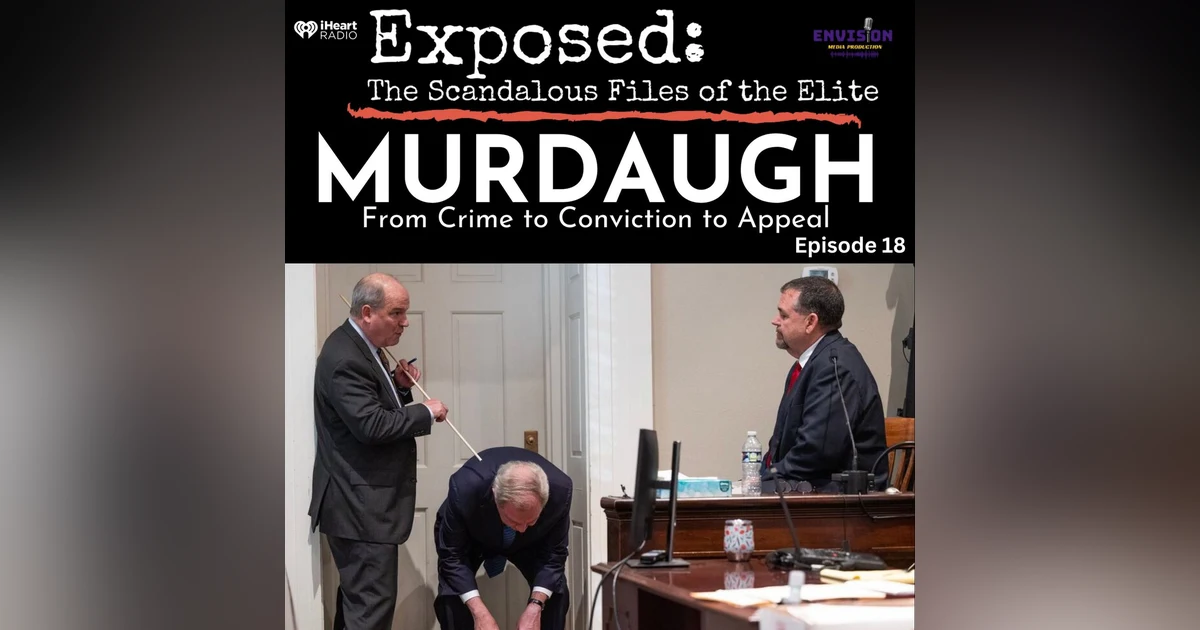

Dr. Kenneth Kinsey analyzes the Murdaugh murders, focusing on forensic evidence, expert testimony discrepancies, and the single shooter theory.
Timestamps
22:12 Analyzing Paul's Injuries
43:17 Shifting Focus to Maggie Murdoch
45:58 Insights on...


Timestamps
22:12 Analyzing Paul's Injuries
43:17 Shifting Focus to Maggie Murdoch
45:58 Insights on Maggie's Fatal Wounds
1:16:43 Debating Shooter's Height and Angles
1:34:01 Defense's Theory of the Shooting
1:35:20 Demonstrating the Shotgun Mechanics
1:35:47 Analyzing the Shooter's Position
1:36:37 Critiquing the Defense's Argument
1:40:43 Understanding Blowback in Gunshot Wounds
1:47:16 The Crime Scene Cleanup Process
1:49:28 Examining the 300 Blackout Shells
2:00:34 Disputing the Angles of Impact
2:16:41 Analyzing Paul's Injuries
2:41:30 Discussing Weapon Choices in the Murders
2:46:33 Variables Affecting Shooter Height
The “Murdaugh case details” may be disturbing for some listeners. Exposed: Scandalous Files of the Elite provides the“latest update on the Alex Murdaugh case” throughout its ”Murdaugh” series podcast. Discover “the impact of the Murdaugh trial ” can be followed by subscribing wherever you listen to your podcasts.
For collaborations, promotions, or appearances email Jim at: https://www.exposedpodcastfiles@gmail.com
Join us on Patreon for commercial free early releases, bonus content and more by clicking HERE
Become a supporter of this podcast: https://www.spreaker.com/podcast/exposed-scandalous-files-of-the-elite--6073723/support.
0:11 Hey everyone, and welcome back to Exposed Scandalous Files of the Elite. I'm your host, Jim Chapman, and today we are back with the eight teenth episode in this Murdall series. Before we get into it, look, i'm pre recording this on Monday this week and tomorrow here in South Louisiana, we got something going down y'all that we ain't used to. They are forecasting some eight inches of snow all the way down here in Caging Country, South Louisiana. So hopefully I will thaw out by the next time you hear an episode for me. But we're pretty excited about it.
0:57 I know. I have a lot of you that are from up in North United States, right, and of course Canada. We have a lot of listeners there, and of course y'all are used to this, but down here in South Louisiana not so much. So let's hope that the next few days aren't absolutely crazy. But you all of y'all in North America and Canada and all these cold places around the world, y'all. I know y'all are laughing at us eight inches of snow, but hey, that's a lot for here, and it's cold, it's supposed to be like fifteen degrees tonight. That's cold for me, but we'll get into it, and I'm going to tell you of all the witnesses called during this trial, this guy I'm featuring today is definitely my personal favorite. Now, what makes this guy so good and actually kind of entertaining is he sneaks up on you.
1:53 Let me explain what I mean. Kenneth Kenzie, or should I say doctor Kenneth Kenzie is what, at verse glance you may term as kind of. A good old boy. He looks like your regular everyday guy. He has a kind of a country accent like I do, comes off somewhat jovial, and is actually quite funny in the way that he gives his testimony, but not in a disrespectful way. It's hard to explain, but behind this facade, if you will, this guy is as smart as they come and likely the best crime scene reconstruction expert in the country. I mean, it is his whole job to go to a crime scene where nobody knows what the hell happened and basically reconstruct this thing to where you know exactly what happened. So before I get into his testimony, let me tell you a little bit about his qualifications, his credentials, his experience. Well, better yet, let me let doctor Kinsey tell you.
3:02 I've got a degree from Clinston University, a master's degree that's undergraduate, a master's degree from Troy University, a PhD from Walden University. I have formerly been certified by the International Association for Identification two different times for crime scene investigation and reconstruction. I've worked approximately eight hundred death scenes in my career, and I've handled and processed countless evidence in crime scene and the crime scene related disciplines. I have completed and passed proficiency in those disciplines as recommended by the International Association for Identification, which includes oral exams, research, technical work. And also I worked under a qualified examiner for a determined amount of time. And I've been a police officer for approximately thirty years in various capacities.
3:56 And just to remind the jury, you were qualified as a forend crime scene forensics expert in this particular case, Yes, sir, I was, and real quick. What other types of qualifications as an expert do you possess? I'm also a firearms instructor for handguns. Shotguns they call them patrol rifles, but that includes subguns, fully automatic and semi automatic platforms. I have endorsements through the South Fline of Criminal Justice Academy. I'm also a SLID Concealed Weapons Permit instructor, and I'm formerly a law enforcement firearms instructor through the NRA. So, as you just heard, this guy is no joke. He knows what he's doing and is really a star witness for the prosecution. So they get right into it with doctor Kenzie in the first thing they discuss are the injuries to Paul Murdall, and doctor Kinsey paints a picture that you're not gonna believe. Here's that club.
4:55 All right, let's talk about if we can, and again we're gonna have to deal with some of maybe not the images as much, but deal with some of the injuries that that Maggie Paul suffered. Right, yes, sir, let's if you could just remind the jury what were the injuries that Paul suffered? Please? They were very, very severe firearms injuries. One was a shotgun wound to just a little anatomical left of the mid line of the body. One was to the shoulder and it proceeded into the jaw and ultimately into the head.
5:37 And the uh was that the first injury or the second. The first injury was the shotgun wound to the middle of the chest, and it was non fatal, at least not fatal immediately. And then what about the second injury? The second injury was immediate of immediate death. And were you able and reviewing the crime scene evidence, to come to any conclusions as to the order in which Paul suffered those gunshot wounds from the shooter? Yes, sir, I was all right, and please relate that to the jury. My conclusion was that the first non fatal wound to the midline of the body occurred as Paul was standing with his body canned in the middle of that dog food room, pointed slightly southwest, and the shot entered the mid line of his chest, exited his under arm, entered his underarm on the actual arm, and exited the outside of his arm, and most of those nine pellets proceeded through the back window of that dog food room He's.
6:43 And then, just real quick, you said nine pellets, So explain that to the jury. Why you say nine pellets? That double buckshot shot shell contains nine pellets and I guess you describe it as a styrofoam packing to keep it tight so it doesn't shake. And when that cartridge is expelled out of the end of that barrel, the styrofoam packing dissipates or goes it own way, and those projectiles continue in the in the correct path. Sure you can. I have the I'm gonna police, I'm gonna show you what's been marked the states five three one, five three two and five three three, and see if you recognize these particular remedies. Yes, sir, I do, all right, and tell the jury just generally what these are plays.
7:29 These are views of the floor of the feed room and a view from the entrance to the feed room, and some digitally placed footprint not footprint's legs that I placed in there to show Paul's approximate position in that feed room at the time of the shooting. All right, Doctor Kensey, you were talking a little bit about Paul's positioning and his location when that first shot happened, and if you could tell the jury your conclusion as to where he was located when that shot was fired, and then if you want to step down and if you could maybe point out what was added to this image to kind of reflect your conclusion in that regard.
8:10 Okay, as you see here, those are the digital legs that I placed there showing Paul's approximate position as he was standing when he had the first gunshot wound. Here along the floor, what you see or passive or ninety degree blood droplets. And when blood, you can tell a lot from the direction of blood by the way it strikes an object. Blood has a cohesive factor. It's viscous and you probably heard that term before with the motor ore for your car. It's thicker than water. And the thing that causes that blood droplet to change shape is the friction and the direction and how much force was used. Well, a ninety degree drop just is exactly that it's perpendicular to the ground. So these ninety degree drops right here tell me that Paul, who was standing there for a moment, can't tell you how long, but those drops were running down from that wound on his arm, more than likely his arm because his chest area had a shirt on it.
9:10 It takes a little while for that blood to make it through the shirt, but it'll run down the outside of your arm and drip off your fingers, and you can see these ninety degree droplets here here, and then they actually lead to the door. You can follow the path to the door. He's not moving very fast because most of them are almost perfectly circular or ninety degrees. Had he been moving real fast, you could see some directionality in them, a tail, because the tail always tells you the direction with a blood drop. So I know he was moving slowly, and I know he was standing in the middle of this room for some time after the first shotgun wound?
9:51 All right, and approximately how far was Paul inside the feed room? Can you just drab a little bit about the dimensions of the fee room and your conclusion is of how far within the room Paul was when he was struck by that first blast. Yes, sir, well, the feed room is ten foot deep by my own calculations and by looking at the other sketches, and where you see his feet here is just on the other side of the halfway point. So I went You know, I'm guessing because I have no way of running a tape measure, because when I went there, everything was moved. But this door is thirty six inches and it's approximately a foot and a half two foot past the door, So that's how I come up with that determination.
10:35 And he's just on the other side of the midpoint of that ten foot. Room, which is about how far from the doorway five foot? All right, and I'm going to show what's de marcus five thirty four. Stay five thirty four and see if you recognize. That I do, yes, sir, all right, and tell the Jerry what that is real quick. That is a general view from outside the feed room that was taken at the time the crime scene was originally processed, and I added a digital enhanced arrow showing the reader or the viewer the direction of the shot down. Right, That's how it offers say spot with four anothers okay. You. All right, I'm gonna put five thirty four up on the screen, and if you would just show that arrow that you're talking about that's been added to.
11:20 This image, yes, sir, right here all right as well? Just show generally where those blood spots are. It's not the best image in the world, but where those bloodstorm spots are. That lets your conclusion about Paul's location within the feed room when the first blasts from them. The placard hasn't been moved, although it's hard to see the droplets. And of course I didn't add the legs to this, but just on the other side of that placard. And then you have here a quantity of ninety degree blood droplets with a partial footwear impression in it. And then you can follow the blood droplets to the door. Going back to the states five thirty one. Again, point out to the jury if you would the sort of the digitally added feet that you had added, all right, and if we would, if you could just if that's the feed room doorway, can you just sort of position me in your opinion of how Paul was standing when that first blast happened.
12:22 That's the door were coming in? Yes, about writing here, all right? And let me ask you this, in your review of the evidence and the available crime scene evidence that you've reviewed in your expert opinion, is there any way that Paul's arms were raised. When he shot when he suffered that first blast to the chest. I see no possible way his arms were oh when he suffered that first shot. Number And can you explain the basis for your. Conclusion to the jury that yes, or I can the shot pellets real close because they stayed together, they went in as one as a unit, and then they did what a shot pellet does. They separated once they struck the skin and made the entry run along inside his body cavity and exited his underarm. If his arms would have been up, he would have had no entry wounds on the bottom of his arm and then more exit wounds on the outside. He had over twenty entry and exit wounds. He's only got nine pellets. So the only way the math works out is if his arm was down, and additionally, the wad stopped and was under his arm.
13:38 Had his arm spent up, in my opinion, that wad would have went on and exited his body. Because it's only plastic. It doesn't take as much resistance to stop that wad as it does a shot pellet. And the wad stopped, it was right. You could grab it with your fingers if you would have been medical personnel. And give me to it. It was right there, all right. And let me ask you this. Do you have I a lot of general experience with firearms. I do. I'm a firearms instructor for handguns, shotguns, patrol rifles, subguns, and fully automatic patrol rifles. Everything but precision Ricker. All right, And when you say an instructor, where is that. I'm certified and I have tredentials in the South Caroline of Criminal Justice Academy. I've also been certified as an NRA Law Enforcement instructor, and I currently have a c WP endorsement to teach concealed weapon permits from a South Combine law enforcement.
14:31 And you testified how many buckshots are typically in your average buck shot. Show according to the literature, and according to my experience, there are nine in that particular buck shot. Did you see any evidence I think you've already mentioned this, but did you see any evidence from the crime scene as to what happened to some of those pellets as Paul was struck as they continued. On, Yes, sir, I did. They exited on through the back window. All right, and I'm going to show what's already been admitted is five thirty two and put that up on the screen, and if you could describe to the jury what you're talking about in that regard, please. This is that window at the back of the feed room, and you can see the shot shell pellet defects here as they went through the window and continued on their path.
15:24 Those kind of big holes. Are those consistent though with a buckshot pellet striking that? Yes, so they are, and some are bigger than others because it's just the makeup of glass. I mean, sometimes you'll get one individual hole and sometimes it'll take out, you know, a large portion. So I have no way to know that, right, And I just. Real quick, I've got. Five point thirty three. I'm gonna put that up on the screen. And again, is that just a close up of where Paul was standing about five feet. Or so inside that feed room? It is, yes, sir, based on your review of the blood avitue that you saw. Yes, sir. And here are the partial footwear impressions, and here you can see the ninety degree blood droplets and some other biological materials.
16:06 Right, And in your conclusion, what's the most just again, what's the most likely explanation for those ninety degrees blood drops? So how's that physically happening? It's the arm mound. Even though it is non fatal, there's less restriction from clothing or anything else on the arm. You know. Here you've got the T shirt that's got to completely saturate before it gets to the bottom and drops but here on the arm you've got nothing. So once those pellets exited, entered and exited again, that blood's free, free, poor or not free, poor and free running down his arm, and then they'll drip off the ends of your fingers. One thing I want to ask you about is you've testified as to your conclusions as to the position of Paul when that first shot struck him. Is there anything about the entrance between itself that supports your conclusion.
16:55 As to the shape of the entrance. Raines it's oblong instead of come completely round. And had he been standing facing that door and took that double locked buck shot to the middle of a chest I've seen it dozens and dozens of times instead of coming out this side. A shot shell or a projectile doesn't make a ninety degree right. Generally, it's gonna follow the same path unless it hit something hard enough to make it ricochet. It would have went on through his body. It still would have exited the window. It just wouldn't have done the damage to his arm and his underarm. So he had to be canned in this direction. And the wound is not perfectly circular, it's more oblong, which tells you that he was canned to some degree, all right.
17:45 In your view of the crimson evidence, Did you come to any conclusion about the location of the shooter when that first buckshot blast struck Paul in his chest. It would be hard to say exact, but I can say to a bare minimum the breach of the shotgun because I don't have the shotgun. I don't know the length of the barrel that kind of thing, or I could run it from the door. But the breach of the shotgun where it ejects the shot shell casing after it fires, was somewhere inside the door, because had it been on the other side of the door, of the shot shell would have been located outside. So depending on the link of the shotgun, at least I can say the ejection port was inside the door of the shed, all.
18:36 Right, and then the shooter. If I have this image up here, which I pologize is stinks five thirty four, And can you kind of illustrate what you're talking about to the jurys and damage. Yes, sir, the breach, the ejection port where you load and unload that shotgun, which is a little less than midpoint from the shoot was inside this doorframe. At least to some degree inside. And where were the. Expended shot shells found on this crime. Scene according to the photographs and the original crime scene behind this door, right?
19:19 And is that consistent with your review of the evidence? As I support your review of the evidence, that that conclusion you just related to. The journey very easily. This is if you look this room as kind of cluttered. And I measured that door myself. It had been pressure washed, but the same door found the same shot shell. Pellet defects in that door an inch and a half at the bottom of the door. There's plenty of room for a shot shell to bounce and roll under the door, so I have no reason to believe it didn't end up there because of the location of the shooting. So one thing we learned so far that is absolutely horrific to me is that Paul was shot in that little bitty feed room at pretty much point blank range, so close in fact, that the wadding from the shotgun shell, which doctor Kinzie explained in the previous clip, it was stuck under Paul's arm. That means the shotgun was almost pressed against him when it was fired. Yet he lived.
20:22 That first shot hits Paul in the chest and exits under his underarm. Then those pellets blew through the back window of the feed room. Nine pellets from a double eye buck shotgun shell right in the chest, and this young man took it and was still alive. Then he mentioned those ninety degree blood droplets, which due to that, he determined that after the first shot, Paul actually did not fall. He started walking towards that door. He knows this because the blood was draining down Paul's arm, not off to the side of his arm, meaning he did not fall after that first shot. Then he saw the footprints. Now, let's stop and think about that for a minute. This is Elix's son. What kind of monster would you have to be to shoot your own son at point blank range with a shotgun loaded with double eye butt big pellets right in the fucking chest.
21:39 Then, after blowing nine holes in your. Own son from those pellets, he stumbles towards you, still alive, and you shoot him again. It's unconscionable. Well, what about that fatal shot? How did that occur? Here's doctor Kinzie explaining just that. Doctor Kenzy Almoche, what's been marked as five three five five three six five three seven and five three eight states exhibits and see if you generally recognize those images.
22:28 Yes, sir, I do, all right, and generally explain to the journey what these images are. And then we'll talk about them specifically. Those are images at the door that I've added some visual enhancements to help the reader understand the flight path of the second shot and the different elements that I looked at and determining where the shoe was for the second or the fatal shot. To Paul, all right, you're run her this time. It offers states five three, five, five, three six, five three seven and five three eight in evidence.
23:09 I believe without abjection, no objection, they admit it. All right, let's look first at five three five and before we get to that, uh, generally describe again to the jury your conclusion as to that second injury suffered by Paul, the fatal shot, as you've described it. Well. The first thing is, once Paul received that second shot, he never walked again. He never made any movement. Any movement he made was involuntary, and it was due to gravity pulling his body down to the ground. When you sustain an injury to your brain like that, that ceases all movement. So he was found outside the feed door.
23:52 He fell over forward after sustaining that movement. Some some wounds are fatal later you can actually see one that receives a fatal wound, and I've seen them run one hundred yards. They can move for a little while. This is not that type of wound. Once he received this wound, it ceased all movement. Right, And did you I I'm gonna put attachment excuse me, stage five thirty five up on the screen and tell the jury what those particular image for flags. Please, yeah, sir, if you can look at the green funnel that I've added just visually. If you look at that green funnel, that is approximately the shot shell path, the shot path from the shot shell after it did the injuries to Paul, or the direction of the shot from the shot shell. And I determined that by shot shell pellet defects that are still in the door, even though the door had been cleaned. I went and looked at it myself, run my own measurements, took the width of the door. I took Paul's approximate height. It's listed as several different things DMV. He shows him at five six the pathologists listed him, I believe at five point nine, so I had to split the difference. I went somewhere in the middle. Then I deducted the distance between the top of your head and the top of your shoulder, so I took another foot off. Then I took the width of the door. And it's one other thing I looked at, and that was a void pattern that's on
25:22 the doorframe of the door. A void patterns caused by something being there. When the blood and biological materials are let we call it a blood letting from the wound. And there's a void pattern, which tells me something was in that way, and because of the narrow door, in my opinion, it was Paul. So that's what caused that void pattern on that door. So I used all of that, and I used a dial rod, and I used a protractor on the doorknob side of that doorframe and I ran it up and that's what helped me miss established the angle of that shot pattern.
26:03 Right. And we're gonna use the images to kind of talk about that a little bit more specifically. But quickly, I want to show you five three nine, five forty and see if you recognize these images. Yes, sir, I do. Uh. Five point forty is my photograph when I visited the scene, and five point thirty nine is also my photograph, and it shows that top hinge of that door is approximately seventy two inches at the top of the at the top of the hinge. All right, your. Runner, this time i'd moved in ovens to play for that. Judgment stage five three nine and five forty O caestionable. Good, admit it? All right, let's uh, if you could, I ask you to stuff down again.
26:44 I know I just sent you back there, but come on now, tell me whether this image reflects if you want to place. Yes, sir, these are thirty six inch standard yellow yard sticks. We use them to measure, uh, certain things. And it right here is the top of the top hinge as a three hinge door. And this is the top of the hinge, and then four inches above this are where those shot pellet defects were that I used to figure out my angle. All right, I'm looking at five forty. It took this particular image. I took this image, so this will have been long after. This has been long after the actual event occurred. Its right, this was last December, Yes, sir, all right, and tell the jury whether the summers reflects.
27:30 You can still see the pellet defects in the door, and this is the approximate center of it here, so that's four inches above seventy two. That's approximately seventy six inches on an eight inch door. I'm gonna show you States five, three, six and explain to the jury what this is and in particular how that's relevant to your conclusion about the angling which Paul suffered the fatal head one. This is the original crime scene pictures, and this is where the pellets took their path. This is where they struck and did damage to the door. And you can actually still see the dents that are documented in my photograph. You can see them in the original crime scene. This is a concentration of blood that's caused by the brain exiting Haul's body in the path of the shot shells.
28:20 And then you also have biological material hair and blood here at the top of the doorframe. And that's where I drew my conclusion. At some time those body parts made contact with these sections of the door, and my opinion is that it's hit here, hit here, and then landed on. The sidewalk looking at the States five point thirty seven. Can you explain. Whether the jerry saying in this image and how it relates to your opinion about the manner in which Paul. Suffered a fatal woman I can with a major blood letting in spa, doctor Kinson, let me ask you this cougium the last ask you to set just a hair.
29:04 So that's the jurors over here can see what you're. What you're saying, Yes, sir, with a shotgun wound, you know you've got one hundreds, well not hundreds, you've got over a hundred pellets that are making damage. It's not like a projectile, a single projectile from a pistol or a rifle, so there's mass damage and it it throws body fluids and blood in several different directions, but they follow the path when I mentioned that it was a void pattern. This is the last blood drop. You can see it in the photograph that I can see, and it's it's a proximately five foot right there. And this is not green tape. That is a digital effect I put on the photograph to show the void I was talking about. So it's sometime it's my opinion that pauls up against that door, are real close to that door to keep that blood from striking the door a point in time that he was shot.
30:01 All right, and the green tape reflects that blood pie or that void area that. Is consistent with Paul blocking that area. Is yes, or digital tape, it's not really tape. All right. Yes, So that's that's been added to yes, sir, okay to illustrate your opinion, Yes, sir. All right. And then five thirty eight, I'm gonna show you this image and again if you can point out what's been added and how this. Relates to the conclusion that you're offering to the journey, Yes, sir. One thing that I looked at to determine that it happened in the doorway and a little bit outside the doorway, more outside than inside. You don't just look for the presence of biological material and blood. You look for the absence of biological material in blood. Here at the top, it didn't have a scale or a ruler, so I can't tell you exactly, but looking at some of these other objects, I was able to scale it approximately four inches up here you have a void, so I know that it happened. The second wound happened far enough outside of that doorframe that that actual frame kept the biological material from hitting at the very top right here. I also looked at these items. You got some medication of canine medication or some cleaning materials and that kind of thing.
31:21 Up here. You can see all the spatter at the front of those containers. And then we got what I call a demarcation line right here here, and I drew it through most of these cans, and that separates the blood the blood contaminated area in the clean area. So that tells me that it was at least forward of the angle on those containers. And that's why I believe he was shot. The second wound happened just outside the doorframe, but his feet were probably still in the doorframe. A right, and just quickly a point of the journey, we can we see part of the doorframe in this particular arm, yes, sir, right here.
32:04 All right. Once I've been going back now to States five thirty five, and just from the record, we were just looking at States five thirty eight and five thirty seven. Going back to. State's five thirty five, did you reach a conclusion as to the location of the shooter on that second fatal shot that Paul suffered to his head. Yes, sir, I did, all right, And explain that to the jury if you would please. The shooter was right here, if you're facing that door, to the right of the doorway outside. And would you have expected there to be in that particular range any sort of biological evidence in that area in proximity to the shooter, Yes.
32:52 Sir, I would. With the doorframe that potentially blocked any of that. As well, it would block some And just depending on the pass positioning, how much of the body of the shooter was exposed, because you know, once you have that kind of catastrophic injury, it's real, real fine blood, blood particles and biological fluids that go in all directions. And the closer the shooter was to the muzzle to the exit end of that firearm, the more stuff you would expect. Let me ask you this and your expert opinion. Is there any way that Paul's fatal head injury came from the top in a contact fashion or a close fashion.
33:39 No, sir, I see no possible way for that. And explain your conclusion in that regard to the jury from the clas what factored way agains that and. Your act working well. Number one, I don't know of a way to mimic this blood evidence on this door, that pattern where that shot traveled through Paul's shoulder, into his jaw, into his brain, and then took a path up and placed the biological material here at the top of the door. If he was shot in the head, then you'd have biological material out here on the ground or at least going down, you know, on the sidewalk in front of him, and it would be different than just free pouring blood. You would see this pattern, and you would see those high velocity blood droplets there on the ground. And plus the shooter would have to be on the roof to shoot down into him, but you wouldn't have this on the door.
34:33 And your extra openion that you see any support or evidence on this crime scene that could support that the injuries suffered by Paul were in any manner a suicide. Or self inflected. I don't see the possibility, knowing that it's not a contact shot gun wound. And I'm fairly strong, and I'm bigger than Paul was, and I don't know of any way you could hold that shot gun out and shoot yourself in that direction at that angle and put that biological material on top of that door like that. I don't think it's possible. All right, thank you. Now let me ask you this, excuse me.
35:20 The second one, the fatal one that Paul suffered to his head. Was that buck shot or was that bird shot? The second wound was bird shot? All right? And can you describe to the jury the difference between the composition of a buck shot round as a relation to the pellets. And a bird shot round, Yes, sir, I can, all right. I think to that with buckshot, you've got a number of larger pellets, approximately thirty to thirty six caliber pellets, and you've got fewer of them. They're made for bringing down larger game. So in the typical double lop buck shot, you're gonna have nine pellets in your typical number two.
36:03 And it's called many things, you know. The typical person calls it bird shot, bird shot, chill shot, steel shot, coated shot. I've heard it call many things, so I just typically call it bird shot. But in this particular shot, there's approximately one hundred and fifty to one hundred and fifty six pellets in that dry lock shot shell. So that's the difference. With the buckshot, you've got fewer and they're larger, and with the bird shot you've got many and that they're greater. They for bringing down winged animals, squirrels, rabbits, dove, quail, turkey, duck. I mean just depending on the number shot. That's what that's for, right.
36:45 And about how many approximately bird shot I might be in an average shotgun show. The literature says that it's one hundred and fifty six and a dry lock. I cut one open and I only counted one hundred and fifty, but that may have been human error. Round HUNTERFID Yes, sir, in. Your expert opinion, when you have bird shot, is there a forensic value to collecting every single pellet or can you explain those concepts to the jury When you're dealing with bird shot. I always try to collect enough that the firearms examiner can weigh it and he can have a good representative sample of what was used to cause this injury. With a projectile or a bullet, you have what's called lands and grooves markings, rifling. Some people call it rifling, and it's caused from that projectile spinning as it goes down the barrel. You don't have that in a shotgun, and a pellet is so small that you couldn't probably couldn't find it if you could have it in a shotgun.
37:46 So in my opinion, there's no forensic value as long as you have enough to determine what type of shot or what type of shell and the weight of it. In your opinion, was the and you've talked about this, but was the shooter when that fatal shot was fired inside or outside of that doorframe? The second shot the second shot? Yes, sir, it was outside the doorframe. And where was that second shot shell located? It was also located under the door. All right, And does that still consistent with your opinion? Absolutely? And can you explain that to the jury Plice. Yes, sir. Like I mentioned earlier, the ejection port on a shotgun. Typically there are left handed shotguns, but typically the majority of shotguns, the ejection port is on the right side. So as long as that shooter had it at an angle and had that ejection port pointed toward the door, even just the least little bit, that would give plenty of opportunity for that shot shell to be ejected and go inside that.
38:47 Door before we move on from Paul, I would and if you could just use me as a mannequin, but can you sort of describe to me your conclusions about the positioning of the of Paul when he suffered that fail head word and just how the trajectory of that worm and that shot as you've described and as a supportive by the evidence, as you said. Can I describe it and demonstrate. Yeah, jurors can see him. The second woman, as I mentioned, went in his arm and calls an injury here a large entrance, exit entrance, and then of course exit here. So it had to be typically with the kind of non fatal wound Paul suffered to his chest in his arm. It's my belief that now his five foot eight frame is dipping or favoring that arm, because as you know, that's over twenty something entrances and exits. I believe it would have hurt him.
39:51 I believe he would have been in pain, and I believe he would have been somewhat effected. And the reason I believe that is because I've got the ninety degree blood drops moving really really slow. If he wasn't feeling it, or if it hadn't affected him in some way. I believe his youthfulness would have allowed him to get out of there faster. But he's moving real slow to the door, so that's going to drop that angle just a couple of inches and I can demonstraight now. All right, And if we didn't make sure that jerk. Can see, yes, sir, that woman went in approximately right here.
40:32 It traveled in, out, in and out in a straight line, in a straight line, so it always goes in a straight line. And then when you're pressing the doll stick there and you're showing the trajectory of the way or not implying. That was a contact wing, No, sir, I'm not. I'm not implying its contact. I'm just showing the level of the woman. All right, Well, I'm thinking about it. Weren't to pause to didn't show evidence of stippling. Yes, sir, right, and just very quickly. What is stippling. Commonly referred to as tattooing. It's particles and material that's in that shell that don't burn up because it's superheated at the time that the powder charge ignites. It doesn't explode, It ignites and burns rapidly and that's unburnt particles of powder and other contents of that shell. They're hot, and when they hit the body they call stippling, or in the old days they called it tattooing, And that's basically what it is. It works as an.
41:35 Ink looking at this particular image, falls about five feet in the feed room. When he suffers the first one, correct, Yes, sir, that is correct, And then he moves towards the door. Is that correct? That is correct, and suffers the second one somewhere near the doorframe, on the inside of it. Yes, sir, with his shoulder just outside that doorframe. And when he suffers that second one, what happens to Paul? He falls immediately where does he call? He falls outside the feed room. So there you have it. If the theory that Alex Murdall killed his son is true, that means after Paul was stumbling toward his father, point blank shot in the chest, nine pellets, still alive, Alex Murdall points that shotgun at him again, but this time blows his brains out of his own son's head. Horrific. What a fucking monster. Now what about Maggie? What happened there? Well, here is doctor Kinzie's spinosis on that.
42:52 Let's move on. Now let's talk a little bit if we can about the injuries to Magian Murdock, and if you could start out reminding the jury of the injuries that she suffered, and then let's talk about your conclusions as to the manner and the order in which. Those were suffering. Yes, sir, all right, so it's good. Just a remind us again of those injuries and if you could go ahead and describe them in the order that your expert opinion they were suffered. Yes, sir. Miss Maggie Murdoch suffered three non fatal injuries from a firearm. One was through her wrist, one was her left upper thigh above the knee. One was at her abdomen here and it exited somewhere around her kidneys.
43:39 Now I'm not that kind of doctor. I can't tell you all the damage it did inside all those organs and things, but it ran a straight line through her body. This one on her left leg and this one on her mid section were approximately the same angle, and they were really really close in distance. One had stippling that said that it was a foot closer than the other, but that would probably fit This was either a total, separate, non fatal wound, or it could have been a continuation of one of the two fatal wounds. Her fatal wounds were. She had an abrasion or burn on the left side of her abdomen. From the outside end, that bullet followed a straight path. It entered the end of her breast and did extensive damage to the end of her breast, entered her left jaw, side of her face area, and went into her brain. That's the first fatal injury, and it was immediate, and she dropped right where she was at.
44:43 I saw no evidence that her body had been manipulated, moved or rolled over. The second fatal injury was down into her head and it actually did what in the day they call a keyhole injury. Just from appearances, the entrance and exit in the top of her head was so close. It made one big injury. And then it entered into her upper shoulders and went down into her body. That would have also been a fatal wound, but it was second in my opinion. That one came second. All right, let's uh, let's talk about that a little bit in a little bit more detail. Those first two wounds, uh, that that you described. Uh, you believe those are the first two ones she.
45:26 Suffered, yes, or I possibly three. I can't tell you much about this because the arm could have been moving, or it could have been here. There's all right, Well, let's talk about the thigh wound and the abdomen wound. Can you did you have any conclusions about, uh, the location of the shooters? Those two wounds were usufer. Yes, sir, did all right, and explain that to the DIRTHY went. A little bit more right there, Yeah, left leg out O little bits about here and here, here and.
46:08 Here, And in your opinion, were those two shots fired at in fairly quick secession around the same time. I think it would have been really, really difficult to get a similar angle if they weren't. All the shooter had to do is raise the weapon or lower the weapon and you're still on the same plane. And those wounds to the abdomen and to the thigh reflect the presence of stippling. They did. And what does that indicate to you about the distance between Maggie and the shooter when those wounds were suffered. I guess four or five feet. Fairly close, Yes, sir. All right? And after those two wounds were suffered, and again we'll put aside the wrist wind for a bet.
46:48 What would have happened after that? In your expert and. In my opinion a bare minimum, she would have been over She would have been in pain. I believe sometime in close props she fell to the ground and that's when the first fatal wound was delivered. Would she have been prone on the ground or still somewhat raised by the ground, or and have been over position when that first fatal one was suffered. In my opinion, from the angle, she would have been on her knees and had at least one hand on the ground. Those first two shots. Well, let me ask you this. There are obviously six shellcases three hundred blackout that were used to murder Maggie Murdock found of the scene.
47:31 Is that correct? That is correct? Explain to the jury is what conclusions, if any, can you draw about the location of those shellcases, if anything? Once again, just like with the shot done, I'm not saying it doesn't exist, but I don't think there are many left handed ar platforms, so generally speaking, the ejection ports gonna be on the right side. I own seven uh, some of them throw it the shell case and a little bit forward, some throw it a little bit back, some throw it perfect ninety degrees to the ejection. For if they were always uniform where they come out, if you'd go target practice, you could place a bucket there and all your shelf cases would drop in the bucket and you would have to bend over and pick up your shell cases. Unfortunately, that's not the real world. So I don't put a lot into that unless I have the actual weapon, and we can test a weapon with the same ammunition, and you can generally get an idea where that shell case is gonna go. So no, sir, I don't pay a lot of attention to it. And I definitely don't think the sequence of from one end to the other, or from this end to this end means that's necessarily the movement of the shooter.
48:42 All right, you said that when she suffered that first fed a word. In your opinion, I mean she would have been over and perhaps been on her hands and knees. Is that correct, Yes, sir? All right, I'm gonna get down on my hands and knees, and if you could come around here and kind of show me where the trajectory of that wound would have gone the first one that was failed for my murdock, I guess you can come a honey, yes. Sir, all right. The shooter was right here, approximately right here. All right, and show us the trajectory as it went threw Maggie into her brain.
49:27 Yes, it burnt or raised her stomach outside to inside, went through the end of her breast, into her jaw, and then into her brain. And what would have been the effect on her once that shot was suffered. She would have immediately fell down with. The front of her body, all right. And that is the position her arms were in the original crime scene photographs. And while I'm down here so I don't have to get up again, tell me about the fatal shot, the position of the shears, the evidence in the case too. The second shot was not as close, but it still wasn't a long distance. It was approximately here into the crown of the head. And used a dallastic to show that injury that Maggie suffered.
50:15 In out in in that line. Okay, thank you. You need to go to the dropping her after this, all right. The first shot, the first fatal shot that I would have immediately been fatal. Is that correct, yes, sir. The second shot I also would have been fatal had she still been loving, but in your opinion, she was not. At that point. Is that correct, yes, sir? All right. She may have had a sign of life, but there was no movement. She was not capable of any movement at that time. Maggie Murdall shot three times with a three hundred blackout rifle, big bullet, y'all, and took them. The theory was in an effort to save her son, then shot a fourth time in the chest, which killed her. However, that monster did this, walked up to her after four shots, and just to make sure she's dead, shoots her point blank in the head. How in the hell could you do that to your own wife, the mother of your children. Monster.
51:42 This woman was running to her son when that first fatal shot hit her on her knees after three shots, struggling to get up one hand on the ground, angled right to where her son was laying outside the feed. Now, another thing that came up during this line of questioning was Paul's cell phone, which was found sitting in the back of Paul's pocket. Well, I'll let you hear doctor. Kinsey's opinion on the placement of that cell phone. Here's that clip. Let me see if you recognize this image. I do, all right, and just generally tell the jury what that is.
52:27 It's a cell phone sitting up on the back right hand side pocket of the victim, Paul Murdock. Is this your understanding of how Paul's phone's found at the crimp scene? It is, all right? And did you make any assessment or analysis of whether or not Paul's phone could have popped out. And be found in that position? I did, all right, And can you relate that to the jury please. It's my opinion that his phone was placed there by someone else. All right, and tell the jury you're basis for that conclusion. Bois Well, after I mentioned the fatality, the fatal shot, at that point in time, you have no movement, even involuntary movement, and there's no way Paul could have retrieved that phone from his pocket and placed it on top of his the back of his pants.
53:18 And in your opinion, if he had been carrying that in his hand, could it have landed in that fashion following the fatal shot he suffered? To us half, mathematically, you may could have made it happen, but I don't believe it's possible. I believe the phone would have fell to the ground and it wouldn't have fell behind him, up in the air and landed on him. Now, it's important to mention before we really get into it, that the defense had their own expert on crime scene reconstruction, a guy by the name of Mike Sutton. Let me tell you he did not perform well, especially for a jury in the low country of South Carolina. A really bad choice for the defense. First was from New York and kind of very pompous sounding, I guess you could say, kind of like a note all is how he came off just the opposite of doctor Kenzie. And one thing he floated and put into the jury's mind was his opinion that two shooters were likely, which if this were true, or if the jury bought that story, it totally blows the whole case for the prosecution because Myrtall would walk.
54:30 Their whole case is built on the fact that Myrdall was the loan shooter. And I'll be honest with you and give my opinion on this at the end of the series. But for now, the prosecution they had their work cut out for them to unravel the web that Mike Sutton spun on that stand. And the good thing for them was doctor Kenzie. He totally disagreed with Sutton's assessment. So in this next clip you're gonna hear the prosecution called doctor Kenzie back to the stand as a rebuttal witness to refute what doctor Sutton gave under direct examination, And right from the start, they confront and they try attempt and I think did a great job of tearing apart Mike Sutton's theory. And here's what that sounded like.
55:25 Doctor Kinzie. We're gonna keep our testimony to day narrowly focused and tailored to a few witnesses that the defense put up this past week. Did you have the opportunity to observe one witness named Michael Sutton, who was a forensic mechanical engineer for the defense? I did. Now, do you recall any of his conclusions or what his main conclusion was regarding the size of the shooter? I do, what was that conclusion? Five foot two to five foot four. I would like, now, Doug, if you would, I would like for you to publish or cut on on a defense Exhibit one, go to page forty nine. Okay, Now, what I want to do is we're gonna get into this in just a moment. But they published this into evidence last week. And you recognize these green lines coming out.
56:24 Yes, sir, I do, okay? And what do those green lines represent? Those green lines represent a predicted static angle or I don't know what you would call that trajectory for possible shooters. And Doug, if you would go to page seventy four of this presentation, please you recognize this photo on page seventy four of the defense exhibit. I do. And what is it? It is mister Sutton pointing a pump action shotgun into the feed room at Moselle.
57:04 Okay. And did mister Sutton make develop his conclusions as to the height of the shooter based on math that he did in this particular case. He said it was trigonometry, But yes, sir, he did. Based on your many years of law enforcement experienced, education and training. What is your overall opinion on his conclusions? I think his intentions are well, but I think his methods were flawed. So what I want to do is I want to go back. And there were three previous angles that we just looked at on the previous slade. Correct, that is correct. And then he also determined an angle here in this photo.
57:47 Correct, that is correct. And those are the angles that he used to determine the height of the shooter. Correct, that is correct. And mister Wilson, I don't know the totality of what he considered, but that was one of the elements one of the criteria used. Okay, just to refresh the jury's recollection, Doug, if you go to page four, it should be State sixty two. It's a picture. What is that a picture of? That is a picture of what's been described as a quailpin. Go to page five, please, and what is that a picture of? That is a close up of that quailpin and it has weathered cardboard on the one end. Okay, And that, for the record is Exhibit sixty three. That that is a picture of. And go to page six, which should be State sixty four. And what is that a picture of? That is a close up of what appears to be.
58:36 A bullet defect or bullet damage in that cardboard. Okay. Now, they based their angles at least two angles. Let's back up. There were two angles taken from this particular one bullet hole. Why is that. There were I believe the original crime scene agent gave a possibility of two angles of the of the angle of impact in the cardboard. Okay, And what are some things that someone can determine from examining a bullet hole in this cardboard? Well, the first thing is direction. It lets you know that you had one or at least at least one projectile fired from that direction. It's a pretty good indicator for direction. Okay.
59:26 What's another thing that you can determine? Sometimes you can determine the angle of impact and whether that bullet was affected before it struck that object. And what I mean is was it deflected by flash or did it hit its target? Or is there an internal problem with the weapon that would cause that bullet to be off center? Are you comfortable with the direction that was determined by Special Agent Worldy in this particular photo. I'm very confident of that direction. Okay, the defense it's determined that there were two potential angles. How confident are you that the methodology using term those angles are accurate?
1:00:08 I have zero confidence from this piece of evidence as far as establishing angles. So that's interesting. You feel good about the direction of the bullet going into the quailcage, but you have a concern about the angle. Correct, that is correct. Do you have a concern about the angle. The angle of impact? Yes, sir, that is correct. What are two things that could affect the angle of impact on a. Surface like this cardboard? As I mentioned before, you could have that bullet could have hit an object which we don't know, or it could be an internal problem with the firearm that causes it. When you think about if I could explain, when you think about a quarterback throwing a football, they spin that football and it makes it stable in flight. Well, a projectile coming out of the muslim a firearm, a single projectile firearm works the same way.
1:01:05 You've got little lands and grooves in that barrel, and as that propellant pushes that projectile down the barrel, it twists. Now there's different twists depending on the firearm, but that twist called rifling most commonly, that's what my grandfather called it. But it makes that bullet stable in flight. Anything that can throw that projectile off of battery, whether it be striking something or a firearm problem, maybe fouling too much lead in the barrel. Those kind of things will make that bullet off center. Now, it still may go the general direction, but the rotation of that projectile could be off just a little bit when it strikes the target.
1:01:47 So good analogy would be alignment getting his hand on a football and making it go wobbly, but it keeps going. That would work. Yes, sir, I'll either us, Doug. Could you zoom in on this hole real quick, Doctor Kenzie, I'd like to ask you to step down here, and for demonstrative purposes, I'd like you to demonstrate how an angle of impact can be affected in cardboard with a dowel. Yes, describe to the jurney what you've done with this box. I've played four strategic holes in this box representing a bullet defect in cardboard, as you probably saw in the photographs.
1:02:31 As a crime scene investigator, we use dow rods to help determine direction and angle of impact. Now, then they can be as simple as a wooden dow rod like you get at your hardware store, or they make some real complicating's made out of fiberglass if you can afford it. You know, most most agencies and most crime scene teams will use a fiberglass rod, but the wooden rods, as long as they're pretty straight and true, they work just the same. So if this represents a projectile def fact in cardboard, and may I say weathered cardboard, because this has been out there at least a year and a half since this incident took place, you placed that dal rod in that defect, and then you can get an approximate angle or angle of impact on it. But you can definitely get a more confident direction if your shooter's over here and you're shooting this direction or over here a puff or down. But it's not the end all be all, and I can explain that to you also.
1:03:31 Okay, so how could could you demonstrate how we'll back up a second and step ways so the jurors can see this photo if you would you saw the I might need you up here. Calling. I will tone. You saw the defense experts testimony mister Sutton, I believe last week describing this hole. Can you explain to them how he determined the angle at impact based on what he was observing in this bullet entry? I can this was? Please please do so for. The jury what mister Sutton did with geometry and trigonometry and a whole lot of tools, but basically a protractor as we use when I testified previously, if you had a confident bullet defect, you can run a string and then put a level or it's a type of protractor.
1:04:26 It's a bullet angle finder on top of that rod, and you can get a general angle of impact in a fixed object. However, this isn't a fixed object. He referred to that little mark around three o'clock. What did he call that? I think he called it a bullet wash? Could it be a bullet white? Bullet white? Yeah, it's not a term I used. Okay, I'm familiar with it. And what was he assuming that bullet white was caused by based on the testimony you. Heard from the angle? He's the same with what the angle of impact? What else could cause that? As we mentioned, striking the surface beforehand, fouling in the barrel, something internal. It just throws the bullet off course a little bit. It's not spinning the way it normally spends, so when it strikes, it doesn't strike, It doesn't enter the way it normally would. It wallers a little bit like that football we talked.
1:05:22 About what about the doll rod. Well, the purpose of incertain the dow rod is to try to get the best angle or the best direction you can, and in a perfect world, the angle would be fairly confident. Like another bullet effect we're going to talk about. Remember this is weather con weather cardboard. So once that examiner and these rods are not caliber specific either, because a crime scene investigator or an examiner can't look at a bullet hole and guess what caliber it is. That's nonsense. So you try to pick the one that fits the hole the best. And some of the fancy kits you get a little shim kit with some little rubber brammet that you can place in there and make it fit a little bit better. But more typically you just pick the doalrod that's closest to the whole.
1:06:11 Could a dowrod affect the angle of impact? Upon me inserting this galrod, I can do damage to that bullet defect, But more importantly, when I remove it, I could do damage. And it's very deceptive damage. It's not intentional, but it can damage the angle of impact. Especially in a soft, unreliable object like cardboard. You can you can turn it the stand thank you kiss, you know, I please go ahead. What I'm saying. Once a trim scene investigator gets what they need, they hit their photographs, their measurements, their direction.
1:06:58 So now this dow rod's here, and none of us know this unless you've got a video of the examiner taking that dow rod out. So we don't know what direction he or she might have pulled that dow right out because she's got her measurement. She's she or here is not considering someone coming behind them and measuring again for something in a piece of cardboard, and we're not talking about in wood or sheep rock, which on my cardboard. If you pull it to the right, you cause that same bullet white that we got in a photograph. Likewise, if I pull it to the left, now it looks like that projectile has entered from a left to right direction.
1:07:41 And then you can go on and up or down. That'll influence the appearance of that of that bullet defect. Because you've got an object like cardboard, something that there's no confidence in. Thank you, you can set that down. So do you recall what the defense expert testified to the direction an angle of that particular angle of impact. I do and what was it? I think one and three degrees?
1:08:24 Do you remember, like was it right to left going up? And from what way to what way? What direction to what direction? Left to right or right to left? Right? Yes? Or right to left. I have to think about the quayopin in my head. Are you confident that the direction was correct on this yes, sir, I have no reason how to believe the direction. I mean that that would have to be a huge defect hole for it to throw the direction off. How confident are you in the angle of this? I have zero confidence in that angle of the of the bullet entry. Doug. If you could go to page twenty one, which I believe the State's exhibit a picture of State's exhibit thirty eight, can you describe for the jury what that is right there?
1:09:07 Like the first defect, this is also a defect in a wooden. It's been described as a doghouse. Now you can also determine the angle of impact and the direction here correct. I can't What degree of certainty do you have that they were right in the angle of impact and the directions in the doghouse. I placed a lot more confidence in this angle because that wood is fixed it'll show a much truer projection of the angle of impact. Can you. Hold one second? How is this particular? I think you just described it, but real quick, how is the dog house different from the quelled cage in determining the angle of impact?
1:09:55 Well, the doghouse, if you look at it, is at least half inch to three quarters thick, So, like I said, you've got a stable, dependable bullet defect. The cardboard is two pieces of brown paper with corrugated paper in between to cause, you know, for strength purposes. But as I mentioned, not only is the cardboard in my opinion, not a good substance to shoot into, it's also weathered, so that makes it even weaker. Doug, can you go to page forty two on this exhibit? All right? Can you?
1:10:35 It doesn't have an exhibit number at the top. This is a page forty two on defensive Exhibit forty Can you describe what this photo is? Yes, sir, that is a computer animated drawing of some potential trajectories into that quailpin. And the two gray boys here, what are they? They are? They're two figures that were placed in that CAD presentation to represent shooters. Go to forty six of the same exhibit, and describe what this is. This is one animated suspect I guess or shooter placed in a similar CAD drawing photograph animation.
1:11:25 Okay, now go to page forty nine and what is straight? Go back, that's the picture I wanted. So there's three angles represented in this picture. Correct, there are three angles. Two of them are from the same hole. Correct, Yes, sir, one of them is from the dog house. Correct. That is correct. You aren't relied, You were fairly You believe that the doghouse angle is fairly reliable. I do you question the qualehouse angle? Correct? I placed no confidence in that angle from quail pen.
1:12:06 Explain for the jury, and you observed the defense expert last week talking about this. How did they come to determine based on these lines and where these people, where these gray figures are placed. How did they come to determine their heights were between five to two and five to four. We'll get to your opinions about that in a moment, but just explain for them how the defense expert got to that decision. The defense expert said he tried plugging in different heights, and he had to place those animated figures on a plane that line that laser line, and he determined that they go back and forth on that plane to achieve the defects that are documented by the original crime scene examiner.
1:12:57 Doug, go to page fifty one real quick, we'll see if that stuff. So there's some yellow placards here on the ground. You see them, I do, And what do those yellow placards represent? Cartridge cases that were found on the ground their markers, So you know once you find the cartridge cases that you put them there for documentation purposes, photography and sketching purposes. And why explain to the jury what the defense The defense has determined that their angle is based on the on the static lins. It's green lights, correct.
1:13:39 That is correct, back and forth on that one static line for one angle and one static line for the other angle. And they've placed them right there at that particular location. Why I think the defense expert was taken into consideration the location of the cartridge cases and he was showing how it would fit those five foot two animated figures that he placed in that presentation. Is that your understanding. I'll demonstrate the gray figures are holding the firearm and those gray lines represent like a stream, they would run up and down. Correct, Yes, sir, that was the testimony. You go back and forth on this on this green.
1:14:21 Line, okay, and that they would be right here because this is where the shell casings are. The shellcasings are ejecting. Correct, That is how I understood his Why. Always state the question why would they be placed right there in that particular location, along that static green line. Because they were in proximity to some of the shell casings? Okay? Can you explain for this jury why their assumptions on the math they did are incorrect in determining that the shooter had to be between five to two and five four. Well, there's a bunch of variables. Variables do matter. They're a bunch that you would have to consider. First, you'd have to consider this to be a static crime scene, very little movement, and when it is movement, it's controlled movement. Second, you would have to place some confidence in that angle of impact on that cardboard. Third, as I testified in my previous testimony, we're not able to test fire or with confidence what we know to be the weapon used in this situation with the same ammo, and they don't throw the AMMO at the same place every time. It may be in the general vicinity. But as I said, I believe in my previous testimony, if you knew exactly where it was going to throw that cartridge case, you could carry a bucket with you and sit that bucket in.
1:15:50 All your cartridge cases would go in the bucket. But like we see in the sketch and in the animated drawing, those cartridge cases are throughout. They're in a in a pretty large little area. And what I also saw that I noticed from this cad drawing is this cartridge cases to the left of these animated shooters, which means that sometime at least two of these shots were fired with the shooter far to the left and not on this static green line. Could you come down here real quick and point out what you're talking about as it relates to the location of the shellcasing. Yes, sir, I'm not sure if this was a shellcase.
1:16:46 And here, mister Wilson, but right here that is a shellcase, and it would not eject this direction in any situation depicted here in the presentation. It's not a left handed Nobody has ever testified it was a left hand in AR fifteen, And like I said, they're kind of uncommon. And if it is, and that's the left hand, and then we couldn't explain the majority of them being to the right. So that's what makes this static line flaw. Thank you. In another photograph you can actually see a larger area of Cart's cases back here. Thank you.
1:17:27 Let's assume for a minute that the angles are correct, and they very well could be correct. They could be. Why is the defensive theory as to the height of the shooter represented in this picture still wrong? What else could affect it? Distance and height? Would you like to. Take a moment to demonstrate for the jury what you're talking. About weapon position? Yes, sir? Will you tell me which angle you like you to demonstrate? First, let me ask you this question for you step down. Can a person beat be a on their knee and get the same angle and be standing and get the same angle?
1:18:09 Yes, sir. Can a six foot four person and a five foot four person still shoot the same angle just at different distances? Absolutely? Can you demonstrate for the jury why that is one way that this could have changed their math? I can, please. I'm measured this step on the witness box during the break, it's eight inches. I used to be five eleven, but as I get older, I'm about five ten. But if I'm here, or I could be five eight or five to two or five four here, I'm five ten, here, I'm six six. Here, I'm even over seven foot and I've still got the same angle.
1:18:59 I have just added a little bit of distance to it. And as far as the quailpin angle, I'm twenty one inches from the floor to my knee. I measured it. I believe it was testified that the defendant is twenty five inches between the floor and his knee. So there's four and a half to five inches difference in our heights. Here I'm probably at four to ten if I'm shouldering this weapon, and I don't know the mechanics or how it's got this way, I'm just saying it's possible. Here I'm at thirty nine thirty eighty some change or I can't even take it lower or higher. And please gonna ask me to demonstrate that, PLFE, because I don't think my lee could do it again. I think I heard of them crack, but that takes me the thirty six inches thirty seven inches with the defend that it would be about thirty nine, So it's definitely possible. Even from a shoulder weapon, it's possible, And we do not know how the weapon was being held.
1:20:03 From what you've observed in this crime scene. Was Maggie moving at the time she was shot? This was a very dynamic crime scene. I believe everything was moving, The victims and the suspect were moving. And how do you know that? Well, suspect would be the different firearms evidence, the cartridge cases. Like I said, there's no absolute They're not going to throw them the exact same spot, but they will throw them in a similar direction. We've got cartridge cases in a pretty nice sized perimeter. We've got them at different locations from where Miss Maggie Murdoch's body the final resting place, and different angles, in different positions, in different directions. So that tells you it's very fluid and it's very dynamic.
1:20:47 So if I'm holding a gun at not moving and shooting, what is happening with those shellcases? As I knew they're moving as they're ejected. Where was Maggie's head pointing when she hit the ground. Miss Maggie Murdock's head was pointed in the direction of Paul Murdoch where his body rested back toward the feed room. What is your opinion of the defensive expert that says the shooter could not have been six feet four inches tall like the defendant Alec Murdoch.
1:21:28 I think that's a flawed opinion. Could it have been a six foot four person? It could have been a five four sixty four or in my opinion of seven four as I just demonstrated, Doug. Let's go to page fifty nine in the defense exhibit one, p. Forty That should reflect state's exhibit fifty seven. Doctor Kenzie, can you describe that picture for the jury? Yes, sir, I can. That is a shot from inside the feed room, that back window pane where the buckshot exited Paul's left arm and then continued and exited the feed room.
1:22:14 Please go to page sixty seven, should be states forty five, I believe. And what is that right there? That's a pink string from the window to a pine tree. And then go to page sixty nine and what is that a picture of. I don't know if it's the same pink string, but it's also a pink string coming out of a window. And go to page seventy four, and that is labeled Exhibit fifty four. And what is that a picture of? That's a picture of mister Sutton with what looks like a pump action shotgun pointed down into the feed room.
1:23:00 And what do you notice about the angle that he's holding the shotgun in the angle of the string, Well, the string is parently let me let me crazy, I'm sorry, let me rephrase that. What is the defensive theory right here represented in this picture. I've heard so many theories, but I really believe mister Sutton was trying to show that the angle wouldn't match if it was a taller shooter shooting into the feed room. Okay, Doug, I'm not quite sure what page it is, but I think it's two back, go back, one more. There you go. That's uh, it's the labeled exhibit fifty three.
1:23:40 And what is that a picture of. That's a picture of mister Sutton holding I believe the same shotgun more parallel to the floor. And what is he trying to demonstrate in this photo? I believe he's trying to follow that that pink string to that pine tree or or whatever him to that pine tree. Do you recall from his testimony how he got that angle? I do. Mister Sutten testified that he got to where he believes Paul was standing, and he got down and he peeped through the hole in the window the one that he thought would match that corresponding defect in that pine tree, and he ran a string to that defect in that pine tree.
1:24:25 Are they trying to determine the angle of the shot is exactly the way the shotgun's being pointed. Well, I believe they were trying to determine trajectory path of that projectile. What is flawed about this? Guys with a with a rifle, you're talking about a single projectile, and most people understand the distinction. If you can find where it was fired and you can get a perfect impact, sometimes that'll give you an idea of the path the path of that projectile. With a shot shell, you're talking about nine twelve or sixteen in this case, nine buck shot pellets. They're packed in a shot shell with filler. It's like a styrofoam material. They're packed in a shot shell. When that cartridge, the primary that cartridge is ignited and those pellets exit the muzzle of that firearm.
1:25:25 They start to spread. We've heard a lot of testimony about that. They start to spread, and they spread in a cone. Okay, you got some at the top, some bottom, some left, and some right, and the more the distance becomes, the greater they spread. They're not like a mother duck with the ducklings right behind it and all the buckshot are in line. So you can't get a true trajectory on this shotgun. You can't even measure a true pattern, not even close to a pattern, with one pellet. So it's my opinion that that pellet that definitely impacted that pine tree. That's the top of the cone. So you've still got a bottom, and you've got two sides of that cone. And unfortunately, none of those pellets were located.
1:26:17 So, in your professional opinion, can you exclude a six foot four defendant like Alec Murdoch or anyone for that matter, at that height from shooting that shotgun. At that angle? Absolutely not. When the defense expert says that the shooter has to be between five two and five four, do you disagree with that? I do disagree with that wholeheartedly. With what degree of certainty do you think they're wrong? In their conclusions. I just think it's an unknown. I don't. I mean, it's many more variables. You have to know how the shooter was holding the gun. You know, how his proportion to legs matches up with body. I mean that's something that we're all a little bit different, and I don't unless you've got a video of that or someone tells you how they held a weapon. I think the notion that being able to look at this evidence and determine that is unscientific.
1:27:14 You said something a minute ago, you said, there's so much we can't know. Could the shooter have been running laterally? Certainly? Could have. Could the shooter have been running toward Maggie? Certainly, Maggie was certainly moving or in my opinion, she was. Could the shooter have been on their knees? Could it been? But there's no way to know for sure. Correct, that's an unknown, yes, sir. And because there's so many unknowns, there is no way the defense expert can definitively exclude a six foot four person from shooting the rifle and the shotgun.
1:27:54 Correct, the defense. Can I do them? In your opinion, can the defense based on what you just testified to exclude a six foot four person from being the shooter with either weapon. In my opinion, know the defense witness is relying on math and absolute and in crime scene investigation sometimes there are no absolutes. Doctor Kinzie, have you ever observed a contact wound to the head by a shotgun?
1:28:35 Yes, sir, I have. How many times have you observed a contact wound to the head by a shotgun? After the fact, I've seen several dozen, maybe three dozen, But I also had a gentleman that committed suicide in front of me, probably from me to you, how. Many times have you actually seen either photos of a contact wound to the back of the head with a shotgun in your professional career? Probably a dozen. Out of that three dozen, probably twenty four of them were suicides or someone taking their own life, probably a dozen execution killings. Can you describe for the jury what kind of trauma of faces? And I know they've heard from a pathologist, but in your experience as an expert in crime scene forensics, can you describe the kind of trauma you have observed in your career with contact wounds to the back of the head or any part of the head.
1:29:34 Yes, sir, I have and specifically to the face. Generally speaking, whether it be a shotgun or a large caliber handgun, the result is similar. You feel as though the forehead and the facial features have went away. And that's a kind way to put it. They're actually there, but they have been they've been shredded, and the pathologist can actually put those features back in place, or the majority of it. But looking at it, it looks like from the teeth up the person went away. It's just a mess.
1:30:18 DoD McKenzie, I would like to show you what's been March of States, he said, at for eighty six. Can you look at that? You've been say if you've seen that picture before? Yes, sir, I have. And what's the picture of It's. A picture of Paul Murdoch at autopsy. In what part of Paul Murdoch is in a picture of. His face and his forehead? Does his face look like it suffered the kind of trauma you have observed in the past from a contact gunshot into the back of the head or any part.
1:31:01 Of the head, No, sir, other than some red features from you know, falling on the cement after the fatal shot, and some blotching to his skin, his face looks fairly normal to have gone through what he suffered. And I'm not going to publish the photo again because I think people are tired of seeing it. But I do need for you to describe what kind of things you've observed with the eyes and the bones, with people that you've seen that have been struck or shot in the back of the head at point blank rage. Yes, sir, Well it's not always the back. Now I've seen something from the side, offsir, But yes, sir, Generally, like I said, it looks like the facial features have gone away or they've at least changed drastically. A lot of times you will get large blood pockets or contusions under the eyes if the eyes don't pop out. A lot of times the eyes will pop out and they will be on what's left of the cheeks, the facial bombs as you can grab them with your with a gloved hand and you can move them around, and then you will actually have pellet exits in the skin flap.
1:32:09 If you pull the skin up, you can see where the pellets, whether they be buckshot or close distance birth shot, you can see the actual defects from those pellets. Based on your training in your many years of law enforcement experience, are the wound suffered to call the back of the head consistent with a contact shot to the back? Absolutely not in my opinion. Okay, doctor Kenzie, we'll move on from that for just a second. You were here yesterday, correct I was? Did you have the opportunity to observe I want to say his name correctly. I believe it was Tim Palmbac, I did.
1:32:51 He was a crime scene investigator who was qualified as an. Expert for the defense. Not right, Yes, sir, okay, I would. H he came up with two significant conclusions. It's say three about how Paul was shot. At the feed room. Can you you remember what those were? For this jury? The big one that I recall is that Paul was shot in the back of the head with a contact womb And the other one will uh the the strikes in my mind, I don't know it. The shooter passed him and shot him from inside the feed room. Those are the two big ones that I recall. M there was another one regarding the number of people there was there.
1:33:35 The thing about two shooters, Yes, sir, okay. We'll get to that in a minute. I would like to. Doug, can you get the l no up. Oh, I'm showing you exhibits. What's side of picture. Of that's a picture of that expert with his hands cooked opposite the hinges on the door the doorframe.
1:34:22 Okay, I wantly just picture up for a moment because what is the direction that the picture was taken from. From inside the feed room? Facing what direction outside the feed room? Okay? Now you had an opportunity to hear the defensive theory on how Paul was shot? Correct, Yes, sir, I did. I would like to demonstrate that with you right now. Yes, sir, can you walk us through the defensive theory as you understood it to be? Yes, sir, I can your honor. For purposes of this demonstration. I don't know if the court would allow it, but to be nice, if we could open this door. I want to make sure that there's security here, but if we could have that door open just for a minute or two, and you thank you, your honor. I'm grabbing what the smartest states send at for which is a Camovanelli Super Black Evil three shotgun twelve games. We'll use this for the demonstration. To step down. Now, is this store the same with as.
1:35:50 The feed room door if a couple of inches wider than the feed room door. And of course the feed room door doesn't have this for you know it's inset. Correct. That is correct. So this is not. Exactly a replication of what happened at the feed room door. Correct. No, sure it's not. The door swings the same direction though. Now you have given me permission. I'm very careful about muzzle velocity. I'm obviously muzzle awareness, but you'll give me permission to point the sit you correct, I have Okay, you actually asked me to correct. Yes, all right, So go in there and stand a couple of feet back. You didn't have to be five feet but you have since testified that Paul was five feet inside the feed room. Correct. Can we demonstrate the first shot out here? I am believing.
1:36:31 Stand back a little bit because you got to stumble toward me. So I'm gonna point like I'm pointing at you. Paul is shot. Where's the shooter approximately outside the door. The reach phase for the ejection before the shot, and just passed the doorframe. Okay, Paul has just been shot. And then in the defensive theory, what walking you tell me what to do, and you you act this out, and I'm gonna do what you tell me to do based on the defensive theory of the case. The defense with the assessment that Paul stood there for a moment, leading down his injured left arm, and he slowly walked toward the door. Okay, And what does the shooter do the shooter's coming in the door. And then what does the shooter do He shoots Paul in the back of the head after he passes he.
1:37:21 Okay, and then shoots Paul in the back of the head like this, And where does the blood spatter go? The blood spatter the pellet defects. And one that I didn't know about that the expert collected within the doorframe at the top of the door. Now I understand it's a little different than the feed room door that the dusty can do. So what did you find odd about the theory? First of all, I think the theory is preposterous in my opinion. Can you can you walk me through why you think it's preposterous? Absolutely? Number one, that dry lock number two shot shell fires a projectile at fourteen hundred and fifty feet per second once it leaves a muzzle of that weapon. As was mentioned, that's a millisecond. That's fast to think that the pressure from flesh and bone will cause that pellet.
1:38:24 Those steel pellets, now we're not talking about lead. Lead's a little bit more giving. Lead will is milable, it will crush or flatten. We're talking about steel BB pellets. They will turn around because of the pressure, go back the opposite direction one hundred and eighty degree direction at enough velocity to damp a steel exterior door and e bed in the doorframe. That doesn't happen. That doesn't happen in my opinion. I don't know if you've mentioned this earlier, but can you talk about forget it right?
1:39:07 And can I add please do also, there's no defects to the OSB or the T one to eleven siding in the bottom of the room. Right. Wait, wait a second, you said a lot right there, Yes, sir, ts what ts one eleven? It's like a xterior paneling the people put on their buildings. That's what's on the building the Frost City boys. We appreciate you describing that. Thank you, Yes, sir, it's a whole weather paneling. Uh, there's no defects at the bottom and if that theory is correct, if this is an entrance and this is an exit, the shot still had to go somewhere. There's no defects down there on anything. The doorframe, as I mentioned in my previous testimony, the doorframe has a clean void that would be perfectly in line with those shots from that shot sheld. There's no cracks, chips, pellet holes in the cement. There's nothing in the OSB that's cheap plywood, that's man made plywood. There's no defects in the plywood.
1:40:06 There's no high velocity blood spatter on the floor. What was pointed out to you is medium velocity, and that's from coming out of the wound and gravity bringing it down to the floor. You would see a pattern on the floor, just like what you can see in the photographs at the top of that door. None of that's there. So I have to look at the science, and I have to look at inertia, and I have to look at that shot shell and how fast that shell is propelled out of that barrel. And I know that it can't turn around one hundred and eighty degrees and go back the other direction. It's not like blood and tissue we're talking about steel steel pellets. Doctor Kinzier, other studies on percentages of blowback when you're shooting into someone there are, and based on your expert opinion, what percentage of blowback would come back at a shooter if they were able to shoot at that angle.
1:40:57 Well, I don't think there's any definite, but what I read is eight to ten percent, excepting you know, like I said, it's not absolute every time, but eight to ten percent. Remember the most of your forces going out the front of the barrel. And a moment ago you were just talking about the defects and all of the trauma that would have happened to the paneling and the floor. Can you point on this photo with the dollarstick behind you for the jury. I just wanted them to see in this. Photo right here the void as I documented in my original testimony, the void was from here down other than one stray satellite drop of blood that was.
1:41:45 Fairly clean from here to at least right here. But there's no defects here. There's no defects in that sement outside, there's no defects in the inside semen, and none in this OSB right here. And that was still there when I did the tour where they ripped out all the shelving and some of the insulation, but this was still there. Doctor Kenjie may have covered this a little bit, but explained for the jury. If someone is shooting down, as we just demonstrated a moment ago here in the doorway, you're leaning out, the shooter is shooting down, how do pellets get embedded into the doorframe up here? How is that possible?
1:42:35 I think it's impossible myself. Physics don't work that way unless you're shooting into a trampoline or a huge piece of steel, and then you may have a pellet deflected back on you. It happens many times, especially when we're shooting steel targets, but not at that velocity. It will not sink into the doorframe and it definitely will not damp that door. With what I documented in my. What is the restate for this jury with the defensive theory based on that belowback that would have exploded into the shooter's face here behind, Paul explain for the jury what the defensive theory is about how that shooter would have been.
1:43:25 In the defense expert testified that that shooter would be most probably incapacitated from blood, bone and body fluid, and that was a high likelihood that he was injured by those pellets. Dotter Kinsey, in your expert opinion, is there anything awkward about a shooter sending outside going into an enclosed ajarry to turn around to shoot someone from enclosed Is there something weird about that to you. I can't figure out the methodology of a shooter. I've never done any crime like that, mister Wilson, But I don't see if we talk about common sense, and everybody's mentioned the totality when they don't have an answer for something, it's always I looked at the totality, but I don't see any reason for someone to squeeze up past one victim in this doorway to go inside to shoot him back out. And if he did, if that scenario did happen, that doesn't explain all the pellets that are in the floor of the feed room that we've testified herd testimony to as to why law enforcement didn't clean those pellets up.
1:44:33 If it happened the way the defense expert says, those pellets would be out here in the yard. They would not be inside that feed room. Doctor kin do you have a chance to review the case file on this particular case and observe the defense testimony from last week? Two separate things, Yes, sir, I have reviewed our case file all crime scene or what I felt was crime scene related evidence. I didn't look into the videos and a lot of that other stuff. And I have witnessed the testimony of the defense experts. Are you familiar with what the investigation has determined about the tool marks found on the three hundred blackout shells found around Maggie's body and the tool marks found on the weathered three hundred blackout shells found way up by the house in the flower bed. Are you familiar with that?
1:45:27 Ham for me? And what do you know about that? The examination. Loop of our case and it's going into completely new information. They're ballistic experts already testified we didn't present a blistic expert, and now they're parading him as a blissed check. Your response. They're experts said yesterday I about an hour nine minutes into their testimony, that would be impractical for one shooter to bring in two long guns. It has always been the state's theory that the shooter owned both guns and had them on him, So we're rebutting what the defense experts said. The objection of overworld.
1:46:11 Please answer the question, asker you Wilson, Please are you familiar with what the investigation has determined about the three hundred blackout shells found around Maggie's body and the three hundred blackout shells found up by the flying re bed that we appeared to be several months old in weather. What relationships the shells have to each other. According to the firearms examination, those cartridge casings were loaded and ejected from the same weapon. So a family owned weapon is what was used to kill Maggie. Leading what do you infer from that information?
1:46:53 I would infer that this is a family owned firearm. There was some testimony yesterday, doctor Kenzie about where it was from the defendant's brother, mister John Marvin Murdoch, and it related to the following day he came upon the crime scene. It had been cleared and he saw how the crime scene was left. Can you explain you've been in law enforcement for how many years? Thirty years, well over thirty, but thirty years getting paid and you're the. Chief deputy at a sheriff's department. Yes, sir, Orangeburg County Shriff's Office.
1:47:34 Just to clarify some things, can you explain normally or traditionally how crime scenes are cleaned up for this jury? Is it the responsibility of law enforcement? In other words, no, sir, there are private companies that are contracted through SOBA where it used to be sold with. The names changed now And what does SILVIS stand for? It's Victims State. It's the State Office of Victims Assistance, but it's now changed. I can't tell you what the new acronym is, but it works through our victims advocates. Law enforcement victims advocates. Almost every department has them, and there's funding provided from taxpayer funds to work through your victims advocates, and you go out and you clean these crime scenes for the families, so they don't bear the burden of cleaning those crime scenes. Law enforcement in particular cannot collect and dispose of and transport sounds, terrible body parts, or body fluids. That's something the coroner has to do because it's actually by permit through d HACK. But to make it easy on the family, these companies can collect those items and then they will turn them over with a chain of custody or they will properly dispose of those items.
1:48:53 Doctor Kinsey, is your expert opinion that a six foot four shooter cannot be excluded from the murder of Maggie and Paul? I see nothing that could exclude a six foot four shooter in. Your expert opinion. Can you tell this jury is it right for the defense to say that there had to be two shooters based on the testimony you heard yesterday? In your expert opinion? Can can two shoot Can you exclude two shooters?
1:49:36 I cannot include or exclude two shooters? Can the defense include, to the exclusion of all other possibilities two shooters? Absolutely not. You heard a lot of things there, and the defense is passed and they want to take a crack at him and y'all. I debated not playing this because it's lengthy. This would make this particular podcast over three hours in le eighth in all likelihood, but it would be a disservice, quite frankly, to not play it. This is the determining factor on the number of shooters, and I just feel like you need to hear it in its completion. So, hey, it's Thursday. When this has dropped. Our next episode doesn't drop till Tuesday next week. So if you don't have the time to listen to this all at once, spread it out over a couple of days, or if you've got time to listen right now, hey, here it is the cross examination and in my opinion, the key to this case of doctor Kenneth Kinsey.
1:50:38 Good afternoon, doctor Kensey. Hey, mister Griffin, the anyone who has a doctorate degree I want to call doctor. It's all right if I call you. Doctor, I'll listen to anything you called me back. Understand that. But now, your degree, though, is in criminal justice. Is that correct? That is correct? Yes, sir. You're not a doctor of pathology, absolutely not, and you have no medical training. I have training in pathology of gunshot ones, yes, sir. I've attended several courses, classes, and seminars. It was also included in the criteria for the certifications I mentioned for the International Association for Identification. I've also conducted extensive research on police officer use of force cases and the injuries that result from Therein.
1:51:25 Your doctorate is in criminal justice, and I believe your dissertation research is in use of force and perceptions of public attitude held by police trainers that is correct. What was that well with the current atmosphere or what's been going on the last five or six years in our country. I was just trying to help. I wanted to figure out something that would assist with because we've seen some law enforcement officers do some terrible things on video. We've also we've got a segment of our society, the minority segment of our popular A lot of those citizens are in fear of law enforcement. And I wanted to study if the media perception as held by the three types of law enforcement trainers, if the media perception and the way they portray law enforcement, if that affected the way we train our officers, if we're too hyper vigilant, or if we you know, we tell them, look, there's death waiting for you around every corner. Is that going to make law enforcement more prone to use force or more or use less force, or those kinds of criteria.
1:52:35 And that's what I was interested in. I was laying the groundwork with a scientific, quantitative study to allow someone to come behind me and and do some further research just to expand that topic. But you've said you also have done some gunshot wound training as part of some certification, Yes, sir, the. II as I mentioned, I was formally certified two different times. I think it's a five year certification, and I did let it lapse in twenty fifteen because that's when I started my PhD and I couldn't study for both. But that is an extensive process where you do research and you are you have to do a written test and then with my proficiencies throughout SLED and then I still do some with our Sharf's office now where you have to pass proficiency and that is practical examinations, testing and that kind of thing.
1:53:36 Okay. Now, in this case that the state did have a pathologist, doctor Riemer. Correct, Yes, sir, they did, and you reviewed her autopsy report as part of your work. Correct, Not so much as reviewed her report, but I went and spoke with her in Charleston at her office. What did you review her? I have access to her report, the script, and I can't tell you. I looked through the. Whole report, and you understood that her opinion was that it was a shoulder shot through the through the neck and then up out of the top of the head. Is that correct, Yes, sir, I believe we agreed on that and in your.
1:54:18 Reconstruction opinion, is that's the exact same angle that Paul was shot by the shooter shoulder, not out the top of the head. Yes, sir, But I didn't just rely on her information. I also looked at the crime scene photographs and I went to the scene myself. I understand, yes, sir. But and then you did you hear doctor Eigenstadt his testimony, I did. Now you worked with SLED, did you not? I did, yes, sir. Doctor Eigenstadt worked for GBI. Correct, Yes, sir. SLED does not have its own in house h division of medical examiners, do they know?
1:55:00 So there are several fine medical examiners throughout the state. I've done autopsies in a lot of the bigger cities in South Carolina. Doctor Eisenstadt worked and he was the chief medical examiner toward then of at GBI. Correct. That's what he testified to. I don't know that doctor. You didn't know of him before this case. I did not know. So now he says his opinion is it is a gunshot wound contact to the back of the head. Is that correct? That is what he testified to, Yes, sir, And. If that and if he is correct, then your opinion is incorrect. Is that right.
1:55:40 I don't share the same opinion as that doctor, but yes, if he would be correct, that would make me incorrect. Now in your training, are you familiar with doctor uh excuse me, mister the Mao's book or Gunshot Wound. I have read the Mayo. I would heard it describe. I have this the Bible. I don't consider no, do my corehorts consider that as the gunshot Bible. There's four or five different versions out. There's one called Terminal Ballistics by Dobb and there's also one Gunshot Wounds by Doherty, and those are the ones that I'm more familiar with. But I'm not saying it's a bad textbook, and I'm not saying that the information and it's not correct.
1:56:22 Okay now, and we'll get more of that than a moment. What I'd like to do is first address mister Sutton's work that you had criticisms of. Well, I didn't have criticisms. We just have different opinions. He's an engineer and I'm a crime scene investigator. Mister Griffin, Well, I just. Seems like you said that the angles of the to the qwel pen were unreliable. Absolute and I have several more criteria that I didn't mention earlier. But I mean, if you want me to go into those, I will.
1:57:09 Well, I want to ask you first, which what's your understanding as of how those measurements were taken? First? Who took those measurements in the twelve pen. The original angles were the original slid crime scene agent that responded to the scene and took those angles. And you understand that mister Sutton relied upon Agent Warley's measurements. I do, Okay, I do. Now, Now you were putting a doll, shoving the in a box and taking the alpha box as if mister Sutton went back and tried to remeasure it. No, sir, that's not what I was insinuating. I said, when the original agent removed her dowel, it wasn't nefarious, but depending on how she removed that dow she could have altered that impact.
1:57:58 Well, let's let's take a look at that Doug states excuse me, defendants exhibit one point and can you pull that up? Yeah, the one you were showing with with the state. Excuse me, Just go to the second slides strut with. There you go. So you understood from this exhibit that mister Sutton relied solely on the shots directories measured by Agent Warring.
1:58:40 As I said, it wasn't his intentions, mister Griffin, it was his results that I disagree with. It's not absolute, and he gave, in my opinion, an absolute opinion to this. Well, why would special Agent Warling take measurements if if someone were not should not rely upon them. I can't answer that. You'd have to ask special agent wordly. But in my opinion, the direction, even though she can obtain a perfect angle of impact, or even if that weather cardboard was damaged, it's not a good substance to depend on because it's just not hardy enough. And she was showing direction. I'm not saying the direction's wrong. I'm just saying I wouldn't put confidence reviewing this case or work in this case. I would not put confidence in anything that that angle of impact tells me because it's.
1:59:37 Cardboard, all right. So if you go to slide number seven, I believe I've numbered them correctly. And do you recognize that as being one of her measurements? I do, yes, sir, And do you think she took the dowel out and then put it back in to put this measuring divide mister Griffin. And I didn't save the angle. I said the angle of impact when he was talking about the bullet wipe and that part. That's what I was referring to. And that's what I'm saying. That hole can be altered when you remove those dow rods. That shows direction, But that direction I don't place a lot of confidence in it because we have more cartridge casings and we have injuries on Miss Maggie Murdoch. We don't know if this bullet struck Miss Maggie Murdoch, if it struck anyone else. We don't know that the defect in that doghouse struck Miss Maggie Murdoch. Those are unknown that we don't know. So all this proves to me is that the shooter was moving and more than likely Miss Maggie Murdoch was moving right.
2:00:44 Hang on, so, Doug, you'll back up one to number six. So are you suggesting that this photograph number six taken by flood Edge at Worley, that that was taken after the doll was removed and before dollars put in the script. I don't know, That's what I'm telling you. I don't know how it was altered when she removed the dowel. I wouldn't place confidence in this before inserting the dowel because it's paper, it's not it's not something hearty. Well, would your opinions be different if you knew she took the picture first before inserting it. I'll still be irrelevant except for direction, because we know we had a moving shooter, we know we had a moving victim, and we can't prove one way or the other whether the projectile that caused this defect struck Miss Maggie Murdock.
2:01:37 All right, So if you'll go to flood eighth again, this is agent Worley's measurements of a doll in the holes that correct same picture. Yes, sir, well let's. Go to number nine. It's a little closer. And is this measuring up and down or left and right, horizontal or verse? That is up and down? And I wasn't gonna mention this, but the actual protractor or level founder is backwards. It would be a much more confident angle if the flat edge was up against the substance. But I wasn't going to bring that out and you sled to this, not sled to that, yes, sir, But I don't know what her intentions were. Like I said, she could have just been trying to show direction. I don't know that, mister Griffin.
2:02:33 Well this, I mean, this is direction, but it's up and down direction, right. Yes, sir. It's showing an angle of impact also. And if you had confidence in the angle of impact, you could do whether you're doing it with a pharaoh system or just you know, the old fashioned way with some sort of colored twine. I mean, that's it's a legitimate way to determine shot angles. I don't know what it would prove, and I've run it through my head a million times. I don't know what more it would prove other than you've got a moving victim, you've got a moving shooter, and that at some point in time, Miss Maggie Murdock was over there in the vicinity of that quailpin. And we know that because we identified that tire tread impression on her leg as being from that Polaris or another or another tire just like it. So I know that already.
2:03:28 So if you go to slide twelve, please just exhibit seventy. So you know that the shot angle through the quelpin also went through the feed room. I mean, excuse me, through the shed through that wooden. I mean that wouldn't wall there, correct. I don't think I observed a photograph of the inside of the shed. I may have, but I don't believe I ever observed that. What do you see number twelve going all the way through? This is the doll. It goes from the outside, the inside and then on through the backside of the quelpen. I see it being held up by the cardboard and the rabbit wire. But I don't know what's behind that cardboard.
2:04:12 You're unaware that it actually went through the wood there. You didn't know that. I do not know. And like I said, I don't see what it would prove. I don't see any more that it would prove. Then you've got to move and suspect and a moving victim. Well, if the measurement that included going through fixed wood sighting, that would give you more confidence that the angle is accurate, would it not? Yes, sir, But the angle itself will prove no more from me than direction, Because what this proves to me is at some point in time, Miss Maggie Murdoch was close to this quailpin. If this shot is related, and I have no reason to believe it's not, and my shooter was moving, my victim was moving. I don't know forensically what else that can prove.
2:05:03 Well, you can certainly measure the angle of the bullet entrance to the quailpen and calculate backwards to see where that shot was fired from. You could, yes, sir, And that's what mister Sutton did. Not He did, And I never disagreed with his direction. I'm disagreeing with his final analysis or his final result that you can judge how tall a shooter is without knowing a whole lot of other variables. Well, you understood that mister Sutton said that the gun the barrel was somewhere on that line at some to make the shot angle moving back.
2:05:48 And forth on that line, Yes, sir, I heard his testimony. And then he picked a spot and said, if you put the gun at a hip level to get on that line. He used a five to two person as an example exclusively, Yes, sir, I do. But he did not say the person had to be five to two, did he. I mean, we all know it could be dynamic of five to eight six foot person can get low. What I gathered from his testimony is it was his opinion that only a person in that height range would could have fired that weapon. That was my opinion. Well, his opinion was that it would be a shooter at six four It would be an unnatural position for them to fire at that low of e level.
2:06:36 And that's the that's the part I disagree with. I don't know how mister Sutton could publish an opinion about what's natural or unnatural. Well, if it's someone six ' four and the and the the muzzle of the gun is being fired at twenty eight inches off the ground, I mean the six or fourth person who's got to get down on the ground or hold it down below their knees. Isn't that correct? I have demonstrated several different ways, depending on distance and height, that a shooter can shoot any We don't know, we don't have a video of it. Mister Griffin, Right, But mister Sutton's methodology, I think when I'm hearing now is you don't have a real dispute to his methodology. He's an engineer, yes, sir, What you dispute is the accuracy of the angle coming out of the quel pen because of the construction being cardboard. Is that right?
2:07:40 Yes, sir, I said that if I was investigating that and even reviewing that case as a consult I put little or no confidence in that angle of the impact of that cardboard. Now I put much greater confidence in the one for the dog kennel. Okay, Well, let's see if we can. You mentioned you had a fair amount of confidence in the at least one of the angles coming out of out of the quellpen. Right left or right? The direction, yes, sir, the direction, And so that's take a look at that right quick.
2:08:33 And Doug, if you'll go to. Time, please go to the jury room. Please not discuss the case. Doc Kenzie, I'm still talking about the quell pen. You remember how tall off the ground that defect is? I do not remember, mister Griffin. If I would show you Agent Wardley's report, take a look at We don't want, sorry, any evidence somewhere, but if you could just fill the jury and that's consistent with your understanding.
2:09:25 Of how high that. Four foot two inches? Yes, sir, okay, And did you did you inspect when you were out there? Did you inspect the entry in the twelpen or the damage to the shop behind the twelve pen at all. I looked at all of it, but I did not run any angles. Okay, And did you ever talk to Agent Warley about her measurements? I did, yes, sir, I did interview Agent Warley about her work on where was that? Back to? First or second week of December at the new Sled Laboratory. I can give you an exact date if I look back through my notes.
2:10:10 I don't need that. But are you being compensated for your time? I am yes, sir. And how much have you been paid thus far? And how much you hope to get paid before it's all sudden done? Well, I'm a Baptist, so if I didn't charge something, my friends and family would talk bad about me. But my retainer is twenty five hundred dollars and I have a flat one hundred dollars an hour rate, and when I added it up, I was up a little over one hundred hours. But I ended my retainer myself without anyone asking me to do a little over a week and a half ago. And I'm now working off of a mutual aid agreement that my sheriffs allowing me to do that, Sheriff Lee Royd Revenuel from Orangeboro. So I'm not charging anything from a little bit before last week on.
2:11:01 So one hundred dollars one hundred dollars is that. That's roughly I've spent. I have expended roughly. Not all of it was daytime, but if I take off, I have to use personal leave from work sure to do this work. So roughly seventy five eighty hours I have used of time from work. Okay, so you've made seventy five hundred, ten thousand dollars. Well, I've spent way more than that running up and down the highways, mister Griffin. I've probably been to twenty meetings or so. But yes, sir, if you look at it that way. Now done back to the exhibit, but I will be going up next week.
2:11:44 Exhibit one forty. And if you'll go to slide thirty one please, I think it's the right number. Yeah. So this is from mister Sutton, and it's goot. Let's just focus on the angle going in the qwell, pen, this is not a height issue. This is this is the angle. Do you have any disagreement with this angle? I don't the only problem I have with it I know there was a side by side there, and I don't see the side by side depicted on this photograph, So looking at it, I could not tell you how that would play into that angle. Okay, But and the well, look the quell pen's four feet the defect in the quell pens four feet two inches off the ground and in according to the agent Warley, the shot angle is rising either one degree or one and a half degrees or three degrees. Is that consis that's accurate? Yes, sir, Well, let me ask you. Do you believe the shot angle is is rising? I mean you may not agree with that exact angle, but do you believe it's rising toward the quel pit?
2:12:55 Well? I believe it could be, yes, sir, I do. Do you believe it could be a. Downward I do not leave looking at it that it could be downward, No, sir, So. We can eliminate downward. Well, if you're going by my results, I'm saying that I don't believe it's downward. And so if it's going upward, and then you take that line bag that we see this line at some point in time, it's going to go into the ground well or not it should, yes, sir, And do you know where that terminal point is? Roughly? I have no idea, Miss Griffin. As I said, I know I've got a moving victim. I know I've got a move in suspect. I know there's a lot of movement.
2:13:41 I don't see where that's worth twenty five cent or a quarter one way or the other. It gives me an idea that this is a fluid and dynamic crime scene. Well, if you had confidence in the vertical angle, then you would be able to determine the depending on where along the way, you would be able to determine the height of the muzzle of the gun. If you had confidence in the ape, well, I'd have to know a bunch of unknowns. Also, how the shooters holding the gun, how tall the shooter is, what did he move a shell case? And did he not? I I don't know those things and I'm not going to make him up now.
2:14:22 I mean, would you have to know all those things to know how high the muzzle is off the ground at any point along that line? If you give me a fixed point, and I knew that I had a strategic fixed position, I was shooting, and I could sure I could run a tape measure and know where they were at. And it doesn't matter what the seven four six four four four person, the muzzle is going to be at a fixed spot. Right, That's the way angles work, Yes, sir. Okay, thank you. Now on this Pharaoh, and pharaoh is the sled?
2:15:04 Does pharaoh work? Do they not? Yes, sir? And it is the state of the art technology. I'm scanning and getting measurements. It is the new thing. We use the sketch pad and a pencil. But I do understand the uh, the the technical part of it. And and would you agree with me that the feed room would be about right in here? Can you see that? Do you want to come down and point out where the feed room would be it? And on this angle? Excuse me, on this Pharaoh, then I'll give you. A I thought that one. I believe it's. Right right there at the end of the structure.
2:15:46 Yes, okay, all right, thank you, yes sir. And I guess you don't have to measure mus But do you know roughly how far this this line, this angle would be away from the corner of that truncture? I have no idea, mister Triman, You've not done that bad. No, sir, And I saw no need to you if all the shellcases were up here by the shed all right.
2:16:27 Now on m H, I want to go back to Paul and and his injuries and the and and I guess the first I want to talk about your analysis. We've been critical of you, all have been critical of mister palm Bought and doctor I. But under your analysis, the shot of the gun was up to the left shoulder, jawing out the top of the head.
2:17:13 Yes, sir, that is my opinion. And you. I'm gonna come up here, and this is the theater and door here. I just wan't understand where you have Paul under your your analysis. Is Paul on this shot? Which shot the last shot, the fatal shot? Yes, well, as I mentioned in my report, I would assume he's closer to this wall because I've got avoid six inches below that light switch. If you look at the outside photograph of that building, there's a silver light cover on the wall, and about six inches below that. I've got one one stray satellite drop of blood, and then it's fairly clean. You've got some outliers, but it's fairly clean.
2:18:06 Going down. Okay, So you think Paul is closer and this will be the door and it's swung open, so you think Paul is closer to this sun, Well. I think it would have to be Paul, because the angle wouldn't match up. If the shooter was here and Paul was over there, it wouldn't match up either way. Whether it was down in the head or up in the head, it still wouldn't match up either way. If Paul was against the hinge side of the door. And Paul was standing roughly hell on standing, no. Sir, as I demonstrated where we tried to demonstrate, Me and mister Harpootley were kind of dancing up here. But I believe he come out with his head down, he's drooped on the left side, and he come out on this side with his shoulder just outside the room, Yes, sir, about.
2:18:48 Like that, okay. And then the shooter is off to Paul's. Left, yes, sir, from this side, yes, sir. And the shooter has a shotgun, absolutely, and he is some two and a half feet away well, and the barrel is two and a half feet away. That's what doctor Reimers said, Yes, sir, what do you say I don't believe it was that far away. But I'm not, like I said in my earlier testimony, I'm not going to contradict a pathologist. She knows more about the human body than I do. All right, but you don't mind contradicting doctor Eisenstadt. Well, because I've been to the scene and I've reviewed all this element Yes, sir, that is correct.
2:19:29 Okay, Well, that's what we're doing. So if you say, let's take two and a half feet from the end of the muzzles that where we talk assert that is, and then you've got to back to shoot her up to hold the gun, and I guess if you got at forty five degrees right. Well, as mentioned a dozen times so far, I don't know how long this shotgun is, okay, but it would be here, and I don't know where he's standing, most probably behind this wall because Paul is stumbling toward him. So here. So the shooter shooting left handed the well. I don't know if he's left the right handed, mister Biffin.
2:20:10 I mean, I don't know that part right, but that angle would match up despite all the h that matches up, Yes, sir, if that would match up, they'll. Tell me in that angle, and this doll is a gun, where's that shot shell going? If it adjects if I'm going into the room, it could go inside the room. Well you just raise it up to me. I mean that under your angle. But I'm behind the gun. I'm behind the gun, so that's gonna push the weapon out a little bit. The ejection ports on the right, so the shell could easily end up in that. Room if Paul's standing there, and and the and the end of the muzzle that's two and a half feet away. Yes, sir, you're saying ejecting the room that, yes, sir, Absolutely that forty five degree, yes sir.
2:20:58 Okay, it's doable, yes sir. And then under your analysis, your analysis, you're my analysis. Okay, you're analysis, Yes, sir. We're not there. We're not there. This is we're still in court. The the shots going up through Paul chess Jael out the top of his head. Yes, sir, number two, bird shot number two, steal shot dry lot three inch, Yes, sir. And you counted, and I think you said one. I can't remember. Well, the literature says one fifty six. I was like one fifty, but I kept getting tired of counting, and I think I kept messing up, So I'm gonna say the literature is probably correct, okay.
2:21:42 And and I think there were some sixty or seventy that were founded in his body. At least I have no reason to doubt that. And sorry I didn't go one, two, three four and count him on the X ray. But I believe that, okay. And and Doug, if if you'll pull up, please uh defend its exhibit Onet eighty eight, which is inevidence. Well, I don't want to do that one, hang on do promising for us and folks, Uh, this is gonna be a a singled exhibit, so please cover your monitors, turn out, and Doug, this is defendance one ninety three as soon as we're ready. So you tell us you recognize this photo, yes, sir.
2:23:05 And this is the door, yes sir. And this part of the door is blood spider, yes sir, it is. And then there's hair, there is hair. There's a little bit of bone, and there's some other body tissue. Okay. And there you think where is Paul in relation to the. Door, He would be right where I showed you. Often the one hundred and thirty five ish, give or take a few degrees closer to this side, so you could make that angle. You can look, you can look at the directionality in the blood and tell which direction it's going. Okay, and coming out the top of his head would be seventy five steel pellets.
2:23:56 Yes, sir, that's no other way for him to get out, Yes, sir. And you went out there and you found one indentation. Well it's an indentation, but that is a little deceptive because you can see the paint damage to the top of the door. One indent is what I found. But I said, bullet defects. The X got dropped from I mean the S got dropped from that. But if you zoom in on that, you can see where the door the paint was was just disturbed around that indentation. But one proves it didn't go back the other direction, mister Griffin. It doesn't take a lot. So if you'll pull up one ada the definish in avalanche one and this is not underseal, and zoom in on the indentation.
2:24:51 There's actually several if you I mean, you're cutting in on that one. But so you say there are more defects on the door. Yes, sir, did you document any defects that you've observed on the door? I got them in a photograph I can show you. I mean, what other documentation did I need to do it to verify that that's the same door. No, No, I'm just talking about other pellet marks. There are other pellet marks on there. Yes, sir, you just cut that one down. But if you move up a little bit, you can see the little indentions right. There in the paint all right back it. I'm done right above the hinge right here, one, two, three, four, five, six seven. There's several of them there.
2:25:33 And then you see this pellet here in the. I did not see that, but I'm vertically challenged, and I wish I could have looked up and saw that pellet. But I did not see that pellet lodged in that doorframe. But I'm glad miss Maybob Pombob how you say it now, I'm glad he found it because that even proves my point a little bit more. That's I'm gonna ask you, according to your shot angle, how would a pellet get there? It's really I mean the cone, it's a cone, mister Griffin. I've already described how shot pattern works. It's a cone. So this missed his head, you think, No.
2:26:15 No, it come out of his head, and the ones in the floor in the feed room probably also come out of his head. They bounced off that door, the OSB and in the feed room. Okay, And so you believe that that this pellet that's in the door jam came, threw his shoulder, threw his neck, out the top of his head, and ended up at that location. Well it didn't turn around and come back out on the top of his head, Yes, sir, I do believe that. Well, now you said there's a blowback eight to ten percent? What do you mean you touched on earlier as blowback about eight If.
2:26:56 Someone is behind the stock of along God, and you shoot someone within distance to have high velocity spatter come back at you, it's going to be eight to ten percent of what's in front of the gun, it's going to come back at you. And a lot of the literature supports that. Well, were you you mean? Let me show you and this is under sal please cover up, and it's defendants Exhibit one under sal one. You see that what this photo? Yes, sir, Now, this blood spatter down here where you say ought to be standing. What's your explanation for that?
2:28:04 What do you mean? What's my explanation? What is it? That is medium directional blood. Spatter from what injury to Paul? Probably his his brain hitting the sidewalk, would be my best guess. But that's not high velocity. Now you understand what mister palm Back said was that that's more consistent with Paul being shot from the top of the head, going through his neck, out his shoulder and producing that sting. I also understand mister palm Back said there's no damage over here from those shot pellets, and you can't have one without the other. I disagree with that result.
2:28:51 So you believe this is from Paul's brain landing. Either his brain, either his brain landing on the sidewalk bouncing off the door, or either his body falling in body fluids outside. That's low velocity load of medium velocity. That's not high velocity blood spatter. That's stomping in a puddle of blood or something moving in a puddle of blood. That's not the projected blood like you'd have a millimeter or less in high velocity blood spatter. That's large. It does show some directionality. It's coming from the doorframe or either right outside the doorframe. But it's large. That's way too large to be associated with the exit hole of a gunshot.
2:29:37 So you understand his brain landed feet outside. I do understand, mister Griffin. But I also know his brain made contact with that door in the top of that doorframe before it landed, and I know gravity works and brings body fluids back down to Earth. You got one or the other, either that or when he fell in existing blood that is low velocity, like I said, that's associated with something in a puddle or something large that's not associated with a gunshot or high speed machinery. Now, would you agree this is the avoiding area over here on the door.
2:30:20 I wouldn't agree it's the void area because I don't see the outline of shoes, or I don't see the outline of a implement or the outline of anything else. I would say there's more concentrated blood droplets over here on the side of opposite the hinge, But I would not necessarily agree that's a void area. I see downward spatter on the door right here. For it to be avoid that would have to be absent. Blood when you see a little bit, I do, yes, sir, but you don't. You don't see very much blood on the door, not compared to the other side. You're correct now. But if there's something there, mister Griffin, in that spot, you're not going to see a little bit. You're gonna see none.
2:31:04 If you're standing there and I splash you with blood, there's gonna be two perfect bloodless footprints there. So that's why I'm not considering this. Avoid unless it goes up and comes down. Gravity brings it down, that is right. And if your person had time to move or whatever, I guess that could count for it. But I don't consider the person and came down, and that would do what if. Body matter went over, brain went over, hit the top of the door, and then bounced out and blood came down. That would account for a drop here or there, would it not? It could count for a drop here or there. But like I told you, the majority of that force is applied upward, upward. That's why you got the hair on the ceiling. That's why you've got the demarcation line on the containers. That body fluid was directed upward with force.
2:31:52 OK, and the you mentioned there's no footprints here. Was any effort made to illuminate footwear impressions through any protein enhancers. I didn't see any of that, mister Griffin. If they did, I see no. I saw no evidence to that one. I went back to the scene. Generally, when you use dicetains and that kind of thing, it's just going to be there for ever. I stain. Would would have picked up perhaps stain footwear impressions you can't see with the naked eye, wouldn't they. It may have if someone had stepped in blood and left the footwear impression.
2:32:33 What there's a shooter somewhere inside or outside the door? Correct, Yes, sir, I agree with that. And there's no effort to determine footwear impressions of the shitter. Mister Griffin. Obviously, I don't know. I don't know what the process was. I know they examined some partial footwear impressions. You can take this down, don but I don't know how far they went beyond that. Well, they certainly should have gone further than they did. Would you agree with that. Mister Griffin. I can only judge what I would do, and sometimes I would sometimes I wouldn't if I saw evidence that I had something that I needed some more detail, I may would use chemicals. But it just depends on the situation.
2:33:40 Kensie. I'm gonna show you what we marked is de finish exhibit one ninety seven and one ninety six, and I'll ask you first seven you recognize that as essentially a picture outside of the feed groin door. Yes, sir, I do, and and y'allor would move one ninety seven in the evidence of this time without objectiona believe out objection? Oh you are from both of them? Yes, any objection, driver, no objection. They're both admitted right in. One Uh doun, Kenzie, what will you make of those pot marks on the concrete outside the feet room door.
2:34:26 I don't know, mister Griffin. Uh, I don't know what they are to they be pellet, I guess they could be all right, They could be from a pressure washer. Also, you have these, okay, great, So so we're we're seeing for the jury one ninety seven and then can you zoom in there? Can you don't get don't go to one ninety six onence, So those could be it from a pressure washer and those could be from a number two bird shot pelts.
2:35:13 Correct. Well, I don't know. I have to see the seamen everywhere else to see how it's weathered. All right, fair enough, now, last few questions. You mentioned that that you had seen some twelve execution styff killings with contact wounds to the head. I said, I've worked about three dozen total. Probably twelve of them were homicides to the head. The execution thing, I don't know if it's execution or just contact, but I will say it's self inflicted as opposed to someone else doing it.
2:35:55 Well, so let's get it right. Thirty six total. I thought probably three total, yes, sir, And ten thirds of that was probably self inflicted. So that would leave twelve. Self inflicted or usually under the chin and the mouth on the side. Well, the one that I witnessed was to the forehead, to the fore end, yes, sir. Now, of the thirty six, how many were shotguns? No, I've worked a lot of self inflicted gun shot deaths. I was saying shotguns. Thirty six shotguns roughly twelve, and a couple of them were accidents too, but yes, sir, okay, And the and how many involved number two bird shot?
2:36:37 I don't recall. I had some with bird shot. I don't recall. If it was number two, four, eight nine, I don't know. And how many were to the back of the head. A dozen, probably a dozen were to the head contact either of the back or the sides, or the one I told you about in the front. Okay, And any of those did the brain uh evacuate from the from the skull cavity? I have seen them. I have seen the brains come out. Usually that was from one here. I'm not gonna say I haven't seen it. I probably have seen it, but most definitely it Like I said earlier when I described it, it looks like it goes away, it's really still there.
2:37:21 It's it's just not something you can quantify. I mean, it's just a mess. That's the only way I can explain it. In your career, have you ever worked your case where a victim's brain has been evacuated the way Paul's was in this case, Yes. Sir, I have. And tongues also, tongue tongue and brain. I have seen them, yes, sir. And where those self inflicted? Both, yes, sir, both. And and you're talking about a shotgun, yes, sir. And I think you described those as execution style killings.
2:38:03 Yes, sir, I would if you put it on somebody's head from the side to the top, I wouldn't. That's how I would describe it. Well, let me ask you. Would you describe Paul's murder here as an execution style killing. In the context that someone executed him, Yes, sir, But it wasn't in the top of the head. I understand, yes, and that and there was no signs of struggle. You agree with that? I saw none, No, sir. And would you agree with mister palmback that appeared that Paul got caught by surprise. I've said that from the start that would account for his arms being down, yes, sir, and or someone he was real comfortable with.
2:38:45 And even under your analysis, the the shooter would have blood blow back blood on them exact correct. I believe they would, Yes, sir. It's just a matter of the quantity between you and and mister palm baggers, how much blood would would. Well, as I mentioned in my report, as you get closer to the musslim of the gun, I think proportionally it's going to increase. You know when I said eight to ten percent is what most of the literature says, that's behind the stock. But as you get proportionally closer to the musle end of the gun, that's going to increase because you're down at the business end where those pellets are coming out doing damage.
2:39:26 And in this case you're talking about brain matter, yes, sir, blood bone, yes sir, and getting it from some skull fragments, yes, sir, that's possible under your scenario as well, Yes, sir, absolutely. And and lastly, how many murder have you worked where one person brings the high power the salt weapon that has a magazine capacity of twenty or more rounds and a shotgun with maximum capacity maybe three shelves.
2:40:12 Well, I have were multiple murders where the available weapons there were used in several calibers were used, but I can't tell you from memory of the other ones. Logically, it would make sense that if you're going to go kill two people and you have a high powered weapon with a high capacity magazine, that was all you need to do the job. Right, Well, if the weapons available, mister Griffin, if it's there and it's available, and maybe it wasn't something that I put a lot of thought in, I'm probably going to use whatever was available.
2:40:52 Well, here we know there were two weapons available. There was a twelve gay shotgun and a they are fifteen style three hundred blackout, yes, sir, and both were used, Yes, sir, And there was sufficient capacity in the three hundred blackout to kill both Maggie and Paul. Well in a perfect scenario, a shotgun is what I would want at night with moving targets. But in a perfect scenario, a young man doesn't take a double loped buck shot to the middle of the chest and walk away from it. So I don't know, I don't think like that. I don't know, but in the dark, I'd rather have a shotgun than that rifle they courts and dolgans and just a shupard.
2:42:05 One more line of question. You you demonstrated shot from the top of the head with Attorney General Wilson a moment ago. Yes, sir, Now that was mister palmback. Never put anybody inside the door of the way y'all demonstrated. And his testimony, did he That is the way I understood it, Yes, sir, Well, I mean he said that what can you come up here with the void? You're you're talking about the void? He said, there's a void here, and this is where I believe the shooter would be if I'm not mistaken. Right, So if you'll come up here, mister ar Bootlin and let me sign the dowel, let me bend down. Don't let him bend down like Jack shutting eternal shut.
2:42:53 Mm hm. So so if you're coming out of the threaten, so get you're gonna get that. Yeah, yeah, get there all up to the ground and over like that further. All right, Yeah, you probably need to get down further, but you probably can't do that. But the shot to the head as he's coming up right for. But he'd have to be twisted this way for it to work out with the arm at that seat. Okay, yes, but that's fine, that's fine. But mister palm Bake never said that they passed. In the doorway. He might not have said those words, but that was my inference. Sit there as a boy there, and when he's in the picture holding his hands here, I took that to be Paul's head, so that that's all right?
2:43:48 Okay, did you not understand when he was in the picture there he was demonstrating what your angle had to be to make it work. Well, I wouldn't in the in the door with my angle understand. Yeah, okay, all right, thank you, yes sir, that's all we have, Thank you, free all right? Uh, doctor Kinzie. You've had an opportunity to speak with uh, with doctor Riemer, the pathologists that actually examined Maggie Paul. Correct, yes, sir, I have, and you. Had an opportunity to observe and listen to the testimony of doctor I think it's Eisenstatt, who was a pathologist that did not examine Maggie and Paul.
2:44:35 Correct, Yes, sir. You've also had an opportunity to go to the crime scene and observe the feed room, observed the areas for both Maggie and Paul or murdered. Correct, that is correct. You've had an opportunity to observe all the brain matter and tissue and the defects and the doors in the wood and everything and get a complete context for what happened that night. Correct, Yes, sir, that is correct. Is doctor Reemer or doctor Eisenstatts con declusions about the trauma to the bodies, which one of them is more consistent with what happened at the crime scene. As you observe if you're expert background. Well, I'll start by saying I don't know either one of them from a can of paignt This was my first time ever meeting doctor Rhema. But my opinions are consistent with hers. I vary a little bit on the distance, but like I said, I'm not going to argue with a pathologist that's not my I'm not that kind of doctor.
2:45:27 Real quick. You differ with her a little bit on the distance of what. The fatal shot to Paul's shoulder. I believe it was a little bit closer, and I can't account for that lack of stippling. But other than that, her opinions and my opinions are fairly consistent. But that would not change that difference of opinion would not change your conclusions either way, No, sir. They would not. For the sake of its redirect. What's assume for a moment that the angles, the angle of impact, and the direction that the defense posed were accurate. Are there other very that the defense experts didn't account for that could change the heights of the shooter?
2:46:07 Well, as I demonstrated, positioning distance, height, the way you're holding the weapon, that could place those cartridge cases there. It's nothing uniform about it. As I said, it's static and dynamic. So the shooter is running around and the victim is moving correct, Yes, sir, it's chaotic, Yes, sir, it's. Crazy, Yes, sir, I would imagine it was. There's no way to know unless you were there, how the gun was being shouldered, where it was being held, the angle. There's no way to know that I have knowing that you asked about how much you were being paid to be here today? Do you recall what the hourly rates of the defense experts were when they testified?
2:46:57 I do. Can you go ahead tell me what those were? Some was three hundred and fifty dollars an hour, some was six hundred and fifty dollars an hour, and I think one was fifty five one hundred dollars a day. I'm not mistaken. So there you have it. What do you think one shooter or two? So we got another episode headed to you next week, of course on the Murdall series. Stay tuned for that War Machine. The third episode in that Bad Boys series is a good one and it's coming your way Tuesday. Please remember to share the podcast, and hey, we got a Patreon We keep massively active. That Patreon helps us to run this show and pay the bills for this show, So if you're so inclined, please check it out early episodes, commercial, free, bonus episodes, a bunch of files. We keep it active around there, and I love to interact with all the celebrity members on that Patreon, so we'd love to have you join us there. Patreon dot com, slash Exposed podcast files, And before I do my clothes, y'all, I got I don't usually talk about ratings, although I love that you give the ratings, and please do so if you're joining the episodes, but I don't usually talk about the comments.
2:48:29 But I have one that I did look at the other day and someone had put that they really love the show, and I appreciate that, but they put a caveat at the end that I say much love and kind of a They termed it as a creepy way, and I just want to say I apologize that I'm not trying to creep you out when I say that. That's kind of a moniker for me, and that goes back a long time, even before I hosted Exposed, So I'm not trying to creep you out. When I do that, that's just kind of like my moniker, my sign off, and so I've got to continue to do that. I'm sorry, but I'm glad you enjoy everything up to that point.
2:49:12 Just when you hear the music start playing at the end, you can go ahead and shut it off. If I creep you out. I do apologize, but until next time for exposed scandalous files of the Elite, I'm your host, Jim Chapman. Much love,


