Exposed Investigates: LSU Versus the SEC
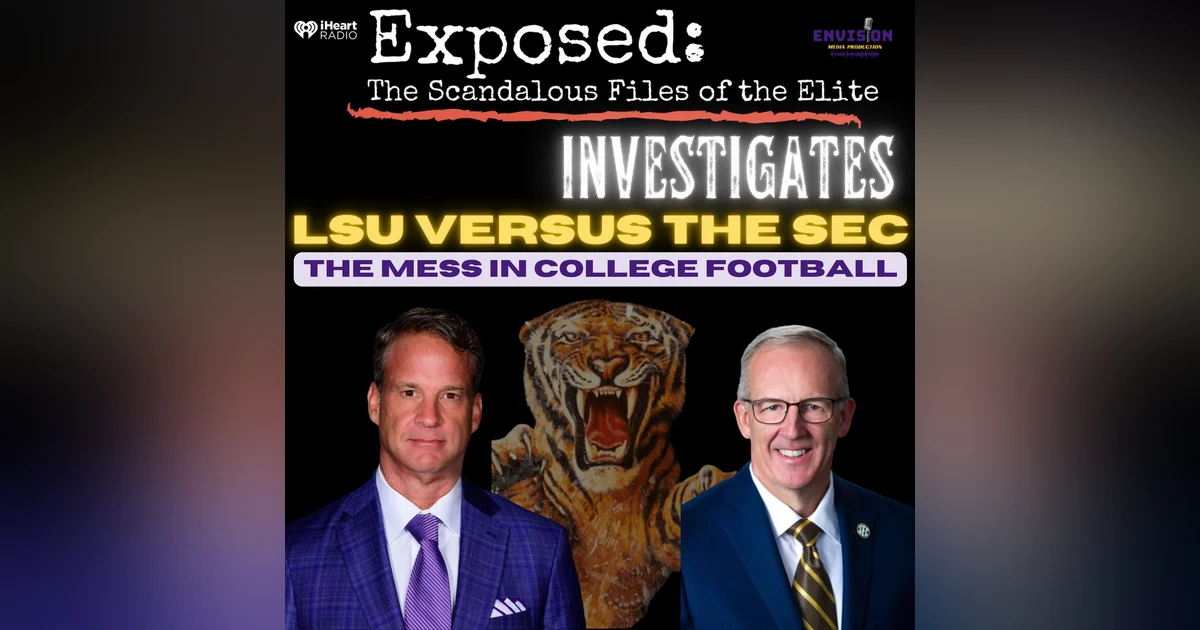


Jim Chapman takes a deep dive into the college football eligibility dispute over the NCAA’s shift from a four-for-five rule to a five-for-five model, and how players from the 2022 class say they were treated differently from others who received extra years.
Jim also explains the new age-based system, its limited exceptions, and the lawsuits and amicus brief challenging the NCAA’s changing eligibility decisions. Jim focuses on the conflict involving LSU, Lane Kiffin, and the SEC, including the SEC’s lawsuit over LSU’s discussions about recruiting players who had received temporary court relief.
For commercial free early releases, bonus episodes and more! https://www.patreon.com/exposedpodcastfiles
#LSU #LaneKiffin #SEC #GregSankey #Sports
Become a supporter of this podcast: https://www.spreaker.com/podcast/exposed-scandalous-files-of-the-elite--6073723/support.
0:23 Hey everyone, welcome back to Exposed Scandalous Files of the Elite. I'm your host, Jim Chapman, and I'm back with a very different episode today. Today we are going to talk about if, look, if you are a fan of college football period, you love this guy or you hate this guy. That is Lane Kiffin, head coach of the LSU Tigers. And there has been so much going on the past few weeks all over the country. And that's important to mention before we go any further. This is not an issue primarily with LSU and Lane Kiffin. There are 200 players from all over the country that a lot of people are calling NFL players now coming back to college football.
1:12 And this all stems from the 2022 class of college football players. I'm going to break it down for you today and I'm going to give you the facts of everything. And I'm going to go off of actual lawsuits that have been filed as long as tell you the result of the most recent lawsuit. And I'm going to break down what a lot of people are getting very confused about in this case and explain to you. why things are happening the way they are. So let's get into it. So I'm going to give you a bird's eye view of what's happening, and then we're going to get into these lawsuits. So the first thing I'm going to do is I'm going to break down what issues this class of 2022, these players from 2022 have with what's going on right now. in college football. Now, the NCAA, they used to have what was called a four-in-five rule, but they changed that recently to what's known as the five-for-five rule. Now, this created a problem with the class of 2022, the players that started in that year, and their gripe, their argument, if you will, is pretty simple. Everyone around them got extra years. They did not They spent their careers competing against COVID extras, medical extras, JUCO extras, and think Diego Pavia from Vanderbilt. He got an extra year due to
2:45 being in a JUCO. And now they're watching younger players get a clean fifth season while they're told they cannot have a fifth season. Now they say they are still inside the five-year college window. And the only reason they are shut out is an arbitrary cutoff date. And I agree with that. We'll get into more of that. So that's the issue. These guys basically, played four years of college football and because they weren't injured or they had like medical red shirts things like that they were told you can't you have no choice but to go to the nfl well They all of a sudden changed the rule to where you get a fifth year. Let me explain to you what the new rule is. The NCAA's 5 for 5 rule is an age-based eligibility model. It was approved in June of 2026. And it replaces the old system of four seasons of competition in five years.
3:47 The NCAA itself says the five for five is not fully accurate. Athletes who enroll on time generally get up to five years of eligibility and But of course, it's not a guarantee for anyone and everyone, especially people who delay college enrollment. Now, what this rule is supposed to do, Division I athletes who enroll no later than the academic year after their 19th birthday, they will get up to five years of eligibility in a continuous process. five-year window. The window starts at the earlier of these two choices. First full-time college enrollment or the academic year after the athlete turns 19. So if you turn 19 before September 1st, the clock starts in the fall. If you turn 19 after September 1st, the clock starts the following academic year, unless they enroll earlier. Now once that clock starts, It will not pause for transferring, injuring, sitting out, and limited playing time. And why they changed to this system was they were attempting to avoid issues with players getting a sixth year, like the quarterback from Ole Miss, Chambliss, got.
5:05 This new clear-cut rule would avoid something like that because you don't get injury or sick issues. excuses to use to say that's why you didn't get your full five years. Now, there are some limited exceptions, and it's important to note this doesn't just affect football. This is all sports. So pregnancy, active duty military, and if you're going on a religious mission somewhere, they say that could qualify as an exception to the rule. And I know all of that is confusing. It actually breaks it down a lot better in the lawsuits, and that is what I'm going to get into now. Now, there's been several players for LSU who were interested in suing, and that's important. LSU didn't sue anybody. Players chose to sue the NCAA players. that were forced out of football, being told they did not have a fifth year and they went to the NFL to try out, to go to training camps, et cetera. And then the NCAA changes the rule and they were kind of left out in the cold because the NCAA chose not to grandfather that class in. And that was the biggest mistake. This is the NCAA's fault all around. They should have grandfathered The 2022 class and they did not do that. Jack Pyburn came out. He was an LSU player. He challenged this.
6:36 And I'm going to refer to what's known as an amicus brief here. that was put out by Liz Murrell. And before I get into it, and she's the Attorney General in the state of Louisiana, she just offered an opinion on this. But before I get into it, I do want to say Jack Pyburn actually got picked up by a team. So this opinion now is irrelevant because Jack Pyburn could not play anyway in college. He is currently on an NFL roster. But I do want to read this because it is interesting. a brief written specifically on Jack Pyburn's case by Liz Murrell, the Attorney General of Louisiana. And it reads... In referring to the case, this case is a classic bait and switch. The NCAA told plaintiffs, members of the class of 2022 who want to play college football, they were no longer eligible for play after the typical timeline for collegiate competition had run its course. Then, shortly thereafter, the NCAA rescinded that decision and promised instead that these individuals could receive an additional year of eligibility to play for the sport that they love.
7:46 But around April 27th, 2026, the NCAA changed course again and once more stripped plaintiffs of their ability to return to the field. Many of those players then took the NCAA at its word and moved on from college football. And that's important, what she just said. That's completely accurate. And basically, they were told they cannot come back to college football. So they start applying to go to training camps to see if they can make an NFL roster. It goes on, but the story didn't end there. Following developments across the country, plaintiffs followed the growing trend and filed a petition in court seeking relief under Louisiana law from the NCAA's eligibility determination. On August 28, 2026, this court entered a temporary restraining order allowing plaintiffs to pursue the opportunity they had been denied, including by requiring they be allowed to enter the transfer portal. The NCAA and its conferences, however, have their own rules governing the consequences for institutions that allow athletes to compete contrary to those rules.
8:55 The result is a struggle that reaches past the plaintiffs themselves. Louisiana's public universities now face the prospect... of having to comply with this court's order while risking serious penalties from the governing body of the sport. The NCAA's ever-changing rules have consequences beyond these individual athletes. They affect the universities that recruit them, the other student athletes with whom they compete, and coaches and administrators responsible for complying with increasingly... complicated rules and those rules can determine who gets a roster spot who receives a scholarship who plays in death valley on saturday and it forces louisiana's public universities and student athletes into a no-win situation the state of louisiana cares deeply about that problem louisiana's public universities and their student athletes are participants in this convoluted arrangement and have struggled under the broken system for years now and they have operated there under often without having access to a fair and unbiased decision-maker. The Louisiana Constitution protects all Louisiana citizens access to open courts and likewise promises them that they may rely on resulting court decisions. Ultimately, the state has an interest in college sport rules that are fair, consistent, and predictable. These plaintiffs entered college expecting to be treated as compared to all athletes they competed against. They subsequently confronted changes to the rules governing their fifth season of competition while their eligibility was ongoing. The NCAA first treated
10:29 these athletes as ineligible, later provided a pathway for additional year, and then changed course again. the incessant back and forth made compliance with the NCAA rules nearly impossible. By the time the rules changed again, some plaintiffs had already graduated, pursued professional opportunities, entered pro contracts, or otherwise moved forward with their lives based on the understanding that their college careers have ended. Others did not enter the transfer portal because under the rules, they would have had little practical purpose. But all operated under the rules set by the NCAA as written. And then it goes on to discuss some other things related that really I don't need to repeat.
11:15 But essentially what she's saying is just what I just told you. The NCAA told these players you have no more eligibility. They start going to these training camps trying to make pro teams because what else are they going to do? And then the NCAA changes the freaking rules. and doesn't grandfather them in. And that is not fair. So they're full within their rights to sue the NCAA. And it's important to mention, this is not the college football of old. These players are getting paid now. Had they not been getting paid, it wouldn't have been that big of a deal. But the NCAA not grandfathering the 2022 class in costs them a lot of real money, y'all.
11:59 So LSU, along with Texas and other schools, Missouri, Arkansas, and a slew of Big Ten schools and schools all over the country, they started looking into this. Now, Lane Kiffin, very high profile. In some circles, people just flat out do not like Lane Kiffin. So anything he touches, they're going to criticize. There were a few players that LSU was interested in in Lane Kiffin. And so their stance was, hey, If these guys are found to be just in what they're saying, in other words, if a court gives them a temporary restraining order and allows them to play football, we're going to recruit them. They're players. They're in the portal.
12:44 And we're going to recruit them and try to get them on our team. But we're going to follow all the rules. as it relates to what a court says. Well, these players did get a temporary restraining order and LSU starts talking to them. The SEC, however, had a problem with that because they said, hold up, this violates our rules. The true fact is, regardless of what the SEC, which it's important to mention, this is not a corporation, y'all. The SEC is a club. It's basically made up of school presidents for every school that is represented in the SEC. They meet and they try to manage that conference, if you will. But they're not a corporation. They're just a group.
13:27 It's like a club. LSU is part of that club. Well, all these other presidents in this club, if you will, basically said, oh, no, y'all can't do that. Y'all cannot recruit NFL players. Now, let me make this clear. These are not people that, you know, Brett Favre's not coming back and playing for LSU. Anyone that is on a pro team, on a pro team, has made one and has a pro contract is not coming back to college football. These are players that went to training camp. Some cases they didn't even do that, but some of them did. They went to training camp and they got cut. So they were never on a team. They practiced and tried out and didn't make the cut. Important to mention that.
14:15 But the SEC still doesn't like it. And they were making that known all over the media. Before I go any further with this, because I'm going to bring you in to where these players actually sued in a Louisiana court to get the right to play just a few days ago. But before I get into that, I'm going to play you a series of clips right now. of Lane Kiffin actually commenting on this stuff just this past week. Now, the first clip I'm going to play you is where a reporter in an LSU press conference asked Lane Kiffin specifically about these players because there were a lot of rumors going around that the team basically was getting the red ass because Lane Kiffin was going to let these quote NFL players play. on his roster. What about the players on the team already? Somebody's already got a spot and this person's taking their spot and he answered that question right here. Listen to this.
15:19 I probably am in the minority of how I make decisions and probably not what most coaches do. I feel like my decisions should always be made in the best interest of the players that sit in this team room and not but for my reputation and how the decisions play in the national media or other fan bases. I've never been that way, and that could be wrong. It's probably part of my story why it is the way it is, but those players and the people that hire me always know he's constantly trying to do the best thing for them. So I struggled with it a lot. There's a lot of factors into it and different things, and one that I struggled too was, okay, this late, even though that's what you do in the NFL, And there's an argument these players are paid like that. And it's what happened yesterday in the NFL. New players come in and take people's spots and added to rosters. And other guys have been there working. So I met with our leadership committee of our players. And I asked them, it's your team. What do you want to do? If these players are allowed to be added to rosters, what do you want to do? And every one of them was emphatic about that. they can help us win, bring them. And, you know, we understand that, you know, we have a team that's practiced together, worked together all off season, but.
16:45 One of them said, Hey, this is how it works at the next level. And this is how the real world works. You know, there aren't days you can't bring employees into, um, certain jobs to help the, help the company. So, um, that made me feel a little better in the struggle and being torn back and forth. Um, So we'll wait to hear for more guidance. The SEC issued guidance in our question about that they'll follow court orders. And so we'll wait until this week to see if there's any more guidance. And the question whether myself as the head coach of football and will football follow SEC orders, I said it earlier this morning when asked, of course we will.
17:29 Now you just heard him right there say, I met with the leadership of the team. That's four or five players that make up a leadership council for LSU football team. They speak for all the players and they said, Hey, if they can help the team, bring them. So that should have put that to bed right there. But of course, some people just can't accept that players are okay with that. As a matter of fact, one of those players that's on that leadership team came out, verified that that conversation did occur with LSU's leadership team inside that locker room and that they were all for it. So moving on from that, the next clip I'm going to play for you is Kiffin speaking on these athletes filing the lawsuits and kind of giving his take on that. Here's that.
18:23 Yeah, there was never... First off, a lot of athletes filed these. Injunctions or temporary restraining orders around the country against the NCAA that were in this fifth year and felt their attorneys and them felt they should get that year back because of the NCAA not handling it properly. So as they started to win these cases, obviously, then came in conference rules. And so I don't think it was much of a surprise very much surprised if those kids' attorneys or those kids, they feel they have a court order saying they can play, and now if they're restricted by someone to not, they brought a court order against the conference.
19:06 So there's no intent, nor there ever was, to play somebody that we're not supposed to in order of an SEC rule. So I think, again, I'm not the spokesperson. I think now you're waiting to see Thursday, you know, The SEC had a stance, made a rule. A judge felt that they couldn't do that to the players. So we'll be practicing, focused on Clemson and spending our time on that all week. And they can figure out the rest and we'll just wait for guidance. I mean, I don't understand why anybody could have a problem with this. He explained it pretty good right there. And he's saying, look, we're going to follow whatever rules the courts decide. And we've been communicating with the SEC on this stuff. Now, the next clip I'm going to play you is regarding why there's such a rush to to get this decision for these players. I mean, obviously, it's the start of the season, but it goes a little beyond that, and I'm going to let you listen to this clip of Lane Kiffin explaining that.
20:13 The SEC has a rule, which I think is the only conference, that we make our list the day before the first competition for the first game, so for almost everybody Friday. We have to turn a list in of the 105 to the SEC, and that is locked. That cannot move. from my understanding from our conference. So you've got to make decisions, unless there's information I don't know, by Friday for that. Now, it's not your question, but I don't also look at, you know, there's a lot of people say, well, how could you take players then and then they'll be ready for the game? It's a long season. So I don't, in my opinion, you don't, just like in the NFL, they take people in week one knowing that, hey, They'll have them ready by week two, three, four, and then they'll be playing their best and they'll know their system.
21:06 Every coach obviously runs their program the way they want to and they see things differently and I respect that. I think that we create systems that help this for people coming late. We did it last year. Trinidad got to us in the summer last year. Not that much earlier as a quarterback, so I think we could do it with other players. Then the players that had an interest in going to LSU, well, they went to a Louisiana court and they said, SEC is trying to stop us from playing. The NCAA is trying to stop us from playing. And we're taking this to court. We're going to stand in front of a judge and plead our case, and that's just what happened just yesterday from this recording. When it was all said and done, the judge agreed with the players and said, I'm going to give you all a TRO, a temporary restraining order, because this is certainly going to go through the court system.
22:03 But. We're not going to allow anybody to stop you from playing until this is determined that you cannot play. So what that means is these players can play college football. Now, they've never played pro ball. They tried out for pro ball and got cut. Very important. I'm going to say that several times. But here's the shady thing and the thing I didn't like, and that was the Southeastern Conference, 30 minutes into this court session, drops a lawsuit in federal court out of the Northern District of Alabama, which is where they're headquartered. I know a lot of people are saying that was to add insult to injury because LSU and Alabama are such rivals. They're headquartered there, so that actually made sense to me that they would file that in the Northern District of Alabama. But they filed this lawsuit, and I want to be fair, and I want to give their argument for this. The introduction says, For more than 90 years, the Southeastern Conference has stood as the intersection of higher education and elite athletic competition.
23:08 Founded in 1933 by university presidents who believed that athletics should promote and serve educational values, the SEC is now the nation's premier athletic conference. Today, the SEC is a 16-member association. The presidents and chancellors of the SEC's member institutions say, have governed together across generations, operating under a set of shared rules that have shaped the athletic and educational paths of thousands of student athletes and provided the competitive integrity and fair competition necessary for the SEC to thrive. Those rules are not fine print. They are the governing framework that keeps college sports unique, protects opportunities for high school and college athletes, and preserves competitive equity and fair competition.
23:57 The SEC has endured and thrived for nearly a century because its members have adhered to a common set of rules which each member institution and every coach has agreed to follow. Among the most fundamental of those rules are the longstanding provisions that prohibit individuals who have entered a professional draft, signed professional contracts, or been rostered on professional athletic teams from returning to college athletics. Those rules are built upon an essential principle. College athletics is reserved for students who are actively pursuing an education while competing for universities. The rules preserve competitive fairness, protect opportunities for high school students and current college athletes, and maintain the distinction between college and professional sports. that distinction is critical to the SEC's member institutions, their presidents, chancellors, and fans. This case arises from defendants' violation of SEC's First Amendment right of expressive association, specifically defendants, and in this case, It is Lane Kiffin, who is the head coach of LSU, along with Virg Osberry, who is the vice president and director of athletics at Louisiana State University, and Wade Roos, in his official capacity, is the president of Louisiana State University. So, It's important to mention they're suing individuals because there is a longstanding law that says a federal court cannot sue a state court. So the way they circumvent that or
25:29 get around it is to sue individuals involved in the scenario. And that's what's going on here. So it says specifically, these defendants waged a deliberate and coordinated campaign to recruit professional athletes to play football for LSU during 2026-27 season. including players who had signed NFL contracts with the Cleveland Browns, New Orleans Saints, and Tampa Bay Buccaneers. Numerous reports have shown at least two of these athletes are on campus and actively practicing with the LSU football team. Defendants have also expressed their unequivocal intent to place those athletes on LSU's official roster and allow them to participate in football games during the upcoming season. Every SEC institution, including LSU, has affirmed that individuals who choose to leave college athletics, sign professional playing contracts, and compete professionally should not be permitted to return to college competition. Just days ago, on August 25, 2026, LSU voted in favor of the SEC issuing a policy statement clarifying its longstanding rules prohibit an SEC institution from having a professional athlete. on its roster. Nevertheless, defendants have continued their campaign to engage in willful efforts to recruit and roster professional athletes in direct defiance of the professionalism rules. This conduct is detrimental to the conference and contrary to its core purpose. Defendants' conduct has already harmed the conference and threatens to cause further substantial harm
27:01 if not stopped. Through their actions, defendants have compelled the SEC and each of its institutions to associate with conduct that every member institution, including until recently LSU, has repudiated. As a result, defendants have violated the SEC's Expressive Association requirements under the First Amendment of the Constitution. The SEC brings this action to vindicate its First Amendment right of expressive association, its right not to be forced to associate its competitions, brand, or championships with conduct that has expressly been condemned since the founding of the SEC. They also seek a declaratory and injunctive relief to vindicate the SEC's right to dissociate from conduct that directly undermines the SEC's purpose and core values. The SEC does not bring this action to declare any student athlete ineligible or to prevent any student athlete from participating in athletic competition.
27:59 Bullshit. That right there, that one sentence absolutely pissed me off because you can't file this lawsuit saying any school that accepts these players is going to go through suspensions and get millions of dollars of fines. You can't do that and then say, we don't have any problem with these players playing and we don't have any problem from them participating in athletic competition, but we just have a problem with them doing it here. You can't do that. It goes on to say this action is directed solely at the member institution and athletic department personnel that have violated the SEC's rights under the First Amendment. That's basically how that section of the lawsuit ends. reads. Now, before we go any further and comment any further on this SEC lawsuit, I want to play you Attorney General Liz Murrell, who went on Matt Moscona's After Further Review podcast, and she was on the phone. She actually called in during court for these players that were suing in the Louisiana court.
29:13 during a recess, and she took some time with Matt Moscona to explain her thoughts on the SEC filing this lawsuit right in the middle of this hearing with these players determining if they could play. Listen to this. A few questions about today's testimony in a moment, but if I could first get a reaction on the SEC filing a lawsuit in federal court against LSU, Wade Roos, Spurge Osbury, and Lane Kiffin. Yeah, I mean, I think it's legal gamesmanship. They're trying to, you know, it was pretty clear that that's what it was when 35 minutes or 40 minutes into the hearing this morning, we find out that they've filed a lawsuit in federal court in the Northern district of Alabama against LSU and LSU officials. Really it's against the board of supervisors and some other LSU officials. You know, the allegations are garbage. They, they claim that LSU recruited these athletes to file this lawsuit. I can tell you, I'm here with them. They are, they've been here all day. They are waiting right now for their opportunity to speak. And they, Two of them have already just testified. And, you know, it's very clear that they are genuine in their desire to play and to have an opportunity. And they just wanted a fair hearing and a fair forum to have that determined because they certainly weren't getting that from the SEC or the NCAA.
30:43 You mentioned legal gamesmanship. What is the benefit of the SEC filing that suit during this court proceeding? Well, I mean, the... The implication, I think, that they wanted, and it could be just for press purposes for all I know, I mean, was to suggest that they could get a federal injunction that would essentially override any state court order that allowed these students to play. But, you know, remember, you're looking at two different parties. You've got student athletes who are seeking an opportunity to play. And then you've now got a federal lawsuit over there where they are trying to enjoin a handful of individuals who work for LSU or the Board of Supervisors from being able to do anything that would effectuate the rights that these students might obtain through an injunction issued by this court. Look, I think the lawsuit that they filed in Alabama is frivolous.
31:47 They're claiming that there is a violation of the SEC's and their member schools' First Amendment rights to expressive association. What that really means is that somebody's trying to prevent them from talking or advocating, and nobody's done that. They can say whatever they want. They've all been doing it. They've been out on Twitter and everywhere else all morning saying that they think the SEC should stick it to LSU. So nobody has stopped them from expressing themselves any way they deem appropriate. This is really about the rules that are being applied by the NCAA and the SEC and how they are being applied in a manner that affects the economic and rights and opportunities of these students.
32:36 Attorney General Liz Murrell is with us. Something I shared with our audience that you shared with me earlier via text is that, was your feeling that LSU, as an arm of the state, has sovereign immunity and therefore has the SEC couldn't sue LSU as an arm of, of the state. Can you explain what that means? Like, like a five and then how they were able to do, how they're able to do it if they're not allowed to? Yeah. Here's your legal constitutional law minute. You know, it's a, it's a little confusing. I mean, if people get confused by it, they shouldn't feel bad. I mean, I think there's, Everyone else, student, whoever learns about this is probably still confused about it even after they get out of law school.
33:21 But there's, you know, the concept of sovereign immunity is that the state can't be sued in federal court. So it's a matter of comedy between the two different types of government, the federal government and the state's government. So when we are sued in federal court, we aren't sued as the state. or a state agency or arm of the state. And LSU is an arm of the state. But what they can do is sue individuals who are employed by the state and who have official duties. And that's how they get around sovereign immunity, is that they sue an individual and they say, that individual is violating my constitutional rights under the color of law. And so I want that individual to stop violating my rights, and you, court, should stop them by issuing an injunction. So that's essentially what the SEC has done. They've claimed that they have a constitutional right. And remember, it's not even an actual association.
34:25 It is a bunch of schools that voluntarily get together and agree to something. So it's not an incorporated entity. It's not a corporation. It's not incorporated under any of our general business rules that would give it any kind of personhood or constitutional rights. Corporations can have constitutional rights, but the SEC is not a corporation. It's just a bunch of. Component schools that make up its membership. And some of those schools are state, arms of the state, like LSU, and so they don't have constitutional rights. So I think there's a lot of defects in that pleading, but we will have to sort those out as we go along in the federal suit. And they have to serve us, for starters. Nobody's been served in that lawsuit. So that's going to take a little time to sort all that out.
35:21 A couple more minutes here with Louisiana Attorney General Liz Murrow. Good enough to join us. She's been down at the courtroom at the 19th JDC all day. You mentioned some notable testimony. By the way, do you know which players have already testified? It's okay if not. I know you're not... I'm the sports guy. You're the state attorney general. It's fine. The two soccer players. Okay. The two LSU soccer players? Correct. Okay. Do either Commissioner Sankey or the two athletes that you heard testify, what do you think just from your legal opinion, was notable in any of the testimony?
36:04 You know, first of all, he was evasive. I mean, he acted like he had never read the five-on-five rule. I thought that was absurd. I mean, with as much litigation going on around the country, all of it centered around the NCAA and the SEC, and here is an individual who is paid $ 4. 8 million a year to know what his own rules are, and he said he didn't know what the rule was. He had never read the rule until today, which is absurd. So I thought that was kind of disingenuous and probably, you know, just evasive. I don't think it you know, I don't think the judge thought it was very credible. You know, he's he's here. He flew here on his private jet and he did not have the courtesy to even stay and listen in.
36:47 to these students testify about why they want to play and why they think this is unfair. And I think that, I think that was, you know, also, you know, for someone who sat on the stand and acted like he actually cared about them and that they, you know, his actions actually show that he doesn't. Did Commissioner Sankey leave? He's going down the elevator as we speak. You want to hand him the phone? Tell him it's me. Well, I don't know. Yeah, he's getting on the elevator with his posse. Attorney General Lismore. Are they about to resume? We are shortly, yeah. Okay, I don't want to take up too much of your time. It's very much appreciated. If I asked you, and with a few people out in the courtroom, it kind of sounds like things might be leaning toward the players.
37:35 I don't know that as an attorney you're really in the prediction business, but what should someone listening, following all this, think the next steps are going to be in all of this? Because it doesn't seem like this is going to end today. You know, it's really, it's hard to say. I mean, I think the judge is a good judge. He's a smart judge. He's been very attentive. You know, I think that he, I've seen him in other cases where he may be very sympathetic to the plaintiff and still rule against the plaintiff because that's what the law demands of him. So I don't know what he will do. You know, I think that the students, they are getting a fair, unbiased, I think, forum to be able to air this grievance.
38:22 And I think that's something they were not getting before. So they've been able to benefit from that. What he will do, I couldn't say. If he does issue an injunction, then, you know, the next thing we're going to hear is whether he issues any kind of contempt penalties against the SEC for trying to do an end run or against the NCAA, I guess, for trying to do an end run around his earlier court order by working in concert with the SEC to try and do kind of through the back door what they couldn't do through the front door. So we'll see. I mean, I don't know how that will all go. The Alabama stuff will have to play itself out. I mean, there'll be proceedings. We'll file motions to dismiss that case. or to transfer it, I'm sure.
39:08 I mean, why it's just in Northern District of Alabama, it should be, the SEC kind of claims it's not really a thing. It's just a bunch of member schools. So it's not, it has no juridical personhood. I don't know why they would be able to stay in Alabama. And y'all, this is the Attorney General, Liz Murrell, who understands the law as good as anybody or better in the state of Louisiana. And she just broke it down for you right there. I couldn't agree with her more. This is ridiculous. These players involved, at least in the LSU side of things, all testified under oath yesterday that LSU had nothing to do with their decision to want to come back and play another year of college football.
39:54 They had nothing to do with it. These players said, we were not recruited by LSU until after we pursued trying to get that fifth year of eligibility in college football. That's all that needs to be said. LSU did not sue the NCAA. These players did. So for the SEC to come out and sue LSU over this is absolutely ridiculous. It's BS. And really, LSU ought to turn around and file a frivolous lawsuit complaint against the SEC. This right here has become a major pissing contest. And a lot of people out there that I've talked to and listened to have said, well, you know what? These are going to be two or three players. They're going to primarily be backups, second string people. They're going to play 20, 30 snaps a game. Why doesn't LSU just wave the red flag? Well, it's kind of become a principle issue.
41:01 as well as a legal issue. The SEC right now is trying to bully LSU into just not pursuing these players. And LSU is not a school that's going to allow the SEC to bully them. We bring a lot to the SEC. Do people realize we are a founding member of the SEC? the Southeastern Conference. So LSU is not going to back down to this, especially now. And I don't blame them. I don't have any problem with that. These players, if they want to play at LSU and they're good enough to play and a judge has ruled them eligible to play, they should be able to do that.
41:45 Nobody on LSU's side is breaking any rules that And when you give in to somebody trying to big dog you like the SEC is doing, you're always going to get big dogged. The SEC is wrong for this. They need to follow the courts. If the courts say these boys can play, they need to fall in line with that. That's my opinion on it. I do not think LSU should waver a white flag and just say, we give up. Sorry, that's not the way I feel. These players deserve better than that. The mess in college football has nothing to do with LSU. This is a nationwide thing. That's why Chambliss is in his sixth year at Ole Miss playing quarterback.
42:38 College sports right now has some issues. It's kind of like the Wild West. And it's up to the NCAA to fix that, not LSU. They're playing within the rules. So this is just kind of an extra episode. I wanted to bring that to you for those that may be interested in it. It's making a lot of news in the sports world. I don't usually cover sports related stuff like this, but it is a lawsuit. It is making big news. And that fits what we do here on Exposed Scandalous Files of the Elite. Thank you so much. I'm Jim Chapman for Exposed Scandalous Files of the Elite.
43:18 Much love.


