


Reclaiming Sexual Pleasure in Midlife with Dr Maria Sophocles



If sex has slowly disappeared from your life - or started to feel like something you dread rather than look forward to - and you're not sure whether to blame your hormones, your relationship, your exhaustion, or just yourself, this episode is going to help.
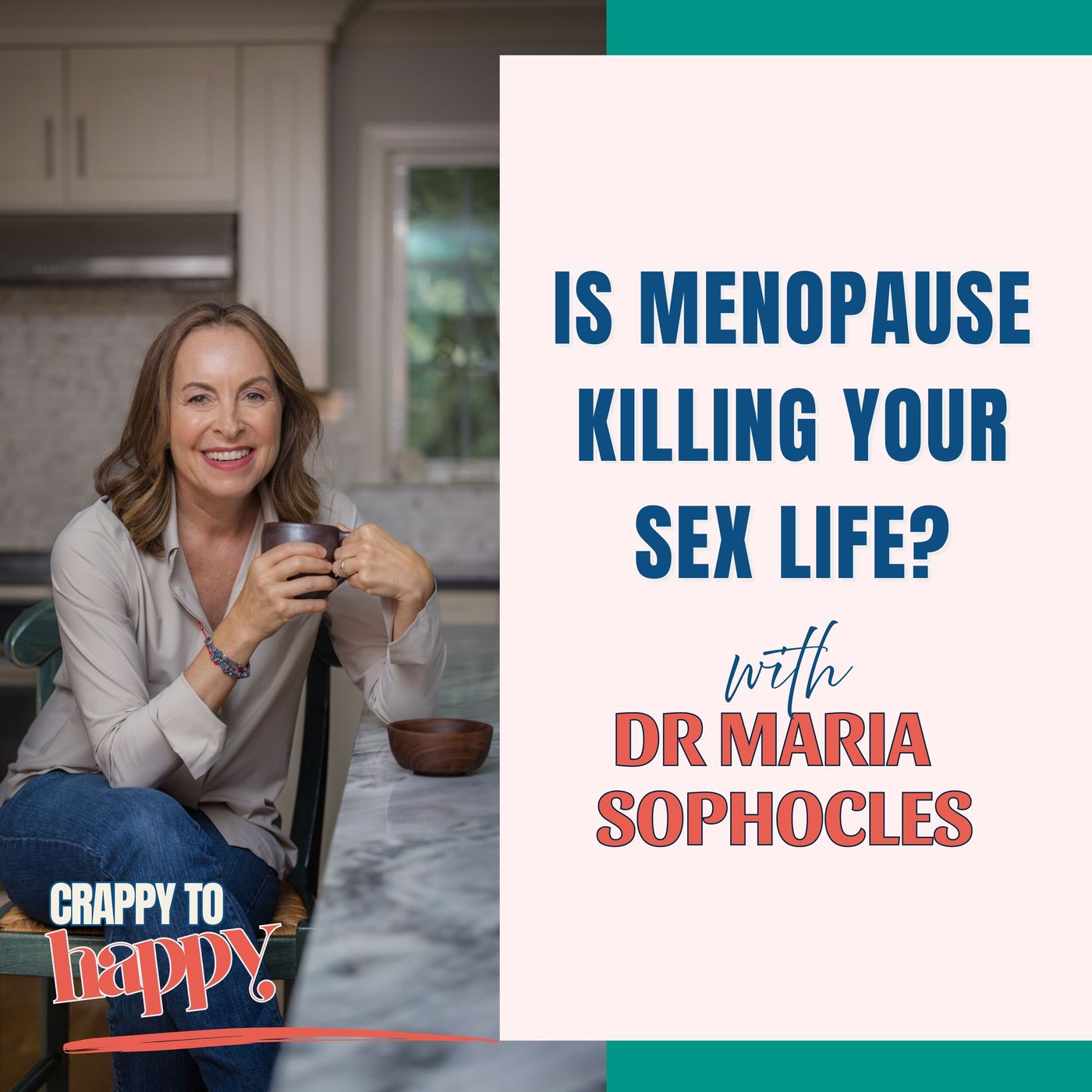
My guest is Dr Maria Sophocles, a board-certified OB/GYN and Menopause Society Certified Practitioner who has spent 30 years working with women on the clinical frontline of this exact problem. She's the author of the brand new book The Bedroom Gap, and the creator of a TED Talk on midlife sex that has now been watched over a million times.
Maria coined the term "the bedroom gap" to describe the very real and very unspoken difference in sexual expectations and abilities between men and women in midlife. It's not just about low libido, but the physical changes happening in your body that nobody explains to you, the cultural messaging that tells women their discomfort doesn't matter, a medical system that created Viagra in 1998 but left women largely without equivalent solutions, and the shame that keeps so many of us from even raising the subject with our doctors.
In this conversation, Maria breaks down the physiology of what oestrogen loss actually does to your vagina, your bladder, and your capacity for arousal . We talk about vaginal oestrogen, why it's safe for virtually every woman on the planet, and why so many women never get offered it; and what to say to your doctor when sexual symptoms aren't being addressed.
In this episode, you'll learn:
- What "the bedroom gap" actually is and why it tends to widen so dramatically during perimenopause and menopause
- What oestrogen loss is really doing to your body - and why pain and dryness during sex are physiological, not a personal failing
- Why vaginal oestrogen is considered safe for virtually every woman but is still widely under-prescribed
- Why your HRT patch or gel alone is often not enough for sexual and bladder symptoms, and what to ask for instead
- How Viagra, despite being a genuine breakthrough for some couples, also made the bedroom gap worse for a great many women
- What the new FDA approval for female sexual desire actually means - and why it matters that it took this long
- The real story on testosterone for women, why it's approved in Australia but not the US or UK, and what it can do
- How porn has become the default sex educator for an entire generation, and the resources Maria actually recommends instead
- What to say when you want to start a conversation about sex with a long-term partner, a doctor, or your adult daughter
Resources mentioned:
- The Bedroom Gap by Dr Maria Sophocles - mariasophoclesmd.com/book/
- Dr Maria Sophocles' TED Talk: "What happens to sex in midlife? A look at the bedroom gap" - ted.com/speakers/maria_sophocles
- OMGYES (sex education resource) - omgyes.com
- Erica Lust TED Talk on female-forward adult content - search "Erica Lust TED Athens"
- Come As You Are by Emily Nagoski
- Dr Maria Sophocles on Instagram: @MariaSophoclesMD
- Dr Maria Sophocles on LinkedIn
Beyond Confident 2.0 for Solopreneurs & Service Providers
Open for enrolment NOW.
Transform self-doubt & self-sabotage, rewire your nervous system for success, and do the inner healing work, while being supported to create a streamlined, profitable business that supports your lifestyle.
Save $1000 with Founding Member Pricing.
www.cassdunn.com/bc2
Connect with Cass:
www.cassdunn.com
www.instagram.com/cassdunn_xo
Contact Crappy to Happy:
Email: hello@crappytohappypod.com
www.crappytohappypod.com
www.instagram.com/crappytohappypod
Cass Dunn
If you are a woman of a certain age and sex has slowly disappeared from your life, or if it is starting to feel like something that you dread rather than look forward to, and you are not sure whether you should blame your hormones, your relationship, your exhaustion, or just yourself, you are going to love this episode.
My guest today is Dr Maria Sophocles. She is a board-certified obstetrician-gynaecologist, a Menopause Society Certified Practitioner, and she has spent 30 years working with women on the clinical frontline of this exact problem.
She is the author of the brand new book The Bedroom Gap and the creator of a TED talk on midlife sex that has now been watched over a million times. She is also, I can confirm, one of the most warm, friendly, refreshingly frank and brilliant people that I have had the pleasure to have on the show.
Maria coined the term the bedroom gap to describe something that she observed over decades of practice, which is the very real and unspoken difference in sexual expectations and abilities between men and women in midlife, and across the lifespan actually.
But this is not just about low libido. It is about the physical changes happening in your body that nobody explains to you. It is the cultural messaging that tells women that their discomfort does not matter, and a medical system that created Viagra in 1998 but left women largely without any equivalent solutions. And it is the shame that keeps so many of us from even raising the subject with our doctors.
In this conversation, Maria breaks down the physiology of what is happening in our bodies at this time in a way that is illuminating and honestly a lot less bleak than you might expect, because it is very treatable.
We also talk about what is happening with the younger generation, what porn is teaching an entire generation about sex, and how we can start having better conversations with our daughters.
I think you are going to love Maria just as much as I do. Here she is to talk about the bedroom gap.
Maria, welcome to the Crappy to Happy podcast.
Dr Maria Sophocles
Thank you. I am so, so glad to be here, Cass.
Cass Dunn
I have been very fortunate. You were very generous in sharing with me a manuscript of your upcoming book, The Bedroom Gap. I have spoken to you in the past and I have told you that I had Dr Louise Newson on the podcast twice talking about menopause and the issues confronting menopause and the benefits of hormones and so on.
But one thing we did not really touch on was the sexual aspect of it. We talk about low libido, but we do not really talk about the physical difficulties associated with sex that come up at this time of life.
Which is why I am so interested to see your book coming out and the work that you do and the things that you talk about. So having said all of that, can you first explain for the listeners what the bedroom gap is?
Dr Maria Sophocles
Absolutely. The bedroom gap is really about the difference in sexual expectations, abilities and perceptions around sex that couples can have. Partners can be heterosexual or homosexual, but it is particularly problematic in heterosexual couples.
Men are fed certain expectations about sex and scripts about sex, and so are women. We are fed this as children, through the media, through sex education. We take this information and go on to become sexually active adults. It is like we follow these scripts.
But then in midlife our bodies change. Testosterone drops for men about one percent a year. Women undergo menopause and their oestrogen and testosterone drop pretty dramatically.
This creates changes in the brain in terms of libido. It also changes vaginal health. There are changes in erectile function and sperm count too. So both partners are having changes and trying to navigate them.
You couple this with really poor communication skills around sex. We are actually taught not to talk about it. Then add pharmaceutical companies, which created wonderful medications for erectile problems but not so much for women. Now the playing field is uneven and the bedroom gap widens.
Add thousands of years of history teaching us that sex is for men. They have needs. Women, if they are in pain or miserable, should probably just be quiet and deal with it.
You get this disconnect that can wreck relationships and damage self-esteem. So the bedroom gap looks at all of that and asks how we rewrite the rules of sex for ourselves as we go through perimenopause and menopause.
How do we make sexual pleasure a priority and part of our overall wellness goals? Because sexual health is a pillar of health. There is scientific data showing that when you are sexually active and have a good relationship with intimacy and affection, you have lower depression, lower anxiety, lower stress and lower blood pressure.
All of that is wrapped up in this little book. The term bedroom gap just seemed to encompass it all. It is a lot more than an orgasm gap. It is really about relationships and society.
Cass Dunn
It really is. And it was such an education for me. There is so much information in there and we could talk about the book later, but the bedroom gap and all the things you just mentioned clearly affect couples across the lifespan.
I want to start talking about menopause and perimenopause, but then perhaps we can talk about other age groups and demographics.
Dr Maria Sophocles
It tends to widen in midlife, Cass. That is why I focused on that stage. I had already written a book about menopause and actually chose not to publish it because many of my peers were starting to publish similar books. I thought we did not need one more book about hot flushes.
This book is directed to women in perimenopause and menopause because those are the patients I have seen for 30 years who come in saying, “I am broken. Something is not right. I do not have interest in sex. Sex hurts. My partner is frustrated. Help me.”
They often say they cannot even find a place to read about this and think maybe it is just them. I wanted women to know what really happens to your body as you move through your forties and fifties.
Even though women of any age could read it, it is really aimed at women roughly between 40 and 60 who are feeling frustrated and thinking they would rather watch television or scroll Instagram and go to bed.
I want them to know they do not have to give up. They can understand what is happening and build little micro-habits that change it and take small steps to turn things around.
Cass Dunn
That is the important part. So Maria, what actually happens to women’s bodies? We know there can be a loss of libido, but when a woman does want to have sex and it is not working like it used to, what is happening physically?
Dr Maria Sophocles
The physiology comes down largely to the loss of oestrogen. Oestrogen is a growth hormone. It is essentially food for our tissues.
When oestrogen declines, the vagina changes. The deep pink colour becomes pale or yellowish. Blood vessels disappear, so moisture disappears. Collagen breaks down and the ridges flatten.
When collagen is lost, elasticity is lost. That is why things can become painful. When blood vessels disappear, even if your brain is aroused, there are not enough vessels to bring moisture into the vagina.
Lubricants can certainly help, and there should be no shame about using them. But lubricants are really a band-aid. The real solution is to treat the underlying cause.
That usually means vaginal oestrogen, which restores blood vessels and tissue health. Sometimes laser treatments or other medications are also used.
When sex becomes painful, the brain remembers that pain. The next time, the body anticipates it and tightens. Women can develop an involuntary tightening of the pelvic floor called vaginismus.
Treatment may include vaginal oestrogen, pelvic floor physiotherapy and sometimes vaginal trainers or dilators that gradually help the muscles relax.
Another important point is that oestrogen loss also affects the bladder. Without healthy vaginal tissue and bacteria, urinary tract infections become more common. That is why many older women experience frequent UTIs.
Using vaginal oestrogen long-term can help protect bladder health as well.
Cass Dunn
One thing that occurs to me is that doctors are getting better at prescribing hormone replacement therapy. Women may get oestrogen patches or gels and progesterone.
But vaginal oestrogen is rarely offered upfront. Women would not even know to ask.
Dr Maria Sophocles
And the reason for that is cultural stigma around female genitalia. We still struggle even to say the word vagina.
Many doctors are uncomfortable raising sexual health topics. Even if they prescribe systemic hormone therapy, the amount of oestrogen that reaches the vagina can be quite small.
That is why many women still need local vaginal oestrogen specifically for genital and bladder symptoms. Women really need to advocate for themselves and ask directly.
Cass Dunn
Another factor in the bedroom gap is the gendered lack of attention to women’s sexual health by medicine.
When men experienced erectile dysfunction, Viagra appeared very quickly. But solutions for women have been much slower.
Dr Maria Sophocles
Yes, that is exactly what inspired the concept of the bedroom gap.
Viagra was originally a blood pressure drug that happened to prolong erections as a side effect. Once that was discovered, it became one of the most successful drug launches in history.
It has helped many couples, but it also widened the gap in some relationships. If a woman has vaginal pain or dryness and her partner suddenly has stronger erections and wants sex more often, that can create tension.
There are now some medications approved for female sexual desire. One called flibanserin, brand name Addyi, was recently approved for use in postmenopausal women with low libido.
That approval is quite recent and represents progress. For the first time there is recognition that women over 50 still value sexual wellbeing.
Cass Dunn
Another hormone that often comes up in this discussion is testosterone.
Dr Maria Sophocles
Testosterone is produced by women throughout life and plays a role in libido, energy and tissue health.
When used in appropriate doses, topical testosterone can improve blood flow and nerve sensitivity in the vulva and clitoris. Many women report improved desire, energy and sexual response.
Cass Dunn
Another big issue affecting expectations around sex is pornography, especially for younger generations.
Dr Maria Sophocles
Yes. Porn has become one of the main sources of sex education.
The problem is that most mainstream porn reflects male-centred fantasies rather than realistic sexual experiences. It creates myths, like the idea that women easily orgasm from penetrative sex alone.
In reality, about 80 percent of women need clitoral stimulation to reach orgasm. Porn rarely shows that.
We need better sexual education that includes communication, pleasure and realistic expectations.
Cass Dunn
As a parent of a nineteen-year-old daughter, that concerns me a lot. Many parents want to talk about this but do not know how.
Dr Maria Sophocles
It is difficult because many of us were not taught to talk about sex ourselves. But we can change that one conversation at a time.
We can tell younger generations that sexual pleasure is not shameful and that communication with partners matters.
Cass Dunn
For middle-aged women listening who may be experiencing these difficulties, what is the key takeaway you would like them to have?
Dr Maria Sophocles
Sexual pleasure is yours to claim.
You do not have to dread sex or feel obligated. With understanding, communication and sometimes medical treatment, sex can become enjoyable again.
Even small steps toward intimacy and understanding your body can make a difference. Sexual pleasure is a legitimate part of overall health.
Cass Dunn
Thank you so much for your time and your work, Dr Maria Sophocles.
Dr Maria Sophocles
You are welcome. Thanks, Cass.