

 Overcast

 Castro

 Spotify

 Apple Podcasts

 PocketCasts

 RSS Feed
146 From Trauma to Healing with 'My Moody Monster' with Jen Ginty
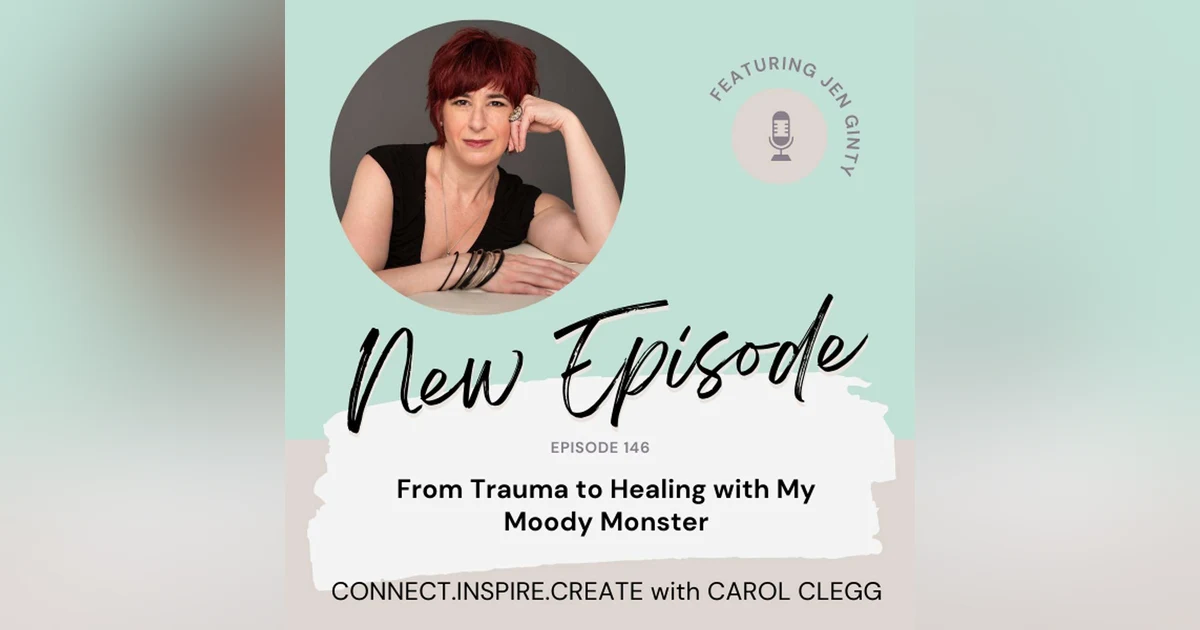

The journey of healing is a personal odyssey, unique and transformative for every individual who embarks upon it.
For Jen Ginty, her odyssey led her to create "My Moody Monster," a pull apart plush toy designed to assist children and adults alike in managing their complex emotional landscapes. The podcast episode featuring Jen's story offers a profound look into the heart of emotional wellness, a subject that resonates with countless individuals navigating their own challenges with mental health.
Jen is a single mom and entrepreneur who lives with Complex PTSD and Major Depressive Disorder from childhood trauma. Throughout her life, Jen has learned valuable coping skills and has made it her mission to help others to better understand their own emotions.
Jen has faced obstacles in her healing journey - from becoming a mother without a healthy parental model of her own to overcoming her inner saboteur while coping with the symptoms of CPTSD and Depression. She has spent the last 4 years developing My Moody Monster - a pull apart plush toy that has helped children to get out their frustrations in a safe way and giving families a tool to talk about emotions and communication.
Jen believes by sharing her own story she can help others to know they are not alone. Her YouTube channel features her Moody Talks focusing on an emotion each month and teaching coping skills that have helped her with her own mental health.
Connect with Jen on:
Youtube
Facebook
Instagram
LinkedIn
and her website http://www.mymoodymonster.com
Hello from your host, Carol Clegg – your accountability business coach for women coaches, entrepreneurs and small teams!
As a coach or heart led entrepreneur, you know all the right tools and strategies to support your clients—but when it comes to applying them to yourself, it’s easy to get stuck. You might find it hard to prioritize self-care, stay motivated, or maintain a positive mindset, especially when juggling the demands of your business. That’s where I come in.
I love helping women reconnect with their own practices. Together, we’ll explore what’s getting in the way, reignite your motivation, and put the right tools in place to support your well-being.
Visit carolclegg.com for more details.
BOOK your ✅ 30-minute complimentary exploration call HERE
Let’s connect on LinkedIn and Instagram, or join my LinkedIn Group Flourish: A Community for Women Business Owners
Thanks for listening to Connect Inspire Create!
I'm your host, Carol Clegg, a Life Coach offering Gentle Accountability to help you navigate change, trust yourself, and create what comes next.
Through a blend of mindfulness, mental fitness, and gentle accountability, I help people find clarity around what matters most in this season of life, take meaningful small steps, and follow through with a little less pressure and more self-trust.
If something in today's conversation sparked an idea or a little curiosity about what might be possible for you, I'd love to connect.
Let's chat!
You're welcome to book a complimentary 30-minute conversation to explore where you are and what you'd like to move towards.
Explore my coaching and book a conversation: carolclegg.com
Thanks for being here and listening. I hope you leave with something that inspires you to pause, reflect, or take one small step forward.
0:00 Well, hello and welcome to Connect, Inspire, Create. I'm your host, Carol Clegg, a progress and mindset business coach, here to help you thrive and flourish and turn those challenges into opportunities for growth. I'm so pleased you're here. Join me for the discussions that I hope will not only encourage you, but also provide the dose of inspiration that you might just need today. This podcast is all about giving you your weekly dose of practical strategies, motivation and insightful conversations designed to boost your business skills, personal growth and happiness. So, whether you're looking to find balance, say goodbye to procrastination, or just in need of a friendly nudge towards your goals, remember we're all on this journey together.
0:52 So grab your favorite cup of something, be it coffee, tea or something else, and let's dive into this conversation today. Well, hello everybody and welcome. In today's episode. Our focus is on how feelings affect your everyday life and learning some healthy coping skills, and I'm joined by my guest, Jenny. Jen Ginty, Jennifer Ginty. I've asked which way Jennifer prefers to be called and I think we're going to go with Jen, but Jen is a mental health advocate and the creator of my Moody Monster, a buddy to help you with your big feelings, and I have seen Jen's posts both on YouTube, Instagram, and I'm just enthralled.
1:48 I think he is the cutest creature and I think you're going to love learning a little bit more about what's behind the Moody Monster, because he's a powerful tool to have on board. But Jen is a single mother and the survivor of childhood trauma, and she lives with complex PTSD and major depressive disorder, and throughout her healing journey she has learned many coping skills. To help through these difficult symptoms of her mental health diagnoses and during a particularly hard period, Jen created my Moody Monster, which is a pull-apart plush doll, and she has found this helps children to better cope with their own frustrations in a safe way, and she's finding it moving into all sorts of spaces.
2:37 Families, therapists, teachers are finding Moody really helpful for communicating with children about their emotions, and it's so interesting because I just firsthand was discussing this with my daughter yesterday, who is doing her master's in chemical therapy and working at an elementary school and the importance of trying to help these children learn. But we're going to dig into that in a moment. So Jen, welcome. Thank you so much for having me, Carol. I'm so excited to have this talk. So, Jen welcome. Thank you so much for having me, Carol. I'm so excited to have this talk. I am as well. I just think it's going to be so beneficial and just to know that you're pouring into the world and making a difference, and I just don't want to applaud you for that. So love what you're doing After introducing you with your formal bio.
3:21 I would just love to ask you because behind every bio there's your story, your own unique story and wondered if there were just some moments or experiences that you would like to share with us that have shaped you into who you are and where you are today. Absolutely so. As you mentioned, I have complex PTSD and depression from childhood abuse and you know, throughout the years that I have been working through my trauma, I found myself very often saying not yet, not yet to healing. I would make excuses to not get into that healing journey because it was complete fear.
4:01 I was so afraid that if I started this journey I wouldn't be able to do the things I'm supposed to do in life you know, just regular day things because it could get so overwhelming. So I used to say not yet and I would be something like not yet I just got to college Not yet I got married, not yet I have a career. And then finally, not yet I have children. Yet I got married, not yet I have a career. And then finally, not yet I have children. How could I possibly get on, you know, a healing journey when I have all of this going on in my life Until one day my brain just said right now it's time, you need to get on this journey and you need to heal yourself, not for just yourself, but for the people that you love as well.
4:45 And so I pretty much had to stop pretty much everything that I was really doing. I mean, I was. I'm a single mom. I did all of the things that I needed to do as a mother and to get us through, but my brain was just like no, this is it. You just have to do it now. Enough is enough. That's so powerful, yeah, that delay that you know, as you say, not yet, not yet, and then our bodies get us into a stage where you can't wait any longer. And I think that's also so inspiring about listening to your story and sharing it as we do on different podcasts the element of just trying to think of the word now, but just to help people make that journey go over the line, find what you need, start searching and believe and know that it's there.
5:37 It's the timing, though, isn't it? I really, you know, and looking back, I honestly do wish that I had started this healing journey when you know it was first made available to me to start the journey, which was fairly young. Body like fear can just sit in your chest, can sit behind your sinuses and just tell you I'm not ready, I can't do this, I can't do this, and in my therapy we do internal family systems. Not knowing this back then, but there were parts of me that were telling me that it was dangerous it was dangerous, so interesting, that inner child work which I've just kind of been prepared to open myself up to that, and I have resisted for decades to go there.
6:33 So, just like you, finding that not yet, not yet, now is time. This literally happened to me a handful of weeks ago, so I can so relate to what you're sharing know it's, it's important and I do I really like to to talk about it, because that fear is can be so palpable and so difficult to get through. But if you can find the way out to just even just a small sliver of I can do this. I think it's really important for yourself and for who you are in life. Who? you are as a person for your loved ones, for your business partners, whoever it may be.
7:16 I know that if I started that journey earlier, that maybe I wouldn't have had so much difficulty in motherhood. Well, your story is going to inspire somebody, we know that, so thank you for being here and to share it with me. I wanted to take us back to the beginning. As you said, as a survivor of childhood abuse, that you'd learned ways to better cope with your PTSD and depression symptoms. So what were some of the powerful tools that you had in your toolbox that helped with that coping? Yes, this is one of the greatest ways that I have learned to deal with my own PTSD. It may not work for every single person, but I do a therapy called DBT, which is dialectical behavioral therapy, and it was initially created for people with PTSD and also with borderline personality disorder, because I guess the two have very, very similar symptoms.
8:15 So DBT has four major tenants it's interpersonal communication, emotion regulation. It's interpersonal communication, emotion regulation, distress tolerance and mindfulness. So these are the four tenets that you use in the therapy process and these tenets have they have coping skills within them that you can really build a great toolbox with. My favorite is for distress tolerance checking the facts, so checking the facts. Oh yes, Is this true?
8:57 This is a very, very good and helpful tool that I carry with me at all times, because you can use this tool not only in the here and now, in the moment, but you can also use it to build you know, to build your understanding of your emotions. So checking the facts is that you're in a situation and you don't. You have to look at that situation outside of emotion mind, so you have to look at it in more of a wise mind aspect, which means you need to take that emotion out and look strictly at exactly what happened in the situation. So this, this is where you learn to understand if you tend to use just your primary emotions or if you have secondary emotions that you jump to.
9:40 So when you're checking the facts, you find out okay. So this situation is relates to the emotion of, let's say, fear, and you're not in that emotion. I mean in that situation feeling fear. You're feeling a different emotion, like for me. I learned when I was young not to show fear because that was dangerous. So I would jump from fear to anger immediately because it felt like I was in more control of anger right and it was safer to feel angry than to feel fear. So with checking the facts, you can really go in and understand how your mind works with your emotions and how you can switch them on and off without even really recognizing it, because it's probably something you learned through childhood or throughout the years with relationships.
10:37 So that's just one tool that you can use in DBT. That has really helped me to learn how to better process in the moment that fear and then anger sort of being so poles apart on the spectrum. Is that obviously, once again, words and the choice of words that we use. I think it's got to be such an important space to explore while you are coming into the finding what emotions and we'll get to that when we, when we talk about in a moment, as you do, some brilliant videos that that people can watch on YouTube. So I will have that link in our notes to make sure that you go there.
11:21 But you also mentioned kind of the difference between complex PTSD and PTSD. Yes, yes, so I did not realize for years that that was a thing. And, honestly, complex PTSD isn't in the DSM book for psychologists, it's only PTSD that is used as a diagnosis. Wow, okay, thing as complex PTSD. And the difference is is. So I was explained this. A social worker explained it to me and really did a great job with it for me.
12:01 So PTSD imagine that a man is in a very bad car accident. You know, maybe they got hurt, or there was someone who got hurt. There was, you know, it was something that was just so upsetting and caused a lot of trauma in the moment. Now that man can have for a while, can have these symptoms of maybe he does not want to get back into a car, maybe he has anxiety attacks when he gets behind the wheel. These types of things are from that trauma, but over time man can start to relearn how they're feeling in those situations and it can get lesser and lesser and their symptoms can get better over time.
12:54 And it can get lesser and lesser and their symptoms can get better over time. So complex PTSD is. Just imagine someone steeped in trauma, like they live their life in trauma every day. This could be childhood abuse. This could be domestic violence, it could be, you know, unhoused individuals, you know having a long period where they don't have a home, foster care. There's so many different places that people can be steeped in that kind of trauma where every day they are coping with something traumatic that's happening in their lives. So that's the difference and complex PTSD kind of changes your whole biology and your neurology because your body just changes to be able to cope with that situation.
13:47 That is a long-term situation. Right, and then, as you say I mean you're waking up and going to sleep, you're not getting a break Right, right are ways that you can bring tools into play when those negative thoughts overwhelm you. And I'm not saying in a sense of the complex PTSD, but certainly for people who just find themselves in real, regular life being overwhelmed with negative thoughts that we do have tools that can help us move that.
14:29 And while we're talking about tools, I would love to know. Now let's switch to the Moody Doll, because I just I honestly believe that this is something that people need to explore and learn more about. How did you come up with the idea of your Moody Doll? Yes, so I was having a pretty hard time with my symptoms, my PTSD and depression symptoms and I was in a therapeutic group one day and I just said, I'm so frustrated, I wish I had a monster that I could rip apart and throw across the room and bang against the wall. And you know other people in the, this little plush being and I actually called them PTSD Pete and PTSD Pete had they had Velcro on their heads, arms and legs so that I could rip them apart.
15:27 I really, after using Pete for a while, I realized that, you know, this could be really good for especially children, who really don't have a hold on what emotions are and how they are all valid for them to have and for families to better understand each other's emotions and to talk about it. So I went through an accelerator program for entrepreneurs and, yes, and really put it together this great nonprofit called E4ALL just to put their name out there, because they're a wonderful, wonderful group, moody and came up with who Moody is and what Moody is about.
16:16 Put together, so Moody comes with their own mode of transportation, so there's a pack for Moody and also put together a coloring book about big feelings. So I put these all together and that started my journey with Moody and I have been working with Moody for prototyping for three to four years and the testing and it's warmed my heart so much, just that, even just one person this has helped in any way and that's why I share my story as well. If my story helps one person to feel as though they're not alone, that's important to me. So Moody has been getting into families and into classrooms and with therapists and they're finding a great home and really working out well with people.
17:08 I would love, Jen, to ask you just how my listening community might be able to support you. You because I know that the moment you are saying that you're sold out of Moody Monster, how can we support you? What would be next steps where other people can come around and collaborate with you? Go ahead and share, yeah. I love collaboration. One of my missions is, for every order that I order for Moody, that I put a percentage of those dolls. I give them to social workers. First responders and hospitals for children who are in traumatic events, you know, like house fires or foster care or cancer treatments like house fires or foster care or cancer treatments, and so I'm always looking for, you know, people who I can work with to get that done when I'm able to bring the next batch of Moody's in.
18:04 So yes, I did sell out. Oh my goodness. Yeah, it was so overwhelming to see that happen, and so I am currently fundraising for a new batch, a bigger batch, and I have put up on my website mymoodymonstercom. I've put up pre-orders for. Moody, okay, so you can order and the great thing about pre-ordering is that you get them as soon as I get them. Lovely, and is there a way to support you in the fundraising? Is there any way that people can contribute? to that for you. Yeah, if they want to pre-order, that's wonderful. That'll be the contribution. But is there a way just to donate? I suppose they could buy a Moody and donate it where they wanted to donate it.
18:48 You know that's one of the things I'd really like to set up is that you I'm'm probably I should put this on the website. I can have a pre-order that is automatically sent to a first responder so that would be yeah, yeah. So you know what. That's a great idea. Thank you so much, carol absolutely. I'm always like how can we share, how can we get this out there? Tell me where you are, because you know what are the hospitals or the cancer centers that are near you. That one could, you know, get, get some support or some collaboration. Where are you in the world? I'm in Boston, Massachusetts. All right. Yes, so we have some amazing hospitals and some amazing communities that help children that I would love to work with, all right.
19:32 So this is a shout-out to all of those of you out in Boston. If there's a way where this sparks your interest and you're going to get some of the moody monsters out there to. You know, children that would just, yeah, make such a difference in their lives. So I know we've got the YouTube channel that I mentioned and you said that's probably the best place for people to go to get an all round. You know All the different emotions that you share. I've seen you. You know, even as an adult. I know that you shared something on LinkedIn and it sparked some interest that this isn't only for children, right? No, no, no, no, no I. People have asked me what's the age range for Moody, and I say zero to 100.
20:12 I have so many parents who use Moody and they use it in front of their children so that they can show their children. Yes, I have emotions too, when I get upset, and I'm going to use Moody to let that out and then I can talk about it. Right, you know so. I know a lawyer who she keeps Moody with her at all times when she's in meetings. Hidden underneath the desk, exactly During Zoom calls Excuse me, while I decapitate my moody Exactly. That's so interesting because within the positive intelligence realm we also have some tools that you can use in meetings, and one of them is just getting in touch with touch, and so all it is is really just rubbing two fingers together and allowing yourself just to settle and, you know, distract yourself from all what might be going on if there's too much energy in the room or too much anger.
21:11 But the beauty is in a meeting you could just rest your hands, you see, on your lap, and you could just rub your fingers together to help ground you and to bring you back down and then be more receptive to the conversation that's going on and not let it overwhelm you. That's a great skill. I'm going to start using that. Well, I'd love to ask you, jen, if there was just one thing that you hope our listeners got from listening today? What would you love for them to take away from this episode? So I feel as though remembering that all of the emotions that you feel are very valid is an important, very important thing to come to remind yourself of.
21:57 And also, if you know you are on a healing journey, it's really important to understand that it's not linear, that your healing journey is a roller coaster. There are going to be good days, there are going to be bad days, there are going to be even worse days, and that's okay. We need to give ourselves grace and to understand that our mind is just processing what it needs to process in the moment. So, if you need to, one day, you know, shut down your computer and grab a book and maybe read outside. If it's a nice day, something that you really should do for yourself, give yourself that time and support for your parts or the parts of you inside that really need to be taken care of thank you, give yourself permission.
22:47 So thank you for being my guest today. Thank you for sharing and I'm looking forward to seeing some more moody monsters. I know we can find you on instagram as well, and this linkedin. I'll make sure to have all those links in the show notes so that people can reach out and connect and find out more. So, once again, thank you for being my guest. Thank you, carol, this was great. Thanks, Jen. Thank you for listening today. If our conversation has sparked some inspiration for you or you could just somebody comes to mind that you think of they need to listen to this episode, I ask you, please, to go ahead and share it with others, and today I encourage you embrace your own unique way of connecting, inspiring or creating, and let it bring a sense of joy into your world.
23:40 In my role as a coach, I love to work with women, business owners, entrepreneurs, solopreneurs, and help them explore fresh ways to focus on their projects, find the right tools for accountability and learn how to build a positive mindset which, in turn, allows for more empathy, not only for yourself but for others and situations. With my personalized accountability and progress coaching, which I combine with the powerful positive intelligence program, you will find ways to shift into an overall happier space. If you would like to take the complimentary saboteur assessment, I offer a follow-up complementary coaching session to help you explore your results.
24:23 Do take a note of the link in the show notes or visit my site carolcleggcom. Until the next time, thanks for listening.

Creator
Jennifer is a single mom and entrepreneur who lives with Complex PTSD and Major Depressive Disorder from childhood trauma. Throughout her life, Jen has learned valuable coping skills and has made it her mission to help others to better understand their own emotions.
Jen has faced obstacles in her healing journey - from becoming a mother without a healthy parental model of her own to overcoming her inner saboteur while coping with the symptoms of CPTSD and Depression. She has spent the last 4 years developing My Moody Monster - a pull apart plush toy that has helped children to get out their frustrations in a safe way and giving families a tool to talk about emotions and communication.
Jen believes by sharing her own story she can help others to know they are not alone. Her YouTube channel features her Moody Talks focusing on an emotion each month and teaching coping skills that have helped her with her own mental health.


