Apple Podcasts

 Spotify

 YouTube

 Goodpods

 Amazon Music

 Overcast

 Castro

 PocketCasts

 Podchaser

 RadioPublic

 RSS Feed
The U.S. Beekeeping Survey: Colony Losses, Varroa, and Better Data (403)

Jeff Ott and Becky Masterman talk with Dr. Geoff Williams, Dr. Nathalie Steinhauer, and Dr. Agostina Giacobino about the U.S. Beekeeping Survey, preliminary 2025–26 colony-loss results, continuity after the Bee Informed Partnership, Varroa-management trends, survey methodology, new management dashboards, state participation, and why summer losses deserve as much attention as winter losses.
What can nearly two decades of beekeeper-reported data tell us about colony health—and what can it not tell us? In this episode, Jeff Ott and Becky Masterman welcome Dr. Geoff Williams, Dr. Nathalie Steinhauer, and Dr. Agostina Giacobino to discuss the 2026 U.S. Beekeeping colony losses survey and its continuity after the closure of the Bee Informed Partnership.
The team explains why annual colony-loss rates function much like a mortality or turnover measure rather than a direct count of the nation’s living colonies. Preliminary 2025–26 results suggest losses improved from the exceptionally difficult previous two years, yet the national annual estimate remained near 40 percent. One in three responding commercial beekeepers reported losing more than half their colonies—sobering numbers even in a comparatively better year.
Nathalie and Agostina describe how consistent questions make long-term comparisons possible, while new dashboards help beekeepers, researchers, inspectors, and extension professionals explore management trends. The conversation highlights increased adoption of Varroa monitoring and treatment, growing commercial use of oxalic acid amid concerns about amitraz resistance, and a central lesson: successful Varroa control is a season-long system of prevention, monitoring, timing, and multiple tools—not a search for one magic product.
The guests also walk through the survey calendar, state participation, rapid preliminary reporting, and why both summer and winter losses matter. More than 2,300 respondents represented roughly 10 to 13 percent of U.S. colonies in the latest survey, but stronger state-level participation remains an important goal.
Before the interview, Becky answers a HiveIQ listener question about how quickly pulled honey supers should be extracted.
Websites from the episode and others we recommend:
- Preliminary Results from the 2025-2026 US Beekeeping Survey: Honey Bee Loss and Management: https://apiaryinspectors.org/US-beekeeping-survey-25-26
- Honey Bee Health Coalition: https://honeybeehealthcoalition.org
- Project Apis m. (PAm): https://www.projectapism.org
- The National Honey Board: https://honey.com
- Honey Bee Obscura Podcast: https://honeybeeobscura.com
Copyright © 2026 by Growing Planet Media, LLC

______________

Betterbee is the presenting sponsor of Beekeeping Today Podcast. Betterbee’s mission is to support every beekeeper with excellent customer service, continued education and quality equipment. From their colorful and informative catalog to their support of beekeeper educational activities, including this podcast series, Betterbee truly is Beekeepers Serving Beekeepers. See for yourself at www.betterbee.com

This episode is brought to you by Global Patties! Global offers a variety of standard and custom patties. Visit them today at http://globalpatties.com and let them know you appreciate them sponsoring this episode!
As a beekeeper, you want products that benefit you and your bees. When you choose Premier Bee Products, you choose hive components that are healthier for bees and more productive for you. Because we believe that in beekeeping, details make all the difference. Premier Bee Products: Better for bees. Better for beekeepers. Use promo code PODCAST for 10% off your next online order.

Thanks to Strong Microbials for their support of Beekeeping Today Podcast. Find out more about their line of probiotics in our Season 3, Episode 12 episode and from their website: https://www.strongmicrobials.com

HiveIQ is revolutionizing the way beekeepers manage their colonies with innovative, insulated hive systems designed for maximum colony health and efficiency. Their hives maintain stable temperatures year-round, reduce stress on the bees, and are built to last using durable, lightweight materials. Whether you’re managing two hives or two hundred, HiveIQ’s smart design helps your bees thrive while saving you time and effort. Learn more at HiveIQ.com.

We’d like to thank Vita Bee Health for supporting the podcast. Vita provides proven tools for controlling Varroa—from Apistan and Apiguard to the new VarroxSan extended-release oxalic acid strips—helping beekeepers keep stronger, healthier colonies.

Thanks for Northern Bee Books for their support. Northern Bee Books is the publisher of bee books available worldwide from their website or from Amazon and bookstores everywhere. They are also the publishers of The Beekeepers Quarterly and Natural Bee Husbandry.

Thanks to Bee Culture, the Magazine of American Beekeeping, for their support of Honey Bee Obscura. Available in print and digital at www.beeculture.com
_______________
We hope you enjoy this podcast and welcome your questions and comments in the show notes of this episode or: questions@beekeepingtodaypodcast.com
Thank you for listening!
Podcast music: Be Strong by Young Presidents; Epilogue by Musicalman; Faraday by BeGun; Walking in Paris by Studio Le Bus; A Fresh New Start by Pete Morse; Wedding Day by Boomer; Christmas Avenue by Immersive Music; Red Jack Blues by Daniel Hart; Bolero de la Fontero by Rimsky Music; Perfect Sky by Graceful Movement; I'm Not Running Away This Time by Max Brodie; Original guitar background instrumental by Jeff Ott.
Beekeeping Today Podcast is an audio production of Growing Planet Media, LLC
** As an Amazon Associate, we may earn a commission from qualifying purchases
Copyright © 2026 by Growing Planet Media, LLC

The U.S. Beekeeping Survey: Colony Losses, Varroa, and Better Data (403)
Anne
Hi, I'm Anne from Denver, Colorado, and thanks for listening to Beekeeping Today Podcast.
Jeff Ott
Welcome to Beekeeping Today Podcast presented by Betterbee, your source for beekeeping news, information, and entertainment. I'm Jeff Ott.
Becky Masterman
I'm Becky Masterman.
Global Patties
Today's episode is brought to you by the Bee Nutrition superheroes at Global Patties. Family-operated and buzzing with passion, Global Patties crafts protein-packed patties that'll turn your hives into powerhouse production. Picture this.
Strong colonies, booming brood, and honey flowing like a sweet river. It's super protein for your bees and they love it. Check out their buffet of patties, tailor-made, for your bees in your specific area.
Head over to www.globalpatties.com and give your bees the nutrition they deserve.
Jeff Ott
Hey, a quick shout out to Betterbee and all of our sponsors whose support allows us to bring you this podcast each week without resorting to a fee-based subscription. We don't want that and we know you don't either. Be sure to check out all of our content on the website.
There, you can read up on all of our guests, read our blog on the various aspects and observations about beekeeping, search for, download, and listen to over 300 past episodes, read episode transcripts, leave comments and feedback on each episode, and check on podcast specials from our sponsors. You can find it all at www.beekeepingtoday.com. Thank you.
And from Colorado for that great opening recorded at the North American Honey Bee Expo.
Becky Masterman
We're gonna be just in time to start loading up on those openers again.
Jeff Ott
That's right, that's right. Oh Becky, we've gotten through boy this the season went quick. We're sitting here sometime in September It's been a season. How did yours end up? I'm I'm still trying to figure it out Here.
Becky Masterman
Well, I can't say anything yet because September is the time when I find some queen problems usually. So I need a little bit of time to report back on that. But as far as honey production, it was pretty amazing.
Strength of colonies, it was really amazing. I had some really nice bees. So even through some of the tough times, you know, pulling honey well, pulling honey is pretty easy, I think, but populous colonies, honestly, I'm pretty happy with the temperament of the multiple kinds of bees that I have, of the multiple strains and lines.
Jeff Ott
And what do you when do you like to pull, honey?
Becky Masterman
I start in June.
Jeff Ott
Yeah, that's right.
Becky Masterman
That's right. And I like to I like to be done by September. So I like to be done by the end of August.
I don't I don't wanna have to pull anything in September. My colonies are full of honey though, so I have some extra boxes on because they're I they're just they've gotta put it someplace. And so it's a good problem to have.
I don't know that it was like this everywhere in Minnesota, but the Twin Cities it was a very strong nectar flow this year. So lucky us.
Jeff Ott
This year's kinda interesting. One of the things I've been able to do is where the farm where I keep uh my yard, they this year they planted a large field of pumpkins and a large planting of uh sunflower seeds or sunflower. And I so I left some supers on the stronger colonies just to see what, if anything, I get.
I don't expect much of anything. I know pumpkins really don't produce any nectar, but it's good for the pollen. It'll be interesting.
Becky Masterman
Yeah, I know sunflower honey, they sometimes warn against depending upon your kind of winter. But my guess is your winter's mild enough to not have to worry about Sunflower honey. The darker honeys are sometimes more difficult for the bees to digest. And so as long as you have access to regular cleansing flights I think it's not as much of an issue, but in Minnesota, bees wintering on sunflower honey uh is worrisome to some beekeepers.
Jeff Ott
Well that's good to know. And this is a very timely topic as we talk about now, this season, preparing for winter, which we all should be doing at this point. Which leads naturally to a question we did receive.
Now this question Did come in what August? Middle of August. So for our listeners, this is our weekly hive IQ hive tool question We select a question and we answer it hopefully by selecting it.
The listener will receive a HiveIQ brand new shiny HiveIQ tool. It's branded by HiveIQ and also beekeeping today. So it's really nice little gift.
Thank you, Hive IQ. Yes. It's a great hive tool.
This question comes from Mike Smith. Love the podcast, keep up the great work. Well, thank you, Mike.
I really appreciate that.
Becky Masterman
That's very nice, Mike.
Jeff Ott
Yeah. That's a great way to ensure your question gets answered.
Becky Masterman
Hint to the listeners, if you compliment us.
Jeff Ott
All right, he goes on. He says, I have been busily pulling honey from my own yard and still have an out yard with fourteen colonies whose honey supers need to be pulled. My schedule is busy with a full-time job and family obligations. My question is, once I pull supers off all of my colonies, how long can I let them sit before spinning them out? No, that's a good timely question that many beekeepers face every fall.
Becky Masterman
It is, and the official answer is it depends. Right? No. But it depends on a few different things. Wait, the rule of thumb is if there are any hive beetle small hive beetles in your proximity is really just a few days and you want to space those supers so you want to make sure that they're not stacked evenly but you want to make sure there's plenty of dry air running through them because you can have your honey crop ruined by small hive beetles very quickly and it's such a such a disappointment.
Jeff Ott
And you can space them by putting paint sticks in between the supers as you can. Oh, that's how you do it.
Becky Masterman
Okay. Okay. I just we just offset them.
when we have extra. But no that paint sticks is a good that's a good tip. And having a dehumidifier.
The other thing is that when you're extracting honey Warm honey is easier to extract than cold honey. So if you have the facilities to keep the honey at a warmer temperature, a hot room, then you're gonna have an easier time spinning that honey. Also, I mean it gets kind of complicated because there are also some honeys that will crystallize quickly and you don't want that to happen.
And so it really depends upon where you're at.
Jeff Ott
Oh, I was gonna add while we're talking about pests is that you also have to consider wax moths too. They can ruin a honey super too before you get it extracted.
Becky Masterman
I have in the way past when I you know had a smaller number of supers, I was able to protect them for a little while until I had time and but I don't have a huge hive beetle threat. But boy, a quick turnaround is better. And if you leave up on the bees, there's always that chance the bees are gonna go grab that honey and bring it back into their nest. So are you you don't you're faced with choices.
Jeff Ott
Mike, I would say that uh the advice would be to extract it as soon as possible. And even if that means splitting up your extracting process just to get it out of out of the supers, there's different strategies to dealing with the wet supers. I like to put 'em back on the colonies above a inner cover, let the bees clean up the wet supers.
If you have a late fall, maybe even leave some supers on top just to maybe catch something. So Thank you, Mike, for that question. We hope you uh like the answer.
Send me your mailing address and I'll get that tool right out to you. Coming up, we have Geoff Williams' team. They're here to talk about all things honey bees of course, but also Jeff has been long involved in uh beekeeping surveys and we'll be talking about the preliminary results of the 2025 -26 U.S. Beekeeping Survey a honey bee colony loss and management report that came out earlier this year.
It's always interesting discussion
Becky Masterman
Looking forward to it. It's not the happiest of all conversations, but it sure is an important one.
Betterbee
For more than forty five years, BetterBee has proudly supported beekeepers by offering high quality, innovative products, Providing outstanding customer service, many of our staff are beekeepers themselves, and sharing education to help beekeepers succeed. Based in Greenwich, New York, BetterBee serves beekeepers all across the United States. Whether you're just getting started or a seasoned pro, Betterbee has the products and experience to help you and your bees succeed.
Visit betterbee.com Or call 1-800 -632-3379. Betterbee, your partners in Betterbeekeeping.
Vita Bee Health
We'd like to thank Vita Bee Health for supporting this podcast. Vita provides proven tools for controlling Varroa, from Apistan and Apiguard to the new Varroxsan extended-release oxalic acid strips, helping beekeepers keep stronger, healthier colonies.
Jeff Ott
Hey everybody, welcome back sitting around this great big virtual beekeeping today podcast table and I'll let them tell you where they're sitting But we have Dr. Geoff Williams, Dr. Nathalie Steinhauer, and Dr. Agostina Giacobino, I think.
Becky Masterman
Oh
Jeff Ott
my gosh. No pressure there. No pressure.
Yeah, I think I'll just shut up through the rest of this episode. Thank you all of you for joining us today. I really appreciate it.
Dr. Geoff Williams
Thanks for having us.
Jeff Ott
We invited you here today to talk about well the U.S. Beekeeping Survey and anything else that you're working on that you'd like to share. But the Beekeeping Survey has gone through a lot of changes and has seen a lot of change in data over the years, and I think that's something that's really interesting. and we should explore.
But before we go down that road, let's introduce you to our listeners. So we'll start with you, Jeff. Just what's your background with bees, how'd you get started, and what you're doing today.
Dr. Geoff Williams
Sure. Well thanks for having me. It's been a couple years.
I think it was me and Nathalie and Selena possibly. Um and I was back in the BIP days. We were probably advertising our BIP survey And yeah, I'm at Auburn.
It's almost a decade since I started. Uh time flies. Yeah, it's absolutely crazy.
So I'm in Auburn right now from Canada originally. I didn't grow up in a beekeeping family. I really got into the bee research realm when I started graduate school.
I got stung once and was hooked uh forever. And I may still have that stinger uh dug into me somewhere. I need to need to check.
So I did all my all my graduate education in Canada, eastern Canada, at Acadia and Dalhousie. Again, that I'm aging myself because that must be ten twenty years ago now. I had the pleasure of jumping over the pond and living in Switzerland and eating a lot of honey, but also chocolate and cheese for almost six or seven years there at the University of Bern in agroscope.
So agroscope is essentially the equivalent of the USDA ARS, like the research branch of the federal government through their department of agriculture and the a very historic group, many collaborators there, so it was really awesome atmosphere. We could work together with uh several scientists in the at the confederation. But of course there's an amazing network of colleagues around Europe.
Beekeeping is so ingrained in society in many countries over there. So Everyone's grandma, grandfather, aunt or uncle, someone in the family has some bees somewhere. So that was really a neat experience.
So yeah, ten years ten years ago moved to Auburn. There really wasn't a bee program here at Auburn. There was a bee lab actual building, cinder block building that we're in right now, and there was actually a Bee Lab Road.
So this was many years ago. Jim Cane, who um used to work at the USDA ARS in Logan, so more of a native bee person, he was at Auburn for a while. But the program kinda went defunct for many years and I popped up to kind of revitalize that and here we are.
I'm really happy that we've got a Bee Center now. So we got acknowledged through the university, through our Alabama Extension service. So there's myself, there's Anthony Abadi, who's our Native Bee professor, and then we've got Selena, who I mentioned earlier.
She's our extension professor. So we've got an awesome group and we've got people like Agostina with us and uh as a visiting scientist other postdocs and grad students so we're just Humming along, um trying to do the best we can for the community, but uh I think we're also having a great time. So No complaints on my side.
Thanks. Nathalie?
Dr. Nathalie Steinhauer
Hi, I've been also going down the memory lane Jeff. I arrived in the United States in 2012. And I was a beekeeper before arriving to the United States and I knew I wanted to work in a honey bee lab.
And at the time, Dennis van Engelsdorp has just moved from Pennsylvania, started his lab at University of Maryland, and I was his first PhD student. And I stayed there during all my PhD and directly got intertwined with a lot of the BIP Bee Informed Partnership projects. So the tech transfer team, the Sentinel, and of course the Loss and Management Survey which has now become the U.S. Beekeeping Survey.
And so I went through the transition where BIP tried to become an independent organization and unfortunately failed Uh and then since then I've actually been uh picked up by Dr. Sajili and so I'm working now as a research associate uh for the honey bee Lab at Oregon State University. And I'm thankful to be able to still continue working in honey bee Health. Because that's where my heart is.
And I guess my specialty is really trying to figure out what's going on when the data is messy. So in beekeeping, I definitely have my job cut off for me. So yeah, mu much of my career has been centered on large monitoring programs such like in the disease surveys, field studies that are driven by hopefully beekeepers themselves and really trying to make sense of information scattered throughout, you know, thousands of colonies, hundreds of operations, and trying to see patterns emerging on the large scale And I'm very thankful to still being able to be associated with the U.S. Beekeeping Survey to try to dig at some of those patterns.
Jeff Ott
And so you're right down the road in Salem or Corvallis?
Dr. Nathalie Steinhauer
Actually no, because I'm still living in Maryland, so I am a remote employee of Oregon State University.
Jeff Ott
Okay, good.
Dr. Nathalie Steinhauer
I bet it's hard to take care of their bees, huh? I ended up doing a lot more uh computer work than bee work these days, which I yeah, I'm a little sad about that, but It's very interesting work.
Becky Masterman
I remember I met you when you were a PhD student then and I remember you and your data. You love that data when we need people like you. So I'm glad you're still at it
Jeff Ott
Agostina?
Dr. Agostina Giacobino
Hi, um I am Agostina. I am from Argentina. I recently moved to the US back in 2024 for a kind of uh experience I moved I told my husband can we go to the US for a few years so I can work with Dr. Geoff Williams and he said yes.
So we moved my boys and my husband to the US for a few years and it's been great since then. Actually I am having a hard time leaving. But back in my country before moving I was working particularly with Varroa mite management at the field level and how that could be connected to all the management that the beekeepers were doing So basically during college I read all Nathalie's papers and all the BIP papers.
So for me now working in the U.S. Beekeeping Survey is a privilege because I have been reading those publication for several years and I fell in love with that kind of approach to the how complex this problem is. So yeah, that's uh for me was a nice surprise when Jeff told me would you like to help me coordinate the new version of the of the survey and I was happy to jump in.
Jeff Ott
And I will say just from the transition from BIP to now, that's kind of a dip I don't want to say difficult, but that was quite of a change, wasn't it? That was uh I don't want to say struggle either, but that was a challenge, I would think. When that happened.
Dr. Geoff Williams
Yeah, I was well, I'll speak from my perspective, but of course Nathalie, you know, was a staff member there and Yeah, it was very difficult, hard decisions. You know, at that point there were some things were taken out of our hands and we didn't really have much of an option for things. So It was difficult.
We lost several programs and the people were all amazing who worked there. And many of them, I mean myself still in touch with a lot of them. Like My guess is Nathalie's also in touch with them because I Dan Arell, our postdoc, used to work for BIP and he was up in the DC area and I know he went and hung out with Nathalie.
So I think you know those connections that were formed uh ten years ago, fifteen years ago, you know, they still exist because that's just the beauty of our of our kind of beekeeping and bee research communities. I mean our bee research network is Amazing. And my wife's a faculty member in the kind of the geoscience realm.
She does dabble in our in our neck of the woods from time to time, making our maps and things. But I think she just doesn't understand like Geoff Williams, why do you want to go to the why are you going to all these meetings? Why are you going to this and that place?
And like It's like it's fun. It's honestly fun, which is like the I mean, from my perspective, I got a dream job, you know. I'm hopefully trying my best to help the community, but also having a great time.
But that so that the closure of BIP was very difficult. Some programs completely disappeared. Other programs actually got morphed and some took opportunities to kind of carry them on, like oh, should give it uh shout out to Ben Solomon doing his thing with the commercial beekeepers and monitoring and advising a lot of commercial beekeepers up in I guess that kind of like northern midwest part of the country.
And another program that we carried on was that survey. And the beekeeping community, like ABF, honey producers, they really rally behind us and a and the Apiary Inspectors of America and Pam at the very beginning to acknowledge the importance of that and who was looking at those data and really allowed us to kind of carry on. So kind of at the beginning of the segment, Jeff, you mentioned like it's morphed over the years and the survey has and you know in some ways it has, but in other ways it's and I'm looking at Nathalie, you know, th those same questions on loss calculations have existed now for I think Nathalie we were reflecting on this like it's getting to nineteen years.
So there's some consistency there, which I think provides a lot of power as well as we're you know, we're getting into that realm of I think looking at You know, these long term trends and that's pretty unique, I would say.
Jeff Ott
From a BIP standpoint, I still have some of the Sentinel tags that I used to have on the hives and I don't know, I can't remember who sent me the email, but someone sent me the email after I sent in a sample, said you might want to check this particular colony out. It may be Queenless. And I tell you though, it's a learning experience.
You say, well, I don't want to do that again. But yeah, BIP was a great program. But I'm so glad to hear the information didn't stop.
others stepped in to pick it up and like the survey is so important.
Becky Masterman
I think I'm gonna interrupt because I now I feel like we've been mourning Bee Informed Partnership. But I want to make sure that all of our listeners are on the same page because we've got some newer beekeepers listening. And so maybe one of you could answer the question of Why are we monitoring colony losses and what does that mean for beekeepers throughout the years
Dr. Nathalie Steinhauer
Yeah, so mortality and loss rates, I usually like to come to compare it to like life expectancy for humans. So it's like it's a very important metric. It can be very revealing of some issues, but it's also not the full picture on its own.
So it's important to uh to to track and to measure because if we see big shifts in in mortality rates it can be indicative of bigger issues. But it's only the start of the story, right? So we know that it's not the end all be all, but it's uh it's an indicator of the health of our Anibi population.
Becky Masterman
The work that you do is picked up by the media, I think, every year faithfully, and it's never good news, right? I mean, there are very few data points that are This is fantastic. We're moving forward. How do you keep going and how do you find those bits of good news? It's a big job to have You're talking about this one of the saddest things that happens in our industry.
Dr. Nathalie Steinhauer
That is a great question. And it's true that it's it's easy to be very pessimistic when we spend our day calculating the number of these that the colonies that have died in a in a single year. And as Jeff was saying, this year was the nineteenth years we've been doing the survey.
The importance of repeating, you know standard methodologies and to being able to have this consistency is really what makes it possible for us to see trends and to track basically compare apples to apples over time and see if we actually pick up something different happening And what we have seen over all of those lines is that there is no like steady trend. It's not it's not steadily going better and it's not steadily getting worse either. We do see a fluctuation between worse year and better years.
And in particular the last two years, so 2024–25, were particularly bad. We had very high estimates of colony loss and in particularly so for commercial beekeepers And in comparison to that, 2025–26 is slightly better and so we want to see it as a good news, but the problem is even that when we have a national estimate of forty percent, that means that in the last calendar year Four out of ten colonies was lost during that time. So just uh a little bit of a sidetrack.
We're not talking about a population drop We're not talking about a reduction in colony numbers in the colony in the country. Uh it is really a mortality rate. So w you can your listeners can envision it as a as a turnover rate.
Those colonies are lost, then they're probably replaced. Beekeepers make splits to recover. the number of colonies, but four out of ten have been lost and therefore would have needed to be replaced.
So that's a lot. And there is kind of two things we have learned over the years. One of them is that it is absolutely higher than what beekeepers tell us is acceptable.
So when we ask beekeepers what they would consider to be a normal turnover, they usually cite about 20% would be acceptable And so we are double that number in a good year. The second lesson is that when we say forty percent is our national estimate, that is or better estimate at the number of colonies that were lost at the national level. But that kind of hides the variability operation to operation.
So some operations are actually doing okay, some operations are doing extremely poorly. And so when we look at that distribution, what we see, for example, if we look at commercial beekeepers One in three commercial beekeepers have reported this year annual loss over 50%. So one in three commercial beekeepers lost more than half of their colonies last year And that was a better year.
Dr. Geoff Williams
And I and I remember, Nathalie, we were on a call with some of the beekeeping leaders of the different groups and I mean, quite frankly, I was like I guess relief was the word when we saw that the losses were much lower than the sixty percent that we had, you know, the previous two years. And yeah, what does that say when like we're relieved to have 40% losses? And even then some of the beekeepers were commenting on I mean this is where we need to take a little bit deeper dive.
I'm sure we're doing a survey, but we need to get our hands in those colonies. That's why like the BIP tech team was so important. The APHIS disease surveys are so important because the inspectors are getting in and seeing those hives.
But even though we had fewer losses, there That doesn't necessarily mean that those remaining colonies were are particularly healthy or strong either. Maybe the beekeepers some beekeepers made a choice of not culling like they would previous years. So It's quite complicated and no doubt like a lot of beekeepers are facing some daunting tasks.
More inputs. Maybe we're not having like colony population decreases, but Beekeepers are spending a lot of money, a lot of time to keep colonies alive.
Becky Masterman
For years we were showing backyard beekeepers and sideliners using those graphs that their losses were higher because we were doing our darndest to get to get people on board with Varroa management. And I think that when the numbers kind of flip and you have higher commercial losses and from professionals who are usually better at preventing higher losses. I think that's you know, you start hearing some alarm bells with that.
So It's nice to have eyes on the data. I'm just stating that. I'm not asking a question everybody.
Dr. Nathalie Steinhauer
But you are asking about what keeps up optimistic. Yeah, I didn't know we haven't gotten there yet, have we? I would say for me, one thing that gives me optimism is that what we actually s can see in the data that beekeepers today know a lot more uh about managing Varroa, for example, than they did twenty years ago.
Like we can actually see in the data adoption curves of people that are monitoring more over the years, doing m more best management practice as, you know, as identified by experts. But like beekeepers are following and adopting and recommend uh recommendations and we can see all of those management waves shift. I do think that we still have mash major challenges, but I also think that no, not just the survey, but the work that every researcher has done in the last 20 years, we are asking better questions as well.
Jeff Ott
Have our expectations of what constitute acceptable colony loss changed in the last nineteen, twenty years It's gone from, you know, acceptables. I think Jeff, you said at the beginning was experiencing twenty percent.
Dr. Geoff Williams
Yeah, I think Nathalie's mentioned twenty. Maybe Agostina, if you can recall, uh recall like the last couple of years about what were the beekeepers Agostina reported?
Dr. Agostina Giacobino
For the last three years they have been reporting between nineteen and twenty percent of that would be acceptable. But that's from the U.S. Beekeeping Survey that I don't know if people have uh
Dr. Nathalie Steinhauer
from the top of my head and I would have to check the data. I'm putting a caveat there, but I think I remember the earlier years of the survey were closer to 15%. So it has edged up a little bit, but not dramatically, definitely not to catch up to the level of loss we're experiencing.
Dr. Geoff Williams
And it's kind of plateaued as I think I r also recall like Agostina confirming, like it I do recall it lower, but it's kind of hovering around that twenty percent. Um Which of I mean begs the question that some people ask is like, is that at all realistic?
Jeff Ott
Is that a goal we can get back to? Is that acceptable level? Is that from a management perspective or a financial perspective?
Dr. Geoff Williams
And it does seem, and uh happy if Agostina and I Nathalie kind of confirm, but it does seem like there's been A bit of a more rapid shift. There was probably a shi and I'm thinking about resistance now, like amitraz resistance. I feel like that this probably happened with like fou valvanate many years ago.
But from what from what I can recollect now, like it does seem like over the last couple of years in terms of management, the beekeepers have had to do another major shift in an attempt to kind of keep up. Like um, for example oxalic acid with commercial beekeepers. I mean the oxalic acid use is skyrocketed from the commercial beekeepers because They're I think out of necessity also reading uh classic IPM strategies is like multiple different types of treatments against a particular pest is important.
So I think right now there does seem to be like a pretty big shift in some of the management actions, at least when it comes to Varroa, um looking, you know, thinking about the data over the years. But uh I don't know, Nathalie, what do you think over over time?
Dr. Nathalie Steinhauer
I mean, I think that you're getting to a an interesting Finding that I think for me was a surprise from the survey and one thing that kind of like stood out for me is how persistent some of the problems are. Right, like so beekeepers are citing causes of loss, so it's a self-diagnosed question where we ask beekeepers, what do you think has caused colony loss in your operation? And year after year we continue to see like Varroa remains the dominant challenge.
And so in a way I was just talking about the fact that we see that treatment and management continue to evolve and yet Varroa still remains this dominant challenge for most beekeepers. So I think That's like one of the strengths of the survey is realism, right? We see what happens in actual beekeeping operation.
We see what beekeepers uh report using. The cost of it is that it's messy, so it's hard for us to use it to draw a real conclusion about actual associations that are causation because the this data can do that One of the lessons I would say is that throughout the data we're not seeing any single management practice that can guarantee success. And it's more about the most successful operation kinda stack together a lot of good practices.
They're basically doing everything they can to give their bees better odds and it's not one single management practice or one single product. And so in terms of management of Varroa, I think, you know, increasingly we're talking about seeing Varro management as a as a management system, right? You m prevention is important, monitoring is important, timing, resistance, all of those aspects are important.
And so if for example for your listeners they shouldn't use the data to try to find oh what is the treatment that works best but more about how should I build a plan for the whole season that I try to ask con you know was Jeff was saying about the IPM approach. is uh the goal is trying to build a management system that will keep my population below damaging levels throughout the whole season. rather than asking which product on its own in the in you know is gonna have the most the best association with loss
Jeff Ott
looking for the appropriate strategy and plan as opposed to looking for a magic bullet for your Varroa problem. Hey, let's take this opportunity to take a quick break and we'll be right back after these words from our sponsors
Premier Bee Products
Beekeeping is demanding work. The last thing you need is equipment that can't keep up. That's why Premier Bee Products builds every frame and hive body in our South Dakota factories with one goal in mind.
reliability when it matters most. From our Bee-Pro frames to our natural ProHive bodies with rough interiors, we design for long life, in the field and in the colony. Because we believe that in beekeeping, Details make all the difference.
Premier Bee Products better for bees, better for beekeepers. Visit online at PremierBeeProducts.com or call us today.
Use promo code PODCAST for 10% off your Next online order.
Strong Microbials
Beekeepers, if you're looking for a smarter way to support colony health, take a look at bee bites from strong microbials. Bee bites are a new protein-patty meal.
With spirulina, chlorella, and targeted probiotics, designed to support nutrition without creating new problems in the hive. With 15% protein, bee bites are unique because they do not attract small hive beetles, a big deal if you've ever battled infestations during feeding. Strong Microbials has been supporting beekeepers and farmers since 2012, developing high-quality commercial probiotics and nutritional supplements you can trust.
Learn more about Bee Bites and their full line of bee nutrition at Strong Microbials.com Welcome back everybody.
Becky Masterman
Nathalie, that was a great question. Even though you're not going to give our beekeepers one answer, you're teaching them, you're teaching them how to fish or teaching them how to beekeep, I guess. But That I guess, you know, you've you were nodding your head and smiling when Nathalie was talking. So can you share your thoughts on the information that Nathalie was talking about?
Dr. Agostina Giacobino
Yeah, so the U.S. Beekeeping Survey has a lot of questions that are connected to how the beekeepers are managing Varroa and we are not asking only about the products they are using, we are asking about non chemical practice here, they are implementing if they are feeding, if they are monitoring Because the whole idea is to have a picture of what are all the practices that the beekeepers are implementing. And as Nathalie said, we are thinking of a program, how we manage men mites from a program or a system perspective and that has a lot of pieces. And then we see changes like we are seeing an increase in oxalic acid use Where it could be in response to the amitraz resistant uh issues that be keepers are experiencing, but also because we have more tools available in that portion.
we have more options how to implement the oxalic acid in our colonies that it will be more suitable for commercials that have a lot of colonies. So basically all that kind of technology or different tools that we have in our integrated pest management toolkit help the beekeepers to rely on different strat uh methods within the strategy and not only using one chemical all the time. So basically the U.S. Beekeeping Survey just wanted to collect that information and have it out there so people can see what are all the what are all the options that are available there.
Especially for Varroa management, but not only from the chemical control perspective because it's kind of more complex than that
Dr. Geoff Williams
And we've actually been, you know, talking about some of the things the survey's been looking at besides the losses. We try our best to publicize the loss results like through press releases and websites that hopefully um you know, many of of the listeners are familiar with and I guess we'll share some links. But we've dived you know, we've always dived into the management portion and always kinda struggled communicating that back out.
I know Nathalie, especially with the BIP days and Dennis did so did some investigations and published some papers. You know, one big surprise I think Nathalie was okay, if you use a Varroa control, you're probably gonna have lower losses. But what we're what we're also doing new with the U.S. Beekeeping Survey is the dashboard.
So It's trying to give back to the beekeepers, but we've also been connecting with extension specialists throughout the country to figure out like What kind of metrics is in are interesting to them? Because every year, especially the extension systems, they have to report back I guess like progress, for example, like how many beekeepers have they brainwashed this year, for example, or how many different, you know, how many more monitoring their colonies and things like that? So I suppose we'll also put a link for that to the dashboard that will allow people to visualize some aspects of the management that we're talking about here.
So Things like what's the percentage of beekeepers doing alcohol washes? Or what are the what are the most common chemical treatments used for Varroa as an example? Or what are the what's the summary or the trends in terms of like factors that beekeepers think are responsible for their losses.
So we're really happy by that and we're really trying to again partner with as many groups as possible to give some information back. So uh extension folks have a have a relatively new group that we've been working with. Another group we've been very close with over the years is AIA, the Apiary Inspectors of America, so they've been helping to distribute the survey.
Becky Masterman
The Apiary Inspectors of America.
Dr. Geoff Williams
Apiary Inspectors of America. Almost every state probably should have a member that's connected to that organization, like uh there bee inspection service, State department of agriculture probably. So they've been also a really great group of individuals to work
Becky Masterman
with. It seems like for a lot of the extension professionals at universities that one of the things, one of the talks they give to beekeeping associations, or at least a few of the slides, would be lost data. But it sounds like you're trying to also maybe increase beekeeper participation in those data and make it more accessible to them.
Dr. Geoff Williams
Mm-hmm. The behind the scenes l uh most of the extension system folks are gonna be following something called the USDA logic model where essentially they're measuring they're trying to measure the impact of everyone's work including theirs. So it kind of starts with like knowledge gain, you know, how many beekeepers in the audience now just learned about an alcohol wash because they're beginner beekeepers?
And then the next step is a behavioral change. Okay. So Someone learned about the importance of alcohol wash.
Now how many of those people are actually going to implement that? And then the final stage, the outcome impact. And this is what we're all like running after is that kind of condition change.
So okay, they learned about alcohol wash as an example. They're now implementing alcohol wash. Hopefully as a result they're reacting other ways like treatments or cultural practices, maybe uh getting resistant stock of bees.
and they're getting like lower mite counts throughout the year and ultimately the you know the holy grail is lower losses. And that's where it gets a little bit it's a bit of a conundrum. You know, we've been working our tails off, researchers, extension people.
beekeepers to limit losses and we're still like seeing those steady losses in fact, you know, the last couple of years higher. But who knows? Maybe if we if we If we did nothing, the losses would have been triple those numbers.
I mean, so it's a bit tricky when it comes to that final piece, that condition change, but we're that's what we're working for. We're working towards the knowledge gains, the behavior changes. and those condition changes.
And that's where we've connected with extension like Selena at Auburn, Garrett, Slater over in Texas A&M to try to come up with some questions. that we can give back to them that they can then use for, of course, their reporting to whatever states and federal levels, but more importantly, they can kind of tweak their own programming because they want to be as effective as possible.
Jeff Ott
The last I saw is that the information was a preliminary survey results. Is the permanent or has the final results for twenty five, twenty six come out yet?
Dr. Geoff Williams
I'm I guess Dina's probably looking at me because our final version is always a submitted manuscript and unfortunately I end up being a little bit of a bottleneck for manuscripts. Selena should rule be kicking my rear end uh even more than she already is. So I mean I think we can all trust those data.
I think like you know, historically the numbers that uh end up in these scientific publications are very similar to those press releases and the websites that we see. I think we just give us a little bit more breathing room by making that statement. So I don't think anything major would change.
And I'm again I'm staring at the data wranglers, Augustine and Nathalie, to confirm what I've just said.
Dr. Agostina Giacobino
No, that's like that's why we work so hard to have that preliminary data out really fast because we know everybody wants to know those numbers so that if they have to wait to the publication process it would take longer and that would be really out of date information. So we now take a like before We take a two-step approach. First we have as soon as the survey is over, we Nathalie not we Nathalie works really hard in having those numbers calculated. with me sending her thousands of emails at any time of the week and then we work on that first and then once that it's out and everybody has access to that first numbers that are pretty important we work on the publication like following a slower process.
Becky Masterman
I would love it if somebody would step through the timeline of the survey beginning, survey close, and then I know a lot of listeners are participants in the survey, but also the fact that those data are then shared as quickly as you can get them out there.
Dr. Agostina Giacobino
Like every year we try to follow because BIP has this big tradition already. A lot of beekeepers ca could relate to that. We try to keep the same timelines and also because it makes from a beekeeping season perspective.
The survey is always open from the first of April to the last day of April. Sometimes we extend a few more days to give some beekeepers the time during a weekend to fill those numbers out and after we finished we tried to have a during the May month we work really hard in having all those Like just to give you an idea, we have to clean a lot of data out of there first before any calculations. So we clean data, we Nathalie again calculate those numbers.
And then there's a lot of people involved. As Jeff mentioned, we are producing also maps that are like showing the variation in the losses across states. So that's we are sending data sets to Dr. Stephanie Rogerss that she also works in Auburn.
She's producing those maps at the same time we are like producing the other figures. And the last week is basically a lot of people sending a lot of emails to have all the resources that we need so we can go again and use the AIA like Apiary Inspectors. of America website to post all those there.
Like we are producing tables that people also can download if they wanna see more accurate numbers or they wanna see their state numbers. So basically between April and June, this is a kind of our timeline for working hard on having those results out.
Dr. Nathalie Steinhauer
And then the part that Agostina has not said is all the months ahead before the survey, which like we usually start preparing the survey as soon as like the next survey as soon as the survey is closed, right? We're already starting to think about the next iteration and I'm gonna let Jeff talk about how the survey has sometimes evolved to answer specific needs in a minute, but I just wanted to say like I go Christina is doing so much work ahead of the survey, making sure that all of the questions display correctly on the website with all of the conditions behind each of the the sub questions of the survey. So it's a very impressive work ahead of the survey as well in preparation to make sure that you know the experience for the beekeepers of taking the survey online is hopefully you know as positive as possible with as few bugs as possible and that's all Agostina
Dr. Geoff Williams
Yeah, and we're s we're still, you know, we're trying to keep it consistent so that we can compare year to year, but we're also all s really trying to work hard to streamline questions, reduce questions when not necessary. Like we know it takes time. We appreciate everyone's response.
Of course we hope that the nation as a whole benefits from every one of those 2,000 beekeepers spending maybe twenty minutes or maybe thirty-five minutes, depending on their notes for the year, uh doing that. So yeah, that's I guess one thing recordkeeping probably helps do that survey uh easier. So uh and of course that's just good practice.
So we try to provide a preview uh ahead of time so that people could prepare if they if they want. And also during that kind of build up Speaking of like Agostina preparing the survey, we're also connecting with colleagues. Like for example, right now, we do have a bit of a row heavy focus in the management, but that's because we've connected with uh USDA SCRI project that's been running for a couple years um that we're a part of.
It's led by Reed Johnson at The Ohio State University. So we're gleaning some information from beekeepers to contribute to that. project again we've connected with the extension specialist to try to give back data to them so that they can help with their assessments, program needs and adjustments, refinements We've talked with other groups at USDA, for example, like ELAP and trying to see if we can better highlight the costs of replacing colonies, you know, how much colonies cost, those aspects.
So we're we are trying to expand further into like really as many useful needs as as possible And every year we're always very nervous about the participants. We're always trying to come up with some new marketing gimmick. And that's my plug, Agostina, to something we need to do here.
So the last two years we gave a little incentive that Jeff or someone else from the Bee Center at Auburn will come visit one of the state meetings on the house on our uh on our own dime. if the state beats their number by the previous year by twenty percent. So actually need to reach out, get back to Iowa, because Iowa was one of those states that qualified last year and they were drawn.
And Agostina this morning sent me the list of states that reach that criteria this year. So we've got twenty-one states on that list. Wow.
Becky Masterman
Wait. You're going over to all those states?
Dr. Geoff Williams
No, here. This is where I'm going to turning over the power. To Becky and Jeff.
I've got 21 states here. So we thank all of those 21 for beating their goal. You know, some of them had to hit triple numbers, triple digits because of previous years.
Others, you know, we were lucky to get double digits. But, you know, we really want to pick up the participation. as a country as a whole, of course some states do um participate more than others and we target those states.
But yeah, really awesome that you know almost half the states in the in the country beat their goal. So who Becky, Jeff, who wants the chance to choose a number between one and twenty-one and who whatever number that is where one of us are going. Of course I've got my high hopes you're gonna you're gonna choose a couple of those uh states because
Becky Masterman
Okay, which number is Hawaii?
Dr. Geoff Williams
I'm not yeah
Becky Masterman
exactly.
Dr. Geoff Williams
So all right, Jeff, Becky, what do you think? Uh one to twenty one, you can choose
Dr. Nathalie Steinhauer
Before you choose, I have to ask. You have randomized the names, right? It's not alphabetic.
Dr. Geoff Williams
Okay. It is random. It is random.
Becky Masterman
I love I love that that's Nathalie. All right. Focus on the thing. There you go. Becky, Jeff, who's choosing it?
Jeff Ott
So I'm just going to give you the All right, so this will be a pick a good number. Just a typical Saturday for me. Um I'll ask Frisco, and Frisco's favorite number is four. Okay. Four is Florida.
Becky Masterman
Whoa. Wow. That's a that's a short trip then for
Dr. Geoff Williams
Yeah that's a pretty quick trip. Geez, I was hoping for something a bit more exotic than that. No no no. We gotta go Florida.
Florida's it. So Congrats, Florida. Yeah, they hit 74 participants.
So we're really trying to get like, you know, as many states as possible into these triple digits. You know, we know there's thousands of beekeepers, so it's we're always trying to you know, reach beekeepers and convince them that it is worthwhile. We of course we need to do better, but we hope that even this podcast gives a little glimpse into some of the benefits of that survey.
Dr. Nathalie Steinhauer
Just to put that in perspective, I want to say like we had last year over 2,300 respondents and we know that our respondent pool is a representative mix of small scale and large scale beekeeper like the like the US population of beekeepers is, right? So we for example in our respondents, like five percent of the respondents, the commercial beekeepers So we know that it's a it's a good representation of what we know of the US population of beekeepers, but more is better. Right now we are about that Ten to thirteen percent of the total number of colonies in the country that have been represented in the survey, but that's from the NASS honey bee producing colonies, right? So we as Jeff said, like at the national level we're pretty confident we have a good representation, but we really want every state to get to the triple digit so that we can have state reports that we're also very confident about.
Becky Masterman
Uh a while back you s you added summer losses to the data, correct? So we're in the fall right now, but for beekeepers can really start preparing to report in April if they maybe jot down a little bit of what happened in their apiary and then maybe when they get to that first few questions they'll feel more prepared. And can you tell us why you added summer losses?
Dr. Nathalie Steinhauer
Yeah, for sure. So uh I'm pretty yeah, pretty proud of that. That was the first paper I published was uh when we added summer losses uh during my PhD years.
And that was because we all the surveys were really just so focused on winter loss because that's the time that we are expecting to lose colonies And then we realized that we had data on the rest of the year because the way that we the survey had been organized since the beginning is to ask What is the number of colonies you have on April 1st, October 1st, and then April 1st again? So we divide the year into those two defined summer and winter seasons. We have we have changed some of that to accommodate for split season.
The people who take the survey will see those accommodations, but that's the general gist of it. It's April, October, April. And so we had those data and we n we never really focused on it until we just, you know, added it as comparison and realized those levels were absolutely not as small as we were expecting.
They were not inconsequential. That's when we started to realize that though we are expecting losses in the winter actually seeing loss rates when we don't expect them is a signal that we need to track as well. And I think COLOSS has started to do that as well.
Dr. Geoff Williams
Yeah, well that's a gl that's a global association.
Dr. Agostina Giacobino
We are uh running surveys too and we have a lot of countries and we don't have a real winter in all countries. But we know that the losses might not be the same during the year. So even if you think about dry and wet season or different accommodations ideally to understand where and when the losses like when the losses are happening that's also pretty informative. So it's good to have at least two moments in the year that we can take a look what is going on.
Jeff Ott
Well this has definitely been a fascinating and important discussion about the U.S. Beekeeping Survey, the statistics behind it and the work of the team that prepares us every year for the last wow nineteen years. So thank you for joining us this afternoon to bring us to our listeners' attention. Thanks for having us.
Becky Masterman
We hope you come back sooner than how many years was it?
Dr. Geoff Williams
Yeah, it was a few.
Becky Masterman
We should be talking about this every year, so it would be great to have you back to talk about it.
Dr. Geoff Williams
We're ready whenever.
Becky Masterman
Thank you.
Jeff Ott
Not to go negative, but Oh Why do I always go negative? Just go ahead and go there. No, th actually we'll spin it positive. But when I l learned or when we heard nationally that the BI um B Informed Partnership was going away That was really depressing, but I'm really happy in the years since and especially talking with Geoff and Nathalie and Agostina now. To see that the important components of the Bee Informed Partnership are continuing and that's really great news.
Becky Masterman
It's not like our industry has oodles of cash around to support organizations. And Bee Informed Partnership was a grant funded operation. that had a certain number of years until they had to become an income supported operation, which was really hard to do because if you're going to support beekeepers, you've got to travel and there are expenses to pay the people who are going out and the technicians and It's just a big operation.
So it is it is it was sad to see it go for sure, but so helpful that some of the key components You're right, are living on because the Bee Informed Partnership stepped up, it was such a critical operation. when our losses were so great. And unfortunately our losses are still great.
But I will say that I think the beekeepers have learned so much over the years and beekeepers are really sophisticated when it comes to taking care of these animals. It's just that we've got a lot of challenges that we're still fighting.
Jeff Ott
I'm glad we have a great team like Geoff and Nathalie and Agostina. Working for us.
Becky Masterman
It definitely makes a difference. So everybody plan to do those surveys.
Jeff Ott
And that about wraps it up for this episode of Beekeeping Today. Before we go, be sure to follow us and leave us a five-star rating on Apple Podcasts or wherever you stream the show.
Even better, write a quick review to help other beekeepers discover what you enjoy. You can get there directly from our website by clicking on the reviews tab on the top of any page. We want to thank Betterbee our presenting sponsor for their ongoing support of the podcast.
We also appreciate our longtime sponsors, Global Patties, Strong Microbials, and Northern Bee Books for their support in bringing you each week's episode. And most importantly, Thank you for listening and spending time with us. If you have any questions or feedback, just head over to our website and drop us a note.
Jeff Ott
We'd love to hear from you. Thanks again, everybody.

PhD
Dr. Steinhauer is an entomologist specialized in questions related to honey bee health. Nathalie was born and raised in Belgium where she completed a Master in Biology, and following a Master Research in Ecology, Evolution and Conservation from Imperial College London (UK), she graduated from University of Maryland. Nathalie took on the responsibilities as Research Coordinator for the Bee Informed Partnership in 2018.
Bee Informed Partnership (BIP) is a non-profit organization dedicated to improving honey bee health, by bridging the gap between science and stakeholders, contributing to, and promoting research on honey bee health and beekeeping management practices. In particular, Nathalie collaborated in the production and analysis of BIP’s Annual Loss and Management Surveys (2013-present), and several other monitoring programs organized by BIP and UMD.
Nathalie is a self-described R-enthusiast (statistical analysis software) and beekeeper since 2009.

PhD, Assistant Professor
I’m a Canadian living and working in Alabama! I grew up in Alberta, went to grad school training in Nova Scotia and have worked with honey bees throughout North America, Europe, and Asia.
Before joining Auburn University, I worked for the Swiss government. Now at Auburn University, I’m building a program that seeks to better understand and promote bee health. To achieve these massive goals (as you can imagine), the AU-BEES lab is working on various topics – from studying the effects of neonicotinoids on queens, to working on the latest Integrated Pest Management tool against varroa, to performing the Bee Informed Partnership’s National Colony Loss and Management Survey, to investigating bee attractiveness to native wildflowers.
Apart from assisting my students with their studies, another aspect of my work that I really enjoy is discussing with beekeepers – hearing why you keep bees and love beekeeping, and what are some of your major challenges. Despite geographic and cultural differences, bees bring many different people together – I love this!
And finally, outside my daily activities at Auburn University, I am also the President of the Bee Informed Partnership and Vice President of the COLOSS Honey Bee Research Association.
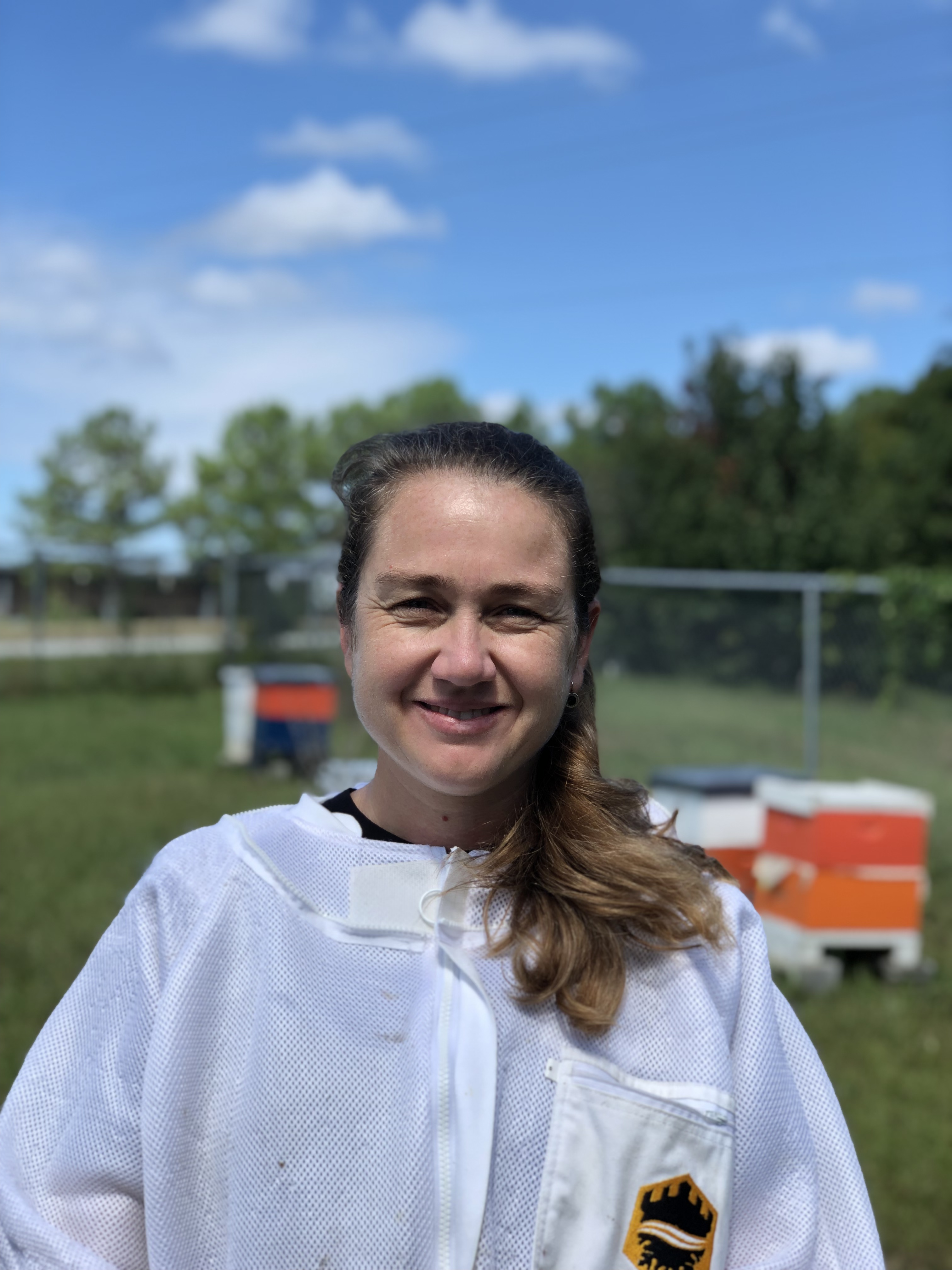
PhD
I am from Argentina and joined the Auburn University Bee Center in 2024 as a visiting researcher. Before moving to the U.S., I worked as an Associate Researcher at Argentina’s National Scientific and Technical Research Council (CONICET), where I am currently on leave to gain international research experience.
My research focuses on understanding the complex interactions between environmental factors and beekeeping management practices that influence the spread of Varroa mites, one of the most significant pests affecting honey bee colonies worldwide.
At the Bee Center, I am involved in several projects exploring alternative strategies for Varroa control, with the goal of promoting more sustainable beekeeping practices. I also help coordinate the annual U.S. Beekeeping Survey, a nationwide project that estimates honey bee colony losses and documents the main management practices used by beekeepers across the United States.