April 30, 2025
The Legacy of George Washington Carver with Curtis Gregory
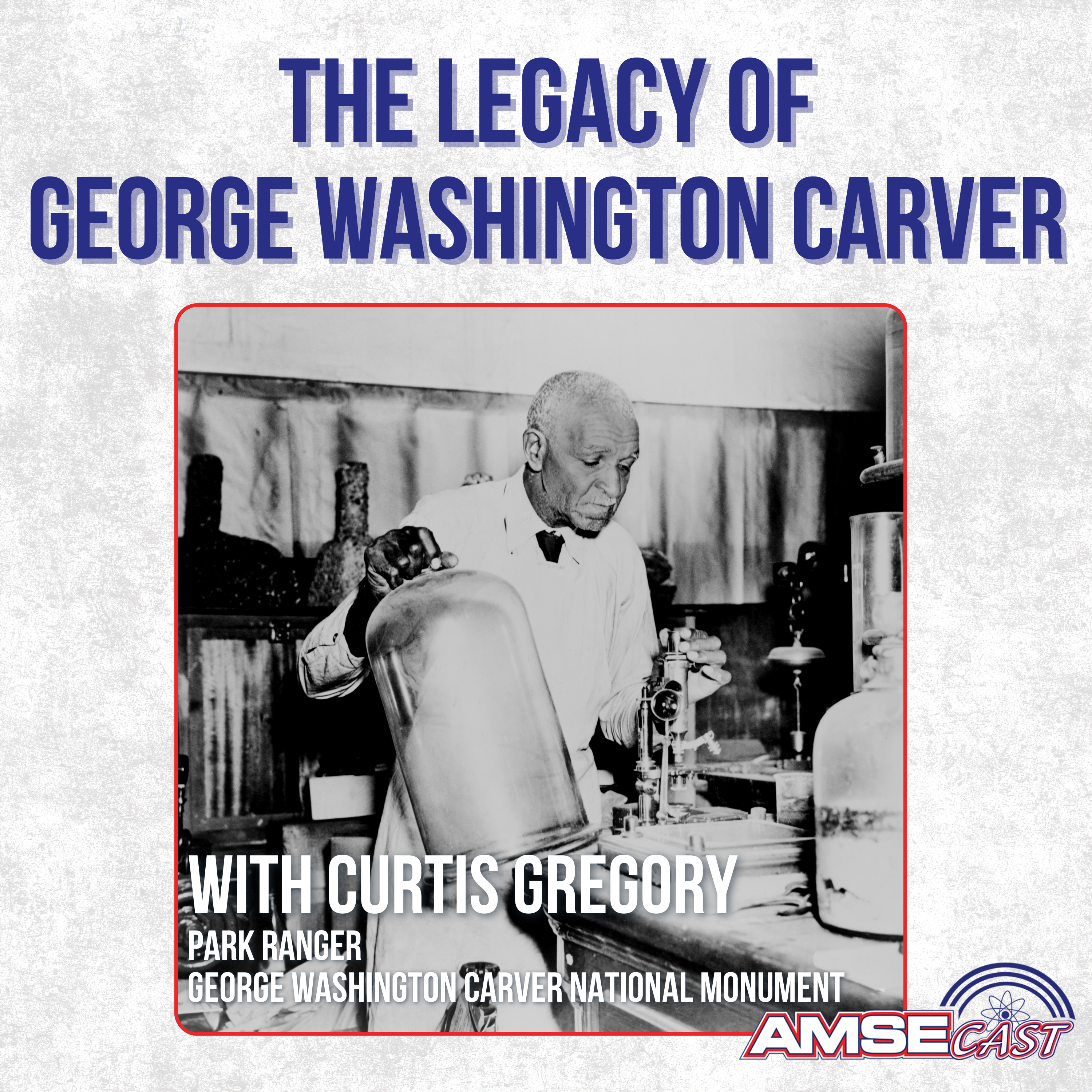
AMSEcast continues celebrating 250 years of American innovation with Curtis Gregory. A park ranger at the George Washington Carver National Monument, Curtis sits down with Alan to share Carver’s inspiring journey from enslavement to becoming a...


AMSEcast continues celebrating 250 years of American innovation with Curtis Gregory. A park ranger at the George Washington Carver National Monument, Curtis sits down with Alan to share Carver’s inspiring journey from enslavement to becoming a pioneering scientist and educator who transformed Southern agriculture. Known for promoting peanuts and sweet potatoes as sustainable crops, Carver created hundreds of uses for them! Beyond his lab, he educated rural farmers through lectures, pamphlets, and the innovative Jesup Wagon. His legacy endures in food security and agricultural education. Visitors can explore his story at the Carver Monument in Diamond, Missouri.
Guest Bio
Curtis Gregory is a longtime park ranger at the George Washington Carver National Monument in Diamond, Missouri, where he has shared Carver’s legacy with visitors for nearly 20 years. With deep knowledge and passion, Curtis brings to life the story of George Washington Carver—scientist, educator, and agricultural innovator—highlighting his contributions to sustainability, food security, and education. As a dedicated steward of this historic site, Curtis helps connect the past to the present, inspiring new generations through Carver’s enduring impact. We’re thrilled to have Curtis join us on AMSEcast to celebrate the remarkable life and innovations of one of America’s greatest minds.
Show Highlights
- (2:00) How George Washington Carve went from being born a slave to a professor by 30
- (6:53) The state of agriculture in the South when Carver arrived at Tuskegee
- (8:25) What led him to the peanut in the first place
- (10:45) George Washington Carver’s innovations with the sweet potato
- (15:51) His impact on agriculture in the South and nationwide
- (17:12) What to expect at the George Washington Carver National Monument
Links Referenced
1
00:00:04,040 --> 00:00:07,840
Welcome to AMSEcast, coming to you from Oak Ridge, Tennessee,
2
00:00:08,179 --> 00:00:11,500
a global leader in science, technology, and innovation.
3
00:00:12,240 --> 00:00:15,309
My name is Alan Lowe, director of the American Museum
4
00:00:15,339 --> 00:00:18,730
of Science and Energy, and the K-25 History Center.
5
00:00:19,690 --> 00:00:23,080
Each episode of AMSEcast presents world-renowned authors,
6
00:00:23,520 --> 00:00:27,480
scientists, historians, policymakers, and everyone in between,
7
00:00:27,929 --> 00:00:31,100
sharing their insights on a variety of fascinating topics.
8
00:00:35,119 --> 00:00:36,419
Welcome to AMSEcast.
9
00:00:36,660 --> 00:00:38,320
Thanks so much for joining us.
10
00:00:38,920 --> 00:00:41,500
With a generous grant from the Institute for Museum and
11
00:00:41,500 --> 00:00:45,489
Library Services, or IMLS, we’re producing a series of AMSEcast
12
00:00:45,490 --> 00:00:50,330
episodes devoted to 250 years of American innovation, all to
13
00:00:50,330 --> 00:00:54,630
celebrate our nation’s upcoming semiquincentennial in 2026.
14
00:00:55,570 --> 00:00:58,879
To help us do that today, we’re joined by Curtis Gregory, park ranger at the
15
00:00:58,890 --> 00:01:03,460
George Washington Carver National Monument, located in Diamond, Missouri.
16
00:01:04,250 --> 00:01:07,280
Curtis has been with the Carver National Monument for nearly 20
17
00:01:07,280 --> 00:01:11,190
years, so we knew he was the person we needed to talk with about the
18
00:01:11,190 --> 00:01:15,310
remarkable legacy of innovation left to us by George Washington Carver.
19
00:01:15,840 --> 00:01:18,539
Curtis, thanks so much for joining us on AMSEcast.
20
00:01:19,530 --> 00:01:19,760
Hey.
21
00:01:19,760 --> 00:01:20,420
Well, thank you.
22
00:01:20,420 --> 00:01:24,719
And on behalf of the National Park Service, thank you for having me, as well as
23
00:01:24,870 --> 00:01:27,810
the National Park—or George Washington Carver National Park—be a part of this.
24
00:01:27,810 --> 00:01:28,630
This is wonderful.
25
00:01:28,879 --> 00:01:29,170
Thank you.
26
00:01:29,180 --> 00:01:32,220
Well—no, no, we appreciate you and our colleagues
27
00:01:32,220 --> 00:01:34,790
at the National Park Service Very, very much.
28
00:01:34,960 --> 00:01:39,399
I also greatly enjoyed learning more about George
29
00:01:39,410 --> 00:01:41,479
Washington Carver as I prepared to talk to you.
30
00:01:41,770 --> 00:01:43,460
You know, I’ve known the story in general.
31
00:01:43,500 --> 00:01:49,670
I must admit, but when I dug a little deeper, so impressive his accomplishments.
32
00:01:49,850 --> 00:01:52,240
And I know that you talk about that every day.
33
00:01:52,240 --> 00:01:54,490
I’m sure it never gets old, though, but to me as a
34
00:01:54,500 --> 00:01:58,339
brand new topic, it was truly astounding in many ways.
35
00:01:58,429 --> 00:02:01,610
And one of those things is, you know, he went from being
36
00:02:01,610 --> 00:02:06,519
born enslaved in Missouri in 1864 to being a college
37
00:02:06,540 --> 00:02:09,310
graduate and professor by the time he was 30 years of age.
38
00:02:09,479 --> 00:02:11,269
I know it’s a big question, Curtis, but how did he
39
00:02:11,270 --> 00:02:15,460
manage to make that transition, that amazing transition?
40
00:02:15,800 --> 00:02:18,990
He had this drive that he would never, never give up.
41
00:02:19,280 --> 00:02:20,209
And he didn’t give up.
42
00:02:20,210 --> 00:02:24,040
There were several times throughout this journey where he could have given up.
43
00:02:24,420 --> 00:02:28,280
And where I’m at here at the George Washington Carver National Monument
44
00:02:28,290 --> 00:02:34,490
is where Carver was born, and where he was born, enslaved, to a mother who
45
00:02:34,500 --> 00:02:40,089
was brought to this property in 1855 as an enslaved girl, about 13 or so.
46
00:02:40,230 --> 00:02:44,880
And she was brought here, she was owned by Moses and Susan Carver.
47
00:02:45,190 --> 00:02:47,450
And Moses and Susan Carver were a white couple who
48
00:02:47,450 --> 00:02:50,950
came to Missouri from Illinois about the 1830s.
49
00:02:51,210 --> 00:02:53,980
The property where we are at now, they started a big working farm.
50
00:02:53,980 --> 00:02:58,330
In 1855 they purchased one enslaved girl by the name of Mary.
51
00:02:58,650 --> 00:03:01,859
As a result of that, Mary had at least two children.
52
00:03:01,860 --> 00:03:04,299
George had another brother, Jim, and then
53
00:03:04,300 --> 00:03:08,560
George was born, we think about 1864 or so.
54
00:03:08,599 --> 00:03:10,720
George’s father, we believe, was another enslaved
55
00:03:10,720 --> 00:03:13,900
individual who died in an accident before he was born.
56
00:03:14,450 --> 00:03:19,260
And so, George’s mother and brother all lived here for a short while together.
57
00:03:19,720 --> 00:03:23,459
And at the close of the Civil War, in southwest Missouri was pretty
58
00:03:23,460 --> 00:03:27,460
dangerous, and George and his mother were abducted—slave raiders,
59
00:03:27,490 --> 00:03:32,930
bushwackers, we’re not really sure who—and George and Moses Carver
60
00:03:33,640 --> 00:03:36,979
wanted to get them back, so he hired someone to go out to find them.
61
00:03:37,350 --> 00:03:40,519
And George was found, supposedly, we think, down in Arkansas,
62
00:03:40,520 --> 00:03:42,940
which is about 40 miles from where the park is located.
63
00:03:43,130 --> 00:03:44,450
But his mother was never found.
64
00:03:44,790 --> 00:03:46,690
And so, we’re not sure what happened to Mary.
65
00:03:46,690 --> 00:03:47,450
Did she die?
66
00:03:47,480 --> 00:03:52,130
Was she sold off into slavery, into deeper south or such?
67
00:03:52,270 --> 00:03:54,459
But George was brought back to the Carver farm.
68
00:03:54,990 --> 00:03:59,959
That’s where he began to learn about the natural world when he had free time.
69
00:04:00,310 --> 00:04:02,480
And around the age of 13 or so, he decided
70
00:04:02,480 --> 00:04:04,930
that he wanted to leave to get an education.
71
00:04:05,230 --> 00:04:11,100
And that started his journey around the age of around the age of 13 or so,
72
00:04:11,389 --> 00:04:16,149
to leave Missouri—well, he stayed in Missouri for a short while—throughout
73
00:04:16,149 --> 00:04:21,779
Kansas, journeying for an education, and making his way to what is now
74
00:04:21,820 --> 00:04:25,429
Iowa State University, where he graduated with two degrees in agriculture.
75
00:04:25,610 --> 00:04:29,290
And he just had that determination that he would never, never give.
76
00:04:29,369 --> 00:04:33,239
And many, many obstacles in that journey to becoming
77
00:04:33,240 --> 00:04:37,010
the first black graduate from Iowa State University,
78
00:04:37,010 --> 00:04:39,760
with both Bachelor and Master’s degree in Agriculture.
79
00:04:40,090 --> 00:04:42,950
And then went south to Tuskegee, Alabama, where he
80
00:04:42,950 --> 00:04:46,080
spent the rest of his life, which was about 47 years.
81
00:04:46,289 --> 00:04:49,890
But it all started on this small property in Diamond, Missouri,
82
00:04:50,230 --> 00:04:54,330
where this kid at that time just never, never, never gave up.
83
00:04:54,780 --> 00:04:57,290
Just a remarkable, remarkable story.
84
00:04:57,790 --> 00:05:01,359
You mentioned Tuskegee—of course, that’s where he gained international
85
00:05:01,370 --> 00:05:05,580
fame—then called—as I learned in my research, Carter, so you tell
86
00:05:05,580 --> 00:05:09,400
me, if I’m right—the Tuskegee Normal and Industrial Institute.
87
00:05:09,410 --> 00:05:12,010
Now, we know it as Tuskegee University.
88
00:05:12,450 --> 00:05:16,180
So, what can you tell us about that institute and the role also of another
89
00:05:16,440 --> 00:05:21,350
African American leader, Booker T. Washington, in hiring Carver at Tuskegee?
90
00:05:22,059 --> 00:05:22,839
Great question.
91
00:05:22,840 --> 00:05:27,720
So, in 1896, while Carver was working on—while he was working on his
92
00:05:27,720 --> 00:05:30,669
master’s degree from what is now Iowa State University—at that time, it
93
00:05:30,670 --> 00:05:34,830
was Iowa Agricultural School—and he’s working on his master’s degree.
94
00:05:35,219 --> 00:05:39,860
Booker T. Washington found out about this young guy at Iowa and
95
00:05:39,900 --> 00:05:43,930
recruited him to come to Tuskegee to start the Agriculture Department.
96
00:05:44,240 --> 00:05:47,070
So, Carver finished his master’s degree, and by
97
00:05:47,110 --> 00:05:51,030
October of 1896, he was on his way to Tuskegee.
98
00:05:51,520 --> 00:05:56,030
Booker T. Washington helped start Tuskegee Institute
99
00:05:56,030 --> 00:06:00,259
in 1881 with another guy by the name of Louis Adams.
100
00:06:00,279 --> 00:06:02,510
Lewis Adams was really the founder of Tuskegee.
101
00:06:03,000 --> 00:06:05,370
Booker T. Washington was the first what was known as
102
00:06:05,370 --> 00:06:08,930
principal, what we know today as president of Tuskegee.
103
00:06:09,270 --> 00:06:14,500
And he invited Carver to come and start the Agriculture Department in 1896.
104
00:06:14,500 --> 00:06:16,979
Booker T. Washington would often recruit
105
00:06:16,980 --> 00:06:20,469
the very best teachers that he could find.
106
00:06:20,810 --> 00:06:24,480
And again, he found out about Carver at Iowa.
107
00:06:24,680 --> 00:06:28,750
Carver had been in negotiations with another school in Mississippi to go to
108
00:06:28,840 --> 00:06:34,230
teach agriculture, but when Washington reached out to him, he went to Tuskegee.
109
00:06:34,600 --> 00:06:38,610
He seemed to be inspired by Booker T. Washington’s
110
00:06:38,690 --> 00:06:41,390
idea, what was known as the Tuskegee idea.
111
00:06:41,760 --> 00:06:45,219
And Tuskegee started out as a vocational and industrial
112
00:06:45,220 --> 00:06:49,070
school to help students to become more self-sufficient, and
113
00:06:49,070 --> 00:06:52,080
Carver believed in that mission, and he stayed at Tuskegee.
114
00:06:52,900 --> 00:06:56,409
When he arrives in Tuskegee, can you just kind of give us the lay of the land?
115
00:06:56,410 --> 00:06:59,210
What was the state of agriculture in the south?
116
00:06:59,210 --> 00:07:01,140
And we know he’ll have a big impact on that, but what
117
00:07:01,140 --> 00:07:03,800
was the state of agriculture when he arrived at Tuskegee?
118
00:07:04,929 --> 00:07:08,770
When he arrived at Tuskegee, he saw the area to be so poor.
119
00:07:08,820 --> 00:07:12,560
That was his first time being in the South, in the rural south.
120
00:07:12,859 --> 00:07:18,640
Carver had grown up in the Midwest, had been in Iowa for several
121
00:07:18,640 --> 00:07:23,960
years, and when he took that train ride to Alabama for the first
122
00:07:23,969 --> 00:07:27,770
time, being in Macon County, Alabama, he saw a different world.
123
00:07:27,920 --> 00:07:32,239
He saw a different world, especially for rural black farmers.
124
00:07:33,110 --> 00:07:37,120
He said that land was poor, the people were poor, and
125
00:07:37,120 --> 00:07:41,719
he just saw a different outlook on life in rural South.
126
00:07:42,080 --> 00:07:45,599
And so, by that point, when Carver got there,
127
00:07:47,830 --> 00:07:53,969
most of the farmers or the sharecroppers were still growing cotton.
128
00:07:53,970 --> 00:07:57,120
But as you know, the boll weevil cleaned out
129
00:07:57,320 --> 00:08:00,859
that section, or the south, devastated that area.
130
00:08:01,270 --> 00:08:04,369
And so Carver, when he got there, he was trying to think
131
00:08:04,369 --> 00:08:08,240
of other innovative ways so that farmers and farming
132
00:08:08,240 --> 00:08:11,840
families could be, you know, become more self-sufficient.
133
00:08:11,950 --> 00:08:15,890
And so, when he got there, he, you know, introduced—well, introduced to
134
00:08:15,890 --> 00:08:20,289
this section of Alabama, peanuts, and sweet potatoes, and different types
135
00:08:20,290 --> 00:08:24,340
of cash crops, where farmers and farming families could make a living.
136
00:08:24,830 --> 00:08:26,040
Why did he turn to the peanut?
137
00:08:26,110 --> 00:08:29,140
He’s known especially for his work on the peanut innovations there.
138
00:08:29,660 --> 00:08:32,439
What led him to the peanut in the first place?
139
00:08:33,150 --> 00:08:35,380
Well, I think what led him to the peanut, Carver
140
00:08:35,380 --> 00:08:37,329
started working with the peanut in about 1903.
141
00:08:38,240 --> 00:08:43,070
And one of the things was, as we just talked about, the devastation of
142
00:08:43,460 --> 00:08:48,860
what the boll weevil did, several people, several farmers, and different
143
00:08:48,860 --> 00:08:53,359
groups were turning to peanuts as well as Carver because of the legume
144
00:08:53,500 --> 00:08:57,919
the peanut is a legume, and it put nitrogen back into the soil to
145
00:08:57,920 --> 00:09:01,520
make the soil nice and rich, and so then you could grow other things.
146
00:09:01,750 --> 00:09:06,620
And so, in this section of Alabama, there was an abundance of peanuts.
147
00:09:06,770 --> 00:09:09,470
And so, Carver went into his laboratory and
148
00:09:09,470 --> 00:09:13,109
started to produce other uses of the peanut.
149
00:09:13,200 --> 00:09:14,800
Yeah, what are some of those uses?
150
00:09:14,800 --> 00:09:18,490
I know I was amazed again at the list of things that he came up with.
151
00:09:19,370 --> 00:09:23,829
Yeah there’s about 300 or 325 different uses,
152
00:09:24,130 --> 00:09:28,749
from different types of oils to paint stains.
153
00:09:28,950 --> 00:09:32,490
He had a patent on a ladies facial cream.
154
00:09:32,730 --> 00:09:36,660
And there’s inks, and dyes, and shoe polishes, and all sorts of
155
00:09:36,660 --> 00:09:39,490
different things, as well as, like, foods and things like that.
156
00:09:39,720 --> 00:09:44,080
Something that is important to—I like to get across, especially when we get
157
00:09:44,080 --> 00:09:47,889
a lot of students here, is that Carver didn’t really invent anything; he came
158
00:09:47,889 --> 00:09:51,880
up with different uses of the peanut, sweet potato, and soybean, and such.
159
00:09:52,420 --> 00:09:55,000
Did he come up with the use of peanut butter?
160
00:09:55,000 --> 00:09:58,599
That’s something in popular culture, but I understand he did not.
161
00:09:58,620 --> 00:09:59,579
Am I correct?
162
00:09:59,980 --> 00:10:00,750
You’re correct.
163
00:10:00,760 --> 00:10:01,480
And you know what?
164
00:10:01,500 --> 00:10:03,069
We get that question all the time.
165
00:10:03,070 --> 00:10:05,410
We get a lot of visitors, like, I like George Washington
166
00:10:05,410 --> 00:10:07,369
Carver so much because he came up with peanut butter.
167
00:10:07,370 --> 00:10:09,370
And you know, we have to tell him, no, he
168
00:10:09,370 --> 00:10:10,699
didn’t really come up with peanut butter.
169
00:10:10,830 --> 00:10:15,080
I’m sure Carver made his own peanut butter, but as I mentioned before,
170
00:10:15,080 --> 00:10:19,180
Carver started working with peanuts about 1903 and peanut butter,
171
00:10:19,200 --> 00:10:22,679
really, the peanut butter that we know of the day came about 1895
172
00:10:25,500 --> 00:10:28,479
or so, and from someone from the Kellogg family.
173
00:10:28,660 --> 00:10:30,520
In your gift shop there, do you sell peanut butter?
174
00:10:30,949 --> 00:10:33,900
No, we don’t sell any peanut butter, but we sell peanuts.
175
00:10:34,020 --> 00:10:36,020
We sell peanuts, and kids can go out and
176
00:10:36,020 --> 00:10:38,199
grow their own grown peanut plant [laugh]
177
00:10:38,450 --> 00:10:39,190
.
Oh, that’d be cool.
178
00:10:39,190 --> 00:10:40,100
I want to do that.
179
00:10:40,160 --> 00:10:40,400
Yeah.
180
00:10:40,400 --> 00:10:40,800
That’s great [laugh]
181
00:10:40,800 --> 00:10:41,030
.
Yeah.
182
00:10:41,030 --> 00:10:43,569
And you can make your own peanut butter [laugh]
183
00:10:43,570 --> 00:10:44,450
.
Fantastic.
184
00:10:44,450 --> 00:10:45,019
I love it.
185
00:10:45,460 --> 00:10:47,640
So, you mentioned earlier the sweet potato, too.
186
00:10:47,640 --> 00:10:49,509
I didn’t realize until getting ready for today
187
00:10:49,510 --> 00:10:51,330
that he also innovated with the sweet potato.
188
00:10:51,370 --> 00:10:53,130
What were some of the uses he found for that?
189
00:10:53,970 --> 00:10:57,400
So, the sweet potato is very interesting because Carver was known
190
00:10:57,420 --> 00:11:03,000
for the peanut, but the sweet potato was actually the first plant
191
00:11:03,009 --> 00:11:05,449
that he started working with right after he got to Tuskegee about
192
00:11:05,469 --> 00:11:11,740
1897 because the peanut, it was easy to cultivate, and you could
193
00:11:11,750 --> 00:11:16,620
store it in the winter months, and it has a lot of nutritional value.
194
00:11:16,809 --> 00:11:20,400
And that was really the first plant that he worked with, was the sweet potato.
195
00:11:20,630 --> 00:11:23,180
And with the sweet potato, he came with a lot of different things.
196
00:11:23,190 --> 00:11:26,320
One of the interesting things that be came up
197
00:11:26,320 --> 00:11:29,460
with—well, products—was a sweet potato flour.
198
00:11:29,690 --> 00:11:33,020
And this was really a result of the First World War.
199
00:11:33,059 --> 00:11:35,290
During the First World War, there was a lot of shortages
200
00:11:35,570 --> 00:11:38,890
of different goods, and one of the things was wheat.
201
00:11:39,620 --> 00:11:43,710
And Carver came up with a sweet potato flour that the
202
00:11:43,720 --> 00:11:46,300
federal government was very, very interested in working
203
00:11:46,300 --> 00:11:50,069
with the USDA in developing this sweet potato flour.
204
00:11:50,260 --> 00:11:54,740
And Carver was on his way of working with the USDA, but in 1918
205
00:11:55,030 --> 00:11:58,710
as we know, the war ended, so there wasn’t really a use for it,
206
00:11:58,920 --> 00:12:01,380
but Carver would have probably been known, if that would have
207
00:12:01,490 --> 00:12:06,400
happened, as this sweet potato man, instead of the peanut man [laugh]
208
00:12:06,520 --> 00:12:07,030
.
The peanut man.
209
00:12:07,030 --> 00:12:07,350
Right.
210
00:12:07,360 --> 00:12:09,399
That’s really interesting stuff.
211
00:12:09,400 --> 00:12:11,389
There’s such an innovative mind.
212
00:12:11,570 --> 00:12:14,360
When he came up with these innovations, when he came up with these uses of
213
00:12:14,360 --> 00:12:17,960
the sweet potato and the peanut and other things, how did he get the word out?
214
00:12:18,190 --> 00:12:21,050
How did he communicate that beyond Tuskegee?
215
00:12:21,570 --> 00:12:26,390
When he first started, he would go to a lot of rural, like, black fairs,
216
00:12:26,550 --> 00:12:31,690
African American, like, fairs, he would go to churches, and he was be invited
217
00:12:31,690 --> 00:12:36,389
to speak, especially in the rural communities, on different—to farmers and such.
218
00:12:36,760 --> 00:12:41,940
And then when he became well known, really, after 1921, after
219
00:12:41,940 --> 00:12:45,840
he appeared before Congress, and when he became known as the
220
00:12:45,840 --> 00:12:50,790
peanut man, as we kind of think of him today as, he was offered
221
00:12:50,809 --> 00:12:53,559
speaking engagements and things around the country and things.
222
00:12:53,770 --> 00:12:57,410
But he would go out into these rural communities, and he would often
223
00:12:57,410 --> 00:13:02,870
go, like I said, to fairs, and church groups, and talk about better
224
00:13:02,870 --> 00:13:07,759
ways of farmers improving their farms, and to sharecroppers, and such.
225
00:13:07,820 --> 00:13:08,510
Interesting.
226
00:13:08,639 --> 00:13:11,120
I’ve read about something called a Jesup Wagon.
227
00:13:11,120 --> 00:13:12,019
What was that?
228
00:13:12,900 --> 00:13:16,650
Yeah, so the Jesup Wagon was one of the ways where he would get the word out.
229
00:13:16,770 --> 00:13:19,120
The Jesup Wagon was a movable school.
230
00:13:19,150 --> 00:13:21,079
It was a movable school on wheels.
231
00:13:21,340 --> 00:13:23,780
This was kind of an innovation of Booker T. Washington.
232
00:13:23,980 --> 00:13:27,589
What Booker T. Washington wanted to do was have his teachers go
233
00:13:27,589 --> 00:13:31,390
out into the rural communities, into the really, really rural
234
00:13:31,390 --> 00:13:35,660
communities, and help and teach the people in these rural areas.
235
00:13:35,950 --> 00:13:39,130
Well, they came up with this movable school idea, where they would take
236
00:13:39,130 --> 00:13:42,960
a school on wheels, and they would go out into the rural communities.
237
00:13:43,250 --> 00:13:46,390
And Booker T. Washington secured funds from a
238
00:13:46,760 --> 00:13:50,400
wealthy New York banker by the name of Morris Jesup.
239
00:13:50,670 --> 00:13:52,700
So, that’s where the name Jesup Wagon comes from.
240
00:13:53,080 --> 00:13:57,760
Carver designed the wagon, and he innovated the wagon, and put different,
241
00:13:57,770 --> 00:14:02,090
like, tools, they would put teaching techniques, teaching methods on the
242
00:14:02,099 --> 00:14:07,420
wagon, and they would take a wagon out at a church or at a fair, and they
243
00:14:07,420 --> 00:14:10,880
would set it up, and they would just teach farmers and farming families about
244
00:14:10,890 --> 00:14:15,360
different ways of improving themselves, as well as their soil and things.
245
00:14:15,599 --> 00:14:17,400
And so, this was about 1906.
246
00:14:17,860 --> 00:14:22,119
And then shortly later, they got money for a truck that
247
00:14:22,119 --> 00:14:25,789
could even go out even further into these communities.
248
00:14:25,999 --> 00:14:31,130
And you know, the movable school was adapted by the USDA a little later.
249
00:14:31,380 --> 00:14:36,180
And so, it was a wonderful way of reaching people in far communities,
250
00:14:36,180 --> 00:14:41,449
especially these rural farmers, and for blacks and such in these areas.
251
00:14:41,949 --> 00:14:45,040
So, not just an innovator in uses of things like the
252
00:14:45,100 --> 00:14:47,810
peanut, but also an innovator on how to get that word out.
253
00:14:47,860 --> 00:14:49,820
Really fascinating.
254
00:14:49,870 --> 00:14:52,659
Yes, how to get the word out by pamphlets, by some
255
00:14:52,660 --> 00:14:55,619
of those agricultural bulletins, and such as well.
256
00:14:56,160 --> 00:14:58,789
So, you mentioned earlier, he became very well known,
257
00:14:58,789 --> 00:15:01,260
testified before Congress, was known around the world.
258
00:15:02,030 --> 00:15:04,310
Can you tell us, perhaps, some of the famous people he met,
259
00:15:04,310 --> 00:15:07,949
and how did he leverage that fame to help support his work?
260
00:15:08,559 --> 00:15:12,339
Well, when he got to Tuskegee and he started working in agriculture in
261
00:15:12,340 --> 00:15:16,560
1896, you know, he was known in the south, where he would go on speaking
262
00:15:16,560 --> 00:15:21,570
engagements, and when he was teaching, but really, the fame, really,
263
00:15:21,630 --> 00:15:25,660
to me, it really started after 1921 when he appeared before Congress.
264
00:15:26,020 --> 00:15:29,030
And some of the people that he met, one of the most
265
00:15:29,030 --> 00:15:33,189
famous that he worked with or met was Henry Ford.
266
00:15:33,240 --> 00:15:36,459
He and Henry Ford seemed to be great friends.
267
00:15:36,730 --> 00:15:40,500
There's a little bit of evidence that Thomas Edison may have known
268
00:15:40,500 --> 00:15:45,190
about him somewhat, but really one of the most famous was Henry Ford.
269
00:15:45,190 --> 00:15:48,070
And he and Henry Ford were great friends.
270
00:15:48,559 --> 00:15:50,630
Some big names there together, for sure.
271
00:15:50,950 --> 00:15:54,810
So, when you look back at his work, what would you say his
272
00:15:54,810 --> 00:15:58,800
impact was on agriculture in the south, and really nationwide?
273
00:15:59,420 --> 00:16:03,020
It was his work with, you know, developing these different
274
00:16:03,200 --> 00:16:06,669
products, from sweet potatoes, and soybeans, and peanuts.
275
00:16:06,900 --> 00:16:13,060
But more importantly, I think what it was really was to help teach farmers
276
00:16:13,300 --> 00:16:18,480
and teach people, especially those rural farmers, about better ways of
277
00:16:18,480 --> 00:16:22,709
improving their lives, especially with the soil, so they could become more
278
00:16:22,710 --> 00:16:28,629
self-sufficient and helping people with food insecurities and things like that.
279
00:16:28,730 --> 00:16:31,910
I think that was, really to me, that was the
280
00:16:31,910 --> 00:16:34,380
impact, and you can still see some of that today.
281
00:16:34,610 --> 00:16:36,550
What about innovators today?
282
00:16:36,680 --> 00:16:41,719
When you look at his way of doing things and the success he had, what
283
00:16:41,719 --> 00:16:45,110
lessons do you think innovators today can take from Carver’s example?
284
00:16:45,429 --> 00:16:49,900
A lot of people today look at some of the things that he tried to do with food
285
00:16:50,110 --> 00:16:54,840
insecurities and research developed different types of ways of helping people.
286
00:16:55,020 --> 00:16:59,110
You see that today at Iowa State University, you see that today
287
00:16:59,110 --> 00:17:04,209
at Tuskegee Institute, at the University of Missouri in the ag
288
00:17:04,209 --> 00:17:06,579
departments and things like that, where you can still see some of
289
00:17:07,430 --> 00:17:11,040
Carver’s some of his techniques today, but being much more advanced.
290
00:17:11,890 --> 00:17:14,129
Now, I want to learn about the George Washington Carver
291
00:17:14,130 --> 00:17:16,410
National Monument, where I intend to come, Curtis.
292
00:17:16,440 --> 00:17:17,949
I’m excited about it now.
293
00:17:17,950 --> 00:17:19,550
I want to come learn more.
294
00:17:19,900 --> 00:17:22,759
What can we visit and do when I do get there?
295
00:17:22,760 --> 00:17:25,829
And when our listeners get there, what can you visit and what can you do there?
296
00:17:26,099 --> 00:17:27,770
Where I’m at, at the George Washington, Carver National
297
00:17:27,810 --> 00:17:30,179
Monument, as I mentioned, we’re a part of the National
298
00:17:30,180 --> 00:17:34,970
Park Service, and we have been here since 1943.
299
00:17:35,219 --> 00:17:38,590
Shortly after Carver died, the Congress
300
00:17:38,590 --> 00:17:40,819
established the National Monument in his honor.
301
00:17:41,209 --> 00:17:43,220
We’re the first park in the National Park Service
302
00:17:43,220 --> 00:17:45,750
dedicated to an African American, in 1943.
303
00:17:46,040 --> 00:17:51,040
And so, we are on the original property where Carver was born, a 240 acre farm.
304
00:17:51,179 --> 00:17:55,500
We have a visitor center, a 13,000 square foot visitor center.
305
00:17:55,759 --> 00:17:59,460
We have three floors of exhibits, films on George Washington Carver.
306
00:17:59,460 --> 00:18:03,540
We have a little classroom that’s kind of like one of George’s laboratories at
307
00:18:03,540 --> 00:18:09,060
Tuskegee, where we do different types of experiments, and we offer guided tours.
308
00:18:09,070 --> 00:18:11,760
And it’s a wonderful property to learn about.
309
00:18:11,760 --> 00:18:12,990
George Washington Carver.
310
00:18:12,990 --> 00:18:16,050
We’re open seven days a week, nine to five, and it’s
311
00:18:16,059 --> 00:18:20,250
all on George Washington Carver, his life story, which
312
00:18:20,250 --> 00:18:23,159
started here in the little town of Diamond, Missouri.
313
00:18:23,830 --> 00:18:23,919
Wow.
314
00:18:24,180 --> 00:18:27,520
Where can our folks go to learn more and to plan their trip?
315
00:18:27,580 --> 00:18:31,320
We have our website on, if you just do a Google search of the National
316
00:18:31,320 --> 00:18:34,949
Park Service, you can find George Washington Carver National Monument.
317
00:18:35,240 --> 00:18:40,150
We’re on social media: Facebook, X, and you can learn about
318
00:18:40,150 --> 00:18:44,020
George Washington Carver on those platforms, or go to our website.
319
00:18:44,210 --> 00:18:46,750
You can actually—visitors, if they’re planning their visit,
320
00:18:46,900 --> 00:18:49,570
they can actually go out there and see our park film on George
321
00:18:49,570 --> 00:18:52,660
Washington Carver, The Legacy of George Washington Carver: Triumph
322
00:18:52,699 --> 00:18:55,639
and Struggle, and you can watch the film out there as well.
323
00:18:56,510 --> 00:19:00,250
Just an amazing story, an amazing man, an amazing innovator.
324
00:19:00,330 --> 00:19:01,720
Curtis, I can’t thank you enough.
325
00:19:02,059 --> 00:19:04,000
I really appreciate you joining us in AMSEcast.
326
00:19:04,219 --> 00:19:07,040
Thank you so much for having us, and we look forward to you
327
00:19:07,040 --> 00:19:09,330
coming to the park, as well, as your listeners, as well.
328
00:19:09,330 --> 00:19:09,770
We’ll do it.
329
00:19:09,770 --> 00:19:10,570
Thank you so much.
330
00:19:15,540 --> 00:19:18,240
Thank you for joining us on this episode of AMSEcast.
331
00:19:18,680 --> 00:19:22,980
For more information on this topic or any others, you can always visit us at
332
00:19:23,250 --> 00:19:29,690
AMSE.org or find, like, and follow us on Facebook, Instagram, and Twitter.
333
00:19:30,109 --> 00:19:32,439
I invite you to visit the American Museum of Science
334
00:19:32,440 --> 00:19:35,240
and Energy and the K-25 History Center in person.
335
00:19:35,560 --> 00:19:39,730
You can also shop at our online store and become a member at AMSE.org.
336
00:19:40,179 --> 00:19:43,629
Thanks to our production team with Matt Mullins, plus our supportive colleagues
337
00:19:43,630 --> 00:19:47,470
at the Department of Energy’s Office of Science, Office of Environmental
338
00:19:47,470 --> 00:19:51,450
Management, and Office of Legacy Management, as well as Oak Ridge National
339
00:19:51,450 --> 00:19:57,310
Laboratory, the Y-12 National Security Complex, NNSA, and the AMSE Foundation.
340
00:19:57,809 --> 00:19:59,540
And of course, thanks to our wonderful guests
341
00:19:59,540 --> 00:20:01,350
today, and to all of you for listening.
342
00:20:01,849 --> 00:20:04,529
I hope you’ll join us for the next episode of AMSEcast.
343
00:20:07,240 --> 00:20:10,220
If you’ve enjoyed this podcast, I would like to ask that you consider
344
00:20:10,220 --> 00:20:14,790
becoming a member of the 117 Society, the newest membership opportunity
345
00:20:14,849 --> 00:20:18,310
offered by the American Museum of Science and Energy Foundation.
346
00:20:19,070 --> 00:20:22,260
By joining the 117 Society, you will help us continue
347
00:20:22,260 --> 00:20:25,070
this podcast and our other innovative programming.
348
00:20:25,450 --> 00:20:28,370
You will support the expansion of our vitally important educational
349
00:20:28,370 --> 00:20:32,240
outreach, including virtual classes, and you will help ensure that both
350
00:20:32,250 --> 00:20:36,880
the American Museum of Science and Energy and the K-25 History Center can
351
00:20:36,880 --> 00:20:40,950
continue to provide world-class exhibits to our community and to the world.
352
00:20:41,789 --> 00:20:44,660
Benefits of membership includes special access to video
353
00:20:44,660 --> 00:20:48,870
and audio content, and 117 Society merchandise, as well
354
00:20:48,870 --> 00:20:51,799
as all the benefits of our Atom Splitter Membership Level.
355
00:20:52,400 --> 00:20:54,689
To learn more, go to AMSE.org.
356
00:20:55,780 --> 00:21:00,570
The 117 Society is vital to the future of AMSE and the K-25 History Center.
357
00:21:00,960 --> 00:21:03,600
I hope you will consider joining, and thank you very much.
00:00:04,040 --> 00:00:07,840
Welcome to AMSEcast, coming to you from Oak Ridge, Tennessee,
2
00:00:08,179 --> 00:00:11,500
a global leader in science, technology, and innovation.
3
00:00:12,240 --> 00:00:15,309
My name is Alan Lowe, director of the American Museum
4
00:00:15,339 --> 00:00:18,730
of Science and Energy, and the K-25 History Center.
5
00:00:19,690 --> 00:00:23,080
Each episode of AMSEcast presents world-renowned authors,
6
00:00:23,520 --> 00:00:27,480
scientists, historians, policymakers, and everyone in between,
7
00:00:27,929 --> 00:00:31,100
sharing their insights on a variety of fascinating topics.
8
00:00:35,119 --> 00:00:36,419
Welcome to AMSEcast.
9
00:00:36,660 --> 00:00:38,320
Thanks so much for joining us.
10
00:00:38,920 --> 00:00:41,500
With a generous grant from the Institute for Museum and
11
00:00:41,500 --> 00:00:45,489
Library Services, or IMLS, we’re producing a series of AMSEcast
12
00:00:45,490 --> 00:00:50,330
episodes devoted to 250 years of American innovation, all to
13
00:00:50,330 --> 00:00:54,630
celebrate our nation’s upcoming semiquincentennial in 2026.
14
00:00:55,570 --> 00:00:58,879
To help us do that today, we’re joined by Curtis Gregory, park ranger at the
15
00:00:58,890 --> 00:01:03,460
George Washington Carver National Monument, located in Diamond, Missouri.
16
00:01:04,250 --> 00:01:07,280
Curtis has been with the Carver National Monument for nearly 20
17
00:01:07,280 --> 00:01:11,190
years, so we knew he was the person we needed to talk with about the
18
00:01:11,190 --> 00:01:15,310
remarkable legacy of innovation left to us by George Washington Carver.
19
00:01:15,840 --> 00:01:18,539
Curtis, thanks so much for joining us on AMSEcast.
20
00:01:19,530 --> 00:01:19,760
Hey.
21
00:01:19,760 --> 00:01:20,420
Well, thank you.
22
00:01:20,420 --> 00:01:24,719
And on behalf of the National Park Service, thank you for having me, as well as
23
00:01:24,870 --> 00:01:27,810
the National Park—or George Washington Carver National Park—be a part of this.
24
00:01:27,810 --> 00:01:28,630
This is wonderful.
25
00:01:28,879 --> 00:01:29,170
Thank you.
26
00:01:29,180 --> 00:01:32,220
Well—no, no, we appreciate you and our colleagues
27
00:01:32,220 --> 00:01:34,790
at the National Park Service Very, very much.
28
00:01:34,960 --> 00:01:39,399
I also greatly enjoyed learning more about George
29
00:01:39,410 --> 00:01:41,479
Washington Carver as I prepared to talk to you.
30
00:01:41,770 --> 00:01:43,460
You know, I’ve known the story in general.
31
00:01:43,500 --> 00:01:49,670
I must admit, but when I dug a little deeper, so impressive his accomplishments.
32
00:01:49,850 --> 00:01:52,240
And I know that you talk about that every day.
33
00:01:52,240 --> 00:01:54,490
I’m sure it never gets old, though, but to me as a
34
00:01:54,500 --> 00:01:58,339
brand new topic, it was truly astounding in many ways.
35
00:01:58,429 --> 00:02:01,610
And one of those things is, you know, he went from being
36
00:02:01,610 --> 00:02:06,519
born enslaved in Missouri in 1864 to being a college
37
00:02:06,540 --> 00:02:09,310
graduate and professor by the time he was 30 years of age.
38
00:02:09,479 --> 00:02:11,269
I know it’s a big question, Curtis, but how did he
39
00:02:11,270 --> 00:02:15,460
manage to make that transition, that amazing transition?
40
00:02:15,800 --> 00:02:18,990
He had this drive that he would never, never give up.
41
00:02:19,280 --> 00:02:20,209
And he didn’t give up.
42
00:02:20,210 --> 00:02:24,040
There were several times throughout this journey where he could have given up.
43
00:02:24,420 --> 00:02:28,280
And where I’m at here at the George Washington Carver National Monument
44
00:02:28,290 --> 00:02:34,490
is where Carver was born, and where he was born, enslaved, to a mother who
45
00:02:34,500 --> 00:02:40,089
was brought to this property in 1855 as an enslaved girl, about 13 or so.
46
00:02:40,230 --> 00:02:44,880
And she was brought here, she was owned by Moses and Susan Carver.
47
00:02:45,190 --> 00:02:47,450
And Moses and Susan Carver were a white couple who
48
00:02:47,450 --> 00:02:50,950
came to Missouri from Illinois about the 1830s.
49
00:02:51,210 --> 00:02:53,980
The property where we are at now, they started a big working farm.
50
00:02:53,980 --> 00:02:58,330
In 1855 they purchased one enslaved girl by the name of Mary.
51
00:02:58,650 --> 00:03:01,859
As a result of that, Mary had at least two children.
52
00:03:01,860 --> 00:03:04,299
George had another brother, Jim, and then
53
00:03:04,300 --> 00:03:08,560
George was born, we think about 1864 or so.
54
00:03:08,599 --> 00:03:10,720
George’s father, we believe, was another enslaved
55
00:03:10,720 --> 00:03:13,900
individual who died in an accident before he was born.
56
00:03:14,450 --> 00:03:19,260
And so, George’s mother and brother all lived here for a short while together.
57
00:03:19,720 --> 00:03:23,459
And at the close of the Civil War, in southwest Missouri was pretty
58
00:03:23,460 --> 00:03:27,460
dangerous, and George and his mother were abducted—slave raiders,
59
00:03:27,490 --> 00:03:32,930
bushwackers, we’re not really sure who—and George and Moses Carver
60
00:03:33,640 --> 00:03:36,979
wanted to get them back, so he hired someone to go out to find them.
61
00:03:37,350 --> 00:03:40,519
And George was found, supposedly, we think, down in Arkansas,
62
00:03:40,520 --> 00:03:42,940
which is about 40 miles from where the park is located.
63
00:03:43,130 --> 00:03:44,450
But his mother was never found.
64
00:03:44,790 --> 00:03:46,690
And so, we’re not sure what happened to Mary.
65
00:03:46,690 --> 00:03:47,450
Did she die?
66
00:03:47,480 --> 00:03:52,130
Was she sold off into slavery, into deeper south or such?
67
00:03:52,270 --> 00:03:54,459
But George was brought back to the Carver farm.
68
00:03:54,990 --> 00:03:59,959
That’s where he began to learn about the natural world when he had free time.
69
00:04:00,310 --> 00:04:02,480
And around the age of 13 or so, he decided
70
00:04:02,480 --> 00:04:04,930
that he wanted to leave to get an education.
71
00:04:05,230 --> 00:04:11,100
And that started his journey around the age of around the age of 13 or so,
72
00:04:11,389 --> 00:04:16,149
to leave Missouri—well, he stayed in Missouri for a short while—throughout
73
00:04:16,149 --> 00:04:21,779
Kansas, journeying for an education, and making his way to what is now
74
00:04:21,820 --> 00:04:25,429
Iowa State University, where he graduated with two degrees in agriculture.
75
00:04:25,610 --> 00:04:29,290
And he just had that determination that he would never, never give.
76
00:04:29,369 --> 00:04:33,239
And many, many obstacles in that journey to becoming
77
00:04:33,240 --> 00:04:37,010
the first black graduate from Iowa State University,
78
00:04:37,010 --> 00:04:39,760
with both Bachelor and Master’s degree in Agriculture.
79
00:04:40,090 --> 00:04:42,950
And then went south to Tuskegee, Alabama, where he
80
00:04:42,950 --> 00:04:46,080
spent the rest of his life, which was about 47 years.
81
00:04:46,289 --> 00:04:49,890
But it all started on this small property in Diamond, Missouri,
82
00:04:50,230 --> 00:04:54,330
where this kid at that time just never, never, never gave up.
83
00:04:54,780 --> 00:04:57,290
Just a remarkable, remarkable story.
84
00:04:57,790 --> 00:05:01,359
You mentioned Tuskegee—of course, that’s where he gained international
85
00:05:01,370 --> 00:05:05,580
fame—then called—as I learned in my research, Carter, so you tell
86
00:05:05,580 --> 00:05:09,400
me, if I’m right—the Tuskegee Normal and Industrial Institute.
87
00:05:09,410 --> 00:05:12,010
Now, we know it as Tuskegee University.
88
00:05:12,450 --> 00:05:16,180
So, what can you tell us about that institute and the role also of another
89
00:05:16,440 --> 00:05:21,350
African American leader, Booker T. Washington, in hiring Carver at Tuskegee?
90
00:05:22,059 --> 00:05:22,839
Great question.
91
00:05:22,840 --> 00:05:27,720
So, in 1896, while Carver was working on—while he was working on his
92
00:05:27,720 --> 00:05:30,669
master’s degree from what is now Iowa State University—at that time, it
93
00:05:30,670 --> 00:05:34,830
was Iowa Agricultural School—and he’s working on his master’s degree.
94
00:05:35,219 --> 00:05:39,860
Booker T. Washington found out about this young guy at Iowa and
95
00:05:39,900 --> 00:05:43,930
recruited him to come to Tuskegee to start the Agriculture Department.
96
00:05:44,240 --> 00:05:47,070
So, Carver finished his master’s degree, and by
97
00:05:47,110 --> 00:05:51,030
October of 1896, he was on his way to Tuskegee.
98
00:05:51,520 --> 00:05:56,030
Booker T. Washington helped start Tuskegee Institute
99
00:05:56,030 --> 00:06:00,259
in 1881 with another guy by the name of Louis Adams.
100
00:06:00,279 --> 00:06:02,510
Lewis Adams was really the founder of Tuskegee.
101
00:06:03,000 --> 00:06:05,370
Booker T. Washington was the first what was known as
102
00:06:05,370 --> 00:06:08,930
principal, what we know today as president of Tuskegee.
103
00:06:09,270 --> 00:06:14,500
And he invited Carver to come and start the Agriculture Department in 1896.
104
00:06:14,500 --> 00:06:16,979
Booker T. Washington would often recruit
105
00:06:16,980 --> 00:06:20,469
the very best teachers that he could find.
106
00:06:20,810 --> 00:06:24,480
And again, he found out about Carver at Iowa.
107
00:06:24,680 --> 00:06:28,750
Carver had been in negotiations with another school in Mississippi to go to
108
00:06:28,840 --> 00:06:34,230
teach agriculture, but when Washington reached out to him, he went to Tuskegee.
109
00:06:34,600 --> 00:06:38,610
He seemed to be inspired by Booker T. Washington’s
110
00:06:38,690 --> 00:06:41,390
idea, what was known as the Tuskegee idea.
111
00:06:41,760 --> 00:06:45,219
And Tuskegee started out as a vocational and industrial
112
00:06:45,220 --> 00:06:49,070
school to help students to become more self-sufficient, and
113
00:06:49,070 --> 00:06:52,080
Carver believed in that mission, and he stayed at Tuskegee.
114
00:06:52,900 --> 00:06:56,409
When he arrives in Tuskegee, can you just kind of give us the lay of the land?
115
00:06:56,410 --> 00:06:59,210
What was the state of agriculture in the south?
116
00:06:59,210 --> 00:07:01,140
And we know he’ll have a big impact on that, but what
117
00:07:01,140 --> 00:07:03,800
was the state of agriculture when he arrived at Tuskegee?
118
00:07:04,929 --> 00:07:08,770
When he arrived at Tuskegee, he saw the area to be so poor.
119
00:07:08,820 --> 00:07:12,560
That was his first time being in the South, in the rural south.
120
00:07:12,859 --> 00:07:18,640
Carver had grown up in the Midwest, had been in Iowa for several
121
00:07:18,640 --> 00:07:23,960
years, and when he took that train ride to Alabama for the first
122
00:07:23,969 --> 00:07:27,770
time, being in Macon County, Alabama, he saw a different world.
123
00:07:27,920 --> 00:07:32,239
He saw a different world, especially for rural black farmers.
124
00:07:33,110 --> 00:07:37,120
He said that land was poor, the people were poor, and
125
00:07:37,120 --> 00:07:41,719
he just saw a different outlook on life in rural South.
126
00:07:42,080 --> 00:07:45,599
And so, by that point, when Carver got there,
127
00:07:47,830 --> 00:07:53,969
most of the farmers or the sharecroppers were still growing cotton.
128
00:07:53,970 --> 00:07:57,120
But as you know, the boll weevil cleaned out
129
00:07:57,320 --> 00:08:00,859
that section, or the south, devastated that area.
130
00:08:01,270 --> 00:08:04,369
And so Carver, when he got there, he was trying to think
131
00:08:04,369 --> 00:08:08,240
of other innovative ways so that farmers and farming
132
00:08:08,240 --> 00:08:11,840
families could be, you know, become more self-sufficient.
133
00:08:11,950 --> 00:08:15,890
And so, when he got there, he, you know, introduced—well, introduced to
134
00:08:15,890 --> 00:08:20,289
this section of Alabama, peanuts, and sweet potatoes, and different types
135
00:08:20,290 --> 00:08:24,340
of cash crops, where farmers and farming families could make a living.
136
00:08:24,830 --> 00:08:26,040
Why did he turn to the peanut?
137
00:08:26,110 --> 00:08:29,140
He’s known especially for his work on the peanut innovations there.
138
00:08:29,660 --> 00:08:32,439
What led him to the peanut in the first place?
139
00:08:33,150 --> 00:08:35,380
Well, I think what led him to the peanut, Carver
140
00:08:35,380 --> 00:08:37,329
started working with the peanut in about 1903.
141
00:08:38,240 --> 00:08:43,070
And one of the things was, as we just talked about, the devastation of
142
00:08:43,460 --> 00:08:48,860
what the boll weevil did, several people, several farmers, and different
143
00:08:48,860 --> 00:08:53,359
groups were turning to peanuts as well as Carver because of the legume
144
00:08:53,500 --> 00:08:57,919
the peanut is a legume, and it put nitrogen back into the soil to
145
00:08:57,920 --> 00:09:01,520
make the soil nice and rich, and so then you could grow other things.
146
00:09:01,750 --> 00:09:06,620
And so, in this section of Alabama, there was an abundance of peanuts.
147
00:09:06,770 --> 00:09:09,470
And so, Carver went into his laboratory and
148
00:09:09,470 --> 00:09:13,109
started to produce other uses of the peanut.
149
00:09:13,200 --> 00:09:14,800
Yeah, what are some of those uses?
150
00:09:14,800 --> 00:09:18,490
I know I was amazed again at the list of things that he came up with.
151
00:09:19,370 --> 00:09:23,829
Yeah there’s about 300 or 325 different uses,
152
00:09:24,130 --> 00:09:28,749
from different types of oils to paint stains.
153
00:09:28,950 --> 00:09:32,490
He had a patent on a ladies facial cream.
154
00:09:32,730 --> 00:09:36,660
And there’s inks, and dyes, and shoe polishes, and all sorts of
155
00:09:36,660 --> 00:09:39,490
different things, as well as, like, foods and things like that.
156
00:09:39,720 --> 00:09:44,080
Something that is important to—I like to get across, especially when we get
157
00:09:44,080 --> 00:09:47,889
a lot of students here, is that Carver didn’t really invent anything; he came
158
00:09:47,889 --> 00:09:51,880
up with different uses of the peanut, sweet potato, and soybean, and such.
159
00:09:52,420 --> 00:09:55,000
Did he come up with the use of peanut butter?
160
00:09:55,000 --> 00:09:58,599
That’s something in popular culture, but I understand he did not.
161
00:09:58,620 --> 00:09:59,579
Am I correct?
162
00:09:59,980 --> 00:10:00,750
You’re correct.
163
00:10:00,760 --> 00:10:01,480
And you know what?
164
00:10:01,500 --> 00:10:03,069
We get that question all the time.
165
00:10:03,070 --> 00:10:05,410
We get a lot of visitors, like, I like George Washington
166
00:10:05,410 --> 00:10:07,369
Carver so much because he came up with peanut butter.
167
00:10:07,370 --> 00:10:09,370
And you know, we have to tell him, no, he
168
00:10:09,370 --> 00:10:10,699
didn’t really come up with peanut butter.
169
00:10:10,830 --> 00:10:15,080
I’m sure Carver made his own peanut butter, but as I mentioned before,
170
00:10:15,080 --> 00:10:19,180
Carver started working with peanuts about 1903 and peanut butter,
171
00:10:19,200 --> 00:10:22,679
really, the peanut butter that we know of the day came about 1895
172
00:10:25,500 --> 00:10:28,479
or so, and from someone from the Kellogg family.
173
00:10:28,660 --> 00:10:30,520
In your gift shop there, do you sell peanut butter?
174
00:10:30,949 --> 00:10:33,900
No, we don’t sell any peanut butter, but we sell peanuts.
175
00:10:34,020 --> 00:10:36,020
We sell peanuts, and kids can go out and
176
00:10:36,020 --> 00:10:38,199
grow their own grown peanut plant [laugh]
177
00:10:38,450 --> 00:10:39,190
.
Oh, that’d be cool.
178
00:10:39,190 --> 00:10:40,100
I want to do that.
179
00:10:40,160 --> 00:10:40,400
Yeah.
180
00:10:40,400 --> 00:10:40,800
That’s great [laugh]
181
00:10:40,800 --> 00:10:41,030
.
Yeah.
182
00:10:41,030 --> 00:10:43,569
And you can make your own peanut butter [laugh]
183
00:10:43,570 --> 00:10:44,450
.
Fantastic.
184
00:10:44,450 --> 00:10:45,019
I love it.
185
00:10:45,460 --> 00:10:47,640
So, you mentioned earlier the sweet potato, too.
186
00:10:47,640 --> 00:10:49,509
I didn’t realize until getting ready for today
187
00:10:49,510 --> 00:10:51,330
that he also innovated with the sweet potato.
188
00:10:51,370 --> 00:10:53,130
What were some of the uses he found for that?
189
00:10:53,970 --> 00:10:57,400
So, the sweet potato is very interesting because Carver was known
190
00:10:57,420 --> 00:11:03,000
for the peanut, but the sweet potato was actually the first plant
191
00:11:03,009 --> 00:11:05,449
that he started working with right after he got to Tuskegee about
192
00:11:05,469 --> 00:11:11,740
1897 because the peanut, it was easy to cultivate, and you could
193
00:11:11,750 --> 00:11:16,620
store it in the winter months, and it has a lot of nutritional value.
194
00:11:16,809 --> 00:11:20,400
And that was really the first plant that he worked with, was the sweet potato.
195
00:11:20,630 --> 00:11:23,180
And with the sweet potato, he came with a lot of different things.
196
00:11:23,190 --> 00:11:26,320
One of the interesting things that be came up
197
00:11:26,320 --> 00:11:29,460
with—well, products—was a sweet potato flour.
198
00:11:29,690 --> 00:11:33,020
And this was really a result of the First World War.
199
00:11:33,059 --> 00:11:35,290
During the First World War, there was a lot of shortages
200
00:11:35,570 --> 00:11:38,890
of different goods, and one of the things was wheat.
201
00:11:39,620 --> 00:11:43,710
And Carver came up with a sweet potato flour that the
202
00:11:43,720 --> 00:11:46,300
federal government was very, very interested in working
203
00:11:46,300 --> 00:11:50,069
with the USDA in developing this sweet potato flour.
204
00:11:50,260 --> 00:11:54,740
And Carver was on his way of working with the USDA, but in 1918
205
00:11:55,030 --> 00:11:58,710
as we know, the war ended, so there wasn’t really a use for it,
206
00:11:58,920 --> 00:12:01,380
but Carver would have probably been known, if that would have
207
00:12:01,490 --> 00:12:06,400
happened, as this sweet potato man, instead of the peanut man [laugh]
208
00:12:06,520 --> 00:12:07,030
.
The peanut man.
209
00:12:07,030 --> 00:12:07,350
Right.
210
00:12:07,360 --> 00:12:09,399
That’s really interesting stuff.
211
00:12:09,400 --> 00:12:11,389
There’s such an innovative mind.
212
00:12:11,570 --> 00:12:14,360
When he came up with these innovations, when he came up with these uses of
213
00:12:14,360 --> 00:12:17,960
the sweet potato and the peanut and other things, how did he get the word out?
214
00:12:18,190 --> 00:12:21,050
How did he communicate that beyond Tuskegee?
215
00:12:21,570 --> 00:12:26,390
When he first started, he would go to a lot of rural, like, black fairs,
216
00:12:26,550 --> 00:12:31,690
African American, like, fairs, he would go to churches, and he was be invited
217
00:12:31,690 --> 00:12:36,389
to speak, especially in the rural communities, on different—to farmers and such.
218
00:12:36,760 --> 00:12:41,940
And then when he became well known, really, after 1921, after
219
00:12:41,940 --> 00:12:45,840
he appeared before Congress, and when he became known as the
220
00:12:45,840 --> 00:12:50,790
peanut man, as we kind of think of him today as, he was offered
221
00:12:50,809 --> 00:12:53,559
speaking engagements and things around the country and things.
222
00:12:53,770 --> 00:12:57,410
But he would go out into these rural communities, and he would often
223
00:12:57,410 --> 00:13:02,870
go, like I said, to fairs, and church groups, and talk about better
224
00:13:02,870 --> 00:13:07,759
ways of farmers improving their farms, and to sharecroppers, and such.
225
00:13:07,820 --> 00:13:08,510
Interesting.
226
00:13:08,639 --> 00:13:11,120
I’ve read about something called a Jesup Wagon.
227
00:13:11,120 --> 00:13:12,019
What was that?
228
00:13:12,900 --> 00:13:16,650
Yeah, so the Jesup Wagon was one of the ways where he would get the word out.
229
00:13:16,770 --> 00:13:19,120
The Jesup Wagon was a movable school.
230
00:13:19,150 --> 00:13:21,079
It was a movable school on wheels.
231
00:13:21,340 --> 00:13:23,780
This was kind of an innovation of Booker T. Washington.
232
00:13:23,980 --> 00:13:27,589
What Booker T. Washington wanted to do was have his teachers go
233
00:13:27,589 --> 00:13:31,390
out into the rural communities, into the really, really rural
234
00:13:31,390 --> 00:13:35,660
communities, and help and teach the people in these rural areas.
235
00:13:35,950 --> 00:13:39,130
Well, they came up with this movable school idea, where they would take
236
00:13:39,130 --> 00:13:42,960
a school on wheels, and they would go out into the rural communities.
237
00:13:43,250 --> 00:13:46,390
And Booker T. Washington secured funds from a
238
00:13:46,760 --> 00:13:50,400
wealthy New York banker by the name of Morris Jesup.
239
00:13:50,670 --> 00:13:52,700
So, that’s where the name Jesup Wagon comes from.
240
00:13:53,080 --> 00:13:57,760
Carver designed the wagon, and he innovated the wagon, and put different,
241
00:13:57,770 --> 00:14:02,090
like, tools, they would put teaching techniques, teaching methods on the
242
00:14:02,099 --> 00:14:07,420
wagon, and they would take a wagon out at a church or at a fair, and they
243
00:14:07,420 --> 00:14:10,880
would set it up, and they would just teach farmers and farming families about
244
00:14:10,890 --> 00:14:15,360
different ways of improving themselves, as well as their soil and things.
245
00:14:15,599 --> 00:14:17,400
And so, this was about 1906.
246
00:14:17,860 --> 00:14:22,119
And then shortly later, they got money for a truck that
247
00:14:22,119 --> 00:14:25,789
could even go out even further into these communities.
248
00:14:25,999 --> 00:14:31,130
And you know, the movable school was adapted by the USDA a little later.
249
00:14:31,380 --> 00:14:36,180
And so, it was a wonderful way of reaching people in far communities,
250
00:14:36,180 --> 00:14:41,449
especially these rural farmers, and for blacks and such in these areas.
251
00:14:41,949 --> 00:14:45,040
So, not just an innovator in uses of things like the
252
00:14:45,100 --> 00:14:47,810
peanut, but also an innovator on how to get that word out.
253
00:14:47,860 --> 00:14:49,820
Really fascinating.
254
00:14:49,870 --> 00:14:52,659
Yes, how to get the word out by pamphlets, by some
255
00:14:52,660 --> 00:14:55,619
of those agricultural bulletins, and such as well.
256
00:14:56,160 --> 00:14:58,789
So, you mentioned earlier, he became very well known,
257
00:14:58,789 --> 00:15:01,260
testified before Congress, was known around the world.
258
00:15:02,030 --> 00:15:04,310
Can you tell us, perhaps, some of the famous people he met,
259
00:15:04,310 --> 00:15:07,949
and how did he leverage that fame to help support his work?
260
00:15:08,559 --> 00:15:12,339
Well, when he got to Tuskegee and he started working in agriculture in
261
00:15:12,340 --> 00:15:16,560
1896, you know, he was known in the south, where he would go on speaking
262
00:15:16,560 --> 00:15:21,570
engagements, and when he was teaching, but really, the fame, really,
263
00:15:21,630 --> 00:15:25,660
to me, it really started after 1921 when he appeared before Congress.
264
00:15:26,020 --> 00:15:29,030
And some of the people that he met, one of the most
265
00:15:29,030 --> 00:15:33,189
famous that he worked with or met was Henry Ford.
266
00:15:33,240 --> 00:15:36,459
He and Henry Ford seemed to be great friends.
267
00:15:36,730 --> 00:15:40,500
There's a little bit of evidence that Thomas Edison may have known
268
00:15:40,500 --> 00:15:45,190
about him somewhat, but really one of the most famous was Henry Ford.
269
00:15:45,190 --> 00:15:48,070
And he and Henry Ford were great friends.
270
00:15:48,559 --> 00:15:50,630
Some big names there together, for sure.
271
00:15:50,950 --> 00:15:54,810
So, when you look back at his work, what would you say his
272
00:15:54,810 --> 00:15:58,800
impact was on agriculture in the south, and really nationwide?
273
00:15:59,420 --> 00:16:03,020
It was his work with, you know, developing these different
274
00:16:03,200 --> 00:16:06,669
products, from sweet potatoes, and soybeans, and peanuts.
275
00:16:06,900 --> 00:16:13,060
But more importantly, I think what it was really was to help teach farmers
276
00:16:13,300 --> 00:16:18,480
and teach people, especially those rural farmers, about better ways of
277
00:16:18,480 --> 00:16:22,709
improving their lives, especially with the soil, so they could become more
278
00:16:22,710 --> 00:16:28,629
self-sufficient and helping people with food insecurities and things like that.
279
00:16:28,730 --> 00:16:31,910
I think that was, really to me, that was the
280
00:16:31,910 --> 00:16:34,380
impact, and you can still see some of that today.
281
00:16:34,610 --> 00:16:36,550
What about innovators today?
282
00:16:36,680 --> 00:16:41,719
When you look at his way of doing things and the success he had, what
283
00:16:41,719 --> 00:16:45,110
lessons do you think innovators today can take from Carver’s example?
284
00:16:45,429 --> 00:16:49,900
A lot of people today look at some of the things that he tried to do with food
285
00:16:50,110 --> 00:16:54,840
insecurities and research developed different types of ways of helping people.
286
00:16:55,020 --> 00:16:59,110
You see that today at Iowa State University, you see that today
287
00:16:59,110 --> 00:17:04,209
at Tuskegee Institute, at the University of Missouri in the ag
288
00:17:04,209 --> 00:17:06,579
departments and things like that, where you can still see some of
289
00:17:07,430 --> 00:17:11,040
Carver’s some of his techniques today, but being much more advanced.
290
00:17:11,890 --> 00:17:14,129
Now, I want to learn about the George Washington Carver
291
00:17:14,130 --> 00:17:16,410
National Monument, where I intend to come, Curtis.
292
00:17:16,440 --> 00:17:17,949
I’m excited about it now.
293
00:17:17,950 --> 00:17:19,550
I want to come learn more.
294
00:17:19,900 --> 00:17:22,759
What can we visit and do when I do get there?
295
00:17:22,760 --> 00:17:25,829
And when our listeners get there, what can you visit and what can you do there?
296
00:17:26,099 --> 00:17:27,770
Where I’m at, at the George Washington, Carver National
297
00:17:27,810 --> 00:17:30,179
Monument, as I mentioned, we’re a part of the National
298
00:17:30,180 --> 00:17:34,970
Park Service, and we have been here since 1943.
299
00:17:35,219 --> 00:17:38,590
Shortly after Carver died, the Congress
300
00:17:38,590 --> 00:17:40,819
established the National Monument in his honor.
301
00:17:41,209 --> 00:17:43,220
We’re the first park in the National Park Service
302
00:17:43,220 --> 00:17:45,750
dedicated to an African American, in 1943.
303
00:17:46,040 --> 00:17:51,040
And so, we are on the original property where Carver was born, a 240 acre farm.
304
00:17:51,179 --> 00:17:55,500
We have a visitor center, a 13,000 square foot visitor center.
305
00:17:55,759 --> 00:17:59,460
We have three floors of exhibits, films on George Washington Carver.
306
00:17:59,460 --> 00:18:03,540
We have a little classroom that’s kind of like one of George’s laboratories at
307
00:18:03,540 --> 00:18:09,060
Tuskegee, where we do different types of experiments, and we offer guided tours.
308
00:18:09,070 --> 00:18:11,760
And it’s a wonderful property to learn about.
309
00:18:11,760 --> 00:18:12,990
George Washington Carver.
310
00:18:12,990 --> 00:18:16,050
We’re open seven days a week, nine to five, and it’s
311
00:18:16,059 --> 00:18:20,250
all on George Washington Carver, his life story, which
312
00:18:20,250 --> 00:18:23,159
started here in the little town of Diamond, Missouri.
313
00:18:23,830 --> 00:18:23,919
Wow.
314
00:18:24,180 --> 00:18:27,520
Where can our folks go to learn more and to plan their trip?
315
00:18:27,580 --> 00:18:31,320
We have our website on, if you just do a Google search of the National
316
00:18:31,320 --> 00:18:34,949
Park Service, you can find George Washington Carver National Monument.
317
00:18:35,240 --> 00:18:40,150
We’re on social media: Facebook, X, and you can learn about
318
00:18:40,150 --> 00:18:44,020
George Washington Carver on those platforms, or go to our website.
319
00:18:44,210 --> 00:18:46,750
You can actually—visitors, if they’re planning their visit,
320
00:18:46,900 --> 00:18:49,570
they can actually go out there and see our park film on George
321
00:18:49,570 --> 00:18:52,660
Washington Carver, The Legacy of George Washington Carver: Triumph
322
00:18:52,699 --> 00:18:55,639
and Struggle, and you can watch the film out there as well.
323
00:18:56,510 --> 00:19:00,250
Just an amazing story, an amazing man, an amazing innovator.
324
00:19:00,330 --> 00:19:01,720
Curtis, I can’t thank you enough.
325
00:19:02,059 --> 00:19:04,000
I really appreciate you joining us in AMSEcast.
326
00:19:04,219 --> 00:19:07,040
Thank you so much for having us, and we look forward to you
327
00:19:07,040 --> 00:19:09,330
coming to the park, as well, as your listeners, as well.
328
00:19:09,330 --> 00:19:09,770
We’ll do it.
329
00:19:09,770 --> 00:19:10,570
Thank you so much.
330
00:19:15,540 --> 00:19:18,240
Thank you for joining us on this episode of AMSEcast.
331
00:19:18,680 --> 00:19:22,980
For more information on this topic or any others, you can always visit us at
332
00:19:23,250 --> 00:19:29,690
AMSE.org or find, like, and follow us on Facebook, Instagram, and Twitter.
333
00:19:30,109 --> 00:19:32,439
I invite you to visit the American Museum of Science
334
00:19:32,440 --> 00:19:35,240
and Energy and the K-25 History Center in person.
335
00:19:35,560 --> 00:19:39,730
You can also shop at our online store and become a member at AMSE.org.
336
00:19:40,179 --> 00:19:43,629
Thanks to our production team with Matt Mullins, plus our supportive colleagues
337
00:19:43,630 --> 00:19:47,470
at the Department of Energy’s Office of Science, Office of Environmental
338
00:19:47,470 --> 00:19:51,450
Management, and Office of Legacy Management, as well as Oak Ridge National
339
00:19:51,450 --> 00:19:57,310
Laboratory, the Y-12 National Security Complex, NNSA, and the AMSE Foundation.
340
00:19:57,809 --> 00:19:59,540
And of course, thanks to our wonderful guests
341
00:19:59,540 --> 00:20:01,350
today, and to all of you for listening.
342
00:20:01,849 --> 00:20:04,529
I hope you’ll join us for the next episode of AMSEcast.
343
00:20:07,240 --> 00:20:10,220
If you’ve enjoyed this podcast, I would like to ask that you consider
344
00:20:10,220 --> 00:20:14,790
becoming a member of the 117 Society, the newest membership opportunity
345
00:20:14,849 --> 00:20:18,310
offered by the American Museum of Science and Energy Foundation.
346
00:20:19,070 --> 00:20:22,260
By joining the 117 Society, you will help us continue
347
00:20:22,260 --> 00:20:25,070
this podcast and our other innovative programming.
348
00:20:25,450 --> 00:20:28,370
You will support the expansion of our vitally important educational
349
00:20:28,370 --> 00:20:32,240
outreach, including virtual classes, and you will help ensure that both
350
00:20:32,250 --> 00:20:36,880
the American Museum of Science and Energy and the K-25 History Center can
351
00:20:36,880 --> 00:20:40,950
continue to provide world-class exhibits to our community and to the world.
352
00:20:41,789 --> 00:20:44,660
Benefits of membership includes special access to video
353
00:20:44,660 --> 00:20:48,870
and audio content, and 117 Society merchandise, as well
354
00:20:48,870 --> 00:20:51,799
as all the benefits of our Atom Splitter Membership Level.
355
00:20:52,400 --> 00:20:54,689
To learn more, go to AMSE.org.
356
00:20:55,780 --> 00:21:00,570
The 117 Society is vital to the future of AMSE and the K-25 History Center.
357
00:21:00,960 --> 00:21:03,600
I hope you will consider joining, and thank you very much.


