July 2, 2025
Gunpowder: From Alchemy to Empire with Jack Kelly
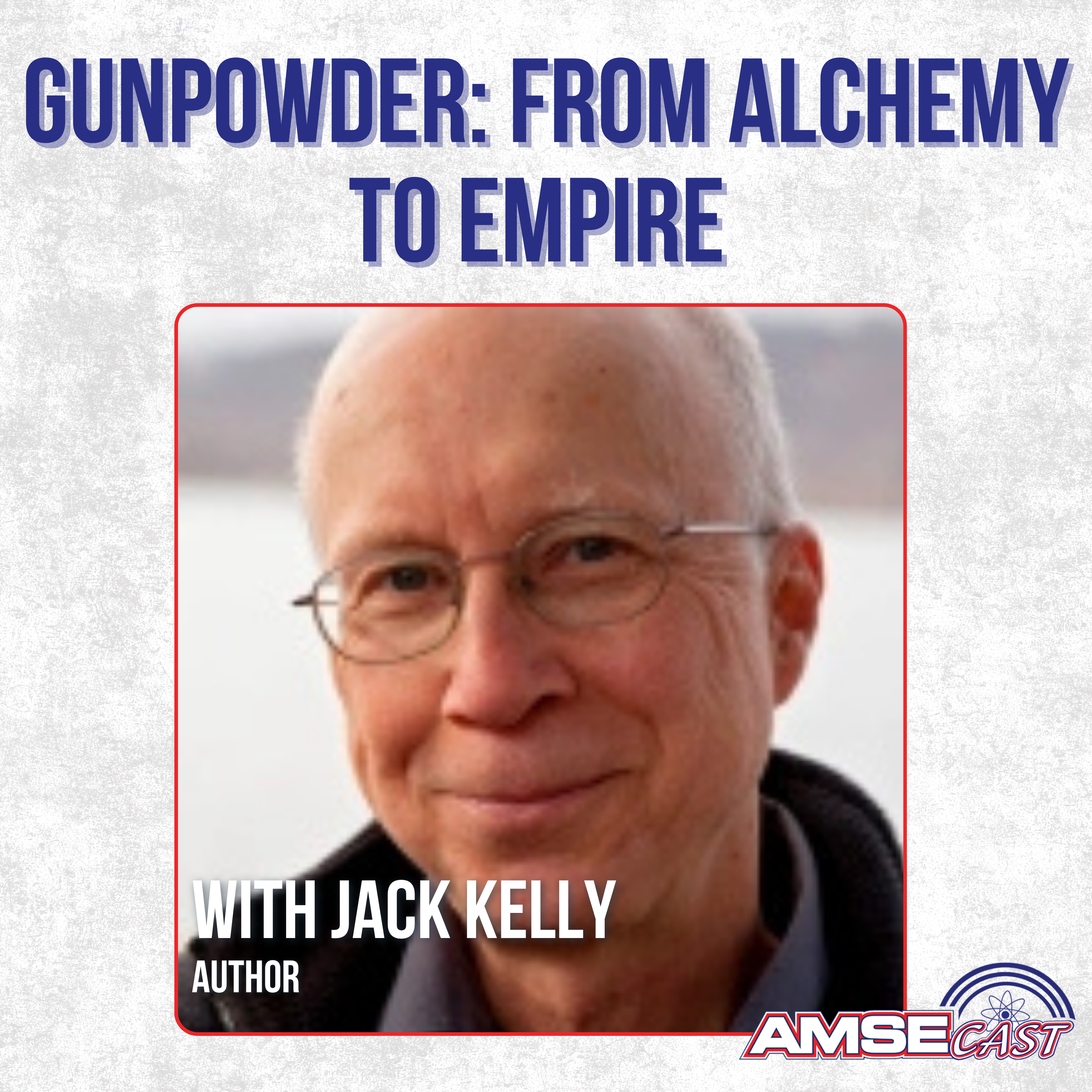


Jack Kelly joins Alan on this episode of AMSEcast to talk about his book Gunpowder: Alchemy, Bombards, and Pyrotechnics. They discuss gunpowder’s accidental invention in 10th-century China and its explosive mix of saltpeter, charcoal, and sulfur. Kelly explains how gunpowder shaped science and warfare, fueling revolutions in physics, ending the era of castles, and powering colonial empires. Though once too expensive for civilian use, gunpowder later drove mining and infrastructure projects before being replaced by safer, more powerful explosives like dynamite. Kelly also previews his upcoming book on Thomas Paine, highlighting Paine’s role as both Enlightenment thinker and Revolutionary soldier.
Guest Bio
Jack Kelly is an award-winning historian, journalist, and novelist, as well as a New York Foundation for the Arts Fellow. His work has appeared in publications like The Wall Street Journal and American Heritage, and he’s been featured on NPR, PBS, and the History Channel. Jack’s books explore pivotal moments in history with vivid storytelling and sharp insight. His titles include Heaven’s Ditch: God, Gold, and Murder on the Erie Canal and God Save Benedict Arnold: The True Story of America’s Most Hated Man. His upcoming book is Gunpowder: Alchemy, Bombards, and Pyrotechnics, an explosive history of invention and empire.
Show Highlights
- (1:24) When the Chinese invented gunpowder and when it arrived in Europe
- (2:35) The ingredients of gunpowder
- (3:54) Why saltpeter is such a challenging ingredient to produce
- (5:43) Challenges faced by European engineers in the production of gunpowder
- (8:34) What the development of chemistry revealed about how gunpowder works
- (10:46) How gunpowder influenced sciences like physics in Europe
- (12:51) When guns and cannons were introduced
- (14:12) Gunpowder’s impact on European architecture, such as castles
- (16:39) The commercial uses of gunpowder
- (20:12) Replacements for gunpowder in weapons and other explosives today
- (22:51) Modern uses for black powder
- (24:26) What Jack Kelly is currently working on
Links Referenced
- Heaven’s Ditch: God, Gold, and Murder on the Erie Canal:
- https://www.amazon.com/Heavens-Ditch-Jack-Kelly-audiobook/dp/B01HU77DIC/
- God Save Benedict Arnold: The True Story of America’s Most Hated Man: https://www.amazon.com/God-Save-Benedict-Arnold-Americas-ebook/dp/B0BQGFMLFK/
- Gunpowder: Alchemy, Bombards, and Pyrotechnics: The History of the Explosive that Changed the World: https://www.amazon.com/Gunpowder-Alchemy-Bombards-Pyrotechnics-Explosive-ebook/dp/B009IU57IS/
1
00:00:04,040 --> 00:00:07,840
Welcome to AMSEcast, coming to you from Oak Ridge, Tennessee,
2
00:00:08,179 --> 00:00:11,500
a global leader in science, technology, and innovation.
3
00:00:12,240 --> 00:00:15,309
My name is Alan Lowe, director of the American Museum
4
00:00:15,339 --> 00:00:18,689
of Science and Energy, and the K-25 History Center.
5
00:00:19,710 --> 00:00:23,080
Each episode of AMSEcast presents world-renowned authors,
6
00:00:23,529 --> 00:00:27,480
scientists, historians, policymakers, and everyone in between,
7
00:00:27,929 --> 00:00:31,100
sharing their insights on a variety of fascinating topics.
8
00:00:34,959 --> 00:00:37,820
Welcome and thanks so much for joining us on AMSEcast.
9
00:00:38,370 --> 00:00:41,090
I’m very pleased to welcome our guest today, Jack Kelly.
10
00:00:41,780 --> 00:00:44,290
Jack is a New York Foundation for the Arts Fellow, and
11
00:00:44,309 --> 00:00:47,140
an award winning historian, journalist and novelist.
12
00:00:47,719 --> 00:00:50,050
He’s written for publications like the Wall Street Journal
13
00:00:50,050 --> 00:00:52,740
and American Heritage, and you may have heard or seen him
14
00:00:52,740 --> 00:00:56,080
during appearances on NPR, PBS, and the History Channel.
15
00:00:56,640 --> 00:01:01,070
Some of his many books include Heaven’s Ditch: God, Gold, and Murder on the
16
00:01:01,080 --> 00:01:06,429
Erie Canal; God Save Benedict Arnold: The True Story of America’s Most Hated
17
00:01:06,429 --> 00:01:13,020
Man; and the book we’re going to discuss today, Gunpowder: Alchemy, Bombards,
18
00:01:13,020 --> 00:01:16,010
and Pyrotechnics: The History of the Explosive that Changed the World.
19
00:01:16,420 --> 00:01:18,300
Jack, welcome to AMSEcast.
20
00:01:18,300 --> 00:01:19,345
Well, thank you very much, Alan.
21
00:01:19,680 --> 00:01:21,490
I so enjoyed this book.
22
00:01:21,490 --> 00:01:24,369
It’s really fascinating from beginning to end.
23
00:01:24,530 --> 00:01:25,970
Let’s start at the beginning.
24
00:01:26,090 --> 00:01:28,160
The Chinese invented gunpowder.
25
00:01:28,160 --> 00:01:28,919
They first created it.
26
00:01:28,949 --> 00:01:30,039
When did that happen?
27
00:01:30,039 --> 00:01:31,730
And then when did it make it to Europe?
28
00:01:32,100 --> 00:01:34,990
The first gunpowder is really developed
29
00:01:34,990 --> 00:01:38,449
around 1000 AD. That’s a good date to pick.
30
00:01:38,539 --> 00:01:44,199
There was actually a piece of writing from 850 AD that was a warning.
31
00:01:44,389 --> 00:01:48,990
And the development of gunpowder in China was mostly done by Alchemists, and
32
00:01:49,010 --> 00:01:54,059
unlike in the West, where the alchemists were looking to change lead into gold,
33
00:01:54,550 --> 00:01:58,780
in China, they were trying to develop an elixir of long life, and they tried
34
00:01:59,130 --> 00:02:04,419
mixing together various chemicals that they thought would have this purpose.
35
00:02:04,709 --> 00:02:08,280
Some of them were deadly poisons, but they didn’t know that at the time.
36
00:02:08,460 --> 00:02:13,589
And there was a warning that was written down in 850 AD, “Watch
37
00:02:13,589 --> 00:02:16,660
out if you combine these various ingredients because they can
38
00:02:16,660 --> 00:02:19,970
explode or they can flame up.” And so, that was thought to
39
00:02:19,970 --> 00:02:22,989
be the first reference really, to anything like gunpowder.
40
00:02:23,190 --> 00:02:27,940
By 1044 AD, they had, already, recipes for gunpowder.
41
00:02:28,360 --> 00:02:31,310
And it was referred to as the fire drug, or the fire
42
00:02:31,310 --> 00:02:34,910
medicine, which gives a kind of clue into the origin of it.
43
00:02:35,070 --> 00:02:37,140
So, what are those basic ingredients?
44
00:02:37,299 --> 00:02:41,250
One of the really fascinating things about gunpowder is that all the
45
00:02:41,250 --> 00:02:46,900
ingredients—the three ingredients, I should say—are naturally occurring.
46
00:02:46,910 --> 00:02:48,280
You can find them in nature.
47
00:02:48,490 --> 00:02:51,150
And the other thing I think that’s worth keeping in mind when we talk
48
00:02:51,160 --> 00:02:55,960
about gunpowder, is that gunpowder is a mixture of these ingredients.
49
00:02:55,969 --> 00:02:58,120
It’s not a chemical in itself.
50
00:02:58,250 --> 00:03:02,090
It’s sort of like a salad, where you have the lettuce and the tomatoes.
51
00:03:02,090 --> 00:03:04,900
You can separate them out, but they’re all mixed together.
52
00:03:05,050 --> 00:03:08,130
The first and most important ingredient in gunpowder is saltpeter.
53
00:03:08,900 --> 00:03:14,609
That makes up about three quarters of gunpowder, and it’s a
54
00:03:14,690 --> 00:03:18,779
naturally occurring salt that could be found in various places.
55
00:03:18,930 --> 00:03:24,990
Charcoal makes up 15%, and that’s simply the same type of charcoal we use in
56
00:03:24,990 --> 00:03:29,200
a barbecue reduced to a powder, and then sulfur makes up the remaining 10%.
57
00:03:29,900 --> 00:03:33,410
And that we use—it’s scraped from the openings of
58
00:03:33,410 --> 00:03:36,869
volcanoes, and there’s other sources of sulfur.
59
00:03:36,980 --> 00:03:40,390
So, those are the three ingredients, and have remained
60
00:03:40,410 --> 00:03:44,010
in those proportions for pretty much 900 years.
61
00:03:44,410 --> 00:03:49,840
And that was the only explosive known to humankind for all those centuries.
62
00:03:49,849 --> 00:03:54,020
So, quite a unique invention back in 1000 AD.
63
00:03:54,270 --> 00:03:57,320
Really unique and really world changing, as you show.
64
00:03:57,440 --> 00:04:01,350
Saltpeter, you mentioned, is a significant part of that recipe.
65
00:04:01,670 --> 00:04:06,140
Why has it proved to be a challenging component to produce?
66
00:04:06,190 --> 00:04:09,079
Why was it hard to produce for folks around the world?
67
00:04:09,460 --> 00:04:14,960
There was really two sources of saltpeter, and one of them was in a climate
68
00:04:14,970 --> 00:04:21,270
where you had a very heavy rainy season and then a very hot dry season.
69
00:04:21,829 --> 00:04:25,329
And during the rainy season, the saltpeter would be
70
00:04:25,330 --> 00:04:29,489
produced by the action of bacteria on organic material.
71
00:04:29,619 --> 00:04:31,840
The bacteria would essentially eat the
72
00:04:31,910 --> 00:04:35,070
organic material and give off this nitrate.
73
00:04:35,240 --> 00:04:39,410
During the dry season, those nitrates would leach up to the top
74
00:04:39,870 --> 00:04:44,330
and precipitate out and form a crust on the surface of the soil.
75
00:04:44,670 --> 00:04:49,090
That occurred mostly in India, and India became a very big source of saltpeter.
76
00:04:49,090 --> 00:04:53,820
It had to be scraped off from the soil and then refined to
77
00:04:53,820 --> 00:04:57,469
make what they needed, but it was the source of saltpeter.
78
00:04:57,599 --> 00:05:01,669
Whereas in Europe, if anybody who’s a gardner knows that you
79
00:05:01,670 --> 00:05:05,829
create a compost heap, you’re trying to create fertilizer
80
00:05:05,830 --> 00:05:09,260
for your garden, and that fertilizer is also nitrate.
81
00:05:09,770 --> 00:05:14,830
And so, in Europe, they would either dig up barnyard soil or
82
00:05:14,889 --> 00:05:18,370
old privies they’d find where there’s a lot of organic material.
83
00:05:18,900 --> 00:05:22,830
Or eventually, they started these farms where they would have
84
00:05:22,830 --> 00:05:27,210
ditches full of organic material and deliberately produce, in
85
00:05:27,210 --> 00:05:30,650
essentially a large compost operation, the nitrate, which then
86
00:05:30,650 --> 00:05:36,150
had to be carefully dissolved in water and refined into a powder.
87
00:05:36,150 --> 00:05:39,479
But because it was the largest, the most important
88
00:05:39,480 --> 00:05:42,990
ingredient in gunpowder, it was always in short supply.
89
00:05:43,460 --> 00:05:47,860
Now, you mentioned, when gunpowder made its way to Europe, it wasn’t
90
00:05:47,870 --> 00:05:51,639
really—the making of the gunpowder wasn’t really a scientific process,
91
00:05:51,920 --> 00:05:55,109
but more of an engineering, almost trial-by-error [laugh] process.
92
00:05:55,370 --> 00:05:58,479
What were some of the challenges that confronted those early
93
00:05:58,480 --> 00:06:00,980
engineers with the production of that gunpowder in Europe?
94
00:06:01,540 --> 00:06:04,520
First of all, chemistry was a very late science
95
00:06:04,520 --> 00:06:07,250
to develop, and I think it’s obvious why.
96
00:06:07,260 --> 00:06:11,070
If you compare it to physics, with physics, you had the actual objects.
97
00:06:11,070 --> 00:06:14,719
You could see things hitting each other, or two weights
98
00:06:14,719 --> 00:06:18,169
dropping, whereas with chemistry, everything was invisible.
99
00:06:18,330 --> 00:06:20,950
And even today, even with electron microscope, we
100
00:06:20,950 --> 00:06:24,390
couldn’t just barely see a molecule because it’s so tiny.
101
00:06:24,580 --> 00:06:26,550
So, everything in the development of
102
00:06:26,550 --> 00:06:29,599
gunpowder had to be through trial and error.
103
00:06:29,719 --> 00:06:33,069
And it was amazing that they developed, really, the formula
104
00:06:33,110 --> 00:06:36,156
that lasted for 900 years through this trial and error.
105
00:06:36,156 --> 00:06:40,310
And the other thing that was an obstacle to making gunpowder
106
00:06:40,800 --> 00:06:45,140
was that you didn’t just mix the ingredients together; they
107
00:06:45,140 --> 00:06:48,310
had to go through a process, what they called incorporation.
108
00:06:48,849 --> 00:06:53,150
And that was essentially they would take the powders, these
109
00:06:53,150 --> 00:06:56,500
three powders, mix them together in the right proportions, and
110
00:06:56,500 --> 00:07:00,300
then moisten them with either water, or sometimes they thought
111
00:07:00,310 --> 00:07:04,040
that urine or wine or something would give it more power.
112
00:07:04,410 --> 00:07:08,409
They would moisten it into a kind of putty, and they would
113
00:07:08,410 --> 00:07:12,270
put that in a mortar and pestle and pound it for 24 hours,
114
00:07:12,430 --> 00:07:16,200
completely integrate the three ingredients together.
115
00:07:16,510 --> 00:07:21,560
They still remained separate ingredients, but they intimately mixed together.
116
00:07:21,679 --> 00:07:25,120
Later, they developed a more industrial way of
117
00:07:25,309 --> 00:07:29,370
incorporating the powder with these giant rollers that
118
00:07:29,370 --> 00:07:33,440
would roll over platters filled with this moist gunpowder.
119
00:07:33,660 --> 00:07:38,629
But those were the challenges that they had to overcome to really—and
120
00:07:38,820 --> 00:07:43,429
gunpowder really did develop slowly for many centuries, you know, just
121
00:07:43,440 --> 00:07:47,910
increasing the power and the reliability and the consistency of it.
122
00:07:48,059 --> 00:07:51,370
Seems like there’s a good amount of danger built into that process, though.
123
00:07:51,940 --> 00:07:54,450
Yeah, that was always the case.
124
00:07:54,520 --> 00:07:58,180
The gunpowder mills tended to blow up quite easily.
125
00:07:58,670 --> 00:08:01,919
I actually went out to see what was the last gunpowder mill in
126
00:08:01,920 --> 00:08:05,940
America—I think—when I was writing the book, and I asked the
127
00:08:06,340 --> 00:08:09,789
proprietor, I said, “How did you get past that danger aspect of
128
00:08:09,790 --> 00:08:13,250
it?” Because now they have OSHA and all these workplace regulations.
129
00:08:13,250 --> 00:08:17,450
And he said, “We never did.” And he said, “They’re still a dicey
130
00:08:17,500 --> 00:08:22,290
operation.” And ironically and really tragically, about a month
131
00:08:22,290 --> 00:08:26,110
afterwards, they did have an explosion there, and two men were killed.
132
00:08:26,170 --> 00:08:30,870
And they were probably the last, hopefully, of a long
133
00:08:30,880 --> 00:08:34,290
list of men who died making gunpowder over the years.
134
00:08:34,549 --> 00:08:37,380
When science did develop, when the science of chemistry
135
00:08:37,380 --> 00:08:41,860
developed, what did it reveal about how gunpowder works?
136
00:08:42,219 --> 00:08:46,100
Each of the ingredients has a specific role.
137
00:08:46,260 --> 00:08:49,930
And the saltpeter, the role of the saltpeter
138
00:08:49,930 --> 00:08:53,099
is to produce oxygen from within the powder.
139
00:08:53,370 --> 00:08:55,459
The saltpeter is potassium nitrate.
140
00:08:55,770 --> 00:08:58,509
The nitrate radical—what they call the nitrate radical in
141
00:08:58,510 --> 00:09:04,380
chemistry—is a nitrogen atom with four oxygen atoms attached to it.
142
00:09:04,660 --> 00:09:08,730
It’s a very unstable radical, and when it gets hot
143
00:09:08,750 --> 00:09:12,079
and starts jiggling around, the oxygen flies off.
144
00:09:12,120 --> 00:09:17,280
That is the key to why gunpowder works because the oxygen, for the
145
00:09:17,280 --> 00:09:23,610
combustion of the charcoal and the sulfur, is inside the powder.
146
00:09:23,860 --> 00:09:26,910
The charcoal burns at very high heat, produces a lot
147
00:09:26,910 --> 00:09:31,460
of hot gas, and sulfur, in the contrary, burns at a
148
00:09:31,460 --> 00:09:35,699
relatively low temperature, so that speeds up the reaction.
149
00:09:36,039 --> 00:09:39,040
I always try to compare it to a candle.
150
00:09:39,520 --> 00:09:46,599
If you light a candle, the hot gasses that are coming off the flame will suck
151
00:09:46,610 --> 00:09:51,980
in oxygen from the air—suck in air, actually—to make the burning continue.
152
00:09:52,299 --> 00:09:54,449
But air is only 20% oxygen.
153
00:09:54,720 --> 00:09:57,920
In gunpowder, you have all the oxygen you
154
00:09:57,920 --> 00:10:01,330
need contained within the actual substance.
155
00:10:01,490 --> 00:10:03,090
So, speed is everything.
156
00:10:03,260 --> 00:10:05,550
The whole gunpowder reaction takes place
157
00:10:05,889 --> 00:10:07,890
in about three one-thousandths of a second.
158
00:10:08,139 --> 00:10:09,850
So, it’s just a blink of an eye, and it’s
159
00:10:09,860 --> 00:10:12,670
all burned up and turned into this hot gas.
160
00:10:13,020 --> 00:10:16,700
I sometimes compare it to, you know, burning a piece of charcoal.
161
00:10:17,000 --> 00:10:21,690
There’s actually more energy, more heat, in a charcoal briquette than
162
00:10:21,690 --> 00:10:27,829
in an equal amount of gunpowder, it’s just that, with the briquette, it
163
00:10:27,839 --> 00:10:32,490
burns over half an hour, and the gunpowder, it goes off instantaneously.
164
00:10:32,750 --> 00:10:34,329
And with the briquette, I can never get them
165
00:10:34,330 --> 00:10:36,030
lit, but that’s another matter altogether.
166
00:10:36,030 --> 00:10:37,100
So [laugh]
167
00:10:37,510 --> 00:10:39,900
.
They always seem to be at the perfect—just getting
168
00:10:39,900 --> 00:10:42,409
to be perfect temperature when you’re done cooking.
169
00:10:42,679 --> 00:10:43,309
[laugh] That’s right.
170
00:10:43,569 --> 00:10:44,810
I never understand that either.
171
00:10:46,100 --> 00:10:48,860
So, I found it really interesting that as gunpowder developed,
172
00:10:48,960 --> 00:10:52,600
men like Galileo were looking at it, it helped really inspire
173
00:10:52,660 --> 00:10:57,000
new ideas in areas like combustion, mechanics, forces of motion.
174
00:10:57,000 --> 00:10:58,470
Can you talk a bit about that?
175
00:10:58,790 --> 00:11:03,210
There was a great incentive to study and to improve gunpowder because it was so
176
00:11:03,259 --> 00:11:09,160
essential to the power of the various countries that were using it in warfare.
177
00:11:09,320 --> 00:11:11,180
They developed the chemistry of it.
178
00:11:11,370 --> 00:11:16,780
For example, Lavoisier was a famous chemist in France in the 18th
179
00:11:16,780 --> 00:11:22,410
century, and also was the man who directed their gunpowder operations.
180
00:11:22,420 --> 00:11:26,000
So, he brought in a lot of improvements to making gunpowder.
181
00:11:26,000 --> 00:11:30,050
He understood what was going on better than the craftsman
182
00:11:30,070 --> 00:11:33,950
of earlier times, and he particularly got past the
183
00:11:33,950 --> 00:11:38,870
idea that the fire was a substance inside of a fuel.
184
00:11:39,309 --> 00:11:43,380
They thought that a block of wood had this phlogiston,
185
00:11:43,380 --> 00:11:46,640
as they called it, inside it, and it was let out when it
186
00:11:46,640 --> 00:11:50,380
burned, and of course, that was not the way that it worked.
187
00:11:50,840 --> 00:11:53,440
As far as physics go, gunpowder weapons I
188
00:11:53,440 --> 00:11:55,970
should say, were very influential in physics.
189
00:11:55,970 --> 00:12:01,069
There was a gentleman in the 1500s who was studying what’s the best
190
00:12:01,070 --> 00:12:05,370
angle to aim a cannon to get the longest range in the cannonball,
191
00:12:05,990 --> 00:12:10,459
and he tried to look at it mathematically as well as it could.
192
00:12:10,840 --> 00:12:14,370
And he found that, for example, if you fire it exactly
193
00:12:14,389 --> 00:12:18,240
parallel to the earth, it still curves downward.
194
00:12:18,469 --> 00:12:19,170
Why is that?
195
00:12:19,550 --> 00:12:21,670
You know, now it seems so obvious to us, but
196
00:12:22,160 --> 00:12:24,000
they started asking, why does it do that?
197
00:12:24,270 --> 00:12:28,790
And that developed—through Galileo, who came a little bit
198
00:12:28,790 --> 00:12:33,269
later—into the idea of gravity, inertia, acceleration.
199
00:12:33,660 --> 00:12:38,010
And the guns were an incentive to study all these aspects.
200
00:12:38,300 --> 00:12:41,990
And eventually you get to Isaac Newton, who really took
201
00:12:42,010 --> 00:12:46,260
the cannonball and compared it to the moon and the planets
202
00:12:47,080 --> 00:12:50,980
and unified the science and totally transformed science.
203
00:12:51,650 --> 00:12:54,939
Mentioning guns and cannons, when do you see those appear on the scene?
204
00:12:55,290 --> 00:12:59,520
One of the interesting myths about gunpowder is a lot of people
205
00:12:59,520 --> 00:13:03,320
say that the Chinese, they discovered gunpowder, but either
206
00:13:03,320 --> 00:13:07,080
they were so wise that they didn’t use it for warfare, or they
207
00:13:07,080 --> 00:13:09,800
were so dumb they didn’t see how they could use it for warfare.
208
00:13:09,960 --> 00:13:11,290
Both of those things are wrong.
209
00:13:11,299 --> 00:13:13,650
They used it very extensively for warfare, and they
210
00:13:13,650 --> 00:13:18,810
developed flamethrowers and rockets and bombs and landmines.
211
00:13:18,920 --> 00:13:21,410
When it got to Europe a couple centuries
212
00:13:21,410 --> 00:13:24,359
later, the Europeans focused mainly on the gun.
213
00:13:24,620 --> 00:13:26,810
They didn’t get going for the more exotic
214
00:13:26,960 --> 00:13:29,159
weapons of war that the Chinese had developed.
215
00:13:29,340 --> 00:13:35,189
And the first guns were used in battle, I think pretty much assumed, in 1346.
216
00:13:35,190 --> 00:13:40,470
Edward III on one of his conquest of France, he fired off guns.
217
00:13:40,500 --> 00:13:44,130
Very ineffective, but it created a big sensation.
218
00:13:44,130 --> 00:13:46,159
It was sort of a psychological weapon almost.
219
00:13:46,270 --> 00:13:51,449
By the 1400s they began to develop larger and more efficient cannon.
220
00:13:51,760 --> 00:13:57,650
Mehmed II in 1452 used a cannon to break down the walls of Constantinople
221
00:13:58,520 --> 00:14:02,910
and end the Byzantine Empire that had been there for many, many centuries.
222
00:14:03,030 --> 00:14:06,239
So, they were beginning to be then, very effective by that time.
223
00:14:06,250 --> 00:14:09,030
A lot of folks don’t realize, the Roman Empire really didn’t end
224
00:14:09,030 --> 00:14:12,340
until the 15th century, and it ended thanks to those cannons, yes.
225
00:14:12,600 --> 00:14:15,910
So, you talk about the impact of these new weapons, powered
226
00:14:15,910 --> 00:14:19,619
by gunpowder, on government-owned social structures.
227
00:14:19,620 --> 00:14:23,060
Can you talk a bit about how that started transforming those in Europe?
228
00:14:23,369 --> 00:14:27,080
As they developed a larger and larger cannon, their main purpose
229
00:14:27,080 --> 00:14:30,400
was not to kill people, but to break down fortifications.
230
00:14:31,430 --> 00:14:32,410
And by the 1450s
231
00:14:34,960 --> 00:14:38,199
they had 16-foot-long cannons shooting two-foot
232
00:14:38,380 --> 00:14:41,020
diameter balls into the walls of castles.
233
00:14:41,330 --> 00:14:47,040
That destroyed the base of the nobility during feudal times.
234
00:14:47,570 --> 00:14:51,050
And they couldn’t hide in their castle anymore, and they didn’t have the
235
00:14:51,050 --> 00:14:56,979
money that the king had in order to buy the guns, very expensive, the
236
00:14:56,980 --> 00:15:01,540
powder was very expensive, and the fortifications that you needed to protect
237
00:15:01,540 --> 00:15:06,260
yourself against cannon fire were much more expensive than building a castle.
238
00:15:06,720 --> 00:15:10,329
So, the feudal age then died out and gunpowder
239
00:15:10,330 --> 00:15:13,369
was one of the things that contributed to that.
240
00:15:13,920 --> 00:15:19,030
The other aspect was that using what was called, originally a hand cannon, or
241
00:15:19,090 --> 00:15:25,569
later a musket, a peasant could fire a ball and pierce the armor of a knight.
242
00:15:25,910 --> 00:15:30,560
And the knights had ruled for many centuries, the knight on horseback
243
00:15:30,560 --> 00:15:34,249
in his armor was sort of impenetrable, and they suddenly became
244
00:15:34,270 --> 00:15:39,660
obsolete as well, so the possibility of power being taken up by common
245
00:15:39,660 --> 00:15:43,390
people who didn’t need a lot of training, they just needed to have a
246
00:15:43,390 --> 00:15:48,569
gun and fire it, really transformed the dynamics of society as well.
247
00:15:48,700 --> 00:15:52,149
And also, as you show, helped lead to the spread of empire as well.
248
00:15:52,469 --> 00:15:55,800
We have to look at gunpowder as a form of power.
249
00:15:55,980 --> 00:15:59,140
And in the days of, for example, of Alexander the
250
00:15:59,140 --> 00:16:02,490
Great, to exert your power, you had to send an army.
251
00:16:02,670 --> 00:16:05,820
And the army was expensive, you had to transport the
252
00:16:05,820 --> 00:16:07,670
troops, you had to pay them, you had to feed them.
253
00:16:07,790 --> 00:16:12,179
With the gunpowder, you had the power concentrated in a ship.
254
00:16:12,309 --> 00:16:13,910
And you had cannon on the ship.
255
00:16:14,220 --> 00:16:19,140
You would take it out, as Vasco da Gama did to India, and threaten to
256
00:16:19,510 --> 00:16:24,649
blow down their buildings, and they would then come to a conclusion
257
00:16:24,650 --> 00:16:28,949
that was made more sense to trade with you on unfavorable terms.
258
00:16:29,369 --> 00:16:34,030
And so, that was the way that Europeans spread their power out through
259
00:16:34,070 --> 00:16:38,779
India and Africa, the West, the East Indies, and then around the world.
260
00:16:38,940 --> 00:16:42,569
Now, we’ve talked about gunpowder in the context of war and conflict,
261
00:16:42,570 --> 00:16:45,959
but it started to be used for more economically productive ways.
262
00:16:45,960 --> 00:16:48,000
What were some of those, and why did it take so long for
263
00:16:48,000 --> 00:16:52,060
it to get to these more peaceful ways of using gunpowder?
264
00:16:52,460 --> 00:16:56,760
It was slow to be used what I would call generally blasting instead
265
00:16:56,760 --> 00:17:01,249
of use in weapons, partly because gunpowder was so expensive.
266
00:17:01,370 --> 00:17:05,260
It was not seen as—these were practical enough
267
00:17:05,270 --> 00:17:08,810
uses to use this very valuable material.
268
00:17:09,000 --> 00:17:10,169
It was dangerous.
269
00:17:10,290 --> 00:17:16,040
It was, just tradition continued on, and people didn’t want to change.
270
00:17:16,179 --> 00:17:21,319
But eventually they did see that gunpowder could be used for making
271
00:17:21,319 --> 00:17:25,829
canals or for drilling tunnels through a mountain or for mining.
272
00:17:25,839 --> 00:17:28,900
It became very big use of gunpowder, for mining.
273
00:17:29,050 --> 00:17:33,140
When we get into the 1800s and gunpowder began to be
274
00:17:33,469 --> 00:17:37,580
produced on an industrial scale, these uses really blossomed.
275
00:17:38,049 --> 00:17:41,129
And if you look at the overall history of gunpowder over the many,
276
00:17:41,129 --> 00:17:45,530
many centuries, there was more gunpowder used for peaceful purposes
277
00:17:45,530 --> 00:17:49,470
and for blasting than was used in all the wars because the wars used
278
00:17:49,490 --> 00:17:52,750
a huge amounts of gunpowder, but only for a few years at a time.
279
00:17:53,380 --> 00:17:56,080
Year in and year out, they were producing a lot of
280
00:17:56,080 --> 00:17:59,940
gunpowder to do what was basically civil engineering jobs.
281
00:18:00,299 --> 00:18:00,989
Interesting.
282
00:18:01,290 --> 00:18:05,060
I know in your book, and I don’t mean to not go into all the details, but
283
00:18:05,070 --> 00:18:08,730
I want our listeners to read the book if they haven’t already, you talk
284
00:18:08,740 --> 00:18:12,440
about a whole host of different types of weapons and ammunition, but we
285
00:18:12,440 --> 00:18:15,930
talked a bit before we went on air today, about the Minié ball—if I’m
286
00:18:15,930 --> 00:18:20,460
saying that correctly—of how that transformed or helped transform warfare.
287
00:18:20,460 --> 00:18:21,730
Can you tell us a bit about that?
288
00:18:22,010 --> 00:18:26,580
I actually have written a number of books about the Revolutionary War, and
289
00:18:26,639 --> 00:18:31,489
during the time, and for a long period of time in the development of muskets—the
290
00:18:31,700 --> 00:18:37,639
musket was a smoothbored weapon, I should call it—and it was very inaccurate.
291
00:18:37,770 --> 00:18:42,330
They didn’t even aim muskets; they would just fire in a phalanx
292
00:18:42,440 --> 00:18:46,029
of muskets and hope that some of the bullets had effect.
293
00:18:46,139 --> 00:18:49,270
And the reason was that it was not rifled.
294
00:18:49,309 --> 00:18:52,760
And the rifling was a way of spinning the bullet in a
295
00:18:53,020 --> 00:18:57,560
predictable way, and it would go in a completely straight line.
296
00:18:57,570 --> 00:18:59,460
That was the idea of the rifle.
297
00:18:59,880 --> 00:19:05,559
But the rifle was a very slow weapon to load, so they thought that firing
298
00:19:05,559 --> 00:19:11,149
more quickly with the musket, the smoothbore musket—the trouble was, of
299
00:19:11,150 --> 00:19:14,950
course, you always had to reload in between the shots, but that remained.
300
00:19:15,180 --> 00:19:19,389
By the Civil War, they had this idea of the Minié ball, which had a hollow
301
00:19:19,470 --> 00:19:24,560
in the back of it, and it was more like a modern bullet as opposed to a ball.
302
00:19:24,950 --> 00:19:28,589
And that hollow would spread out and it would catch the
303
00:19:28,600 --> 00:19:33,090
grooves in the barrel of the gun and deliver that spin.
304
00:19:33,310 --> 00:19:36,010
It was still a muzzle loader, but it was much
305
00:19:36,010 --> 00:19:39,710
more accurate out to quarter or half a mile.
306
00:19:39,860 --> 00:19:44,809
And a lot of the destruction, a lot of the fatalities in the Civil War were
307
00:19:44,849 --> 00:19:49,580
because their tactics were had been developed during the time of the musket, but
308
00:19:49,630 --> 00:19:53,340
when the Minié ball had come in, and these rifled muskets came in, with their
309
00:19:53,340 --> 00:19:59,020
accuracy, they were able to mow down troops and Pickett’s charge—and I talk in
310
00:19:59,020 --> 00:20:02,910
the book about Pickett charge is just one of the great tragic results of that.
311
00:20:03,070 --> 00:20:05,370
As I mentioned to you previously, I was director of the Lincoln
312
00:20:05,370 --> 00:20:08,480
Library Museum in Illinois for a while, and certainly that
313
00:20:08,490 --> 00:20:11,670
weapon has used a devastating effect during the Civil War.
314
00:20:12,150 --> 00:20:14,980
Let’s talk about the age after gunpowder.
315
00:20:14,980 --> 00:20:19,330
So, what has replaced gunpowder and weapons and other explosives today?
316
00:20:19,599 --> 00:20:24,639
If you were to point to one person who brought down this 900 years
317
00:20:24,690 --> 00:20:29,660
of technological supremacy of gunpowder, it would be Alfred Nobel.
318
00:20:29,850 --> 00:20:31,139
I wouldn’t call him a scientist.
319
00:20:31,140 --> 00:20:35,330
He was an engineer, a Swedish engineer, quite knowledgeable about
320
00:20:35,330 --> 00:20:41,689
chemistry, though, and he found a way to use nitroglycerin for the
321
00:20:41,840 --> 00:20:45,350
type of blasting projects that we were talking about a minute ago.
322
00:20:45,510 --> 00:20:49,469
And nitroglycerin was a synthetic product made in a
323
00:20:49,760 --> 00:20:54,060
chemistry lab using glycerin and treating it with acids.
324
00:20:54,160 --> 00:20:57,240
It was highly explosive, but it was hard
325
00:20:57,240 --> 00:20:59,349
to figure out exactly how to set it off.
326
00:20:59,369 --> 00:21:03,960
And he came up with the idea of the blasting cap—which was really his most
327
00:21:03,960 --> 00:21:08,940
important invention—of using a little tube of gunpowder that could be set
328
00:21:08,940 --> 00:21:14,560
off with a fuse to create a shock that would set off the nitroglycerin.
329
00:21:14,570 --> 00:21:17,129
He started a whole industry of selling nitroglycerin.
330
00:21:18,369 --> 00:21:23,649
The problem was that the nitroglycerin got to be—it could easily
331
00:21:23,650 --> 00:21:28,909
go unstable when it was being shipped or stored and explode
332
00:21:28,909 --> 00:21:32,160
spontaneously, which you didn’t want to happen, of course.
333
00:21:32,179 --> 00:21:35,270
So, he went back to the drawing boards, and he found that if he
334
00:21:35,330 --> 00:21:39,040
took the nitroglycerin and absorbed it in clay, and then took
335
00:21:39,040 --> 00:21:44,360
that clay and formed it into sticks wrapped with paper, that it
336
00:21:44,360 --> 00:21:47,909
was stable and he could still set it off with the blasting cap.
337
00:21:48,389 --> 00:21:50,070
He called it dynamite.
338
00:21:50,250 --> 00:21:54,960
And that was the end of the blasting off with gunpowder because dynamite was
339
00:21:55,380 --> 00:22:00,600
easier to make, it was more reliable and it was much, much more powerful.
340
00:22:01,570 --> 00:22:05,569
He invented that in 1867 and by the end of
341
00:22:05,569 --> 00:22:08,360
the 1800s, gunpowder was pretty much obsolete.
342
00:22:08,820 --> 00:22:12,860
The other use for gunpowder was as a propellant to shoot
343
00:22:12,920 --> 00:22:17,200
bullets out of a gun, and that use was taken over by
344
00:22:17,210 --> 00:22:21,040
nitrocellulose, or what they call guncotton when they invented it.
345
00:22:21,630 --> 00:22:26,860
And the big advantage that had was it was just as powerful as gunpowder, but
346
00:22:26,860 --> 00:22:30,500
it didn’t produce the smoke that had always been a problem with gunpowder.
347
00:22:30,500 --> 00:22:35,270
If you ever see a reenactment of Revolutionary War or Civil War battles,
348
00:22:35,680 --> 00:22:39,130
there’s always a lot of smoke, and that was a product of gunpowder.
349
00:22:39,530 --> 00:22:44,990
So, they called this new powder, smokeless powder, and gunpowder became
350
00:22:44,990 --> 00:22:50,510
known as black powder and reached the end of its useful life, I’d say.
351
00:22:50,900 --> 00:22:52,920
Is black powder used in anything today?
352
00:22:53,280 --> 00:22:57,070
Well, it’s still used in fireworks.
353
00:22:57,130 --> 00:22:59,210
There’s certain aspects of fireworks, the lift
354
00:22:59,210 --> 00:23:02,960
charge that throws the mortars up into the air.
355
00:23:03,089 --> 00:23:05,199
It’s used in reenactments.
356
00:23:05,730 --> 00:23:10,149
It’s very popular among Civil War and Revolutionary War reenactors.
357
00:23:10,200 --> 00:23:12,860
Muzzle-loading hunters use it.
358
00:23:12,950 --> 00:23:17,710
Gunpowder continues to be in heavy use in certain quarrying operations,
359
00:23:17,740 --> 00:23:21,449
particularly slate and marble, where you don’t want to shatter the
360
00:23:21,450 --> 00:23:26,710
rock, you just want to split off sections of it, and dynamite would be
361
00:23:26,710 --> 00:23:31,429
too powerful for that, and would tend to totally shatter the material.
362
00:23:31,820 --> 00:23:37,700
Those are relatively minor compared to the vast use of gunpowder in the 19th
363
00:23:37,740 --> 00:23:42,629
century, and I think you can effectively say that gunpowder is obsolete today.
364
00:23:43,090 --> 00:23:44,630
This one thing I’ll have to note, I had no
365
00:23:44,630 --> 00:23:47,270
idea that there still were musket hunters.
366
00:23:47,290 --> 00:23:47,870
That’s amazing.
367
00:23:47,870 --> 00:23:48,680
I had no idea.
368
00:23:48,960 --> 00:23:51,230
Yeah, they have a season that extends beyond the
369
00:23:51,960 --> 00:23:55,510
regular season for muzzle-loading guns, yeah.
370
00:23:55,740 --> 00:24:00,669
And just as an interesting thing, they’ve now developed a substance
371
00:24:00,670 --> 00:24:04,750
called Pyrodex that these hunters use and the reenactors use as well.
372
00:24:05,240 --> 00:24:07,980
That’s essentially smokeless powder, with
373
00:24:07,980 --> 00:24:11,250
a another chemical added to create smoke.
374
00:24:11,370 --> 00:24:14,560
It’s less corrosive and it’s more reliable than the
375
00:24:14,560 --> 00:24:18,199
old black powder, but it still looks like black powder.
376
00:24:18,320 --> 00:24:18,990
Interesting.
377
00:24:19,309 --> 00:24:22,060
Well, I’ve been to several of those reenactments, including Gettysburg,
378
00:24:22,060 --> 00:24:25,000
and that’s I’m sure, I assume, then they’re using that new thing.
379
00:24:25,010 --> 00:24:25,720
That’s interesting.
380
00:24:26,150 --> 00:24:28,030
Jack, you have so many interesting books.
381
00:24:28,050 --> 00:24:29,419
What are you working on right now?
382
00:24:29,420 --> 00:24:30,409
What’s next for you?
383
00:24:30,889 --> 00:24:33,500
The last few years, I’ve been specializing in books about the
384
00:24:33,500 --> 00:24:38,760
Revolutionary War, and of course, we’re now in the 250th anniversary
385
00:24:38,760 --> 00:24:41,320
of the war, and next year is going to be the culmination.
386
00:24:41,660 --> 00:24:43,970
I thi—I’m hoping there’ll be a lot of interest in
387
00:24:44,010 --> 00:24:47,610
the 250th anniversary of the birth of the country.
388
00:24:47,650 --> 00:24:52,769
And I have a book coming out in January of 2026 that’s
389
00:24:52,770 --> 00:24:55,840
about Thomas Paine and his role in the revolution.
390
00:24:56,380 --> 00:25:01,129
He’s noted as a thinker, and he wrote the famous essay that, “These are
391
00:25:01,130 --> 00:25:04,779
the times that try men’s souls,” but a lot of people don’t realize that he
392
00:25:04,780 --> 00:25:11,060
was also a soldier, and he marched with Washington’s army during 1776 and
393
00:25:11,320 --> 00:25:15,870
was really involved in the action in a very crucial time for the country.
394
00:25:15,870 --> 00:25:19,480
So, I refer to him as the founder for our time, and
395
00:25:19,720 --> 00:25:22,890
I think his ideas are well worth looking at again.
396
00:25:23,200 --> 00:25:23,640
Absolutely.
397
00:25:23,640 --> 00:25:24,520
I’m really interested.
398
00:25:24,540 --> 00:25:25,550
I can’t wait to read that.
399
00:25:25,550 --> 00:25:28,669
I will tell you right now at AMSE, we have an exhibit all about
400
00:25:28,719 --> 00:25:32,450
President science and engineering, and the story we tell about
401
00:25:32,450 --> 00:25:36,129
George Washington is when Paine came to visit him while they’re
402
00:25:36,130 --> 00:25:39,379
waiting on the treaty to come back from France, and they do a little
403
00:25:39,380 --> 00:25:43,310
experiment on the river in New Jersey to see why it catches on fire.
404
00:25:43,660 --> 00:25:46,460
And it’s really fascinating to see that interest in science early on
405
00:25:46,469 --> 00:25:49,269
from our founding father, George Washington, along with Mr. Paine.
406
00:25:49,820 --> 00:25:52,980
They were all men of the Enlightenment, and the Enlightenment
407
00:25:52,990 --> 00:25:58,030
was—science was their guiding compass, so yeah, that’s not surprising.
408
00:25:58,429 --> 00:25:59,769
So, thank you again, Jack.
409
00:25:59,770 --> 00:26:01,270
Really enjoyed our conversation.
410
00:26:01,360 --> 00:26:02,219
Thank you so much.
411
00:26:02,360 --> 00:26:04,700
Yeah, same here, Alan, and best of luck.
412
00:26:09,540 --> 00:26:12,240
Thank you for joining us on this episode of AMSEcast.
413
00:26:12,650 --> 00:26:16,980
For more information on this topic or any others, you can always visit us at
414
00:26:18,009 --> 00:26:23,690
AMSE.org or find, like, and follow us on Facebook, Instagram, and Twitter.
415
00:26:24,109 --> 00:26:26,439
I invite you to visit the American Museum of Science
416
00:26:26,440 --> 00:26:29,240
and Energy and the K-25 History Center in person.
417
00:26:29,560 --> 00:26:33,690
You can also shop at our online store and become a member at AMSE.org.
418
00:26:34,179 --> 00:26:37,630
Thanks to our production team with Matt Mullins, plus our supportive colleagues
419
00:26:37,630 --> 00:26:41,470
at the Department of Energy’s Office of Science, Office of Environmental
420
00:26:41,470 --> 00:26:45,450
Management, and Office of Legacy Management, as well as Oak Ridge National
421
00:26:45,450 --> 00:26:51,310
Laboratory, the Y-12 National Security Complex, NNSA, and the AMSE Foundation.
422
00:26:51,809 --> 00:26:53,540
And of course, thanks to our wonderful guests
423
00:26:53,540 --> 00:26:55,350
today, and to all of you for listening.
424
00:26:55,849 --> 00:26:58,529
I hope you’ll join us for the next episode of AMSEcast.
425
00:27:01,240 --> 00:27:04,220
If you’ve enjoyed this podcast, I would like to ask that you consider
426
00:27:04,220 --> 00:27:08,790
becoming a member of the 117 Society, the newest membership opportunity
427
00:27:08,849 --> 00:27:12,310
offered by the American Museum of Science and Energy Foundation.
428
00:27:13,070 --> 00:27:16,260
By joining the 117 Society, you will help us continue
429
00:27:16,260 --> 00:27:19,070
this podcast and our other innovative programming.
430
00:27:19,450 --> 00:27:22,360
You will support the expansion of our vitally important educational
431
00:27:22,360 --> 00:27:26,240
outreach, including virtual classes, and you will help ensure that both
432
00:27:26,250 --> 00:27:30,880
the American Museum of Science and Energy and the K-25 History Center can
433
00:27:30,880 --> 00:27:34,990
continue to provide world-class exhibits to our community and to the world.
434
00:27:35,789 --> 00:27:38,660
Benefits of membership includes special access to video
435
00:27:38,660 --> 00:27:42,870
and audio content, and 117 Society merchandise, as well
436
00:27:42,870 --> 00:27:45,809
as all the benefits of our Atom Splitter Membership Level.
437
00:27:46,400 --> 00:27:48,689
To learn more, go to AMSE.org.
438
00:27:49,780 --> 00:27:54,570
The 117 Society is vital to the future of AMSE and the K-25 History Center.
439
00:27:54,960 --> 00:27:57,600
I hope you will consider joining, and thank you very much.
00:00:04,040 --> 00:00:07,840
Welcome to AMSEcast, coming to you from Oak Ridge, Tennessee,
2
00:00:08,179 --> 00:00:11,500
a global leader in science, technology, and innovation.
3
00:00:12,240 --> 00:00:15,309
My name is Alan Lowe, director of the American Museum
4
00:00:15,339 --> 00:00:18,689
of Science and Energy, and the K-25 History Center.
5
00:00:19,710 --> 00:00:23,080
Each episode of AMSEcast presents world-renowned authors,
6
00:00:23,529 --> 00:00:27,480
scientists, historians, policymakers, and everyone in between,
7
00:00:27,929 --> 00:00:31,100
sharing their insights on a variety of fascinating topics.
8
00:00:34,959 --> 00:00:37,820
Welcome and thanks so much for joining us on AMSEcast.
9
00:00:38,370 --> 00:00:41,090
I’m very pleased to welcome our guest today, Jack Kelly.
10
00:00:41,780 --> 00:00:44,290
Jack is a New York Foundation for the Arts Fellow, and
11
00:00:44,309 --> 00:00:47,140
an award winning historian, journalist and novelist.
12
00:00:47,719 --> 00:00:50,050
He’s written for publications like the Wall Street Journal
13
00:00:50,050 --> 00:00:52,740
and American Heritage, and you may have heard or seen him
14
00:00:52,740 --> 00:00:56,080
during appearances on NPR, PBS, and the History Channel.
15
00:00:56,640 --> 00:01:01,070
Some of his many books include Heaven’s Ditch: God, Gold, and Murder on the
16
00:01:01,080 --> 00:01:06,429
Erie Canal; God Save Benedict Arnold: The True Story of America’s Most Hated
17
00:01:06,429 --> 00:01:13,020
Man; and the book we’re going to discuss today, Gunpowder: Alchemy, Bombards,
18
00:01:13,020 --> 00:01:16,010
and Pyrotechnics: The History of the Explosive that Changed the World.
19
00:01:16,420 --> 00:01:18,300
Jack, welcome to AMSEcast.
20
00:01:18,300 --> 00:01:19,345
Well, thank you very much, Alan.
21
00:01:19,680 --> 00:01:21,490
I so enjoyed this book.
22
00:01:21,490 --> 00:01:24,369
It’s really fascinating from beginning to end.
23
00:01:24,530 --> 00:01:25,970
Let’s start at the beginning.
24
00:01:26,090 --> 00:01:28,160
The Chinese invented gunpowder.
25
00:01:28,160 --> 00:01:28,919
They first created it.
26
00:01:28,949 --> 00:01:30,039
When did that happen?
27
00:01:30,039 --> 00:01:31,730
And then when did it make it to Europe?
28
00:01:32,100 --> 00:01:34,990
The first gunpowder is really developed
29
00:01:34,990 --> 00:01:38,449
around 1000 AD. That’s a good date to pick.
30
00:01:38,539 --> 00:01:44,199
There was actually a piece of writing from 850 AD that was a warning.
31
00:01:44,389 --> 00:01:48,990
And the development of gunpowder in China was mostly done by Alchemists, and
32
00:01:49,010 --> 00:01:54,059
unlike in the West, where the alchemists were looking to change lead into gold,
33
00:01:54,550 --> 00:01:58,780
in China, they were trying to develop an elixir of long life, and they tried
34
00:01:59,130 --> 00:02:04,419
mixing together various chemicals that they thought would have this purpose.
35
00:02:04,709 --> 00:02:08,280
Some of them were deadly poisons, but they didn’t know that at the time.
36
00:02:08,460 --> 00:02:13,589
And there was a warning that was written down in 850 AD, “Watch
37
00:02:13,589 --> 00:02:16,660
out if you combine these various ingredients because they can
38
00:02:16,660 --> 00:02:19,970
explode or they can flame up.” And so, that was thought to
39
00:02:19,970 --> 00:02:22,989
be the first reference really, to anything like gunpowder.
40
00:02:23,190 --> 00:02:27,940
By 1044 AD, they had, already, recipes for gunpowder.
41
00:02:28,360 --> 00:02:31,310
And it was referred to as the fire drug, or the fire
42
00:02:31,310 --> 00:02:34,910
medicine, which gives a kind of clue into the origin of it.
43
00:02:35,070 --> 00:02:37,140
So, what are those basic ingredients?
44
00:02:37,299 --> 00:02:41,250
One of the really fascinating things about gunpowder is that all the
45
00:02:41,250 --> 00:02:46,900
ingredients—the three ingredients, I should say—are naturally occurring.
46
00:02:46,910 --> 00:02:48,280
You can find them in nature.
47
00:02:48,490 --> 00:02:51,150
And the other thing I think that’s worth keeping in mind when we talk
48
00:02:51,160 --> 00:02:55,960
about gunpowder, is that gunpowder is a mixture of these ingredients.
49
00:02:55,969 --> 00:02:58,120
It’s not a chemical in itself.
50
00:02:58,250 --> 00:03:02,090
It’s sort of like a salad, where you have the lettuce and the tomatoes.
51
00:03:02,090 --> 00:03:04,900
You can separate them out, but they’re all mixed together.
52
00:03:05,050 --> 00:03:08,130
The first and most important ingredient in gunpowder is saltpeter.
53
00:03:08,900 --> 00:03:14,609
That makes up about three quarters of gunpowder, and it’s a
54
00:03:14,690 --> 00:03:18,779
naturally occurring salt that could be found in various places.
55
00:03:18,930 --> 00:03:24,990
Charcoal makes up 15%, and that’s simply the same type of charcoal we use in
56
00:03:24,990 --> 00:03:29,200
a barbecue reduced to a powder, and then sulfur makes up the remaining 10%.
57
00:03:29,900 --> 00:03:33,410
And that we use—it’s scraped from the openings of
58
00:03:33,410 --> 00:03:36,869
volcanoes, and there’s other sources of sulfur.
59
00:03:36,980 --> 00:03:40,390
So, those are the three ingredients, and have remained
60
00:03:40,410 --> 00:03:44,010
in those proportions for pretty much 900 years.
61
00:03:44,410 --> 00:03:49,840
And that was the only explosive known to humankind for all those centuries.
62
00:03:49,849 --> 00:03:54,020
So, quite a unique invention back in 1000 AD.
63
00:03:54,270 --> 00:03:57,320
Really unique and really world changing, as you show.
64
00:03:57,440 --> 00:04:01,350
Saltpeter, you mentioned, is a significant part of that recipe.
65
00:04:01,670 --> 00:04:06,140
Why has it proved to be a challenging component to produce?
66
00:04:06,190 --> 00:04:09,079
Why was it hard to produce for folks around the world?
67
00:04:09,460 --> 00:04:14,960
There was really two sources of saltpeter, and one of them was in a climate
68
00:04:14,970 --> 00:04:21,270
where you had a very heavy rainy season and then a very hot dry season.
69
00:04:21,829 --> 00:04:25,329
And during the rainy season, the saltpeter would be
70
00:04:25,330 --> 00:04:29,489
produced by the action of bacteria on organic material.
71
00:04:29,619 --> 00:04:31,840
The bacteria would essentially eat the
72
00:04:31,910 --> 00:04:35,070
organic material and give off this nitrate.
73
00:04:35,240 --> 00:04:39,410
During the dry season, those nitrates would leach up to the top
74
00:04:39,870 --> 00:04:44,330
and precipitate out and form a crust on the surface of the soil.
75
00:04:44,670 --> 00:04:49,090
That occurred mostly in India, and India became a very big source of saltpeter.
76
00:04:49,090 --> 00:04:53,820
It had to be scraped off from the soil and then refined to
77
00:04:53,820 --> 00:04:57,469
make what they needed, but it was the source of saltpeter.
78
00:04:57,599 --> 00:05:01,669
Whereas in Europe, if anybody who’s a gardner knows that you
79
00:05:01,670 --> 00:05:05,829
create a compost heap, you’re trying to create fertilizer
80
00:05:05,830 --> 00:05:09,260
for your garden, and that fertilizer is also nitrate.
81
00:05:09,770 --> 00:05:14,830
And so, in Europe, they would either dig up barnyard soil or
82
00:05:14,889 --> 00:05:18,370
old privies they’d find where there’s a lot of organic material.
83
00:05:18,900 --> 00:05:22,830
Or eventually, they started these farms where they would have
84
00:05:22,830 --> 00:05:27,210
ditches full of organic material and deliberately produce, in
85
00:05:27,210 --> 00:05:30,650
essentially a large compost operation, the nitrate, which then
86
00:05:30,650 --> 00:05:36,150
had to be carefully dissolved in water and refined into a powder.
87
00:05:36,150 --> 00:05:39,479
But because it was the largest, the most important
88
00:05:39,480 --> 00:05:42,990
ingredient in gunpowder, it was always in short supply.
89
00:05:43,460 --> 00:05:47,860
Now, you mentioned, when gunpowder made its way to Europe, it wasn’t
90
00:05:47,870 --> 00:05:51,639
really—the making of the gunpowder wasn’t really a scientific process,
91
00:05:51,920 --> 00:05:55,109
but more of an engineering, almost trial-by-error [laugh] process.
92
00:05:55,370 --> 00:05:58,479
What were some of the challenges that confronted those early
93
00:05:58,480 --> 00:06:00,980
engineers with the production of that gunpowder in Europe?
94
00:06:01,540 --> 00:06:04,520
First of all, chemistry was a very late science
95
00:06:04,520 --> 00:06:07,250
to develop, and I think it’s obvious why.
96
00:06:07,260 --> 00:06:11,070
If you compare it to physics, with physics, you had the actual objects.
97
00:06:11,070 --> 00:06:14,719
You could see things hitting each other, or two weights
98
00:06:14,719 --> 00:06:18,169
dropping, whereas with chemistry, everything was invisible.
99
00:06:18,330 --> 00:06:20,950
And even today, even with electron microscope, we
100
00:06:20,950 --> 00:06:24,390
couldn’t just barely see a molecule because it’s so tiny.
101
00:06:24,580 --> 00:06:26,550
So, everything in the development of
102
00:06:26,550 --> 00:06:29,599
gunpowder had to be through trial and error.
103
00:06:29,719 --> 00:06:33,069
And it was amazing that they developed, really, the formula
104
00:06:33,110 --> 00:06:36,156
that lasted for 900 years through this trial and error.
105
00:06:36,156 --> 00:06:40,310
And the other thing that was an obstacle to making gunpowder
106
00:06:40,800 --> 00:06:45,140
was that you didn’t just mix the ingredients together; they
107
00:06:45,140 --> 00:06:48,310
had to go through a process, what they called incorporation.
108
00:06:48,849 --> 00:06:53,150
And that was essentially they would take the powders, these
109
00:06:53,150 --> 00:06:56,500
three powders, mix them together in the right proportions, and
110
00:06:56,500 --> 00:07:00,300
then moisten them with either water, or sometimes they thought
111
00:07:00,310 --> 00:07:04,040
that urine or wine or something would give it more power.
112
00:07:04,410 --> 00:07:08,409
They would moisten it into a kind of putty, and they would
113
00:07:08,410 --> 00:07:12,270
put that in a mortar and pestle and pound it for 24 hours,
114
00:07:12,430 --> 00:07:16,200
completely integrate the three ingredients together.
115
00:07:16,510 --> 00:07:21,560
They still remained separate ingredients, but they intimately mixed together.
116
00:07:21,679 --> 00:07:25,120
Later, they developed a more industrial way of
117
00:07:25,309 --> 00:07:29,370
incorporating the powder with these giant rollers that
118
00:07:29,370 --> 00:07:33,440
would roll over platters filled with this moist gunpowder.
119
00:07:33,660 --> 00:07:38,629
But those were the challenges that they had to overcome to really—and
120
00:07:38,820 --> 00:07:43,429
gunpowder really did develop slowly for many centuries, you know, just
121
00:07:43,440 --> 00:07:47,910
increasing the power and the reliability and the consistency of it.
122
00:07:48,059 --> 00:07:51,370
Seems like there’s a good amount of danger built into that process, though.
123
00:07:51,940 --> 00:07:54,450
Yeah, that was always the case.
124
00:07:54,520 --> 00:07:58,180
The gunpowder mills tended to blow up quite easily.
125
00:07:58,670 --> 00:08:01,919
I actually went out to see what was the last gunpowder mill in
126
00:08:01,920 --> 00:08:05,940
America—I think—when I was writing the book, and I asked the
127
00:08:06,340 --> 00:08:09,789
proprietor, I said, “How did you get past that danger aspect of
128
00:08:09,790 --> 00:08:13,250
it?” Because now they have OSHA and all these workplace regulations.
129
00:08:13,250 --> 00:08:17,450
And he said, “We never did.” And he said, “They’re still a dicey
130
00:08:17,500 --> 00:08:22,290
operation.” And ironically and really tragically, about a month
131
00:08:22,290 --> 00:08:26,110
afterwards, they did have an explosion there, and two men were killed.
132
00:08:26,170 --> 00:08:30,870
And they were probably the last, hopefully, of a long
133
00:08:30,880 --> 00:08:34,290
list of men who died making gunpowder over the years.
134
00:08:34,549 --> 00:08:37,380
When science did develop, when the science of chemistry
135
00:08:37,380 --> 00:08:41,860
developed, what did it reveal about how gunpowder works?
136
00:08:42,219 --> 00:08:46,100
Each of the ingredients has a specific role.
137
00:08:46,260 --> 00:08:49,930
And the saltpeter, the role of the saltpeter
138
00:08:49,930 --> 00:08:53,099
is to produce oxygen from within the powder.
139
00:08:53,370 --> 00:08:55,459
The saltpeter is potassium nitrate.
140
00:08:55,770 --> 00:08:58,509
The nitrate radical—what they call the nitrate radical in
141
00:08:58,510 --> 00:09:04,380
chemistry—is a nitrogen atom with four oxygen atoms attached to it.
142
00:09:04,660 --> 00:09:08,730
It’s a very unstable radical, and when it gets hot
143
00:09:08,750 --> 00:09:12,079
and starts jiggling around, the oxygen flies off.
144
00:09:12,120 --> 00:09:17,280
That is the key to why gunpowder works because the oxygen, for the
145
00:09:17,280 --> 00:09:23,610
combustion of the charcoal and the sulfur, is inside the powder.
146
00:09:23,860 --> 00:09:26,910
The charcoal burns at very high heat, produces a lot
147
00:09:26,910 --> 00:09:31,460
of hot gas, and sulfur, in the contrary, burns at a
148
00:09:31,460 --> 00:09:35,699
relatively low temperature, so that speeds up the reaction.
149
00:09:36,039 --> 00:09:39,040
I always try to compare it to a candle.
150
00:09:39,520 --> 00:09:46,599
If you light a candle, the hot gasses that are coming off the flame will suck
151
00:09:46,610 --> 00:09:51,980
in oxygen from the air—suck in air, actually—to make the burning continue.
152
00:09:52,299 --> 00:09:54,449
But air is only 20% oxygen.
153
00:09:54,720 --> 00:09:57,920
In gunpowder, you have all the oxygen you
154
00:09:57,920 --> 00:10:01,330
need contained within the actual substance.
155
00:10:01,490 --> 00:10:03,090
So, speed is everything.
156
00:10:03,260 --> 00:10:05,550
The whole gunpowder reaction takes place
157
00:10:05,889 --> 00:10:07,890
in about three one-thousandths of a second.
158
00:10:08,139 --> 00:10:09,850
So, it’s just a blink of an eye, and it’s
159
00:10:09,860 --> 00:10:12,670
all burned up and turned into this hot gas.
160
00:10:13,020 --> 00:10:16,700
I sometimes compare it to, you know, burning a piece of charcoal.
161
00:10:17,000 --> 00:10:21,690
There’s actually more energy, more heat, in a charcoal briquette than
162
00:10:21,690 --> 00:10:27,829
in an equal amount of gunpowder, it’s just that, with the briquette, it
163
00:10:27,839 --> 00:10:32,490
burns over half an hour, and the gunpowder, it goes off instantaneously.
164
00:10:32,750 --> 00:10:34,329
And with the briquette, I can never get them
165
00:10:34,330 --> 00:10:36,030
lit, but that’s another matter altogether.
166
00:10:36,030 --> 00:10:37,100
So [laugh]
167
00:10:37,510 --> 00:10:39,900
.
They always seem to be at the perfect—just getting
168
00:10:39,900 --> 00:10:42,409
to be perfect temperature when you’re done cooking.
169
00:10:42,679 --> 00:10:43,309
[laugh] That’s right.
170
00:10:43,569 --> 00:10:44,810
I never understand that either.
171
00:10:46,100 --> 00:10:48,860
So, I found it really interesting that as gunpowder developed,
172
00:10:48,960 --> 00:10:52,600
men like Galileo were looking at it, it helped really inspire
173
00:10:52,660 --> 00:10:57,000
new ideas in areas like combustion, mechanics, forces of motion.
174
00:10:57,000 --> 00:10:58,470
Can you talk a bit about that?
175
00:10:58,790 --> 00:11:03,210
There was a great incentive to study and to improve gunpowder because it was so
176
00:11:03,259 --> 00:11:09,160
essential to the power of the various countries that were using it in warfare.
177
00:11:09,320 --> 00:11:11,180
They developed the chemistry of it.
178
00:11:11,370 --> 00:11:16,780
For example, Lavoisier was a famous chemist in France in the 18th
179
00:11:16,780 --> 00:11:22,410
century, and also was the man who directed their gunpowder operations.
180
00:11:22,420 --> 00:11:26,000
So, he brought in a lot of improvements to making gunpowder.
181
00:11:26,000 --> 00:11:30,050
He understood what was going on better than the craftsman
182
00:11:30,070 --> 00:11:33,950
of earlier times, and he particularly got past the
183
00:11:33,950 --> 00:11:38,870
idea that the fire was a substance inside of a fuel.
184
00:11:39,309 --> 00:11:43,380
They thought that a block of wood had this phlogiston,
185
00:11:43,380 --> 00:11:46,640
as they called it, inside it, and it was let out when it
186
00:11:46,640 --> 00:11:50,380
burned, and of course, that was not the way that it worked.
187
00:11:50,840 --> 00:11:53,440
As far as physics go, gunpowder weapons I
188
00:11:53,440 --> 00:11:55,970
should say, were very influential in physics.
189
00:11:55,970 --> 00:12:01,069
There was a gentleman in the 1500s who was studying what’s the best
190
00:12:01,070 --> 00:12:05,370
angle to aim a cannon to get the longest range in the cannonball,
191
00:12:05,990 --> 00:12:10,459
and he tried to look at it mathematically as well as it could.
192
00:12:10,840 --> 00:12:14,370
And he found that, for example, if you fire it exactly
193
00:12:14,389 --> 00:12:18,240
parallel to the earth, it still curves downward.
194
00:12:18,469 --> 00:12:19,170
Why is that?
195
00:12:19,550 --> 00:12:21,670
You know, now it seems so obvious to us, but
196
00:12:22,160 --> 00:12:24,000
they started asking, why does it do that?
197
00:12:24,270 --> 00:12:28,790
And that developed—through Galileo, who came a little bit
198
00:12:28,790 --> 00:12:33,269
later—into the idea of gravity, inertia, acceleration.
199
00:12:33,660 --> 00:12:38,010
And the guns were an incentive to study all these aspects.
200
00:12:38,300 --> 00:12:41,990
And eventually you get to Isaac Newton, who really took
201
00:12:42,010 --> 00:12:46,260
the cannonball and compared it to the moon and the planets
202
00:12:47,080 --> 00:12:50,980
and unified the science and totally transformed science.
203
00:12:51,650 --> 00:12:54,939
Mentioning guns and cannons, when do you see those appear on the scene?
204
00:12:55,290 --> 00:12:59,520
One of the interesting myths about gunpowder is a lot of people
205
00:12:59,520 --> 00:13:03,320
say that the Chinese, they discovered gunpowder, but either
206
00:13:03,320 --> 00:13:07,080
they were so wise that they didn’t use it for warfare, or they
207
00:13:07,080 --> 00:13:09,800
were so dumb they didn’t see how they could use it for warfare.
208
00:13:09,960 --> 00:13:11,290
Both of those things are wrong.
209
00:13:11,299 --> 00:13:13,650
They used it very extensively for warfare, and they
210
00:13:13,650 --> 00:13:18,810
developed flamethrowers and rockets and bombs and landmines.
211
00:13:18,920 --> 00:13:21,410
When it got to Europe a couple centuries
212
00:13:21,410 --> 00:13:24,359
later, the Europeans focused mainly on the gun.
213
00:13:24,620 --> 00:13:26,810
They didn’t get going for the more exotic
214
00:13:26,960 --> 00:13:29,159
weapons of war that the Chinese had developed.
215
00:13:29,340 --> 00:13:35,189
And the first guns were used in battle, I think pretty much assumed, in 1346.
216
00:13:35,190 --> 00:13:40,470
Edward III on one of his conquest of France, he fired off guns.
217
00:13:40,500 --> 00:13:44,130
Very ineffective, but it created a big sensation.
218
00:13:44,130 --> 00:13:46,159
It was sort of a psychological weapon almost.
219
00:13:46,270 --> 00:13:51,449
By the 1400s they began to develop larger and more efficient cannon.
220
00:13:51,760 --> 00:13:57,650
Mehmed II in 1452 used a cannon to break down the walls of Constantinople
221
00:13:58,520 --> 00:14:02,910
and end the Byzantine Empire that had been there for many, many centuries.
222
00:14:03,030 --> 00:14:06,239
So, they were beginning to be then, very effective by that time.
223
00:14:06,250 --> 00:14:09,030
A lot of folks don’t realize, the Roman Empire really didn’t end
224
00:14:09,030 --> 00:14:12,340
until the 15th century, and it ended thanks to those cannons, yes.
225
00:14:12,600 --> 00:14:15,910
So, you talk about the impact of these new weapons, powered
226
00:14:15,910 --> 00:14:19,619
by gunpowder, on government-owned social structures.
227
00:14:19,620 --> 00:14:23,060
Can you talk a bit about how that started transforming those in Europe?
228
00:14:23,369 --> 00:14:27,080
As they developed a larger and larger cannon, their main purpose
229
00:14:27,080 --> 00:14:30,400
was not to kill people, but to break down fortifications.
230
00:14:31,430 --> 00:14:32,410
And by the 1450s
231
00:14:34,960 --> 00:14:38,199
they had 16-foot-long cannons shooting two-foot
232
00:14:38,380 --> 00:14:41,020
diameter balls into the walls of castles.
233
00:14:41,330 --> 00:14:47,040
That destroyed the base of the nobility during feudal times.
234
00:14:47,570 --> 00:14:51,050
And they couldn’t hide in their castle anymore, and they didn’t have the
235
00:14:51,050 --> 00:14:56,979
money that the king had in order to buy the guns, very expensive, the
236
00:14:56,980 --> 00:15:01,540
powder was very expensive, and the fortifications that you needed to protect
237
00:15:01,540 --> 00:15:06,260
yourself against cannon fire were much more expensive than building a castle.
238
00:15:06,720 --> 00:15:10,329
So, the feudal age then died out and gunpowder
239
00:15:10,330 --> 00:15:13,369
was one of the things that contributed to that.
240
00:15:13,920 --> 00:15:19,030
The other aspect was that using what was called, originally a hand cannon, or
241
00:15:19,090 --> 00:15:25,569
later a musket, a peasant could fire a ball and pierce the armor of a knight.
242
00:15:25,910 --> 00:15:30,560
And the knights had ruled for many centuries, the knight on horseback
243
00:15:30,560 --> 00:15:34,249
in his armor was sort of impenetrable, and they suddenly became
244
00:15:34,270 --> 00:15:39,660
obsolete as well, so the possibility of power being taken up by common
245
00:15:39,660 --> 00:15:43,390
people who didn’t need a lot of training, they just needed to have a
246
00:15:43,390 --> 00:15:48,569
gun and fire it, really transformed the dynamics of society as well.
247
00:15:48,700 --> 00:15:52,149
And also, as you show, helped lead to the spread of empire as well.
248
00:15:52,469 --> 00:15:55,800
We have to look at gunpowder as a form of power.
249
00:15:55,980 --> 00:15:59,140
And in the days of, for example, of Alexander the
250
00:15:59,140 --> 00:16:02,490
Great, to exert your power, you had to send an army.
251
00:16:02,670 --> 00:16:05,820
And the army was expensive, you had to transport the
252
00:16:05,820 --> 00:16:07,670
troops, you had to pay them, you had to feed them.
253
00:16:07,790 --> 00:16:12,179
With the gunpowder, you had the power concentrated in a ship.
254
00:16:12,309 --> 00:16:13,910
And you had cannon on the ship.
255
00:16:14,220 --> 00:16:19,140
You would take it out, as Vasco da Gama did to India, and threaten to
256
00:16:19,510 --> 00:16:24,649
blow down their buildings, and they would then come to a conclusion
257
00:16:24,650 --> 00:16:28,949
that was made more sense to trade with you on unfavorable terms.
258
00:16:29,369 --> 00:16:34,030
And so, that was the way that Europeans spread their power out through
259
00:16:34,070 --> 00:16:38,779
India and Africa, the West, the East Indies, and then around the world.
260
00:16:38,940 --> 00:16:42,569
Now, we’ve talked about gunpowder in the context of war and conflict,
261
00:16:42,570 --> 00:16:45,959
but it started to be used for more economically productive ways.
262
00:16:45,960 --> 00:16:48,000
What were some of those, and why did it take so long for
263
00:16:48,000 --> 00:16:52,060
it to get to these more peaceful ways of using gunpowder?
264
00:16:52,460 --> 00:16:56,760
It was slow to be used what I would call generally blasting instead
265
00:16:56,760 --> 00:17:01,249
of use in weapons, partly because gunpowder was so expensive.
266
00:17:01,370 --> 00:17:05,260
It was not seen as—these were practical enough
267
00:17:05,270 --> 00:17:08,810
uses to use this very valuable material.
268
00:17:09,000 --> 00:17:10,169
It was dangerous.
269
00:17:10,290 --> 00:17:16,040
It was, just tradition continued on, and people didn’t want to change.
270
00:17:16,179 --> 00:17:21,319
But eventually they did see that gunpowder could be used for making
271
00:17:21,319 --> 00:17:25,829
canals or for drilling tunnels through a mountain or for mining.
272
00:17:25,839 --> 00:17:28,900
It became very big use of gunpowder, for mining.
273
00:17:29,050 --> 00:17:33,140
When we get into the 1800s and gunpowder began to be
274
00:17:33,469 --> 00:17:37,580
produced on an industrial scale, these uses really blossomed.
275
00:17:38,049 --> 00:17:41,129
And if you look at the overall history of gunpowder over the many,
276
00:17:41,129 --> 00:17:45,530
many centuries, there was more gunpowder used for peaceful purposes
277
00:17:45,530 --> 00:17:49,470
and for blasting than was used in all the wars because the wars used
278
00:17:49,490 --> 00:17:52,750
a huge amounts of gunpowder, but only for a few years at a time.
279
00:17:53,380 --> 00:17:56,080
Year in and year out, they were producing a lot of
280
00:17:56,080 --> 00:17:59,940
gunpowder to do what was basically civil engineering jobs.
281
00:18:00,299 --> 00:18:00,989
Interesting.
282
00:18:01,290 --> 00:18:05,060
I know in your book, and I don’t mean to not go into all the details, but
283
00:18:05,070 --> 00:18:08,730
I want our listeners to read the book if they haven’t already, you talk
284
00:18:08,740 --> 00:18:12,440
about a whole host of different types of weapons and ammunition, but we
285
00:18:12,440 --> 00:18:15,930
talked a bit before we went on air today, about the Minié ball—if I’m
286
00:18:15,930 --> 00:18:20,460
saying that correctly—of how that transformed or helped transform warfare.
287
00:18:20,460 --> 00:18:21,730
Can you tell us a bit about that?
288
00:18:22,010 --> 00:18:26,580
I actually have written a number of books about the Revolutionary War, and
289
00:18:26,639 --> 00:18:31,489
during the time, and for a long period of time in the development of muskets—the
290
00:18:31,700 --> 00:18:37,639
musket was a smoothbored weapon, I should call it—and it was very inaccurate.
291
00:18:37,770 --> 00:18:42,330
They didn’t even aim muskets; they would just fire in a phalanx
292
00:18:42,440 --> 00:18:46,029
of muskets and hope that some of the bullets had effect.
293
00:18:46,139 --> 00:18:49,270
And the reason was that it was not rifled.
294
00:18:49,309 --> 00:18:52,760
And the rifling was a way of spinning the bullet in a
295
00:18:53,020 --> 00:18:57,560
predictable way, and it would go in a completely straight line.
296
00:18:57,570 --> 00:18:59,460
That was the idea of the rifle.
297
00:18:59,880 --> 00:19:05,559
But the rifle was a very slow weapon to load, so they thought that firing
298
00:19:05,559 --> 00:19:11,149
more quickly with the musket, the smoothbore musket—the trouble was, of
299
00:19:11,150 --> 00:19:14,950
course, you always had to reload in between the shots, but that remained.
300
00:19:15,180 --> 00:19:19,389
By the Civil War, they had this idea of the Minié ball, which had a hollow
301
00:19:19,470 --> 00:19:24,560
in the back of it, and it was more like a modern bullet as opposed to a ball.
302
00:19:24,950 --> 00:19:28,589
And that hollow would spread out and it would catch the
303
00:19:28,600 --> 00:19:33,090
grooves in the barrel of the gun and deliver that spin.
304
00:19:33,310 --> 00:19:36,010
It was still a muzzle loader, but it was much
305
00:19:36,010 --> 00:19:39,710
more accurate out to quarter or half a mile.
306
00:19:39,860 --> 00:19:44,809
And a lot of the destruction, a lot of the fatalities in the Civil War were
307
00:19:44,849 --> 00:19:49,580
because their tactics were had been developed during the time of the musket, but
308
00:19:49,630 --> 00:19:53,340
when the Minié ball had come in, and these rifled muskets came in, with their
309
00:19:53,340 --> 00:19:59,020
accuracy, they were able to mow down troops and Pickett’s charge—and I talk in
310
00:19:59,020 --> 00:20:02,910
the book about Pickett charge is just one of the great tragic results of that.
311
00:20:03,070 --> 00:20:05,370
As I mentioned to you previously, I was director of the Lincoln
312
00:20:05,370 --> 00:20:08,480
Library Museum in Illinois for a while, and certainly that
313
00:20:08,490 --> 00:20:11,670
weapon has used a devastating effect during the Civil War.
314
00:20:12,150 --> 00:20:14,980
Let’s talk about the age after gunpowder.
315
00:20:14,980 --> 00:20:19,330
So, what has replaced gunpowder and weapons and other explosives today?
316
00:20:19,599 --> 00:20:24,639
If you were to point to one person who brought down this 900 years
317
00:20:24,690 --> 00:20:29,660
of technological supremacy of gunpowder, it would be Alfred Nobel.
318
00:20:29,850 --> 00:20:31,139
I wouldn’t call him a scientist.
319
00:20:31,140 --> 00:20:35,330
He was an engineer, a Swedish engineer, quite knowledgeable about
320
00:20:35,330 --> 00:20:41,689
chemistry, though, and he found a way to use nitroglycerin for the
321
00:20:41,840 --> 00:20:45,350
type of blasting projects that we were talking about a minute ago.
322
00:20:45,510 --> 00:20:49,469
And nitroglycerin was a synthetic product made in a
323
00:20:49,760 --> 00:20:54,060
chemistry lab using glycerin and treating it with acids.
324
00:20:54,160 --> 00:20:57,240
It was highly explosive, but it was hard
325
00:20:57,240 --> 00:20:59,349
to figure out exactly how to set it off.
326
00:20:59,369 --> 00:21:03,960
And he came up with the idea of the blasting cap—which was really his most
327
00:21:03,960 --> 00:21:08,940
important invention—of using a little tube of gunpowder that could be set
328
00:21:08,940 --> 00:21:14,560
off with a fuse to create a shock that would set off the nitroglycerin.
329
00:21:14,570 --> 00:21:17,129
He started a whole industry of selling nitroglycerin.
330
00:21:18,369 --> 00:21:23,649
The problem was that the nitroglycerin got to be—it could easily
331
00:21:23,650 --> 00:21:28,909
go unstable when it was being shipped or stored and explode
332
00:21:28,909 --> 00:21:32,160
spontaneously, which you didn’t want to happen, of course.
333
00:21:32,179 --> 00:21:35,270
So, he went back to the drawing boards, and he found that if he
334
00:21:35,330 --> 00:21:39,040
took the nitroglycerin and absorbed it in clay, and then took
335
00:21:39,040 --> 00:21:44,360
that clay and formed it into sticks wrapped with paper, that it
336
00:21:44,360 --> 00:21:47,909
was stable and he could still set it off with the blasting cap.
337
00:21:48,389 --> 00:21:50,070
He called it dynamite.
338
00:21:50,250 --> 00:21:54,960
And that was the end of the blasting off with gunpowder because dynamite was
339
00:21:55,380 --> 00:22:00,600
easier to make, it was more reliable and it was much, much more powerful.
340
00:22:01,570 --> 00:22:05,569
He invented that in 1867 and by the end of
341
00:22:05,569 --> 00:22:08,360
the 1800s, gunpowder was pretty much obsolete.
342
00:22:08,820 --> 00:22:12,860
The other use for gunpowder was as a propellant to shoot
343
00:22:12,920 --> 00:22:17,200
bullets out of a gun, and that use was taken over by
344
00:22:17,210 --> 00:22:21,040
nitrocellulose, or what they call guncotton when they invented it.
345
00:22:21,630 --> 00:22:26,860
And the big advantage that had was it was just as powerful as gunpowder, but
346
00:22:26,860 --> 00:22:30,500
it didn’t produce the smoke that had always been a problem with gunpowder.
347
00:22:30,500 --> 00:22:35,270
If you ever see a reenactment of Revolutionary War or Civil War battles,
348
00:22:35,680 --> 00:22:39,130
there’s always a lot of smoke, and that was a product of gunpowder.
349
00:22:39,530 --> 00:22:44,990
So, they called this new powder, smokeless powder, and gunpowder became
350
00:22:44,990 --> 00:22:50,510
known as black powder and reached the end of its useful life, I’d say.
351
00:22:50,900 --> 00:22:52,920
Is black powder used in anything today?
352
00:22:53,280 --> 00:22:57,070
Well, it’s still used in fireworks.
353
00:22:57,130 --> 00:22:59,210
There’s certain aspects of fireworks, the lift
354
00:22:59,210 --> 00:23:02,960
charge that throws the mortars up into the air.
355
00:23:03,089 --> 00:23:05,199
It’s used in reenactments.
356
00:23:05,730 --> 00:23:10,149
It’s very popular among Civil War and Revolutionary War reenactors.
357
00:23:10,200 --> 00:23:12,860
Muzzle-loading hunters use it.
358
00:23:12,950 --> 00:23:17,710
Gunpowder continues to be in heavy use in certain quarrying operations,
359
00:23:17,740 --> 00:23:21,449
particularly slate and marble, where you don’t want to shatter the
360
00:23:21,450 --> 00:23:26,710
rock, you just want to split off sections of it, and dynamite would be
361
00:23:26,710 --> 00:23:31,429
too powerful for that, and would tend to totally shatter the material.
362
00:23:31,820 --> 00:23:37,700
Those are relatively minor compared to the vast use of gunpowder in the 19th
363
00:23:37,740 --> 00:23:42,629
century, and I think you can effectively say that gunpowder is obsolete today.
364
00:23:43,090 --> 00:23:44,630
This one thing I’ll have to note, I had no
365
00:23:44,630 --> 00:23:47,270
idea that there still were musket hunters.
366
00:23:47,290 --> 00:23:47,870
That’s amazing.
367
00:23:47,870 --> 00:23:48,680
I had no idea.
368
00:23:48,960 --> 00:23:51,230
Yeah, they have a season that extends beyond the
369
00:23:51,960 --> 00:23:55,510
regular season for muzzle-loading guns, yeah.
370
00:23:55,740 --> 00:24:00,669
And just as an interesting thing, they’ve now developed a substance
371
00:24:00,670 --> 00:24:04,750
called Pyrodex that these hunters use and the reenactors use as well.
372
00:24:05,240 --> 00:24:07,980
That’s essentially smokeless powder, with
373
00:24:07,980 --> 00:24:11,250
a another chemical added to create smoke.
374
00:24:11,370 --> 00:24:14,560
It’s less corrosive and it’s more reliable than the
375
00:24:14,560 --> 00:24:18,199
old black powder, but it still looks like black powder.
376
00:24:18,320 --> 00:24:18,990
Interesting.
377
00:24:19,309 --> 00:24:22,060
Well, I’ve been to several of those reenactments, including Gettysburg,
378
00:24:22,060 --> 00:24:25,000
and that’s I’m sure, I assume, then they’re using that new thing.
379
00:24:25,010 --> 00:24:25,720
That’s interesting.
380
00:24:26,150 --> 00:24:28,030
Jack, you have so many interesting books.
381
00:24:28,050 --> 00:24:29,419
What are you working on right now?
382
00:24:29,420 --> 00:24:30,409
What’s next for you?
383
00:24:30,889 --> 00:24:33,500
The last few years, I’ve been specializing in books about the
384
00:24:33,500 --> 00:24:38,760
Revolutionary War, and of course, we’re now in the 250th anniversary
385
00:24:38,760 --> 00:24:41,320
of the war, and next year is going to be the culmination.
386
00:24:41,660 --> 00:24:43,970
I thi—I’m hoping there’ll be a lot of interest in
387
00:24:44,010 --> 00:24:47,610
the 250th anniversary of the birth of the country.
388
00:24:47,650 --> 00:24:52,769
And I have a book coming out in January of 2026 that’s
389
00:24:52,770 --> 00:24:55,840
about Thomas Paine and his role in the revolution.
390
00:24:56,380 --> 00:25:01,129
He’s noted as a thinker, and he wrote the famous essay that, “These are
391
00:25:01,130 --> 00:25:04,779
the times that try men’s souls,” but a lot of people don’t realize that he
392
00:25:04,780 --> 00:25:11,060
was also a soldier, and he marched with Washington’s army during 1776 and
393
00:25:11,320 --> 00:25:15,870
was really involved in the action in a very crucial time for the country.
394
00:25:15,870 --> 00:25:19,480
So, I refer to him as the founder for our time, and
395
00:25:19,720 --> 00:25:22,890
I think his ideas are well worth looking at again.
396
00:25:23,200 --> 00:25:23,640
Absolutely.
397
00:25:23,640 --> 00:25:24,520
I’m really interested.
398
00:25:24,540 --> 00:25:25,550
I can’t wait to read that.
399
00:25:25,550 --> 00:25:28,669
I will tell you right now at AMSE, we have an exhibit all about
400
00:25:28,719 --> 00:25:32,450
President science and engineering, and the story we tell about
401
00:25:32,450 --> 00:25:36,129
George Washington is when Paine came to visit him while they’re
402
00:25:36,130 --> 00:25:39,379
waiting on the treaty to come back from France, and they do a little
403
00:25:39,380 --> 00:25:43,310
experiment on the river in New Jersey to see why it catches on fire.
404
00:25:43,660 --> 00:25:46,460
And it’s really fascinating to see that interest in science early on
405
00:25:46,469 --> 00:25:49,269
from our founding father, George Washington, along with Mr. Paine.
406
00:25:49,820 --> 00:25:52,980
They were all men of the Enlightenment, and the Enlightenment
407
00:25:52,990 --> 00:25:58,030
was—science was their guiding compass, so yeah, that’s not surprising.
408
00:25:58,429 --> 00:25:59,769
So, thank you again, Jack.
409
00:25:59,770 --> 00:26:01,270
Really enjoyed our conversation.
410
00:26:01,360 --> 00:26:02,219
Thank you so much.
411
00:26:02,360 --> 00:26:04,700
Yeah, same here, Alan, and best of luck.
412
00:26:09,540 --> 00:26:12,240
Thank you for joining us on this episode of AMSEcast.
413
00:26:12,650 --> 00:26:16,980
For more information on this topic or any others, you can always visit us at
414
00:26:18,009 --> 00:26:23,690
AMSE.org or find, like, and follow us on Facebook, Instagram, and Twitter.
415
00:26:24,109 --> 00:26:26,439
I invite you to visit the American Museum of Science
416
00:26:26,440 --> 00:26:29,240
and Energy and the K-25 History Center in person.
417
00:26:29,560 --> 00:26:33,690
You can also shop at our online store and become a member at AMSE.org.
418
00:26:34,179 --> 00:26:37,630
Thanks to our production team with Matt Mullins, plus our supportive colleagues
419
00:26:37,630 --> 00:26:41,470
at the Department of Energy’s Office of Science, Office of Environmental
420
00:26:41,470 --> 00:26:45,450
Management, and Office of Legacy Management, as well as Oak Ridge National
421
00:26:45,450 --> 00:26:51,310
Laboratory, the Y-12 National Security Complex, NNSA, and the AMSE Foundation.
422
00:26:51,809 --> 00:26:53,540
And of course, thanks to our wonderful guests
423
00:26:53,540 --> 00:26:55,350
today, and to all of you for listening.
424
00:26:55,849 --> 00:26:58,529
I hope you’ll join us for the next episode of AMSEcast.
425
00:27:01,240 --> 00:27:04,220
If you’ve enjoyed this podcast, I would like to ask that you consider
426
00:27:04,220 --> 00:27:08,790
becoming a member of the 117 Society, the newest membership opportunity
427
00:27:08,849 --> 00:27:12,310
offered by the American Museum of Science and Energy Foundation.
428
00:27:13,070 --> 00:27:16,260
By joining the 117 Society, you will help us continue
429
00:27:16,260 --> 00:27:19,070
this podcast and our other innovative programming.
430
00:27:19,450 --> 00:27:22,360
You will support the expansion of our vitally important educational
431
00:27:22,360 --> 00:27:26,240
outreach, including virtual classes, and you will help ensure that both
432
00:27:26,250 --> 00:27:30,880
the American Museum of Science and Energy and the K-25 History Center can
433
00:27:30,880 --> 00:27:34,990
continue to provide world-class exhibits to our community and to the world.
434
00:27:35,789 --> 00:27:38,660
Benefits of membership includes special access to video
435
00:27:38,660 --> 00:27:42,870
and audio content, and 117 Society merchandise, as well
436
00:27:42,870 --> 00:27:45,809
as all the benefits of our Atom Splitter Membership Level.
437
00:27:46,400 --> 00:27:48,689
To learn more, go to AMSE.org.
438
00:27:49,780 --> 00:27:54,570
The 117 Society is vital to the future of AMSE and the K-25 History Center.
439
00:27:54,960 --> 00:27:57,600
I hope you will consider joining, and thank you very much.


