Handling the Word with Clean Hands: What Paul Would Say About AI in Sermon Prep
Somewhere in the preparation of most things I put in front of you now, a piece of software has had a hand in it. Not writing my convictions for me, but helping me search, draft, and sharpen. And that raises a question worth sitting with honestly: what does it mean to handle God's word with integrity when you're not the only one touching it before it reaches you?
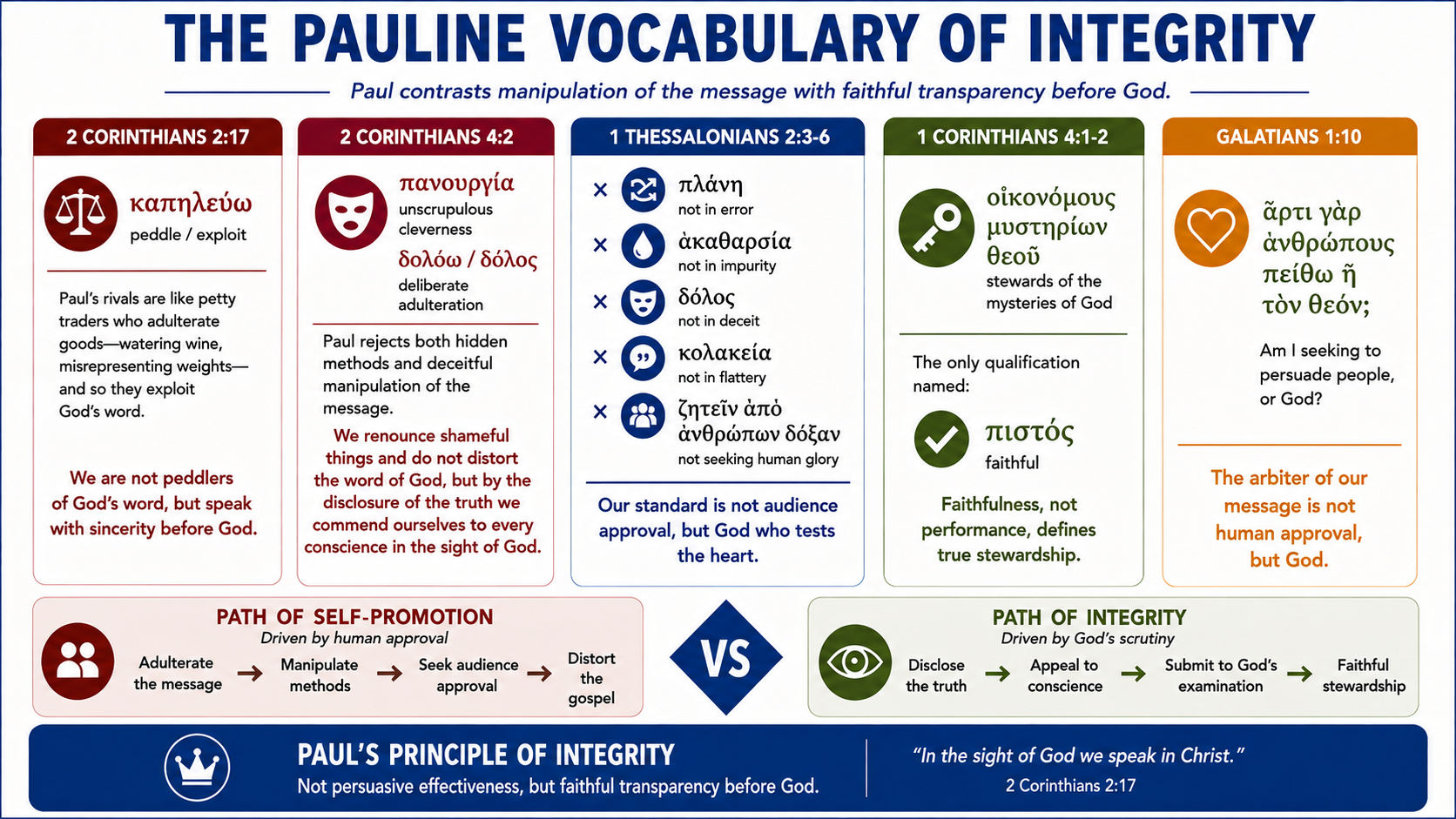
It's not actually a new question. Paul faced his own version of it, from people who peddled the gospel for profit, watered it down to make it more palatable, or shaped their words to please a crowd rather than God. His answers are worth hearing before we get anywhere near AI.
Not Pedaling the Word
In 2 Corinthians 2:17, Paul says he isn't like those who "corrupt the word of God." The word he uses pictures a market trader watering down wine or dressing up shoddy goods to move them fast. Applied to preaching, it's a warning against content that's been diluted or dressed up rather than tested and true.
Not Manipulating the Hearer
A few verses later, in 2 Corinthians 4:2, Paul renounces "craftiness" and "handling the word of God deceitfully," committing instead to "the manifestation of the truth," commending himself "to every man's conscience in the sight of God." His method wasn't shaped to produce a response. It was shaped to tell the truth plainly and let the truth do its own work.
In 1 Thessalonians 2, he goes further: no flattery, no cloak of covetousness, not seeking to please men but God, "who trieth our hearts."
That's a high standard for anyone communicating today, especially online, where every tool available is built to hold attention by whatever means might actually work.
What This Means for AI
None of this is really about technology. But the tests Scripture sets for a Christian Communication's integrity carry over cleanly to the discussion of sermon prep. and AI.
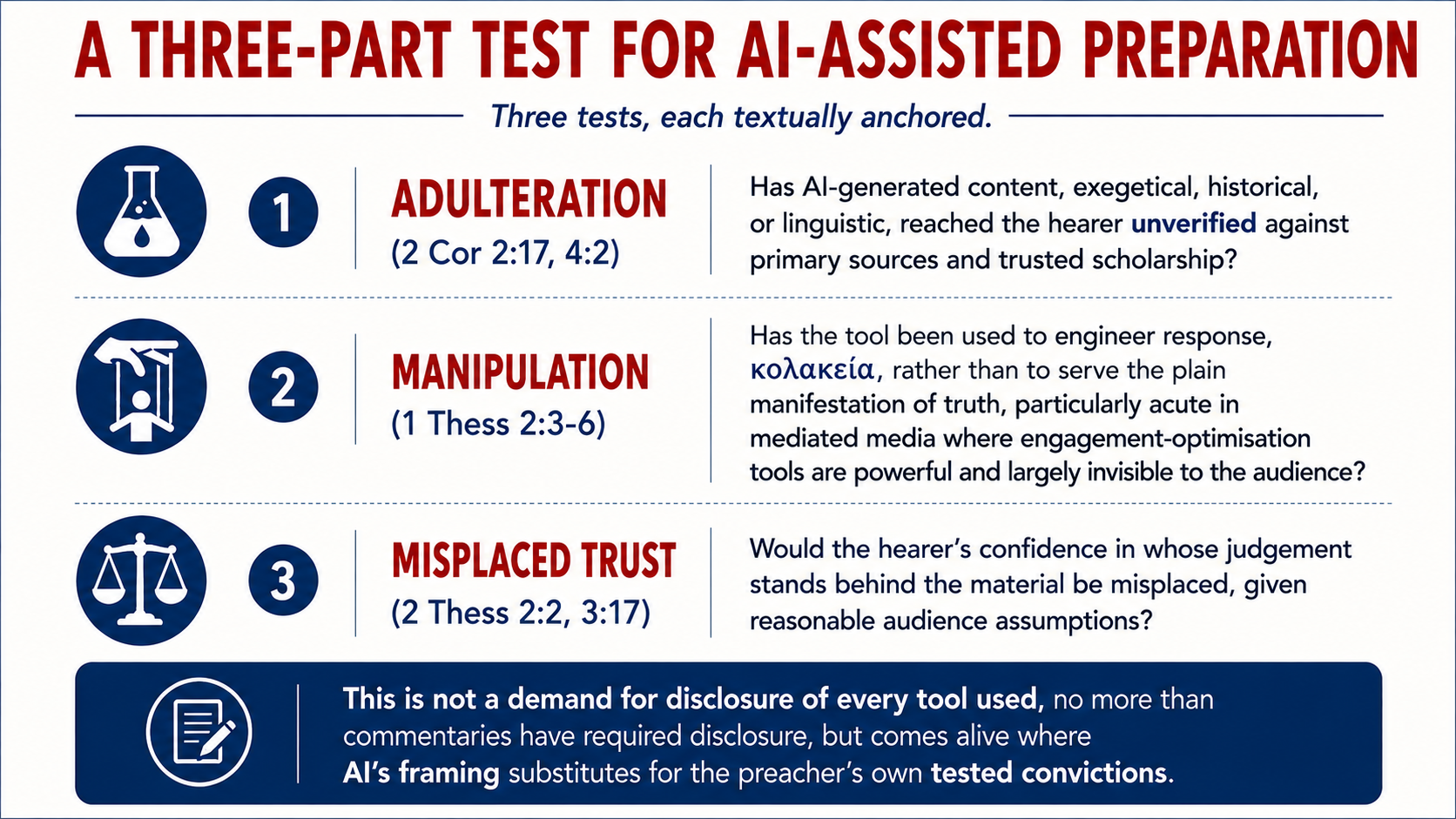
If I let AI generate a claim, a piece of background, a point of interpretation, and I put it in front of you without checking it against Scripture, against my pre-existing knowledge and theological training and against scholars I trust, I've done exactly what Paul warns against. I will have put unverified goods on the shelf and called them sound. And the responsibility for it all is still mine whatever tools I've used to prepare.
If I let a tool shape a script purely to hold your attention ... worse still to entertain you ... rather than to carry the truth's actual impact, I've swapped faithfulness for craftiness, and that remains the case whatever the online metrics say about how well it 'worked'.
And if what you're hearing me suggesting it's my own tested conviction when it's really substituting AI's judgement for mine, that touches something Paul guarded closely too: trust in what stands behind the message actually being what it claims to be ... that is, the unpacking of the very words we have received from Him in Scripture, by the inspiration of the Spirit of God.
Where this takes me ...
I use AI in preparation.
I will not pretend otherwise, and I don't think Scripture requires me to.
But I use it as you would use a lazy and unreliable research assistant.
I set the questions asked and require them to make a case for both sides of any particular point.
I get different AIs to check each other (because they don't get on with one another and I use that to my advantage!)
I make them reference all their information (and I check the references too) then I rewrite prayerfully everything I hear from them according to my insights and understanding.
That's a far more precautionary approach than Ministers have always used with their accustomed tools: commentaries, concordances, and (let's face it) other people's sermons as prompts for thought.
And I strongly suspect it sets a higher criterion of critical awareness than is practced by many large church pastors whose churches employ unacknowledged research assistants to write sermons, books, articles and whatever else for them.
The biggest issue though in my view is that unlike peer reviewed research (which seeks to descry using AI the way I do but always starts and builds off a review of previously published literature in the paper's subject area anyway) Scripture goes nowhere near requiring that the Christian communicator should create its content and originate every word. Biblically, that is where heresy come from!
Scripture does however require that I test everything that reaches you, that I don't manipulate you to get a response, and that what you receive is honestly what it claims to be.
That's the standard I'm trying to hold to.
No craftiness.
No flattery.
Just the truth, as far as I can grasp it, however it was prepared, commended to your conscience, because it was tested and found pure before it ever reached you.
And I would very much value your prayers as I set about that task.
If you'd like to dig into the Greek behind this, to take a deeper look at where the word "plagiarism" actually comes from and whether Scripture even has that category, I've written a more detailed piece on my Substack HERE
(Click the diagram up there to go Substacking!)
Free copy of Mark's Gospel here: https://live.bible.is/bible/ENGNLH/MRK/1

Slow on the Uptake: Why Jesus Keeps Telling Us What We're Very Slow to Hear Mark 10:32-45