
S2E15: Eddy Badrina - Creating Exponential Positive Change
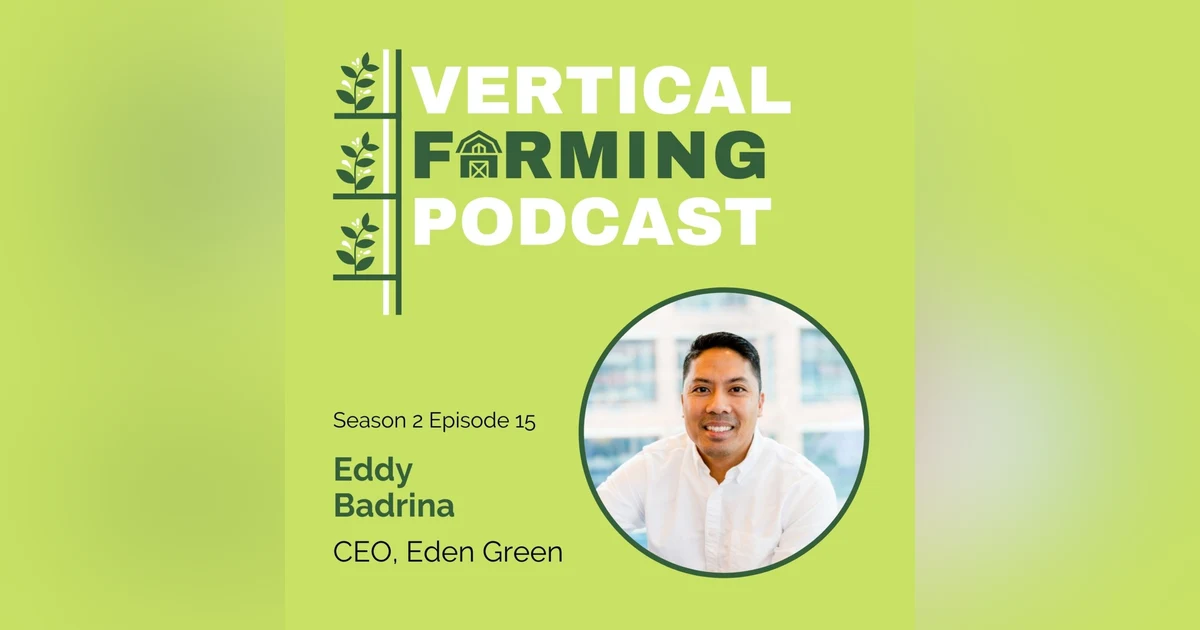
Join Harry Duran, host of Vertical Farming Podcast, as he welcomes to the show CEO of Eden Green, Eddy Badrina. Eden Green is a vertical farming technology company dedicated to changing the way we farm our food, and feed our communities. In this episode, Harry and Eddy discuss Eddy’s entrepreneurial journey, from working in politics, to launching his own start-up, to becoming CEO of Eden Green. Eddy speaks to his background in digital marketing, his thoughts on risk-taking and his longtime personal and professional goal of creating exponential positive social and cultural change.
Special thanks to our Season 2 Sponsor
Key Takeaways
03:00 – Harry welcomes to the show Eddy Badrina, who shares his first memories of entrepreneurship, his former role at the State Department and how his faith and the Bush family impacted his career
11:43 – Eddy discusses his first start-up, Buzzshift, trends he’s observed in the vertical farming industry, and the origin story of Eden Green
26:45 – Eddy speaks to Eden Green’s business model, current offerings and future target markets
42:28 – The value Eddy places on social and cultural change and growing an organization built on purpose
44:23 – How Eddy leveraged his background in digital marketing to help grow Eden Green
52:19 – A hard question Eddy has had to ask himself lately and Eddy’s thoughts on the future from 2021 and beyond
1:00:51 – Harry thanks Eddy for joining the show and let’s listeners know where they can learn more about Eden Green
Tweetables:
“Begin with the end in mind and then reverse engineer.” (46:30)
“To me, the company is the people. Products come and go, but the people are what make the company.” (52:40)
Links Mentioned:
Ceres Greenhouse Solutions
Website | Facebok | Pinterest | Instagram | YouTube
See omnystudio.com/listener for privacy information.
Mentioned in this episode:
Indoor AgCon 2025
$680 million poured into precision ag last year.
Speaker:Autonomous weeding robots dominated, and John Deere made 2 acquisitions in 3
Speaker:months. A food company, not an equipment maker, bought a
Speaker:robotics startup to protect its own supply chain. The deals are
Speaker:accelerating, the money is moving, and the winners are already separating from the
Speaker:pack. If you're investing, building, or buying in this space,
Speaker:you need the full picture before your competitors get it. The 2025
Speaker:Precision Agriculture Intelligence Report From iGrow News is now
Speaker:available. Get your copy today at
Speaker:igrownews.com/precision. I remember
Speaker:distinctly H.W. Bush, who's since passed away,
Speaker:but I had a chance to sit down with him and he said to me,
Speaker:I love that you're interested in public service, but I would really encourage you
Speaker:to establish a career for yourself and make
Speaker:that mark, and then either in tandem or after
Speaker:the fact, uh, go into public service, because then you're not
Speaker:necessarily beholden to a salary from
Speaker:that service.
Speaker:Welcome to the Vertical Farming Podcast, weekly conversations
Speaker:with fascinating CEOs, founders, and agtech
Speaker:visionaries. Join us every week as we dive deep into the
Speaker:world of vertical farming with your host, Harry Duran.
Speaker:Vertical Farming Podcast, Season 2. Welcome back. If this is your first
Speaker:time listening, I'm positive you're in the right place, as this is the show where
Speaker:we interview fascinating CEOs and founders of some of the leading vertical farming
Speaker:companies from around the world. I'm your host, Harry Duran. In case
Speaker:you missed last week's episode, I had a great conversation with Tobias Peggs.
Speaker:He's the CEO of Square Roots. Tobias is such an engaging personality
Speaker:and we really had a great time, and I couldn't think of a better way
Speaker:to kick off the season. If you haven't listened to it already, I highly recommend
Speaker:you check it out. I couldn't be more excited to announce our partnership
Speaker:with Ceres as a sponsor for this episode and several
Speaker:of our episodes this season. Ceres combines smart
Speaker:greenhouse design with customized climate control technology to build
Speaker:sustainable grow environments for year-round production. They work with their
Speaker:customers and clients every step of the way, from helping to secure funding
Speaker:to providing growing data Whether you're a commercial entrepreneur, an
Speaker:educator, or someone looking for a rewarding hobby, visit
Speaker:ceresgreenhousesolutions.com, and that's spelled out
Speaker:C-E-R-E-S greenhouse solutions dot com,
Speaker:and get started today on your greenhouse goals. This week, another
Speaker:great conversation. I get to speak with Eddie Badrina. He's the CEO of Eden
Speaker:Green. It's a vertical farming technology company dedicated to changing the way
Speaker:we farm food and feed our communities. Eddie and I
Speaker:discuss his entrepreneurial journey, his experience working in
Speaker:politics, how he launched his own startup, and the path
Speaker:to becoming CEO of Eden Green, including the story of the founders of the
Speaker:company itself. Eddie's got a strong background in digital marketing, and
Speaker:he shares his thoughts on risk-taking and his longtime personal and professional goal
Speaker:of creating exponential positive social and cultural
Speaker:change. You'll hear Eddie talk repeatedly about this idea of
Speaker:product-market fit, and I think it's really appropriate that he comes from a different
Speaker:industry and applying that knowledge to Eden Green. As a reminder,
Speaker:if you're enjoying this episode or past episodes, I'd love it if you leave a
Speaker:rating and a review at ratethispodcast.com/vfp.
Speaker:As promised, here's a couple of recent reviews that came in. I may
Speaker:have read these off last season. I had them marked as open.
Speaker:So in case you're hearing this again, apologies.
Speaker:A new podcast addressing a rising industry, a nice
Speaker:balance of facts and people. Mark-Andre M says,
Speaker:what a unique opportunity to listen to all these CEOs and inventors. It
Speaker:is almost only possible because the market is still small but will grow
Speaker:rapidly in the coming years. Thank you, Harry and the team, for all of this
Speaker:useful information that we cannot find anywhere else. Keep up the
Speaker:good work. Thank you so much. And lastly, Bound
Speaker:to Cover Ground writes, leveraging science and
Speaker:scale, Harry provides great content and interviews with industry leaders. His
Speaker:podcasts introduce the necessary tough questions for vertical farming
Speaker:as an emerging market and desperately needed scaling to meet demand.
Speaker:Thank you all for the reviews. I really, really take those to heart.
Speaker:It's a sign that the podcast is resonating with you, and I
Speaker:appreciate the time you take to write them. Okay, I'm really excited about this conversation
Speaker:with Eddie, so let's get into it. So Eddie Badrina, CEO
Speaker:of Eden Green, thank you so much for joining us on the Vertical Farming
Speaker:Podcast. Thanks for having me. Pleasure to be here. Likewise.
Speaker:I'm a little groggy-eyed. Date stamping this, it's November
Speaker:4th, 2020. I went to sleep at 2:00 AM, so— You and me
Speaker:both. You and me both. We're just fine. Been a long night and I'm sure
Speaker:it might be another couple of those before we figure out who the new
Speaker:leader of the free world is. The good thing is
Speaker:the history of this country says we'll get it solved. We'll get it figured out.
Speaker:Either way, one way or another. In doing a bit of research on your background,
Speaker:Eddie, it seems like you've had what I would call
Speaker:the entrepreneurial bug or the bug to work
Speaker:on a bunch of different businesses. I'm wondering if you can recall
Speaker:the earliest memory of you making a dollar.
Speaker:Oh, man. I can absolutely recall that. So I grew up
Speaker:as the son of Filipino immigrants. So my parents came over in
Speaker:1969 and they just instilled in me
Speaker:a really hard work ethic, both me and my older sister. But
Speaker:one of the things was we had to earn our
Speaker:allowance. And if we wanted to buy anything, we had to
Speaker:buy it on our own. So I would say my first official
Speaker:job was mowing the lawn. Yeah. And then that was
Speaker:quickly followed by understanding just, man, that
Speaker:it's hot in Houston. So I was born and raised in Houston and it's really
Speaker:hot. And there are younger kids all around me. So I said, well,
Speaker:what if I babysat for the summer? So I ended up running— no joke—
Speaker:I ended up running like a little daycare. for 3 other
Speaker:kids. I don't remember how old I was. I couldn't have been
Speaker:more than 7th grade. And so I ran that for the whole summer. It was
Speaker:pretty, it was pretty fun. All I did was play with the other little kiddos.
Speaker:And now that I think back on it, Harry, I'm unsure about
Speaker:why the parents even trusted me to do that. There are
Speaker:other Filipino immigrant parents, so they had to work. So I guess it was like,
Speaker:hey, Yeah. I know him. I saw him in diapers. He's a
Speaker:responsible kid. I'm just going to foist my kids over to him.
Speaker:And so it was pretty fun, but I earned my keep that way. And then
Speaker:had a chance to just everywhere, even in college,
Speaker:university, and then in grad school, I worked. So I wasn't a
Speaker:stranger to the entrepreneurial bug.
Speaker:And then when you got out of college, you're a Texas
Speaker:A&M grad. And so when you came out, was the
Speaker:initial thought that seed had been planted for you from an
Speaker:entrepreneurial perspective? Or did you think, okay, I need the
Speaker:9 to 5. I need the security. I should go looking for that?
Speaker:So I've not had a traditional career per se.
Speaker:So after undergrad, I went to grad school at the Bush
Speaker:School, got a degree, a grad degree in
Speaker:international affairs, public administration and international affairs, and then just
Speaker:had a chance to go up to Washington, D.C. and enter
Speaker:into the policy world. So November 4th, this is very
Speaker:familiar to me because I was, for 4 years, I was an
Speaker:analyst at the State Department in the Middle East. Wow. And then
Speaker:for 2 years, I was President Bush's Asian American spokesperson.
Speaker:So I was involved in the, I guess it
Speaker:was the '04 elections pretty heavily. So you're
Speaker:getting all sorts of like reminders and
Speaker:flashbacks. What I'm getting is PTSD is what I'm getting. That's true.
Speaker:Yeah. Yeah. So I'm glad, very thankful for— I'm
Speaker:actually very thankful for the staff and the workers in both
Speaker:parties to make this thing possible and just to make voting
Speaker:possible. So anyway, that was my first
Speaker:6 years of my career was in
Speaker:international politics policy and then in the domestic
Speaker:arena. After that, in '06, I just found
Speaker:myself really jaded with politics. Wasn't great for me, wasn't great for my
Speaker:marriage. And so we decided to move back from
Speaker:D.C., back to Texas. And I spent some
Speaker:time with a bank, and then I jumped off and joined a
Speaker:telecom startup. So that was my reintroduction
Speaker:into the entrepreneurial lifestyle. I was the director of
Speaker:comms for a telecom startup here in town in Dallas,
Speaker:and really learned how to run a business that way. So it was a year
Speaker:and a half in that startup. didn't end well, but it
Speaker:was a paid— basically, it was the MBA of hard knocks
Speaker:for me. And I got paid to learn how to run a business,
Speaker:like all aspects of it: operations, finance, sales, investor
Speaker:relations, the whole deal, as well as product-market fit.
Speaker:So after that, I hung my own shingle and said, man, I can
Speaker:do this. I can consult on strategy and marketing and communications.
Speaker:And then I paired up with my business partner, of one of my companies
Speaker:called BuzzShift, paired up with them, with him, and started
Speaker:BuzzShift in 2010. We built that up from
Speaker:scratch, bootstrapped it, and then actually sold it in 2016.
Speaker:And so have the— I've been there, done that, gotten the M&A t-shirt.
Speaker:And then we had the opportunity 11 months later to buy it back. Wow! So
Speaker:yeah, we actually bought it back. And it was up and running
Speaker:after about a year after that. It was up and running, and we had created
Speaker:a leadership team so well that I was able to take a step back.
Speaker:And look and see, OK, what do I want to do
Speaker:for the second half of my career that— 3 things that stuck out to me.
Speaker:One, I really wanted to do hardware/software. I had done professional
Speaker:services, and it was great, but I wanted a new challenge. Again, that
Speaker:entrepreneurial bug, right? Yeah, yeah. The second is, I
Speaker:wanted to leave a social and cultural impact that was
Speaker:a multiple of my level of effort. So if, for one,
Speaker:unit of energy or effort that I was giving out, I wanted it
Speaker:to produce through a company 10 or 12x
Speaker:of that unit, but have it as social and cultural capital. Can I pause you
Speaker:there for a second? Because that's really fascinating. Where
Speaker:was the thought that that was important to you? Where's the
Speaker:seed for that planted? So it's really planted in my faith,
Speaker:honestly. So as I had just grown up,
Speaker:Having a faith and growing up in church, it was always— and then
Speaker:honestly, the Bush family had a huge impact on my life
Speaker:of really emphasizing public service. Hmm.
Speaker:And that public service is a noble calling. And
Speaker:I remember distinctly H.W. Bush, who's since
Speaker:passed away, but I had a chance to sit down with him. And he
Speaker:said to me, hey, I love that you're interested in public
Speaker:service, but I would really encourage you to establish a career
Speaker:for yourself. and make that mark and
Speaker:then either in tandem or after the fact
Speaker:go into public service because then you're not necessarily beholden
Speaker:to a salary from that, you know, from that
Speaker:service, right? Yeah. You've made your mark. You've made a
Speaker:financial— made yourself and your family financially stable
Speaker:and you're able to act with much more freedom when you want to go and
Speaker:serve the public. So that's really what the seed was.
Speaker:And then, you know, just through the years, seeing other people do it, thinking, man,
Speaker:is there a way I can combine that? Right? And so that
Speaker:was really crystallized; that thought was really crystallized.
Speaker:There's some folks out of New York City called Praxis Labs, and
Speaker:they really emphasize what's called a Redemptive Framework for
Speaker:organizations. Mm-hmm. And that's where, in contrast
Speaker:to exploitative companies, which treat their
Speaker:employees poorly. The leaders eat first; they're always at the
Speaker:head of the line. And they're a net negative to the community
Speaker:around them. Mm-hmm. In contrast to that, you have ethical
Speaker:companies, which they treat their employees fairly; the leaders
Speaker:eat alongside them; and they are a net neutral to the
Speaker:community around them, or slightly positive.
Speaker:Praxis emphasizes a 3rd way, which is the Redemptive
Speaker:Framework, which is The leaders eat last. They're sacrificial,
Speaker:right? They bless their employees generously.
Speaker:And then they're a net positive to the community around them.
Speaker:So that's what I really wanted to— that's what I was looking for
Speaker:in the next business that I wanted to help create or join.
Speaker:I was looking for that Redemptive Framework. So— Did you know
Speaker:that's what you were looking for when you set out on that journey?
Speaker:Or did it sort of appear and then you said, oh,
Speaker:this is what I've been looking for? That's a great question. So it actually,
Speaker:I identified those 3 things that I had talked about before,
Speaker:the hardware/software, the cultural and
Speaker:social impact, and then the third one was just a unique culture,
Speaker:identifying and building a unique company culture. I had
Speaker:identified those 3 things as well as had been
Speaker:exposed to the Redemptive Framework before I even came
Speaker:across Eden Green. Yeah, it was sort of set in my
Speaker:mind, and I was just, you know, I was running BuzzShift, and
Speaker:I wanted to be excellent with that, right? My parents and
Speaker:what they had taught me in just work and in faith is in
Speaker:everything, do it with excellence. So I wanted to be
Speaker:excellent with working with BuzzShift, but I also knew That
Speaker:I had the, I think I had the skill set and the drive to be
Speaker:excellent in something else additionally. So I was
Speaker:looking for that, and I was patient, and to wait for that
Speaker:to come along. I had, I had talked about it with some
Speaker:friends and close colleagues, just about my desire to
Speaker:do something different, to take a step back from
Speaker:Buzzshift. We had created a great leadership team, and Buzzshift is
Speaker:doing great. Honestly, I think it's doing better without me. I had kind of worked
Speaker:myself out of a job, which is what every leader ought to do, right? Should
Speaker:rise, hire people who are better than yourself, who are smarter
Speaker:than yourself. Don't be ashamed or don't be threatened
Speaker:by those folks. And then, and then see how they perform. And
Speaker:they'll usually raise the level of the entire organization,
Speaker:which then allows you to focus on the highest and best
Speaker:use of your time. And so the highest and best use of my time
Speaker:was a little bit of time there, but really it opened me up to saying,
Speaker:okay, what's the higher and best use of my time? And that was trying
Speaker:to find and trying to run a company with those
Speaker:3 pieces and with that redemptive framework. When
Speaker:did this concept of
Speaker:locally grown food, the challenges we
Speaker:have with the food supply chain, vertical farming,
Speaker:agtech, when did these things start to appear on your
Speaker:radar? So the locally grown food had
Speaker:appeared quite a while ago. When I was, even when I was in
Speaker:Washington, D.C., my wife and I made it a
Speaker:regular point to go to the farmer's market. And as our kids have grown
Speaker:up, they have always enjoyed going to farmer's markets, whether it's in
Speaker:Virginia or here in Dallas. Yeah. The problem was for me
Speaker:was it was a qualitative thing. It was a great Saturday
Speaker:morning jaunt with our kiddos. But
Speaker:if you wanted to get something on the regular besides eggs
Speaker:and some meat, but if you wanted to get produce on the
Speaker:regular, you just couldn't do it. And it wasn't consistent.
Speaker:And really, honestly, I looked around me and there was a lot of folks that
Speaker:not necessarily looked like me but were in the same socioeconomic
Speaker:status. And so it wasn't accessible just to the normal
Speaker:everyday person who maybe couldn't get out on a Saturday because they're working.
Speaker:Yeah, yeah. So I saw gaps in
Speaker:that locally grown space,
Speaker:and that's where it just first dawned on me that
Speaker:there's a market gap there for locally grown food.
Speaker:Now, COVID, as you know, didn't
Speaker:necessarily trigger any trends. It just accelerated all
Speaker:the trends that were all preexisting. That's a good point, yeah. And
Speaker:so one of the trends that it accelerated, that it
Speaker:amplified, was this trend of locally grown food. So
Speaker:all of a sudden, it became from qualitative and
Speaker:optional, if you will, to post-COVID with the
Speaker:bottlenecks in the supply chains and the fragility in the supply chain.
Speaker:All of a sudden, locally grown meant a very, very
Speaker:different value proposition. And so that's what we're
Speaker:trying to do, and that's what I identified for Eden Green is one of our
Speaker:goals is to to redefine locally grown. And for us,
Speaker:locally grown doesn't mean farmers markets. It doesn't mean it's not
Speaker:qualitative, but it's very rigorous in one,
Speaker:providing consistent greens. So
Speaker:year-round, season-agnostic, basic
Speaker:foodstuffs that people need to survive. And that could be
Speaker:butterhead lettuce, it could be arugula, spinach, kale, peppers,
Speaker:strawberry, things like that, right? Herbs that
Speaker:you don't— all of a sudden you don't want to be
Speaker:dependent on the Salinas Valley in California,
Speaker:right? That it's great and it grows volumes of it, but right now we're seeing
Speaker:a lettuce shortage sheerly because of warmer weather and because of a virus,
Speaker:right? Hmm. So you don't want to be dependent on the
Speaker:Salinas Valley, and then you don't want to be dependent on East
Speaker:Coast weather patterns and they're more susceptible to snow and cold,
Speaker:right? So there's the consistency. And the second thing we want
Speaker:to redefine for locally grown is accessibility. We want
Speaker:everyone to be able to have nutritious leafy
Speaker:greens and fruits and vegetables. So
Speaker:I would say the big thing with that is, with accessibility, is
Speaker:we're seeing a rise in population. So there's a rise in demand.
Speaker:We're seeing a rise in demand overall for
Speaker:year-round leafy greens. We're seeing
Speaker:a rise in vegetable demand, whether it be through
Speaker:straight salads or through your plant-based
Speaker:protein, right? So you're seeing a rise not just in
Speaker:fresh produce, but in consumer packaged goods that
Speaker:use produce. And then the last thing is you're seeing
Speaker:a diminished supply due to supply chain due
Speaker:to just overall weather patterns, due to volatility. So when you
Speaker:see a rise in demand and a drop in supply, basic
Speaker:economics tell you you're going to see a rise in price. Well, then the rise
Speaker:in price doesn't make it accessible to everyone, right?
Speaker:But with vertical farming and with what we're doing, we think we can
Speaker:level that price out to make it accessible to everyone and even lower
Speaker:the price as the technology becomes more just
Speaker:optimized, right, and matures. And then the last thing
Speaker:besides consistency and accessibility is just safety.
Speaker:It's food safety. Yeah. I think we've all seen a rise
Speaker:in E. coli and salmonella outbreaks and these
Speaker:viruses that are in Salinas Valley that are affecting the lettuce.
Speaker:And it's because either because of weather patterns, unforeseen external
Speaker:factors, or it's because we're cutting corners in the supply chain
Speaker:and we're trying to get more out quicker because of those bottlenecks,
Speaker:and we're just stuffing those bottlenecks with produce. But
Speaker:you've seen it. The, the byproduct of that is a lot of it
Speaker:goes to waste because you can't get it through all the bottleneck, right? Yeah. Or
Speaker:it gets through so quickly, and we've cut corners that it comes out to the
Speaker:consumer and it's older, it's more prone to disease, and
Speaker:they're more susceptible to seeing, uh, to seeing
Speaker:the manifestations of that. And that's not being consumer-centric. That's
Speaker:being supply chain-centric. Hmm. And we don't want to be,
Speaker:as coming from a marketing world, right, with a
Speaker:marketing company, consumer-centric is everything,
Speaker:everything for a brand and for a supplier.
Speaker:So we have this dual thing in Eden Green of being
Speaker:plant-centric. Our greenhouses are plant-centric. But our
Speaker:business is consumer-centric. That's an important
Speaker:distinction. Yeah. Can you talk a little bit for those that
Speaker:don't know the origin story of Eden Green, how it was founded?
Speaker:Yeah, it's an amazing story. So 2 brothers,
Speaker:Jacques and Eugene Van Buren, were in South Africa, and this
Speaker:was probably 8 to 10 years ago. And the
Speaker:story is a poignant one. They were passing out food in their
Speaker:community, and they're passing out candy, actually. They had sort of bounce houses and all
Speaker:this food. and they're passing out
Speaker:candy. And this little kid came up to them. He was probably only 6,
Speaker:5. And they gave him candy, and he stuffed it in his pocket.
Speaker:And they said, well, why did you stuff it in your pocket? You can have
Speaker:some. And he said, well, it's not my day to eat. My
Speaker:sister's back home, and I have to bring it to her because it's her day
Speaker:to eat. Wow! And for them, I mean, they were structural
Speaker:mechanical engineers, but it struck such a chord in their heart. They said,
Speaker:man, we have to figure out a way to where
Speaker:No kid has to say, it's not my day to eat. And
Speaker:so that triggered in them just this journey of developing
Speaker:this vertical farming technology and these towers. So we
Speaker:have these— the patents of the technology are actually these
Speaker:18-foot towers. We can actually build them taller, but they're 18-foot
Speaker:towers that grow plants and produce very, very
Speaker:efficiently. That, to me,
Speaker:is the heart of the company, and I didn't want to lose that. As
Speaker:fast as we grow and as big as we scale,
Speaker:at the end of the day, we're just trying to change the way we farm
Speaker:so that we can change the way we feed people. That's the genesis of Eden
Speaker:Green, and my vision is that we continue through
Speaker:to wherever this takes us. How
Speaker:did you meet the brothers? So I met them through a
Speaker:mutual friend. They had created a great technology.
Speaker:They were just having trouble with the business model, right? And,
Speaker:you know, every— there's
Speaker:no invalid business model if you can make money.
Speaker:But the business model of the Plenties, the business model of
Speaker:the Bowerys just wasn't working for them.
Speaker:And I think that's probably a big difference. When you're making something from
Speaker:scratch in South Africa, you have to be efficient from the
Speaker:get-go. There's not a lot of money being thrown at you.
Speaker:And so you have to be scrappy and resourceful. Well, the
Speaker:byproduct of that is an entrepreneur's dream. That means
Speaker:you're working from a base, a foundation of profitability.
Speaker:Yeah. Right? And so as they develop this,
Speaker:they were trying to, I think, you know, the previous management
Speaker:were doing their best to try to emulate some of these bigger companies.
Speaker:But at the end of the day, you know, I took a look at it
Speaker:and I just told them like, hey guys, this is a fantastic
Speaker:technology company that happens to grow produce.
Speaker:I come from a, from a technology, a mar-tech background.
Speaker:Yeah. And what, what I see is you could potentially make
Speaker:this, and this is where we're going, is we want to be the
Speaker:intel inside. We want to be the Salesforce of produce, right?
Speaker:Oh, that's nice. I will build the platform. We have a great
Speaker:platform. We will help you construct. We will help you hire,
Speaker:manage, and train the staff, and then we'll license you the technology.
Speaker:But like Salesforce and Benioff, he doesn't care what you do with it,
Speaker:right? He just wants you using that platform, and then he's going to create
Speaker:an ecosystem, and he has created an ecosystem where other
Speaker:vendors, contractors, entrepreneurs, businesses can
Speaker:plug into that platform, API into that platform,
Speaker:and produce whole businesses off of that. Yeah. It's the same thing that we want
Speaker:to do, right? We want to empower
Speaker:entrepreneur-led investor groups. We want to empower philanthropies,
Speaker:nonprofits, nation-states, regional authorities,
Speaker:universities, corporate research arms. We want to empower them to
Speaker:use this platform of this patented technology,
Speaker:grow what they want to grow. We'll help them figure out the
Speaker:profitability, even if they, for universities and for
Speaker:nonprofits, they don't want it to be profitable. They just want it to be
Speaker:sustainable economically, right? Break-even. We'll help
Speaker:you do that. But then, man, you go off to the races, and we want
Speaker:to train you to do that. And man, if you can create
Speaker:analytics packages off of it, BI, predictive consumer
Speaker:analytics, you know, growing analytics and growing
Speaker:predictions, by all means, plug it in,
Speaker:right? Interesting. And, and go for it. But that's what we want. We
Speaker:have no interest in having our own
Speaker:retail brand, per se, like Aplenty, right? And
Speaker:kudos to them. They have gobs of money to produce that
Speaker:retail brand. But you and I both know it's hard to grow. Yeah.
Speaker:It's hard to distribute, and it's hard to run a retail brand. You want
Speaker:to do all 3? You need a ton of money and a ton
Speaker:of time. And again, our foundation is
Speaker:scrappy. Our foundation is entrepreneurial.
Speaker:And so we want— the way that we are now positioned,
Speaker:the shift, the pivot, if you will, is these greenhouses are
Speaker:economic units unto themselves. And we just
Speaker:want to provide folks with the opportunity to use them. to
Speaker:their benefit. And I would love to see
Speaker:100 greenhouses all around the world that are all mesh
Speaker:networked together and that are learning, that have their own ecosystem, right? Their
Speaker:business ecosystem. They're all learning from each other. Maybe they
Speaker:specialize, right? Maybe they— maybe, you know, in a
Speaker:tri-state area, in a 400-mile radius,
Speaker:you've got one greenhouse that just wants to specialize in arugula,
Speaker:another one that just wants to specialize in lettuce, and another one that
Speaker:just wants to specialize in Herbs, right?
Speaker:They may all be owned by different entities, but they're all working
Speaker:together and saying, hey, I've got this customer that wants this. I've got this
Speaker:offtake agreement that's looking for this. Let's mesh network together
Speaker:and distribute that as a group, right? And we can all benefit from
Speaker:that even though we're all running our own separate
Speaker:P&Ls. Yeah. It's just really fascinating because
Speaker:what you brought to Eden Green has been that
Speaker:whole experience. Obviously talking about mesh networks, talking
Speaker:about lettuce as a service or vegetables as a
Speaker:service. Those are concepts that I think if people don't
Speaker:come from that background, they come from the traditional agriculture route,
Speaker:it's not something that they're thinking of. They're not thinking of how can I be
Speaker:more efficient? They're just focused on the growth and how to make the best
Speaker:vegetables, tastiest vegetables possible. Yeah. And I think in order
Speaker:to succeed in this environment, having that experience from
Speaker:that you have specifically in the work you've done at Buzzshift? I'm sure
Speaker:you probably have seen examples of projects you've tried,
Speaker:of initiatives that with a little bit of creativity, you then
Speaker:can apply to this world. Absolutely. I've
Speaker:seen hundreds of companies and business models come through
Speaker:our doors, right? Because our job was to market them, right?
Speaker:And the first thing that we look at Now, and the first thing that I
Speaker:looked at when I got here was product-market fit. Okay, so
Speaker:what's the product? What's the market? And does it— is it
Speaker:valuable to that market at a rate, at a scale that
Speaker:makes it profitable from an enterprise value and that makes it
Speaker:profitable and valuable from like an enterprise
Speaker:valuation, right? So, and then some business models
Speaker:are just geared towards market share. they're not really worried about
Speaker:profitability. They just want market share because their end goal is to then
Speaker:sell to a, you know, a bigger entity. Yeah. Right? That just
Speaker:wants either the top-line revenue or they want the technology or they just want,
Speaker:right, the volume. This was not built for that. So I
Speaker:had to find a product-market fit for this particular
Speaker:type of technology. And
Speaker:fortunately, I mean, it came very, very easily to me. It was as
Speaker:clear as day what the business model ought to be. So now
Speaker:we've perfected the technology. We're about to break ground on
Speaker:our first commercial facility. And then it's, and it's off to the
Speaker:races now. Like we've gotten so much interest. COVID, again, has
Speaker:accelerated the trend. So while it, while
Speaker:it has slowed for a lot of other businesses, it's actually, it's heightened
Speaker:the awareness for folks like us. Yeah.
Speaker:Who, from a capital perspective,
Speaker:the capital is starting to thaw and they're
Speaker:looking to deploy that capital in undervalued ways.
Speaker:And right now, I think as a whole, the vertical farming industry
Speaker:has had its fits and starts, but it's
Speaker:undervalued. The technology and the
Speaker:industry itself is very nascent. It's very young and it's
Speaker:undervalued. And so we're seeing a lot of capital interest because of that.
Speaker:What was it about, or what did you see
Speaker:specifically in the brothers, um, that,
Speaker:you know, made you decide that this is a
Speaker:partnership that was important for you in terms of the next journey in,
Speaker:in your career? I think what I saw in them was, one,
Speaker:first of all, passion, right? They weren't doing it
Speaker:to, uh, you know, to make a buck per se.
Speaker:Obviously they're business people, But their passion was really
Speaker:feeding people. And so that spoke to me volumes, because I knew,
Speaker:when things got tough, their ability to solve
Speaker:problems was based on that inner passion. Right? I
Speaker:think that another thing that was attractive was
Speaker:that the technology wasn't vaporware. Like, it
Speaker:actually existed. They had proven it out. Yeah. And it just
Speaker:needed a business model to be wrapped around it. So if I
Speaker:had come into something where they had this idea or this
Speaker:concept and it had— they had never, you know, they had
Speaker:never run it through trials, they had never
Speaker:used it in, you know, extensively,
Speaker:it would have been a much harder sell for me to come on board.
Speaker:So the probability of success was increased
Speaker:sheerly because they had done the heavy lifting of creating
Speaker:the first R&D facility, have it up and running, working
Speaker:out all the kinks, right? So that was huge.
Speaker:So now fast forward to present day, can you talk a little bit about the
Speaker:current offerings and where you've set your
Speaker:sights on in terms of like your target market, what
Speaker:areas you want to play in, you know, which specific technologies
Speaker:you want to make a, you know, you want to make a name for yourself
Speaker:in? Yeah, so our current offerings are our
Speaker:acre-and-a-half greenhouses. And like I said before, we'll
Speaker:build, we'll construct them. We have
Speaker:partnerships with great engineering firms that we've
Speaker:developed things that the mechanical engineering and plumbing,
Speaker:and of course the towers, the lights, the greenhouse
Speaker:module itself, the shell, we can package everything
Speaker:up in shipping containers and send them over. So
Speaker:it's made to be shipped and stood up.
Speaker:in a very quick fashion. So the
Speaker:acre-and-a-half modules are really our core product.
Speaker:We've developed smaller ones. Obviously, when you get smaller, your economies of
Speaker:scale go down and you get to a size where they're not
Speaker:profitable. Maybe they're break-even at a certain size. But,
Speaker:you know, for a nonprofit who can afford that,
Speaker:maybe they want that capital investment. They're able to find a couple of donors who
Speaker:are willing willing to donate that CapEx to put one of these,
Speaker:call it 10,000 square feet or 20,000 square feet down, and
Speaker:that'll produce 100,000 pounds a year
Speaker:of produce. Mm-hmm. So that's a— I mean, that
Speaker:makes a serious dent in your local
Speaker:population's dietary needs. So
Speaker:then if we can have those modules, those smaller modules, as well
Speaker:as the big 1.5-acre greenhouses, then what?
Speaker:Who's the audience, right? Yeah. So the audience is,
Speaker:I think I mentioned it before, is retailers, wholesalers who want to—
Speaker:their value proposition or their problem that they're trying to solve is they
Speaker:want to integrate their supply chain. They want to vertically integrate their
Speaker:supply chain. Maybe they want to— they're both
Speaker:diversifying their supply chain as well as
Speaker:backstopping it in in the case
Speaker:of supply chain breaks from a distributor or from
Speaker:a supplier perspective. Some of them may want to
Speaker:use these to power their own private labels,
Speaker:right? And they want something special that can
Speaker:power their private labels. It may be a distributor who
Speaker:wants to just become a little more diversified and not depend so
Speaker:much on the processors or the growers. You know, so that could be
Speaker:a— and then you can have wholesalers as well, specialty wholesalers who
Speaker:specify, you know, specialize in one particular product.
Speaker:So that's the first one. The second one is universities and research
Speaker:arms, and their value prop is consistency.
Speaker:Everything in our greenhouse, in our system, is trackable.
Speaker:So we've developed a tracking— we can track it from seed to
Speaker:harvest. And we can track every
Speaker:variable that you need. I mean, you're familiar with it,
Speaker:with vertical farming. Every variable that is needed to
Speaker:grow, we can track and we can control, even down to
Speaker:water temperature. Hmm. So that's something that's very appealing to
Speaker:pharma research arms, right? Biotech,
Speaker:universities who want to both enable
Speaker:professors who are tenured as well as research professors
Speaker:And then the third one is nation-states and municipal authorities.
Speaker:Could be cities who are looking for city resiliency,
Speaker:could be regional authorities that are looking for different ways to
Speaker:subsidize serving their underserved
Speaker:populations, and it could be nation-states that are looking for global
Speaker:food independence. Do you find that the offerings are
Speaker:appealing to each of those individual sectors because of the
Speaker:decision to not have it be a solution that's 100%
Speaker:indoors, because yours is, it's almost like a hybrid because it's
Speaker:greenhouse married with vertical farming. And I'm wondering,
Speaker:was that vision always there originally, or is that something that's been
Speaker:sort of evolving? Yeah, so that vision has always been there. So
Speaker:again, it goes back to the foundation of scrappiness.
Speaker:When you go full CEA, right? controlled
Speaker:environment ag. When you go full CEA, you cut off all the
Speaker:sunlight. You do that, what's the why? The why behind that is
Speaker:because you want to control the light spectrum. Well,
Speaker:control requires cost. So at what cost are you
Speaker:controlling? You're doing it at the cost of electricity and power,
Speaker:right? So all of a sudden, when you cut that off,
Speaker:guess what? It's not economically sustainable.
Speaker:at scale. You may could do it on a small level,
Speaker:but when you start to scale up, the electricity needs of these CEA
Speaker:modules, even with LED lights, partial spectrum LED lights,
Speaker:the electricity needs are gargantuan, right?
Speaker:So there's no amount of lettuce that you're selling at $2 a pound
Speaker:that's going to make up for that electricity cost. I'm sorry, there's just not, right?
Speaker:Yeah. And you're not going to be able to sell that at a premium at
Speaker:$5, because, you know, a pound, because
Speaker:the market, the price elasticity isn't there.
Speaker:And, and again, a lot of the folks who are creating these are not, are
Speaker:they scientists? They're not business people. And they don't have an
Speaker:understanding of market dynamics. So,
Speaker:you know, when you're trying to make a profit, you, you try to be
Speaker:efficient where possible. So, you know, for Jacques and
Speaker:Eugene, It was a question of why would we cut out
Speaker:sunlight when it's free energy,
Speaker:right? It just doesn't make sense to us. Yeah. Again, they're in South Africa, right?
Speaker:So let's see if we can use sunlight to our
Speaker:advantage, but then also realize if we want consistency
Speaker:from a commercial scale that we have to control the other aspects. So
Speaker:we have complementary LED lights, but our electricity
Speaker:usage is like 1/14th of a CEA, a normal CEA.
Speaker:Greenhouse, right? So that's the— I think
Speaker:that is the key to economic viability is
Speaker:we're using so much less electricity and power than
Speaker:your normal CEA. And then compared to a normal greenhouse, because
Speaker:we're vertical, we've got the density per square foot that a normal
Speaker:greenhouse can't do, right? Mm-hmm. So, you know, good luck trying to
Speaker:find 5 acres in the middle of a city We don't need 5 acres, we
Speaker:need an acre and a half, right? For the same amount of produce.
Speaker:So all of a sudden, the feasibility of locally
Speaker:grown, because we're that dense and because we're
Speaker:using a greenhouse, all of a sudden becomes very, very attainable.
Speaker:Yeah. And then the last piece is water. Yeah.
Speaker:And that's where we compete really well against traditional farming.
Speaker:1.5 acres of ours is equal to 33 traditional farming
Speaker:acres. Wow. And you think about what 33 traditional farming
Speaker:acres, flat traditional, requires in terms of water
Speaker:as well as energy, right? Diesel. And labor. Harvesting and
Speaker:labor, right? 862,000 gallons of
Speaker:water for 33 farming acres trying to grow butter
Speaker:lettuce. We use 90,000 gallons of water. Wow.
Speaker:And just for perspective, my household alone
Speaker:Family of 5, average American household uses 45,000
Speaker:gallons of water a year. Wow. So we're able to
Speaker:grow 800,000 to 900,000 pounds of leafy greens in an
Speaker:acre and a half using the equivalent of 2 households of water.
Speaker:That's a game changer. Yeah. Right? Very cool. So
Speaker:that's really, really compelling. It's a compelling
Speaker:argument to these for whomever, but especially for the
Speaker:folks who want to do urban agriculture. And then the last piece is
Speaker:because our other economics are so low, it allows us
Speaker:to pull the lever of labor.
Speaker:Most people, because their other
Speaker:economic line items are so high, they have to put
Speaker:additional CapEx into automation because your
Speaker:CapEx skyrockets, but at least your yearly OpEx is down because you're
Speaker:not employing all the labor, right? Yeah. There's— it's a give and take,
Speaker:but that stinks because their CapEx is then
Speaker:6, 7 times higher than ours. Yeah. For the
Speaker:same size of greenhouse. But because we're able to use
Speaker:sunlight and because we're so efficient in all the other areas, guess what? We
Speaker:don't have to pull that labor of autonomy. We can,
Speaker:but we don't have to. And so we can employ 30 full-time people,
Speaker:and 30 full-time people Not minimum wage, living
Speaker:day's wage with full benefits
Speaker:year-round. And if it's in an urban
Speaker:area, guess what? That's where people need the jobs the most.
Speaker:Absolutely. Absolutely. Right? So you put
Speaker:one of these, you know, where all of a sudden they're able to walk to
Speaker:work, they're growing greens, they're in an industry that you and
Speaker:I know is going to grow by leaps and bounds, right?
Speaker:Anywhere from $25 to $50 billion in 10 years market
Speaker:cap on the— on CEA. And
Speaker:they're doing it, so they're not doing it— it's not a dead-end job. It's a
Speaker:full-time job in an industry that's growing. It could be
Speaker:next door to their house. And they're also, you know, we've
Speaker:got a model to where the greenhouse can subsidize a portion
Speaker:of their greens to say like a 1 or 2 or
Speaker:3-mile radius around them. So every resident
Speaker:in a 1-mile radius gets a pound of greens a week
Speaker:for a dollar, right? Wow. If you think about
Speaker:800,000 to 900,000 pounds of produce,
Speaker:giving it to 1,000 residents around is a drop in the bucket.
Speaker:It's so funny because it feels like it just— the conversation has now come
Speaker:full circle when you talked about why
Speaker:you're in this and this idea of redemptive framework
Speaker:and giving back and being a company that's going to give something
Speaker:back to the community, educating these employees, because I'm sure some of them
Speaker:have never even experienced a job like this ever before. Yeah.
Speaker:I've talked to a lot of my African American friends. One of my friends said,
Speaker:hey, listen, I'm only a generation or two away
Speaker:from being out in the fields. So like my grandparents
Speaker:farmed all their life. And then they moved to, you know, then my parents moved
Speaker:to Dallas. And then here I am, right, in a professional industry.
Speaker:But he said, man, our community, in specific, he was
Speaker:referring to the African American community, but, but the Black community
Speaker:is very much in touch or just one
Speaker:generation removed from agriculture. Yeah. So
Speaker:he's excited about it because, and he's very, very
Speaker:influential here in Dallas, but he's excited about it because it's
Speaker:reopening this idea of agriculture, but in a 21st century
Speaker:way that honestly is
Speaker:not foreign, it's not unfamiliar to
Speaker:his community. They can very quickly adapt to it, identify with it,
Speaker:and make real inroads into a 21st century technology.
Speaker:How important is it for you, given your experience with your past companies
Speaker:and the type of leader you've decided that you want to be,
Speaker:to build an organization, to grow an organization
Speaker:where it seems like what you're doing on this
Speaker:end of it sounds like you're creating a family, right, of people
Speaker:that take pride in what they do, take pride in giving back to the community,
Speaker:and then you in turn as the CEO, like, That fills you with a
Speaker:sense of purpose because of the opportunities you're giving these
Speaker:folks and setting the model for what's possible. Yeah, that's
Speaker:really, really important to me. It's one of my primary goals, right?
Speaker:Back to this thing that was set in my heart even before I found Eden
Speaker:Green was I wanted to make a huge social and cultural
Speaker:impact that was exponential to my own level of effort.
Speaker:We can't do it alone. Right? We just can't. I can't do it alone.
Speaker:I may be a great leader, but if I got no one to lead, then
Speaker:what's the point, right? Yeah. You're not a leader unless you have someone, people who
Speaker:are following you, right? So really, for me, it
Speaker:was saying, OK, what is, what am I really good at?
Speaker:And then what's on my heart? And naturally,
Speaker:with my skill sets of being an entrepreneur, it's like, how can we make money?
Speaker:How can we monetize this? And how can Not just to make money,
Speaker:but because when we make it a profitable
Speaker:organization, we can employ more people, right?
Speaker:And we can provide them with a sense of
Speaker:value, a sense of purpose. We can provide them with
Speaker:career paths. That to me is very, very, very
Speaker:important. And I wouldn't be in this role if I didn't think
Speaker:what we were building could enable that. Trying to figure out all the different
Speaker:paths I didn't want to go, but just— Oh yeah, we can go a lot
Speaker:of different places. I want to go touch a little bit on the marketing because
Speaker:of your experience and expertise, you know, with your digital marketing agency.
Speaker:I, I feel like you sort of have a leg up on some— with some
Speaker:of these other companies in the vertical farming industry just because, like,
Speaker:that's your, that's your jam. Like, you know digital marketing,
Speaker:and I'm wondering How you've been beginning to think about, to the extent that
Speaker:you can share it, ideas that you have for doing something different
Speaker:from a marketing perspective? Well, I think,
Speaker:and it's one of the reasons that the brothers
Speaker:and the investors were really keen on bringing me on
Speaker:board, was because I've had experience, one, with bringing
Speaker:my own company to market, identifying
Speaker:product-market fit for my own company and then bringing it, going to
Speaker:market and producing a strategy and Executing on it, but also
Speaker:able to look at other organizations, both nonprofit and
Speaker:for-profit, and bringing them to market, or at least enhancing their
Speaker:market position. Right? So taking, and then, then
Speaker:taking ownership of this and saying, OK, how would I bring
Speaker:this to market? It was just, you're right. I mean, I
Speaker:do have a leg up because it's not just one company that I've brought to
Speaker:market. It's literally 100
Speaker:through my 10 years of owning BuzzShift. Yeah. And so
Speaker:that, yeah, that is, I would say that is definitely a
Speaker:competitive advantage that we have, right? And it's one of the first
Speaker:things that I addressed when I got here was product-market fit. So I
Speaker:think, you know, in terms of innovation,
Speaker:maybe it seems sort of just normal for me
Speaker:or de rigueur for me, but it may seem really, really
Speaker:innovative for the space. But I think the first thing,
Speaker:and I'm, I mean, I'm an open book, but I would say the first thing
Speaker:for a lot of these other vertical farming
Speaker:companies and organizations is what's your product-market fit and
Speaker:what's your end goal? I always, you know, I told clients and I tell
Speaker:myself, I tell our staff this, what's the end in mind? Begin with the end
Speaker:in mind and then reverse engineer it, right? If your
Speaker:goal is to sell you know, container farms,
Speaker:right, to folks, is it going to cost
Speaker:$200,000, $300,000? Okay. So where are they getting
Speaker:that money? And do they want to recoup that money? Well, if they want to
Speaker:recoup that money, there are certain, only certain crops that they
Speaker:can grow, right? You have to think in your customers
Speaker:at the end, the end in mind for your customers. And if you're
Speaker:audience-centric, you'll understand very quickly Do they want to
Speaker:make a profit, or are they doing this for philanthropic
Speaker:purposes? As soon as you figure that out, then you can
Speaker:back-engineer and say, well, I'm only going to focus on the philanthropic
Speaker:part. They're not worried about profitability. They only want break-evenness,
Speaker:right? Or they're willing to go to their donors every
Speaker:year and ask for $250,000 a year
Speaker:to keep this thing going. OK, so then I'm going to arm
Speaker:them so that they can go back year after year and say, hey,
Speaker:this is how much produce we gave out. This is how many, you know,
Speaker:people that we're employing. This is how many people are interning. This is how
Speaker:many people we're educating, right? So
Speaker:I'm always thinking about, and I encourage, you know,
Speaker:folks who are running businesses and organizations to think about, hey,
Speaker:what's the end in mind for your audience? What do they really want? What's
Speaker:the end in mind for you as a company? And then what are those— how
Speaker:do you know you're successful? Yeah, what gets measured gets managed,
Speaker:right? Right. You can't manage what you can't measure, right? And so
Speaker:I think that's— a lot of people miss that because they are— maybe they're
Speaker:engineers, maybe they've got a great idea, but they have this whole Field
Speaker:of Dreams mentality of like, if you build it, they will come.
Speaker:And I've seen— I mean, I have seen so many businesses
Speaker:whose founders are just, I mean, they are, they are
Speaker:so passionate about this thing. And they're like, man, if
Speaker:we build it, I know we'll get customers. Like, really? You
Speaker:really think that? Let's take a step back through it, right?
Speaker:Unfortunately, they test that theory after they've already built the product,
Speaker:right? And they've spent a ton of money building a prototype or a
Speaker:full-on product going to market, and they don't even really know their
Speaker:audience or not able to test out So that, I
Speaker:think, you know, is the biggest sort of leg up that we have in
Speaker:terms of marketing. It's not actually like digital marketing or social or
Speaker:anything else. Yeah. It's really honing product-market fit
Speaker:that has set us apart and I think has set us up for success. We
Speaker:know where we want to go. We know the valuations that we're looking
Speaker:for. We know the specifically, like, we were
Speaker:built to be economic units. So then how do we sell those economic
Speaker:units in a way to people that they in turn—
Speaker:everyone wants to use an economic unit to generate more units. So
Speaker:how do you do that, right? And that's Business 101,
Speaker:that's Economics 101. How has your relationship been with other
Speaker:folks in the vertical farming industry, agtech? You know,
Speaker:obviously there's no industry conferences, right, for a while now, so
Speaker:there's no hobnobbing in the hallways, right? So I'm wondering
Speaker:what's been your experience as someone new to the So
Speaker:I've had limited experience with the
Speaker:other vertical farming companies, and I think it's just
Speaker:because we haven't been to a lot of events, right? Yeah.
Speaker:I would like to think if I interacted with them, they would
Speaker:welcome us with open arms because it is a very young industry and we're all
Speaker:trying to make a name for ourselves, right? Yeah. I would say in
Speaker:some of the ancillary and complementary industries,
Speaker:whether it's supply chain management, or whether
Speaker:it's the value chain of produce from
Speaker:growers all the way to retailers, they have been very,
Speaker:very, one, welcoming, and then two, open
Speaker:to talking. Yeah. I had, you know, I've had great
Speaker:conversations with Sam Eater down at Big
Speaker:Wheelbarrow and folks at you know, all across from
Speaker:Walmart to folks at 80 Acres and, you know,
Speaker:all across because, you know, honestly, at the end of the day, I tell
Speaker:people like, there's not going to be one winner in this. Yeah, of course.
Speaker:The demand is too great. It's too, too great.
Speaker:And vertical farming is not a silver bullet.
Speaker:Like, we don't want to grow rice. It just doesn't
Speaker:make sense for us, right? We're not growing hops, right?
Speaker:We're not doing, you know, we can't grow a lot
Speaker:of types of berries because they have very woody stems. That's just not our deal.
Speaker:And then, you know, for some flat tray greenhouses, they
Speaker:may be just the economies of scale that may lend themselves
Speaker:to cheaper, you know, like an iceberg lettuce or something
Speaker:on the lower end of that. Yeah. We're not going to touch that. That just
Speaker:doesn't make sense for our economics. So I think there's a place for a lot
Speaker:of different types of vertical farming and a lot of different CEA.
Speaker:players. But I've been collaborative all of my life. I like to say
Speaker:that, that we play well in the sandbox with others.
Speaker:We also want to win, right? Whatever game we're playing, we want to win.
Speaker:I'm fully aware that there's not just going to be one winner, though. So there's,
Speaker:there's a, there's a comfort in that, knowing like, hey, there's probably going to
Speaker:be 3 or 4 or 5 or half a dozen of us. And it's having
Speaker:that, that abundance mindset as well, too, right? Oh yeah.
Speaker:Again, population is growing, right?
Speaker:Demand is increasing. Supply is diminishing. There is
Speaker:room at the table for all of us. Yes.
Speaker:What's a hard question you've had to ask yourself recently? Hard question
Speaker:that I've had to ask myself. I think,
Speaker:you know, I think honestly is when we're
Speaker:expanding the team, Do I have the right
Speaker:people on the bus in the right seats?
Speaker:So to me, the company is the
Speaker:people, right? You can— products come and go,
Speaker:but the company is what— the people are what make the company. And so
Speaker:to make this company successful, I've got to have one,
Speaker:the bus going in the right direction. I'm the bus driver, right?
Speaker:But 2, I've got to have the right people on the bus. And then
Speaker:3, I have to have them in the right seats. Sometimes I've
Speaker:got the wrong people in the bus, and I'm just like, man, we got to
Speaker:part ways, right? We're headed this direction and you're going this direction.
Speaker:And by the way, it happens all the time. You know,
Speaker:old-school bus routes, people get on and off because they're going in
Speaker:different directions. Right. But for that time period, And we're all
Speaker:going in the same direction. So jump on the bus, get in the seat.
Speaker:Right? So I think there's the right people on the
Speaker:bus. And then sometimes you have the right people on the bus; they're just in
Speaker:the wrong seats. Yeah, yeah. And so that is a
Speaker:lot of what I'm, I'm questioning about, a hard question of like,
Speaker:do I have the right people on the bus? And do I have them in
Speaker:the right seats? I think by, by far and large, I
Speaker:ask my question, I ask that question myself a lot. And then I ask
Speaker:that question of myself. Yeah. Right? What is the highest and
Speaker:best use of my time? I tell a lot of entrepreneurs and
Speaker:just people who want to be, you know, just people who are climbing up the
Speaker:professional ladder is I tell them like, one of the things you
Speaker:have to do is you have to rank from top down
Speaker:what's most important to you and what's least important to you.
Speaker:And then on the second column, you have to rank What's
Speaker:most essential that you have to do versus
Speaker:what is least essential that you have to do. Yeah. You match those
Speaker:up; you find the things that are most
Speaker:important and the most essential. That's the highest and
Speaker:best use of your time. And then you stack-rank both of those
Speaker:columns. And then you start hiring out or
Speaker:delegating from the bottom all the way up. Totally
Speaker:agree. But in order for you to do that, you have to ask yourself the
Speaker:hard question of, what do I want to do versus what do I
Speaker:need to do? And then what's a really good use of
Speaker:my time versus what's a bad use of
Speaker:my time? So for instance, when you're starting a business,
Speaker:for me, accounting is essential, but I hate
Speaker:it, right? I would much rather be out, you know.
Speaker:Same here. Much rather be out building the business, talking to people,
Speaker:making sales, all that. At the beginning, you got to do
Speaker:accounting. But guess what? Because it's so bottom of the list on what's
Speaker:most important to you versus what's— but it's highest on the
Speaker:list of essential, that's the first thing you hire out for.
Speaker:Hmm, good point. Yeah. So I'm constantly asking
Speaker:myself and asking my team,
Speaker:what's the highest and best use of your time right now? And what do we
Speaker:need to do to get to a place where we either— you can delegate that
Speaker:out or hire it out, or you just
Speaker:need to suck it up for 6 months? Yeah. Right? Till we get more
Speaker:revenue, and then we'll— and then, but that'll be, that'll be in my
Speaker:priority, my queue of what are the next
Speaker:resources that I need to, need to fulfill. So that, that's a
Speaker:very hard question. I ask myself that all the time. Highest and best use of
Speaker:time. Yeah, great answer. Thank you for sharing that. So
Speaker:as we wrap up, Eddy, given the uncertainty of what we're
Speaker:about to head into, not only from an election standpoint,
Speaker:but also from an environment standpoint, COVID,
Speaker:it's a lot of unknowns out there. How are you thinking
Speaker:about 2021? I'm actually very optimistic
Speaker:about 2021. I think from a
Speaker:pandemic level, they're going to find a vaccine. But I
Speaker:also know that something else will come up, right? It just will. Yeah.
Speaker:Again, growing population, high rate of mobility, high rate of
Speaker:globalization, something else will come up. So
Speaker:all I can— the knowns are there will continue to be
Speaker:chaos. I'm not worried about mitigating the chaos.
Speaker:And on the economic side, I think
Speaker:that's the greatness of living in the United States is we
Speaker:just are— I do believe in American
Speaker:exceptionalism. And I do believe that we've got
Speaker:an economy that can survive huge
Speaker:tumultuous political events like this because
Speaker:of democracy. And so I
Speaker:think the markets will survive. And what I'm seeing right now from a trend
Speaker:perspective is I'm seeing
Speaker:investment loosen up. I'm seeing there's
Speaker:distressed real estate. So that's opportunity for me, right?
Speaker:Oh yeah. As you think
Speaker:about the plays of a cash-flowing business on
Speaker:top of distressed real estate, man,
Speaker:sky's the limit. Opportunities. Opportunities all over
Speaker:the place, right? I want us to be able to
Speaker:thrive on volatility. Hmm. Right?
Speaker:Most people thrive on stability. I'm training our
Speaker:staff. I've, I've, uh, I've focused our
Speaker:team, our company, and honestly, I train my
Speaker:kids, uh, to thrive in
Speaker:chaos. When you can thrive in instability and
Speaker:you can thrive in chaos, then you're going to
Speaker:stand, stand out above the rest. And then when things are
Speaker:calm, You'll be so much better positioned than
Speaker:anyone else. Absolutely. Right? So
Speaker:a lot of that is contrary thinking. So for instance, with marketing, you go— I
Speaker:was just thinking about this from a marketing innovation. We
Speaker:have the ability because of just great
Speaker:capital partners, when everyone else is getting
Speaker:softer, we were getting louder.
Speaker:Interesting. Right? When everyone else was dialing back their marketing dollars.
Speaker:And as a business owner, I can tell you, and as a, you know, an
Speaker:agency owner, I can tell you, the best time to up your
Speaker:marketing spend is when everyone else is dialing theirs back.
Speaker:Yeah. It's a hard decision to make. It is, yeah. Scary one
Speaker:too. It's a scary one too. But if you know your KPIs,
Speaker:if you know your key performance indicators, and you have metrics for success,
Speaker:Then it's a risk, but it's not risky. Right? There's a
Speaker:difference. My, my dad taught me a long time ago, there's a difference between risk
Speaker:and risky. Take risks; just don't be risky.
Speaker:So that is from a marketing innovation; that's what we're trying to do.
Speaker:But when I look at the, when I look at the markets in general, when
Speaker:I look at trends, when I look at where the company's headed and how I'm
Speaker:handling, going to be handling 2021, We're getting
Speaker:louder. Awesome. That's all we're going to do is we're going to get louder. We're
Speaker:going to beat the drum. We have our value props. We are focused on
Speaker:our audiences, you know, our target clients. We've got a
Speaker:team that's ready to rumble, you know, and we've got a technology that I
Speaker:think, and I really believe, is a game changer. Some
Speaker:technology is evolutionary. I think vertical
Speaker:farming and what we're doing is revolutionary. I agree.
Speaker:And so that to me is— it gets me excited
Speaker:and just fired up for 2021 because we want to thrive on
Speaker:instability. And in fact, vertical farming is the answer
Speaker:for instability. It's a stable,
Speaker:controllable environment amidst
Speaker:economic, environmental, community
Speaker:instability, and it can provide that stability, especially for that
Speaker:community. It can provide that stability of food supply.
Speaker:Reminds me of the book Antifragile. Have you read that, Nicholas? Yes.
Speaker:Yeah. It's kind of that mindset as well. Yes, exactly.
Speaker:So yeah, so Eddie, the, the hour flew by.
Speaker:Um, thank you so much. There's lots of wisdom here, and I love
Speaker:the insight that you bring from your experience having grown and
Speaker:had success with your previous companies. And so you've— you're creating this
Speaker:interesting hybrid And I think your answer on what
Speaker:you're looking forward to in 2021 speaks to that
Speaker:exactly because you have this optimism, this energy, this enthusiasm
Speaker:that is contagious. And I think is exactly what's needed for business
Speaker:owners who actually want to position themselves to succeed
Speaker:in the upcoming year. So thanks for sharing that perspective. Absolutely. Thanks for having
Speaker:me. I really appreciate it. Yeah. So where's the best place for folks to—
Speaker:if they wanted to connect with you personally or learn more about Eden Green? Sure.
Speaker:It's just edengreen.com. E-D-E-N, like Garden
Speaker:of Eden, green.com. And then for me,
Speaker:people can reach out to me at eddyb@edengreen.com.
Speaker:Okay. And we'll make sure we put all those links in the show notes for
Speaker:this episode as well. But thanks again for your time. Yeah, absolutely. Thanks again for
Speaker:having me. Thanks again to Eddie for that wide-ranging
Speaker:conversation. I think I say that all the time about my podcast episodes, but you
Speaker:never know where they're going to lead. But I was really impressed with his past
Speaker:experience working for George W. Bush, starting his own
Speaker:digital marketing agency, having a keen eye for what works in
Speaker:marketing. It was really a lot of fun. Don't forget, if you're enjoying this
Speaker:podcast, leave us a rating and a review at ratethispodcast.com/vfp.
Speaker:As you heard at the beginning of the show, we'll be sure to read them
Speaker:out on future episodes. Special thanks to our episode
Speaker:sponsors, Ceres Greenhouse Solutions. Find out more
Speaker:at ceresgs.com. That's C-E-R-E-S-G-S
Speaker:dot com. Until we meet again, here's to your health. Thanks for
Speaker:listening. To read the full show notes for this episode, which includes
Speaker:any links mentioned in the episode, as well as a full show transcription,
Speaker:visit verticalfarmingpodcast.com. There, you
Speaker:can sign up for our email list to be notified when new episodes are released.
Speaker:Episodes are published.
Speaker:$680 million poured into precision ag last year.
Speaker:Autonomous weeding robots dominated, and John Deere made 2 acquisitions in 3
Speaker:months. A food company, not an equipment maker, bought a
Speaker:robotics startup to protect its own supply chain. The deals are
Speaker:accelerating, the money is moving, and the winners are already separating from the
Speaker:pack. If you're investing, building, or buying in this space,
Speaker:you need the full picture before your competitors get it. The 2025
Speaker:Precision Agriculture Intelligence Report from iGrow News is now
Speaker:available. Get your copy today at
Speaker:igrownews.com/precision.


